



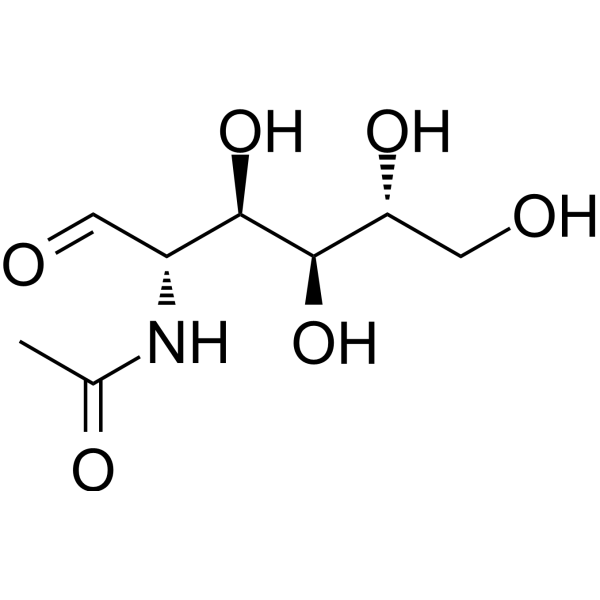
N-Acetyl-D-mannosamine

Based on 1 Customer Validation
N-Acetyl-D-mannosamine (ManNAc) is an oral active sialic acid precursor that can prevent hypertension by increasing sialylation of IgG, making it a promising candidate for cardiovascular disease research. Additionally, N-Acetyl-D-mannosamine can activate hypocretin (HCRT) gene expression in orexin neurons and improve neurodegeneration caused by aging, offering potential avenues for research in neurological disorders.
Nos produits utilisent uniquement pour la recherche. Nous ne vendons pas aux patients.
- Pureté : 99.94%
- CAS No.: 3615-17-6
- Formule: C8H15NO6
- Masse moléculaire:221.21
-
Stockage:
4°C, protect from light
* In solvent : -80°C, 6 months; -20°C, 1 month (protect from light)

To place orders, for customer services and technical support, please contact: MedChemExpress USA
Tel: 609-228-6898 E-mail: [email protected] [email protected]


-
 Activité biologique
-
Chemical Information
-
Solvant et solubilité
- Protocole
- Pureté et documentation
- Références
-
 Help & FAQs



Voir tous les produits spécifiques à Isoform Endogenous Metabolite
More

Activité biologique
Description
IC50 & Target
|
Human Endogenous Metabolite |
In Vivo
MedChemExpress (MCE) has not independently confirmed the accuracy of these methods. They are for reference only.
-
Animal Model:High-fat diet-induced hypertension C57BL/6 mice model[2]
-
Dosage:Dissolved in drinking water at a concentration of 1%
-
Administration:Oral gavage (p.o.), once daily for 16 weeks
-
Result:Inhibited high-fat diet-induced weight gain and increased the sialylation of IgG glycans.
-
Animal Model:Knock-in C57BL/6J mice model (Gne p.M712T) of GNE myopathy
-
Dosage:1 or 2 g/kg
-
Administration:Administered via drinking water (4-6 mL daily), once daily for 12 weeks
-
Result:Showed a significant decrease of proteinuria after only one week on the treatment (2 g/kg)
Essai clinique
| NCT Number | Sponsor | Condition | Start Date |
Phase

|
|---|---|---|---|---|
| NCT01329991 | Plexxikon| | 2011-05 | PHASE1 |


Chemical Information
-
CAS No. 3615-17-6
-
Appearance Solid
-
Masse moléculaire 221.21
-
Formule C8H15NO6
-
Color White to off-white
-
SMILES
OC[C@@H](O)[C@@H](O)[C@H](O)[C@@H](C=O)NC(C)=O
-
Synonyms
N-Acetylmannosamine; ManNAc
-
Structure Classification
-
Initial Source
-
Livraison
Room temperature in continental US; may vary elsewhere.
-
Stockage
4°C, protect from light
* In solvent : -80°C, 6 months; -20°C, 1 month (protect from light)


Solvant et solubilité
In Vitro:
H2O : 100 mg/mL (452.06 mM; Need ultrasonic)
Please refer to the solubility information to select the appropriate solvent. Once prepared, please aliquot and store the solution to prevent product inactivation from repeated freeze-thaw cycles.
Storage method and period of stock solution: -80°C, 6 months; -20°C, 1 month (protect from light). When stored at -80°C, please use it within 6 months. When stored at -20°C, please use it within 1 month.
* Note: If you choose water as the stock solution, please dilute it to the working solution, then filter and sterilize it with a 0.22 μm filter before use.
Please refer to the solubility information to select the appropriate solvent. Once prepared, please aliquot and store the solution to prevent product inactivation from repeated freeze-thaw cycles.
Storage method and period of stock solution: -80°C, 6 months; -20°C, 1 month (protect from light). When stored at -80°C, please use it within 6 months. When stored at -20°C, please use it within 1 month.
* Note: If you choose water as the stock solution, please dilute it to the working solution, then filter and sterilize it with a 0.22 μm filter before use.
Concentration (start) × Volume (start) = Concentration (final) × Volume (final)
In Vivo:
For the following dissolution methods, please prepare the working solution directly:
It is recommended to prepare fresh solutions and use them promptly within a short period of time.
The percentages shown for the solvents indicate their volumetric ratio in the final prepared solution. If precipitation or phase separation occurs during preparation, heat and/or sonication can be used to aid dissolution.
Add each solvent one by one: PBS
Solubility: 25 mg/mL (113.01 mM); Clear solution; Need ultrasonic

Protocole
-
RT-PCR
Reverse transcription technology uses RNA as a template to synthesize DNA. RT-PCR is simple, specific and sensitive, and can be used to detect gene expression levels and expression differences in cells; detect RNA virus content; clone cDNA sequences of specific genes.
-
RNA extraction experimental
By lysing cells, releasing RNA, and removing impurities such as proteins and DNA, high-purity RNA products are finally obtained. The commonly used traditional method is the guanidine isothiocyanate/phenol/chloroform method (Trizol), which is suitable for a variety of animal materials including animal tissues, microorganisms, cultured cells, etc., and most plant materials.
-
Neurotoxicity Study
This protocol assesses in vitro neurotoxicity by combining neuronal viability, mitochondrial/metabolic activity, neurite outgrowth, and optional neuronal network function readouts. Calcein-AM or resazurin/PrestoBlue readouts estimate viable or metabolically active cells; βIII-tubulin immunofluorescence detects neuronal morphology and neurite networks; TMRE detects mitochondrial membrane potential; and MEA recordings detect functional changes in neuronal network activity.
-
Research Protocol for Cardiovascular Diseases
Cardiovascular disease can be modeled as maladaptive cardiac remodeling, where ischemic injury or pressure overload activates inflammatory signaling, fibroblast activation, extracellular-matrix deposition, cardiomyocyte hypertrophy, vascular remodeling, and progressive ventricular dysfunction. The TGF-β/SMAD axis is a central profibrotic pathway after myocardial injury and pressure overload, while innate immune and cytokine pathways regulate leukocyte recruitment, scar formation, and adverse remodeling. Key unresolved questions include which inflammatory signals are reparative versus harmful, when fibrosis is protective versus maladaptive, and whether pathway inhibition improves function without weakening necessary infarct healing or compensatory remodeling.
-
Real Time qPCR (Q-PCR)
Real-time quantitative PCR (qPCR) quantifies an amplifiable nucleic-acid target by monitoring fluorescence during PCR cycling rather than measuring product only after amplification. The increase in fluorescence tracks accumulation of PCR product, and the quantification cycle (Cq; historically also Ct/CP) is related to the initial amount of target: samples containing more starting target generally reach the defined fluorescence threshold in fewer cycles.


Pureté et documentation
-
Fiche technique (276 KB)
-
SDS (394 KB)
- English - EN (394 KB)
- Français - FR (394 KB)
- Deutsch - DE (394 KB)
- Norwegian - NO (394 KB)
- Español - ES (394 KB)
- Swedish - SV (394 KB)
- Italian - IT (394 KB)
- Korean - KR (394 KB)
- Portuguese - PT (394 KB)
-
Instruction de manipulation (2659 KB)
Références
[1]. Revilla-Nuin B, et al. Transport of N-acetyl-D-mannosamine and N-acetyl-D-glucosamine in Escherichia coli K1: effect on capsular polysialic acid production. FEBS Lett. 2002 Jan 30;511(1-3):97-101. [Content Brief]
[2]. Hayakawa K, et al. Reactivation of hyperglycemia-induced hypocretin (HCRT) gene silencing by N-acetyl-d-mannosamine in the orexin neurons derived from human iPS cells. Epigenetics. 2017 Sep;12(9):764-778. [Content Brief]
[3]. Peng J, et al. Supplementation With the Sialic Acid Precursor N-Acetyl-D-Mannosamine Breaks the Link Between Obesity and Hypertension. Circulation. 2019 Dec 10;140(24):2005-2018. [Content Brief]
[4]. Niethamer TK, et al. Oral monosaccharide therapies to reverse renal and muscle hyposialylation in a mouse model of GNE myopathy. Mol Genet Metab. 2012 Dec;107(4):748-55. [Content Brief]
[5]. Taniguchi S, et al. Chronic administration of N-acetyl-D-mannosamine improves age-associated impairment of long-term potentiation in the senescence-accelerated mouse. Neurosci Lett. 2015 Jun 26;598:41-6. [Content Brief]


Complete Stock Solution Preparation Table
Please refer to the solubility information to select the appropriate solvent. Once prepared, please aliquot and store the solution to prevent product inactivation from repeated freeze-thaw cycles.
Storage method and period of stock solution: -80°C, 6 months; -20°C, 1 month (protect from light). When stored at -80°C, please use it within 6 months. When stored at -20°C, please use it within 1 month.
| Optional Solvent | Concentration Solvent Mass | 1 mg | 5 mg | 10 mg | 25 mg |
|---|---|---|---|---|---|
| H2O | 1 mM | 4.5206 mL | 22.6030 mL | 45.2059 mL | 113.0148 mL |
| 5 mM | 0.9041 mL | 4.5206 mL | 9.0412 mL | 22.6030 mL | |
| 10 mM | 0.4521 mL | 2.2603 mL | 4.5206 mL | 11.3015 mL | |
| 15 mM | 0.3014 mL | 1.5069 mL | 3.0137 mL | 7.5343 mL | |
| 20 mM | 0.2260 mL | 1.1301 mL | 2.2603 mL | 5.6507 mL | |
| 25 mM | 0.1808 mL | 0.9041 mL | 1.8082 mL | 4.5206 mL | |
| 30 mM | 0.1507 mL | 0.7534 mL | 1.5069 mL | 3.7672 mL | |
| 40 mM | 0.1130 mL | 0.5651 mL | 1.1301 mL | 2.8254 mL | |
| 50 mM | 0.0904 mL | 0.4521 mL | 0.9041 mL | 2.2603 mL | |
| 60 mM | 0.0753 mL | 0.3767 mL | 0.7534 mL | 1.8836 mL | |
| 80 mM | 0.0565 mL | 0.2825 mL | 0.5651 mL | 1.4127 mL | |
| 100 mM | 0.0452 mL | 0.2260 mL | 0.4521 mL | 1.1301 mL |
* Note: If you choose water as the stock solution, please dilute it to the working solution, then filter and sterilize it with a 0.22 μm filter before use.


N-Acetyl-D-mannosamine Related Classifications
HY-128850 Related Classifications
 Powered by Bioz