



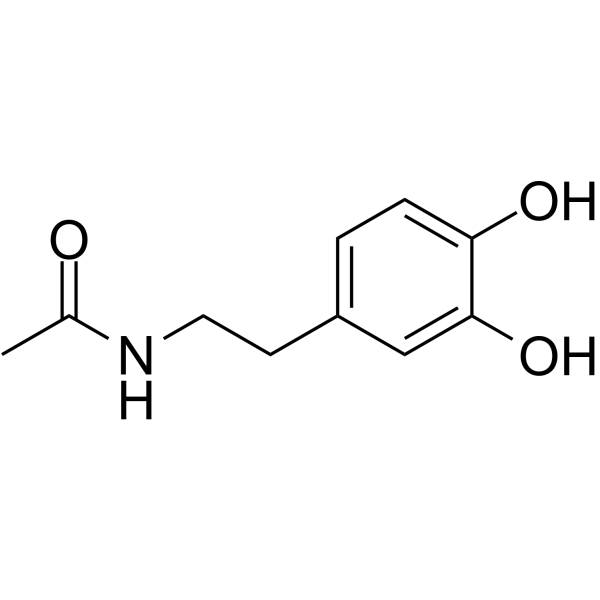
N-acetyldopamine
Based on 1 publication(s) in Google Scholar
N-acetyldopamine is a sepiapterin reductase inhibitor. N-acetyldopamine is a catecholamine that is used by insects as sclerotizing precursors to harden their cuticle. N-acetyldopamine can attenuate LPS-stimulated TNF-α production and superoxide production in THP-1 cells.
연구목적의 판매만을 진행합니다. 환자를 대상으로 한 판매는 하지 않습니다.
- Purity : 99.36%
- CAS No.: 2494-12-4
- 화학식: C10H13NO3
- 분자량:195.22
-
보관:
-20°C, stored under nitrogen
* In solvent : -80°C, 6 months; -20°C, 1 month (stored under nitrogen)

To place orders, for customer services and technical support, please contact: MedChemExpress USA
Tel: 609-228-6898 E-mail: [email protected] [email protected]


-
 Biological Activity
-
Chemical Information
-
용액&용해도
- 순도&문서
- References
-
 Help & FAQs



Publications Citing Use of MedChemExpress (MCE) N-acetyldopamine
MoreAll Endogenous Metabolite Isoforms
More

Biological Activity
제품 설명
IC50 & Target
|
Human Endogenous Metabolite |
Cellular Effect
|
Cell Line

|
Type | Value | Description | References |
|---|---|---|---|---|
| B16 | IC50 |
1.22 mM
Compound: N-acetyldopamine
|
The compound was tested for inhibition of B16-BL6 melanoma cells growing in culture.
The compound was tested for inhibition of B16-BL6 melanoma cells growing in culture.
|
[PMID: 1447731] |
| B16 | IC50 |
2.06 mM
Compound: N-acetyldopamine
|
The compound was tested for inhibition of B16-BL6 melanoma cells growing in culture with 0.25 mM DFMO.
The compound was tested for inhibition of B16-BL6 melanoma cells growing in culture with 0.25 mM DFMO.
|
[PMID: 1447731] |
In Vitro
N-acetyldopamine (Compound NAD) (0-400 μM, 24 h) results in a marked decrease in LPS-stimulated TNF-α production dose-dependently in THP-1 cells[1].
N-acetyldopamine (0-400 μM, 30 min) results in a modest decrease in PMA-stimulated and fMLP-stimulated superoxide production does-dependently in HL-60 derived neutrophils[1].
MedChemExpress (MCE) has not independently confirmed the accuracy of these methods. They are for reference only.
Clinical Trial
| NCT Number | Sponsor | Condition | Start Date |
Phase
|
|---|---|---|---|---|
| NCT01329991 | Plexxikon| | 2011-05 | PHASE1 |


Chemical Information
-
CAS No. 2494-12-4
-
Appearance <65°C Solid,>70°C Liquid
-
분자량 195.22
-
화학식 C10H13NO3
-
Color White to off-white
-
SMILES
CC(NCCC1=CC=C(O)C(O)=C1)=O
-
Synonyms
NADA
-
Structure Classification
-
Initial Source
Schistocerca gregaria
-
선적
Room temperature in continental US; may vary elsewhere.
-
보관
-20°C, stored under nitrogen
* In solvent : -80°C, 6 months; -20°C, 1 month (stored under nitrogen)


Publications (1)
-
Journal Impact Factor
-
Most Recent
-
Mol Plant
The biosynthetic pathway of the hallucinogen mescaline and its heterologous reconstruction. [Abstract]2024 Jul 1;17(7):1129-1150. PMID: 38835170


용액&용해도
In Vitro:
DMSO : 100 mg/mL (512.24 mM; Need ultrasonic; Hygroscopic DMSO has a significant impact on the solubility of product, please use newly opened DMSO)
Please refer to the solubility information to select the appropriate solvent. Once prepared, please aliquot and store the solution to prevent product inactivation from repeated freeze-thaw cycles.
Storage method and period of stock solution: -80°C, 6 months; -20°C, 1 month (stored under nitrogen). When stored at -80°C, please use it within 6 months. When stored at -20°C, please use it within 1 month.
Please refer to the solubility information to select the appropriate solvent. Once prepared, please aliquot and store the solution to prevent product inactivation from repeated freeze-thaw cycles.
Storage method and period of stock solution: -80°C, 6 months; -20°C, 1 month (stored under nitrogen). When stored at -80°C, please use it within 6 months. When stored at -20°C, please use it within 1 month.
Concentration (start) × Volume (start) = Concentration (final) × Volume (final)
In Vivo:
Select the appropriate dissolution method based on your experimental animal and administration route.
- For the following dissolution methods, please ensure to first prepare a clear stock solution using an In Vitro approach and then sequentially add co-solvents:
- To ensure reliable experimental results, the clarified stock solution can be appropriately stored based on storage conditions. As for the working solution for In Vivo experiments, it is recommended to prepare freshly and use it on the same day.
- The percentages shown for the solvents indicate their volumetric ratio in the final prepared solution. If precipitation or phase separation occurs during preparation, heat and/or sonication can be used to aid dissolution.
Add each solvent one by one: 10% DMSO 40% PEG300 5% Tween-80 45% Saline
Solubility: ≥ 3.75 mg/mL (19.21 mM); Clear solution
This protocol yields a clear solution of ≥ 3.75 mg/mL (saturation unknown).
Taking 1 mL working solution as an example, add 100 μL DMSO stock solution (37.5 mg/mL) to 400 μL PEG300, and mix evenly; then add 50 μL Tween-80 and mix evenly; then add 450 μL Saline to adjust the volume to 1 mL.
Preparation of Saline: Dissolve 0.9 g sodium chloride in ddH₂O and dilute to 100 mL to obtain a clear Saline solution.
Add each solvent one by one: 10% DMSO 90% (20% SBE-β-CD in Saline)
Solubility: ≥ 2.5 mg/mL (12.81 mM); Clear solution
This protocol yields a clear solution of ≥ 2.5 mg/mL (saturation unknown).
Taking 1 mL working solution as an example, add 100 μL DMSO stock solution (25.0 mg/mL) to 900 μL 20% SBE-β-CD in Saline, and mix evenly.
Preparation of 20% SBE-β-CD in Saline (4°C, storage for one week): 2 g SBE-β-CD powder is dissolved in 10 mL Saline, completely dissolve until clear.
In Vivo Dissolution Calculator
Please enter the basic information of animal experiments:
-
-
-
-
Recommended: Prepare an additional quantity of animals to account for potential losses during experiments.
Please enter your animal formula composition:
-
%DMSO +
Recommended: Keep the proportion of DMSO in working solution below 2% if your animal is weak.
-
%+
-
+%Tween-80 + +
-
%Saline +
The co-solvents required include: DMSO, . All of co-solvents are available by MedChemExpress (MCE). , Tween 80. All of co-solvents are available by MedChemExpress (MCE).
Working solution concentration: 0.22 mg/mL
Method for preparing stock solution: mg drug dissolved in μL DMSO. Stock solution concentration: mg/mL. * In solvent : -80°C, 6 months; -20°C, 1 month (stored under nitrogen)
1. Take μL DMSO stock solution;
2. Add μL .
μL , mix evenly;
3. Then add μL Tween 80, mix evenly;
4. Then add μL
Please ensure that the stock solution in the first step is dissolved to a clear state, and add co-solvents in sequence. You can use ultrasonic heating (ultrasonic cleaner, recommended frequency 20-40 kHz), vortexing, etc. to assist dissolution.


순도&문서
-
Data Sheet (272 KB)
-
SDS (394 KB)
- English - EN (394 KB)
- Français - FR (394 KB)
- Deutsch - DE (394 KB)
- Norwegian - NO (394 KB)
- Español - ES (394 KB)
- Swedish - SV (394 KB)
- Italian - IT (394 KB)
- Korean - KR (394 KB)
- Portuguese - PT (394 KB)
-
Handling Instructions (2659 KB)
References
[1]. Hanine Barek, et al. Unraveling Complex Molecular Transformations of N-β-alanyldopamine That Account for Brown Coloration of Insect Cuticle. Rapid Commun Mass Spectrom. 2017 Aug 30;31(16):1363-1373. [Content Brief]
[2]. Perianayagam, M. C., et al., (2005). Immune-modulating effects of melatonin, N-acetylserotonin, and N-acetyldopamine. Annals of the New York Academy of Sciences, 1053, 386–393. [Content Brief]


Complete Stock Solution Preparation Table
Please refer to the solubility information to select the appropriate solvent. Once prepared, please aliquot and store the solution to prevent product inactivation from repeated freeze-thaw cycles.
Storage method and period of stock solution: -80°C, 6 months; -20°C, 1 month (stored under nitrogen). When stored at -80°C, please use it within 6 months. When stored at -20°C, please use it within 1 month.
| Optional Solvent | Concentration Solvent Mass | 1 mg | 5 mg | 10 mg | 25 mg |
|---|---|---|---|---|---|
| DMSO | 1 mM | 5.1224 mL | 25.6121 mL | 51.2243 mL | 128.0606 mL |
| 5 mM | 1.0245 mL | 5.1224 mL | 10.2449 mL | 25.6121 mL | |
| 10 mM | 0.5122 mL | 2.5612 mL | 5.1224 mL | 12.8061 mL | |
| 15 mM | 0.3415 mL | 1.7075 mL | 3.4150 mL | 8.5374 mL | |
| 20 mM | 0.2561 mL | 1.2806 mL | 2.5612 mL | 6.4030 mL | |
| 25 mM | 0.2049 mL | 1.0245 mL | 2.0490 mL | 5.1224 mL | |
| 30 mM | 0.1707 mL | 0.8537 mL | 1.7075 mL | 4.2687 mL | |
| 40 mM | 0.1281 mL | 0.6403 mL | 1.2806 mL | 3.2015 mL | |
| 50 mM | 0.1024 mL | 0.5122 mL | 1.0245 mL | 2.5612 mL | |
| 60 mM | 0.0854 mL | 0.4269 mL | 0.8537 mL | 2.1343 mL | |
| 80 mM | 0.0640 mL | 0.3202 mL | 0.6403 mL | 1.6008 mL | |
| 100 mM | 0.0512 mL | 0.2561 mL | 0.5122 mL | 1.2806 mL |


N-acetyldopamine Related Classifications
HY-N7493 Related Classifications
 Powered by Bioz