



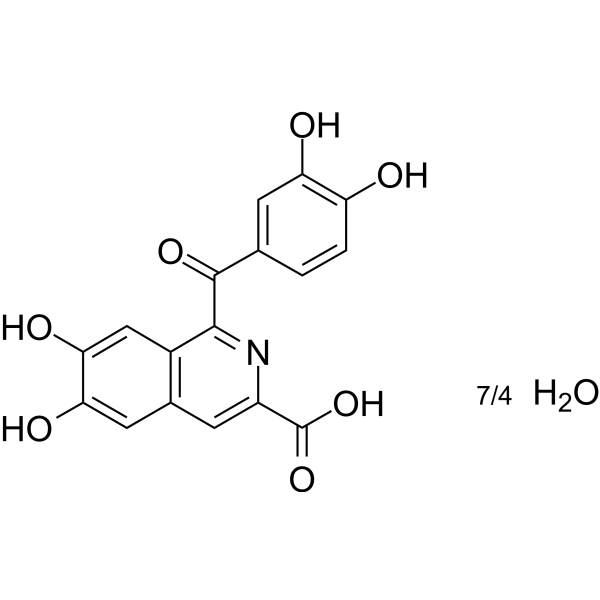
NBI-31772 hydrate
Based on 3 publication(s) in Google Scholar
NBI-31772 hydrate is a potent inhibitor of interaction between insulin-like growth factor (IGF) and IGF-binding proteins (IGFBPs). NBI-31772 hydrate is also a nonpeptide ligand that releases bioactive IGF-I from the IGF-I/IGFBP-3 complex (Kis=1-24 nM for all six human subtypes). Anxiolytic and antidepressant-like effects.
For research use only. We do not sell to patients.
- Purity : 99.42%
- Formula: C17H11NO7.7/4H2O
- Molecular Weight:372.82
-
Storage:
4°C, stored under nitrogen, away from moisture
* In solvent : -80°C, 6 months; -20°C, 1 month (stored under nitrogen, away from moisture)

To place orders, for customer services and technical support, please contact: MedChemExpress USA
Tel: 609-228-6898 E-mail: [email protected] [email protected]


-
 Biological Activity
-
Chemical Information
-
Solvent & Solubility
- Protocols
- Purity & Documentation
- References
-
 Help & FAQs


Publications Citing Use of MedChemExpress (MCE) NBI-31772 hydrate
More

Biological Activity
Description
In Vivo
MedChemExpress (MCE) has not independently confirmed the accuracy of these methods. They are for reference only.
-
Animal Model:Sprague-Dawley rats (subtemporal middle cerebral artery occlusion model, MCAO)[3]
-
Dosage:5-100 μg
-
Administration:Icv; immediately or at 1, 2, or, 3 hours after MCAO
-
Result:Resulted in a significant reduction of the total and cortical lesion volume.


Chemical Information
-
Appearance Solid
-
Molecular Weight 372.82
-
Formula C17H11NO7.7/4H2O
-
Color Light brown to yellow
-
SMILES
O=C(C1=CC(O)=C(O)C=C1)C2=NC(C(O)=O)=CC3=C2C=C(O)C(O)=C3.O
-
Shipping
Room temperature in continental US; may vary elsewhere.
-
Storage
4°C, stored under nitrogen, away from moisture
* In solvent : -80°C, 6 months; -20°C, 1 month (stored under nitrogen, away from moisture)


Publications (3)
-
Journal Impact Factor
-
Most Recent
-
J Nanobiotechnology
Apoptotic vesicles from macrophages exacerbate periodontal bone resorption in periodontitis via delivering miR-143-3p targeting Igfbp5. [Abstract]2024 Oct 26;22(1):658. PMID: 39456001 -
Int J Biol Macromol
Unveiling the mechanistic link between peroxiredoxin inhibition and ferroptosis-like cell death induced by Dinaciclib in Entamoeba histolytica. [Abstract]2026 Mar:350:150992. PMID: 41713546 -


Solvent & Solubility
In Vitro:
DMSO : 100 mg/mL (268.23 mM; Need ultrasonic; Hygroscopic DMSO has a significant impact on the solubility of product, please use newly opened DMSO)
Please refer to the solubility information to select the appropriate solvent. Once prepared, please aliquot and store the solution to prevent product inactivation from repeated freeze-thaw cycles.
Storage method and period of stock solution: -80°C, 6 months; -20°C, 1 month (stored under nitrogen, away from moisture). When stored at -80°C, please use it within 6 months. When stored at -20°C, please use it within 1 month.
Please refer to the solubility information to select the appropriate solvent. Once prepared, please aliquot and store the solution to prevent product inactivation from repeated freeze-thaw cycles.
Storage method and period of stock solution: -80°C, 6 months; -20°C, 1 month (stored under nitrogen, away from moisture). When stored at -80°C, please use it within 6 months. When stored at -20°C, please use it within 1 month.
Concentration (start) × Volume (start) = Concentration (final) × Volume (final)
In Vivo:
Select the appropriate dissolution method based on your experimental animal and administration route.
- For the following dissolution methods, please ensure to first prepare a clear stock solution using an In Vitro approach and then sequentially add co-solvents:
- To ensure reliable experimental results, the clarified stock solution can be appropriately stored based on storage conditions. As for the working solution for In Vivo experiments, it is recommended to prepare freshly and use it on the same day.
- The percentages shown for the solvents indicate their volumetric ratio in the final prepared solution. If precipitation or phase separation occurs during preparation, heat and/or sonication can be used to aid dissolution.
Add each solvent one by one: 10% DMSO 40% PEG300 5% Tween-80 45% Saline
Solubility: ≥ 2.5 mg/mL (6.71 mM); Clear solution
This protocol yields a clear solution of ≥ 2.5 mg/mL (saturation unknown).
Taking 1 mL working solution as an example, add 100 μL DMSO stock solution (25.0 mg/mL) to 400 μL PEG300, and mix evenly; then add 50 μL Tween-80 and mix evenly; then add 450 μL Saline to adjust the volume to 1 mL.
Preparation of Saline: Dissolve 0.9 g sodium chloride in ddH₂O and dilute to 100 mL to obtain a clear Saline solution.
Add each solvent one by one: 10% DMSO 90% (20% SBE-β-CD in Saline)
Solubility: ≥ 2.5 mg/mL (6.71 mM); Clear solution
This protocol yields a clear solution of ≥ 2.5 mg/mL (saturation unknown).
Taking 1 mL working solution as an example, add 100 μL DMSO stock solution (25.0 mg/mL) to 900 μL 20% SBE-β-CD in Saline, and mix evenly.
Preparation of 20% SBE-β-CD in Saline (4°C, storage for one week): 2 g SBE-β-CD powder is dissolved in 10 mL Saline, completely dissolve until clear.
In Vivo Dissolution Calculator
Please enter the basic information of animal experiments:
-
-
-
-
Recommended: Prepare an additional quantity of animals to account for potential losses during experiments.
Please enter your animal formula composition:
-
%DMSO +
Recommended: Keep the proportion of DMSO in working solution below 2% if your animal is weak.
-
%+
-
+%Tween-80 + +
-
%Saline +
The co-solvents required include: DMSO, . All of co-solvents are available by MedChemExpress (MCE). , Tween 80. All of co-solvents are available by MedChemExpress (MCE).
Working solution concentration: 0.22 mg/mL
Method for preparing stock solution: mg drug dissolved in μL DMSO. Stock solution concentration: mg/mL. * In solvent : -80°C, 6 months; -20°C, 1 month (stored under nitrogen, away from moisture)
1. Take μL DMSO stock solution;
2. Add μL .
μL , mix evenly;
3. Then add μL Tween 80, mix evenly;
4. Then add μL
Please ensure that the stock solution in the first step is dissolved to a clear state, and add co-solvents in sequence. You can use ultrasonic heating (ultrasonic cleaner, recommended frequency 20-40 kHz), vortexing, etc. to assist dissolution.


Purity & Documentation
-
Data Sheet (276 KB)
-
SDS (252 KB)
- English - EN (252 KB)
- Français - FR (252 KB)
- Deutsch - DE (252 KB)
- Norwegian - NO (252 KB)
- Español - ES (252 KB)
- Swedish - SV (252 KB)
- Italian - IT (252 KB)
- Korean - KR (252 KB)
- Portuguese - PT (252 KB)
-
Handling Instructions (2659 KB)
References
[1]. Liu XJ, et al. Identification of a nonpeptide ligand that releases bioactive insulin-like growth factor-I from its binding protein complex. J Biol Chem. 2001 Aug 31;276(35):32419-22. [Content Brief]
[2]. De Ceuninck F, et al. Pharmacological disruption of insulin-like growth factor 1 binding to IGF-binding proteins restores anabolic responses in human osteoarthritic chondrocytes. Arthritis Res Ther. 2004;6(5):R393-403. [Content Brief]
[3]. Malberg JE, et al, Rosenzweig-Lipson S. Increasing the levels of insulin-like growth factor-I by an IGF binding protein inhibitor produces anxiolytic and antidepressant-like effects. Neuropsychopharmacology. 2007 Nov;32(11):2360-8. [Content Brief]


Complete Stock Solution Preparation Table
Please refer to the solubility information to select the appropriate solvent. Once prepared, please aliquot and store the solution to prevent product inactivation from repeated freeze-thaw cycles.
Storage method and period of stock solution: -80°C, 6 months; -20°C, 1 month (stored under nitrogen, away from moisture). When stored at -80°C, please use it within 6 months. When stored at -20°C, please use it within 1 month.
| Optional Solvent | Concentration Solvent Mass | 1 mg | 5 mg | 10 mg | 25 mg |
|---|---|---|---|---|---|
| DMSO | 1 mM | 2.6823 mL | 13.4113 mL | 26.8226 mL | 67.0565 mL |
| 5 mM | 0.5365 mL | 2.6823 mL | 5.3645 mL | 13.4113 mL | |
| 10 mM | 0.2682 mL | 1.3411 mL | 2.6823 mL | 6.7056 mL | |
| 15 mM | 0.1788 mL | 0.8941 mL | 1.7882 mL | 4.4704 mL | |
| 20 mM | 0.1341 mL | 0.6706 mL | 1.3411 mL | 3.3528 mL | |
| 25 mM | 0.1073 mL | 0.5365 mL | 1.0729 mL | 2.6823 mL | |
| 30 mM | 0.0894 mL | 0.4470 mL | 0.8941 mL | 2.2352 mL | |
| 40 mM | 0.0671 mL | 0.3353 mL | 0.6706 mL | 1.6764 mL | |
| 50 mM | 0.0536 mL | 0.2682 mL | 0.5365 mL | 1.3411 mL | |
| 60 mM | 0.0447 mL | 0.2235 mL | 0.4470 mL | 1.1176 mL | |
| 80 mM | 0.0335 mL | 0.1676 mL | 0.3353 mL | 0.8382 mL | |
| 100 mM | 0.0268 mL | 0.1341 mL | 0.2682 mL | 0.6706 mL |


NBI-31772 hydrate Related Classifications
HY-110135A Related Classifications
 Powered by Bioz