



NLRP3-IN-33
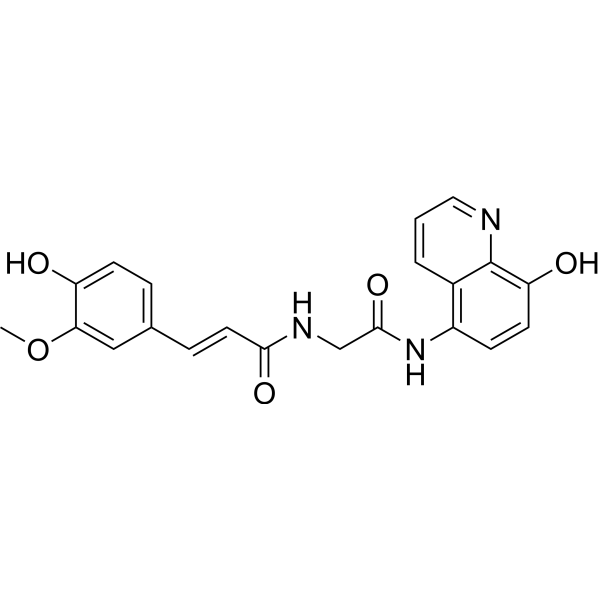
NLRP3-IN-33 (Compound 12o) is a blood-brain barrier permeable inhibitor of AChE and BChE, with IC50 values of 1.02 μM and 7.03 μM against hAChE and hBChE respectively. NLRP3-IN-33 possesses antioxidant, anti-inflammatory, and metal chelating activities, making it a potential candidate for research in Alzheimer's disease (AD).
For research use only. We do not sell to patients.
- Formula: C21H19N3O5
- Molecular Weight:393.39
-
Storage:
Please store the product under the recommended conditions in the Certificate of Analysis.

To place orders, for customer services and technical support, please contact: MedChemExpress USA
Tel: 609-228-6898 E-mail: [email protected] [email protected]


-
 Biological Activity
-
Chemical Information
- Protocols
- Purity & Documentation
- References
-
 Help & FAQs




Biological Activity
Description
IC50 & Target
In Vitro
NLRP3-IN-33 (12o) (1-30 μM; 24 h) exhibits no significant cytotoxicity in PC-12 cells[1]. NLRP3-IN-33 possesses antioxidant activity and can inhibit the generation of free radicals, with an IC50 value of 6.19 μM. 12o (1-20 μM; 24 h) effectively alleviates H2O2 (600 μM; 24 h)-induced oxidative stress and exhibits neuroprotective effects in PC-1 cells[1]. NLRP3-IN-33 (1-20 μM; 24 h) also inhibits the activation of the NLRP3 inflammasome in PC-1 cells and mitigates the damage caused by mitochondrial-induced reactive oxygen species (ROS) and mitochondrial membrane potential (MMP) triggered by LPS (1 μg/mL) and ATP (5 mM) in HMC-3 cells[1].
MedChemExpress (MCE) has not independently confirmed the accuracy of these methods. They are for reference only. Further protocols information, click here.
-
Cell Line:HMC-3
-
Concentration:12.5 μM, 25 μM
-
Incubation Time:24 h
-
Result:Inhibited the NLRP3 inflammasome activation and caspase-1 release.
Significantly decreased the expression of NF-κB and NLRP3 proteins.
In Vivo
NLRP3-IN-33 (5 mg/kg; i.p.; once daily for 22 consecutive days) is capable of improving memory and cognitive impairments in AD mouse models induced by Scopolamine (HY-N0296) (1.4 mg/kg; i.p.; once daily for 5 consecutive days)[1].
MedChemExpress (MCE) has not independently confirmed the accuracy of these methods. They are for reference only.
-
Animal Model:Alzheimer's disease (AD) fractional model[1]
-
Dosage:1 mg/kg, 5 mg/kg
-
Administration:Intraperitoneal injection (i.p.); Once daily for 22 days. Received scopolamine (HY-N0296) (1.4 mg/kg; i.p.; once daily for 5 days) on the last 5 days of the experiment (day 18 to day 22).
-
Result:Significantly shortened escape latency time as compared to the scopolamine-treated group.


Chemical Information
-
Molecular Weight 393.39
-
Formula C21H19N3O5
-
SMILES
O=C(NCC(NC1=C2C=CC=NC2=C(O)C=C1)=O)/C=C/C3=CC=C(O)C(OC)=C3
-
Shipping
Room temperature in continental US; may vary elsewhere.
-
Storage
Please store the product under the recommended conditions in the Certificate of Analysis.

Protocols
-
Cell Cytotoxicity Assay
Cytotoxicity assays are usually based on the assessment of cell membrane damage, which can also be indirectly detected by measuring cell viability. Detection methods include MTT assay, CKK-8 assay, LDH assay and ATP assay, etc.
-
Research Protocol for Inflammation-related Diseases
The NLRP3 inflammasome is a cytosolic innate immune signaling platform that integrates priming signals and danger-signal activation to promote caspase-1 activation, maturation of IL-1β and IL-18, and gasdermin D-mediated pyroptotic cell death. The core experimental logic is to determine whether inflammatory disease phenotypes are driven by increased NLRP3 expression, ASC-containing inflammasome assembly, caspase-1 cleavage, GSDMD cleavage, and extracellular release of IL-1β/IL-18 rather than by nonspecific cell injury alone. The pathway is strongly linked to inflammation-related disease phenotypes because monosodium urate crystals activate NALP3/NLRP3 inflammasome signaling in gout-like crystal inflammation, cholesterol crystals activate NLRP3 inflammasomes in atherogenesis models, and DSS-induced intestinal inflammation has been reported to involve NLRP3 inflammasome activity. However, experimental colitis studies also show context-dependent protective effects of NLRP3 inflammasome co
-
Alzheimer’s Disease Modeling
Alzheimer’s Disease (AD) is a neurodegenerative disorder characterized by a progressive decline in cognitive functions and loss of specific types of neurons and synapses. Alzheimer's symptoms can be simulated in mice by injecting drugs (such as Aβ) or genetically modified.


Purity & Documentation
References

Calculators
Concentration (start) × Volume (start) = Concentration (final) × Volume (final)


NLRP3-IN-33 Related Classifications
HY-162402 Related Classifications
 Powered by Bioz