



OPB-171775

Based on 1 Customer Validation
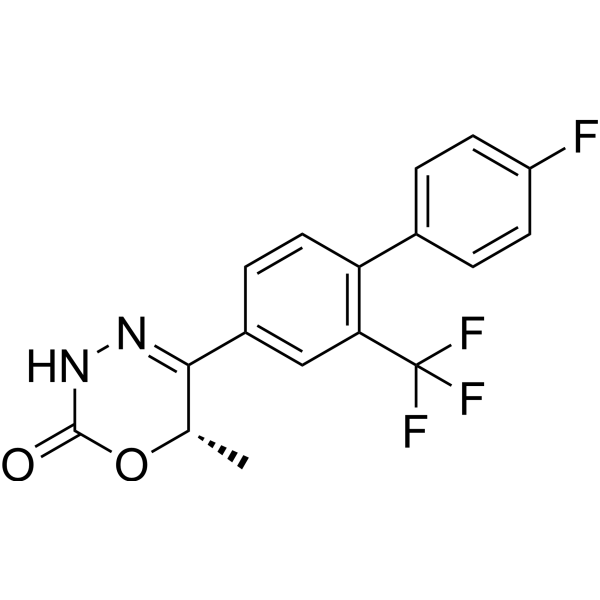
OPB-171775 is an orally active molecular glue. OPB-171775 forms ternary complex with phosphodiesterase 3A (PDE3A) and schlafen family member 12 (SLFN12). OPB-171775 causes SLFN12 RNase-mediated cell death, activates SLFN12 RNase-associated GCN2 signaling pathway. OPB-171775 exhibits significant efficacy against gastrointestinal stromal tumor.
For research use only. We do not sell to patients.
- Purity : 99.80%
- CAS No.: 2131210-15-4
- Formula: C15H18F2N2O3
- Molecular Weight:312.31
-
Storage:
4°C, protect from light
* In solvent : -80°C, 6 months; -20°C, 1 month (protect from light)


To place orders, for customer services and technical support, please contact: MedChemExpress USA
Tel: 609-228-6898 E-mail: [email protected] [email protected]


-
 Biological Activity
-
Chemical Information
-
Solvent & Solubility
- Protocols
- Purity & Documentation
- References
-
 Help & FAQs




Biological Activity
Description
In Vitro
In Vivo
OPB-171775 (0.03 mg/kg; p.o.; once daily; 21 days) combined Imatinib can lead to complete tumor regression in all mice bearing GS11353 PDX tumors[1].
MedChemExpress (MCE) has not independently confirmed the accuracy of these methods. They are for reference only.
-
Animal Model:Female C.B-17/Icr-scid/scidJcl mice with subcutaneous xenograft models derived from PFSK-1 cells[1]
-
Dosage:0.003, 0.01, 0.03, 0.1, 0.3 mg/kg
-
Administration:Orally administered once daily for 14 days
-
Result:Inhibited tumor growth in a dose-dependent manner.
Had no significant adverse effects on animal body weight.


Chemical Information
-
CAS No. 2131210-15-4
-
Appearance Solid
-
Molecular Weight 312.31
-
Formula C15H18F2N2O3
-
Color White to off-white
-
SMILES
FC1=C(C([C@H](C)C2)=NNC2=O)C=CC(OCC(O)(C)C)=C1F
-
Shipping
Room temperature in continental US; may vary elsewhere.
-
Storage
4°C, protect from light
* In solvent : -80°C, 6 months; -20°C, 1 month (protect from light)


Solvent & Solubility
In Vitro:
DMSO : 100 mg/mL (320.19 mM; Need ultrasonic; Hygroscopic DMSO has a significant impact on the solubility of product, please use newly opened DMSO)
Please refer to the solubility information to select the appropriate solvent. Once prepared, please aliquot and store the solution to prevent product inactivation from repeated freeze-thaw cycles.
Storage method and period of stock solution: -80°C, 6 months; -20°C, 1 month (protect from light). When stored at -80°C, please use it within 6 months. When stored at -20°C, please use it within 1 month.
Please refer to the solubility information to select the appropriate solvent. Once prepared, please aliquot and store the solution to prevent product inactivation from repeated freeze-thaw cycles.
Storage method and period of stock solution: -80°C, 6 months; -20°C, 1 month (protect from light). When stored at -80°C, please use it within 6 months. When stored at -20°C, please use it within 1 month.
Concentration (start) × Volume (start) = Concentration (final) × Volume (final)


Purity & Documentation
-
Data Sheet (271 KB)
-
SDS (252 KB)
- English - EN (252 KB)
- Français - FR (252 KB)
- Deutsch - DE (252 KB)
- Norwegian - NO (252 KB)
- Español - ES (252 KB)
- Swedish - SV (252 KB)
- Italian - IT (252 KB)
- Korean - KR (252 KB)
- Portuguese - PT (252 KB)
-
Handling Instructions (2659 KB)
References


Complete Stock Solution Preparation Table
Please refer to the solubility information to select the appropriate solvent. Once prepared, please aliquot and store the solution to prevent product inactivation from repeated freeze-thaw cycles.
Storage method and period of stock solution: -80°C, 6 months; -20°C, 1 month (protect from light). When stored at -80°C, please use it within 6 months. When stored at -20°C, please use it within 1 month.
| Optional Solvent | Concentration Solvent Mass | 1 mg | 5 mg | 10 mg | 25 mg |
|---|---|---|---|---|---|
| DMSO | 1 mM | 3.2019 mL | 16.0097 mL | 32.0195 mL | 80.0487 mL |
| 5 mM | 0.6404 mL | 3.2019 mL | 6.4039 mL | 16.0097 mL | |
| 10 mM | 0.3202 mL | 1.6010 mL | 3.2019 mL | 8.0049 mL | |
| 15 mM | 0.2135 mL | 1.0673 mL | 2.1346 mL | 5.3366 mL | |
| 20 mM | 0.1601 mL | 0.8005 mL | 1.6010 mL | 4.0024 mL | |
| 25 mM | 0.1281 mL | 0.6404 mL | 1.2808 mL | 3.2019 mL | |
| 30 mM | 0.1067 mL | 0.5337 mL | 1.0673 mL | 2.6683 mL | |
| 40 mM | 0.0800 mL | 0.4002 mL | 0.8005 mL | 2.0012 mL | |
| 50 mM | 0.0640 mL | 0.3202 mL | 0.6404 mL | 1.6010 mL | |
| 60 mM | 0.0534 mL | 0.2668 mL | 0.5337 mL | 1.3341 mL | |
| 80 mM | 0.0400 mL | 0.2001 mL | 0.4002 mL | 1.0006 mL | |
| 100 mM | 0.0320 mL | 0.1601 mL | 0.3202 mL | 0.8005 mL |


OPB-171775 Related Classifications
HY-162730 Related Classifications
 Powered by Bioz