



Palmitoylcarnitine
Based on 2 publication(s) in Google Scholar
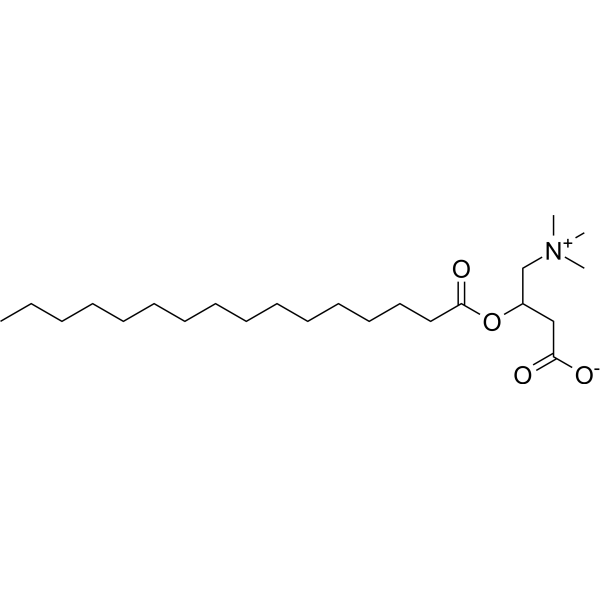
Palmitoylcarnitine is a C16:0 long-chain acylcarnitine and an intermediate product of fatty acid oxidation. The level of Palmitoylcarnitine in human prostate cancer tissues is higher than that in non-cancerous tissues. Palmitoylcarnitine can be used in studies related to lipid metabolism associated with prostate cancer.
Nur für Forschungszwecke. Wir verkaufen nicht an Patienten.
- Reinheit : 99.97%
- CAS. Nr.: 1935-18-8
- Formel: C23H45NO4
- Molecular Weight:399.61
-
Speicherung:Powder -20°C, 3 years , 4°C, 2 years ; In solvent -80°C, 6 months , -20°C, 1 month

To place orders, for customer services and technical support, please contact: MedChemExpress USA
Tel: 609-228-6898 E-mail: [email protected] [email protected]


-
 Biologische Aktivität
-
Chemical Information
-
Lösungsmittel & Löslichkeit
- Reinheit & Dokumentation
- Verweise
-
 Help & FAQs


Publications Citing Use of MedChemExpress (MCE) Palmitoylcarnitine
MoreAlle Endogenous Metabolite Isoform-spezifische Produkte anzeigen
More

Biologische Aktivität
Beschreibung
In Vitro
Palmitoylcarnitine accumulates at significantly higher levels in human prostate cancer tissues than in non-cancerous prostate tissues[1].
Palmitoylcarnitine (0-100 μM; 24 h) exerts no effect on the viability of normal human PNT1A prostate epithelial cells even at concentrations up to 100 μM, but reduces the viability of human PC3 prostate adenocarcinoma cells at concentrations ≥50 μM[1].
Palmitoylcarnitine (0-100 μM; 24 h) promotes IL-6 secretion in human PC3 prostate adenocarcinoma cells at a concentration of 50 μM, but exerts no effect on IL-6 secretion in human PNT1A normal prostate epithelial cells or human LnCaP prostate adenocarcinoma cells even at concentrations up to 100 μM[1].
Palmitoylcarnitine (50-100 μM; 24 h) upregulates IL-6 gene expression in human PNT1A normal prostate epithelial cells and human PC3 prostate adenocarcinoma cells, with a stronger response observed in PC3 cells[1].
Palmitoylcarnitine (5-50 μM; 5 min post-treatment) induces rapid, dose-dependent Ca2+ influx in human PC3 prostate adenocarcinoma cells, but exerts no effect on Ca2+ influx in human PNT1A normal prostate epithelial cells, human BPH-1 benign prostatic hyperplasia cells, or human DU145 prostate adenocarcinoma cells[1].
Palmitoylcarnitine (50 nM-5 μM; 8 h) induces a DHT-like gene expression response in human PNT1A normal prostate epithelial cells, with the highest degree of overlap (169 shared genes total) observed at the 5 μM concentration, involving pathways such as glycolysis, cytokine signaling, and apoptosis regulation[1].
MedChemExpress (MCE) has not independently confirmed the accuracy of these methods. They are for reference only. .
-
Cell Line:human normal prostate epithelial PNT1A cells, human prostate adenocarcinoma PC3 cells
-
Concentration:0-100 μM
-
Incubation Time:24 h
-
Result:Showed no toxic effect on PNT1A cells at any tested concentration.
Induced a significant decrease in cell viability in PC3 cells at concentrations greater than 50 μM.
-
Cell Line:human normal prostate epithelial PNT1A cells, human prostate adenocarcinoma PC3 cells, human prostate adenocarcinoma LnCaP cells
-
Concentration:0-100 μM
-
Incubation Time:24 h
-
Result:Induced a significant increase in IL-6 secretion in PC3 cells only at 50 μM.
Showed no increase in IL-6 secretion in PNT1A cells at any tested concentration.
Had no effect on IL-6 secretion in LnCaP cells at any tested concentration, where basal IL-6 levels were undetectable.
-
Cell Line:human normal prostate epithelial PNT1A cells, human prostate adenocarcinoma PC3 cells
-
Concentration:0-100 μM
-
Incubation Time:24 h
-
Result:Induced a significant increase in IL-6 gene expression in both PNT1A and PC3 cells at 50-100 μM.
Caused an approximately sixfold increase in IL-6 gene expression in PC3 cells, showing a more pronounced effect than in PNT1A cells.


Chemical Information
-
CAS. Nr. 1935-18-8
-
Appearance Solid
-
Molecular Weight 399.61
-
Formel C23H45NO4
-
Color White to off-white
-
SMILES
CCCCCCCCCCCCCCCC(OC(CC([O-])=O)C[N+](C)(C)C)=O
-
Structure Classification
-
Versand
Room temperature in continental US; may vary elsewhere.
-
Speicherung
Powder -20°C 3 years 4°C 2 years In solvent -80°C 6 months -20°C 1 month


Publications (2)
-
Journal Impact Factor
-
Most Recent
-
Nature
2025 Jul;643(8070):192-200. PMID: 39695227 -
NPJ Biofilms Microbiomes
Gut bacteria facilitate leaf beetles in adapting to dietary specialization by enhancing larval fitness. [Abstract]2024 Oct 22;10(1):110. PMID: 39438487


Lösungsmittel & Löslichkeit
In Vitro:
Ethanol : 10 mg/mL (25.02 mM; Need ultrasonic)
Please refer to the solubility information to select the appropriate solvent. Once prepared, please aliquot and store the solution to prevent product inactivation from repeated freeze-thaw cycles.
Storage method and period of stock solution: -80°C, 6 months; -20°C, 1 month. When stored at -80°C, please use it within 6 months. When stored at -20°C, please use it within 1 month.
Please refer to the solubility information to select the appropriate solvent. Once prepared, please aliquot and store the solution to prevent product inactivation from repeated freeze-thaw cycles.
Storage method and period of stock solution: -80°C, 6 months; -20°C, 1 month. When stored at -80°C, please use it within 6 months. When stored at -20°C, please use it within 1 month.
Konzentration (Stammlösung) × Volumen (Stammlösung) = Konzentration (Ziellösung) × Volumen (Ziellösung)
In Vivo:
Select the appropriate dissolution method based on your experimental animal and administration route.
- For the following dissolution methods, please ensure to first prepare a clear stock solution using an In Vitro approach and then sequentially add co-solvents:
- To ensure reliable experimental results, the clarified stock solution can be appropriately stored based on storage conditions. As for the working solution for In Vivo experiments, it is recommended to prepare freshly and use it on the same day.
- The percentages shown for the solvents indicate their volumetric ratio in the final prepared solution. If precipitation or phase separation occurs during preparation, heat and/or sonication can be used to aid dissolution.
Add each solvent one by one: 10% EtOH 40% PEG300 5% Tween-80 45% Saline
Solubility: ≥ 1 mg/mL (2.50 mM); Clear solution
This protocol yields a clear solution of ≥ 1 mg/mL (saturation unknown).
Taking 1 mL working solution as an example, add 100 μL EtOH stock solution (10.0 mg/mL) to 400 μL PEG300, and mix evenly; then add 50 μL Tween-80 and mix evenly; then add 450 μL Saline to adjust the volume to 1 mL.
Preparation of Saline: Dissolve 0.9 g sodium chloride in ddH₂O and dilute to 100 mL to obtain a clear Saline solution.
Add each solvent one by one: 10% EtOH 90% (20% SBE-β-CD in Saline)
Solubility: ≥ 1 mg/mL (2.50 mM); Clear solution
This protocol yields a clear solution of ≥ 1 mg/mL (saturation unknown).
Taking 1 mL working solution as an example, add 100 μL EtOH stock solution (10.0 mg/mL) to 900 μL 20% SBE-β-CD in Saline, and mix evenly.
Preparation of 20% SBE-β-CD in Saline (4°C, storage for one week): 2 g SBE-β-CD powder is dissolved in 10 mL Saline, completely dissolve until clear.
Add each solvent one by one: 10% EtOH 90% Corn Oil
Solubility: ≥ 1 mg/mL (2.50 mM); Clear solution
This protocol yields a clear solution of ≥ 1 mg/mL (saturation unknown). If the continuous dosing period exceeds half a month, please choose this protocol carefully.
Taking 1 mL working solution as an example, add 100 μL EtOH stock solution (10.0 mg/mL) to 900 μL Corn oil, and mix evenly.
In Vivo Dissolution Calculator
Please enter the basic information of animal experiments:
-
-
-
-
Recommended: Prepare an additional quantity of animals to account for potential losses during experiments.
Working solution concentration: 0.22 mg/mL


Reinheit & Dokumentation
-
Data Sheet (276 KB)
-
SDS (251 KB)
- English - EN (251 KB)
- Français - FR (251 KB)
- Deutsch - DE (251 KB)
- Norwegian - NO (251 KB)
- Español - ES (251 KB)
- Swedish - SV (251 KB)
- Italian - IT (251 KB)
- Korean - KR (251 KB)
- Portuguese - PT (251 KB)
-
Handling Instructions (2659 KB)
Verweise


Complete Stock Solution Preparation Table
Please refer to the solubility information to select the appropriate solvent. Once prepared, please aliquot and store the solution to prevent product inactivation from repeated freeze-thaw cycles.
Storage method and period of stock solution: -80°C, 6 months; -20°C, 1 month. When stored at -80°C, please use it within 6 months. When stored at -20°C, please use it within 1 month.
| Optional Solvent | Concentration Solvent Mass | 1 mg | 5 mg | 10 mg | 25 mg |
|---|---|---|---|---|---|
| Ethanol | 1 mM | 2.5024 mL | 12.5122 mL | 25.0244 mL | 62.5610 mL |
| 5 mM | 0.5005 mL | 2.5024 mL | 5.0049 mL | 12.5122 mL | |
| 10 mM | 0.2502 mL | 1.2512 mL | 2.5024 mL | 6.2561 mL | |
| 15 mM | 0.1668 mL | 0.8341 mL | 1.6683 mL | 4.1707 mL | |
| 20 mM | 0.1251 mL | 0.6256 mL | 1.2512 mL | 3.1280 mL | |
| 25 mM | 0.1001 mL | 0.5005 mL | 1.0010 mL | 2.5024 mL |


Palmitoylcarnitine Related Classifications
HY-126357 Related Classifications
 Powered by Bioz
Keywords
- Palmitoylcarnitine
- 1935-18-8
- Endogenous Metabolite
- calcium influx
- PNT1A normal prostate epithelial cells
- apoptosis regulation
- prostate cancer
- androgen-independent cancer cells
- LnCaP prostate adenocarcinoma cells
- IL-6
- cytokine-cytokine receptor interaction
- glycolysis/gluconeogenesis
- PC3 prostate adenocarcinoma cells
- Inhibitor
- inhibitor
- inhibit