



Pipemidic acid trihydrate
Based on 1 publication(s) in Google Scholar
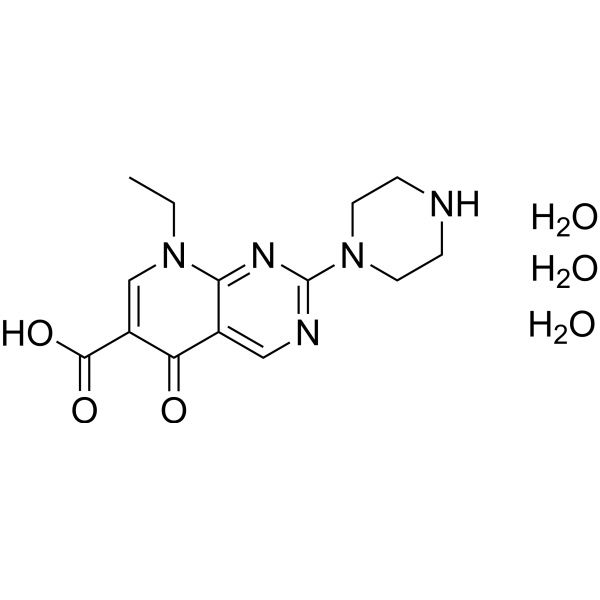
Pipemidic acid trihydrate, a derivative of Piromidic acid, is an antibacterial agent. Pipemidic acid trihydrate inhibits DNA gyrase. Pipemidic acid trihydrate is active against gram-negative bacteria including Pseudomonas aeruginosa as well as some gram-positive bacteria. Pipemidic acid trihydrate can be used for the research of intestinal, urinary, and biliary tract infections.
For research use only. We do not sell to patients.
- Purity : 98.0%
- CAS No.: 72571-82-5
- Formula: C14H23N5O6
- Molecular Weight:357.36
-
Storage:
4°C, sealed storage, away from moisture
* In solvent : -80°C, 6 months; -20°C, 1 month (sealed storage, away from moisture)

To place orders, for customer services and technical support, please contact: MedChemExpress USA
Tel: 609-228-6898 E-mail: [email protected] [email protected]


-
 Biological Activity
-
Chemical Information
- Protocols
- Purity & Documentation
- References
-
 Help & FAQs


-

HY-W013766R
Pipemidic acid trihydrate (Standard)Antibacterial Agent -
HY-13594
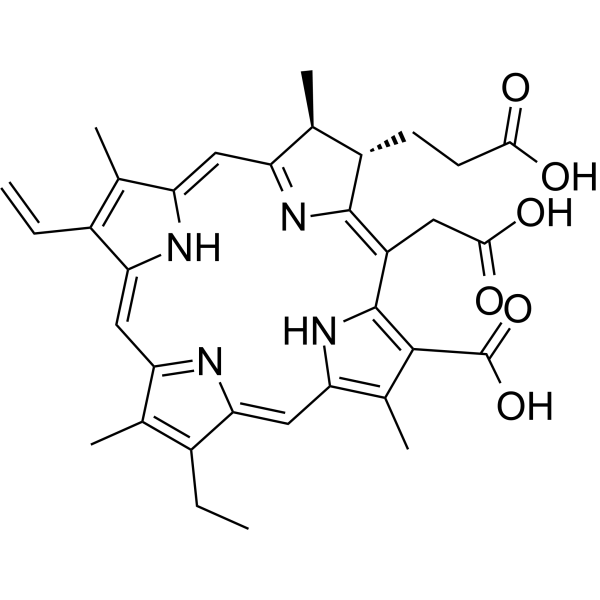
Chlorin e6Photosensitizer -
HY-N7118
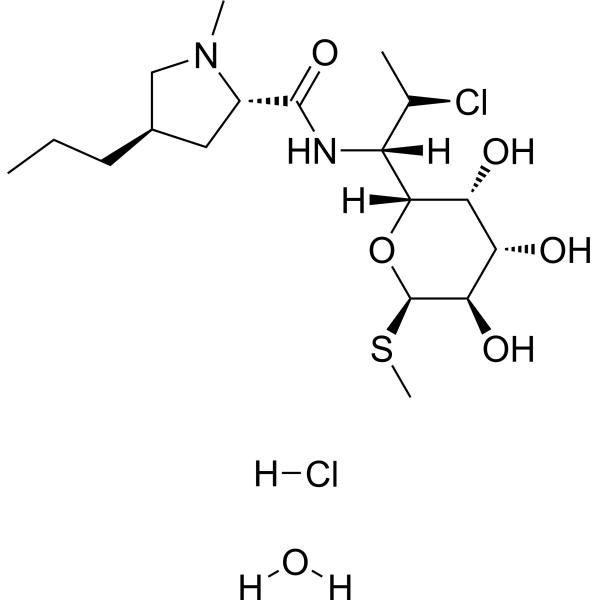
Clindamycin hydrochloride monohydrateBacterial Inhibitor -

HY-N7118R
Clindamycin hydrochloride monohydrate (Standard)Bacterial Inhibitor -

HY-DY1092
Chlorin e6 (solution)Photosensitizer -
HY-137898
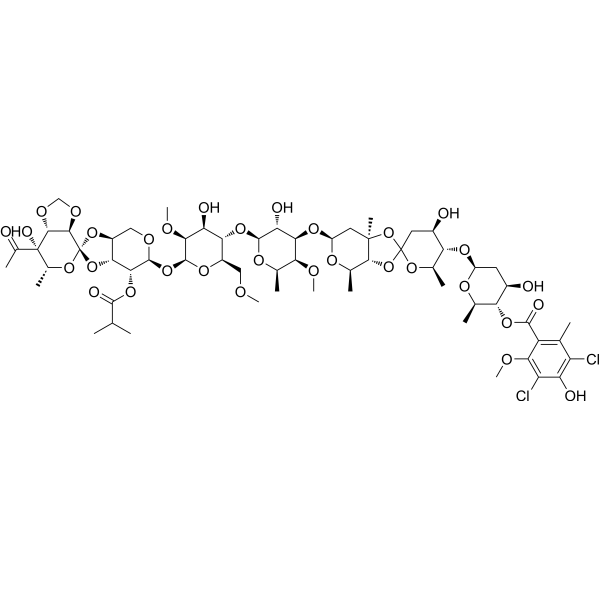
Avilamycin AAntibiotic
Publications Citing Use of MedChemExpress (MCE) Pipemidic acid trihydrate
MoreAll Antibiotic Isoforms
More

Biological Activity
Description
In Vitro
Pipemidic acid trihydrate is an inhibitor of DNA gyrase that is a bacterial enzyme which catalyzes the ATP-dependent negative supercoiling of DNA[2].
MedChemExpress (MCE) has not independently confirmed the accuracy of these methods. They are for reference only. Further protocols information, click here.
In Vivo
The mean lethal dose of Pipemidic acid trihydrate after a single oral dose was more than 16000 mg/kg in mice[3].
MedChemExpress (MCE) has not independently confirmed the accuracy of these methods. They are for reference only.


Chemical Information
-
CAS No. 72571-82-5
-
Appearance Solid
-
Molecular Weight 357.36
-
Formula C14H23N5O6
-
Color White to off-white
-
SMILES
CCN1C=C(C(O)=O)C(C2=CN=C(N3CCNCC3)N=C21)=O.O.O.O
-
Shipping
Room temperature in continental US; may vary elsewhere.
-
Storage
4°C, sealed storage, away from moisture
* In solvent : -80°C, 6 months; -20°C, 1 month (sealed storage, away from moisture)


Publications (1)
-
Journal Impact Factor
-
Most Recent
-
Int J Biol Macromol
Reticuline isomerase AKR1B1 with aldo-keto reductase activity and detoxification function from the insect Blaps rhynchopetera. [Abstract]2026 Mar:352:151224. PMID: 41791543

Protocols
-
Research Protocol for Infectious Diseases
Infectious-disease experiments test how pathogens interact with host barriers, innate immune receptors, inflammatory signaling, pathogen replication, and tissue injury; pattern-recognition receptors such as TLRs, RIG-I-like receptors, NOD-like receptors, and inflammasomes detect microbial molecules and activate NF-κB, interferon, and cytokine responses. The central hypothesis is that infection severity reflects the balance between pathogen burden and host response: protective inflammation restricts pathogen growth, whereas excessive or mislocalized inflammation contributes to tissue damage and disease phenotype. Unresolved questions include which host pathways are protective versus pathogenic, why some infection models fail to translate to human disease, and which combined readouts best predict clinically relevant infection outcomes.
-
Gram Staining of Tissue Sections
Gram staining of tissue sections is a histochemical technique used to differentiate Gram-positive and Gram-negative bacteria within histological specimens based on differences in bacterial cell wall structure and dye retention, adapted from classical bacteriological Gram staining into tissue-compatible “histological Gram stain” variants. In tissue applications, modifications of the Brown-Hopps and Brown-Brenn methods are commonly used to improve differentiation of microorganisms embedded within host connective tissue and to reduce overstaining or loss of Gram-negative signal, which are known limitations of earlier approaches. The principle relies on crystal violet-iodine complex retention in Gram-positive organisms and subsequent decolorization and counterstaining steps that allow contrast visualization of Gram-negative organisms against tissue background.


Purity & Documentation
-
Data Sheet (267 KB)
-
SDS (419 KB)
- English - EN (419 KB)
- Français - FR (419 KB)
- Deutsch - DE (419 KB)
- Norwegian - NO (419 KB)
- Español - ES (419 KB)
- Swedish - SV (419 KB)
- Italian - IT (419 KB)
- Korean - KR (419 KB)
- Portuguese - PT (419 KB)
-
Handling Instructions (2659 KB)
References
[1]. Iacovino R, et al. β-Cyclodextrin inclusion complex to improve physicochemical properties of pipemidic acid: characterization and bioactivity evaluation. Int J Mol Sci. 2013 Jun 25;14(7):13022-41. [Content Brief]
[2]. Aoyama H, et, al. Purification of Citrobacter freundii DNA gyrase and inhibition by quinolones. Antimicrob Agents Chemother. 1988 Jan;32(1):104-9. [Content Brief]
[3]. Shimizu M, et, al. Pipemidic acid: absorption, distribution, and excretion. Antimicrob Agents Chemother. 1975 Apr;7(4):441-6. [Content Brief]

Calculators
Concentration (start) × Volume (start) = Concentration (final) × Volume (final)


Pipemidic acid trihydrate Related Classifications
HY-W013766 Related Classifications
 Powered by Bioz