



S-HP210

Based on 1 Customer Validation
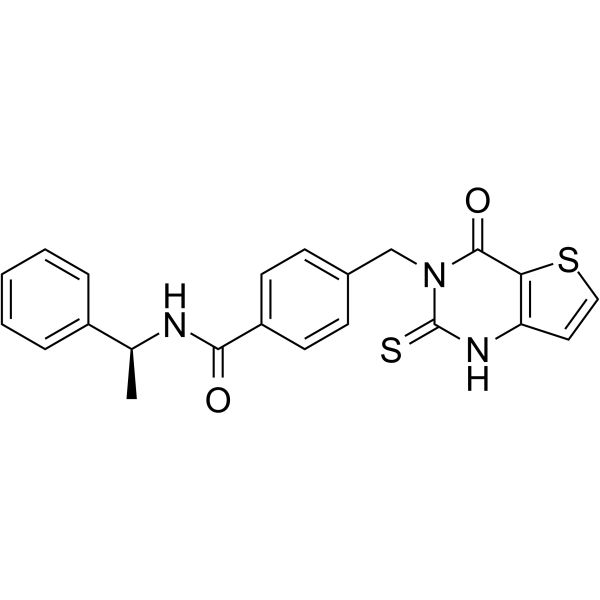
S-HP210 is a potent and selective glucocorticoid receptor (GR) with an IC50 value of 1.92 μM for NF-κB transrepression (TR). S-HP210 represses the LPS-induced transcription of a variety of proinflammatory genes such as IL-1β, IL-6 and COX-2. S-HP210 is nontoxic at effective doses against mouse fibroblasts 3T3 cells.
Nur für Forschungszwecke. Wir verkaufen nicht an Patienten.
- Reinheit : 98.12%
- CAS. Nr.: 3034696-13-1
- Formel: C22H19N3O2S2
- Molecular Weight:421.54
-
Speicherung:Powder -20°C, 3 years ; In solvent -80°C, 6 months , -20°C, 1 month

To place orders, for customer services and technical support, please contact: MedChemExpress USA
Tel: 609-228-6898 E-mail: [email protected] [email protected]


-
 Biologische Aktivität
-
Chemical Information
-
Lösungsmittel & Löslichkeit
- Protokoll
- Reinheit & Dokumentation
- Verweise
-
 Help & FAQs




Biologische Aktivität
Beschreibung
IC50 & Target
IC50: 1.92 μM (NF-κB TR)[1]


Chemical Information
-
CAS. Nr. 3034696-13-1
-
Appearance Solid
-
Molecular Weight 421.54
-
Formel C22H19N3O2S2
-
Color White to off-white
-
SMILES
C[C@@H](C1=CC=CC=C1)NC(C2=CC=C(C=C2)CN3C(C4=C(NC3=S)C=CS4)=O)=O
-
Versand
Room temperature in continental US; may vary elsewhere.
-
Speicherung
Powder -20°C 3 years In solvent -80°C 6 months -20°C 1 month


Lösungsmittel & Löslichkeit
In Vitro:
DMSO : 250 mg/mL (593.06 mM; Need ultrasonic; Hygroscopic DMSO has a significant impact on the solubility of product, please use newly opened DMSO)
Please refer to the solubility information to select the appropriate solvent. Once prepared, please aliquot and store the solution to prevent product inactivation from repeated freeze-thaw cycles.
Storage method and period of stock solution: -80°C, 6 months; -20°C, 1 month. When stored at -80°C, please use it within 6 months. When stored at -20°C, please use it within 1 month.
Please refer to the solubility information to select the appropriate solvent. Once prepared, please aliquot and store the solution to prevent product inactivation from repeated freeze-thaw cycles.
Storage method and period of stock solution: -80°C, 6 months; -20°C, 1 month. When stored at -80°C, please use it within 6 months. When stored at -20°C, please use it within 1 month.
Konzentration (Stammlösung) × Volumen (Stammlösung) = Konzentration (Ziellösung) × Volumen (Ziellösung)


Reinheit & Dokumentation
-
Data Sheet (270 KB)
-
SDS (252 KB)
- English - EN (252 KB)
- Français - FR (252 KB)
- Deutsch - DE (252 KB)
- Norwegian - NO (252 KB)
- Español - ES (252 KB)
- Swedish - SV (252 KB)
- Italian - IT (252 KB)
- Korean - KR (252 KB)
- Portuguese - PT (252 KB)
-
Handling Instructions (2659 KB)
Verweise


Complete Stock Solution Preparation Table
Please refer to the solubility information to select the appropriate solvent. Once prepared, please aliquot and store the solution to prevent product inactivation from repeated freeze-thaw cycles.
Storage method and period of stock solution: -80°C, 6 months; -20°C, 1 month. When stored at -80°C, please use it within 6 months. When stored at -20°C, please use it within 1 month.
| Optional Solvent | Concentration Solvent Mass | 1 mg | 5 mg | 10 mg | 25 mg |
|---|---|---|---|---|---|
| DMSO | 1 mM | 2.3723 mL | 11.8613 mL | 23.7225 mL | 59.3064 mL |
| 5 mM | 0.4745 mL | 2.3723 mL | 4.7445 mL | 11.8613 mL | |
| 10 mM | 0.2372 mL | 1.1861 mL | 2.3723 mL | 5.9306 mL | |
| 15 mM | 0.1582 mL | 0.7908 mL | 1.5815 mL | 3.9538 mL | |
| 20 mM | 0.1186 mL | 0.5931 mL | 1.1861 mL | 2.9653 mL | |
| 25 mM | 0.0949 mL | 0.4745 mL | 0.9489 mL | 2.3723 mL | |
| 30 mM | 0.0791 mL | 0.3954 mL | 0.7908 mL | 1.9769 mL | |
| 40 mM | 0.0593 mL | 0.2965 mL | 0.5931 mL | 1.4827 mL | |
| 50 mM | 0.0474 mL | 0.2372 mL | 0.4745 mL | 1.1861 mL | |
| 60 mM | 0.0395 mL | 0.1977 mL | 0.3954 mL | 0.9884 mL | |
| 80 mM | 0.0297 mL | 0.1483 mL | 0.2965 mL | 0.7413 mL | |
| 100 mM | 0.0237 mL | 0.1186 mL | 0.2372 mL | 0.5931 mL |


S-HP210 Related Classifications
HY-146561 Related Classifications
 Powered by Bioz