



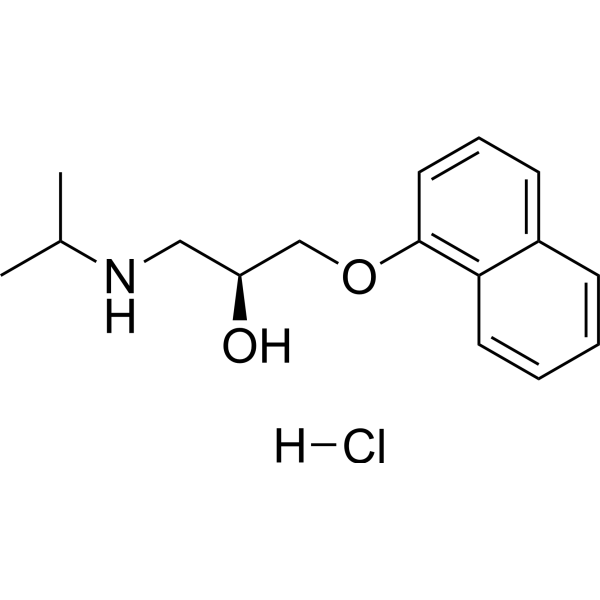
(S)-(-)-Propranolol hydrochloride
Based on 2 publication(s) in Google Scholar
(S)-(-)-Propranolol hydrochloride is the active isomer of Propranolol (HY-B0573B), with 98-fold greater activity than (R)-(+)-Propranolol. (S)-(-)-Propranolol hydrochloride produces antinociception-related phenotypes in mouse models, accompanied by sedative and ataxic side effects. (S)-(-)-Propranolol hydrochloride can be used in research related to hypertension, myocardial infarction, and pain.
商品は「研究用試薬」です。人や動物の医療用・臨床診断用・食品用の製品ではありません。
研究用途以外に使用した場合、当社は一切の責任を負いかねます。
- 純度 : 99.97%
- CAS 番号: 4199-10-4
- 分子式: C16H22ClNO2
- 分子量:295.81
-
保管条件:
4°C, sealed storage, away from moisture
* In solvent : -80°C, 6 months; -20°C, 1 month (sealed storage, away from moisture)

To place orders, for customer services and technical support, please contact: MedChemExpress USA
Tel: 609-228-6898 E-mail: [email protected] [email protected]


-
 生物活性
生物活性
-
化学情報
-
溶剤 & 溶解度
- プロトコル
- 純度とドキュメンテーション
- 参考文献
-
 Help & FAQs


MedChemExpress(MCE)の使用を引用している文献 (S)-(-)-Propranolol hydrochloride
MoreAdrenergic Receptor アイソフォーム固有の製品をすべて表示
More

生物活性
製品説明
IC50 & Target
[1]|
β-adrenoceptor |
体外実験
(S)-(-)-Propranolol hydrochloride can be synthesized from D-Sorbitol (HY-B0400)[1].
(S)-(-)-Propranolol hydrochloride is the active isomer of Propranolol (HY-B0573B), a non-selective and blood-brain barrier-permeable β-adrenergic receptor antagonist[1][2].
MedChemExpress (MCE) has not independently confirmed the accuracy of these methods. They are for reference only. Further protocols information, click here.
体内実験
(S)-(-)-Propranolol hydrochloride (30-60 mg/kg; 60 min after administration) impairs motor coordination and induces ataxia in mice in the rotarod test, with an ataxia ED50 = 22.2 mg/kg[2].
MedChemExpress (MCE) has not independently confirmed the accuracy of these methods. They are for reference only.


化学情報
-
CAS 番号 4199-10-4
-
性状 Solid
-
分子量 295.81
-
分子式 C16H22ClNO2
-
Color White to off-white
-
SMILES
O[C@H](COC1=C2C=CC=CC2=CC=C1)CNC(C)C.[H]Cl
-
別名
(S)-(?)-プロプラノロール 塩酸塩
-
輸送条件
Room temperature in continental US; may vary elsewhere.
-
保管条件
4°C, sealed storage, away from moisture
* In solvent : -80°C, 6 months; -20°C, 1 month (sealed storage, away from moisture)


Publications (2)
-
Journal Impact Factor
-
Most Recent
-
Cancer Discov
Myofibroblasts Induce Neuroplasticity to Promote Pancreatic Inflammation and Cancer Progression. [Abstract]2026 Feb 9. PMID: 41661076 -
Arterioscler Thromb Vasc Biol
TGF-β1 Promotes Angiogenesis via Endothelial-to-Mesenchymal Transition in Infantile Hemangioma. [Abstract]2025 Aug 21. PMID: 40836919


溶剤 & 溶解度
体外:
DMSO : 50 mg/mL (169.03 mM; Need ultrasonic; Hygroscopic DMSO has a significant impact on the solubility of product, please use newly opened DMSO)
H2O : ≥ 10 mg/mL (33.81 mM)
* "≥" means soluble, but saturation unknown.
Please refer to the solubility information to select the appropriate solvent. Once prepared, please aliquot and store the solution to prevent product inactivation from repeated freeze-thaw cycles.
Storage method and period of stock solution: -80°C, 6 months; -20°C, 1 month (sealed storage, away from moisture). When stored at -80°C, please use it within 6 months. When stored at -20°C, please use it within 1 month.
* Note: If you choose water as the stock solution, please dilute it to the working solution, then filter and sterilize it with a 0.22 μm filter before use.
Please refer to the solubility information to select the appropriate solvent. Once prepared, please aliquot and store the solution to prevent product inactivation from repeated freeze-thaw cycles.
Storage method and period of stock solution: -80°C, 6 months; -20°C, 1 month (sealed storage, away from moisture). When stored at -80°C, please use it within 6 months. When stored at -20°C, please use it within 1 month.
* Note: If you choose water as the stock solution, please dilute it to the working solution, then filter and sterilize it with a 0.22 μm filter before use.
濃度 (開始) × 体積 (開始) = 濃度 (終了) × 体積 (終了)
体内:
Select the appropriate dissolution method based on your experimental animal and administration route.
- For the following dissolution methods, please ensure to first prepare a clear stock solution using an In Vitro approach and then sequentially add co-solvents:
- To ensure reliable experimental results, the clarified stock solution can be appropriately stored based on storage conditions. As for the working solution for In Vivo experiments, it is recommended to prepare freshly and use it on the same day.
- The percentages shown for the solvents indicate their volumetric ratio in the final prepared solution. If precipitation or phase separation occurs during preparation, heat and/or sonication can be used to aid dissolution.
Add each solvent one by one: 10% DMSO 40% PEG300 5% Tween-80 45% Saline
Solubility: ≥ 2.5 mg/mL (8.45 mM); Clear solution
This protocol yields a clear solution of ≥ 2.5 mg/mL (saturation unknown).
Taking 1 mL working solution as an example, add 100 μL DMSO stock solution (25.0 mg/mL) to 400 μL PEG300, and mix evenly; then add 50 μL Tween-80 and mix evenly; then add 450 μL Saline to adjust the volume to 1 mL.
Preparation of Saline: Dissolve 0.9 g sodium chloride in ddH₂O and dilute to 100 mL to obtain a clear Saline solution.
Add each solvent one by one: 10% DMSO 90% (20% SBE-β-CD in Saline)
Solubility: ≥ 2.5 mg/mL (8.45 mM); Clear solution
This protocol yields a clear solution of ≥ 2.5 mg/mL (saturation unknown).
Taking 1 mL working solution as an example, add 100 μL DMSO stock solution (25.0 mg/mL) to 900 μL 20% SBE-β-CD in Saline, and mix evenly.
Preparation of 20% SBE-β-CD in Saline (4°C, storage for one week): 2 g SBE-β-CD powder is dissolved in 10 mL Saline, completely dissolve until clear.
In Vivo Dissolution Calculator
Please enter the basic information of animal experiments:
-
-
-
-
Recommended: Prepare an additional quantity of animals to account for potential losses during experiments.
Please enter your animal formula composition:
-
%DMSO +
Recommended: Keep the proportion of DMSO in working solution below 2% if your animal is weak.
-
%+
-
+%Tween-80 + +
-
%Saline +
The co-solvents required include: DMSO, . All of co-solvents are available by MedChemExpress (MCE). , Tween 80. All of co-solvents are available by MedChemExpress (MCE).
Working solution concentration: 0.22 mg/mL
Method for preparing stock solution: mg drug dissolved in μL DMSO. Stock solution concentration: mg/mL. * In solvent : -80°C, 6 months; -20°C, 1 month (sealed storage, away from moisture)
1. Take μL DMSO stock solution;
2. Add μL .
μL , mix evenly;
3. Then add μL Tween 80, mix evenly;
4. Then add μL
Please ensure that the stock solution in the first step is dissolved to a clear state, and add co-solvents in sequence. You can use ultrasonic heating (ultrasonic cleaner, recommended frequency 20-40 kHz), vortexing, etc. to assist dissolution.

プロトコル
-
Formalin-Induced Paw Inflammation/Nociceptive Inflammation
The formalin-induced paw inflammation/nociceptive test is a chemical persistent pain model in rodents in which subcutaneous injection of formalin into the hind paw produces spontaneous nocifensive behaviors such as flinching and licking. The response is classically biphasic, consisting of an early acute phase (Phase I) reflecting direct activation of peripheral nociceptors (particularly C-fiber afferents), followed by a later prolonged phase (Phase II) associated with central sensitization in the spinal dorsal horn driven by sustained afferent input and inflammatory signaling. This model is widely used to evaluate analgesic and anti-inflammatory interventions because it captures both peripheral nociception and central sensitization processes within a single assay system.
-
Research Protocol for Cardiovascular Diseases
Cardiovascular disease can be modeled as maladaptive cardiac remodeling, where ischemic injury or pressure overload activates inflammatory signaling, fibroblast activation, extracellular-matrix deposition, cardiomyocyte hypertrophy, vascular remodeling, and progressive ventricular dysfunction. The TGF-β/SMAD axis is a central profibrotic pathway after myocardial injury and pressure overload, while innate immune and cytokine pathways regulate leukocyte recruitment, scar formation, and adverse remodeling. Key unresolved questions include which inflammatory signals are reparative versus harmful, when fibrosis is protective versus maladaptive, and whether pathway inhibition improves function without weakening necessary infarct healing or compensatory remodeling.


純度とドキュメンテーション
-
データシート (281 KB)
-
SDS (394 KB)
- English - EN (394 KB)
- Français - FR (394 KB)
- Deutsch - DE (394 KB)
- Norwegian - NO (394 KB)
- Español - ES (394 KB)
- Swedish - SV (394 KB)
- Italian - IT (394 KB)
- Korean - KR (394 KB)
- Portuguese - PT (394 KB)
-
取扱説明書 (2659 KB)
参考文献


Complete Stock Solution Preparation Table
Please refer to the solubility information to select the appropriate solvent. Once prepared, please aliquot and store the solution to prevent product inactivation from repeated freeze-thaw cycles.
Storage method and period of stock solution: -80°C, 6 months; -20°C, 1 month (sealed storage, away from moisture). When stored at -80°C, please use it within 6 months. When stored at -20°C, please use it within 1 month.
| Optional Solvent | Concentration Solvent Mass | 1 mg | 5 mg | 10 mg | 25 mg |
|---|---|---|---|---|---|
| H2O / DMSO | 1 mM | 3.3805 mL | 16.9027 mL | 33.8055 mL | 84.5137 mL |
| 5 mM | 0.6761 mL | 3.3805 mL | 6.7611 mL | 16.9027 mL | |
| 10 mM | 0.3381 mL | 1.6903 mL | 3.3805 mL | 8.4514 mL | |
| 15 mM | 0.2254 mL | 1.1268 mL | 2.2537 mL | 5.6342 mL | |
| 20 mM | 0.1690 mL | 0.8451 mL | 1.6903 mL | 4.2257 mL | |
| 25 mM | 0.1352 mL | 0.6761 mL | 1.3522 mL | 3.3805 mL | |
| 30 mM | 0.1127 mL | 0.5634 mL | 1.1268 mL | 2.8171 mL | |
| DMSO | 40 mM | 0.0845 mL | 0.4226 mL | 0.8451 mL | 2.1128 mL |
| 50 mM | 0.0676 mL | 0.3381 mL | 0.6761 mL | 1.6903 mL | |
| 60 mM | 0.0563 mL | 0.2817 mL | 0.5634 mL | 1.4086 mL | |
| 80 mM | 0.0423 mL | 0.2113 mL | 0.4226 mL | 1.0564 mL | |
| 100 mM | 0.0338 mL | 0.1690 mL | 0.3381 mL | 0.8451 mL |
* Note: If you choose water as the stock solution, please dilute it to the working solution, then filter and sterilize it with a 0.22 μm filter before use.


(S)-(-)-Propranolol hydrochloride 関連分類
HY-B0573A 関連分類
 Powered by Bioz