



SCH-202676 hydrobromide

Based on 1 Customer Validation
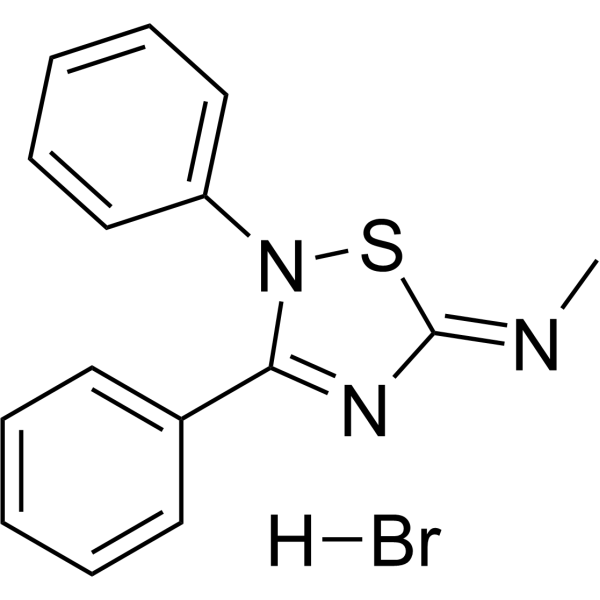
SCH-202676 hydrobromide is an allosteric modulator of G protein-coupled receptors (GPCRs) and adenosine receptor (AR). SCH-202676 hydrobromide has antiviral activity and inhibits 3CLpro in a time-dependent manner with an IC50 value of 0.655 μM.
For research use only. We do not sell to patients.
- Purity : 98.85%
- CAS No.: 265980-25-4
- Formula: C15H14BrN3S
- Molecular Weight:348.26
-
Storage:
-20°C, sealed storage, away from moisture
* In solvent : -80°C, 6 months; -20°C, 1 month (sealed storage, away from moisture)

To place orders, for customer services and technical support, please contact: MedChemExpress USA
Tel: 609-228-6898 E-mail: [email protected] [email protected]


-
 Biological Activity
-
Chemical Information
-
Solvent & Solubility
- Protocols
- Purity & Documentation
- References
-
 Help & FAQs


All Adenosine Receptor Isoforms
More

Biological Activity
Description


Chemical Information
-
CAS No. 265980-25-4
-
Appearance Solid
-
Molecular Weight 348.26
-
Formula C15H14BrN3S
-
Color White to off-white
-
SMILES
[H]Br.C/N=C1N=C(C2=CC=CC=C2)N(C3=CC=CC=C3)S/1
-
Shipping
Room temperature in continental US; may vary elsewhere.
-
Storage
-20°C, sealed storage, away from moisture
* In solvent : -80°C, 6 months; -20°C, 1 month (sealed storage, away from moisture)


Solvent & Solubility
In Vitro:
DMSO : 10 mg/mL (28.71 mM; Need ultrasonic and warming; Hygroscopic DMSO has a significant impact on the solubility of product, please use newly opened DMSO)
Please refer to the solubility information to select the appropriate solvent. Once prepared, please aliquot and store the solution to prevent product inactivation from repeated freeze-thaw cycles.
Storage method and period of stock solution: -80°C, 6 months; -20°C, 1 month (sealed storage, away from moisture). When stored at -80°C, please use it within 6 months. When stored at -20°C, please use it within 1 month.
Please refer to the solubility information to select the appropriate solvent. Once prepared, please aliquot and store the solution to prevent product inactivation from repeated freeze-thaw cycles.
Storage method and period of stock solution: -80°C, 6 months; -20°C, 1 month (sealed storage, away from moisture). When stored at -80°C, please use it within 6 months. When stored at -20°C, please use it within 1 month.
Concentration (start) × Volume (start) = Concentration (final) × Volume (final)


Purity & Documentation
-
Data Sheet (280 KB)
-
SDS (252 KB)
- English - EN (252 KB)
- Français - FR (252 KB)
- Deutsch - DE (252 KB)
- Norwegian - NO (252 KB)
- Español - ES (252 KB)
- Swedish - SV (252 KB)
- Italian - IT (252 KB)
- Korean - KR (252 KB)
- Portuguese - PT (252 KB)
-
Handling Instructions (2659 KB)
References
[1]. Ren P, et al. Discovery, synthesis and mechanism study of 2,3,5-substituted [1,2,4]-thiadiazoles as covalent inhibitors targeting 3C-Like protease of SARS-CoV-2. Eur J Med Chem. 2023 Jan 18;249:115129. [Content Brief]
[2]. Lewandowicz AM, et al. The 'allosteric modulator' SCH-202676 disrupts G protein-coupled receptor function via sulphydryl-sensitive mechanisms. Br J Pharmacol. 2006 Feb;147(4):422-9. [Content Brief]
[4]. Gao ZG, et al. Effects of the allosteric modulator SCH-202676 on adenosine and P2Y receptors. Life Sci. 2004 May 7;74(25):3173-80. [Content Brief]


Complete Stock Solution Preparation Table
Please refer to the solubility information to select the appropriate solvent. Once prepared, please aliquot and store the solution to prevent product inactivation from repeated freeze-thaw cycles.
Storage method and period of stock solution: -80°C, 6 months; -20°C, 1 month (sealed storage, away from moisture). When stored at -80°C, please use it within 6 months. When stored at -20°C, please use it within 1 month.
| Optional Solvent | Concentration Solvent Mass | 1 mg | 5 mg | 10 mg | 25 mg |
|---|---|---|---|---|---|
| DMSO | 1 mM | 2.8714 mL | 14.3571 mL | 28.7142 mL | 71.7854 mL |
| 5 mM | 0.5743 mL | 2.8714 mL | 5.7428 mL | 14.3571 mL | |
| 10 mM | 0.2871 mL | 1.4357 mL | 2.8714 mL | 7.1785 mL | |
| 15 mM | 0.1914 mL | 0.9571 mL | 1.9143 mL | 4.7857 mL | |
| 20 mM | 0.1436 mL | 0.7179 mL | 1.4357 mL | 3.5893 mL | |
| 25 mM | 0.1149 mL | 0.5743 mL | 1.1486 mL | 2.8714 mL |


SCH-202676 hydrobromide Related Classifications
HY-110012 Related Classifications
 Powered by Bioz