242 Results for "

splicing

" in MedChemExpress (MCE) Product Catalog:
Products (242)

242 Results for "splicing" in MCE Product Catalog:

  • Categories Recommended:
    More
Cat. No.: HY-13650R
CAS No.: 165668-41-7
Synonyms: E 7070 (Standard)
Indisulam (Standard) (E 7070 (Standard)) is the analytical standard of Indisulam (HY-13650). This product is intended for research and analytical applications. Indisulam (E 7070) is a carbonic anhydrase inhibitor and RBM39 molecular glue degrader, with Ki values of 31, 15, and 24 nM against human carbonic anhydrase I, II, and IX, respectively, and a Ki value of 65 nM against bovine carbonic anhydrase IV. Indisulam promotes the recruitment of RBM39 to the CUL4-DCAF15 E3 ubiquitin ligase complex, triggering polyubiquitination and proteasomal degradation of RBM39. Indisulam induces aberrant pre-mRNA splicing, G1 cell cycle arrest, and cell death in cancer cells. As an anticancer agent, Indisulam drives tumor regression and growth inhibition in xenograft models. Indisulam can be used in research related to solid tumors, hematologic and lymphoid malignancies, colorectal cancer, and non-small cell lung cancer .
loading...
    loading...
Cat. No.: HY-145425
CAS No.: 2771006-54-1
Target:  

IRE1 Apoptosis FGFR

Research Areas:  

Inflammation/Immunology

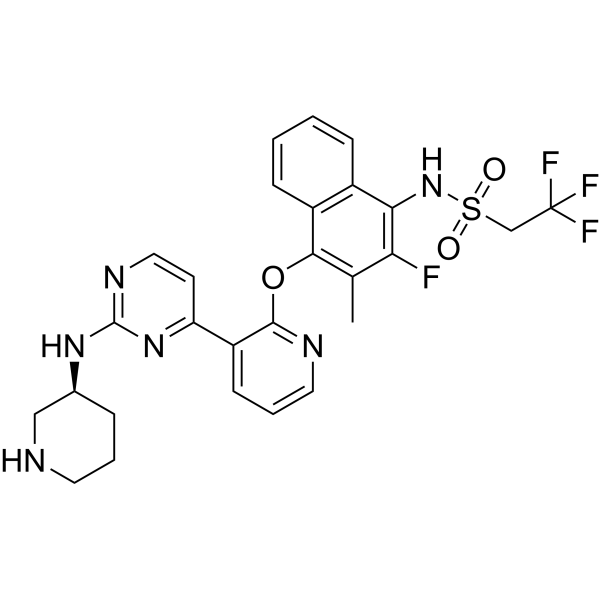
PAIR2 is a highly selective inhibitor targeting the kinase domain of human IRE1α, with a Ki value of 8.8 nM against human IRE1α. PAIR2 fully occupies the ATP-binding site of the IRE1α kinase domain, partially antagonizes the ribonuclease activity of IRE1α, specifically inhibits regulated IRE1α-dependent decay (RIDD) and its mediated substrate cleavage, while preserving the splicing function of Xbp1 mRNA. PAIR2 also promotes the differentiation of B cells into plasma cells, blocks IRE1α-induced cell apoptosis, and restores the expression of Fgfr2 mRNA in AT2 cells. PAIR2 effectively reaches a steady-state concentration in the lung tissues of Mus musculus, and serves as an important tool for investigating the function of the IRE1α signaling pathway in diseases such as pulmonary fibrosis .
loading...
    loading...
Cat. No.: HY-P11698
CAS No.: 476667-31-9
Research Areas:  

Cancer

Guanidino-G-Clamp-PNA is a highly efficient sequence-specific RNA binder and gene silencer. Guanidino-G-Clamp-PNA precisely targets such targets as miR-155 or transthyretin (TTR) mRNA through base pairing: the former regulates tumor-related signaling pathways by reducing microRNA activity, while the latter inhibits the translation of harmful proteins via steric hindrance. Guanidino-G-Clamp-PNA effectively stabilizes DNA/RNA duplexes, induces cancer cell apoptosis, and suppresses tumor growth. In addition, Guanidino-G-Clamp-PNA can be conjugated with targeting ligands to improve tissue-specific delivery and reduce in vivo adverse reactions, and it can also enhance the splicing regulation efficacy of other oligonucleotide platforms (such as PMO) when integrated into them. Guanidino-G-Clamp-PNA is applicable to the research of various diseases including diffuse large B-cell lymphoma and hereditary transthyretin-related amyloidosis .
loading...
    loading...
Cat. No.: HY-P7692
Purity:  ≥ 95%, as determined by reducing SDS-PAGE.
Synonyms: C1QBP; splicing Factor SF2-Associated Protein; Prev. HABP1; ASF/SF2-Associated Protein P32; Complement Component 1 Q Subcomponent-Binding Protein, Mitochondrial; Glycoprotein GC1qBP; Mitochondrial Matrix Protein P32; SF2AP32; Hyaluronan-Binding Protein 1
Species:  
Human
Source:  
E. coli
loading...
    loading...
Cat. No.: HY-P72517
Purity:  ≥ 95%, as determined by reducing SDS-PAGE.
Synonyms: LILRB5; Leukocyte Immunoglobulin-Like Receptor 8; Leukocyte Immunoglobulin Like Receptor B5; CD85 Antigen-Like Family Member C; LIR-8; Leucocyte Ig-Like Receptor B5; LIR8; Leukocyte Immunoglobulin Like Receptor B5 Short splicing Isoform; CD85c; Leukocyte
Species:  
Human
Source:  
HEK293
loading...
    loading...
Cat. No.: HY-P77443
Purity:  ≥ 95%, as determined by reducing SDS-PAGE.
Synonyms: LILRB5; Leukocyte Immunoglobulin-Like Receptor 8; Leukocyte Immunoglobulin Like Receptor B5; CD85 Antigen-Like Family Member C; LIR-8; Leucocyte Ig-Like Receptor B5; LIR8; Leukocyte Immunoglobulin Like Receptor B5 Short splicing Isoform; CD85c; Leukocyte
Species:  
Human
Source:  
HEK293
loading...
    loading...
Cat. No.: HY-P78485
Purity:  ≥ 95%, as determined by Bis-Tris PAGE.
Synonyms: LILRB5; Leukocyte Immunoglobulin-Like Receptor 8; Leukocyte Immunoglobulin Like Receptor B5; CD85 Antigen-Like Family Member C; LIR-8; Leucocyte Ig-Like Receptor B5; LIR8; Leukocyte Immunoglobulin Like Receptor B5 Short splicing Isoform; CD85c; Leukocyte
Species:  
Human
Source:  
HEK293
loading...
    loading...
Cat. No.: HY-P78839
Purity:  ≥ 95%, as determined by reducing SDS-PAGE.
Synonyms: LILRB5; Leukocyte Immunoglobulin-Like Receptor 8; Leukocyte Immunoglobulin Like Receptor B5; CD85 Antigen-Like Family Member C; LIR-8; Leucocyte Ig-Like Receptor B5; LIR8; Leukocyte Immunoglobulin Like Receptor B5 Short splicing Isoform; CD85c; Leukocyte
Species:  
Human
Source:  
HEK293
loading...
    loading...
Cat. No.: HY-P700781
Purity:  ≥ 95%, as determined by reducing SDS-PAGE.
Synonyms: LILRB5; Leukocyte Immunoglobulin-Like Receptor 8; Leukocyte Immunoglobulin Like Receptor B5; CD85 Antigen-Like Family Member C; LIR-8; Leucocyte Ig-Like Receptor B5; LIR8; Leukocyte Immunoglobulin Like Receptor B5 Short splicing Isoform; CD85c; Leukocyte
Species:  
Human
Source:  
HEK293
loading...
    loading...
Cat. No.: HY-N6973R
CAS No.: 476-70-0
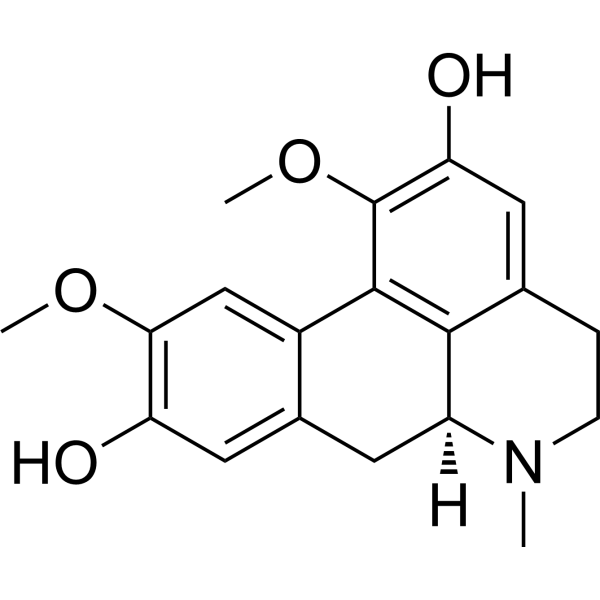
Boldine (Standard) is the analytical standard of Boldine (HY-N6973). This product is intended for research and analytical applications. Boldine is an aporphine alkaloid telomerase (telomerase) inhibitor (IC50 of 0.17 μM for TERT) and a pannexin/connexin hemichannel blocker, with oral activity and blood-brain barrier permeability. Boldine inhibits telomerase activity through direct interaction with the telomerase ribonucleoprotein and non-competitive binding near the TERT active site, and downregulates hTERT mRNA while shifting alternative splicing toward non-functional transcripts. Boldine blocks Panx1, Cx43, Cx26, and Cx30 hemichannels as well as P2X7 receptor-mediated calcium influx. Boldine exhibits antioxidant, anti-inflammatory, antiproliferative, and cytotoxic activities by scavenging ROS, inhibiting NFκB, dephosphorylating SGK1, and reducing TNF-alpha levels. Boldine can be used in research on breast cancer, Alzheimer's disease, glioblastoma, diabetes, and spinal cord injury .
loading...
    loading...
Cat. No.: HY-P704529
Purity:  ≥ 90%, as determined by reducing SDS-PAGE.
Synonyms: CDK5; Cyclin-Dependent Kinase 5; Cyclin Dependent Kinase 5; TPKII Catalytic Subunit; PSSALRE; Epididymis Secretory Sperm Binding Protein; Serine/Threonine-Protein Kinase PSSALRE; Protein Kinase CDK5 splicing; Tau Protein Kinase II Catalytic Subunit; CDKN5; Cell Division Protein Kinase 5; LIS7; Cyclin-Dependent-Like Kinase 5
Species:  
Human
Source:  
E. coli
loading...
    loading...
Cat. No.: HY-P85533
Synonyms: Cdk 5; Cdk5; CDK5_HUMAN; Cell division protein kinase 5; Crk6; Cyclin dependent kinase 5; Cyclin-dependent kinase 5; Protein kinase CDK5 splicing; PSSALRE; Serine threonine protein kinase PSSALRE; Serine/threonine-protein kinase PSSALRE; Tau protein kinase II catalytic subunit; TPKII catalytic subunit.

Host:  

Mouse

Application:  

WB, ICC/IF

Reactivity:  

Human, Mouse, Rat, Monkey

loading...
    loading...
Cat. No.: HY-P72056
Purity:  ≥ 90%, as determined by reducing SDS-PAGE.
Synonyms: TRA2B; TRA-2 Beta; Prev. SFRS10; Transformer 2 Beta Homolog (Drosophila); Htra2-Beta; HTRA2-Beta; PPP1R156; TRA2-BETA; splicing Factor, Arginine/Serine-Rich 10 (Transformer 2 Homolog, Drosophila); TRA2-Beta; Protein Phosphatase 1, Regulatory Subunit 156;
Species:  
Human
Source:  
Sf9 insect cells
loading...
    loading...
Cat. No.: HY-P72298
Purity:  ≥ 90%, as determined by reducing SDS-PAGE.
Synonyms: CDK5; Cyclin-Dependent Kinase 5; Cyclin Dependent Kinase 5; TPKII Catalytic Subunit; PSSALRE; Epididymis Secretory Sperm Binding Protein; Serine/Threonine-Protein Kinase PSSALRE; Protein Kinase CDK5 splicing; Tau Protein Kinase II Catalytic Subunit; CDKN5; Cell Division Protein Kinase 5; LIS7; Cyclin-Dependent-Like Kinase 5
Species:  
Human
Source:  
P. pastoris
loading...
    loading...
Cat. No.: HY-P705886
Purity:  ≥ 85%, as determined by reducing SDS-PAGE.
Synonyms: SRPK1; Serine/Arginine-Rich splicing Factor Kinase 1; SRSF Protein Kinase 1; SR-Protein-Specific Kinase 1; SFRS Protein Kinase 1; Non-Specific Serine/Threonine Protein Kinase; SFRSK1; Serine/Threonine-Protein Kinase SRPK1; Serine/Arginine-Rich Protein-Specific Kinase 1; SR Protein Kinase 1
Species:  
Human
Source:  
E. coli
loading...
    loading...
Cat. No.: HY-P703295
Purity:  ≥ 90%, as determined by reducing SDS-PAGE.
Synonyms: U2AF2; U2AF65; U2 SnRNP Auxiliary Factor Large Subunit; U2 Small Nuclear RNA Auxiliary Factor 2; splicing factor U2AF 65 kDa subunit; U2 auxiliary factor 65 kDa subunit; hU2AF65; hU2AF65; U2 snRNP auxiliary factor large subunit; DEVDFB; HU2AF(65); Splicin
Species:  
Human
Source:  
E. coli
loading...
    loading...
Cat. No.: HY-P705437
Purity:  ≥ 95%, as determined by reducing SDS-PAGE.
Synonyms: PPARG; PPARG5; Peroxisome Proliferator Activated Receptor Gamma; Peroxisome Proliferator-Activated Receptor-Gamma splicing; NR1C3; Peroxisome Proliferative Activated Receptor, Gamma; Peroxisome Proliferator-Activated Receptor Gamma; Peroxisome Proliferator-Activated Receptor-Gamma 5; Nuclear Receptor Subfamily 1 Group C Member 3; PPAR Gamma; PPAR-Gamma; PPARG2D5; PPARgamma; FPLD3; PPARG2; CIMT1; PPARG1; GLM1
Species:  
Mouse
Source:  
E. coli
loading...
    loading...
Cat. No.: HY-P87087
Synonyms: Serine/arginine rich protein specific kinase 1 antibody; Serine/arginine rich splicing factor kinase 1 antibody; Serine/arginine-rich protein-specific kinase 1 antibody; Serine/threonine protein kinase SRPK1 antibody; Serine/threonine-protein kinase SRPK1 antibody; SFRS protein kinase 1 antibody; SFRSK1 antibody; SR protein kinase 1 antibody; SR protein specific kinase 1 antibody; SR-protein-specific kinase 1 antibody; Serine/arginine rich protein specific kinase 1 antibody; Serine/arginine rich splicing factor kinase 1 antibody; Serine/arginine-rich protein-specific kinase 1 antibody; Serine/threonine protein kinase SRPK1 antibody; Serine/threonine-protein kinase SRPK1 antibody; SFRS protein kinase 1 antibody; SFRSK1 antibody; SR protein kinase 1 antibody; SR protein specific kinase 1 antibody; SR-protein-specific kinase 1 antibody; SRPK1 antibody; SRPK1_HUMAN antibody;

Host:  

Rabbit

Application:  

WB, ICC/IF, IHC-P, IF-Tissue, FC, IP

Reactivity:  

Human, Mouse

loading...
    loading...
Cat. No.: HY-N15135
CAS No.: 9040-27-1
Arabinoxylan Medium viscosity is an orally active Dectin-1 splice variant modulator, glucose absorption inhibitor, and chyme viscosity enhancer. Arabinoxylan Medium viscosity inhibits particulate β-glucan-induced Dectin-1A activation and mildly suppresses Dectin-1B activation. In human dendritic cells stimulated with particulate β-glucan, Arabinoxylan Medium viscosity reduces the production of IL-10 and TNF-α, and increases the production of IL-4 and IL-23. Arabinoxylan Medium viscosity also supports antifungal immune responses without activating TLR2, TLR4 or TLR5, and does not induce cytokine production when used to stimulate human dendritic cells alone. Arabinoxylan Medium viscosity increases small intestinal chyme viscosity, gets degraded in the large intestine to produce short-chain fatty acids, reduces glucose absorption and insulin response, and improves glucose homeostasis. Arabinoxylan Medium viscosity supports microbial fermentation and the growth of beneficial microbiota in the gastrointestinal tract, prevents bile acid reabsorption, and delays starch digestion. Arabinoxylan Medium viscosity can be used in research related to type 2 diabetes, impaired glucose tolerance, and metabolic syndrome .
loading...
    loading...
Cat. No.: HY-L248
858 compounds

The RNA-targeted bioactive compound library is a high-quality collection of small molecules specifically designed and curated to target RNA structures and functions. It is widely applied in cutting-edge drug discovery and life science research. Unlike traditional strategies that focus on protein targets, RNA-targeted compounds can directly modulate various functional RNA molecules by influencing their splicing, translation, stability, or structural conformation, thereby enabling precise intervention in key biological processes. In the field of drug development, these compounds provide a novel approach to addressing previously “undruggable” targets and have demonstrated significant potential in areas such as oncology, antiviral therapies, and neurodegenerative diseases. For example, by targeting disease-associated RNA structural domains or regulating the aberrant expression of non-coding RNAs, these compounds can effectively inhibit disease progression or restore normal cellular function. In mechanistic studies, RNA-targeted compounds serve as valuable chemical biology tools to elucidate the roles of RNA in gene expression regulation, cellular signaling pathways, and disease development.

The MCE RNA-targeted bioactive compound library contains 858 compounds, sourced from databases such as TargetRX Atlas and R-BIND. The library features excellent structural diversity and biological activity, making it suitable for high-throughput screening (HTS), target validation, phenotypic screening, and lead compound discovery. It represents a valuable resource for RNA-related research and innovative drug development.

