35 Results for "

trypanocidal,

" in MedChemExpress (MCE) Product Catalog:
Products (35)

35 Results for "trypanocidal," in MCE Product Catalog:

Cat. No.: HY-12404R
CAS No.: 908-54-3
Synonyms: Diminazene diaceturate (Standard)
Diminazene (aceturate) (Standard) is the analytical standard of Diminazene (aceturate). This product is intended for research and analytical applications. Diminazene aceturate (Diminazene diaceturate) is an anti-trypanosome agent for livestock. The main biochemical mechanism of the trypanocidal actions of Diminazene aceturate is by binding to trypanosomal kinetoplast DNA (kDNA) in a non-intercalative manner through specific interaction with sites rich in adenine-thymine base pairs. Diminazene aceturate is also an angiotensin-converting enzyme 2 (ACE2) activator and has strong and potent anti-inflammatory properties .
loading...
    loading...
Cat. No.: HY-124623
CAS No.: 2222660-40-2
Target:  

Parasite

Research Areas:  

Infection

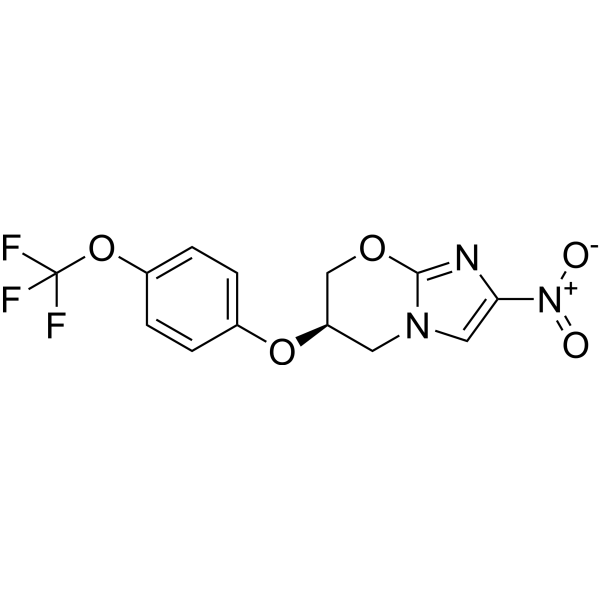
DNDI-8219 (compound 58) is a potent selective and orally active trypanocidal agent, possessing inhibitory activity against Trypanosoma cruzi (T. cruzi) with an IC50 of 0.4 μM. DNDI-8219 has low cytotoxicity (L6 cells IC50 > 100 μM). DNDI-8219 can effectively cure chronic T. cruzi infection and markedly reduce parasite burdens in mouse model. DNDI-8219 has good solubility, metabolic stability and safety.
loading...
    loading...
Cat. No.: HY-135190R
CAS No.: 469-61-4
Synonyms: α-cedrene (Standard)
(-)-Cedrene (α-cedrene) (Standard) is the analytical standard of (-)-Cedrene. This product is intended for research and analytical applications. (-)-Cedrene is a major constituent that can be found in essential oils. (-)-Cedrene (α-cedrene) is a natural, orally active ligand of mouse olfactory receptor 23, which induces skeletal muscle hypertrophy in mice. (-)-Cedrene exhibits trypanocidal (Trypanosoma b. brucei) (IC50 = 4.07 μg/mL). (-)-Cedrene is antileukemic in vitro (IC50 = 22.2 μg/mL). (-)-Cedrene has antimicrobial activity against anaerobic bacteria and yeast. (-)-Cedrene exhibits anti-obesity activity .
loading...
    loading...
Cat. No.: HY-181508
CAS No.: 3113099-14-9
Target:  

Parasite

Research Areas:  

Infection

Antitrypanosomal agent 30 (compound 6b) is a trypanocidal agent with extremely low cytotoxicity against mouse macrophages. Antitrypanosomal agent 30 can be used for the research of Chagas disease .
loading...
    loading...
Cat. No.: HY-N19754
CAS No.: 307503-97-5
Target:  

Parasite

Cladospirone B is a secondary metabolite of the endophytic fungus Lasiodiplodia theobromae. Cladospirone B exhibits trypanocidal activity, with a MIC of 17.8 µM against Trypanosoma brucei. Cladospirone B can be used in the research of African human trypanosomiasis (sleeping sickness) .
loading...
    loading...
Cat. No.: HY-118606
CAS No.: 296246-47-4
Target:  

PAK Parasite

Research Areas:  

Infection Cancer

LDN-0044878 is a PAK3 inhibitor. LDN-0044878 inhibits the proliferation or induces the death of p53-deficient cells. LDN-0044878 exhibits moderate trypanocidal activity against Trypanosoma brucei, but does not directly inhibit the core target Rhodesain. LDN-0044878 can be used in studies related to cervical adenocarcinoma and Trypanosoma brucei infection.
loading...
    loading...
Cat. No.: HY-133983
CAS No.: 21840-08-4
Research Areas:  

Infection

Melarsen oxide is a blood-brain barrier-permeable, competitive antimalarial agent and Glutathione reductase inhibitor with a Ki of 23.7 μM. Melarsen oxide induces rapid lysis of bloodstream-form Trypanosoma brucei cells by disrupting the plasma membrane. Melarsen oxide exhibits trypanocidal activity against Trypanosoma brucei rhodesiense. Melarsen oxide is applicable to research related to filariasis and African trypanosomiasis .
loading...
    loading...
Cat. No.: HY-181516
Target:  

Parasite

Research Areas:  

Infection

Anti-Trypanosoma cruzi agent-8 is an anti-Trypanosoma agent and also a Trypanosoma cruzi trypanothione reductase (TcTR) inhibitor, with an IC50 of 3.9 μM against TcTR. Anti-Trypanosoma cruzi agent-8 functionally inhibits the enzymatic activity of TcTR. Anti-Trypanosoma cruzi agent-8 exhibits trypanocidal activity against intracellular Trypanosoma cruzi amastigotes .
loading...
    loading...
Cat. No.: HY-184074
CAS No.: 2152662-88-7
Target:  

Parasite

Research Areas:  

Infection

Enfiborole is an oxaborolane ester inhibitor with trypanocidal activity against parasites. Enfiborole displays IC50 values ≤ 20 nM against Trypanosoma brucei and Trypanosoma cruzi, and its IC50 against replicating trypanosomes ranges from 21 to 999 nM. Enfiborole inhibits the growth of Trypanosoma brucei, suppresses hypoxanthine incorporation in replicating trypanosomes, and inhibits the growth of Trypanosoma cruzi amastigotes. Enfiborole can be used in studies related to trypanosome infections .
loading...
    loading...
Cat. No.: HY-189095
CAS No.: 57323-76-9
Target:  

Parasite Kallikrein

Research Areas:  

Infection

KLK6-IN-2 is a reversible non-covalent and selective KLK6 inhibitor, with an IC50 of 2.1 μM against hKLK6. KLK6-IN-2 acts as a reversible competitive inhibitor of boar Spermatozoa acrosin, with a Ki of 2.6 μM against porcine acrosin. KLK6-IN-2 exhibits trypanocidal activity against Trypanosoma brucei rhodesiense, with an IC50 of 3.71 μM .
loading...
    loading...
Cat. No.: HY-180158
CAS No.: 2413738-47-1
Research Areas:  

Infection Cancer

Antitrypanosomal agent 28 (Compound 2a) is a trypanocidal agent. Antitrypanosomal agent 28 effectively inhibits Trypanosoma cruzi by inducing the generation of ROS and mitochondrial damage, with an IC₅₀ of 49.4 μM. Antitrypanosomal agent 28 exhibits broad-spectrum anti-tumor activity against various tumor cell lines, especially being sensitive to leukemia, colon cancer, and breast cancer. Antitrypanosomal agent 28 can be used for research on anti-cancer and anti-trypanosome activities .
loading...
    loading...
Cat. No.: HY-N18878
CAS No.: 850655-31-1
Ambigol C is an ambigol, Antibacterial agent and Antimalarial agent. Ambigol C is isolated from Fischerella ambigua 108b. Ambigol C exhibits selective antibacterial activity against Gram-positive Staphylococcus aureus strains (including MRSA) with MIC values of 0.98-3.91 μg/mL. Ambigol C also shows potent antibacterial activity against B. megaterium, and possesses weak antimalarial and trypanocidal effects. Ambigol C can be used in the research of bacterial infections, plasmodial infections and trypanosomal infections .
loading...
    loading...
Cat. No.: HY-D0788R
CAS No.: 518-67-2
Dimidium bromide (Standard) is the analytical standard of Dimidium bromide (HY-D0788). This product is intended for research and analytical applications. Dimidium bromide is a phenanthridine cationic fluorescent dye with trypanocidal activity and antibacterial activity. Dimidium bromide is a nucleic acid intercalating binding molecule that can bind both DNA and RNA, and its fluorescence signal is significantly enhanced upon binding; it can inhibit the biosynthesis of DNA and RNA. Dimidium bromide can stain the nucleoplasm and nucleoli of various living plant leaf cells, with a fluorescence emission peak at 600 nm under an excitation wavelength of 525 nm. Dimidium bromide can be used in fluorescence imaging-related research .
loading...
    loading...
Cat. No.: HY-182443
CAS No.: 1884470-47-6
Target:  

Parasite

Research Areas:  

Infection

PEX5-PEX14 PPI-IN-4 is a potent PEX14-PEX5 PPI inhibitor, with EC50 values of 7.78 μM, 27.5 μM and 9.31 μM against the protein-protein interactions of TbPEX14-PEX5, TcPEX14-PEX5 and HsPEX14-PEX5, respectively. PEX5-PEX14 PPI-IN-4 exhibits trypanocidal activity against Trypanosoma brucei rhodesiense and Trypanosoma cruzi. PEX5-PEX14 PPI-IN-4 shows cytotoxic activity against mammalian cells. PEX5-PEX14 PPI-IN-4 can be used in the research of human African trypanosomiasis and Chagas disease .
loading...
    loading...
Cat. No.: HY-B0670S
Dihydroergotamine-d3 is the d3-labeled Dihydroergotamine (HY-B0670). Dihydroergotamine (DFN-19) is a blood-brain barrier-permeable semi-synthetic ergot alkaloid, acting as a full agonist of 5-HT1B/1D receptors (Ki values of 0.3 nM and 2.5 nM, respectively; functional IC50 values of 2 nM and 2.2 nM, respectively). Dihydroergotamine inhibits Forskolin (HY-15371)-stimulated cAMP accumulation, possesses α-adrenergic receptor antagonistic activity and weak dopaminergic agonistic activity. It mediates intracranial cerebrovascular contraction, inhibits the release of neuropeptides such as CGRP/substance P, and suppresses neurogenic inflammation by activating 5-HT1B/1D receptors in the trigeminovascular system. Dihydroergotamine binds to the catalytic site of Trypanosoma cruzi trypanothione reductase and exhibits trypanocidal activity in vitro. Dihydroergotamine can be used in studies related to migraine and trypanosome infections .
loading...
    loading...

