309 Results for "

BCL-2/BAX

" in MedChemExpress (MCE) Product Catalog:
Products (309)

309 Results for "BCL-2/BAX" in MCE Product Catalog:

Cat. No.: HY-136778
CAS No.: 137881-27-7
INH2BP is a poly(ADP-ribose) polymerase (PARP) inhibitor with antioxidant and anti-apoptotic activities. INH2BP reduces the production of intracellular reactive oxygen species (ROS), modulates the expression of apoptosis-related proteins such as Bax, Bcl-2 and cleaved caspase-3 and enhances cell survival through the activation of the ERK1/2 and p38 MAPK signaling pathways. INH2BP is promising for research of cardiovascular diseases .
loading...
    loading...
Cat. No.: HY-N2342R
CAS No.: 37064-30-5
Synonyms: PCC1 (Standard)
Procyanidin C1 (Standard) is the analytical standard of Procyanidin C1. This product is intended for research and analytical applications. Procyanidin C1 (PCC1), a natural polyphenol with oral activity, causes DNA damage, cell cycle arrest and induces apoptosis. Procyanidin C1 decreases the level of Bcl-2, but enhances BAX, caspase 3 and 9 expression in cancer cells. Procyanidin C1 shows senotherapeutic activity and increases lifespan in mice .
loading...
    loading...
Cat. No.: HY-P10614
CAS No.: 300349-78-4
Target:  

Apoptosis Bcl-2 Family

Research Areas:  

Cancer

Bid BH3 peptide is a pro-apoptotic peptide derived from the Bid protein. Through its α-helical conformation, Bid BH3 peptide inserts into the hydrophobic grooves of anti-apoptotic Bcl-2 family proteins (Bcl-xl, Bcl-2, Bcl-w and Bax), competitively displaces and releases the pro-apoptotic proteins Bax/Bak, thereby initiating mitochondrial outer membrane permeabilization (MOMP) and the caspase cascade for apoptosis. Bid BH3 peptide can be used in cancer-related research .
loading...
    loading...
Cat. No.: HY-161577
CAS No.: 701231-39-2
Target:  

Bcl-2 Family

Research Areas:  

Cancer

BFC1103 is a small-molecule compound whose primary mechanism of action involves interaction with a specific domain of Bcl-2, particularly its loop domain. This interaction induces a conformational change in Bcl-2, exposing its BH3 (Bcl-2 homology 3) domain, thereby switching Bcl-2's function from anti-apoptotic to pro-apoptotic. The cell death induced by BFC1103 is dependent on the presence of Bax or Bak, both of which are key proteins involved in the intrinsic apoptotic pathway mediated by mitochondria. BFC1103 has successfully inhibited lung metastasis of triple-negative breast cancer in mouse models. It can be utilized in studying the roles of Bcl-2 family proteins in cancer development and how they impact the survival and proliferation of cancer cells .
loading...
    loading...
Cat. No.: HY-175034
Research Areas:  

Cancer

Topoisomerase I/II-IN-1 is a dual inhibitor of topoisomerase I/II. Topoisomerase I/II-IN-1 induces G2/M arrest and apoptosis in cancer cells by upregulating p53, p21, and Bax mRNA levels, caspase-3 protein levels, and the Bax/Bcl-2 ratio, while downregulating Bcl-2. Topoisomerase I/II-IN-1 is useful in the study of various cancers, including melanoma, renal cancer, colorectal cancer, and breast cancer .
loading...
    loading...
Cat. No.: HY-165550
CAS No.: 134053-67-1
Synonyms: C22-D-erythro-Sphingosine
Sphingosine (C22-D-erythro-Sphingosine) is a metabolite of sphingolipid and a pro-Apoptotic signaling messenger. Sphingosine induces apoptosis via Caspase-dependent, mitochondria-dependent and lysosomal affinity detergent pathways, downregulates Bcl-2 and Bcl-xL, and truncates Bid and Bax. Sphingosine is used for cancer research .
loading...
    loading...
Cat. No.: HY-122423
CAS No.: 83409-32-9
Synonyms: N-Desethylamiodarone; LB 33020
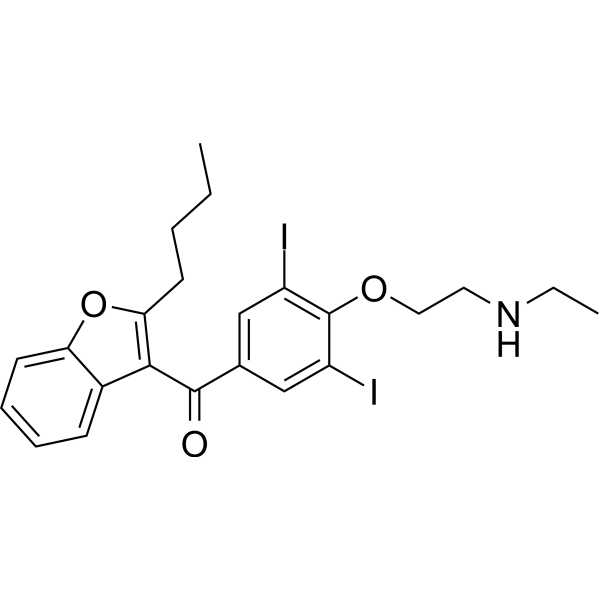
Desethylamiodarone (N-Desethylamiodarone; LB 33020) is the major active metabolite of Amiodarone (HY-14187) generated via CYP3A4 metabolism. Desethylamiodarone downregulates p‑Akt, p‑Bad and Bcl‑2, upregulates Bax, promotes mitochondrial release of cytochrome c, activates caspase‑3 and cleaves PARP‑1, thereby inducing cell cycle arrest and apoptosis. Desethylamiodarone can be used in cervical cancer-related research .
loading...
    loading...
Cat. No.: HY-174419
CAS No.: 3017240-62-6
TFSeB is an orally active neuroprotective agent. TFSeB can reduce Streptozotocin (STZ) (HY-13753) induced MAO-B and AChE activity. TFSeB exerts neuroprotective effects by increasing the expression of BCL-2, BDNF, NRF2, and decreasing the expression of BAX. TFSeB can reduce lipid peroxidation (TBARS) and reactive oxygen species (ROS) levels. TFSeB can reduce neuroinflammation. TFSeB can be used for research on Alzheimer’s disease .
loading...
    loading...
Cat. No.: HY-175848
NSC 850745 is a selective and potent c-Met/STAT3 inhibitor with IC50 values of 210 and 670 nM. NSC 850745 can inhibit cell proliferation, induce G2/M phase arrest and induce apoptosis. NSC 850745 can downregulate AKT-1, VEGF and Bcl-2 expression and upregulate p53, Bax and caspase expression. NSC 850745 can be used for the research of cancer, such as leukemia and colon cancer .
loading...
    loading...
Cat. No.: HY-P11374
Target:  

Bcl-2 Family Apoptosis

Research Areas:  

Cancer

Bid BH3-Gly-r8 is Bid BH3 linked to eight arginine residues. Bid BH3-Gly-r8 shows no difference in apoptotic effects compared to its unmodified peptide homologue. Bid BH3 has high affinity for Bax and Bcl-2. Bid BH3-Gly-r8 can be used in the research of tumors .
loading...
    loading...
Cat. No.: HY-N0361R
CAS No.: 19408-84-5
Dihydrocapsaicin (Standard) is the analytical standard of Dihydrocapsaicin. This product is intended for research and analytical applications. Dihydrocapsaicin, a capsaicin, is a potent and selective TRPV1 (transient receptor potential vanilloid channel 1) agonist. Dihydrocapsaicin reduces AIF, Bax, and Caspase-3 expressions, and increased Bcl-2, Bcl-xL and p-Akt levels. Dihydrocapsaicin enhances the hypothermia-induced neuroprotection following ischemic stroke via PI3K/Akt regulation in rat .
loading...
    loading...
Cat. No.: HY-N0882
CAS No.: 4099-30-3
Synonyms: Deacetylcinobufotalin
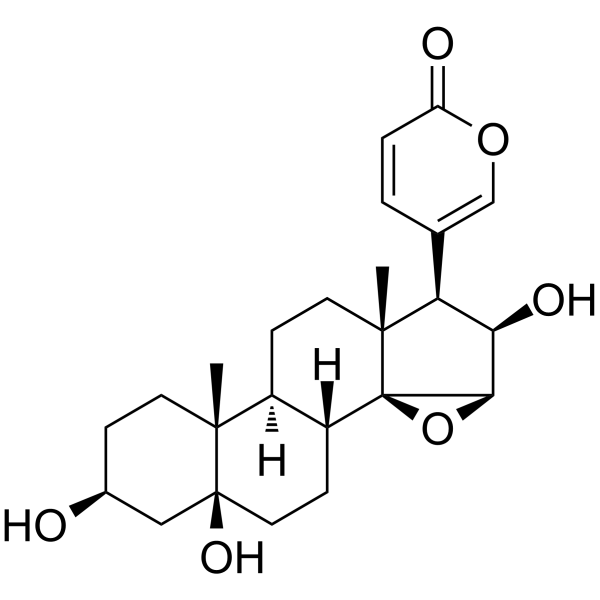
Desacetylcinobufotalin is an active component isolated from Venenum Bufonis, which exhibits significant cytotoxicity against human hepatocellular carcinoma HepG2 cells (IC50 = 0.0279 µmol/mL). Desacetylcinobufotalin upregulates Bax protein expression, downregulates Bcl-2 protein expression, and induces apoptosis via the mitochondrial pathway. Desacetylcinobufotalin inhibits cancer cell survival, and shows lower cytotoxicity compared to its parent compound Cinobufagin (HY-N0421). Desacetylcinobufotalin can be used in hepatocellular carcinoma-related research .
loading...
    loading...
Cat. No.: HY-174404
Research Areas:  

Cancer

Topoisomerase II inhibitor 23 is a potent topoisomerase II inhibitor (IC50 = 0.94 μM). Topoisomerase II inhibitor 23 shows high selectivity and exceptional cytotoxic activity in MCF-7, HepG2, and HCT116 cells. Topoisomerase II inhibitor 23 induces cell cycle arrest at the G1 phase, leading to inhibition of cell proliferation. Topoisomerase II inhibitor 2 induces apoptosis by up-regulating the pro-apoptotic Bax level and down-regulating the anti-apoptotic Bcl-2 level.
loading...
    loading...
Cat. No.: HY-175815
Research Areas:  

Cancer

Apoptosis inducer 44 is an apoptosis inducer. Apoptosis inducer 44 triggers apoptosis in MDA-MB-231 cells by increasing the levels of Bax and Cyt C, reducing Bcl-2, and initiating caspase-3 cleavage. Apoptosis inducer 44 suppresses the invasion and migration of MDA-MB-231 cells by down-regulating MMP-2 and MMP-9 expression and up-regulating E-cadherin protein levels. Apoptosis inducer 44 can be used for the study of breast cancer .
loading...
    loading...
Cat. No.: HY-189216
CAS No.: 1416344-06-3
Target:  

Bcl-2 Family Apoptosis

Research Areas:  

Cancer

BCL2/BAX modulator-1 is an orally active BCL2/BAX modulator and apoptosis inducer. BCL2/BAX modulator-1 downregulates BCL2 mRNA expression, upregulates BAX mRNA expression, and occupies the BAX trigger site. BCL2/BAX modulator-1 can be used for research on prostate adenocarcinoma, hepatocellular carcinoma, and lung adenocarcinoma .
loading...
    loading...
Cat. No.: HY-122047
CAS No.: 533876-30-1
Target:  

Autophagy

Research Areas:  

Cancer

SW063058 is an autophagy inducer that specifically disrupts the binding of Beclin 1 to Bcl-2 while leaving the interaction between Bcl-2 and pro-apoptotic members like Bax and BIM unaffected. By inhibiting the negative regulatory effects of Bcl-2 on Beclin 1, which is crucial for the initiation of autophagy, SW063058 promotes autophagic activity without triggering cytotoxicity, apoptosis, or other forms of cell death in vitro.
loading...
    loading...
Cat. No.: HY-162820
Target:  

Bcl-2 Family

Research Areas:  

Cancer

Bcl-2-IN-21 (compound C1) is an iridium compound with anticancer activity that targets and inhibits Bcl-2. Bcl-2-IN-21 inhibits colony formation of cancer cells and induces elevated levels of Bax and caspase 3 .
loading...
    loading...
Cat. No.: HY-131405
CAS No.: 544-73-0
Target:  

Apoptosis Bcl-2 Family

Research Areas:  

Cancer

β-Eleostearic acid is an apoptosis inducer with antiproliferative properties. β-Eleostearic acid down-regulates and up-regulates the mRNA levels of Bcl-2 and Bax, respectively .
loading...
    loading...
Cat. No.: HY-175588
Research Areas:  

Cancer

EGFR-IN-170 (Compound 5c) is an EGFR inhibitor with an IC50 of 5.17 μM. EGFR-IN-170 induces apoptosis by inhibiting Bcl2 expression and activating Bax expression with a significantly increased ratio of Bax/Bcl2. EGFR-IN-170 has potent anticancer activity and inhibits the cell growth of resistant lung cancer cells .
loading...
    loading...
Cat. No.: HY-101999
CAS No.: 141266-44-6
Research Areas:  

Cancer

EM20-25 is an inhibitor for Bcl-2, which interferes with the interaction between BCL-2 and BAX, activates caspase-9 and thus induces the apoptosis. EM20-25 affects the mitochondrial function, causes the open of permeability transition pore (PTP). EM20-25 enhances the sensitivity of cells to Staurosporine (HY-15141), and enhances the killing effect of BCL-2-expressing leukemia cells to Chlorambucil (HY-13593) and Fludarabine (HY-B0069) .
loading...
    loading...

