1018 Results for "

detection

" in MedChemExpress (MCE) Product Catalog:
Products (1018)

1018 Results for "detection" in MCE Product Catalog:

Cat. No.: HY-P990836

Target:  

Interleukin Related

Research Areas:  

Inflammation/Immunology

Anti-IL-9 Antibody (MH9A4) is a kind of mouse IgG2b κ chimeric antibody inhibitor, targeting to human IL-9. Anti-IL-9 Antibody (MH9A4) reacts with human IL-9 (interleukin-9) and does not block the binding of IL-9 to the IL-9 receptor. Anti-IL-9 Antibody (MH9A4) can be used for the detection of flow cytometry and ELISA .
loading...
    loading...
Cat. No.: HY-P990873

Target:  

DNA/RNA Synthesis

Research Areas:  

Cancer

Anti-BRCA1 Antibody (BR64) is a kind of mouse IgG1 κ chimeric antibody, targeting to human BRCA1. Anti-BRCA1 Antibody (BR64) reacts with BRCA1 (Breast cancer susceptibility gene 1) involved in tumor suppression, transcription, genomic stability, DNA repair and recombination. Anti-BRCA1 Antibody (BR64) can be used for the detections of immunofluorescence, western blot, and immunoprecipitation in cancer, such as breast and ovarian cancer .
loading...
    loading...
Cat. No.: HY-W007337
CAS No.: 627-18-9
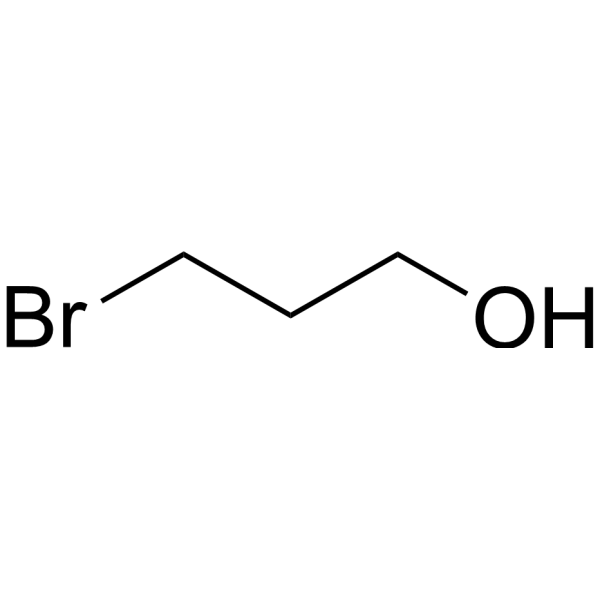
3-Bromopropan-1-ol is an endogenous metabolite. 3-Bromopropan-1-ol is significantly up-regulated during the estrous period of buffaloes. 3-Bromopropan-1-ol acts as an alkylating agent . 3-Bromopropan-1-ol participates in the enantioselective synthesis of nornicotine enantiomers. 3-Bromopropan-1-ol can be used in studies related to estrus detection in buffaloes .
loading...
    loading...
Cat. No.: HY-W012683
CAS No.: 142-73-4
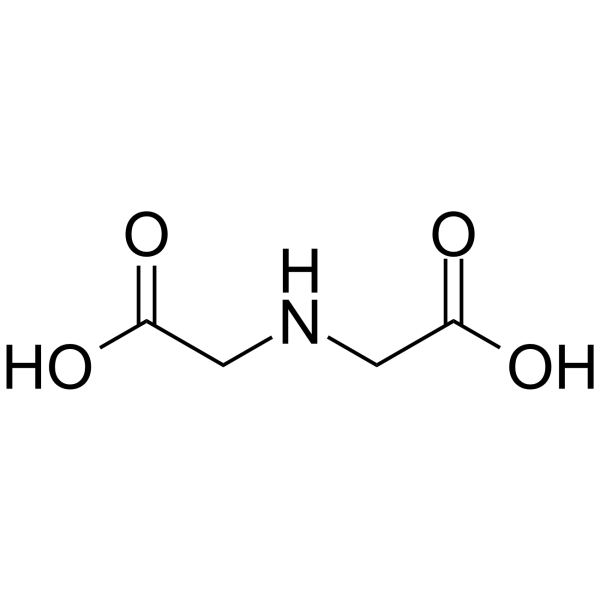
Iminodiacetic acid is a metal ion chelator targeting Cr 6+, Cd 2+, Ni 2+, and Pb 2+. Iminodiacetic acid selectively and irreversibly binds metal ions through the coordination of carboxyl and imino groups, reduces the toxicity of metal ions and promotes their adsorption and separation. Iminodiacetic acid has the functions of heavy metal ion removal and coordination complex stabilization. Iminodiacetic acid is often used in environmental pollution control (such as heavy metal adsorption in water) and coordination chemistry (such as metal ion detection and separation) research .
loading...
    loading...
Cat. No.: HY-W012683R
CAS No.: 142-73-4
Iminodiacetic acid is a metal ion chelator targeting Cr6+, Cd2+, Ni2+, and Pb2+. Iminodiacetic acid selectively and irreversibly binds metal ions through the coordination of carboxyl and imino groups, reduces the toxicity of metal ions and promotes their adsorption and separation. Iminodiacetic acid has the functions of heavy metal ion removal and coordination complex stabilization. Iminodiacetic acid is often used in environmental pollution control (such as heavy metal adsorption in water) and coordination chemistry (such as metal ion detection and separation) research .
loading...
    loading...
Cat. No.: HY-W112090
CAS No.: 72076-09-6
Synonyms: PdTFPP; 5,10,15,20-Tetrakis(pentafluorophenyl)-21H,23H-porphine palladium(II)
Target:  

Fluorescent Dye

Research Areas:  

Others

Palladium meso-tetra(pentafluorophenyl)porphyrin (PdTFPP) derives from palladium(II), acting as a fluorescence-quenched optical probe and high-performance oxygen concentration sensor with outstanding photostability and antioxidant capacity. Palladium meso-tetra(pentafluorophenyl)porphyrin exhibits reduced luminescence intensity as dissolved oxygen concentration rises. Palladium meso-tetra(pentafluorophenyl)porphyrin can be applied for real-time monitoring of live-cell respiration, hypoxic tissue imaging, and nanofibrous organic semiconductors in photodetectors for ambient oxygen detection .
loading...
    loading...
Cat. No.: HY-W250306
CAS No.: 4197-24-4
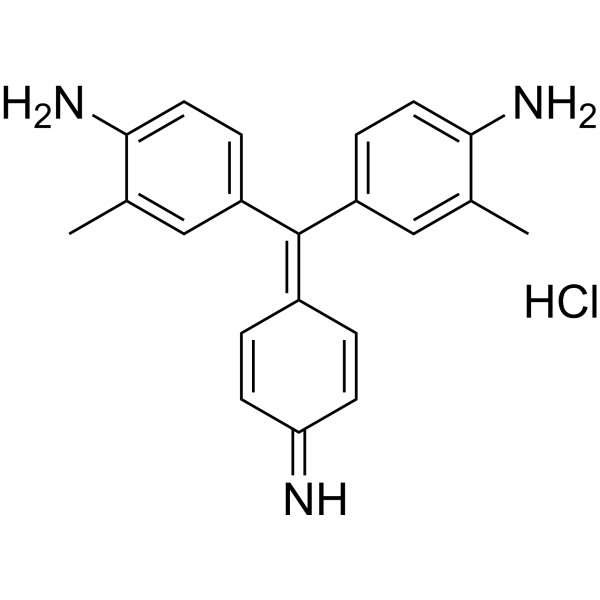
Carbol fuchsin is a histological stain used in microbiology to distinguish acid-fast bacteria from non-acid-fast bacteria. It is a mixture of basic fuchsin, phenol, and water and is commonly used in the Ziehl-Neelsen staining technique for the detection of tuberculosis and other mycobacterial infections. Carbol fuchsin stains the cell walls of acid-fast bacteria bright red, while other cells are unstained or slightly stained. This makes it easier to see and identify these microbes under a microscope. Carbol fuchsin is also used in veterinary medicine and phytopathology for similar purposes.
loading...
    loading...
Cat. No.: HY-W750960
CAS No.: 1377605-22-5
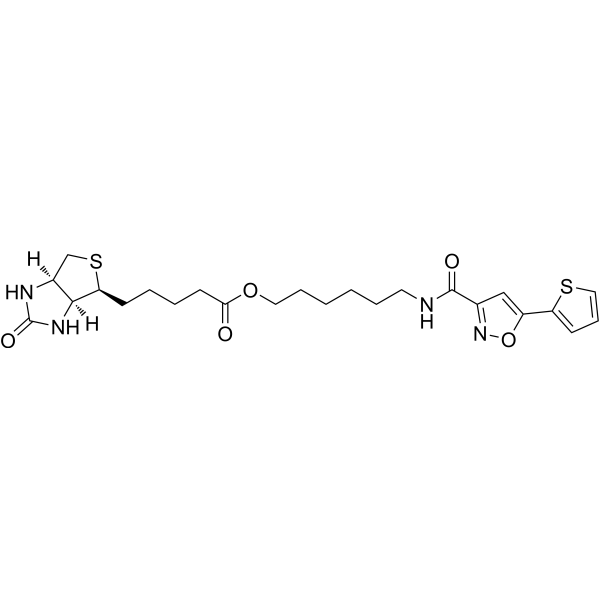
Biotinylated isoxazole is a chemical probe that selectively precipitates proteins containing prion-like low-complexity domains and Cross-β prion-like polymers through recognition of Cross-β structure. Biotinylated isoxazole induces precipitation of proteins containing intrinsically disordered regions through microcrystal formation in solution. Biotinylated isoxazole enables enrichment of Amyloid oligomers for ELISA-based detection. Biotinylated isoxazole decreases Gems and increases misfolded PFN1 aggregates .
loading...
    loading...
Cat. No.: HY-D3133
CAS No.: 2410296-16-9
Target:  

Fluorescent Dye

Research Areas:  

Others

HS-CyBz is a Fluorescent probe for H₂S detection, enabling ratiometric optical/photoacoustic dual-modality in/ex vivo imaging. Its detection mechanism relies on nucleophilic substitution of its benzoic ester group by HS⁻, which releases an enolic meso-hydroxyltricarboheptamethine cyanine that then undergoes keto-enol tautomerization to form Cy-ketone; this tautomerization causes distinct shifts in absorption and emission spectra, producing a ratiometric response that reduces interferences from tissue scattering, autofluorescence, and probe concentration. In its initial state, HS-CyBz has an excitation wavelength of 595 nm, with emission bands centered at 805 nm (main) and 630 nm (minor); upon reaction with H₂S, the 805 nm emission band decreases while the 630 nm band drastically increases, and its absorption spectrum shows a sharp band at 775 nm and a shoulder band at 708 nm, which decrease upon H₂S reaction with a minor increase at 850 nm and an isosbestic point at 825 nm. For in vivo optical imaging, excitation at 560 nm is used with emission channels at 620 nm and 790 nm, while in vivo photoacoustic imaging uses excitation at 775 nm and 825 nm. The detection limit of HS-CyBz for H₂S is 0.5 μM, and it shows high selectivity, with only H₂S inducing a distinct enhancement of the emission ratio F₆₃₀/F₈₀₅ and PA ratio PA₈₂₅/PA₇₇₅, while other biochemical species including cations, anions, reactive oxygen species, biothiols, and carboxylesterase trigger only minor changes and do not interfere with H₂S sensing. Tail intravenous injection of HS-CyBz leads to accumulation in the liver of mice, and it can be used to verify endogenous H₂S upregulation triggered by S-adenosyl-L-methionine via ratiometric optical/photoacoustic imaging .
loading...
    loading...
Cat. No.: HY-120512
CAS No.: 13159-16-5
5-Phenyl-4E-pentenol is a product of the peroxidase-catalyzed reduction of PPHP. 5-Phenyl-4E-pentenol can be rapidly isolated by solid phase extraction and quantified by isocratic reversed-phase high performance liquid chromatography (HPLC) with UV detection. 5-Phenyl-4E-pentenol is a fluorescent dye that can be used to determine the kinetic properties of heme-containing and non-heme peroxidases and to evaluate the ability of oxidative compounds to serve as substrates for peroxidase reduction. .
loading...
    loading...
Cat. No.: HY-145769
CAS No.: 2547100-02-5
Target:  

PD-1/PD-L1

Research Areas:  

Cancer

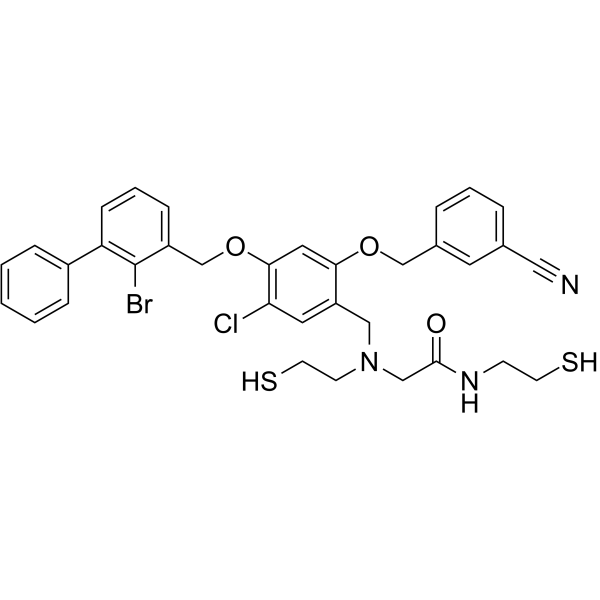
N2S2-CBMBC, an N2S2 bromo-benzyl ether derivative, acts as a ligand and use 99mTc-labelled complexes 99mTc-N2S2-CBMBC can be used as an imaging agent to be applied to the aspect of detecting PD-L1 expression, realize the real-time, comprehensive and convenient detection of the PD-L1 level of tumors, and overcome the defects of an immunohistochemical method .
loading...
    loading...
Cat. No.: HY-15930R
CAS No.: 54827-17-7
Synonyms: BM blue (Standard); Sure Blue TMB (Standard)
TMB (Standard) is the analytical standard of TMB. This product is intended for research and analytical applications. TMB is a non-toxic, non-mutagenic, colorless dye that is also used as a chromogenic agent in enzyme detection systems based on horseradish peroxidase (HRP). TMB can function as a photoacoustic probe for reactive oxygen and nitrogen species (ROS/RNS), reacting with hypochlorite, hydrogen peroxide, singlet oxygen, and nitrogen dioxide to produce blue oxidation products. TMB can detect the singlet oxygen produced by the outer membrane of Escherichia coli ATCC 25922 .
loading...
    loading...
Cat. No.: HY-185414
CAS No.: 2724919-70-2
Research Areas:  

Others

KB05-Biotin is streptavidin-conjugated KB05 (HY-149461) that retains the site-specific cysteine covalent reactivity of KB05, enabling specific detection of target proteins via the biotin-streptavidin system. KB05-Biotin serves as a site-specific probe in ELISA-ABPP assays for screening electrophilic small molecules that bind to scout fragment-sensitive cysteines on target proteins in cell lysates, without the need for protein purification .
loading...
    loading...
Cat. No.: HY-D0027
CAS No.: 26093-31-2
Synonyms: Coumarin 120; AMC
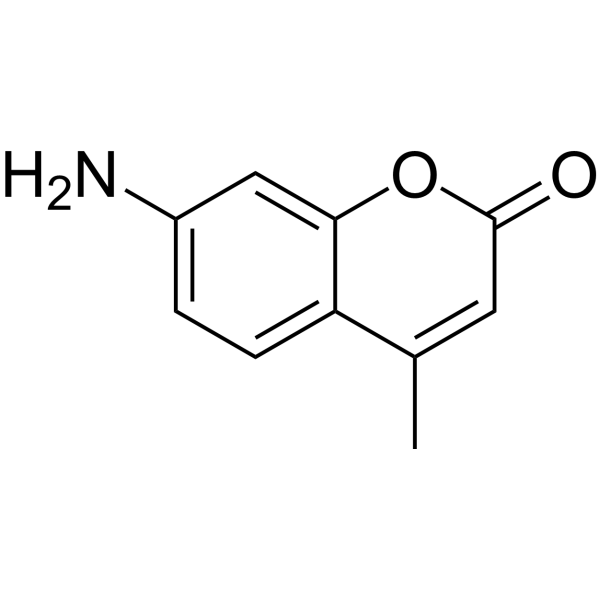
7-Amino-4-methylcoumarin belongs to the coumarin class, can be isolated from the endophytic fungus Xylaria sp. and has a broad spectrum of antibacterial activity. 7-Amino-4-methylcoumarin is also commonly used as an important laser dye that emits in the blue region, capable of analyzing glycoprotein monosaccharides and N-linked oligosaccharides, and is also utilized in tissue pathology analysis, enzyme activity measurement, and copper ion detection. The excitation wavelength and emission wavelength are 351 nm and 430 nm, respectively.
loading...
    loading...
Cat. No.: HY-D1759
Target:  

Fluorescent Dye

Research Areas:  

Others

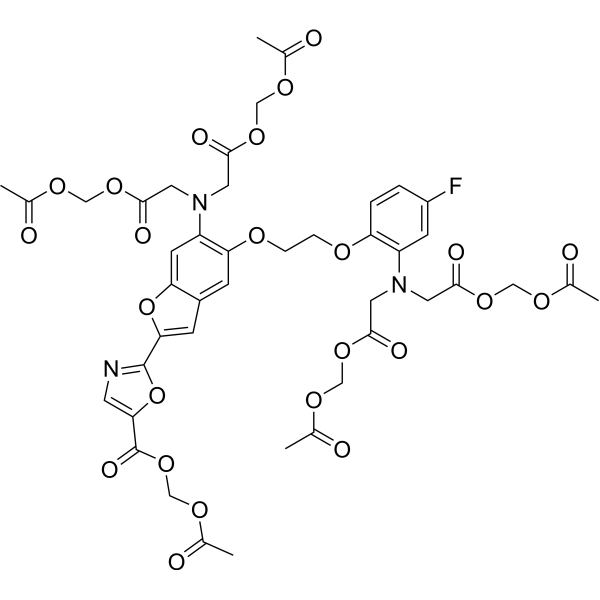
Fura-4F AM is a fluorescent dye used for detecting intracellular free calcium concentration ([Ca 2+]ᵢ). Fura-4F AM is cell membrane-permeable; after entering cells, it is hydrolyzed by intracellular esterases to form Fura-4F, and reflects changes in intracellular Ca 2+ concentration through Ca 2+ binding-dependent fluorescence changes, making it suitable for rapid detection of high-concentration Ca 2+ signals (Ex = 385 nm) .
loading...
    loading...
Cat. No.: HY-D2970
Golgi-P is a near-infrared Golgi-targeted fluorescent probe specifically used for the detection of Golgi polarity in living cells and living tissues. Golgi-P exhibits a significant polarity-dependent spectral behavior, with its emission wavelength shifting redward with polarity (Ex/Em: 700 nm/780-825 nm). Golgi-P achieves near-infrared fluorescence imaging directly in the brain tissue of depressed mice. Golgi-P combines polarity sensing with Golgi-targeting functionality, providing a new tool for the molecular diagnosis of depression .
loading...
    loading...
Cat. No.: HY-D3124
Target:  

Fluorescent Dye

Research Areas:  

Others

Gol-SiRhoNox is a Golgi apparatus-targeted fluorescent probe with high selectivity for Fe (II), with a limit of detection of 50 nM. Gol-SiRhoNox integrates a myristoyl motif for Golgi apparatus targeting and a silicon-fused rhodamine N-oxide as the Fe (II)-sensitive moiety. Gol-SiRhoNox is non-fluorescent in its native state; Fe (II)-mediated deoxygenation of the N-oxide triggers fluorescence recovery. Its fluorescent product, Gol-SiR, has excitation/emission wavelengths of 630/665 nm and a maximum absorption wavelength of 655 nm .
loading...
    loading...
Cat. No.: HY-D3136
Target:  

Fluorescent Dye

Research Areas:  

Cancer

MC-PSE is a fluorescent probe that can be used for glutathione (GSH) detection, NIR-II fluorescence imaging and ratiometric photoacoustic imaging. MC-PSE spontaneously forms J-aggregates in aqueous solution through π-π stacking, and its phenylselenyl group acts as a fluorescence quencher and GSH recognition receptor, thereby eliminating intrinsic fluorescence and generating a maximum absorption peak at 1000 nm. The excitation/emission wavelengths of MC-PSE are Ex = 808 nm and Em = 940 nm. MC-PSE can be applied in tumor-related research .
loading...
    loading...
Cat. No.: HY-D3269
CAS No.: 2088127-60-8
Mito-Cu (II) is a mitochondria-targeted fluorescent probe (Ex/Em = 370/450 nM). Mito-Cu (II) specifically accumulates in mitochondria of living cells and enables real-time detection of exogenous Cu 2+ within mitochondria of living cells. Mito-Cu (II) achieves "on-off-on" fluorescence switching through sequential exposure to Cu 2+ and ethylenediaminetetraacetic acid (EDTA) (HY-Y0682). Its fluorescence is quenched after forming a 1:1 complex with Cu 2+, and the fluorescence recovers when Cu 2+ is chelated by EDTA .
loading...
    loading...
Cat. No.: HY-D3405
CAS No.: 173357-16-9
BO-TAP-3 is an orange fluorescent carbocyanine monomer dye, and it is also a cell impermeable nucleic acid staining agent. When there is no nucleic acid present, BO-TAP-3 shows a non-fluorescent state. However, when it binds to double-stranded DNA, it exhibits multiple fluorescence enhancement effects. BO-TAP-3 can be used for cell nucleus and cytoplasm imaging, bacterial and sperm labeling, and can also be applied in nucleic acid detection and amplification research. It can also be used as a temperature sensor (Ex/Em = 564/600 nM).
loading...
    loading...

