
134 Results for "

diffuse large B cell lymphoma

" in MedChemExpress (MCE) Product Catalog:
Products (134)

134 Results for "diffuse large B cell lymphoma" in MCE Product Catalog:

Cat. No.: HY-180886
Research Areas:  

Cancer

ZD-1-186 is a non-degradative, covalent-dependent molecular glue that targets BCL6 and BRD9. ZD-1-186 inhibits the transcriptional output of MYC, relieves the repression of canonical BCL6 target loci (including CDKN1A (p21)), and mediates the selective recruitment of BRD9 to BCL6. ZD-1-186 can be used for research on diffuse large B-cell lymphoma .
loading...
    loading...
Cat. No.: HY-10293R
CAS No.: 791828-58-5
Synonyms: INCB007839 (Standard); INCB7839 (Standard)
Target:  

Reference Standards MMP

Research Areas:  

Cancer

Aderbasib (Standard) is the analytical standard of Aderbasib (HY-10293). This product is intended for research and analytical applications. Aderbasib (INCB007839) is a potent, orally active and target specific low nanomolar hydroxamate-based inhibitor of ADAM10 and ADAM17. Aderbasib exhibits robust antineoplastic activity and can be used for cancer research, including diffuse large B-cell non-Hodgkin lymphoma, HER2+ breast cancer, gliomas, et al .
loading...
    loading...
Cat. No.: HY-189422
Research Areas:  

Cancer

CDK9/EZH2-IN-2 is a potent dual CDK9 and EZH2 inhibitor with an IC50 of 8.9 nM against EZH2. CDK9/EZH2-IN-2 inhibits anti-apoptotic proteins and induces DNA damage by blocking the activity of CDK9 and EZH2, ultimately leading to tumor cell apoptosis. CDK9/EZH2-IN-2 can be used for research on diffuse large B-cell lymphoma .
loading...
    loading...
Cat. No.: HY-182009
CAS No.: 3038316-36-5
DNMT-IN-6 is a DNA methyltransferase inhibitor with activity against DNMT1, DNMT3A, and DNMT3B. DNMT-IN-6 drives demethylation, and restores TMS1 tumor suppressor gene expression. DNMT-IN-6 induces apoptosis, causes G2/M phase arrest, disrupts mitochondrial integrity, and activates the intrinsic caspase cascade (3/7/9). DNMT-IN-6 inhibits tumor growth, and improves survival in xenograft models. DNMT-IN-6 can be used for the research of cancer, such as diffuse large B-cell lymphoma .
loading...
    loading...
Cat. No.: HY-175002
CAS No.: 3051829-20-7
Target:  

PI3K Akt Apoptosis

Research Areas:  

Cancer

PI3Kδ-IN-24 is a selective PI3Kδ inhibitor (IC50 = 0.1 nM). PI3Kδ-IN-24 exhibits significant antiproliferative effects against PI3Kδ-overexpressing cancer cell lines. PI3Kδ-IN-24 reduces p-AKT levels and induces cell cycle arrest and apoptosis in tumor cells. PI3Kδ-IN-24 is useful in cancer research, such as diffuse large B-cell lymphoma (DLBCL) .
loading...
    loading...
Cat. No.: HY-189455
CAS No.: 3094127-54-2
Research Areas:  

Cancer

USP1-IN-20 is an orally effective and selective USP1 inhibitor with an IC50 of 3.0 nM. USP1-IN-20 inhibits the USP1-UAF1 complex, leading to the accumulation of Ub-PCNA, which in turn induces DNA damage and G2/M phase arrest, while simultaneously promoting the degradation of the oncogenic protein c-MYC. USP1-IN-20 can be used for research on breast cancer and diffuse large B-cell lymphoma .
loading...
    loading...
Cat. No.: HY-177730
Research Areas:  

Cancer

PROTAC BRD4 Degrader-40 is a BRD4 PROTAC degrader. PROTAC BRD4 Degrader-40 binds to Cereblon and recruits the CRL4 CRBN E3 ubiquitin ligase complex, mediates BRD4 degradation via the ubiquitin-proteasome pathway, and does not induce the degradation of classic CRBN neo-substrates IKZF1 and IKZF3. PROTAC BRD4 Degrader-40 induces BRD4 degradation in cancer cells. PROTAC BRD4 Degrader-40 can be used in research related to diffuse large B-cell lymphoma and acute myeloid leukemia .
loading...
    loading...
Cat. No.: HY-150105
CAS No.: 2448172-22-1
Purity:  98.72%
Synonyms: BMF-219; Menin-MLL inhibitor 21
Icovamenib (BMF-219) is a selective, orally active, irreversible Menin inhibitor. Icovamenib forms a stable and irreversible covalent bond with Menin. Icovamenib promotes selective and controlled proliferation of beta cells and improvement of beta cell function in ex vivo human islet cultures. Icovamenib enhances glycemic control in animal diabetic models. Icovamenib induces a dose-dependent enhancement in insulin secretion potentiated by the GLP-1 RA. Icovamenib can be used for the study of multiple hematologic malignancies, solid tumors, and diabetes mellitus, such as diffuse large B-cell lymphoma (DLBCL), multiple myeloma (MM) and chronic lymphocytic leukemia and type 2 diabetes .
loading...
    loading...
Cat. No.: HY-168614
CAS No.: 2991817-99-1
Research Areas:  

Cancer

MGD-4 is an orally active cereblon-dependent molecular glue degrader with a phthalazinone scaffold. MGD-4 degrades the Ikaros family proteins IKZF1, IKZF2 and IKZF3 in a dose-dependent manner, with DC50 values of 67.2 nM, 918.2 nM and 95.8 nM, respectively. MGD-4 exhibits weak degradation activity against CK1α. MGD-4 inhibits the viability of multiple myeloma (MM) and acute myeloid leukemia (AML) cells and induces cell apoptosis. MGD-4 is used for the research of multiple myeloma, acute myeloid leukemia, diffuse large B-cell lymphoma and related hematological malignancies .
loading...
    loading...
Cat. No.: HY-P990033
CAS No.: 2543693-10-1
Synonyms: CC-95251; BMS-986351

Target:  

CD47

Research Areas:  

Cancer

Anzurstobart (CC-95251; BMS-986351) is a CD47/SIRPα inhibitor with human SIRPα Kd of 0.0541 nM and human SIRPα IC50 of 100 nM. Anzurstobart binds SIRPα at a CD47-overlapping site, blocks CD47-SIRPα interactions, inhibits CD47-SIRPα axis signaling, and binds across 6 prevalent human SIRPα haplotypes. Anzurstobart binds SIRPγ and inhibits CD47-SIRPγ interactions. Anzurstobart can be used for the research of non-Hodgkin's lymphoma, colorectal cancer, squamous cell carcinoma of the head and neck, diffuse large B-cell lymphoma, and advanced solid and hematologic malignancies .
loading...
    loading...
Cat. No.: HY-111101R
CAS No.: 2196204-23-4
Research Areas:  

Cancer

AZ1495 (Standard) is the analytical standard of AZ1495 (HY-111101). This product is intended for research and analytical applications. AZ1495, a weak base, is a potent orally active interleuKin-1 receptor associated Kinase 4 (IRAK4) inhibitor. AZ1495 has a favorable physicochemical and Kinase selectivity for IRAK4 and IRAK1 with IC50 values of 0.005 μM and 0.023 μM, respectively. AZ1495 has IRAK4 inhibition with a Kd value of 0.0007 μM. AZ1495 can be used for the research of diffuse large B-cell lymphoma (DLBCL) .
loading...
    loading...
Cat. No.: HY-178777
CAS No.: 3084696-50-1
Target:  

PROTACs BCL6

Research Areas:  

Cancer

BCL6-760 is an orally active BCL-6 PROTAC degrader with an EC50 of 0.8 nM. BCL6-760 only degrades BCL6 and has no effect on other CRBN substrates. BCL6-760 demonstrates significant efficacy in the orthotopic xenograft mouse model of OCI-LY-1 tumors. BCL6-760 can be used in the research of diffuse Large B-cell Lymphoma (DLBCL) (Pink: BCL-6 ligand (HY-179317); Blue: CRBN ligand (HY-179305); Black: Linker) .
loading...
    loading...
Cat. No.: HY-176701
CAS No.: 3025838-18-7
Research Areas:  

Cancer

PRMT5-MTA-IN-4 (Compound 30) is a potent irreversible protein arginine methyltransferase 5 (PRMT5) inhibitor (IC50=8 nM). PRMT5-MTA-IN-4 blocks arginine methylation, inhibiting ribosomal RNA processing and cell cycle-related protein expression. PRMT5-MTA-IN-4 exhibits antiproliferative activity in multiple tumor cell lines (e.g., IC50=0.3 μM in DLD-1 cells). PRMT5-MTA-IN-4 is promising for research of hematological malignancies, such as acute myeloid leukemia, diffuse large B-cell lymphoma .
loading...
    loading...
Cat. No.: HY-175502
CAS No.: 2991818-12-1
Research Areas:  

Cancer

MGD-22, a molecular glue, is an orally active IKZF1/2/3 degrader with DC50 values of 8.33 nM, 9.91 nM, and 5.74 nM, respectively. MGD-22 exhibits extremely potent anti-proliferative activity against diverse hematological cancer cells. MGD-22 induces apoptosis in cancer cells. MGD-22 demonstrates potent anti-tumor efficacy in mice bearing NCI-H929 xenografts or WSU-DLCL-2 xenografts. MGD-22 can be used for the study of hematological cancers, including multiple myeloma (MM), acute myeloid leukemia (AML), and diffuse large B-cell lymphoma (DLBCL) .
loading...
    loading...
Cat. No.: HY-P11280A
Target:  

Melanocortin Receptor

Research Areas:  

Cancer

PRAME peptide (425-433) acetate is a proteasome-degraded peptide derived from the cancer-testis antigen PRAME (Preferentially Expressed Antigen in Melanoma). PRAME peptide (425-433) acetate is restricted by HLA-A*02:01 and can serve as a target for bispecific T cell engager therapy in the context of major histocompatibility complex I presentation. PRAME peptide (425-433) acetate shows application potential in various malignant tumors and is widely suitable for research related to solid tumors, melanoma, ovarian cancer, endometrial cancer, and lung cancer (including lung adenocarcinoma and lung squamous cell carcinoma). PRAME peptide (425-433) acetate can be used to explore disease of triple-negative breast cancer, diffuse large B-cell lymphoma, and head and neck squamous cell carcinoma .
loading...
    loading...
Cat. No.: HY-168615
CAS No.: 2991818-13-2
Research Areas:  

Cancer

MGD-28 is an orally effective cereblon-dependent molecular glue degrader that potently degrades CK1α, IKZF1, IKZF2, and IKZF3, with respective DC50 values of 7.8, 3.8, 56.3, and 7.1 nM. MGD-28 also induces the degradation of multiple novel substrate proteins including ZFP91, DTWD1, ZNFX1, MBD1, and MBD3 via a CRBN/Cullin- and proteasome-dependent mechanism. MGD-28 induces cell apoptosis. MGD-28 is used in the research of multiple myeloma, acute myeloid leukemia, diffuse large B-cell lymphoma, and related malignancies .
loading...
    loading...
Cat. No.: HY-179077
CAS No.: 2416130-49-7
Research Areas:  

Cancer

PROTAC BTK/IKZF1/3 Degrader-1 is an orally active PROTAC-IMiD bifunctional protein degrader that selectively degrades BTK, IKZF1 and IKZF3. PROTAC BTK/IKZF1/3 Degrader-1 recruits the CRBN E3 ubiquitin ligase to form a ternary complex, mediating ubiquitination and proteasome-dependent degradation of target proteins, with no obvious degrading effect on GSPT1. PROTAC BTK/IKZF1/3 Degrader-1 inhibits cancer cell proliferation, induces cancer cell apoptosis, and suppresses tumor growth. PROTAC BTK/IKZF1/3 Degrader-1 can be used for the research of diffuse large B-cell lymphoma .
loading...
    loading...
Cat. No.: HY-182671
CAS No.: 2409965-28-0
Target:  

PI3K Btk Apoptosis

Research Areas:  

Cancer

SRX3305 is an BTK/PI3K/BRD4 inhibitor with IC50s of 6.5 nM, 15 nM, and 4 nM toward BTK, PI3Kɑ and PI3Kδ, respectively. SRX3305 attenuates chronic lymphocytic leukemia (CLL) and mantle cell lymphoma (MCL) cell proliferation and promotes apoptosis in a dose-dependent fashion. SRX3305 yields potent anti-tumor effects but spares healthy bystander cells. SRX3305 inhibits the activation-induced proliferation of primary CLL cells in vitro and effectively blocks microenvironment-mediated survival signals. SRX3305 blocks CLL cell migration toward CXCL-12 and CXCL-13. SRX3305 maintains its anti-tumor effects in Ibrutinib (HY-10997)-resistant CLL cells. SRX3305 can be used for research in CLL, diffuse large B-cell lymphoma (DLBCL) and MCL .
loading...
    loading...
Cat. No.: HY-187629
CAS No.: 2202678-04-2
Research Areas:  

Cancer

HH2853 is an orally active EZH1/EZH2 inhibitor, with an IC50 of 9.26 nM for EZH1 and IC50 values ranging from 2.21 to 3.75 nM for both wild-type and mutant EZH2 . HH2853 simultaneously inhibits the methyltransferase activities of EZH1 and EZH2, blocks the compensatory pathway that arises following EZH2 inhibition, and reduces H3K27me3 levels. HH2853 upregulates the expression of c-Myc and TfR-1 to induce intracellular iron accumulation, and stabilizes GPX4 via HSPA5 to suppress ferroptosis. HH2853 combined with Erastin (HY-15763) synergistically inhibits EZH2 wild-type DLBCL cell proliferation. HH2853 alone shows weak activity against EZH2 wild-type DLBCL and is well tolerated. HH2853 is applicable for research related to diffuse large B-cell lymphoma, non-Hodgkin's lymphoma, epithelioid sarcoma, and follicular lymphoma .
loading...
    loading...
Cat. No.: HY-149924
CAS No.: 3033993-13-1
Purity:  95.87%
Target:  

PROTACs IAP Apoptosis

Research Areas:  

Cancer

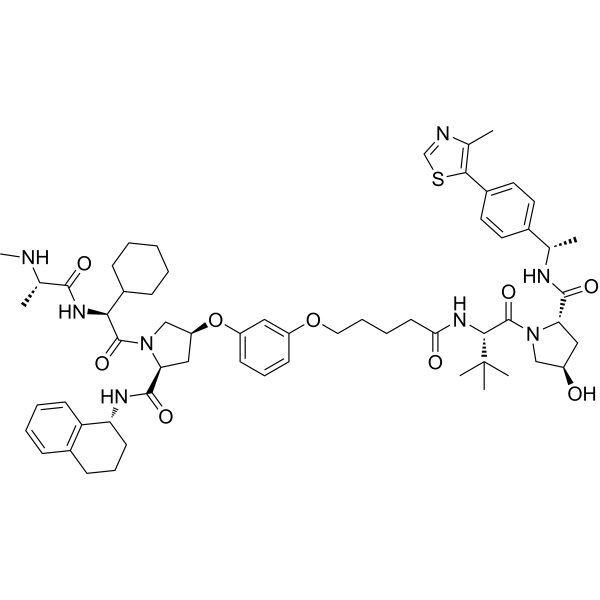
CST626 is a PROTAC degrader targeting IAP, with DC50 values of 0.7 nM, 2.4 nM and 6.2 nM against XIAP, cIAP1 and cIAP2, respectively. This compound recruits the VHL E3 ubiquitin ligase to form a heterotrimeric complex, thereby inducing ubiquitination and proteasomal degradation of the target proteins. CST626 also exhibits certain degrading activity against VHL30 and VHL19. CST626 inhibits the proliferation and induces apoptosis of various hematologic tumor cell lines, and its anti-tumor effect is further enhanced when used in combination with TNF-α. CST626 can be used in research related to multiple myeloma, acute myeloid leukemia and diffuse large B-cell lymphoma .
loading...
    loading...

