



CST626

Based on 1 Customer Validation
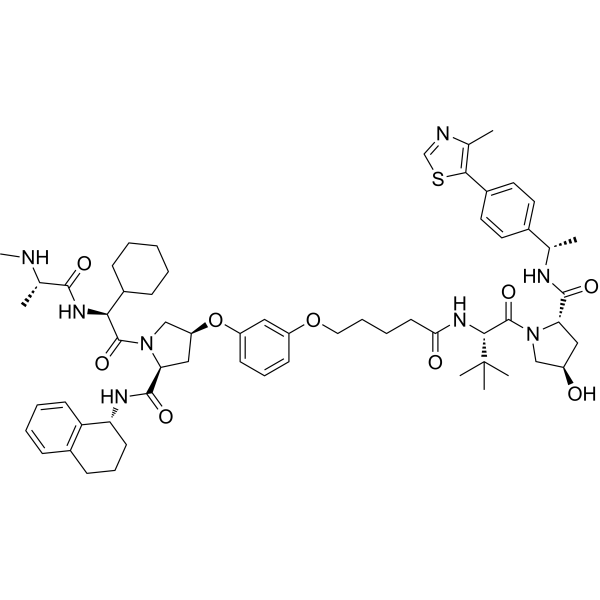
CST626 is a PROTAC degrader targeting IAP, with DC50 values of 0.7 nM, 2.4 nM and 6.2 nM against XIAP, cIAP1 and cIAP2, respectively. This compound recruits the VHL E3 ubiquitin ligase to form a heterotrimeric complex, thereby inducing ubiquitination and proteasomal degradation of the target proteins. CST626 also exhibits certain degrading activity against VHL30 and VHL19. CST626 inhibits the proliferation and induces apoptosis of various hematologic tumor cell lines, and its anti-tumor effect is further enhanced when used in combination with TNF-α. CST626 can be used in research related to multiple myeloma, acute myeloid leukemia and diffuse large B-cell lymphoma.
(Pink: IAP and XIAP ligand (HY-175925); Blue: VHL ligand (HY-112078); Black: linker).
For research use only. We do not sell to patients.
- Purity : 99.60%
- CAS No.: 3033993-13-1
- Formula: C61H82N8O9S
- Molecular Weight:1103.42
-
Storage:Powder -20°C, 3 years , 4°C, 2 years ; In solvent -80°C, 6 months , -20°C, 1 month

To place orders, for customer services and technical support, please contact: MedChemExpress USA
Tel: 609-228-6898 E-mail: [email protected] [email protected]


-
 Biological Activity
-
Chemical Information
-
Solvent & Solubility
- Protocols
- Purity & Documentation
- References
-
 Help & FAQs


All PROTACs Isoforms
More

Biological Activity
Description
IC50 & Target
[1]|
XIAP 0.7 nM (EC50) |
cIAP1 2.4 nM (EC50) |
cIAP2 6.2 nM (EC50) |
VHL30 |
VHL19 |
Cellular Effect
|
Cell Line

|
Type | Value | Description | References |
|---|---|---|---|---|
| DB | IC50 |
0.46 μM
Compound: 9; CST626
|
Cytotoxicity against human DB cells assessed as reduction in cell viability measured after 96 hrs in presence of TNF-alpha by CellTiter-Glo luminescent assay
Cytotoxicity against human DB cells assessed as reduction in cell viability measured after 96 hrs in presence of TNF-alpha by CellTiter-Glo luminescent assay
|
[PMID: 36996313] |
| HEL | IC50 |
1.17 μM
Compound: 9; CST626
|
Cytotoxicity against human HEL cells assessed as reduction in cell viability measured after 96 hrs in presence of TNF-alpha by CellTiter-Glo luminescent assay
Cytotoxicity against human HEL cells assessed as reduction in cell viability measured after 96 hrs in presence of TNF-alpha by CellTiter-Glo luminescent assay
|
[PMID: 36996313] |
| JJN-3 | IC50 |
1.14 μM
Compound: 9; CST626
|
Cytotoxicity against human JJN-3 cells assessed as reduction in cell viability measured after 96 hrs in presence of TNF-alpha by CellTiter-Glo luminescent assay
Cytotoxicity against human JJN-3 cells assessed as reduction in cell viability measured after 96 hrs in presence of TNF-alpha by CellTiter-Glo luminescent assay
|
[PMID: 36996313] |
| K562 | IC50 |
0.42 μM
Compound: 9; CST626
|
Cytotoxicity against human K562 cells assessed as reduction in cell viability measured after 96 hrs in presence of TNF-alpha by CellTiter-Glo luminescent assay
Cytotoxicity against human K562 cells assessed as reduction in cell viability measured after 96 hrs in presence of TNF-alpha by CellTiter-Glo luminescent assay
|
[PMID: 36996313] |
| MOLM-13 | IC50 |
0.002 μM
Compound: 9; CST626
|
Cytotoxicity against human MOLM-13 cells assessed as reduction in cell viability measured after 96 hrs in presence of TNF-alpha by CellTiter-Glo luminescent assay
Cytotoxicity against human MOLM-13 cells assessed as reduction in cell viability measured after 96 hrs in presence of TNF-alpha by CellTiter-Glo luminescent assay
|
[PMID: 36996313] |
| NCI-H929 | IC50 |
0.008 μM
Compound: 9; CST626
|
Cytotoxicity against human NCI-H929 cells assessed as reduction in cell viability measured after 96 hrs in presence of TNF-alpha by CellTiter-Glo luminescent assay
Cytotoxicity against human NCI-H929 cells assessed as reduction in cell viability measured after 96 hrs in presence of TNF-alpha by CellTiter-Glo luminescent assay
|
[PMID: 36996313] |
| RPMI-8226 | IC50 |
2.54 μM
Compound: 9; CST626
|
Cytotoxicity against human RPMI-8226 cells assessed as reduction in cell viability measured after 96 hrs in presence of TNF-alpha by CellTiter-Glo luminescent assay
Cytotoxicity against human RPMI-8226 cells assessed as reduction in cell viability measured after 96 hrs in presence of TNF-alpha by CellTiter-Glo luminescent assay
|
[PMID: 36996313] |
| SUD4 | IC50 |
1.69 μM
Compound: 9; CST626
|
Cytotoxicity against human SU-DHL-4 cells assessed as reduction in cell viability measured after 96 hrs in presence of TNF-alpha by CellTiter-Glo luminescent assay
Cytotoxicity against human SU-DHL-4 cells assessed as reduction in cell viability measured after 96 hrs in presence of TNF-alpha by CellTiter-Glo luminescent assay
|
[PMID: 36996313] |
| SU-DHL-6 | IC50 |
0.001 μM
Compound: 9; CST626
|
Cytotoxicity against human SU-DHL-6 cells assessed as reduction in cell viability measured after 96 hrs in presence of TNF-alpha by CellTiter-Glo luminescent assay
Cytotoxicity against human SU-DHL-6 cells assessed as reduction in cell viability measured after 96 hrs in presence of TNF-alpha by CellTiter-Glo luminescent assay
|
[PMID: 36996313] |
In Vitro
CST626 (0.1 μM; 3-6 h) induces complete degradation of cIAP1, cIAP2, and XIAP in MM.1S cells within 3 h at 0.1 μM, with maximal VHL30 degradation observed at 6 h[1].
CST626 (1 μM; single exposure, followed by incubation up to 72 h post-washout) mediates long-lasting pan-IAP degradation in MM.1S cells for up to 72 h after a single 1 μM exposure, while VHL isoform levels recover more quickly[1].
CST626-induced IAP degradation in MM.1S cells relies on the functional ubiquitin-proteasome system[1].
CST626 (0.1 μM; 3 h) selectively degrades cIAP1 and XIAP in MM.1S cells at 0.1 μM after 3 h, with no significant off-target proteome-wide effects[1].
Combination of VenAza with CST626 (100 nM) significantly increases cytotoxicity in TP53+/+ and TP53-/R248Q MOLM-13 AML cells compared to VenAza or CST626 alone[2].
MedChemExpress (MCE) has not independently confirmed the accuracy of these methods. They are for reference only.
-
Cell Line:MM.1S multiple myeloma cells
-
Concentration:0.001, 0.01, 0.1, 1 μM
-
Incubation Time:16 h
-
Result:Induced dose-dependent degradation of cIAP1, cIAP2, XIAP, VHL30, and VHL19.
Reached DC50 values of 2.4 nM for cIAP1, 6.2 nM for cIAP2, and 0.7 nM for XIAP.
Achieved maximum degradation (Dmax) of >99% for cIAP1 and XIAP, and >90% for cIAP2 at 0.1 μM.
-
Cell Line:MM.1S multiple myeloma cells
-
Concentration:0.1 μM
-
Incubation Time:3, 6, 24, 48, 72, 96 h
-
Result:Induced complete degradation of cIAP1, cIAP2, and XIAP after 3 h of treatment.
Detected the most pronounced depletion of VHL30 after 6 h of treatment.
-
Cell Line:MM.1S multiple myeloma cells
-
Concentration:1 μM
-
Incubation Time:2, 5, 8, 24, 48, 72 h
-
Result:Maintained nearly full and stable pan-degradation of cIAP1, cIAP2, and XIAP up to 72 h post-washout.
Restored VHL19 and VHL30 levels more rapidly after compound removal.
-
Cell Line:nine hematological cancer cell lines (RPMI-8226, JJN3, NCI-H929, HEL, K562, MOLM13, SUDHL4, DB, SUDHL6)
-
Concentration:0.001, 0.01,0.1, 0.4, 1, 4, 10 μM
-
Incubation Time:96 h
-
Result:Inhibited cell viability with IC50 values of 2.54 μM (RPMI-8226), 1.14 μM (JJN3), 0.0085 μM (NCI-H929), 1.17 μM (HEL), 0.42 μM (K562), 0.0021 μM (MOLM13), 1.69 μM (SUDHL4), 0.46 μM (DB), and 0.0016 μM (SUDHL6).
Outperformed IAP antagonists in several cell lines, including NCI-H929, MOLM13, and SUDHL6.


Chemical Information
-
CAS No. 3033993-13-1
-
Appearance Solid
-
Molecular Weight 1103.42
-
Formula C61H82N8O9S
-
Color White to off-white
-
SMILES
O=C([C@H]1N(C([C@H](C2CCCCC2)NC([C@@H](NC)C)=O)=O)C[C@@H](OC3=CC=CC(OCCCCC(N[C@@H](C(C)(C)C)C(N4[C@H](C(N[C@H](C5=CC=C(C6=C(C)N=CS6)C=C5)C)=O)C[C@@H](O)C4)=O)=O)=C3)C1)N[C@@H]7CCCC8=C7C=CC=C8
-
Shipping
Room temperature in continental US; may vary elsewhere.
-
Storage
Powder -20°C 3 years 4°C 2 years In solvent -80°C 6 months -20°C 1 month


Solvent & Solubility
In Vitro:
DMSO : 100 mg/mL (90.63 mM; Need ultrasonic; Hygroscopic DMSO has a significant impact on the solubility of product, please use newly opened DMSO)
Please refer to the solubility information to select the appropriate solvent. Once prepared, please aliquot and store the solution to prevent product inactivation from repeated freeze-thaw cycles.
Storage method and period of stock solution: -80°C, 6 months; -20°C, 1 month. When stored at -80°C, please use it within 6 months. When stored at -20°C, please use it within 1 month.
Please refer to the solubility information to select the appropriate solvent. Once prepared, please aliquot and store the solution to prevent product inactivation from repeated freeze-thaw cycles.
Storage method and period of stock solution: -80°C, 6 months; -20°C, 1 month. When stored at -80°C, please use it within 6 months. When stored at -20°C, please use it within 1 month.
Concentration (start) × Volume (start) = Concentration (final) × Volume (final)
In Vivo:
Select the appropriate dissolution method based on your experimental animal and administration route.
- For the following dissolution methods, please ensure to first prepare a clear stock solution using an In Vitro approach and then sequentially add co-solvents:
- To ensure reliable experimental results, the clarified stock solution can be appropriately stored based on storage conditions. As for the working solution for In Vivo experiments, it is recommended to prepare freshly and use it on the same day.
- The percentages shown for the solvents indicate their volumetric ratio in the final prepared solution. If precipitation or phase separation occurs during preparation, heat and/or sonication can be used to aid dissolution.
Add each solvent one by one: 10% DMSO 40% PEG300 5% Tween-80 45% Saline
Solubility: 2.5 mg/mL (2.27 mM); Clear solution; Need ultrasonic
This protocol yields a clear solution of 2.5 mg/mL.
Taking 1 mL working solution as an example, add 100 μL DMSO stock solution (25.0 mg/mL) to 400 μL PEG300, and mix evenly; then add 50 μL Tween-80 and mix evenly; then add 450 μL Saline to adjust the volume to 1 mL.
Preparation of Saline: Dissolve 0.9 g sodium chloride in ddH₂O and dilute to 100 mL to obtain a clear Saline solution.
Add each solvent one by one: 10% DMSO 90% (20% SBE-β-CD in Saline)
Solubility: 2.5 mg/mL (2.27 mM); Clear solution; Need ultrasonic
This protocol yields a clear solution of 2.5 mg/mL.
Taking 1 mL working solution as an example, add 100 μL DMSO stock solution (25.0 mg/mL) to 900 μL 20% SBE-β-CD in Saline, and mix evenly.
Preparation of 20% SBE-β-CD in Saline (4°C, storage for one week): 2 g SBE-β-CD powder is dissolved in 10 mL Saline, completely dissolve until clear.
In Vivo Dissolution Calculator
Please enter the basic information of animal experiments:
-
-
-
-
Recommended: Prepare an additional quantity of animals to account for potential losses during experiments.
Please enter your animal formula composition:
-
%DMSO +
Recommended: Keep the proportion of DMSO in working solution below 2% if your animal is weak.
-
%+
-
+%Tween-80 + +
-
%Saline +
The co-solvents required include: DMSO, . All of co-solvents are available by MedChemExpress (MCE). , Tween 80. All of co-solvents are available by MedChemExpress (MCE).
Working solution concentration: 0.22 mg/mL
Method for preparing stock solution: mg drug dissolved in μL DMSO. Stock solution concentration: mg/mL.
1. Take μL DMSO stock solution;
2. Add μL .
μL , mix evenly;
3. Then add μL Tween 80, mix evenly;
4. Then add μL
Please ensure that the stock solution in the first step is dissolved to a clear state, and add co-solvents in sequence. You can use ultrasonic heating (ultrasonic cleaner, recommended frequency 20-40 kHz), vortexing, etc. to assist dissolution.


Purity & Documentation
-
Data Sheet (282 KB)
-
SDS (254 KB)
- English - EN (254 KB)
- Français - FR (254 KB)
- Deutsch - DE (254 KB)
- Norwegian - NO (254 KB)
- Español - ES (254 KB)
- Swedish - SV (254 KB)
- Italian - IT (254 KB)
- Korean - KR (254 KB)
- Portuguese - PT (254 KB)
-
Handling Instructions (2659 KB)
References
[1]. Ng YLD, et al. Heterobifunctional Ligase Recruiters Enable pan-Degradation of Inhibitor of Apoptosis Proteins. Journal of medicinal chemistry. 2023 Apr 13;66(7):4703-4733. [Content Brief]
[2]. Mamdouh AM, et al. Targetable BIRC5 dependency in therapy-resistant TP53 mutated acute myeloid leukemia. bioRxiv [Preprint]. 2025 May 22:2025.05.17.654633. [Content Brief]


Complete Stock Solution Preparation Table
Please refer to the solubility information to select the appropriate solvent. Once prepared, please aliquot and store the solution to prevent product inactivation from repeated freeze-thaw cycles.
Storage method and period of stock solution: -80°C, 6 months; -20°C, 1 month. When stored at -80°C, please use it within 6 months. When stored at -20°C, please use it within 1 month.
| Optional Solvent | Concentration Solvent Mass | 1 mg | 5 mg | 10 mg | 25 mg |
|---|---|---|---|---|---|
| DMSO | 1 mM | 0.9063 mL | 4.5314 mL | 9.0627 mL | 22.6568 mL |
| 5 mM | 0.1813 mL | 0.9063 mL | 1.8125 mL | 4.5314 mL | |
| 10 mM | 0.0906 mL | 0.4531 mL | 0.9063 mL | 2.2657 mL | |
| 15 mM | 0.0604 mL | 0.3021 mL | 0.6042 mL | 1.5105 mL | |
| 20 mM | 0.0453 mL | 0.2266 mL | 0.4531 mL | 1.1328 mL | |
| 25 mM | 0.0363 mL | 0.1813 mL | 0.3625 mL | 0.9063 mL | |
| 30 mM | 0.0302 mL | 0.1510 mL | 0.3021 mL | 0.7552 mL | |
| 40 mM | 0.0227 mL | 0.1133 mL | 0.2266 mL | 0.5664 mL | |
| 50 mM | 0.0181 mL | 0.0906 mL | 0.1813 mL | 0.4531 mL | |
| 60 mM | 0.0151 mL | 0.0755 mL | 0.1510 mL | 0.3776 mL | |
| 80 mM | 0.0113 mL | 0.0566 mL | 0.1133 mL | 0.2832 mL |


CST626 Related Classifications
HY-149924 Related Classifications
 Powered by Bioz