139 Results for "

Radiolabeling

" in MedChemExpress (MCE) Product Catalog:
Products (139)

139 Results for "Radiolabeling" in MCE Product Catalog:

Cat. No.: HY-P11553B
CAS No.: 2850189-48-7
DOTA-ECL1i is a conjugate of the CCR2 inhibitor ECL1i (HY-P11553) and DOTA. When radiolabeled with 68Ga, DOTA-ECL1i serves as a PET tracer that targets CCR2 expression. DOTA-ECL1i can be used in research related to pulmonary fibrosis, cardiac injury, abdominal aortic aneurysm inflammation, atherosclerosis, head and neck cancer, and pancreatic cancer .
loading...
    loading...
Cat. No.: HY-180832
Target:  

COX

Research Areas:  

Neurological Disease

COX-1 ligand 1 (Compound 44) is a selective COX-1 ligand (Kds or Kis: 22 nM for rhesus monkey COX-1; 43 nM for hCOX-1). COX-1 ligand 1 inhibits [ 3H]PS13 binding to human COX-1. COX-1 ligand 1, when radiolabeled with 11C or 18F, can be used in studies of COX-1 imaging and psychiatric disorders .
loading...
    loading...
Cat. No.: HY-158067
CAS No.: 2359695-48-8
Purity:  89.40%
Synonyms: DFO-DBCO
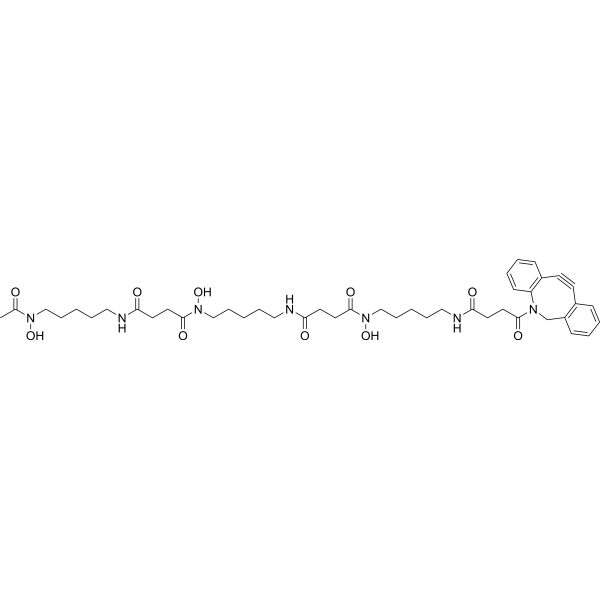
Deferoxamine-DBCO (DFO-DBCO) is a bifunctional small-molecule synthetic building block obtained by covalent conjugation of the DFO metal-chelating group with DBCO, and is a bifunctional chelator. Deferoxamine-DBCO efficiently chelates radioactive metals (such as 89Zr) through the DFO moiety to achieve radiolabeling. Deferoxamine-DBCO undergoes a metal-free Huisgen cycloaddition reaction with azide-containing biomolecules (such as siRNA and monoclonal antibodies) through the DBCO moiety under bioorthogonal conditions to accomplish targeted conjugation. Deferoxamine-DBCO is applicable to research related to bioconjugation chemistry and the preparation of PET radiotracer probes .
loading...
    loading...
Cat. No.: HY-181478
Target:  

HSP

Research Areas:  

Cancer

Hsp90-IN-45 is a Hsp90 inhibitor. Hsp90-IN-45 competitively binds to the ATP-binding site of purified Hsp90α with a Kd of 70 nM, blocks ATP hydrolysis, and disrupts Hsp90 client signaling. Hsp90-IN-45 inhibits ATPase activity of purified Hsp90α. Hsp90-IN-45 will be radiolabeled with 76/ 77Br for use as a radiotheragnostic agent for PET imaging and Meitner-Auger electron therapy. Hsp90-IN-45 can be used for the research of cancer .
loading...
    loading...
Cat. No.: HY-P10781
CAS No.: 3056440-83-3
Research Areas:  

Cancer

PSMA-D5 has a binding affinity for PSMA with a Ki of 0.21 nM and can be used for PSMA tracing after radiolabeling. PSMA-D5 ([68Ga]-labeled) contains a DOTA chelator, allowing convenient labeling with therapeutic radionuclides such as 177Lu and 225Ac. PSMA-D5 ([68Ga]-labeled) shows excellent pharmacokinetic properties, exhibiting remarkable tumor uptake in 22Rv1 tumors . PSMA-D5 can be used for the synthesis/research of Radionuclide-Drug Conjugates (RDCs).
loading...
    loading...
Cat. No.: HY-P11852
Target:  

FGFR

Research Areas:  

Cancer

NOTA-cRY9M is a reagent targeting FGFR1 with a Kd value of 58 nM, and exhibits subtype selectivity for FGFR2-4. When radiolabeled as [ 68Ga]Ga-NOTA-cRY9M, it functions as a stabilizer, imaging contrast enhancer, and tumor-targeting agent, and accumulates in FGFR1-positive non-small cell lung cancer xenograft models. NOTA-cRY9M can be used in studies related to non-small cell lung cancer .
loading...
    loading...
Cat. No.: HY-W003969R
CAS No.: 695-34-1
Synonyms: Ascensil (Standard); 2-Amino-4-methylpyridine (Standard)
Research Areas:  

Others

Aminopicoline (Standard) is the analytical standard of Aminopicoline. Aminopicoline (Ascensil) is a potent and non-selective inhibitor of nitric oxide synthase (NOS) isoenzymes (iNOS, nNOS, eNOS). Aminopicoline competes with arginine at the substrate-binding site of nitric oxide synthase, reduces cellular nitric oxide production, inhibits the elevation of plasma nitrate, increases mean arterial pressure at high doses, and also serves as a basis for radiolabeled ligands to localize nitric oxide synthase binding sites. Aminopicoline can be used in the research of diseases associated with septic shock, joint inflammation, intestinal inflammation, and CNS inflammation 。
loading...
    loading...
Cat. No.: HY-W010973S
CAS No.: 2687960-56-9
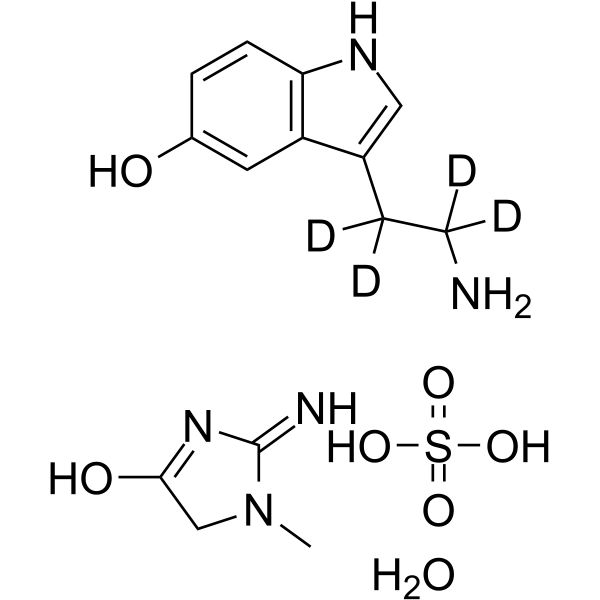
5-Hydroxytryptamine-d4 creatinine sulfate monohydrate is the deuterated-labeled 5-Hydroxytryptamine creatinine sulfate monohydrate (HY-W010973). 5-Hydroxytryptamine creatinine sulfate monohydrate is a 5-HT receptor agonist and amine oxidase substrate that acts through multiple physiological responses, including induction of vasoconstriction, pressor effects, acceleration of platelet potassium exchange, and endothelium-dependent relaxation, and can serve as a radiolabeled substrate for organelle uptake assays. 5-Hydroxytryptamine creatinine sulfate monohydrate can be used in research on burns, tourniquet and botulinum shock .
loading...
    loading...
Cat. No.: HY-110391
CAS No.: 193542-65-3
Synonyms: VUF 2274
Target:  

CCR

BX-513 is a highly potent and selective CCR1 antagonist. BX-513 effectively inhibits the binding of radiolabeled MIP-1α and RANTES to CCR1, with Ki values of 40 nM and 60 nM, respectively. BX-513 suppresses MIP-1α-induced extracellular acidification, MIP-1α- and RANTES-induced intracellular calcium mobilization, as well as MIP-1α- and RANTES-induced migration of peripheral blood mononuclear cells. BX-513 can be used for the research of rheumatoid arthritis and multiple sclerosis .
loading...
    loading...
Cat. No.: HY-123733
CAS No.: 949575-22-8
Synonyms: RPS-001
MIP-1095 (RPS-001) is a PSMA inhibitor with a Ki value of 0.24 nM. MIP-1095 binds to PSMA with high affinity and can be internalized into PSMA-expressing cancer cells. When radiolabeled with 123I, 124I or 131I, MIP-1095 enables SPECT/CT imaging, PET/CT imaging or targeted radiation delivery, respectively. 131I-MIP-1095 can alter serum PSA levels and relieve bone pain. MIP-1095 can be used in research related to metastatic castration-resistant prostate cancer .
loading...
    loading...
Cat. No.: HY-128890A
CAS No.: 1823122-52-6
Research Areas:  

Cancer

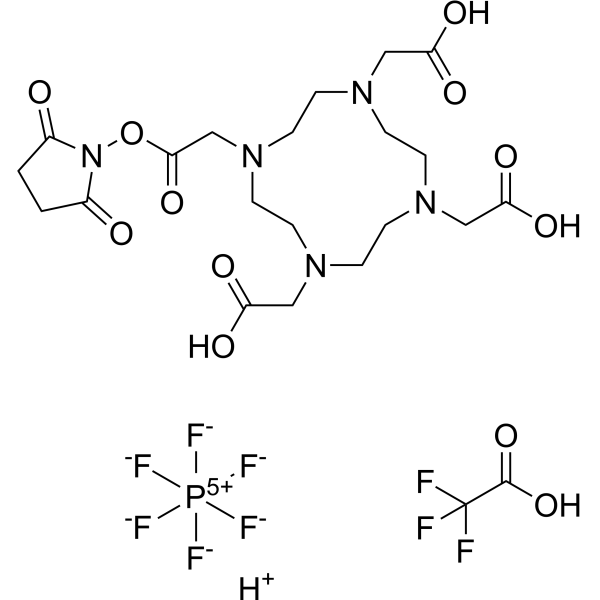
DOTA-NHS-ester hexafluorophosphate TFA is a bifunctional reagent containing a DOTA chelating group and an NHS ester. DOTA-NHS-ester hexafluorophosphate TFA can be conjugated to proteins/antibodies/HSA via primary amino groups for radiolabeling with radiometals, and when combined with 16-amino-1-hexadecanethiol hydrochloride, it enables the construction of self-assembled monolayers on gold surfaces for lectin microarrays. DOTA-NHS-ester hexafluorophosphate TFA can be used to prepare DOTA-HSA-Z (HER2:342) imaging probes, as well as to construct Trop2-targeted radiotherapeutic and diagnostic probes for pancreatic cancer .
loading...
    loading...
Cat. No.: HY-129615
CAS No.: 949575-20-6
Research Areas:  

Cancer

MIP-1072 is a competitive prostate-specific membrane antigen (PSMA) inhibitor with a Ki value of 4.6 nM. MIP-1072 specifically binds to PSMA and is internalized into PSMA-expressing prostate cancer cells. MIP-1072 accumulates in PSMA-expressing prostate cancer xenografts. MIP-1072 specifically blocks the uptake of 68Ga-NOTA-GUL by PSMA-positive prostate cancer xenografts. When radiolabeled with 123I, MIP-1072 functions as a SPECT/CT molecular imaging agent. MIP-1072 can be used in prostate cancer-related research .
loading...
    loading...
Cat. No.: HY-178271
CAS No.: 147597-66-8
Target:  

Drug Intermediate

Research Areas:  

Cancer

P-SCN-Bn-NOTA is a metal chelator and molecular imaging probe precursor that allows radiolabeling with Ga-68. P-SCN-Bn-NOTA can be conjugated to CD70-specific molecules B3, B6, ABDB3 and ABDB6 to form NOTA-labeled derivatives. P-SCN-Bn-NOTA is applicable for preclinical PET/CT imaging of CD70-expressing tumors in NCG mouse PDX models. P-SCN-Bn-NOTA can be used in studies related to CD70-positive tumors .
loading...
    loading...
Cat. No.: HY-180306
CAS No.: 84693-92-5
Fluoroestradiol is an Estrogen receptor PET imaging tracer precursor. Fluoroestradiol, when radiolabeled with 18F, can be used as an Estrogen receptor PET imaging tracer. 18F-Fluoroestradiol exhibits the highest uptake selectivity and target-to-background ratio among
several 18F-labeled estrogens. 18F-Fluoroestradiol has demonstrated Estrogen receptor expression in normal brain tissues and in meningiomas. 18F-Fluoroestradiol can quantify regional Estrogen receptor expression in breast cancer. 18F-Fluoroestradiol has potential applications in assessing and monitoring heterogeneity in ovarian cancer .
loading...
    loading...
Cat. No.: HY-182944
CAS No.: 1265900-99-9
Target:  

GABA Receptor

Research Areas:  

Neurological Disease

GATT-44 is a blood-brain barrier-permeable, selective GABA transporter 1 (GAT-1) ligand with an IC50 of 126 nM. GATT-44 shows selectivity for GAT-2, GAT-3 and BGT-1 subtypes, and undergoes copper-mediated 18F-radiofluorination. The radiolabeled GATT-44 ([ 18F]GATT-44) exhibits brain uptake, metabolic stability and high GAT-1 binding specificity in non-human primates. GATT-44 is applicable for research on neurodegenerative and neuropsychiatric diseases .
loading...
    loading...
Cat. No.: HY-P10444
CAS No.: 3033865-40-3
Research Areas:  

Cancer

DOTA Conjugated JM#21 derivative 7 (compound Ligand-7) is a derivative of CXCR4 targeting peptide conjugated with DOTA and can be used to produce radioligands. Radiolabeled DOTA Conjugated JM#21 derivative 7, i.e., 177Lu-DOTA, has excellent CXCR4 tumor targeting. In vitro biodistribution results of 177Lu-DOTA showed very low uptake in all non-targeted organs except kidney . DOTA Conjugated JM#21 derivative 7 can be used for the synthesis/research of Radionuclide-Drug Conjugates (RDCs).
loading...
    loading...
Cat. No.: HY-P11486
NOTA-RHAU18 is a conjugate of the chelator NOTA and the peptide RHAU18. NOTA-RHAU18 can be used to synthesize the radiolabeled peptide probe [ 18F]AlF-NOTA-RHAU18. [ 18F]AlF-NOTA-RHAU18 targets mitochondrial DNA G4. [ 18F]AlF-NOTA-RHAU18 can be used to visualize and detect solid tumors in homozygous mice. [ 18F]AlF-NOTA-RHAU18 can also be used in PET imaging studies .
loading...
    loading...
Cat. No.: HY-P11863
Target:  

c-Met/HGFR

Research Areas:  

Infection Cancer

SMIC-1014 is a cellular mesenchymal-epithelial transition factor (c-Met) ligand. SMIC-1014 binds to the c-Met ectodomain without activating c-Met phosphorylation or inducing receptor internalization. SMIC-1014, when radiolabeled as [ 68Ga]Ga-SMIC-1014, acts as a positron emission tomography (PET) probe with defined pharmacokinetics, achieves specific tumor uptake in xenografts, and functions as a c-Met-targeted diagnostic probe. SMIC-1014 can be used for the research of colon cancer, hepatocellular carcinoma, prostate cancer .
loading...
    loading...
Cat. No.: HY-P11864
Research Areas:  

Cancer

DOTA-SMIC-1014 is a DOTA chelator-conjugated precursor of the c-Met-targeting peptide SMIC-1014 (HY-P11863). DOTA-SMIC-1014 binds to the extracellular domain of c-Met (Kd = 42.83 nM). After radiolabeling to [ 68Ga]Ga-SMIC-1014, DOTA-SMIC-1014 acts as a positron emission tomography (PET) probe that achieves specific tumor uptake in xenografts and functions as a diagnostic probe targeting c-Met. SMIC-1014 can be used in research related to colon cancer, hepatocellular carcinoma, and prostate cancer .
loading...
    loading...
Cat. No.: HY-P12120
CAS No.: 499773-67-0
Synonyms: KCCYSL
Research Areas:  

Cancer

ErbB-2-binding peptide-2 (KCCYSL) is a peptide targeting ErbB-2/HER2, which specifically binds to the extracellular domain of HER2 and accumulates in HER2-expressing cancer cells. When radiolabeled, ErbB-2-binding peptide-2 serves as a SPECT/CT and PET imaging agent, enabling the visualization of HER2-expressing tumor xenografts. ErbB-2-binding peptide-2 is applicable to research related to ovarian cancer and breast cancer .
loading...
    loading...

