Search Result
Results for "
Benzyl
" in MedChemExpress (MCE) Product Catalog:
130
Biochemical Assay Reagents
71
Isotope-Labeled Compounds
| Cat. No. |
Product Name |
Target |
Research Areas |
Chemical Structure |
-
- HY-129389
-
|
|
Glycosyltransferase
|
Cancer
|
|
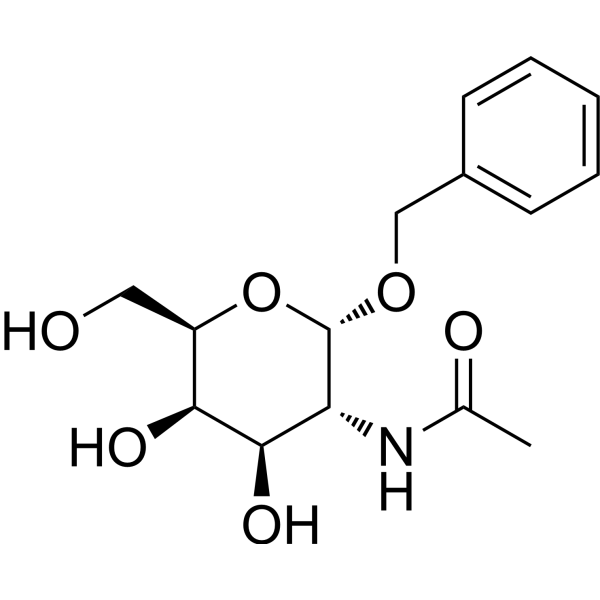
Benzyl-α-GalNAc is a potent O-glycosylation inhibitor. Benzyl-α-GalNAc effectively inhibits the proliferation and activation of LX-2 cells and suppresses the expression of collagen I/III, which has good potential for investigation in liver fibrosis. Benzyl-α-GalNAc also significantly enhances the anti-tumour activity of 5-Fluorouracil (HY-90006) (e.g. pancreatic cancer) by inhibiting O-glycosylation .
|
-
-
- HY-B0892
-
-
-
- HY-77813
-
|
|
Bacterial
Apoptosis
Antibiotic
Parasite
Autophagy
Reactive Oxygen Species (ROS)
|
Infection
Endocrinology
Cancer
|
|
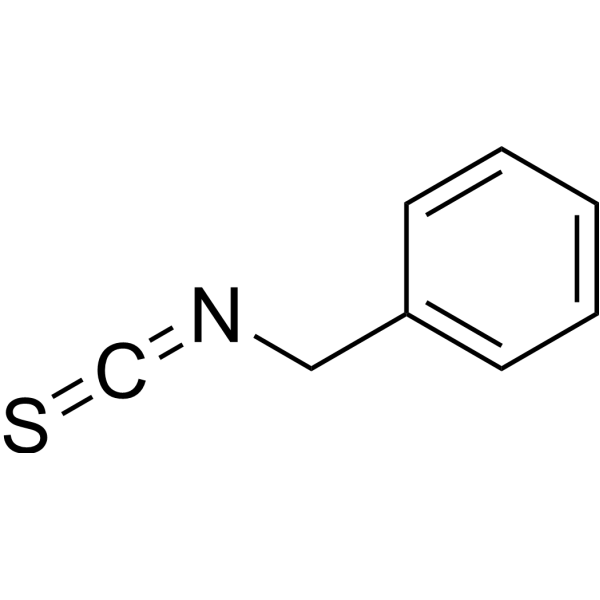
Benzyl isothiocyanate is an orally available isothiocyanate with bactericidal, anticancer, antiangiogenic and anthelmintic activities. Benzyl isothiocyanate exerts anticancer functions by regulating multiple signaling pathways, including apoptosis, cell proliferation, cell cycle arrest, metastasis, angiogenesis, and autophagy. In addition, Benzyl isothiocyanate can enhance muscle insulin sensitivity to improve obesity-induced hyperglycemia .
|
-
-
- HY-B0892S4
-
-
-
- HY-B0935
-
-
-
- HY-B1556
-
-
-
- HY-N7124
-
|
|
Environmental Pollutants
|
Others
|
|
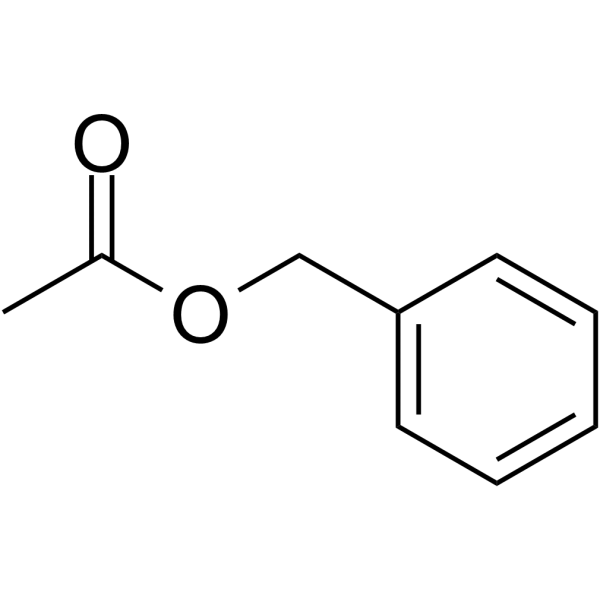
Benzyl acetate is an aromatic ester with a jasmine scent. Benzyl acetate found in plants and is commonly used as a base fragrance ingredient in perfumes, cosmetics, and soap fragrances. Benzyl acetate is also one of the largest varieties in the synthetic fragrance industry .
|
-
-
- HY-W007388
-
|
|
Biochemical Assay Reagents
Drug Intermediate
|
Others
|
|
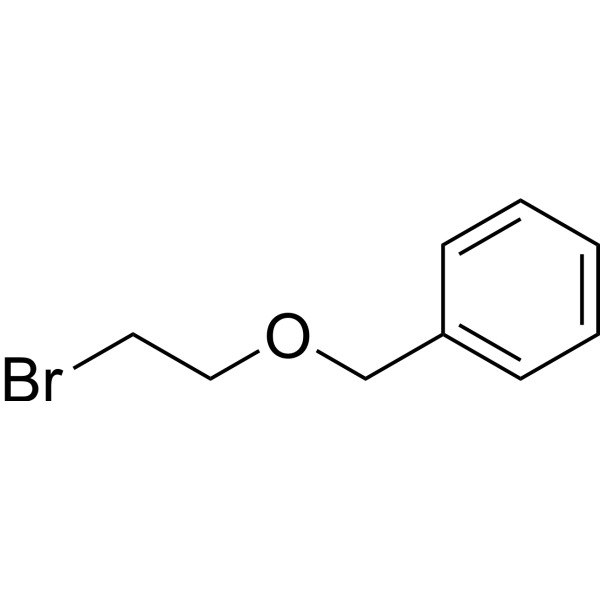
Benzyl 2-bromoethyl ether is a biochemical reagent that can be used as a biological material or organic compound for life science related research. Benzyl 2-bromoethyl ether can also be used in the synthesis of other active compounds.
|
-
-
- HY-W011338S
-
|
|
Aryl Hydrocarbon Receptor
|
Cancer
|
|
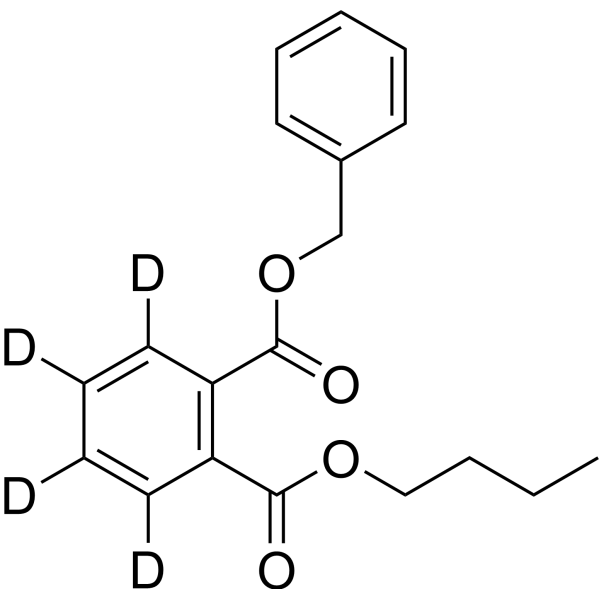
Benzyl butyl phthalate-d4 is the deuterium labeled Benzyl butyl phthalate . Benzyl butyl phthalate, a member of phthalic acid esters (PAEs), can trigger the migration and invasion of hemangioma (HA) cells via upregulation of Zeb1. Benzyl butyl phthalate activates aryl hydrocarbon receptor (AhR) in breast cancer cells to stimulate SPHK1/S1P/S1PR3 signaling and enhances formation of metastasis-initiating breast cancer stem cells (BCSCs) .
|
-
-
- HY-153469
-
|
|
ADC Payload
|
Cancer
|
|
Benzyl DC-81 (Compound 6a) is an anticancer agent with antiproliferative activity against A375 and MCF-7 cells .
|
-
-
- HY-33743
-
|
(3-Oxocyclobutyl)carbamic acid Benzyl ester; N-(Benzyloxycarbonyl)-3-amino-1-cyclobutanone
|
Drug Intermediate
|
Others
|
|
Benzyl (3-oxocyclobutyl)carbamate ((3-Oxocyclobutyl)carbamic acid benzyl ester) is a drug intermediate for synthesis of various active compounds.
|
-
-
- HY-B1555
-
-
-
- HY-B0935S
-
|
|
Parasite
Endogenous Metabolite
|
Infection
|
|
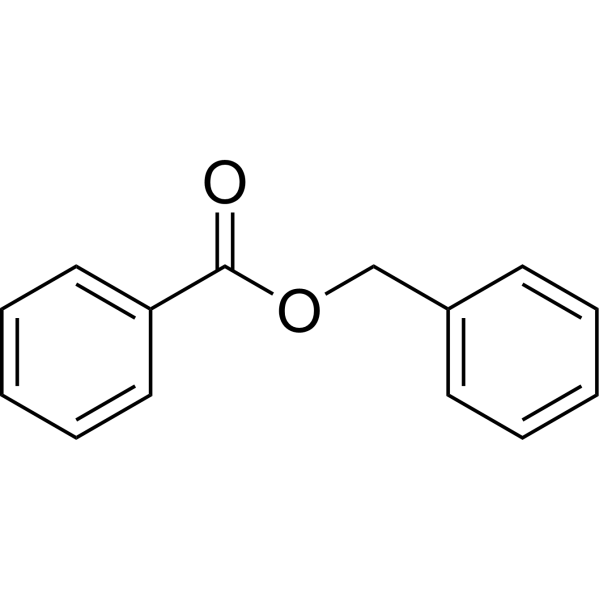
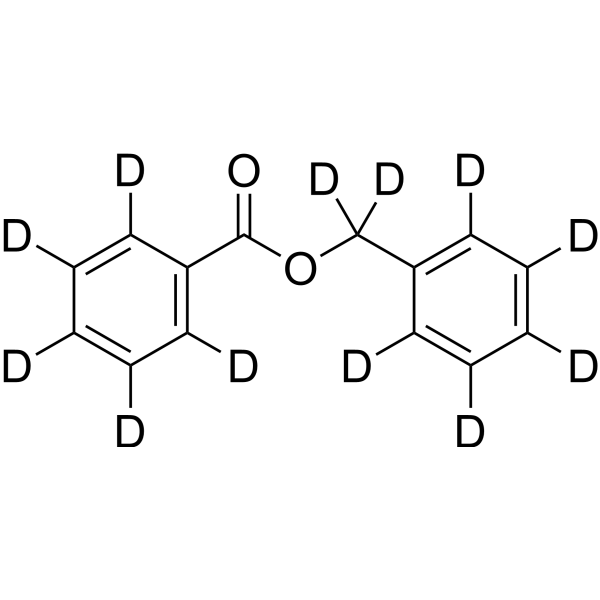
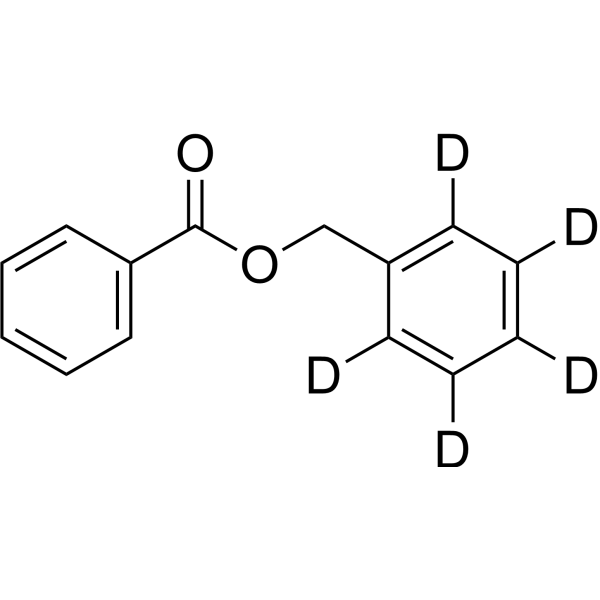
Benzyl benzoate-d5 is the deuterium labeled Benzyl benzoate . Benzyl benzoate (Benzoic acid benzyl ester) is a fragrance ingredient in cosmetic products. Benzyl benzoate can be used for the research of Scabies and Demodex-associated inflammatory skin conditions .
|
-
-
- HY-B0892R
-
-
-
- HY-W053678
-
-
-
- HY-W013482
-
|
Benzyl Paraben
|
Biochemical Assay Reagents
|
Others
|
|
Benzyl 4-hydroxybenzoate is a prominent material. Benzyl 4-hydroxybenzoate can be used as an excipient, such as bacteriostatic agent, preservative. Pharmaceutical excipients, or pharmaceutical auxiliaries, refer to other chemical substances used in the pharmaceutical process other than pharmaceutical ingredients. Pharmaceutical excipients generally refer to inactive ingredients in pharmaceutical preparations, which can improve the stability, solubility and processability of pharmaceutical preparations. Pharmaceutical excipients also affect the absorption, distribution, metabolism, and elimination (ADME) processes of co-administered drugs .
|
-
-
- HY-B1556S
-
-
-
- HY-133100
-
|
Benzyl-ALA hydrochloride
|
Endogenous Metabolite
|
Cancer
|
|
5-ALA benzyl ester hydrochloride (Benzyl-ALA hydrochloride) is a protoporphyrin precursor used as a photodetection agent. 5-ALA benzyl ester hydrochloride induces protoporphyrin IX (PPIX) accumulation in colon carcinoma cell lines .
|
-
-
- HY-B0935S1
-
|
Benzoic acid Benzyl ester-d12
|
Parasite
Endogenous Metabolite
|
Infection
|
|
Benzyl benzoate-d12 is the deuterium labeled Benzyl benzoate . Benzyl benzoate (Benzoic acid benzyl ester) is a fragrance ingredient in cosmetic products. Benzyl benzoate can be used for the research of Scabies and Demodex-associated inflammatory skin conditions .
|
-
-
- HY-W016484
-
-
-
- HY-N7090
-
|
|
Environmental Pollutants
|
Others
|
|
Benzyl cinnamate, occurs in Balsam of Peru and Tolu balsam, in Sumatra and Penang benzoin, and as the main constituent of copaiba balsam, is used in heavy oriental perfumes and as a fixative. Benzyl cinnamate has antibacterial activity against S. aureus and S. epidermidis (MIC = 537.81 μM). Benzyl cinnamate can induce acute toxixity, depression, and skin irritation in vivo .
|
-
-
- HY-131991
-
|
|
DNA Methyltransferase
|
Cancer
|
|
Benzyl selenocyanate is a chemopreventive agent for various chemically induced tumors in animal models at both the initiation and postinitiation stages. Benzyl selenocyanate is an inhibitor of DNA (cytosine-5)-methyltransferase (Mtase), with an with an IC50 of 8.4 µM .
|
-
-
- HY-B0892S2
-
-
-
- HY-B0892S1
-
-
-
- HY-42757B
-
-
-
- HY-W012837
-
|
|
Drug Derivative
Cytochrome P450
Toll-like Receptor (TLR)
|
Others
|
|
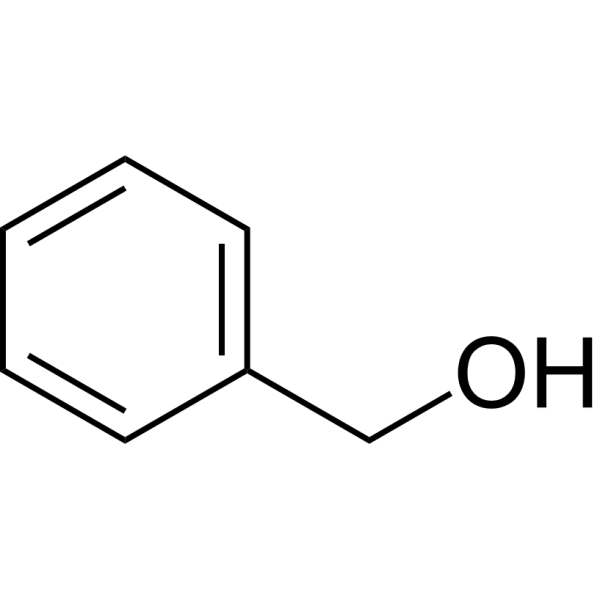
Benzylmethyl ether is a derivative of HY-B0892 (Benzyl alcohol). Benzylmethyl ether is an aromatic alcohol, a colorless liquid with a mild aromatic odor. Benzylmethyl ether is an inhibitor of P450 enzyme. Benzylmethyl ether mediated Toll-Like Receptor 4 to reduce the inflammatory response of liver injury in mice .
|
-
-
- HY-W111214
-
-
-
- HY-W097267
-
|
|
PROTAC Linkers
|
Cancer
|
|
Benzyl (4-aminobutyl)carbamate hydrochloride is a PROTAC linker that can be used in the synthesis of PROTACs.
|
-
-
- HY-W129178
-
|
|
PROTAC Linkers
|
Cancer
|
|
Benzyl (5-aminopentyl)carbamate hydrochloride is a PROTAC linker that can be used in the synthesis of PROTACs.
|
-
-
- HY-B0935R
-
-
-
- HY-W142194
-
|
|
DNA/RNA Synthesis
|
Cancer
|
|
Benzyl (5-hydroxypentyl)carbamate is a linker capable of repairing damaged DNA by binding to the 5'-hydroxyl group on the sugar backbone. Benzyl (5-hydroxypentyl)carbamate can also bind to DNA ligands and can inhibit cell proliferation in resistant cell lines. However, Benzyl (5-hydroxypentyl)carbamate is toxic to cells and can also cause DNA damage and strand breakage.
|
-
-
- HY-W130690
-
|
|
PROTAC Linkers
|
Cancer
|
|
Benzyl 5-hydroxypentanoate is a PROTAC linker that can be used in the synthesis of PROTACs.
|
-
-
- HY-W011338R
-
|
|
Reference Standards
Aryl Hydrocarbon Receptor
|
Cancer
|
|
Benzyl butyl phthalate (Standard) is the analytical standard of Benzyl butyl phthalate. This product is intended for research and analytical applications. Benzyl butyl phthalate, a member of phthalic acid esters (PAEs), can trigger the migration and invasion of hemangioma (HA) cells via upregulation of Zeb1. Benzyl butyl phthalate activates aryl hydrocarbon receptor (AhR) in breast cancer cells to stimulate SPHK1/S1P/S1PR3 signaling and enhances formation of metastasis-initiating breast cancer stem cells (BCSCs) .
|
-
-
- HY-W041844
-
|
|
PROTAC Linkers
|
Cancer
|
|
Benzyl (3-aminopropyl)carbamate is a PROTAC linker that can be used in the synthesis of PROTACs.
|
-
-
- HY-W574973
-
|
|
PROTAC Linkers
|
Cancer
|
|
Benzyl (5-aminopentyl)carbamate is a PROTAC linker that can be used in the synthesis of PROTACs.
|
-
-
- HY-W009257
-
-
-
- HY-W096073
-
|
|
PROTAC Linkers
|
Cancer
|
|
Benzyl-PEG4-amine is a PEG-based PROTAC linker that can be used in the synthesis of PROTACs .
|
-
-
- HY-B0892S5
-
-
-
- HY-N7124R
-
|
|
Reference Standards
Others
|
Others
|
|
Benzyl acetate (Standard) is the analytical standard of Benzyl acetate (HY-N7124). This product is intended for research and analytical applications. Benzyl acetate is an aromatic ester with a jasmine scent. Benzyl acetate found in plants and is commonly used as a base fragrance ingredient in perfumes, cosmetics, and soap fragrances. Benzyl acetate is also one of the largest varieties in the synthetic fragrance industry.
|
-
-
- HY-N7124S
-
|
|
Isotope-Labeled Compounds
|
Others
|
Benzyl acetate-d5 is the deuterium labeled Benzyl acetate (HY-N7124) . Benzyl acetate is an aromatic ester with a jasmine scent. Benzyl acetate found in plants and is commonly used as a base fragrance ingredient in perfumes, cosmetics, and soap fragrances. Benzyl acetate is also one of the largest varieties in the synthetic fragrance industry .
|
-
-
- HY-B1555R
-
|
|
Reference Standards
Liposome
|
Cardiovascular Disease
|
|
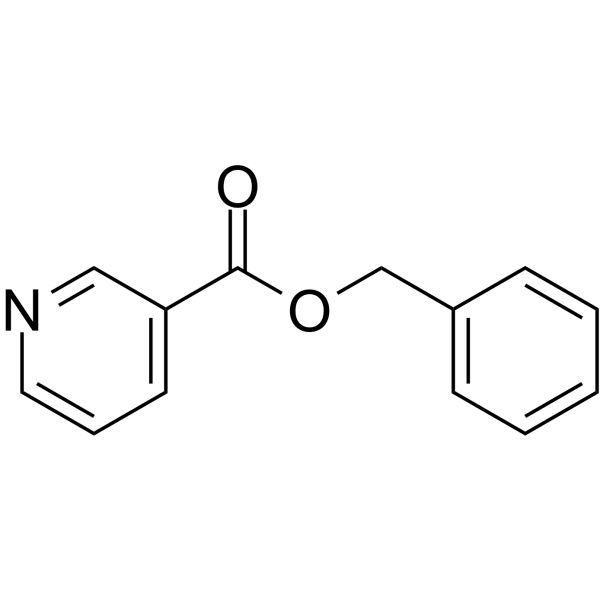
Benzyl nicotinate (Standard) is the analytical standard of Benzyl nicotinate. This product is intended for research and analytical applications. Benzyl nicotinate is a vasodilator that increases skin oxygenation levels by increasing skin blood flow .
|
-
-
- HY-N7090R
-
|
|
Others
Reference Standards
|
Others
|
|
Benzyl cinnamate (Standard) is the analytical standard of Benzyl cinnamate. This product is intended for research and analytical applications. Benzyl cinnamate, occurs in Balsam of Peru and Tolu balsam, in Sumatra and Penang benzoin, and as the main constituent of copaiba balsam, is used in heavy oriental perfumes and as a fixative. Benzyl cinnamate has antibacterial activity against S. aureus and S. epidermidis (MIC = 537.81 μM). Benzyl cinnamate can induce acute toxixity, depression, and skin irritation in vivo .
|
-
-
- HY-77813R
-
|
|
Reference Standards
Bacterial
Apoptosis
Antibiotic
Parasite
Autophagy
Reactive Oxygen Species (ROS)
|
Infection
Endocrinology
Cancer
|
|
Benzyl isothiocyanate (Standard) is the analytical standard of Benzyl isothiocyanate. This product is intended for research and analytical applications. Benzyl isothiocyanate is an orally available isothiocyanate with bactericidal, anticancer, antiangiogenic and anthelmintic activities. Benzyl isothiocyanate exerts anticancer functions by regulating multiple signaling pathways, including apoptosis, cell proliferation, cell cycle arrest, metastasis, angiogenesis, and autophagy. In addition, Benzyl isothiocyanate can enhance muscle insulin sensitivity to improve obesity-induced hyperglycemia[1][2][3][4][5][6][7][8][9].
|
-
-
- HY-77813S
-
|
|
Isotope-Labeled Compounds
Bacterial
Apoptosis
Antibiotic
|
Endocrinology
Cancer
|
|
Benzyl isothiocyanate-d7 is the deuterium labeled Benzyl isothiocyanate. Benzyl isothiocyanate is a member of natural isothiocyanates with antimicrobial activity . Benzyl isothiocyanate potent inhibits cell mobility, migration and invasion nature and matrix metalloproteinase-2 (MMP-2) activity of murine melanoma cells .
|
-
-
- HY-W129181
-
|
Benzyl laurate
|
Biochemical Assay Reagents
|
Others
|
|
Benzyl dodecanoate is a biochemical reagent that can be used as a biological material or organic compound for life science related research.
|
-
-
- HY-W698621
-
-
-
- HY-W013482R
-
|
Benzyl Paraben (Standard)
|
Biochemical Assay Reagents
Reference Standards
|
Others
|
|
Benzyl 4-hydroxybenzoate (Standard) is the analytical standard of Benzyl 4-hydroxybenzoate. This product is intended for research and analytical applications. Benzyl 4-hydroxybenzoate is a prominent material. Benzyl 4-hydroxybenzoate can be used as an excipient, such as bacteriostatic agent, preservative. Pharmaceutical excipients, or pharmaceutical auxiliaries, refer to other chemical substances used in the pharmaceutical process other than pharmaceutical ingredients. Pharmaceutical excipients generally refer to inactive ingredients in pharmaceutical preparations, which can improve the stability, solubility and processability of pharmaceutical preparations. Pharmaceutical excipients also affect the absorption, distribution, metabolism, and elimination (ADME) processes of co-administered drugs .
|
-
-
- HY-N7090S
-
|
|
Isotope-Labeled Compounds
|
Others
|
|
Benzyl cinnamate-d5 is the deuterium labeled Benzyl cinnamate . Benzyl cinnamate, occurs in Balsam of Peru and Tolu balsam, in Sumatra and Penang benzoin, and as the main constituent of copaiba balsam, is used in heavy oriental perfumes and as a fixative .
|
-
-
- HY-W591969
-
|
|
Biochemical Assay Reagents
|
Others
|
|
Benzyl (6-oxohexyl)carbamate is a linker containing an aldehyde group and a benzyl (Cbz) protecting group. The aldehyde can react with hydrazine or hydrazide to form a hydrolytic acyl hydrozone linkage. The benzyl protecting group can be removed via hydrogenolysis to form a free amine.
|
-
-
- HY-134607
-
|
Benzyl (E)-p-coumarate
|
Others
|
Others
|
|
(E)-Benzyl ferulate is a phenolic ester that can be isolated from Thai propolis .
|
-
- HY-W035886
-
-
- HY-B1556R
-
|
NSC 6647 (Standard)
|
Reference Standards
ERK
Drug Derivative
Apoptosis
p38 MAPK
JNK
|
Cancer
|
|
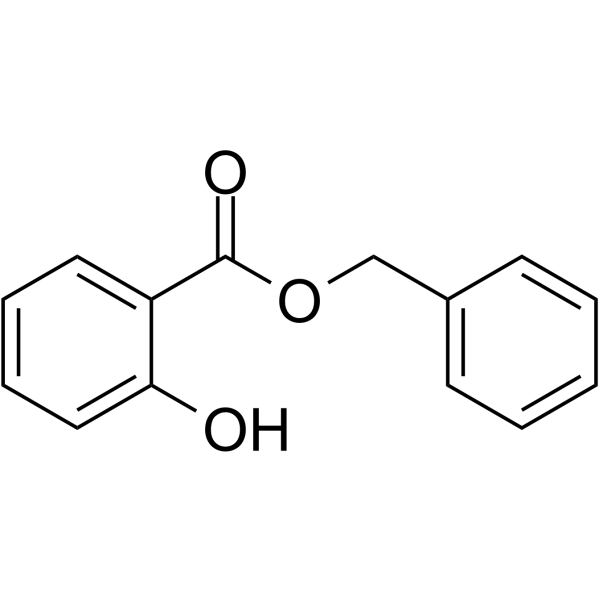
Benzyl salicylate (Standard) (NSC 6647 (Standard)) is the analytical standard of Benzyl salicylate (HY-B1556). This product is intended for research and analytical applications. Benzyl salicylate (NSC 6647)?is a salicylic acid benzyl ester. It can be used as a fragrance additive or UV light absorber .
|
-
- HY-W054216
-
|
|
PROTAC Linkers
|
Cancer
|
|
Benzyl 4-hydroxybutanoate is a PROTAC linker that can be used in the synthesis of PROTACs.
|
-
- HY-W013482S1
-
|
|
Isotope-Labeled Compounds
Biochemical Assay Reagents
|
Others
|
|
Benzyl Paraben-d7 is deuterium labeled Benzyl 4-hydroxybenzoate. Benzyl 4-hydroxybenzoate is a prominent material. Benzyl 4-hydroxybenzoate can be used as an excipient, such as bacteriostatic agent, preservative. Pharmaceutical excipients, or pharmaceutical auxiliaries, refer to other chemical substances used in the pharmaceutical process other than pharmaceutical ingredients. Pharmaceutical excipients generally refer to inactive ingredients in pharmaceutical preparations, which can improve the stability, solubility and processability of pharmaceutical preparations. Pharmaceutical excipients also affect the absorption, distribution, metabolism, and elimination (ADME) processes of co-administered drugs .
|
-
- HY-W416118
-
|
|
Biochemical Assay Reagents
|
Others
|
|
Benzyl 2,3,4-tri-O-benzyl-L-rhamnopyranose is a class of biochemical reagents used in glycobiology research. Glycobiology studies the structure, synthesis, biology, and evolution of sugars. It involves carbohydrate chemistry, enzymology of glycan formation and degradation, protein-glycan recognition, and the role of glycans in biological systems. This field is closely related to basic research, biomedicine, and biotechnology .
|
-
- HY-W399770
-
|
|
Biochemical Assay Reagents
|
Others
|
|
Benzyl 2,3,4-Tri-O-benzyl-D-glucuronate is a class of biochemical reagents used in glycobiology research. Glycobiology studies the structure, synthesis, biology, and evolution of sugars. It involves carbohydrate chemistry, enzymology of glycan formation and degradation, protein-glycan recognition, and the role of glycans in biological systems. This field is closely related to basic research, biomedicine, and biotechnology .
|
-
- HY-130595
-
|
|
PROTAC Linkers
|
Cancer
|
|
Benzyl-PEG4-acid is a PEG-based PROTAC linker can be used in the synthesis of PROTACs.
|
-
- HY-W747060
-
|
Benzyl Paraben-13C6
|
Isotope-Labeled Compounds
Biochemical Assay Reagents
|
Others
|
|
Benzyl 4-hydroxybenzoate- 13C6 (Benzyl Paraben- 13C6) is the 13C-labeled Benzyl 4-hydroxybenzoate (HY-W013482). Benzyl 4-hydroxybenzoate is a prominent material. Benzyl 4-hydroxybenzoate can be used as an excipient, such as bacteriostatic agent, preservative. Pharmaceutical excipients, or pharmaceutical auxiliaries, refer to other chemical substances used in the pharmaceutical process other than pharmaceutical ingredients. Pharmaceutical excipients generally refer to inactive ingredients in pharmaceutical preparations, which can improve the stability, solubility and processability of pharmaceutical preparations. Pharmaceutical excipients also affect the absorption, distribution, metabolism, and elimination (ADME) processes of co-administered drugs .
|
-
- HY-138487
-
|
|
PROTAC Linkers
|
Cancer
|
|
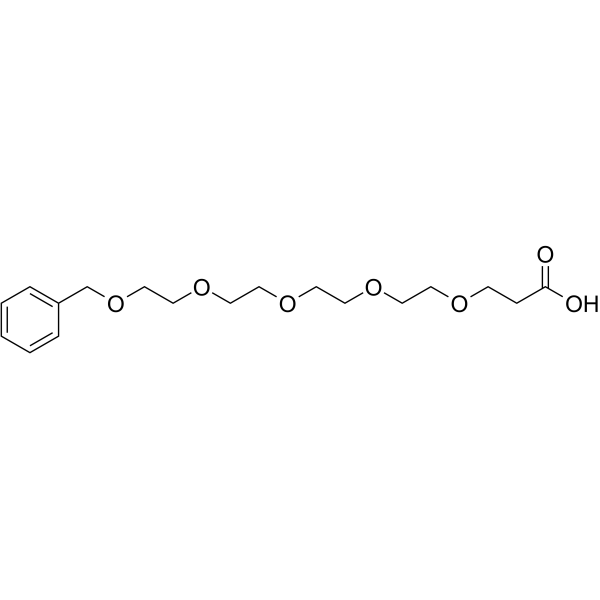
Benzyl-PEG5-acid is a PEG-based PROTAC linker that can be used in the synthesis of PROTACs .
|
-
- HY-W096089
-
|
|
PROTAC Linkers
|
Cancer
|
|
Benzyl-PEG3-acid is a PEG-based PROTAC linker that can be used in the synthesis of PROTACs .
|
-
- HY-W096142
-
|
|
PROTAC Linkers
|
Cancer
|
|
Benzyl-PEG2-acid is a PEG-based PROTAC linker that can be used in the synthesis of PROTACs .
|
-
- HY-132012
-
|
|
PROTAC Linkers
|
Cancer
|
|
Benzyl-PEG9-acid is a PEG-based PROTAC linker that can be used in the synthesis of PROTACs .
|
-
- HY-138393
-
|
|
PROTAC Linkers
|
Cancer
|
|
Benzyl-PEG6-acid is a PEG-based PROTAC linker that can be used in the synthesis of PROTACs .
|
-
- HY-132027
-
|
|
PROTAC Linkers
|
Cancer
|
|
Benzyl-PEG7-acid is a PEG-based PROTAC linker that can be used in the synthesis of PROTACs .
|
-
- HY-132015
-
|
|
PROTAC Linkers
|
Cancer
|
|
Benzyl-PEG8-acid is a PEG-based PROTAC linker that can be used in the synthesis of PROTACs .
|
-
- HY-W105943
-
|
|
PROTAC Linkers
|
Cancer
|
|
Benzyl (3-bromopropyl)carbamate is a PROTAC linker that can be used in the synthesis of PROTACs.
|
-
- HY-W097012
-
|
|
PROTAC Linkers
|
Cancer
|
|
Benzyl (6-hydroxyhexyl)carbamate is a PROTAC linker that can be used in the synthesis of PROTACs.
|
-
- HY-W012016
-
|
|
PROTAC Linkers
|
Cancer
|
|
Benzyl (3-aminopropyl)carbamate hydrochloride is a PROTAC linker that can be used in the synthesis of PROTACs.
|
-
- HY-W038309
-
|
|
PROTAC Linkers
|
Cancer
|
|
Benzyl (4-hydroxybutyl)carbamate is a PROTAC linker that can be used in the synthesis of PROTACs.
|
-
- HY-200226
-
|
|
PROTAC Linkers
|
Cancer
|
|
Benzyl (4-bromobutyl)carbamate is a PROTAC linker that can be used in the synthesis of PROTACs.
|
-
- HY-N12978
-
|
|
Others
|
Cancer
|
|
Benzyl β-gentiobioside is a phenyl alcohol glycoside found in peach kernels (Prunus persica seeds). Benzyl β-gentiobioside has anti-tumor promoting activity by inhibiting TPA (12-O-tetradecanoylphorbol 13-acetate, a tumor promoter)-induced Epstein-Barr virus early antigen (EBV-EA) activation .
|
-
- HY-W108220
-
|
|
PROTAC Linkers
|
Cancer
|
|
Benzyl-PEG5-Ots is a PEG-based PROTAC linker can be used in the synthesis of PROTACs.
|
-
- HY-W108219
-
|
|
PROTAC Linkers
|
Cancer
|
|
Benzyl-PEG4-Ots is a PEG-based PROTAC linker can be used in the synthesis of PROTACs.
|
-
- HY-138709
-
|
|
PROTAC Linkers
|
Cancer
|
|
Benzyl-PEG6-Ots is a PEG-based PROTAC linker can be used in the synthesis of PROTACs.
|
-
- HY-138713
-
|
|
PROTAC Linkers
|
Cancer
|
|
Benzyl-PEG10-Ots is a PEG-based PROTAC linker can be used in the synthesis of PROTACs.
|
-
- HY-138711
-
|
|
PROTAC Linkers
|
Cancer
|
|
Benzyl-PEG8-Ots is a PEG-based PROTAC linker can be used in the synthesis of PROTACs.
|
-
- HY-138714
-
|
|
PROTAC Linkers
|
Cancer
|
|
Benzyl-PEG12-Ots is a PEG-based PROTAC linker can be used in the synthesis of PROTACs.
|
-
- HY-138710
-
|
|
PROTAC Linkers
|
Cancer
|
|
Benzyl-PEG7-Ots is a PEG-based PROTAC linker can be used in the synthesis of PROTACs.
|
-
- HY-46572
-
|
|
ADC Linker
|
Cancer
|
|
Benzyl 2-cyclopropyl-2-hydroxyacetate is an intermediate in the synthesis of ADC linker.The linker composed of Benzyl 2-cyclopropyl-2-hydroxyacetate can be coupled to Exatecan (HY-13631) and combined with antibodies (such as antibody hu2F7) .
|
-
- HY-134710
-
|
|
PROTAC Linkers
|
Cancer
|
|
Benzyl-PEG24-alcohol is a PEG-based PROTAC linker that can be used in the synthesis of PROTACs .
|
-
- HY-132052
-
|
|
PROTAC Linkers
|
Cancer
|
|
Benzyl-PEG12-alcohol is a PEG-based PROTAC linker that can be used in the synthesis of PROTACs .
|
-
- HY-140742
-
|
|
PROTAC Linkers
|
Cancer
|
|
Benzyl-PEG2-amine is a PEG-based PROTAC linker that can be used in the synthesis of PROTACs .
|
-
- HY-134752
-
|
|
PROTAC Linkers
|
Cancer
|
|
Benzyl-PEG9-Boc is a PEG-based PROTAC linker that can be used in the synthesis of PROTACs .
|
-
- HY-138513
-
|
|
PROTAC Linkers
|
Cancer
|
|
Benzyl-PEG4-acyl chloride is a PEG-based PROTAC linker that can be used in the synthesis of PROTACs .
|
-
- HY-132053
-
|
|
PROTAC Linkers
|
Cancer
|
|
Benzyl-PEG16-alcohol is a PEG-based PROTAC linker that can be used in the synthesis of PROTACs .
|
-
- HY-N19758
-
|
|
Others
|
Others
|
|
Benzyl alcohol-O-β-xylopyranosyl-(1→2)-β-glucopyranoside is a benzyl alcohol glycoside found in the leaves of Phlomis aurea .
|
-
- HY-W095744
-
|
Benzyl cyanoacetate
|
PROTAC Linkers
|
Cancer
|
|
Benzyl 2-cyanoacetate (Benzyl cyanoacetate) is a PROTAC linker that can be used in the synthesis of PROTACs.
|
-
- HY-W699186
-
-
- HY-W140765R
-
|
Phenylmethyl butyrate (Standard)
|
Reference Standards
|
|
|
benzyl butyrate (Standard) is the analytical standard of benzyl butyrate. This product is intended for research and analytical applications.
|
-
- HY-W277332R
-
|
|
Reference Standards
|
|
|
Benzyl(methyl)sulfane (Standard) is the analytical standard of Benzyl(methyl)sulfane. This product is intended for research and analytical applications.
|
-
- HY-W707713
-
-
- HY-N8705
-
-
- HY-W674673
-
|
|
PROTAC Linkers
|
Cancer
|
|
Benzyl 5-Bromopentanoate is a PROTAC linker that can be used in the synthesis of PROTACs.
|
-
- HY-180319
-
|
|
Drug Intermediate
|
Others
|
|
Benzyl m-hydroxycarbanilate (Compound 9) is a biologically active chemical substance and also an intermediate .
|
-
- HY-W097114
-
-
- HY-W097113
-
|
|
PROTAC Linkers
|
Cancer
|
|
Benzyl (6-aminohexyl)carbamate hydrochloride is a PROTAC linker that can be used in the synthesis of PROTACs.
|
-
- HY-W574894
-
|
|
PROTAC Linkers
|
Cancer
|
|
Benzyl (6-aminohexyl)carbamate is a PROTAC linker that can be used in the synthesis of PROTACs.
|
-
- HY-W244921
-
|
|
PROTAC Linkers
|
Cancer
|
|
Benzyl (4-aminobutyl)carbamate is a PROTAC linker that can be used in the synthesis of PROTACs.
|
-
- HY-W639342
-
|
|
PROTAC Linkers
|
Cancer
|
|
Benzyl (5-oxopentyl)carbamate is a PROTAC linker that can be used in the synthesis of PROTACs.
|
-
- HY-W698501
-
|
|
Biochemical Assay Reagents
|
Others
|
|
Benzyl 2-O-Benzyl-4,6-O-benzylidene-α-D-mannopyranoside is a class of biochemical reagents used in glycobiology research. Glycobiology studies the structure, synthesis, biology, and evolution of sugars. It involves carbohydrate chemistry, enzymology of glycan formation and degradation, protein-glycan recognition, and the role of glycans in biological systems. This field is closely related to basic research, biomedicine, and biotechnology .
|
-
- HY-W096075
-
|
|
PROTAC Linkers
|
Cancer
|
|
Benzyl-PEG5-THP is a PEG-based PROTAC linker that can be used in the synthesis of PROTACs .
|
-
- HY-W096081
-
|
|
PROTAC Linkers
|
Cancer
|
|
Benzyl-PEG10-alcohol is a PEG-based PROTAC linker that can be used in the synthesis of PROTACs .
|
-
- HY-138342
-
|
|
PROTAC Linkers
|
Cancer
|
|
Benzyl-PEG1-MS is a PEG-based PROTAC linker that can be used in the synthesis of PROTACs .
|
-
- HY-W096072
-
|
|
PROTAC Linkers
|
Cancer
|
|
Benzyl-PEG2-MS is a PEG-based PROTAC linker that can be used in the synthesis of PROTACs .
|
-
- HY-134697
-
|
|
PROTAC Linkers
|
Cancer
|
|
Benzyl-PEG15-alcohol is a PEG-based PROTAC linker that can be used in the synthesis of PROTACs .
|
-
- HY-138477
-
|
|
PROTAC Linkers
|
Cancer
|
|
Benzyl-PEG24-THP is a PEG-based PROTAC linker that can be used in the synthesis of PROTACs .
|
-
- HY-132021
-
|
|
PROTAC Linkers
|
Cancer
|
|
Benzyl-PEG7-NHBoc is a PEG-based PROTAC linker that can be used in the synthesis of PROTACs .
|
-
- HY-138346
-
|
|
PROTAC Linkers
|
Cancer
|
|
Benzyl-PEG4-Boc is a PEG-based PROTAC linker that can be used in the synthesis of PROTACs .
|
-
- HY-132048
-
|
|
PROTAC Linkers
|
Cancer
|
|
Benzyl-PEG7-MS is a PEG-based PROTAC linker that can be used in the synthesis of PROTACs .
|
-
- HY-140751
-
|
|
PROTAC Linkers
|
Cancer
|
|
Benzyl-PEG5-MS is a PEG-based PROTAC linker that can be used in the synthesis of PROTACs .
|
-
- HY-138323
-
|
|
PROTAC Linkers
|
Cancer
|
|
Benzyl-PEG36-alcohol is a PEG-based PROTAC linker that can be used in the synthesis of PROTACs .
|
-
- HY-W096077
-
|
|
PROTAC Linkers
|
Cancer
|
|
Benzyl-PEG7-amine is a PEG-based PROTAC linker that can be used in the synthesis of PROTACs .
|
-
- HY-132013
-
|
|
PROTAC Linkers
|
Cancer
|
|
Benzyl-PEG8-amine is a PEG-based PROTAC linker that can be used in the synthesis of PROTACs .
|
-
- HY-W190795
-
|
|
PROTAC Linkers
|
Cancer
|
|
Benzyl-PEG3-amine is a PEG-based PROTAC linker that can be used in the synthesis of PROTACs .
|
-
- HY-138338
-
|
|
PROTAC Linkers
|
Cancer
|
|
Benzyl-PEG9-THP is a PEG-based PROTAC linker that can be used in the synthesis of PROTACs .
|
-
- HY-138378
-
|
|
PROTAC Linkers
|
Cancer
|
|
Benzyl-PEG5-NHBoc is a PEG-based PROTAC linker that can be used in the synthesis of PROTACs .
|
-
- HY-132009
-
|
|
PROTAC Linkers
|
Cancer
|
|
Benzyl-PEG7-bromide is a PEG-based PROTAC linker that can be used in the synthesis of PROTACs .
|
-
- HY-140743
-
|
|
PROTAC Linkers
|
Cancer
|
|
Benzyl-PEG5-amine is a PEG-based PROTAC linker that can be used in the synthesis of PROTACs .
|
-
- HY-153153
-
|
|
PROTAC Linkers
|
Cancer
|
|
Benzyl-PEG45-alcohol is a PEG-based PROTAC linker that can be used in the synthesis of PROTACs .
|
-
- HY-132051
-
|
|
PROTAC Linkers
|
Cancer
|
|
Benzyl-PEG14-alcohol is a PEG-based PROTAC linker that can be used in the synthesis of PROTACs .
|
-
- HY-138433
-
|
|
PROTAC Linkers
|
Cancer
|
|
Benzyl-PEG1-propanol is a PEG-based PROTAC linker that can be used in the synthesis of PROTACs .
|
-
- HY-132105
-
|
|
PROTAC Linkers
|
Cancer
|
|
Benzyl-PEG6-THP is a PEG-based PROTAC linker that can be used in the synthesis of PROTACs .
|
-
- HY-132029
-
|
|
PROTAC Linkers
|
Cancer
|
|
Benzyl-PEG6-amine is a PEG-based PROTAC linker that can be used in the synthesis of PROTACs .
|
-
- HY-138479
-
|
|
PROTAC Linkers
|
Cancer
|
|
Benzyl-PEG2-ethanol is a PEG-based PROTAC linker that can be used in the synthesis of PROTACs .
|
-
- HY-132028
-
|
|
PROTAC Linkers
|
Cancer
|
|
Benzyl-PEG6-bromide is a PEG-based PROTAC linker that can be used in the synthesis of PROTACs .
|
-
- HY-132074
-
|
|
PROTAC Linkers
|
Cancer
|
|
Benzyl-PEG11-alcohol is a PEG-based PROTAC linker that can be used in the synthesis of PROTACs .
|
-
- HY-W096107
-
|
|
PROTAC Linkers
|
Cancer
|
|
Benzyl-PEG8-alcohol is a PEG-based PROTAC linker that can be used in the synthesis of PROTACs .
|
-
- HY-114843
-
|
|
PROTAC Linkers
|
Cancer
|
|
Benzyl-PEG1-Tos is a PEG-based PROTAC linker that can be used in the synthesis of PROTACs .
|
-
- HY-132011
-
|
|
PROTAC Linkers
|
Cancer
|
|
Benzyl-PEG13-THP is a PEG-based PROTAC linker that can be used in the synthesis of PROTACs .
|
-
- HY-W093833
-
|
|
PROTAC Linkers
|
Cancer
|
|
Benzyl-PEG9-alcohol is a PEG-based PROTAC linker that can be used in the synthesis of PROTACs .
|
-
- HY-138319
-
|
|
PROTAC Linkers
|
Cancer
|
|
Benzyl-PEG25-amine is a PEG-based PROTAC linker that can be used in the synthesis of PROTACs .
|
-
- HY-W096090
-
|
|
PROTAC Linkers
|
Cancer
|
|
Benzyl-PEG4-MS is a PEG-based PROTAC linker that can be used in the synthesis of PROTACs .
|
-
- HY-132026
-
|
|
PROTAC Linkers
|
Cancer
|
|
Benzyl-PEG6-MS is a PEG-based PROTAC linker that can be used in the synthesis of PROTACs .
|
-
- HY-W096067
-
|
|
PROTAC Linkers
|
Cancer
|
|
Benzyl-PEG7-alcohol is a PEG-based PROTAC linker that can be used in the synthesis of PROTACs .
|
-
- HY-138367
-
|
|
PROTAC Linkers
|
Cancer
|
|
Benzyl-PEG3-methyl ester is a PEG-based PROTAC linker that can be used in the synthesis of PROTACs .
|
-
- HY-138339
-
|
|
PROTAC Linkers
|
Cancer
|
|
Benzyl-PEG8-Br is a PEG-based PROTAC linker that can be used in the synthesis of PROTACs .
|
-
- HY-132030
-
|
|
PROTAC Linkers
|
Cancer
|
|
Benzyl-PEG6-NHBoc is a PEG-based PROTAC linker that can be used in the synthesis of PROTACs .
|
-
- HY-132023
-
|
|
PROTAC Linkers
|
Cancer
|
|
Benzyl-PEG11-MS is a PEG-based PROTAC linker that can be used in the synthesis of PROTACs .
|
-
- HY-138444
-
|
|
PROTAC Linkers
|
Cancer
|
|
Benzyl-PEG18-alcohol is a PEG-based PROTAC linker that can be used in the synthesis of PROTACs .
|
-
- HY-134741
-
|
|
PROTAC Linkers
|
Cancer
|
|
Benzyl-PEG8-MS is a PEG-based PROTAC linker that can be used in the synthesis of PROTACs .
|
-
- HY-132106
-
|
|
PROTAC Linkers
|
Cancer
|
|
Benzyl-PEG7-THP is a PEG-based PROTAC linker that can be used in the synthesis of PROTACs .
|
-
- HY-138360
-
|
|
PROTAC Linkers
|
Cancer
|
|
Benzyl-PEG18-THP is a PEG-based PROTAC linker that can be used in the synthesis of PROTACs .
|
-
- HY-138376
-
|
|
PROTAC Linkers
|
Cancer
|
|
Benzyl-PEG12-MS is a PEG-based PROTAC linker that can be used in the synthesis of PROTACs .
|
-
- HY-138345
-
|
|
PROTAC Linkers
|
Cancer
|
|
Benzyl-PEG11-Boc is a PEG-based PROTAC linker that can be used in the synthesis of PROTACs .
|
-
- HY-138456
-
|
|
PROTAC Linkers
|
Cancer
|
|
Benzyl-PEG20-alcohol is a PEG-based PROTAC linker that can be used in the synthesis of PROTACs .
|
-
- HY-138480
-
|
|
PROTAC Linkers
|
Cancer
|
|
Benzyl-PEG13-Boc is a PEG-based PROTAC linker that can be used in the synthesis of PROTACs .
|
-
- HY-132008
-
|
|
PROTAC Linkers
|
Cancer
|
|
Benzyl-PEG4-THP is a PEG-based PROTAC linker that can be used in the synthesis of PROTACs .
|
-
- HY-138328
-
|
|
PROTAC Linkers
|
Cancer
|
|
Benzyl-PEG18-MS is a PEG-based PROTAC linker that can be used in the synthesis of PROTACs .
|
-
- HY-W043841
-
|
|
PROTAC Linkers
|
Cancer
|
|
Benzyl-PEG2-Tos is a PEG-based PROTAC linker that can be used in the synthesis of PROTACs .
|
-
- HY-132108
-
|
|
PROTAC Linkers
|
Cancer
|
|
Benzyl-PEG3-MS is a PEG-based PROTAC linker that can be used in the synthesis of PROTACs .
|
-
- HY-132035
-
|
|
PROTAC Linkers
|
Cancer
|
|
Benzyl-PEG13-alcohol is a PEG-based PROTAC linker that can be used in the synthesis of PROTACs .
|
-
- HY-138341
-
|
|
PROTAC Linkers
|
Cancer
|
|
Benzyl-PEG10-THP is a PEG-based PROTAC linker that can be used in the synthesis of PROTACs .
|
-
- HY-138332
-
|
|
PROTAC Linkers
|
Cancer
|
|
Benzyl-PEG24-MS is a PEG-based PROTAC linker that can be used in the synthesis of PROTACs .
|
-
- HY-W096066
-
|
|
PROTAC Linkers
|
Cancer
|
|
Benzyl-PEG8-THP is a PEG-based PROTAC linker that can be used in the synthesis of PROTACs .
|
-
- HY-138712
-
|
|
PROTAC Linkers
|
Cancer
|
|
Benzyl-PEG9-Ots is a PEG-based PROTAC linker that can be used in the synthesis of PROTACs .
|
-
- HY-132016
-
|
|
PROTAC Linkers
|
Cancer
|
|
Benzyl-PEG8-NHS ester is a PEG-based PROTAC linker that can be used in the synthesis of PROTACs .
|
-
- HY-138442
-
|
|
PROTAC Linkers
|
Cancer
|
|
Benzyl-PEG16-THP is a PEG-based PROTAC linker that can be used in the synthesis of PROTACs .
|
-
- HY-W330302
-
|
|
PROTAC Linkers
|
Cancer
|
|
Benzyl (3-aminopropyl)(methyl)carbamate hydrochloride is a PROTAC linker that can be used in the synthesis of PROTACs.
|
-
- HY-W651679
-
|
|
PROTAC Linkers
|
Cancer
|
|
Benzyl 2-(4-(bromomethyl)phenyl)acetate is a PROTAC linker that can be used in the synthesis of PROTACs.
|
-
- HY-W013482S
-
-
- HY-W008518
-
|
|
PROTAC Linkers
|
Cancer
|
|
Benzyl N-(2-aminoethyl)carbamate hydrochloride is a PROTAC linker that can be used in the synthesis of PROTACs.
|
-
- HY-W046404
-
|
|
PROTAC Linkers
|
Cancer
|
|
Benzyl (piperidin-4-ylmethyl)carbamate is a PROTAC linker that can be used in the synthesis of PROTACs.
|
-
- HY-W011338
-
|
|
Environmental Pollutants
Aryl Hydrocarbon Receptor
|
Cancer
|
|
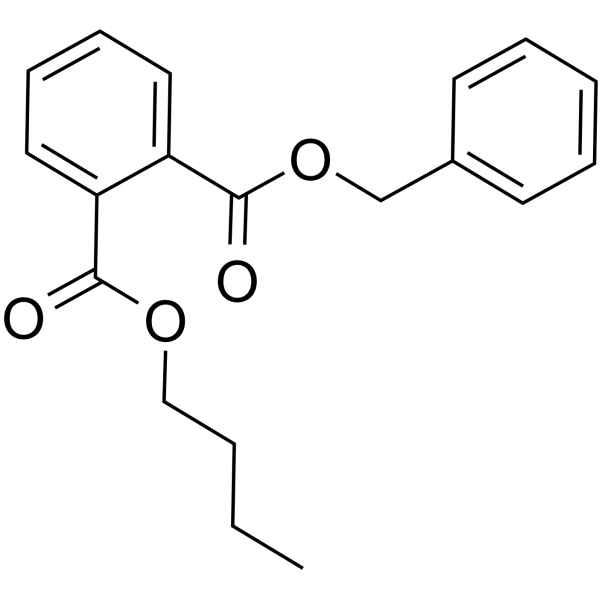
Benzyl butyl phthalate, a member of phthalic acid esters (PAEs), can trigger the migration and invasion of hemangioma (HA) cells via upregulation of Zeb1. Benzyl butyl phthalate activates aryl hydrocarbon receptor (AhR) in breast cancer cells to stimulate SPHK1/S1P/S1PR3 signaling and enhances formation of metastasis-initiating breast cancer stem cells (BCSCs) .
|
-
- HY-W819785
-
|
|
Biochemical Assay Reagents
|
Others
|
|
Benzyl (8-hydroxyoctyl)carbamate is a biochemical reagent that can be used as a biological material or organic compound for life science related research.
|
-
- HY-144344S
-
|
|
Isotope-Labeled Compounds
|
Others
|
|
Benzyl(2R)-3-N,N-dibenzylamino-2-fluoropropanoate- 13C3 is a 13C-labeled and deuterium labeled Benzyl(2R)-3-N,N-dibenzylamino-2-fluoropropanoate .
|
-
- HY-79861
-
-
- HY-B0892S3
-
-
- HY-141413
-
|
|
Biochemical Assay Reagents
|
Others
|
|
Benzyl 2,3-Di-O-benzyl-4-O-benzoyl-β-D-galactopyranoside is a class of biochemical reagents used in glycobiology research. Glycobiology studies the structure, synthesis, biology, and evolution of sugars. It involves carbohydrate chemistry, enzymology of glycan formation and degradation, protein-glycan recognition, and the role of glycans in biological systems. This field is closely related to basic research, biomedicine, and biotechnology .
|
-
- HY-W002603
-
-
- HY-132034
-
|
|
PROTAC Linkers
|
Cancer
|
|
Benzyl-PEG6-t-butyl ester is a PEG-based PROTAC linker that can be used in the synthesis of PROTACs .
|
-
- HY-132081
-
|
|
PROTAC Linkers
|
Cancer
|
|
Benzyl-PEG10-t-butyl ester is a PEG-based PROTAC linker that can be used in the synthesis of PROTACs .
|
-
- HY-132044
-
|
|
PROTAC Linkers
|
Cancer
|
|
Benzyl-PEG8-t-butyl ester is a PEG-based PROTAC linker that can be used in the synthesis of PROTACs .
|
-
- HY-132073
-
|
|
PROTAC Linkers
|
Cancer
|
|
Benzyl-PEG14-t-butyl-ester is a PEG-based PROTAC linker that can be used in the synthesis of PROTACs .
|
-
- HY-132054
-
|
|
PROTAC Linkers
|
Cancer
|
|
Benzyl-PEG17-t-butyl ester is a PEG-based PROTAC linker that can be used in the synthesis of PROTACs .
|
-
- HY-132025
-
|
|
PROTAC Linkers
|
Cancer
|
|
Benzyl-PEG7-t-butyl ester is a PEG-based PROTAC linker that can be used in the synthesis of PROTACs .
|
-
- HY-132049
-
|
|
PROTAC Linkers
|
Cancer
|
|
Benzyl-PEG7-azide is a PEG-based PROTAC linker that can be used in the synthesis of PROTACs . Benzyl-PEG7-azide is a click chemistry reagent, it contains an Azide group and can undergo copper-catalyzed azide-alkyne cycloaddition reaction (CuAAc) with molecules containing Alkyne groups. It can also undergo strain-promoted alkyne-azide cycloaddition (SPAAC) reactions with molecules containing DBCO or BCN groups.
|
-
- HY-138715
-
|
|
PROTAC Linkers
|
Cancer
|
|
Benzyl-PEG4-Azido is a PEG-based PROTAC linker can be used in the synthesis of PROTACs. Benzyl-PEG4-Azido is a click chemistry reagent, it contains an Azide group and can undergo copper-catalyzed azide-alkyne cycloaddition reaction (CuAAc) with molecules containing Alkyne groups. It can also undergo strain-promoted alkyne-azide cycloaddition (SPAAC) reactions with molecules containing DBCO or BCN groups.
|
-
- HY-140744
-
|
|
PROTAC Linkers
|
Cancer
|
|
Benzyl-PEG5-azide is a PEG-based PROTAC linker that can be used in the synthesis of PROTACs . Benzyl-PEG5-azide is a click chemistry reagent, it contains an Azide group and can undergo copper-catalyzed azide-alkyne cycloaddition reaction (CuAAc) with molecules containing Alkyne groups. It can also undergo strain-promoted alkyne-azide cycloaddition (SPAAC) reactions with molecules containing DBCO or BCN groups.
|
-
- HY-134717
-
|
|
PROTAC Linkers
|
Cancer
|
|
Benzyl-PEG24-azide is a PEG-based PROTAC linker that can be used in the synthesis of PROTACs . Benzyl-PEG24-azide is a click chemistry reagent, it contains an Azide group and can undergo copper-catalyzed azide-alkyne cycloaddition reaction (CuAAc) with molecules containing Alkyne groups. It can also undergo strain-promoted alkyne-azide cycloaddition (SPAAC) reactions with molecules containing DBCO or BCN groups.
|
-
- HY-130188
-
|
|
PROTAC Linkers
|
Cancer
|
|
Benzyl-PEG2-azide is a PEG-based PROTAC linker can be used in the synthesis of PROTACs. Benzyl-PEG2-azide is a click chemistry reagent, it contains an Azide group and can undergo copper-catalyzed azide-alkyne cycloaddition reaction (CuAAc) with molecules containing Alkyne groups. It can also undergo strain-promoted alkyne-azide cycloaddition (SPAAC) reactions with molecules containing DBCO or BCN groups.
|
-
- HY-132082
-
|
|
PROTAC Linkers
|
Cancer
|
|
Benzyl-PEG13-azide is a PEG-based PROTAC linker that can be used in the synthesis of PROTACs . Benzyl-PEG13-azide is a click chemistry reagent, it contains an Azide group and can undergo copper-catalyzed azide-alkyne cycloaddition reaction (CuAAc) with molecules containing Alkyne groups. It can also undergo strain-promoted alkyne-azide cycloaddition (SPAAC) reactions with molecules containing DBCO or BCN groups.
|
-
- HY-W096070
-
|
|
PROTAC Linkers
|
Cancer
|
|
Benzyl-PEG6-azide is a PEG-based PROTAC linker that can be used in the synthesis of PROTACs . Benzyl-PEG6-azide is a click chemistry reagent, it contains an Azide group and can undergo copper-catalyzed azide-alkyne cycloaddition reaction (CuAAc) with molecules containing Alkyne groups. It can also undergo strain-promoted alkyne-azide cycloaddition (SPAAC) reactions with molecules containing DBCO or BCN groups.
|
-
- HY-132010
-
|
|
PROTAC Linkers
|
Cancer
|
|
Benzyl-PEG8-azide is a PEG-based PROTAC linker that can be used in the synthesis of PROTACs . Benzyl-PEG8-azide is a click chemistry reagent, it contains an Azide group and can undergo copper-catalyzed azide-alkyne cycloaddition reaction (CuAAc) with molecules containing Alkyne groups. It can also undergo strain-promoted alkyne-azide cycloaddition (SPAAC) reactions with molecules containing DBCO or BCN groups.
|
-
- HY-W275908
-
|
|
PROTAC Linkers
|
Cancer
|
|
Benzyl (2-(2-aminoethoxy)ethyl)carbamate is a PROTAC linker that can be used in the synthesis of PROTACs.
|
-
- HY-W761208
-
|
|
PROTAC Linkers
|
Cancer
|
|
Benzyl (2-(2-bromoethoxy)ethyl)carbamate is a PROTAC linker that can be used in the synthesis of PROTACs.
|
-
- HY-145755
-
-
- HY-W755262
-
|
|
Biochemical Assay Reagents
|
Others
|
|
Benzyl 2-acetamido-2-deoxy-3,6-di-O-benzyl-β-D-glucopyranoside is a class of biochemical reagents used in glycobiology research. Glycobiology studies the structure, synthesis, biology, and evolution of sugars. It involves carbohydrate chemistry, enzymology of glycan formation and degradation, protein-glycan recognition, and the role of glycans in biological systems. This field is closely related to basic research, biomedicine, and biotechnology .
|
-
- HY-W709340
-
|
Benzyl S-Benzyl-N-(tert-butoxycarbonyl)-L-cysteinylglycinate-13C2,15N
|
Isotope-Labeled Compounds
|
Others
|
|
N-Boc-S-Bzl-L-Cys-Gly-OBzl- 13C2, 15N (Benzyl S-benzyl-N-(tert-butoxycarbonyl)-L-cysteinylglycinate- 13C2, 15N) is the 13C- and 15N-labeled Benzyl S-benzyl-N-(tert-butoxycarbonyl)-L-cysteinylglycinate (HY-W699579).
|
-
- HY-44816
-
|
|
Drug Intermediate
|
Others
|
|
Benzyl methyl(2-(methylamino)ethyl)carbamate is a drug intermediate for synthesis of various active compounds.
|
-
- HY-W007017A
-
-
- HY-W442183
-
-
- HY-W058000
-
|
|
PROTAC Linkers
|
Cancer
|
|
Benzyl 3-(hydroxymethyl)azetidine-1-carboxylate is a PROTAC linker that can be used in the synthesis of PROTACs.
|
-
- HY-W002981
-
|
|
PROTAC Linkers
|
Cancer
|
|
Benzyl 4-(aminomethyl)piperidine-1-carboxylate is a PROTAC linker that can be used in the synthesis of PROTACs.
|
-
- HY-140588
-
|
N-Benzyl-N-bis(PEG3-t-butyl ester)
|
PROTAC Linkers
|
Cancer
|
|
Benzyl-N-bis(PEG3-Boc) is a PEG-based PROTAC linker that can be used in the synthesis of PROTACs .
|
-
- HY-139900
-
|
|
Fungal
|
Infection
|
|
Benzyl 2-hydroxy-6-methoxybenzoate shows the strongest antifungal effect, with IC50 of 25–26 μg/mL for both fungal strains.
|
-
- HY-W822795
-
|
|
PROTAC Linkers
|
Cancer
|
|
Benzyl hex-5-yn-1-ylcarbamate is a PROTAC linker that can be used in the synthesis of PROTACs.
|
-
- HY-W552130
-
|
|
Biochemical Assay Reagents
|
Others
|
|
Benzyl 2-acetamido-3,4,6-tri-O-benzyl-2-deoxy-α-D-glucopyranoside is a class of biochemical reagents used in glycobiology research. Glycobiology studies the structure, synthesis, biology, and evolution of sugars. It involves carbohydrate chemistry, enzymology of glycan formation and degradation, protein-glycan recognition, and the role of glycans in biological systems. This field is closely related to basic research, biomedicine, and biotechnology .
|
-
- HY-W014888S
-
|
Benzyl phenyl sylphide-d2
|
Isotope-Labeled Compounds
|
Others
|
|
Benzy(phenyl)sulfane-d2 (Benzyl phenyl sylphide-d2) is the deuterium labeled Benzyl(phenyl)sulfane (HY-W014888) .
|
-
- HY-130738
-
|
|
PROTAC Linkers
|
Cancer
|
|
Benzyl-PEG3-CH2-Boc is a PEG-based PROTAC linker can be used in the synthesis of PROTACs.
|
-
- HY-130172
-
|
|
PROTAC Linkers
|
Cancer
|
|
Benzyl-PEG2-CH2-Boc is a PEG-based PROTAC linker can be used in the synthesis of PROTACs.
|
-
- HY-138476
-
|
|
PROTAC Linkers
|
Cancer
|
|
Benzyl-PEG2-ethoxyethane-PEG2 is a PEG-based PROTAC linker that can be used in the synthesis of PROTACs .
|
-
- HY-W036860
-
|
Benzyl N-{4-aminobicyclo[2.1.1]hexan-1-yl}carbamate hydrochloride
|
Drug Intermediate
|
Others
|
|
Benzyl (4-aminobicyclo[2.1.1]hexan-1-yl)carbamate hydrochloride (Benzyl N-{4-aminobicyclo[2.1.1]hexan-1-yl}carbamate hydrochloride) is a drug intermediate for synthesis of various active compounds.
|
-
- HY-135339
-
|
|
PROTAC Linkers
|
Cancer
|
|
Benzyl-PEG2-CH2COOH is a PEG-based PROTAC linker that can be used in the synthesis of PROTACs .
|
-
- HY-W088806
-
|
|
PROTAC Linkers
|
Cancer
|
|
Benzyl 4-(3-hydroxypropyl)piperidine-1-carboxylate is a PROTAC linker that can be used in the synthesis of PROTACs.
|
-
- HY-W113678
-
|
|
PROTAC Linkers
|
Cancer
|
|
Benzyl 4-(2-hydroxyethyl)piperidine-1-carboxylate is a PROTAC linker that can be used in the synthesis of PROTACs.
|
-
- HY-W822059
-
|
|
PROTAC Linkers
|
Cancer
|
|
Benzyl 3-(2-bromoethyl)azetidine-1-carboxylate is a PROTAC linker that can be used in the synthesis of PROTACs.
|
-
- HY-W088712
-
|
|
Biochemical Assay Reagents
|
Others
|
|
Benzyl N6-(t-Boc)-L-lysinate is a biochemical reagent that can be used as a biological material or organic compound for life science related research.
|
-
- HY-W618963
-
|
|
PROTAC Linkers
|
Cancer
|
|
Benzyl 4-((2-aminoethoxy)methyl)piperidine-1-carboxylate is a PROTAC linker that can be used in the synthesis of PROTACs.
|
-
- HY-124021
-
|
|
Aryl Hydrocarbon Receptor
|
Others
|
|
Benzyl 2-naphthyl ether is a compound mentioned in the study of the effects of aromatic sensitizers on zebrafish embryos. It can cause morphological abnormalities and changes in gene expression in zebrafish embryos. Its toxicity mechanism is partly related to AHR, and there may be other mechanisms independent of AHR.
|
-
- HY-W013231
-
|
Benzyltriethylammonium iodide
|
Biochemical Assay Reagents
|
Others
|
|
N-Benzyl-N,N-diethylethanaminium iodide is a quaternary ammonium salt consisting of a positively charged N-benzyl-N,N-diethylethylamine cation and a negatively charged iodide anion. This compound is commonly used as a phase transfer catalyst in organic chemical reactions, facilitating the transfer of reactants between immiscible phases. It can also be used as a reagent for the synthesis of various organic compounds, and as a surfactant or emulsifier in industrial and personal care products.
|
-
- HY-W075004
-
|
[Benzyl(phosphonomethyl)amino]methylphosphonic acid
|
MOFs
|
Others
|
|
((Benzylazanediyl)bis(methylene))bis(phosphonic acid) ([Benzyl(phosphonomethyl)amino]methylphosphonic acid) is a metal-organic framework (MOF).
|
-
- HY-B0892S
-
-
- HY-172290
-
|
|
ADC Linker
|
Cancer
|
|
Benzyl N1-[PEG1-NHS] -N6-(t-Boc)-L-lysinate is a multifunctional ADC linker consisting of a terminal benzyl group, one PEG unit, an NHS ester, and a t-Boc-protected L-lysine, often used for bioconjugation and chemical modifications in R&D.
|
-
- HY-W088558
-
|
|
Drug Intermediate
|
Others
|
|
Benzyl (1R,3R)-3-hydroxycyclopentane-1-carboxylate is a synthetic intermediate useful for pharmaceutical synthesis.
|
-
- HY-W674500
-
|
|
PROTAC Linkers
|
Cancer
|
|
Benzyl 4-(4-((Tert-butoxycarbonyl)amino)butyl)piperazine-1-carboxylate is a PROTAC linker that can be used in the synthesis of PROTACs.
|
-
- HY-W320548S
-
|
Butanoic acid, 2,4-dibromo-, phenylmethyl ester-d5
|
Isotope-Labeled Compounds
|
Others
|
|
Benzyl 2,4-dibromobutanoate-d5 (Butanoic acid, 2,4-dibromo-, phenylmethyl ester-d5) is the deuterium labeled Benzyl 2,4-dibromobutanoate (HY-W320548).
|
-
- HY-W699843
-
|
|
Biochemical Assay Reagents
|
Others
|
|
Benzyl dibenzylidene-α-D-mannopyranoside is a class of biochemical reagents used in glycobiology research. Glycobiology studies the structure, synthesis, biology, and evolution of sugars. It involves carbohydrate chemistry, enzymology of glycan formation and degradation, protein-glycan recognition, and the role of glycans in biological systems. This field is closely related to basic research, biomedicine, and biotechnology .
|
-
- HY-W153847
-
|
|
Biochemical Assay Reagents
|
Others
|
|
Benzyl β-D-glucopyranoside is a class of biochemical reagents used in glycobiology research. Glycobiology studies the structure, synthesis, biology, and evolution of sugars. It involves carbohydrate chemistry, enzymology of glycan formation and degradation, protein-glycan recognition, and the role of glycans in biological systems. This field is closely related to basic research, biomedicine, and biotechnology .
|
-
- HY-W126745
-
|
|
PROTAC Linkers
|
Cancer
|
|
Benzyl 2,6-diazaspiro[3.3]heptane-2-carboxylate oxalic acid is a PROTAC linker that can be used in the synthesis of PROTACs.
|
-
- HY-N16947
-
|
|
Drug Derivative
|
Others
|
|
Benzyl [5-O-benzoyl-β-D-apiofuranosyl(1→2)]-β-D-glucopyranoside is a natural phenolic compound.
|
-
- HY-W053847
-
|
|
PROTAC Linkers
|
Cancer
|
|
Benzyl 2-oxo-7-azaspiro[3.5]nonane-7-carboxylate is a PROTAC linker that can be used in the synthesis of PROTACs.
|
-
- HY-W050105
-
|
|
PROTAC Linkers
|
Cancer
|
|
Benzyl 6-amino-2-azaspiro[3.3]heptane-2-carboxylate is a PROTAC linker that can be used in the synthesis of PROTACs.
|
-
- HY-W127490
-
-
- HY-W415837
-
|
|
Biochemical Assay Reagents
|
Others
|
|
Benzyl β-D-Lactoside Heptaacetate is a class of biochemical reagents used in glycobiology research. Glycobiology studies the structure, synthesis, biology, and evolution of sugars. It involves carbohydrate chemistry, enzymology of glycan formation and degradation, protein-glycan recognition, and the role of glycans in biological systems. This field is closely related to basic research, biomedicine, and biotechnology .
|
-
- HY-W706346
-
|
|
Biochemical Assay Reagents
|
Others
|
|
Benzyl N,N′-diacetyl-β-chitobioside is a class of biochemical reagents used in glycobiology research. Glycobiology studies the structure, synthesis, biology, and evolution of sugars. It involves carbohydrate chemistry, enzymology of glycan formation and degradation, protein-glycan recognition, and the role of glycans in biological systems. This field is closely related to basic research, biomedicine, and biotechnology .
|
-
- HY-W101367
-
|
N-Acetyl-S-Benzyl-L-cysteine; Benzylmercapturic acid
|
Drug Metabolite
|
Others
|
|
Ac-Cys(Bzl)-OH (N-Acetyl-S-benzyl-L-cysteine) is a toluene metabolite. Ac-Cys(Bzl)-OH in urine samples is a good marker of occupational toluene exposure.
|
-
- HY-W800631
-
|
|
Biochemical Assay Reagents
|
Others
|
|
Benzyl N1-(PEG1-acid)-N6-(t-Boc)-L-lysinate is a biochemical reagent that can be used as a biological material or organic compound for life science related research.
|
-
- HY-75071
-
|
|
Drug Intermediate
|
Others
|
|
Benzyl tetrahydro-1H-pyrrolo[3,4-c]isoxazole-5(3H)-carboxylate is a drug intermediate for synthesis of various active compounds.
|
-
- HY-W674266
-
|
|
Biochemical Assay Reagents
|
Others
|
|
Benzyl N-acetyl-4,6-O-benzylidene normuranic acid is a class of biochemical reagents used in glycobiology research. Glycobiology studies the structure, synthesis, biology, and evolution of sugars. It involves carbohydrate chemistry, enzymology of glycan formation and degradation, protein-glycan recognition, and the role of glycans in biological systems. This field is closely related to basic research, biomedicine, and biotechnology .
|
-
- HY-W357122
-
|
|
Biochemical Assay Reagents
|
Others
|
|
Benzyl 2-acetamido-2-deoxy-beta-D-glucopyranoside is a class of biochemical reagents used in glycobiology research. Glycobiology studies the structure, synthesis, biology, and evolution of sugars. It involves carbohydrate chemistry, enzymology of glycan formation and degradation, protein-glycan recognition, and the role of glycans in biological systems. This field is closely related to basic research, biomedicine, and biotechnology .
|
-
- HY-W703016
-
|
|
Biochemical Assay Reagents
|
Others
|
|
Benzyl N-acetyl-4,6-O-benzylidene-α-isomuramic acid is a class of biochemical reagents used in glycobiology research. Glycobiology studies the structure, synthesis, biology, and evolution of sugars. It involves carbohydrate chemistry, enzymology of glycan formation and degradation, protein-glycan recognition, and the role of glycans in biological systems. This field is closely related to basic research, biomedicine, and biotechnology .
|
-
- HY-W800833
-
|
|
Biochemical Assay Reagents
|
Others
|
|
Benzyl N-[2-(prop-2-enamido)ethyl]carbamate is a short aliphatic linker featuring a Cbz-protected amine and an acrylamide. Acrylamide is a Michael acceptor which is a good Michael acceptor which can be used in thiol-based bioconjugation or polymerization. Meanwhile, the Cbz protecting group can be removed using Pd-C hydrogenation to reveal a free amine that can participate in a wide variety of reactions such as couplings or reductive amination.
|
-
- HY-W776886
-
|
|
Biochemical Assay Reagents
|
Others
|
|
Benzyl 2,3-O-isopropylidene-α-D-mannopentenofuranoside-6-aldehydeis a class of biochemical reagents used in glycobiology research. Glycobiology studies the structure, synthesis, biology, and evolution of sugars. It involves carbohydrate chemistry, enzymology of glycan formation and degradation, protein-glycan recognition, and the role of glycans in biological systems. This field is closely related to basic research, biomedicine, and biotechnology .
|
-
- HY-W739801
-
|
|
Biochemical Assay Reagents
|
Others
|
|
Benzyl 2,3-O-Isopropylidene-6-O-trityl-α-D-mannofuranose is a class of biochemical reagents used in glycobiology research. Glycobiology studies the structure, synthesis, biology, and evolution of sugars. It involves carbohydrate chemistry, enzymology of glycan formation and degradation, protein-glycan recognition, and the role of glycans in biological systems. This field is closely related to basic research, biomedicine, and biotechnology .
|
-
- HY-43347S
-
|
|
Isotope-Labeled Compounds
|
Others
|
|
Benzyl 2-(4-(4-fluorobenzylcarbamoyl)-5-hydroxy-1-methyl-6-oxo-1,6-dihydropyrimidin-2-yl)propan-2-ylcarbamate-d3 is the deuterium labeled Benzyl 2-(4-(4-fluorobenzylcarbamoyl)-5-hydroxy-1-methyl-6-oxo-1,6-dihydropyrimidin-2-yl)propan-2-ylcarbamate .
|
-
- HY-W699199
-
|
|
Biochemical Assay Reagents
|
Others
|
|
Benzyl 2,3,4-Tri-O-acetyl-4-nitromethyl-β-D-arabinopyranoside is a class of biochemical reagents used in glycobiology research. Glycobiology studies the structure, synthesis, biology, and evolution of sugars. It involves carbohydrate chemistry, enzymology of glycan formation and degradation, protein-glycan recognition, and the role of glycans in biological systems. This field is closely related to basic research, biomedicine, and biotechnology .
|
-
- HY-W777089
-
|
|
Biochemical Assay Reagents
|
Others
|
|
Benzyl 5-amino-5-deoxy-2,3-O-isopropyl-α-D-mannofuranoside is a class of biochemical reagents used in glycobiology research. Glycobiology studies the structure, synthesis, biology, and evolution of sugars. It involves carbohydrate chemistry, enzymology of glycan formation and degradation, protein-glycan recognition, and the role of glycans in biological systems. This field is closely related to basic research, biomedicine, and biotechnology .
|
-
- HY-W355196
-
|
|
Biochemical Assay Reagents
|
Others
|
|
Benzyl 2-deoxy-2-phthalimido-4,6-O-benzylidene-β-D-glucopyranosideis a class of biochemical reagents used in glycobiology research. Glycobiology studies the structure, synthesis, biology, and evolution of sugars. It involves carbohydrate chemistry, enzymology of glycan formation and degradation, protein-glycan recognition, and the role of glycans in biological systems. This field is closely related to basic research, biomedicine, and biotechnology .
|
-
- HY-W699293
-
|
|
Biochemical Assay Reagents
|
Others
|
|
Benzyl 2-acetamido-2-deoxy-4,6-O-benzylidene-α-D-galactopyranoside is a class of biochemical reagents used in glycobiology research. Glycobiology studies the structure, synthesis, biology, and evolution of sugars. It involves carbohydrate chemistry, enzymology of glycan formation and degradation, protein-glycan recognition, and the role of glycans in biological systems. This field is closely related to basic research, biomedicine, and biotechnology .
|
-
- HY-W698498
-
|
|
Biochemical Assay Reagents
|
Others
|
|
Benzyl 2-Acetamido-2-deoxy-3-O-(β-D-galactopyranosyl)-α-D-glucopyranoside is a class of biochemical reagents used in glycobiology research. Glycobiology studies the structure, synthesis, biology, and evolution of sugars. It involves carbohydrate chemistry, enzymology of glycan formation and degradation, protein-glycan recognition, and the role of glycans in biological systems. This field is closely related to basic research, biomedicine, and biotechnology .
|
-
- HY-W699261
-
|
|
Biochemical Assay Reagents
|
Others
|
|
Benzyl 2-acetamido-3,6-di-O-benzoyl-2-deoxy-α-D-galactopyranoside is a class of biochemical reagents used in glycobiology research. Glycobiology studies the structure, synthesis, biology, and evolution of sugars. It involves carbohydrate chemistry, enzymology of glycan formation and degradation, protein-glycan recognition, and the role of glycans in biological systems. This field is closely related to basic research, biomedicine, and biotechnology .
|
-
- HY-W699511
-
|
|
Biochemical Assay Reagents
|
Others
|
|
Benzyl 2,3-O-Isopropylidene-6-O-trityl-5-keto-α-D-mannofuranose is a class of biochemical reagents used in glycobiology research. Glycobiology studies the structure, synthesis, biology, and evolution of sugars. It involves carbohydrate chemistry, enzymology of glycan formation and degradation, protein-glycan recognition, and the role of glycans in biological systems. This field is closely related to basic research, biomedicine, and biotechnology .
|
-
- HY-W698516
-
|
|
Biochemical Assay Reagents
|
|
|
Benzyl 2-acetamido-2-deoxy-6-O-(β-D-galactopyranosyl) -α-D-Galactopyranoside is a class of biochemical reagents used in the study of glycobiology. Glycobiology studies the structure, synthesis, biology, and evolution of sugars. It deals with carbohydrate chemistry, glycan formation and degradation enzymology, protein-glycan recognition, and the role of glycans in biological systems. The field is closely related to basic research, biomedicine and biotechnology .
|
-
- HY-W333469
-
|
|
Biochemical Assay Reagents
|
Others
|
|
Benzyl 2-acetamido-4,6-O-benzylidene-2-deoxy-α-D-glucopyranoside 3-acetate is a class of biochemical reagents used in glycobiology research. Glycobiology studies the structure, synthesis, biology, and evolution of sugars. It involves carbohydrate chemistry, enzymology of glycan formation and degradation, protein-glycan recognition, and the role of glycans in biological systems. This field is closely related to basic research, biomedicine, and biotechnology .
|
-
- HY-W410995
-
|
|
Biochemical Assay Reagents
|
Others
|
|
Benzyl 2-deoxy-2-phthalimido-3,4,6-tri-O-acetyl-β-D-glucopyranosideis a class of biochemical reagents used in glycobiology research. Glycobiology studies the structure, synthesis, biology, and evolution of sugars. It involves carbohydrate chemistry, enzymology of glycan formation and degradation, protein-glycan recognition, and the role of glycans in biological systems. This field is closely related to basic research, biomedicine, and biotechnology .
|
-
- HY-W703826
-
|
|
Biochemical Assay Reagents
|
|
|
Benzyl 2-acetamido-2, 6-dideoxy-3-o-β-D-Galactopyranosyl-α-d-Galactopyranoside is a class of biochemical reagents used in glycobiology studies. Glycobiology studies the structure, synthesis, biology, and evolution of sugars. It deals with carbohydrate chemistry, glycan formation and degradation enzymology, protein-glycan recognition, and the role of glycans in biological systems. The field is closely related to basic research, biomedicine and biotechnology .
|
-
- HY-W777090
-
|
|
Biochemical Assay Reagents
|
Others
|
|
Benzyl 5-amino-5-deoxy-2,3-O-isopropylidene-6-O-trityl-α-D-mannofuranoside is a class of biochemical reagents used in glycobiology research. Glycobiology studies the structure, synthesis, biology, and evolution of sugars. It involves carbohydrate chemistry, enzymology of glycan formation and degradation, protein-glycan recognition, and the role of glycans in biological systems. This field is closely related to basic research, biomedicine, and biotechnology .
|
-
- HY-W699260
-
|
|
Biochemical Assay Reagents
|
Others
|
|
Benzyl 2-acetamido-3,6-di-O-benzoyl-2,4-dideoxy-4-fluoro-α-D-glucopyranose is a class of biochemical reagents used in glycobiology research. Glycobiology studies the structure, synthesis, biology and evolution of sugars. It involves carbohydrate chemistry, enzymology of glycan formation and degradation, protein-Glycan recognition and the role of glycans in biological systems. This field is closely related to basic research, biomedicine and biotechnology.
|
-
- HY-W699164
-
|
Benzyl β-D-galactopyranosyl-(1→4)-β-D-N-acetylglucosamine
|
Biochemical Assay Reagents
|
Others
|
|
Gal1-β-4GlcNAc-β-Bn (Benzyl β-D-galactopyranosyl-(1→4)-β-D-N-acetylglucosamine) is a class of biochemical reagents used in glycobiology research. Glycobiology studies the structure, synthesis, biology, and evolution of sugars. It involves carbohydrate chemistry, enzymology of glycan formation and degradation, protein-glycan recognition, and the role of glycans in biological systems. This field is closely related to basic research, biomedicine, and biotechnology .
|
-
- HY-76819
-
|
|
Drug Intermediate
|
Others
|
|
Benzyl (3aS,4R,6S,6aR)-6-hydroxy-2,2-dimethyltetrahydro-3aH-cyclopenta[d][1,3]dioxol-4-ylcarbamate is a drug intermediate for synthesis of various active compounds.
|
-
- HY-W698499
-
|
|
Biochemical Assay Reagents
|
Others
|
|
Benzyl 2-acetamido-3-O-(2,3,4,6-tetra-O-acetyl-β-D-galactopyranosyl-2-deoxy-α-D-glucopyranoside is a class of biochemical reagents used in glycobiology research. Glycobiology studies the structure, synthesis, biology, and evolution of sugars. It involves carbohydrate chemistry, enzymology of glycan formation and degradation, protein-glycan recognition, and the role of glycans in biological systems. This field is closely related to basic research, biomedicine, and biotechnology .
|
-
- HY-W699294
-
|
|
Biochemical Assay Reagents
|
Others
|
|
Benzyl 2-acetamido-2-deoxy-3-O-(2',3',4',6'-tetra- O-acetyl-β-D-galactopyranosyl)-α-D-galactopyranoside is a class of biochemical reagents used in glycobiology research. Glycobiology studies the structure, synthesis, biology and evolution of sugars. It involves carbohydrate chemistry, enzymology of glycan formation and degradation, protein-Glycan recognition and the role of glycans in biological systems. This field is closely related to basic research, biomedicine and biotechnology.
|
-
- HY-W018454
-
|
|
Biochemical Assay Reagents
|
Others
|
|
Benzyl trimethyl ammonium tribromide is an organic ammonium tribromide. Benzyl trimethyl ammonium tribromide provides controlled bromide ions, enabling efficient cyclization and oxidation while minimizing side reactions caused by excess bromine. Benzyl trimethyl ammonium tribromide can be used in the synthesis of 2-aminobenzothiazole compounds .
|
-
- HY-W800684
-
|
|
Biochemical Assay Reagents
|
Others
|
|
Benzyloxy carbonyl-PEG4-NHS ester is a reagent with a benzyl protecting group and an NHS ester. The NHS ester reacts with primary amines (-NH2). The benzyl protecting group can be removed by hydrogenolysis.
|
-
- HY-W000993
-
|
|
Biochemical Assay Reagents
|
Others
|
|
2-Benzyl-4,4,5,5-tetramethyl-1,3,2-dioxaborolane is a biochemical reagent that can be used as a biological material or organic compound for life science related research.
|
-
- HY-W800681
-
|
|
Biochemical Assay Reagents
|
Others
|
|
Benzyloxy carbonyl-PEG4-acid is a linker with a benzyl protecting group and a carboxylic acid. The carboxylic acid can undergo reactions with primary amines with the help of activators (EDC or HATU). The benzyl protecting group can be removed via hydrogenolysis.
|
-
- HY-W699766
-
-
- HY-W698505
-
-
- HY-W069177
-
|
6-Benzyl-2-thiouracil
|
TSH Receptor
|
Others
|
|
Benzylthiouracil is an active pharmaceutical ingredient against hyperthyroidism .
|
-
- HY-W016321
-
|
N-PhenylBenzylamine; Benzylaniline
|
Drug Derivative
|
Others
|
|
N-Benzylaniline (N-Phenylbenzylamine) is an N-alkylated derivative of aniline .
|
-
- HY-W127697
-
|
N-Benzyl-N,N-diethylethanaminium tetrahydroborate
|
Biochemical Assay Reagents
|
Others
|
|
Benzyltriethylammonium Borohydride is a biochemical reagent that can be used as a biological material or organic compound for life science related research.
|
-
- HY-ER019
-
|
N-Benzyl-N,N-dibutylbutan-1-aminium chloride
|
Biochemical Assay Reagents
|
Others
|
|
Benzyltributylammonium chloride is an organic salt compound, usually used in catalytic reactions and surfactants. It can play a catalytic role in some organic synthesis reactions, and can be used as a cleaning agent, lubricant and emulsifier. In addition, the compound is widely used in certain industrial fields, such as in the plastic, rubber and textile manufacturing processes.
|
-
- HY-B1290
-
|
Phenylethyl alcohol; Phenethyl alcohol; Benzyl carbinol
|
Environmental Pollutants
Bacterial
Virus Protease
|
Infection
|
|
2-Phenylethanol (Phenethyl alcohol) is an aromatic alcohol with a rose-like odour. 2-Phenylethanol is a flavour and fragrance compound, and can be used as a preservative and anti-microbial agent. 2-Phenylethanol has antityrosinase and antimicrobial activities .
|
-
- HY-B1290R
-
|
Phenylethyl alcohol (Standard); Phenethyl alcohol (Standard); Benzyl carbinol (Standard)
|
Virus Protease
Bacterial
Reference Standards
|
Infection
|
|
2-Phenylethanol (Standard) is the analytical standard of 2-Phenylethanol. This product is intended for research and analytical applications. 2-Phenylethanol (Phenethyl alcohol) is an aromatic alcohol with a rose-like odour. 2-Phenylethanol is a flavour and fragrance compound, and can be used as a preservative and anti-microbial agent. 2-Phenylethanol has antityrosinase and antimicrobial activities .
|
-
- HY-138152
-
|
Benzyl-D-Arg-Gly-Arg-pNA dihydrochloride
|
Fluorescent Dye
|
Others
|
|
Z-D-Arg-Gly-Arg-pNA dihydrochloride is a hydrolytic chromogenic plasmin substrate .
|
-
- HY-W011087
-
|
|
Environmental Pollutants
Biochemical Assay Reagents
|
Others
|
|
Benzyldimethyltetradecylammonium chloride is a quaternary ammonium salt consisting of a positively charged N-benzyl-N,N-dimethyltetradecyl-1-amine cation and a negatively charged chloride anion. The compound is commonly used as a surfactant and emulsifier in a variety of applications including detergents, fabric softeners and personal care products. It also has antimicrobial properties and is used as a disinfectant or antiseptic in some products.
|
-
- HY-W011087R
-
|
|
Biochemical Assay Reagents
Reference Standards
|
Others
|
|
Benzyldimethyltetradecylammonium (chloride) (Standard) is the analytical standard of Benzyldimethyltetradecylammonium (chloride). This product is intended for research and analytical applications. Benzyldimethyltetradecylammonium chloride is a quaternary ammonium salt consisting of a positively charged N-benzyl-N,N-dimethyltetradecyl-1-amine cation and a negatively charged chloride anion. The compound is commonly used as a surfactant and emulsifier in a variety of applications including detergents, fabric softeners and personal care products. It also has antimicrobial properties and is used as a disinfectant or antiseptic in some products.
|
-
- HY-B1290S1
-
|
Phenylethyl alcohol-d9; Phenethyl alcohol-d9; Benzyl carbinol-d9
|
Bacterial
Virus Protease
Antibiotic
|
Infection
|
|
2-Phenylethanol-d9 is the deuterium labeled 2-Phenylethanol . 2-Phenylethanol (Phenethyl alcohol), extracted from rose, carnation, hyacinth, Aleppo pine, orange blossom and other organisms, is a colourless liquid. It has a pleasant floral odor and also an autoantibiotic produced by the fungus Candida albicans . It is used as an additive in cigarettes and also used as a preservative in soaps due to its stability in basic conditions.
|
-
- HY-B1290S2
-
|
Phenylethyl alcohol-d5; Phenethyl alcohol-d5; Benzyl carbinol-d5
|
Bacterial
Virus Protease
Antibiotic
|
Infection
|
|
2-Phenylethanol-d5 is the deuterium labeled 2-Phenylethanol . 2-Phenylethanol (Phenethyl alcohol), extracted from rose, carnation, hyacinth, Aleppo pine, orange blossom and other organisms, is a colourless liquid. It has a pleasant floral odor and also an autoantibiotic produced by the fungus Candida albicans . It is used as an additive in cigarettes and also used as a preservative in soaps due to its stability in basic conditions.
|
-
- HY-B1290S
-
|
Phenylethyl alcohol-d4; Phenethyl alcohol-d4; Benzyl carbinol-d4
|
Bacterial
Virus Protease
Antibiotic
|
Infection
|
|
2-Phenylethanol-d4 is the deuterium labeled 2-Phenylethanol . 2-Phenylethanol (Phenethyl alcohol), extracted from rose, carnation, hyacinth, Aleppo pine, orange blossom and other organisms, is a colourless liquid. It has a pleasant floral odor and also an autoantibiotic produced by the fungus Candida albicans . It is used as an additive in cigarettes and also used as a preservative in soaps due to its stability in basic conditions.
|
-
- HY-W099594
-
|
Benzyldimethyldodecylammonium bromide
|
Environmental Pollutants
Biochemical Assay Reagents
|
Others
|
|
N-Benzyl-N, N-dimethyldodecan-1-aminium bromide, also known as Benzalkonium Chloride (BAC), is a quaternary ammonium compound widely used as an antimicrobial and surfactant in various industries. BAC is commonly used as a disinfectant and antiseptic in a variety of products including hand sanitizers, disinfectant wipes and eye drops. Its ability to kill bacteria, viruses and fungi makes it an effective tool in preventing the spread of infection. BAC is also used as a preservative and disinfectant in the food industry. It is added to food packaging and processing equipment to prevent the growth of microorganisms and increase the shelf life of foods. Additionally, BACs are found in many household products such as cleaning solutions, fabric softeners and personal care products. Its surfactant properties allow it to be used to reduce surface tension and increase the effectiveness of cleaning agents. Although BAC has many uses, ingestion or exposure to high concentrations of BAC can cause skin irritation and other adverse effects.
|
-
- HY-B1290S3
-
|
Phenylethyl alcohol-13C2; Phenethyl alcohol-13C2; Benzyl carbinol-13C2
|
Bacterial
Virus Protease
Isotope-Labeled Compounds
|
Infection
|
|
2-Phenylethanol- 13C2 is 13C labeled 2-Phenylethanol (HY-B1290). 2-Phenylethanol (Phenethyl alcohol) is an aromatic alcohol with a rose-like odour. 2-Phenylethanol is a flavour and fragrance compound, and can be used as a preservative and anti-microbial agent. 2-Phenylethanol has antityrosinase and antimicrobial activities .
|
-
- HY-W020655
-
|
D-(-)-Mandelic Acid Benzyl Ester
|
Drug Intermediate
|
Others
|
|
(R)-Benzyl mandelate (D-(-)-Mandelic Acid Benzyl Ester) is a synthetic intermediate useful for pharmaceutical synthesis.
|
-
- HY-W015158
-
-
- HY-42066
-
|
S)-3-Amino-4-(Benzyloxy)-4-oxobutanoic acid; 1-Benzyl L-aspartate; Aspartic acid 1-Benzyl ester; Aspartic acid α-Benzyl ester
|
Amino Acid Derivatives
|
Others
|
|
L-Aspartic acid 1-benzyl ester is an aspartic acid derivative .
|
-
- HY-CE01827
-
-
- HY-W726600
-
|
|
Herbicide
|
Infection
|
|
Florpyrauxifen-benzyl is an auxin herbicide. Florpyrauxifen-benzyl is promising for research of agricultural weeds, such as Echinochloa crusgalli in rice paddies .
|
-
- HY-W726600S
-
|
|
Isotope-Labeled Compounds
Herbicide
|
Others
|
|
Florpyrauxifen-benzyl-d5 is the deuterium labeled Florpyrauxifen-benzyl (HY-W726600). Florpyrauxifen-benzyl is an auxin herbicide. Florpyrauxifen-benzyl is promising for research of agricultural weeds, such as Echinochloa crusgalli in rice paddies .
|
-
- HY-Z0061R
-
|
|
Reference Standards
|
|
|
Valsartan benzyl ester (Standard) is the analytical standard of Valsartan benzyl ester. This product is intended for research and analytical applications.
|
-
- HY-30230
-
-
- HY-W347776
-
-
- HY-42069
-
-
- HY-W111999
-
|
|
Endogenous Metabolite
|
Neurological Disease
|
|
1-Benzyl-3-phenylthiourea is a sensor material for detecting nerve agents and related simulants, and has biosensor activity. 1-Benzyl-3-phenylthiourea can be used to increase the sensitivity of sensors to nerve agents and enhance detection capabilities. The reaction characteristics of 1-Benzyl-3-phenylthiourea are similar to those of nerve agents and their simulants, making it show good results in detection .
|
-
- HY-138369
-
-
- HY-41882
-
|
(-)-4-Benzyl-2-oxazolidinone
|
Biochemical Assay Reagents
|
Others
|
|
(S)-4-Benzyl-2-oxazolidinone is a biochemical reagent that can be used as a biological material or organic compound for life science related research.
|
-
- HY-W090078
-
|
1-Benzyl-3-methylimidazolium bromide
|
MOFs
|
Others
|
|
3-Benzyl-1-methyl-1H-imidazol-3-ium bromide (1-Benzyl-3-methylimidazolium bromide) is a metal-organic framework (MOF).
|
-
- HY-138468
-
|
|
PROTAC Linkers
|
Cancer
|
|
Boc-PEG25-benzyl is a PEG-based PROTAC linker that can be used in the synthesis of PROTACs .
|
-
- HY-133316
-
|
|
PROTAC Linkers
|
Cancer
|
|
HO-PEG4-benzyl ester is a PEG-based PROTAC linker that can be used in the synthesis of PROTACs .
|
-
- HY-133315
-
|
|
PROTAC Linkers
|
Cancer
|
|
HO-PEG1-benzyl ester is a PEG-based PROTAC linker that can be used in the synthesis of PROTACs .
|
-
- HY-132019
-
|
|
PROTAC Linkers
|
Cancer
|
|
Methylamino-PEG7-benzyl is a PEG-based PROTAC linker that can be used in the synthesis of PROTACs .
|
-
- HY-W045315
-
|
(R)-4-Benzyl-5-oxo-3-morpholinecarboxylic Acid
|
MOFs
|
Others
|
|
(3R)-4-Benzyl-5-oxomorpholine-3-carboxylic acid ((R)-4-Benzyl-5-oxo-3-morpholinecarboxylic Acid) is a metal-organic framework (MOF).
|
-
- HY-W007664
-
|
|
Drug Intermediate
Cytochrome P450
|
Cancer
|
|
(R)-4-Benzyl-2-oxazolidinone is an oxazolidinone-type auxiliary that enables highly stereoselective asymmetric alkylation reactions. (R)-4-Benzyl-2-oxazolidinone is applied in the total synthesis of natural products and pharmaceutical preparations. Especially in pharmaceutical research and development, (R)-4-Benzyl-2-oxazolidinone not only serves as a key precursor for the synthesis of aromatase inhibitors, but also can be used in studies related to estrogen-dependent breast cancer .
|
-
- HY-W013110S
-
-
- HY-I0909S
-
-
- HY-166872S
-
-
- HY-140239
-
|
|
PROTAC Linkers
|
Cancer
|
|
Amino-PEG4-benzyl ester is a PEG- and Alkyl/ether-based PROTAC linker that can be used in the synthesis of PROTACs .
|
-
- HY-W042417R
-
|
N-Benzyl-N-methylethanolamine (Standard)
|
Reference Standards
|
|
|
2-(Benzyl(methyl)amino)ethanol (Standard) is the analytical standard of 2-(Benzyl(methyl)amino)ethanol. This product is intended for research and analytical applications.
|
-
- HY-W770176
-
-
- HY-W287562
-
|
5-Benzyl-Meldrum's acid
|
Drug Intermediate
|
Others
|
|
5-Benzyl-2,2-dimethyl-1,3-dioxane-4,6-dione (5-Benzyl-Meldrum's acid) is a drug intermediate for synthesis of various active compounds.
|
-
- HY-W683849A
-
-
- HY-169835
-
|
|
mGluR
|
Neurological Disease
|
|
1-Benzyl-APDC acts as an agonist for mGluR6, with an EC50 of 20 μM in CHO cells. 1-Benzyl-APDC is a weak antagonist of mGluR2, with an IC50 of 200 μM .
|
-
- HY-79908A
-
-
- HY-W294556S
-
-
- HY-132746S
-
-
- HY-W003903A
-
-
- HY-W042417S
-
|
N-Benzyl-N-methylethanolamine-d4
|
Isotope-Labeled Compounds
|
Others
|
|
2-(Benzyl(methyl)amino)ethanol-d4 is the deuterium labeled 2-(Benzyl(methyl)amino)ethanol .
|
-
- HY-W013791
-
|
4-Benzyl Albuterol
|
Drug Intermediate
|
Others
|
|
Salbutamol impurity 11 (4-Benzyl Albuterol) is an impurity of Salbutamol.
|
-
- HY-W041864
-
-
- HY-78906
-
-
- HY-W015788
-
|
Styrene Glycol
|
Environmental Pollutants
Drug Metabolite
Biochemical Assay Reagents
|
Neurological Disease
|
|
1-Phenylethane-1,2-diol (Styrene Glycol) is a benzyl diol compound, which is the major metabolite of Styrene. 1-Phenylethane-1,2-diol can be oxidized to hydroxyl ketone (2-hydroxy-1-phenylethan-1-one) selectively with variety of catalysts, including organocatalysts, metal complexes, non-noble metal oxides, bimetallics .
|
-
- HY-W497908
-
-
- HY-115765
-
-
- HY-I0716
-
|
|
Drug Intermediate
|
Others
|
|
3-Benzyl-6-bromo-2-methoxyquinoline is a drug intermediate for synthesis of various active compounds.
|
-
- HY-78184
-
|
|
Drug Intermediate
|
Others
|
|
1-Boc-3-benzyl-3-piperidinecarboxylic acid is a drug intermediate for synthesis of various active compounds.
|
-
- HY-131091
-
|
|
Amino Acid Derivatives
|
Others
|
|
Boc-Glu(OBzl)-OSu can be used for the solid-phase peptide synthesis containing glutamate benzyl ester residues.
|
-
- HY-W061616
-
|
3,4,6-Tri-O-Benzyl-D-glucal, 97%
|
Biochemical Assay Reagents
|
Others
|
|
Tri-O-benzyl-D-glucal, 97% (3,4,6-Tri-O-benzyl-D-glucal, 97%) can be used in glycobiology research.
|
-
- HY-W018620
-
-
- HY-W009908
-
-
- HY-30232
-
-
- HY-Y0028
-
|
N-(tert-Butoxycarbonyl)aspartic acid 1-Benzyl ester; N-(tert-Butoxycarbonyl)aspartic acid Benzyl ester
|
Amino Acid Derivatives
|
Others
|
|
(S)-2-(tert-Butoxycarbonylamino)succinic acid benzyl ester is an aspartic acid derivative .
|
-
- HY-W742819
-
-
- HY-168826
-
-
- HY-W702354
-
|
|
Isotope-Labeled Compounds
|
Others
|
|
1'-Benzyl-1,4'-bipiperidine-4'-carboxamide-d10 is the deuterium labeled 1'-Benzyl-[1,4'-bipiperidine]-4'-carboxamide (HY-48342).
|
-
- HY-W702355
-
|
|
Isotope-Labeled Compounds
|
Others
|
|
1'-Benzyl-1,4'-bipiperidine-4'-carbonitrile-d10 is the deuterium labeled 1'-Benzyl-[1,4'-bipiperidine]-4'-carbonitrile (HY-44489).
|
-
- HY-132730S
-
-
- HY-W738320
-
|
|
Isotope-Labeled Compounds
|
Others
|
|
Carboxyphosphamide Benzyl Ester-d4 is the deuterium labeled Benzyl 3-((amino(bis(2-chloroethyl)amino)phosphoryl)oxy)propanoate (HY-W701421).
|
-
- HY-152725
-
|
|
Nucleoside Antimetabolite/Analog
|
Others
|
|
N1-Benzyl pseudouridine is a purine nucleoside analogue. Purine nucleoside analogs have broad antitumor activity targeting indolent lymphoid malignancies. Anticancer mechanisms in this process rely on inhibition of DNA synthesis, induction of apoptosis, etc .
|
-
- HY-175154
-
|
(1S,3S)-Benzyl-3-hydroxycyclopentanecarboxylate
|
Drug Intermediate
|
Others
|
|
(1S,3S)-3-Hydroxycyclopentane carboxylic acid benzyl ester ((1S,3S)-Benzyl-3-hydroxycyclopentanecarboxylate) is a synthetic intermediate. (1S,3S)-3-Hydroxycyclopentane carboxylic acid benzyl ester is useful for pharmaceutical synthesis.
|
-
- HY-W424717
-
|
1-Benzyl vinyl medetomidine
|
Drug Intermediate
|
Others
|
|
Dexmedetomidine impurity 7 (1-Benzyl vinyl medetomidine) is an impurity of Dexmedetomidine.
|
-
- HY-W750774
-
|
N-3-propionyl-(4R)-Benzyl-2-oxazolidinone-d3
|
Isotope-Labeled Compounds
|
Others
|
|
(R)-4-Benzyl-3-propionyloxazolidin-2-one-d3 (N-3-propionyl-(4R)-benzyl-2-oxazolidinone-d3) is the deuterium labeled (R)-4-Benzyl-3-propionyloxazolidin-2-one (HY-W008773).
|
-
- HY-75605
-
|
|
Drug Intermediate
|
Others
|
|
Methyl 1-benzyl-4-methylpyrrolidine-3-carboxylate is a drug intermediate for synthesis of various active compounds.
|
-
- HY-W006185
-
-
- HY-W101367S
-
-
- HY-W554799
-
-
- HY-W004110
-
-
- HY-138475
-
|
|
PROTAC Linkers
|
Cancer
|
|
Boc-PEG2-ethoxyethane-PEG2-benzyl is a PEG-based PROTAC linker that can be used in the synthesis of PROTACs .
|
-
- HY-I0450S
-
-
- HY-W057811
-
|
|
Drug Intermediate
|
Others
|
|
cis-Benzyl 3-hydroxycyclobutylcarbamate is a drug intermediate for synthesis of various active compounds.
|
-
- HY-I0169R
-
|
|
Reference Standards
Drug Metabolite
|
Neurological Disease
|
|
(R)-Amino-N-benzyl-3-methoxypropionamide (Standard) is the analytical standard of (R)-Amino-N-benzyl-3-methoxypropionamide. This product is intended for research and analytical applications. (R)-Amino-N-benzyl-3-methoxypropionamide is a stable intermediate of Lacosamide (an antiepileptic drug) .
|
-
- HY-168832
-
-
- HY-W002303
-
-
- HY-175161
-
|
(1R,3S)-Benzyl-3-hydroxycyclopentanecarboxylate
|
Biochemical Assay Reagents
|
Others
|
|
(1R,3S)-3-Hydroxycyclopentane carboxylic acid benzyl ester ((1R,3S)-Benzyl-3-hydroxycyclopentanecarboxylate) is an intermediate in organic synthesis.
|
-
- HY-139491S
-
-
- HY-118547
-
|
2-Benzyl-4-chlorophenol
|
Bacterial
|
Infection
|
|
Clorofene (2-Benzyl-4-chlorophenol) is an aryl halide fungicide widely used in hospitals and homes as a broad-spectrum fungicide in general cleaning and disinfection disinfectant solutions and in soap formulations. Clorofene has antibacterial and carcinogenic activity .
|
-
- HY-N2735
-
|
|
Influenza Virus
|
Infection
Inflammation/Immunology
|
|
7,3',4'-Trihydroxy-3-benzyl-2H-chromene is an reversible noncompetitive neuraminidase (NA) inhibitor. 7,3',4'-Trihydroxy-3-benzyl-2H-chromene can be isolated from the dried heartwood of Caesalpinia sappan L. 7,3',4'-Trihydroxy-3-benzyl-2H-chromene has potent NAs inhibitory activities with IC50 values of 34.6 µM [H1N1], 39.5 µM [H3N2], and 50.5µM [H9N2], respectively. 7,3',4'-Trihydroxy-3-benzyl-2H-chromene can be used for the research of influenza virus .
|
-
- HY-30809
-
|
|
Drug Intermediate
|
Others
|
|
2-Benzyl-2,5-diazaspiro[3.4]octane dihydrochloride is a drug intermediate for synthesis of various active compounds.
|
-
- HY-30534
-
|
|
PROTAC Linkers
|
Cancer
|
|
3-Benzyl-3,9-diazaspiro[5.5]undecane is a PROTAC linker that can be used in the synthesis of PROTACs.
|
-
- HY-30761A
-
|
|
Drug Intermediate
|
Others
|
|
7-Benzyl-2,7-diazaspiro[3.5]nonane dihydrochloride is a drug intermediate for synthesis of various active compounds.
|
-
- HY-W743864
-
|
|
Isotope-Labeled Compounds
|
Others
|
|
4-Benzyl-1-piperazineacetic Acid Hydrazide-d8 is the deuterium labeled 1-Piperazineacetic acid, 4-(phenylmethyl)-, hydrazide (HY-40270).
|
-
- HY-138652
-
|
|
Bacterial
|
Others
|
|
L-Histidine benzyl ester bistosylate could play a role in the activation of HutP (an RNA-binding protein) .
|
-
- HY-W004217
-
|
|
Drug Intermediate
|
Others
|
|
cis-1-Benzyl-3,5-dimethyl-4-oxopiperidine is a drug intermediate for synthesis of various active compounds.
|
-
- HY-Z0061
-
|
|
Drug Intermediate
|
Others
|
|
Valsartan benzyl ester is an intermediate of Valsartan (HY-18204). Valsartan is an angiotensin II receptor antagonist and has the potential for high blood pressure and heart failure research .
|
-
- HY-W778173
-
-
- HY-79132
-
-
- HY-W015788R
-
|
Styrene Glycol (Standard)
|
Biochemical Assay Reagents
Reference Standards
Drug Metabolite
|
Neurological Disease
|
|
1-Phenylethane-1,2-diol (Standard) is the analytical standard of 1-Phenylethane-1,2-diol. This product is intended for research and analytical applications. 1-Phenylethane-1,2-diol (Styrene Glycol) is a benzyl diol compound, which is the major metabolite of Styrene. 1-Phenylethane-1,2-diol can be oxidized to hydroxyl ketone (2-hydroxy-1-phenylethan-1-one) selectively with variety of catalysts, including organocatalysts, metal complexes, non-noble metal oxides, bimetallics[1][2][3].
|
-
- HY-W029659
-
-
- HY-W129448
-
-
- HY-W141771
-
-
- HY-W004064
-
-
- HY-W151576
-
|
|
PROTAC Linkers
|
Cancer
|
|
3-[Benzyl(methyl)amino]propanoic acid is a PROTAC linker that can be used in the synthesis of PROTACs.
|
-
- HY-W543716
-
|
|
MOFs
|
Others
|
|
1-Benzyl-6-oxo-1,6-dihydropyridine-2-carboxylicacid is a metal-organic framework (MOF).
|
-
- HY-157386S
-
-
- HY-W403047
-
|
|
Biochemical Assay Reagents
|
Others
|
|
Methyl 2,3,4-Tri-O-benzyl-α-D-glucuronic Acid, Benzyl Ester is a class of biochemical reagents used in glycobiology research. Glycobiology studies the structure, synthesis, biology, and evolution of sugars. It involves carbohydrate chemistry, enzymology of glycan formation and degradation, protein-glycan recognition, and the role of glycans in biological systems. This field is closely related to basic research, biomedicine, and biotechnology .
|
-
- HY-Z7998
-
|
Aceclofenac Benzyl ester
|
Drug Intermediate
|
Others
|
|
Aceclofenac impurity 4 (Aceclofenac benzyl ester) is an impurity of Aceclofenac.
|
-
- HY-W741963
-
-
- HY-W250115
-
|
|
Biochemical Assay Reagents
|
Others
|
|
Triethy benzyl ammonium tribromide is a biochemical reagent that can be used as a biological material or organic compound for life science related research.
|
-
- HY-136140
-
|
|
PROTAC Linkers
|
Cancer
|
|
Aldehyde-benzyl-PEG5-alkyne is a PEG-based PROTAC linker that can be used in the synthesis of PROTACs . Aldehyde-benzyl-PEG5-alkyne is a click chemistry reagent, it contains an Alkyne group and can undergo copper-catalyzed azide-alkyne cycloaddition (CuAAc) with molecules containing Azide groups.
|
-
- HY-42520
-
|
|
Drug Intermediate
|
Others
|
|
(S)-4-Benzyl-3-(5-bromopentanoyl)oxazolidin-2-one is a drug intermediate for synthesis of various active compounds.
|
-
- HY-W002176
-
-
- HY-42549
-
|
|
Drug Intermediate
|
Others
|
|
N-[4-(Trifluoromethyl)benzyl]piperazine is a drug intermediate for synthesis of various active compounds.
|
-
- HY-W039951
-
|
|
PROTAC Linkers
|
Cancer
|
|
N-(3-Hydroxypropyl)carbamic acid benzyl ester is a PROTAC linker that can be used in the synthesis of PROTACs.
|
-
- HY-W555457
-
-
- HY-I1084
-
|
|
Drug Intermediate
|
Others
|
|
3-Benzyl-6-bromo-1H-quinolin-2-one is a drug intermediate for synthesis of various active compounds.
|
-
- HY-44924
-
|
|
Drug Intermediate
|
Others
|
|
1-Benzyl-2-methyl-1H-imidazole-5-carbaldehyde is a drug intermediate for synthesis of various active compounds.
|
-
- HY-W063269
-
-
- HY-W003991
-
-
- HY-W141895
-
-
- HY-W005485
-
|
2,3,4,6-Tetra-O-Benzyl-D-glucono-1,5-lactone
|
Biochemical Assay Reagents
|
Others
|
|
Tetra-O-benzyl-δ-D-Gluconolactone (2,3,4,6-Tetra-O-benzyl-D-glucono-1,5-lactone) is a 1,5-sugar lactone and protected D-glucono-1,5-lactone, which serves as a synthetic intermediate in the field of carbohydrate chemistry. Tetra-O-benzyl-δ-D-Gluconolactone acts as a model substrate for zinc-mediated Barbier allylation, crotylation and propargylation reactions .
|
-
- HY-18172
-
-
- HY-N10159
-
|
|
E1/E2/E3 Enzyme
|
Cancer
|
|
1-Benzyl-I3C is a NEDD4-1 inhibitor with significant anticancer activity. 1-Benzyl-I3C can directly inhibit the ubiquitination activity of NEDD4-1 with an IC50 of 12.3μM, which is significantly better than its precursor compound I3C of 284μM. 1-Benzyl-I3C and its analogs showed good effects in inhibiting the proliferation of human melanoma cells, which is roughly related to their potency as NEDD4-1 enzyme inhibitors. By combining in vitro ubiquitination experiments and thermal stability analysis, 1-Benzyl-I3C was shown to be able to bind to the catalytic HECT domain of NEDD4-1 .
|
-
- HY-W742818
-
-
- HY-W027595
-
-
- HY-W424715
-
|
N-Benzyl medetomidine
|
Drug Intermediate
|
Others
|
|
Dexmedetomidine impurity 6 (N-Benzyl medetomidine) is an impurity of Dexmedetomidine.
|
-
- HY-W345169
-
|
Donepezil Benzyl bromide
|
Drug Intermediate
|
Others
|
|
Donepezil impurity 2 (Donepezil benzyl bromide) is an impurity of Donepezil.
|
-
- HY-Z8709
-
|
N-Benzyl albuterol
|
Drug Intermediate
|
Others
|
|
Salbutamol impurity 8 (N-Benzyl albuterol) is an impurity of Salbutamol.
|
-
- HY-W424716
-
|
N-Benzyl hydroxymedetomidine
|
Drug Intermediate
|
Others
|
|
Dexmedetomidine impurity 8 (N-Benzyl hydroxymedetomidine) is an impurity of Dexmedetomidine.
|
-
- HY-41944
-
|
|
Drug Intermediate
|
Others
|
|
5-Benzyl-5-azaspiro[2.4]heptane-4,7-dione is a drug intermediate for synthesis of various active compounds.
|
-
- HY-149448
-
-
- HY-18172A
-
|
|
Potassium Channel
|
Neurological Disease
|
|
(+)-KCC2 blocker 1 is a selective K +-Cl - cotransporter KCC2 blocker with an IC50 of 0.4 μM. (+)-KCC2 blocker 1 is a benzyl prolinate and a enantiomer of KCC2 blocker 1 .
|
-
- HY-W098616R
-
|
|
Reference Standards
|
|
|
2-(Benzyl(methyl)amino)-1-(3-hydroxyphenyl)ethanone hydrochloride (Standard) is the analytical standard of 2-(Benzyl(methyl)amino)-1-(3-hydroxyphenyl)ethanone hydrochloride. This product is intended for research and analytical applications.
|
-
- HY-W012071
-
|
|
Biochemical Assay Reagents
|
Others
|
|
(S)-Benzyl pyrrolidine-2-carboxylate hydrochloride is a biochemical reagent that can be used as a biological material or organic compound for life science related research.
|
-
- HY-W037200
-
|
2,3,5-Tri-O-Benzyl-D-ribofuranose
|
Fungal
|
Infection
|
|
2,3,5-Tri-O-benzyl-D-ribose (Compound 1) is an effective inhibitor of Botrytis cinerea chitin synthase (CHS) with an IC50 value of 1.8 μM. 2,3,5-Tri-O-benzyl-D-ribose exhibits antifungal activity and is able to inhibit the B. cinerea BD90 strain, with a MIC value of 190 μM .
|
-
- HY-140586
-
|
|
PROTAC Linkers
|
Cancer
|
|
N-Benzyl-N-bis-PEG2 is a PEG-based PROTAC linker that can be used in the synthesis of PROTACs .
|
-
- HY-140587
-
|
|
PROTAC Linkers
|
Cancer
|
|
N-Benzyl-N-bis-PEG4 is a PEG-based PROTAC linker that can be used in the synthesis of PROTACs .
|
-
- HY-176757
-
|
|
NADPH Oxidase
|
Cancer
|
|
N-Benzyl-N-demethylpronqodine A (Compound 16) is an inhibitor of NAD(P)H:quinine acceptor oxidoreductase 1 (NQO1) with an IC50 of 83.3 nM .
|
-
- HY-148431
-
|
|
Bacterial
|
Infection
|
|
Antimicrobial agent-14, a benzyl thiophene sulfonamide derivative is an antimicrobial agent, with a MIC of 200 μM against Campylobacter coli ATCC33559. Antimicrobial agent-14 can be used for the research of bacterial foodborne gastroenteritis .
|
-
- HY-W778171
-
-
- HY-W778172
-
-
- HY-154597
-
|
|
Nucleoside Antimetabolite/Analog
|
Cancer
|
|
2’-Chloro-N6-benzyl adenosine is an adenosine analog. Adenosine analogs mostly act as smooth muscle vasodilators and have also been shown to inhibit cancer progression. Its popular products are adenosine phosphate, Acadesine (HY-13417), Clofarabine (HY-A0005), Fludarabine phosphate (HY-B0028) and Vidarabine (HY-B0277) .
|
-
- HY-W699795
-
|
|
Biochemical Assay Reagents
|
Others
|
|
N-Benzyl-2,3,4,6-tetra-O-benzyl-1,5-dideoxy-imino-L-iditol is a class of biochemical reagents used in glycobiology research. Glycobiology studies the structure, synthesis, biology, and evolution of sugars. It involves carbohydrate chemistry, enzymology of glycan formation and degradation, protein-glycan recognition, and the role of glycans in biological systems. This field is closely related to basic research, biomedicine, and biotechnology .
|
-
- HY-140542
-
|
|
PROTAC Linkers
|
Cancer
|
|
N-Benzyl-N-bis(PEG3-acid) is a PEG-based PROTAC linker that can be used in the synthesis of PROTACs .
|
-
- HY-W424224
-
|
|
PROTAC Linkers
|
Cancer
|
|
Tert-butyl (4-(hydroxymethyl)benzyl)(methyl)carbamate is a PROTAC linker that can be used in the synthesis of PROTACs.
|
-
- HY-W803700
-
|
|
PROTAC Linkers
|
Cancer
|
|
Tert-butyl (4-(aminomethyl)benzyl)(methyl)carbamate is a PROTAC linker that can be used in the synthesis of PROTACs.
|
-
- HY-W740673
-
-
- HY-W560593
-
-
- HY-W142047
-
-
- HY-I0169
-
|
|
Drug Metabolite
|
Neurological Disease
|
|
(R)-Amino-N-benzyl-3-methoxypropionamide is a key intermediate for the synthesis of the antiepileptic agent (R)-Lacosamide. To improve its chiral purity and chemical stability, (R)-Amino-N-benzyl-3-methoxypropionamide can react with phosphoric acid to form a phosphate salt. Detected by high performance liquid chromatography (HPLC), this phosphate salt exhibits extremely high chiral purity, with the content of the R-enantiomer reaching up to 99.37% .
|
-
- HY-152409
-
|
|
Nucleoside Antimetabolite/Analog
|
Cancer
|
|
N6-Benzyl-2’-C-methyladenosine is an adenosine analog. Adenosine analogs mostly act as smooth muscle vasodilators and have also been shown to inhibit cancer progression. Its popular products are adenosine phosphate, Acadesine (HY-13417), Clofarabine (HY-A0005), Fludarabine phosphate (HY-B0028) and Vidarabine (HY-B0277) .
|
-
- HY-N15174
-
|
|
Others
|
Others
|
|
N-Benzyl-9-oxooctadec-12-enamide (Compound 1) is an alkamide compound found in Lepidium meyenii .
|
-
- HY-400708
-
|
|
ADC Payload
|
Cancer
|
|
(R)-Benzyl 2-cyclopropyl-2-hydroxyacetate can be used in the synthesis of pyrrolidines, a relevant molecule for ADC applications .
|
-
- HY-180315
-
|
|
Others
|
Others
|
|
N-(5-Amino-2-(octyloxy)benzyl)benzamide is a bioactive chemical substance .
|
-
- HY-112796
-
|
1-S-Ethyl 2,3,4,6-tetra-O-Benzyl-b-D-thiogalactopyranoside
|
Biochemical Assay Reagents
|
Others
|
|
Ethyl 2,3,4,6-tetra-O-benzyl-β-D-thiogalactopyranoside (1-S-Ethyl 2,3,4,6-tetra-O-benzyl-b-D-thiogalactopyranoside) can be used in glycobiology research.
|
-
- HY-D0146
-
|
BzRes; 7-Benzyloxyresorufin; 7-Benzyloxyphenoxazone
|
Fluorescent Dye
|
Others
|
|
Resorufin benzyl ether (BzRes), a fluorogenic enzyme substrate, can be used to detect CYP3A4 enzyme activity. Resorufin benzyl ether modified with a recognizing moiety boronate, can be used for ONOO - detection via a self-immolation mechanism. Ex/Em=530-570 nm/590 nm .
|
-
- HY-131831A
-
|
N6-Benzyl ADP sodium
|
ATP Synthase
|
Cancer
|
|
6-Bn-ADP (N6-benzyl ADP) sodium is a derivative of Adenosine 5'-diphosphate (ADP) (HY-W010918) that inhibits ATP hydrolysis. 6-Bn-ADP sodium inhibits the ATPase activities of Mortalin, Hsc70, and Hsp70 protein with Kis of 86.51 μM, 294.5 μM, and 1612 μM, respectively .
|
-
- HY-W054361
-
|
|
PROTAC Linkers
|
Cancer
|
|
tert-Butyl 6-benzyl-2,6-diazaspiro[3.4]octane-2-carboxylate is a PROTAC linker that can be used in the synthesis of PROTACs.
|
-
- HY-W699450
-
|
|
Isotope-Labeled Compounds
|
Others
|
|
N-Benzyl-1-(4-methoxyphenyl)propan-2-amine-d6 is the deuterium labeled N-benzyl-1-(4-methoxyphenyl)propan-2-amine (HY-76729).
|
-
- HY-181453
-
|
2’-O-Benzyl-3’-MANT-GTP sodium
|
Drug Derivative
Fluorescent Dye
|
Others
|
|
2'-O-Benzyl-3'-O-(N'-methylanthraniloyl) guanosine-5'-O-triphosphate sodium (Mant-GTP R=CH3, B=Gua) (2'-O-Benzyl-3'-MANT-GTP sodium) is a methylanthraniloyl derivative of GTP (HY-113225). Methylanthraniloyl-GTP exhibits fluorescent properties (λmax: 442 nm in water; 432 nm in ethanol) .
|
-
- HY-W131704S
-
|
Methyl 1-Benzyl-4-(phenylamino)piperidine-4-carboxylate-d5
|
Isotope-Labeled Compounds
|
Others
|
|
Remifentanil impurity 8-d5 (Methyl 1-benzyl-4-(phenylamino)piperidine-4-carboxylate-d5) is the deuterium labeled Methyl 1-benzyl-4-(phenylamino)piperidine-4-carboxylate (HY-W131704).
|
-
- HY-W713989
-
-
- HY-W710422
-
|
|
Biochemical Assay Reagents
|
Others
|
|
1-O-Octadecyl-2-O-benzyl-rac-glycerol is a diacylglycerol that contains octadecyl alcohol at the sn-1 and benzyl alcohol at the sn-3 position. It is used in the synthesis of alkylphospholipids containing modifications of the phosphocholine moiety with antitumor activities. The hydroxyl group enables further derivatization or replacement with other reactive functional groups.
|
-
- HY-131840A
-
|
6-Bn-ATP sodium
|
Drug Derivative
|
Others
|
|
N6-Benzyl-ATP (6-Bn-ATP) sodium is an ATP analogue that can be used in phosphate transfer reactions .
|
-
- HY-W357105R
-
|
1,2-O-Isopropylidene-3,5,6-tri-o-Benzyl-α-D-glucofuranose (Standard)
|
Biochemical Assay Reagents
Reference Standards
|
Others
|
|
3,5,6-tri-O-Benzyl-1,2-O-isopropylidene-D-glucofuranose (Standard) is the analytical standard of 3,5,6-tri-O-Benzyl-1,2-O-isopropylidene-D-glucofuranose. This product is intended for research and analytical applications. 3,5,6-tri-O-Benzyl-1,2-O-isopropylidene-D-glucofuranose (1,2-O-Isopropylidene-3,5,6-tri-o-benzyl-α-D-glucofuranose) is a synthetic sugar compound.
|
-
- HY-W702097
-
|
|
Isotope-Labeled Compounds
|
Others
|
|
2-(Benzyl(methyl)amino)-2-phenylbutan-1-ol-d5 is the deuterium labeled 2-(Benzyl(methyl)amino)-2-phenylbutan-1-ol (HY-W702096).
|
-
- HY-79863
-
|
|
Amino Acid Derivatives
|
Others
|
|
(6S,9S,12S)-Benzyl 12-benzyl-9-isobutyl-2,2-dimethyl-4,7,10-trioxo-6-phenethyl-3-oxa-5,8,11-triazatridecan-13-oate is a phenylalanine derivative .
|
-
- HY-B0431AS1
-
|
|
Isotope-Labeled Compounds
Adrenergic Receptor
|
Cardiovascular Disease
Endocrinology
Cancer
|
|
Phenoxybenzamine (benzyl-2,3,4,5,6-d5) (hydrochloride) is the deuterium labeled Phenoxybenzamine hydrochloride. Phenoxybenzamine hydrochloride is a nonselective, irreversible, orally active α-adrenoceptor antagonist that is commonly used for the research of hypertension, specifically caused by pheochromocytoma. Phenoxybenzamine hydrochloride also shows antitumor activity[1][2][3].
|
-
- HY-W357105
-
|
1,2-O-Isopropylidene-3,5,6-tri-o-Benzyl-α-D-glucofuranose
|
Biochemical Assay Reagents
|
Others
|
|
3,5,6-tri-O-Benzyl-1,2-O-isopropylidene-D-glucofuranose (1,2-O-Isopropylidene-3,5,6-tri-o-benzyl-α-D-glucofuranose) is a synthetic sugar compound.
|
-
- HY-W145589
-
|
4-Methoxyphenyl 3-O-Benzyl-beta-D-glucopyranoside
|
Biochemical Assay Reagents
|
Others
|
|
4-Methoxyphenyl 3-O-Benzyl-β-D-glucopyranoside is a biochemical reagent that can be used as a biological material or organic compound for life science related research.
|
-
- HY-W145598
-
|
4-Methoxyphenyl 3-O-Benzyl-beta-D-galactopyranoside
|
Biochemical Assay Reagents
|
Others
|
|
4-Methoxyphenyl 3-O-Benzyl-β-D-galactopyranoside is a biochemical reagent that can be used as a biological material or organic compound for life science related research.
|
-
- HY-W075617
-
|
|
MOFs
|
Others
|
|
4,4'-(1-Benzyl-1H-1,2,4-triazole-3,5-diyl)dipyridine is a metal-organic framework (MOF).
|
-
- HY-W015777
-
|
P-Methoxy-Benzyl alcoho; (4-Methoxyphenyl)methanol
|
Biochemical Assay Reagents
|
Others
|
|
4-Methoxybenzyl alcohol (P-Methoxy-benzyl alcohol; (4-Methoxyphenyl)methanol) is a Benzyl alcohol (HY-B0892) derivative, which is photocatalytically oxidized into p-anisaldehyde (PAA) in water. 4-Methoxybenzyl alcohol can undergo esterification reaction with α-lipoic acid .
|
-
- HY-W017199S
-
-
- HY-42938
-
-
- HY-20792
-
|
|
Drug Intermediate
|
Others
|
|
N-(Benzotriazol-1-ylmethyl)-N-benzyl-1-phenylmethanamine is a drug intermediate for synthesis of various active compounds.
|
-
- HY-W556584
-
-
- HY-W699369
-
-
- HY-W128313
-
|
2,2,2-Trichloro-1-phenylethyl acetate
|
Biochemical Assay Reagents
|
Others
|
|
Alpha-(trichloromethyl)benzyl acetate (2,2,2-Trichloro-1-phenylethyl acetate) can be used as a fixative in soap fragrances, especially suitable for soap and cosmetic perfume formulations, acting as a harmonizer in formulations. Alpha-(trichloromethyl)benzyl acetate is a kind of biological materials or organic compounds that are widely used in life science research .
|
-
- HY-154354
-
|
|
Nucleoside Antimetabolite/Analog
|
Cancer
|
|
Methyl 3’-O-benzyl xyloriboside is a purine nucleoside analog. Purine nucleoside analogs have broad antitumor activity targeting indolent lymphoid malignancies. Anticancer mechanisms in this process rely on inhibition of DNA synthesis, induction of apoptosis, etc .
|
-
- HY-W134141
-
|
2,3,4,6-Tetra-O-Benzyl-D-galactose
|
Biochemical Assay Reagents
|
Others
|
|
2,3,4,6-Tetra-O-benzyl-D-galactopyranose is a biochemical reagent that can be used as a biological material or organic compound for life science related research .
|
-
- HY-W741005
-
-
- HY-49556
-
|
|
Topoisomerase
|
Cancer
|
|
(S)-Benzyl 2-cyclopropyl-2-hydroxyacetate is an intermediate reactant in the synthesis of Camptothecin (HY-16560). Camptothecin is an inhibitor of the DNA topoisomerase Topo I, withIC50=679 nM .
|
-
- HY-W018604
-
|
|
Nucleoside Antimetabolite/Analog
|
Cancer
|
|
2,3,5-Tri-O-benzyl-D-ribono-1,4-lactone is a purine nucleoside analog. 2,3,5-Tri-O-benzyl-D-ribono-1,4-lactone can be synthesized from D-ribose by reacting with methanol under Fischer glycosylation conditions. Purine nucleoside analogs have broad antitumor activity targeting indolent lymphoid malignancies. 2,3,5-Tri-O-benzyl-D-ribono-1,4-lactone exerts anticancer activities through inhibition of DNA synthesis, induction of apoptosis, etc. 2,3,5-Tri-O-benzyl-D-ribono-1,4-lactone can be studied in anticancer research for lymphoid malignancies .
|
-
- HY-W424242
-
|
|
PROTAC Linkers
|
Cancer
|
|
Tert-butyl 4-(4-(aminomethyl)benzyl)piperazine-1-carboxylate is a PROTAC linker that can be used in the synthesis of PROTACs.
|
-
- HY-W274524
-
|
|
PROTAC Linkers
|
Cancer
|
|
Tert-butyl 4-(4-(hydroxymethyl)benzyl)piperazine-1-carboxylate is a PROTAC linker that can be used in the synthesis of PROTACs.
|
-
- HY-W127793
-
|
(S)-1-(p-BromoacetamidoBenzyl)ethylenediaminetetraacetic acid
|
Biochemical Assay Reagents
|
Others
|
|
EDTA-p-Bromoacetamido benzyl ((S)-1-(p-Bromoacetamidobenzyl)ethylenediaminetetraacetic acid) is a compound of EDTA and phenylbromoacetamide that can be coupled to antibodies .
|
-
- HY-42994
-
-
- HY-47848
-
|
|
Drug Intermediate
|
Others
|
|
1-Benzyl-4-hydroxy-N,N,2-trimethyl-1H-benzo[d]imidazole-6-carboxamide is a drug intermediate for synthesis of various active compounds.
|
-
- HY-W342932S
-
|
N,N'-Bis(4-ethoxycarboxylphenyl)-N-Benzylformamidine-d5
|
Isotope-Labeled Compounds
|
Others
|
|
Ethyl 4-(((benzyl(4-(ethoxycarbonyl)phenyl)amino)methylene)amino)benzoate-d5 (N,N'-Bis(4-ethoxycarboxylphenyl)-N-benzylformamidine-d5) is deuterium labeled Ethyl 4-(((benzyl(4-(ethoxycarbonyl)phenyl)amino)methylene)amino)benzoate .
|
-
- HY-W548481
-
-
- HY-W141772S
-
-
- HY-114999
-
-
- HY-W040252
-
|
|
Biochemical Assay Reagents
|
Others
|
|
2,3,5-Tri-O-benzyl-β-L-arabinofuranose is a biochemical reagent that can be used as a biological material or organic compound for life science related research.
|
-
- HY-W098607
-
|
|
PROTAC Linkers
|
Cancer
|
|
N1-Benzyl-N1-methylethane-1,2-diamine is a PROTAC linker that can be used in the synthesis of PROTACs.
|
-
- HY-W767035
-
-
- HY-W378863
-
|
|
Biochemical Assay Reagents
|
|
|
Methyl 2,3,5-tri-O-benzyl-β-D-ribofuranoside is a glycosylation reagent that can be used in the synthesis of oligosaccharides and polysaccharides .
|
-
- HY-W741021
-
|
2-Oxazolidinone, 3-(1-oxopropyl)-4-(phenylmethyl)-, (4S)-d3
|
Isotope-Labeled Compounds
|
Others
|
|
(S)-4-Benzyl-3-propionyloxazolidin-2-one-d3 (2-Oxazolidinone, 3-(1-oxopropyl)-4-(phenylmethyl)-, (4S)-d3) is the deuterium labeled (S)-4-Benzyl-3-propionyloxazolidin-2-one (HY-W008304).
|
-
- HY-176145S
-
-
- HY-W357106
-
|
1,2:5,6-di-O-Isopropylidene-3-O-Benzyl-α-D-allofuranose
|
Biochemical Assay Reagents
|
Others
|
|
3-O-Benzyl-1,2:5,6-di-O-isopropylidene-a-D-allofuranose is a nucleoside analog.
|
-
- HY-W039855A
-
|
|
Biochemical Assay Reagents
|
Others
|
|
1,2,3,4-Tetra-O-benzyl-β-D-glucopyranoside is a substrate for enzymatic glycosylation reactions and glycosyltransferase assays.
|
-
- HY-78907
-
-
- HY-78698
-
|
|
Drug Intermediate
|
Others
|
|
tert-Butyl (4-(prop-2-yn-1-yloxy)benzyl)carbamate is a drug intermediate for synthesis of various active compounds.
|
-
- HY-W145623
-
|
2,3,4,6-Tetra-O-Benzyl-beta-D-glucopyranosyl fluoride
|
Biochemical Assay Reagents
|
Others
|
|
2,3,4,6-Tetra-O-benzyl-β-D-glucopyranosyl Fluoride is a biochemical reagent that can be used as a biological material or organic compound for life science related research.
|
-
- HY-W145636
-
|
2,3,4,6-Tetra-O-Benzyl-alpha-D-glucopyranosyl fluoride
|
Biochemical Assay Reagents
|
Others
|
|
2,3,4,6-Tetra-O-benzyl-α-D-glucopyranosyl Fluoride is a biochemical reagent that can be used as a biological material or organic compound for life science related research.
|
-
- HY-Q51221
-
-
- HY-W1119946
-
|
|
Nucleoside Antimetabolite/Analog
|
Others
|
|
(3R,5S)-5-O-DMT-3-pyrrolidinol-benzyl laurate is a laurate derivative with a dimethoxytrityl (DMT) protecting group and a 3-pyrrolidinol structure. (3R,5S)-5-O-DMT-3-pyrrolidinol-benzyl laurate can be used for oligonucleotide modification or as a lipid-soluble delivery vehicle.
|
-
- HY-W072732
-
-
- HY-174068
-
|
2'-O-Benzyl GTP tertsodium
|
Biochemical Assay Reagents
|
Others
|
|
2'-O-Benzylguanosine-5'-O-triphosphate (tertsodium) (2'-O-Benzyl gtp (tertsodium)) is a modified nucleotide .
|
-
- HY-W145560
-
|
|
Biochemical Assay Reagents
|
Others
|
|
4-Methoxyphenyl 2,6-Di-O-benzyl-β-D-galactopyranoside is a biochemical reagent that can be used as a biological material or organic compound for life science related research.
|
-
- HY-132672S
-
|
|
Isotope-Labeled Compounds
|
Others
|
|
(4S)-3-[(2R)-2-[(2R)-2-(2,4-Difluorophenyl)oxiranyl]-1-oxopropyl]-4-benzyl-2-oxazolidinone-d3 is the deuterium labeled (4S)-3-[(2R)-2-[(2R)-2-(2,4-Difluorophenyl)oxiranyl]-1-oxopropyl]-4-benzyl-2-oxazolidinone .
|
-
- HY-154082
-
|
|
Nucleoside Antimetabolite/Analog
|
Cancer
|
|
5-Caroxy uracil-1-yl acetic acid benzyl ester is a purine nucleoside analog. Purine nucleoside analogs have broad antitumor activity targeting indolent lymphoid malignancies. Anticancer mechanisms in this process rely on inhibition of DNA synthesis, induction of apoptosis, etc .
|
-
- HY-W145641
-
|
|
Biochemical Assay Reagents
|
Others
|
|
3,4,6-Tri-O-benzyl-2-deoxy-D-galactopyranose is a biochemical reagent that can be used as a biological material or organic compound for life science related research.
|
-
- HY-W145542
-
|
|
Biochemical Assay Reagents
|
Others
|
|
3,4,6-Tri-O-benzyl-2-deoxy-D-glucopyranose is a biochemical reagent that can be used as a biological material or organic compound for life science related research.
|
-
- HY-W337673
-
-
- HY-W015777R
-
|
P-Methoxy-Benzyl alcoho (Standard); (4-Methoxyphenyl)methanol (Standard)
|
Reference Standards
Biochemical Assay Reagents
|
Others
|
|
4-Methoxybenzyl alcohol (Standard) is the analytical standard of 4-Methoxybenzyl alcohol. This product is intended for research and analytical applications. 4-Methoxybenzyl alcohol (P-Methoxy-benzyl alcohol; (4-Methoxyphenyl)methanol) is a Benzyl alcohol (HY-B0892) derivative, which is photocatalytically oxidized into p-anisaldehyde (PAA) in water. 4-Methoxybenzyl alcohol can undergo esterification reaction with α-lipoic acid .
|
-
- HY-W357102
-
-
- HY-W105516
-
|
PhenylBenzyldimethylammonium chloride
|
Biochemical Assay Reagents
|
Others
|
|
N-Benzyl-N,N-dimethylbenzeneminium chloride is a quaternary ammonium compound belonging to the class of alkylammonium salts. This compound is widely used as a phase transfer catalyst in organic synthesis to facilitate the transfer of reactants between immiscible phases. In addition, it is used as an emulsifier, surfactant or disinfectant in various industrial applications. Its unique chemical properties make it an important ingredient in the production of pharmaceuticals, agrochemicals and polymer materials.
|
-
- HY-152332
-
|
|
Nucleoside Antimetabolite/Analog
|
Cancer
|
|
2’-Chloro-N6-(4-methoxy)benzyl adenosine is a purine nucleoside analog. Purine nucleoside analogs have broad antitumor activity targeting indolent lymphoid malignancies. Anticancer mechanisms in this process rely on inhibition of DNA synthesis, induction of apoptosis, etc .
|
-
- HY-152337
-
|
|
Nucleoside Antimetabolite/Analog
|
Cancer
|
|
2’-Chloro-N6-(4-trifluoromethyl)benzyl adenosine is a purine nucleoside analog. Purine nucleoside analogs have broad antitumor activity targeting indolent lymphoid malignancies. Anticancer mechanisms in this process rely on inhibition of DNA synthesis, induction of apoptosis, etc .
|
-
- HY-152330
-
|
|
Nucleoside Antimetabolite/Analog
|
Cancer
|
|
2’-Chloro-N6-(3-methoxy)benzyl adenosine is a purine nucleoside analog. Purine nucleoside analogs have broad antitumor activity targeting indolent lymphoid malignancies. Anticancer mechanisms in this process rely on inhibition of DNA synthesis, induction of apoptosis, etc .
|
-
- HY-152335
-
|
|
Nucleoside Antimetabolite/Analog
|
Cancer
|
|
2’-Chloro-N6-(3-trifluoromethyl)benzyl adenosine is a purine nucleoside analog. Purine nucleoside analogs have broad antitumor activity targeting indolent lymphoid malignancies. Anticancer mechanisms in this process rely on inhibition of DNA synthesis, induction of apoptosis, etc .
|
-
- HY-152455
-
|
|
Nucleoside Antimetabolite/Analog
|
Cancer
|
|
3’-Deoxy-N6-(m-methoxy benzyl)adenosine is a purine nucleoside analog. Purine nucleoside analogs have broad antitumor activity targeting indolent lymphoid malignancies. Anticancer mechanisms in this process rely on inhibition of DNA synthesis, induction of apoptosis, etc .
|
-
- HY-123628
-
-
- HY-16690
-
BTS
3 Publications Verification
N-Benzyl-p-toluenesulfonamide; N-TosylBenzylamine
|
Myosin
|
Others
|
|
BTS (N-Benzyl-p-toluenesulfonamide) is a potent and selective inhibitor of skeletal muscle myosin II subfragment 1 (S1) ATPase activity, with an IC50s of ~5 µM for actin- and Ca 2+-stimulated myosin S1 ATPase. BTS specifically inhibits the contraction of fast skeletal muscle fibers .
|
-
- HY-W036324
-
-
- HY-W145700
-
|
1,3,4,6-Tetra-O-acetyl-2-O-Benzyl-a-D-mannopyranose
|
Biochemical Assay Reagents
|
Others
|
|
2-O-Benzyl-1,3,4,6-tetra-O-acetyl-α-D-mannopyranose is a biochemical reagent that can be used as a biological material or organic compound for life science related research.
|
-
- HY-W047393
-
|
|
Nucleoside Antimetabolite/Analog
|
Cancer
|
|
Methyl 2,3,5-tri-O-benzyl-D-ribofuranoside is a purine nucleoside analog. Purine nucleoside analogs have broad antitumor activity targeting indolent lymphoid malignancies. Anticancer mechanisms in this process rely on inhibition of DNA synthesis, induction of apoptosis, etc .
|
-
- HY-W145564
-
|
|
Biochemical Assay Reagents
|
Others
|
|
Phenyl 2,3,4-tri-O-benzyl-1-thio-β-L-fucopyranoside is a biochemical reagent that can be used as a biological material or organic compound for life science related research.
|
-
- HY-W145526
-
|
|
Biochemical Assay Reagents
|
Others
|
|
Methyl 2,3,4-tri-O-benzyl-1-thio-β-L-fucopyranoside is a biochemical reagent that can be used as a biological material or organic compound for life science related research.
|
-
- HY-W145551
-
|
|
Biochemical Assay Reagents
|
Others
|
|
4-Methoxyphenyl 2,3,4,6-tetra-O-benzyl-β-D-galactopyranoside is a biochemical reagent that can be used as a biological material or organic compound for life science related research.
|
-
- HY-154404
-
|
|
Nucleoside Antimetabolite/Analog
|
Cancer
|
|
2’,3’,5’-Tri-O-benzyl-4’-thio-arabinouridine is a purine nucleoside analog. Purine nucleoside analogs have broad antitumor activity targeting indolent lymphoid malignancies. Anticancer mechanisms in this process rely on inhibition of DNA synthesis, induction of apoptosis, etc .
|
-
- HY-167228
-
|
|
Biochemical Assay Reagents
|
Others
|
|
2,3,4-Tri-O-benzyl-L-rhamnopyranose is a class of biochemical reagents used in glycobiology research. Glycobiology studies the structure, synthesis, biology, and evolution of sugars. It involves carbohydrate chemistry, enzymology of glycan formation and degradation, protein-glycan recognition, and the role of glycans in biological systems. This field is closely related to basic research, biomedicine, and biotechnology .
|
-
- HY-131736A
-
|
3'-O-Benzyl-5'-O-guanosine triphosphate sodium
|
Nucleoside Antimetabolite/Analog
|
Metabolic Disease
|
|
3'-O-Bn-GTP (3'-O-Benzyl-5'-O-guanosine triphosphate) sodium (CAP-164) is an analog of GTP. 3'-O-Bn-GTP sodium has a higher stability against esterases .
|
-
- HY-131736
-
-
- HY-152449
-
|
|
Nucleoside Antimetabolite/Analog
|
Cancer
|
|
3’-Beta-C-ethynyl-N6-(m-trifluoromethyl benzyl)adenosine is an adenosine analog. Adenosine analogs mostly act as smooth muscle vasodilators and have also been shown to inhibit cancer progression. Its popular products are adenosine phosphate, Acadesine (HY-13417), Clofarabine (HY-A0005), Fludarabine phosphate (HY-B0028) and Vidarabine (HY-B0277) . 3’-Beta-C-ethynyl-N6-(m-trifluoromethyl benzyl)adenosine is a click chemistry reagent, it contains an Alkyne group and can undergo copper-catalyzed azide-alkyne cycloaddition (CuAAc) with molecules containing Azide groups.
|
-
- HY-W090103
-
|
|
Biochemical Assay Reagents
|
Others
|
|
3,4,6-Tri-O-benzyl-D-galactal is a class of biochemical reagents used in glycobiology research. Glycobiology studies the structure, synthesis, biology, and evolution of sugars. It involves carbohydrate chemistry, enzymology of glycan formation and degradation, protein-glycan recognition, and the role of glycans in biological systems. This field is closely related to basic research, biomedicine, and biotechnology .
|
-
- HY-144354S
-
|
|
Isotope-Labeled Compounds
ASCT
|
Cancer
|
|
S-Benzyl-DL-cysteine-2,3,3-d3 is a deuterium labeled Benzylcysteine. Benzylcysteine is an ASCT2 inhibitor that binds to ASCT2 with an apparent Ki of 780 μM. Benzylcysteine inhibit ASCT2 function based on a competitive mechanism, indicating that Benzylcysteine binds to the substrate-binding site of ASCT2 .
|
-
- HY-45464
-
|
|
Biochemical Assay Reagents
|
Others
|
|
2,3,4,6-Tetra-O-benzyl-D-glucitol is a class of biochemical reagents used in glycobiology research. Glycobiology studies the structure, synthesis, biology, and evolution of sugars. It involves carbohydrate chemistry, enzymology of glycan formation and degradation, protein-glycan recognition, and the role of glycans in biological systems. This field is closely related to basic research, biomedicine, and biotechnology .
|
-
- HY-W699956
-
|
|
Biochemical Assay Reagents
|
|
|
Methyl 2,3, 4-tri-o-Benzyl-D-Galactopyranoside is a class of biochemical reagents used in the study of glycobiology. Glycobiology studies the structure, synthesis, biology, and evolution of sugars. It deals with carbohydrate chemistry, glycan formation and degradation enzymology, protein-glycan recognition, and the role of glycans in biological systems. The field is closely related to basic research, biomedicine and biotechnology .
|
-
- HY-W118459
-
|
|
PROTAC Linkers
|
Cancer
|
|
1-(4-(4,4,5,5-Tetramethyl-1,3,2-dioxaborolan-2-yl)benzyl)piperazine is a PROTAC linker that can be used in the synthesis of PROTACs.
|
-
- HY-W145614
-
|
|
Biochemical Assay Reagents
|
Others
|
|
1,6-Di-O-acetyl-2,3,4-tri-O-benzyl-α-D-mannopyranose is a biochemical reagent that can be used as a biological material or organic compound for life science related research.
|
-
- HY-43489
-
|
|
Drug Intermediate
|
Others
|
|
5-Fluoro-2-(4,4,5,5-tetramethyl-1,3,2-dioxaborolan-2-yl)benzyl acetate is a drug intermediate for synthesis of various active compounds.
|
-
- HY-W010751
-
|
2,3,4,6-Tetrakis-O-(phenylmethyl)-D-glucopyranose
|
Drug Intermediate
|
Others
|
|
2,3,4,6-Tetra-O-benzyl-D-glucopyranose is a glucose derivative that serves as an important intermediate in the synthesis of complex glycoconjugates, oligosaccharides, and glycosylated drug molecules .
|
-
- HY-112793
-
|
|
Biochemical Assay Reagents
|
Others
|
|
3-O-Benzyl-1,2-O-isopropylidene-α-D-glucofuranose is a class of biochemical reagents used in glycobiology research. Glycobiology studies the structure, synthesis, biology, and evolution of sugars. It involves carbohydrate chemistry, enzymology of glycan formation and degradation, protein-glycan recognition, and the role of glycans in biological systems. This field is closely related to basic research, biomedicine, and biotechnology .
|
-
- HY-154667
-
|
|
Nucleoside Antimetabolite/Analog
|
Cancer
|
|
1,2-Di-O-acetyl-3,5-di-O-benzyl-D-xylofuranose is a purine nucleoside analog. Purine nucleoside analogs have broad antitumor activity targeting indolent lymphoid malignancies. Anticancer mechanisms in this process rely on inhibition of DNA synthesis, induction of apoptosis, etc .
|
-
- HY-W117482
-
|
|
PROTAC Linkers
|
Cancer
|
|
Tert-butyl methyl(4-(4,4,5,5-tetramethyl-1,3,2-dioxaborolan-2-yl)benzyl)carbamate is a PROTAC linker that can be used in the synthesis of PROTACs.
|
-
- HY-W010752
-
|
2,3,4,6-Tetrakis-O-(phenylmethyl)-α-D-glucopyranose
|
Biochemical Assay Reagents
|
Others
|
|
2,3,4,6-Tetra-O-benzyl-alpha-D-glucopyranose is a biochemical reagent that can be used as a biological material or organic compound for life science related research .
|
-
- HY-W815518
-
-
- HY-W075532
-
|
|
MOFs
|
Others
|
|
N1-Benzyl-N1,N3,N3-tris(pyridin-2-ylmethyl)propane-1,3-diamine is a metal-organic framework (MOF).
|
-
- HY-154057
-
|
|
Nucleoside Antimetabolite/Analog
|
Cancer
|
|
5-(2,3,5-Tri-O-benzyl-beta-D-ribofuranosyl)-2(1H)-pyridinone is a purine nucleoside analog. Purine nucleoside analogs have broad antitumor activity targeting indolent lymphoid malignancies. Anticancer mechanisms in this process rely on inhibition of DNA synthesis, induction of apoptosis, etc .
|
-
- HY-W145590
-
|
|
Biochemical Assay Reagents
|
Others
|
|
4-Methoxyphenyl 3-O-benzyl-4,6-O-benzylidene-β-D-glucopyranoside is a class of biochemical reagents used in glycobiology research. Glycobiology studies the structure, synthesis, biology, and evolution of sugars. It involves carbohydrate chemistry, enzymology of glycan formation and degradation, protein-glycan recognition, and the role of glycans in biological systems. This field is closely related to basic research, biomedicine, and biotechnology .
|
-
- HY-W416204
-
|
|
Biochemical Assay Reagents
|
Others
|
|
2,3,4,6-Tetra-O-benzyl-D-galactono-1,5-lactone is a class of biochemical reagents used in glycobiology research. Glycobiology studies the structure, synthesis, biology, and evolution of sugars. It involves carbohydrate chemistry, enzymology of glycan formation and degradation, protein-glycan recognition, and the role of glycans in biological systems. This field is closely related to basic research, biomedicine, and biotechnology .
|
-
- HY-154416
-
|
|
Nucleoside Antimetabolite/Analog
|
Cancer
|
|
5-(2,3,5-Tri-O-benzyl-beta-D-ribofuranosyl)-3-methyl-2-benzyloxypyridine is a purine nucleoside analog. Purine nucleoside analogs have broad antitumor activity targeting indolent lymphoid malignancies. Anticancer mechanisms in this process rely on inhibition of DNA synthesis, induction of apoptosis, etc .
|
-
- HY-W700524
-
|
|
Biochemical Assay Reagents
|
Others
|
|
Methyl 6-deoxy-2-O-methyl-3-O-benzyl-α-D-galactopyranoside is a class of biochemical reagents used in glycobiology research. Glycobiology studies the structure, synthesis, biology, and evolution of sugars. It involves carbohydrate chemistry, enzymology of glycan formation and degradation, protein-glycan recognition, and the role of glycans in biological systems. This field is closely related to basic research, biomedicine, and biotechnology .
|
-
- HY-D1507
-
|
|
Fluorescent Dye
|
Others
|
|
1-[3-(Succinimidyloxycarbonyl)benzyl]-4-[2-(3,4-dihydro-2H-1-benzopyran-6-yl)-5-oxazolyl]pyridinium bromide is a fluorescence dye .
|
-
- HY-W357116
-
|
Methyl 2,3,4,6-Tetra-O-Benzyl-α-D-mannopyranoside
|
Biochemical Assay Reagents
|
Others
|
|
Methyl-2,3,4,6-tetrakis-O-(phenylmethyl)-α-D-mannopyranoside (Methyl 2,3,4,6-Tetra-O-benzyl-α-D-mannopyranoside) is a synthetic sugar compound.
|
-
- HY-W792078
-
|
|
Biochemical Assay Reagents
|
Others
|
|
Methyl 2-acetamido-2-deoxy-3,6-di-O-benzyl-α-D-glucopyranosideis a class of biochemical reagents used in glycobiology research. Glycobiology studies the structure, synthesis, biology, and evolution of sugars. It involves carbohydrate chemistry, enzymology of glycan formation and degradation, protein-glycan recognition, and the role of glycans in biological systems. This field is closely related to basic research, biomedicine, and biotechnology .
|
-
- HY-129300S
-
|
S-Benzyl dipropylthiocarbamate-d7
|
Isotope-Labeled Compounds
Endogenous Metabolite
|
Others
|
|
Prosulfocarb-d7 (S-Benzyl dipropylthiocarbamate-d7) is deuterium labeled Prosulfocarb. Prosulfocarb is a herbicide with a rapidly growing use trend. Prosulfocarb is used in winter cereals to help address the problem of increasing biotic resistance of weeds to certain pesticides. Environmental and food effects of prosulfocarb have been observed, and its transfer pattern from target crops to non-target areas has been studied. The volatility effect of prosulfocarb is an important factor explaining the inefficiency of isolated area contamination and marginal protection against residue spread .
|
-
- HY-W699196
-
|
|
Biochemical Assay Reagents
|
Others
|
|
(4R,4S)-Benzyl-4-deoxy-4-C-nitromethyl-β-D-arabinopyranoside is a class of biochemical reagents used in glycobiology research. Glycobiology studies the structure, synthesis, biology, and evolution of sugars. It involves carbohydrate chemistry, enzymology of glycan formation and degradation, protein-glycan recognition, and the role of glycans in biological systems. This field is closely related to basic research, biomedicine, and biotechnology .
|
-
- HY-W145588
-
|
|
Biochemical Assay Reagents
|
Others
|
|
4-Methoxyphenyl 2,4,6-Tri-O-acetyl-3-O-benzyl-β-D-glucopyranosideis a class of biochemical reagents used in glycobiology research. Glycobiology studies the structure, synthesis, biology, and evolution of sugars. It involves carbohydrate chemistry, enzymology of glycan formation and degradation, protein-glycan recognition, and the role of glycans in biological systems. This field is closely related to basic research, biomedicine, and biotechnology .
|
-
- HY-W145537
-
|
|
Biochemical Assay Reagents
|
Others
|
|
4-Methoxyphenyl 3,6-Di-O-benzyl-2-deoxy-2-phthalimido-β-D-glucopyranoside is a class of biochemical reagents used in glycobiology research. Glycobiology studies the structure, synthesis, biology, and evolution of sugars. It involves carbohydrate chemistry, enzymology of glycan formation and degradation, protein-glycan recognition, and the role of glycans in biological systems. This field is closely related to basic research, biomedicine, and biotechnology .
|
-
- HY-W698356
-
|
|
Biochemical Assay Reagents
|
Others
|
|
Methyl 2-O-allyl-3-O-benzyl-4,6-O-benzylidene-α-D-mannopyranoside is a class of biochemical reagents used in glycobiology research. Glycobiology studies the structure, synthesis, biology, and evolution of sugars. It involves carbohydrate chemistry, enzymology of glycan formation and degradation, protein-glycan recognition, and the role of glycans in biological systems. This field is closely related to basic research, biomedicine, and biotechnology .
|
-
- HY-W393741
-
|
|
Biochemical Assay Reagents
|
Others
|
|
Phenyl 2-O-acetyl-3,4,6-tri-O-benzyl-1-thio-bD-galactopyranoside is a class of biochemical reagents used in glycobiology research. Glycobiology studies the structure, synthesis, biology and evolution of sugars. It involves carbohydrate chemistry, enzymology of glycan formation and degradation, protein-Glycan recognition and the role of glycans in biological systems. This field is closely related to basic research, biomedicine and biotechnology.
|
-
- HY-W145625
-
|
|
Biochemical Assay Reagents
|
Others
|
|
2-Acetamido-3-O-benzyl-4,6-O-benzylidene-2-deoxy-β-D-glucopyranosyl azide is a class of biochemical reagents used in glycobiology research. Glycobiology studies the structure, synthesis, biology, and evolution of sugars. It involves carbohydrate chemistry, enzymology of glycan formation and degradation, protein-glycan recognition, and the role of glycans in biological systems. This field is closely related to basic research, biomedicine, and biotechnology .
|
-
- HY-W543737
-
|
|
MOFs
|
Others
|
|
Mono(4,4',4'',4'''-([1,1'-biphenyl]-3,3',5,5'-tetrayl)tetrakis(1-(4-(bromomethyl)benzyl)pyridin-1-ium))mono(hexafluorophosphate(V)) is a metal-organic framework (MOF).
|
-
- HY-W332361
-
|
4-MOP
|
Biochemical Assay Reagents
|
|
|
4-Methoxyphenyl 2-Amino-3, 6-di-o-benzyl-2-deoxy-β-d-Glucopyranoside (4-MOP) is a class of biochemical reagents used for glycobiology research. Glycobiology studies the structure, synthesis, biology, and evolution of sugars. It deals with carbohydrate chemistry, glycan formation and degradation enzymology, protein-glycan recognition, and the role of glycans in biological systems. The field is closely related to basic research, biomedicine and biotechnology .
|
-
- HY-W751665
-
|
N-Benzyl-3-carboethoxy-4-piperidone hydrochloride-d3
|
Isotope-Labeled Compounds
|
Others
|
|
1-(Adamantan-1-yl)ethan-1-one-d3 (N-Benzyl-3-carboethoxy-4-piperidone hydrochloride-d3) is the deuterium labeled 1-(Adamantan-1-yl)ethan-1-one (HY-W067624).
|
-
- HY-W416359
-
|
|
Biochemical Assay Reagents
|
|
|
Methyl 3-O-benzyl-4, 6-O-Benzylidene-2-deoxy-2-N-Phthalimido-β-d-Glucopyranoside is a class of biochemical reagents used in the study of glycobiology. Glycobiology studies the structure, synthesis, biology, and evolution of sugars. It deals with carbohydrate chemistry, glycan formation and degradation enzymology, protein-glycan recognition, and the role of glycans in biological systems. The field is closely related to basic research, biomedicine and biotechnology .
|
-
- HY-Z0501R
-
|
|
Reference Standards
|
|
|
2-Benzyl 1-(tert-butyl) (R)-5-oxopyrrolidine-1,2-dicarboxylate (Standard) is the analytical standard of 2-Benzyl 1-(tert-butyl) (R)-5-oxopyrrolidine-1,2-dicarboxylate. This product is intended for research and analytical applications.
|
-
- HY-W042985
-
|
|
Biochemical Assay Reagents
|
Others
|
|
1-Benzyl-1H-imidazole is a biochemical reagent that can be used as a biological material or organic compound for life science related research.
|
-
- HY-N17625
-
|
|
Others
|
Others
|
|
Salsaside B is a glycoside that can be found in the stems of Cistanche salsa .
|
-
- HY-W060779
-
-
- HY-12692
-
|
DO3A tert-butyl; DO3A-t-Bu-ester
|
Drug Derivative
|
Cancer
|
|
DOTA tert-Butyl ester is a cyclic tosamide benzyl derivative.
|
-
- HY-W768491
-
|
The intermediate of Entecavir hydrate-13C2,15N
|
Isotope-Labeled Compounds
|
Others
|
|
3',5'-Di-O-benzyl Entecavir- 13C2, 15N (The intermediate of Entecavir hydrate- 13C2, 15N) is the 13C- and 15N-labeled 2-Amino-9-((1S,3R,4S)-4-(benzyloxy)-3-((benzyloxy)methyl)-2-methylenecyclopentyl)-1H-purin-6(9H)-one (HY-W105415).
|
-
- HY-W011934
-
|
|
Drug Intermediate
|
Others
|
|
1,3-Dibromo-5-methylbenzene is an aromatic halide that can be used for the synthesis of other active compounds .
|
-
- HY-W142456
-
|
N-Benzyl-L-pyroglutamic acid
|
|
|
|
|
-
- HY-Z0791R
-
|
|
Reference Standards
|
|
|
Benzyl (R)-2-amino-3-(3-(methylsulfonyl)phenyl)propanoate hydrochloride (Standard) is the analytical standard of Benzyl (R)-2-amino-3-(3-(methylsulfonyl)phenyl)propanoate hydrochloride. This product is intended for research and analytical applications.
|
-
- HY-Z8728R
-
|
|
Reference Standards
|
|
|
2-(Benzyl(methyl)amino)-1-(3,4-dihydroxyphenyl)ethanone hydrochloride (Adrenaline Impurity) (Standard) is the analytical standard of 2-(Benzyl(methyl)amino)-1-(3,4-dihydroxyphenyl)ethanone hydrochloride (Adrenaline Impurity). This product is intended for research and analytical applications.
|
-
- HY-N19769
-
|
|
Others
|
Others
|
|
Phenylmethyl O-β-D-glucopyranosyl-(1→3)-O-β-D-glucopyranoside (Compound 10) is a triglycoside compound. Phenylmethyl O-β-D-glucopyranosyl-(1→3)-O-β-D-glucopyranoside is isolated from the whole plant of sesame (Sesamum indicum) .
|
-
- HY-156776
-
|
|
Ferroptosis
|
Others
|
|
HAPSBC is an S-benzyl iron chelator that mobilizes intracellular 59Fe distribution .
|
-
- HY-129281
-
-
- HY-W003903
-
-
- HY-W391701
-
-
- HY-148135
-
|
|
Carbonic Anhydrase
|
Neurological Disease
|
|
hCAI/II-IN-6 is an orally active human carbonic anhydrase (CA) inhibitor. hCAI/II-IN-6 selectively inhibits hCA II and hCA VII isoforms with Ki values of 220, 4.9, 6.5 and >50000 nM for hCA I, hCA II , hCA VII and hCA XII respectively. hCAI/II-IN-6 shows anticonvulsant activity and anti maximal electroshock (MES) activity in vivo. hCAI/II-IN-6 can be used for the research of epilepsy .
|
-
- HY-I0577AR
-
|
|
Reference Standards
|
|
|
(R)-1-(naphthalen-1-yl)-N-(3-(trifluoromethyl)benzyl)ethanamine hydrochloride (Standard) is the analytical standard of (R)-1-(naphthalen-1-yl)-N-(3-(trifluoromethyl)benzyl)ethanamine hydrochloride. This product is intended for research and analytical applications.
|
-
- HY-118093
-
|
|
Drug Metabolite
|
Others
|
|
N-benzoyl-L-aspartic acid, a major metabolite of benzyl glucosinolate, can be used for modification of peptides or proteins .
|
-
- HY-W451433
-
|
|
Biochemical Assay Reagents
|
Others
|
|
OTs-PEG1-NHCbz is a PEG linker containing a tosyl group and benzyl (Cbz) protecting group. The hydrophilic PEG spacer increases the water solubility of the compound in aqueous media. The tosyl group is a very good leaving group for nucleophilic substitution reactions. The benzyl protecting group can be removed via hydrogenolysis to form a free amine.
|
-
- HY-B1185
-
-
- HY-W160298
-
|
|
Biochemical Assay Reagents
|
Others
|
|
N-Cbz-7-Aminoheptanoic acid is a six carbon linker containing an carboxylic acid (CO2H) group and a benzyl (Cbz) protecting group. The terminal carboxylic acid is reactive with primary amine groups in the presence of activators (e.g. EDC, or HATU) forming a stable amide bond. The benzyl protecting group can be removed via hydrogenolysis to form a free amine.
|
-
- HY-W415169
-
|
|
Drug Intermediate
|
Others
|
|
H-Aeg(Fmoc)-OBzl hydrochloride is an Fmoc-protected aminoethylglycine derivative with benzyl ester and can be used for synthesis of peptide nucleic acid and protected oligomers.
|
-
- HY-W460227
-
|
|
Ligands for E3 Ligase
|
Cancer
|
|
Lenalidomide-4-Br-7-fluoro is a derivative of Lenalidomide with a flouride and bromide groups on the benzyl ring.
|
-
- HY-I0577R
-
|
|
Reference Standards
|
|
|
(R)-1-(naphthalen-1-yl)-N-(3-(trifluoromethyl)benzyl)ethan-1-amine (Standard) is the analytical standard of (R)-1-(naphthalen-1-yl)-N-(3-(trifluoromethyl)benzyl)ethan-1-amine. This product is intended for research and analytical applications.
|
-
- HY-79019
-
|
|
Biochemical Assay Reagents
|
Others
|
|
N-Benzylsulfamide is a benzyl-substituted sulfamide reagent. N-Benzylsulfamide can be used as a synthetic precursor to generate dioxides of bicyclic thiadiazines .
|
-
- HY-135448
-
|
|
Drug Derivative
|
Neurological Disease
|
|
25G-NBOMe hydrochloride is a derivative of 2,5-phenethylamines, characterized by the addition of a benzyl-methoxy (BOMe) group to the amine .
|
-
- HY-W010865
-
|
|
Biochemical Assay Reagents
|
Others
|
|
N-Benzylquinine (chloride) is an organic compound. N-Benzylquinine is a derivative of quinoxalines with benzyl substituents. N-Benzylquinine salts are beneficial for the production of tetrahydrofuran trans epoxides .
|
-
- HY-34027
-
|
|
Biochemical Assay Reagents
|
Others
|
|
Ethyl 5-methyl-1H-pyrazole-3-carboxylate is a biochemical reagent that can be used as a biological material or organic compound for life science related research. Ethyl 5-methyl-1H-pyrazole-3-carboxylate can be used to synthesize 1-benzyl-5-methyl-1H-pyrazole-3-carboxylic acid .
|
-
- HY-W403327
-
|
|
Biochemical Assay Reagents
|
Others
|
|
CbzNH-PEG4-CH2COOH is a PEG linker containing an carboxylic acid (CO2H) group and a benzyl (Cbz) protecting group. The hydrophilic PEG spacer increases the water solubility of a compound in aqueous media. The terminal carboxylic acid is reactive with primary amine groups in the presence of activators (e.g. HATU) forming a stable amide bond. The benzyl protecting group can be removed via hydrogenolysis to form a free amine.
|
-
- HY-W348348
-
|
|
Biochemical Assay Reagents
|
Others
|
|
CbzNH-PEG3-CH2CH2NH2 is a PEG linker containing an amine group and a benzyl (Cbz) protecting group. The hydrophilic PEG spacer increases the water solubility of a compound in aqueous media. Amine group is reactive with carboxylic acids, activated NHS esters, carbonyls (ketone, aldehyde), etc. The benzyl protecting group can be removed via hydrogenolysis to form a free amine.
|
-
- HY-B1185R
-
|
N-Benzyl-3-chloropropionamide (Standard)
|
Drug Derivative
Reference Standards
|
Neurological Disease
|
|
Beclamide (Standard) is the analytical standard of Beclamide. This product is intended for research and analytical applications. Beclamide is an active molecule with anticonvulsant activity, used as an anticonvulsant drug.
|
-
- HY-124332
-
-
- HY-78004
-
|
s-Diphenylethane; DiBenzyl
|
Drug Intermediate
|
Inflammation/Immunology
Cancer
|
|
Bibenzyl (s-Diphenylethane; Dibenzyl) is a compound containing two benzyl groups. Its derivatives possess various activities such as antioxidant, anti-inflammatory, and anti-cancer properties .
|
-
- HY-120858
-
-
- HY-I0909
-
|
4-[4-[4-[4-[[(3r,5r)-5-(2,4-Difluorophenyl)-5-(1,2,4-triazol-1-ylmethyl)oxolan-3-yl]methoxy]phenyl]piperazin-1-yl]phenyl]-2-[(2s,3s)-2-phenylmethoxypentan-3-yl]-1,2,4-triazol-3-one
|
Drug Intermediate
|
Others
|
|
O-Benzyl posaconazole (4-[4-[4-[4-[[(3r,5r)-5-(2,4-Difluorophenyl)-5-(1,2,4-triazol-1-ylmethyl)oxolan-3-yl]methoxy]phenyl]piperazin-1-yl]phenyl]-2-[(2s,3s)-2-phenylmethoxypentan-3-yl]-1,2,4-triazol-3-one) is a drug intermediate for synthesis of various active compounds.
|
-
- HY-W145533
-
|
|
Biochemical Assay Reagents
|
Others
|
|
2,3,4,6-Tetra-O-benzyl-D-glucopyranosyl Fluoride is a biochemical reagent that can be used as a biological material or organic compound for life science related research.
|
-
- HY-W076313
-
|
|
Ligands for E3 Ligase
|
Cancer
|
|
2-(2,6-Dioxopiperidin-3-yl)-4-iodoisoindoline-1,3-dione is a derivative of Thalidomide with an iodine atom on the benzyl ring
|
-
- HY-W006418
-
|
|
Biochemical Assay Reagents
|
Cancer
|
|
Trp-O-Bz (hydrochloride) (Compound 5b) is a benzyl ester with a KD of 200 μM for HumRADA2. Trp-O-Bz (hydrochloride) can be studied in research on tumor suppression protein and protein-protein interaction .
|
-
- HY-13764
-
-
- HY-116201
-
-
- HY-W008308
-
-
- HY-W008321
-
|
|
Biochemical Assay Reagents
|
Metabolic Disease
|
|
6-Bromo-3,4-dihydro-1 (2H)-naphthalenone is a synthetic intermediate. 6-Bromo-3,4-dihydro-1 (2H)-naphthalenone can be used for the synthesis of 2-Benzyl-6-bromo-3,4-dihydro-1 (2H)-naphthalenone. 6-Bromo-3,4-dihydro-1 (2H)-naphthalenone can be applied to the development of hypoglycemic agents .
|
-
- HY-118093R
-
|
|
Drug Metabolite
Reference Standards
|
Others
|
|
N-benzoyl-L-aspartic acid (Standard) is the analytical standard of N-benzoyl-L-aspartic acid. This product is intended for research and analytical applications. N-benzoyl-L-aspartic acid, a major metabolite of benzyl glucosinolate, can be used for modification of peptides or proteins .
|
-
- HY-W015570
-
|
4-Nitrobenzenemathanol; 4-NitroBenzyl alcohol
|
Biochemical Assay Reagents
|
Others
|
|
4-Nitrobenzyl alcohol (4-Nitrobenzenemathanol) is a nitro compound used as a reactant in drug synthesis. 4-Nitrobenzyl alcohol can be catalyzed to 4-nitrobenzaldehyde by the enzyme encoded by the benzyl alcohol dehydrogenase gene (ntnD) .
|
-
- HY-E70984
-
|
|
Biochemical Assay Reagents
|
Metabolic Disease
|
|
Apotryptophanase, Escherichia coli (EC 4.1.99.1) hydrolizes tryptophan and is capable of catalyzing α,β-elimination reactions with a number of substituted amino acids, including S-methyl-, S-ethyl-and S-benzyl-L-cysteine. DTNB inactivates tryptophanase.
|
-
- HY-N10824
-
|
|
Others
|
Others
|
|
2,3,5,6-Tetramethoxyaporphine is an antitussive agent, a medicinally valuable benzyl isoquinoline alkaloid. 2,3,5,6-Tetramethoxyaporphine can be isolated from the yellow hornpoppy, Glaucium flavum Cr. (Fam. Papaveraceae) .
|
-
- HY-Y0029
-
-
- HY-D2966
-
|
|
Fluorescent Dye
|
Others
|
|
TMR-NO-BG is a hybrid probe (Ex/Em: 557 nm/571 nm). TMR-NO-BG covalently connects the tetramethylrhodamine (TMR) lactone NO sensing unit with the SNAP-tag reactive benzyl guanine (BG) for achieving subcellular-specific nitric oxide (NO) detection .
|
-
- HY-W143230
-
|
4-Benzyloxybutanal
|
Biochemical Assay Reagents
|
Others
|
|
4-(Benzyloxy)butanal (4-Benzyloxybutanal) is a linker with an acid labile, benzyl protecting group and a reactive primary aldehyde. The primary aldehyde can react with hydrazide and aminooxy groups which are commonly used in biomolecular probes for labeling and crosslinking carbonyls (oxidized carbohydrates).
|
-
- HY-116730
-
|
|
Reactive Oxygen Species (ROS)
|
Others
|
|
CHS-111 is a benzyl indazole inhibitor of superoxide anion O 2- generation. CHS-111 inhibits the cell migration, and reduces the formyl-Met-Leu-Phe- but not phorbol ester-stimulated phospholipase D activity, with the IC50 of 3.9 μM .
|
-
- HY-W703819
-
|
|
Isotope-Labeled Compounds
|
Others
|
|
5-Benzyloxy rosiglitazone-d4 is the deuterium labeled 5-(4-(2-((5-(Benzyloxy)pyridin-2-yl)(methyl)amino)ethoxy)benzyl)thiazolidine-2,4-dione (HY-W700248).
|
-
- HY-13764R
-
-
- HY-W001851
-
|
N-Benzylmaleimide
|
Drug Intermediate
|
Others
|
|
1-Benzylpyrrole-2,5-dione (N-Benzylmaleimide) is a heterocyclic compound containing a maleimide ring and a benzyl group. 1-Benzylpyrrole-2,5-dione can be used as a key reactant for the green chemical modification of cellulose nanocrystals (CNC).
|
-
- HY-U00280
-
|
|
Potassium Channel
|
Neurological Disease
|
|
Potassium Channel Activator 1 ((2,4-Dimethyl-6-morpholin-4-yl-pyridin-3-yl)-carbamic acid benzyl ester) is a potassium channel activator. Potassium Channel Activator 1 can be used for the study diseases or symptoms of dopaminergic system disorders .
|
-
- HY-133426
-
|
Ald-Benzyl-amide-PEG4-propargyl
|
ADC Linker
|
Cancer
|
|
Ald-Ph-amido-PEG4-propargyl is a non-cleavable 4 unit PEG ADC linker used in the synthesis of antibody-drug conjugates (ADCs) . Ald-Ph-amido-PEG4-propargyl is a click chemistry reagent, it contains an Alkyne group and can undergo copper-catalyzed azide-alkyne cycloaddition (CuAAc) with molecules containing Azide groups.
|
-
- HY-D2958
-
|
|
Fluorescent Dye
|
Others
|
|
ZP1BG is a SNAP tag fluorescent probe for detecting Zn 2+, which is formed by the covalent connection of the zinc sensor ZP1 from the Zinpyr family with the benzyl guanine group. ZP1BG can be used to detect the concentration of Zn 2+ in neuronal organelles such as the Golgi apparatus and mitochondria .
|
-
- HY-147516
-
|
|
SARS-CoV
|
Infection
|
|
SARS-CoV-2-IN-21 (compound 10), a penicillin sulfone benzyl C6 derivative, is a potent SARS-CoV-2 main protease inhibitor, with an IC50 of 5.3 μM. SARS-CoV-2-IN-21 can be used for COVID-19 research .
|
-
- HY-138576
-
-
- HY-W015777S
-
-
- HY-W416185
-
-
- HY-W700579
-
-
- HY-W250541
-
|
|
ADC Linker
|
Cancer
|
|
Fmoc-Gly-NH-CH2-O-Cyclopropane-CH2COOH is an intermediate in the synthesis of ADC linker.The linker composed of Benzyl 2-cyclopropyl-2-hydroxyacetate can be coupled to Exatecan (HY-13631) and combined with antibodies (such as antibody hu2F7) .
|
-
- HY-W011122
-
|
|
Biochemical Assay Reagents
|
Others
|
|
Tributylbenzylammonium bromide is a quaternary ammonium salt composed of a positively charged N-benzyl-N,N-dibutylbutan-1-amine cation and a negatively charged bromide anion composition. The compound is commonly used as a surfactant and emulsifier in a variety of applications including detergents, fabric softeners and personal care products. It also has antimicrobial properties and is used as a disinfectant or antiseptic in some products.
|
-
- HY-W698363
-
-
- HY-145082
-
|
|
Drug Derivative
|
Others
|
|
4-Sulfo-N-(4-aminobenzyl)-1,8-naphthalimide potassium is an inactive 1,8-Naphthalimide derivative. 4-Sulfo-N-(4-aminobenzyl)-1,8-naphthalimide potassium can be used as a negative control for the clathrin inhibitor 3-Sulfo-N-benzyl-1,8-naphthalimide, potassium salt .
|
-
- HY-I0838R
-
|
|
Reference Standards
|
|
|
(2R,3R,4R,5S,6S)-2-(acetoxymethyl)-6-(4-chloro-3-(4-(((S)-tetrahydrofuran-3-yl)oxy)benzyl)phenyl)tetrahydro-2H-pyran-3,4,5-triyl triacetate (Standard) is the analytical standard of (2R,3R,4R,5S,6S)-2-(acetoxymethyl)-6-(4-chloro-3-(4-(((S)-tetrahydrofuran-3-yl)oxy)benzyl)phenyl)tetrahydro-2H-pyran-3,4,5-triyl triacetate. This product is intended for research and analytical applications.
|
-
- HY-W956235
-
|
|
E3 Ligase Ligand-Linker Conjugates
|
Cancer
|
|
(2S,4R)-1-((S)-3,3-Dimethyl-2-(2-(piperazin-1-yl)acetamido)butanoyl)-4-hydroxy-N-(4-(4-methylthiazol-5-yl)benzyl)pyrrolidine-2-carboxamide is an E3 ligase ligand-linker conjugate.
|
-
- HY-P11690
-
|
|
Biochemical Assay Reagents
|
Cancer
|
|
Fmoc-Aeg-OBn is a benzyl-protected N-(2-aminoethyl)-glycine PNA backbone derivative. Fmoc-Aeg-OBn serves as a key intermediate for the synthesis of Fmoc-protected PNA monomers with modified nucleobases. Fmoc-Aeg-OBn can be used to prepare PNA with unique physicochemical properties, which is suitable for antisense and gene diagnostic applications. Fmoc-Aeg-OBn is applicable to cancer-related research .
|
-
- HY-119698
-
|
SD 8339; N-Benzyl-9-(tetrahydro-2h-pyran-2-yl)adenine
|
Environmental Pollutants
Drug Derivative
|
Others
|
|
BAP9THP is a synthetic cytokinin derivative and a growth regulator. BAP9THP promotes chlorophyll retention (and senescence delay) in plant tissues exceptionally strongly, and growth of tobacco callus almost as strongly as 6-Benzylaminopurine (BAP). BAP9THP induces adventitious shoot formation ignificantly more strongly than N6-isopentenyladenine or Kinetin .
|
-
- HY-W002585
-
|
|
DNA/RNA Synthesis
Apoptosis
|
Cancer
|
|
O6-Benzylguanine, a guanine analog, is the DNA repair enzyme O6-alkylguanine-DNA alkyltransferase (MGMT/AGT) inhibitor. O6-Benzylguanine acts as an AGT substrate, which transfers its benzyl group to the AGT cysteine residue, thereby irreversibly inactivating AGT and preventing DNA repair. O6-Benzylguanine induces tumor cell apoptosis. Antineoplastic activity .
|
-
- HY-160496
-
|
|
STAT
|
Cancer
|
|
STAT3-IN-25 (Compound 2p) is a potent STAT3 inhibitor with a p-trifluoroethoxy benzyl substituent. STAT3-IN-25 shows STAT3 luciferase inhibition activity using HEK293T cells with an IC50 of 22.3 nM and ATP production inhibition activity using BxPC-3 cells with an IC50 of 32.5 nM. STAT3-IN-25 has the potential for pancreatic cancer research .
|
-
- HY-W002585R
-
|
|
Reference Standards
DNA/RNA Synthesis
Apoptosis
|
Cancer
|
|
O6-Benzylguanine, a guanine analog, is the DNA repair enzyme O6-alkylguanine-DNA alkyltransferase (MGMT/AGT) inhibitor. O6-Benzylguanine acts as an AGT substrate, which transfers its benzyl group to the AGT cysteine residue, thereby irreversibly inactivating AGT and preventing DNA repair. O6-Benzylguanine induces tumor cell apoptosis. Antineoplastic activity .
|
-
- HY-159487
-
|
|
E3 Ligase Ligand-Linker Conjugates
|
Cancer
|
|
(2S,4R)-4-Hydroxy-1-((S)-2-(6-(4-methoxyphenyl)spiro[3.3]heptane-2-carboxamido)-3,3-dimethylbutanoyl)-N-(4-(4-methylthiazol-5-yl)benzyl)pyrrolidine-2-carboxamide is an E3 ligase ligand-linker conjugate.
|
-
- HY-W098021
-
|
Photoinitiator-651
|
Biochemical Assay Reagents
|
Others
|
|
2,2-Dimethoxy-2-phenylacetophenone is a hydrophobic benzoin ether-based free radical photoinitiator. 2,2-Dimethoxy-2-phenylacetophenone undergoes α-cleavage upon UV irradiation to generate benzoyl and substituted benzyl free radicals, thereby initiating photopolymerization reactions. 2,2-Dimethoxy-2-phenylacetophenone serves as a hydrophobic free radical photoinitiator for the photopolymerization of acrylamide and trimethylolpropane triacrylate in specific systems .
|
-
- HY-137842
-
|
Alanine β-naphthylamide
|
Aminopeptidase
Biochemical Assay Reagents
|
Others
|
|
L-Alanine-2-naphthylamide (Alanine β-naphthylamide) is an Aminopeptidase (E.C. 3.4.11.) substrate and detection reagent. L-Alanine-2-naphthylamide detects the functional activity of aminopeptidase in the intestine of larval whitefish (Coregonus lavaretus). L-Alanine-2-naphthylamide serves as an initiator in the N-carboxyanhydride (NCA) method for synthesizing poly (β-benzyl-L-aspartate) polymers with a terminal 2-naphthyl energy donor group .
|
-
- HY-Y0007
-
|
L-Alanine, N-carboxy-, N-Benzyl ester (6CI,7CI); (S)-2-(Benzyloxycarbonylamino)propanoic acid
|
Amino Acid Derivatives
|
Others
|
|
N-[(Benzyloxy)carbonyl]-L-alanine is an alanine derivative .
|
-
- HY-Y0967
-
|
N-(Benzyloxycarbonyl)glycine; N-(Carbobenzoxy)glycine; N-(CarboBenzyloxy)glycine; N-(α-Carbobenzoxy)glycine; N-Carboxyglycine N-Benzyl ester
|
Amino Acid Derivatives
|
Others
|
|
Z-Glycine is a Glycine (HY-Y0966) derivative .
|
-
- HY-E71324
-
|
|
Biochemical Assay Reagents
|
Others
|
|
β-Primeverosidase (EC 3.2.1.149) is responsible for the formation of the alcoholic aroma in oolong and black tea. In addition to β-primeverosides [i.e. 6-O-(β-D-xylopyranosyl)-β-D-glucopyranosides], it also hydrolyses 6-O-(β-D-apiofuranosyl)-β-D-glucopyranosides and, less rapidly, β-vicianosides and 6-O-(α-L-arabinofuranosyl)-β-D-glucopyranosides, but not β-glucosides. Geranyl-, linaloyl-, benzyl-and p-nitrophenol glycosides are all hydrolysed.
|
-
- HY-145769
-
|
|
PD-1/PD-L1
|
Cancer
|
|
N2S2-CBMBC, an N2S2 bromo-benzyl ether derivative, acts as a ligand and use 99mTc-labelled complexes 99mTc-N2S2-CBMBC can be used as an imaging agent to be applied to the aspect of detecting PD-L1 expression, realize the real-time, comprehensive and convenient detection of the PD-L1 level of tumors, and overcome the defects of an immunohistochemical method .
|
-
- HY-119698R
-
|
SD 8339 (Standard); N-Benzyl-9-(tetrahydro-2h-pyran-2-yl)adenine (Standard)
|
Drug Derivative
Reference Standards
|
Others
|
|
BAP9THP (Standard) is the analytical standard of BAP9THP. This product is intended for research and analytical applications. BAP9THP is a synthetic cytokinin derivative and a growth regulator. BAP9THP promotes chlorophyll retention (and senescence delay) in plant tissues exceptionally strongly, and growth of tobacco callus almost as strongly as 6-Benzylaminopurine (BAP). BAP9THP induces adventitious shoot formation ignificantly more strongly than N6-isopentenyladenine or Kinetin .
|
-
- HY-172389
-
|
Methyl 2,3,4,6-Tetra-O-Benzyl-D-glucoside
|
Biochemical Assay Reagents
|
Others
|
|
Methyl 2,3,4,6-tetrakis-O-(phenylmethyl)-D-glucopyranoside can be used for glycobiology research.
|
-
- HY-W068645R
-
|
tert-Butyl N-[(3R)-1-Benzyl-3-piperidyl]carbamate (Standard)
|
Reference Standards
|
|
|
(R)-tert-Butyl (1-benzylpiperidin-3-yl)carbamate (Standard) is the analytical standard of (R)-tert-Butyl (1-benzylpiperidin-3-yl)carbamate. This product is intended for research and analytical applications.
|
-
- HY-W145524
-
|
Phenyl 3-O-allyl-2,4,6-tri-O-Benzyl-1-thio-β-D-galactopyranoside
|
Biochemical Assay Reagents
|
Others
|
|
Gal[246Bn,3All]-β-SPh is a biochemical reagent that can be used as a biological material or organic compound for life science related research.
|
-
- HY-129907
-
|
2-Aminoethyl methylphosphonate
|
GABA Receptor
|
Neurological Disease
|
|
2-AEMP (2-Aminoethyl methylphosphonate) is an anti-GABA(A)-ρ1 receptor compound with antagonist activity. 2-AEMP exhibits competitive inhibition compared to TPMPA with an IC(50) value of 18 μM, compared to 7 μM for TPMPA. The release rate of inhibition at termination of 2-AEMP is significantly higher than that of TPMPA. The preincubation time required for the onset of inhibition of 2-AEMP is much shorter than that of TPMPA. Some analogs of 2-AEMP, especially those with benzyl or n-butyl substituents, show lower potency in terms of biological activity .
|
-
- HY-W012658
-
|
O-Methylacetophenone
|
Xanthine Oxidase
|
Metabolic Disease
Inflammation/Immunology
|
|
2-Methylacetophenone (O-Methylacetophenone), acetophenone derivative and acaricide, is a xanthine dehydrogenase (XDH) inhibitor. 2-Methylacetophenone competitively binds to the XDH active site, blocking the pathway for xanthine to be converted to uric acid. 2-Methylacetophenone can be used for the study of hyperuricemia and house dust .
|
-
- HY-W011848
-
|
2-((Benzyloxy)carbonyl)benzoic acid
|
Drug Metabolite
|
Metabolic Disease
|
|
Monobenzyl phthalate is a phthalate metabolite (aromatic alkyl chain monophthalate) with oral activity, which acts as a male reproductive development inhibitor and antiandrogen in rat fetuses .
|
-
- HY-W145548
-
|
4-Methoxyphenyl 4-O-Acetyl-3,6-di-O-Benzyl-2-deoxy-2-phthalimido-beta-D-glucopyranoside
|
Biochemical Assay Reagents
|
Others
|
|
GlcNPhth[36Bn,4Ac]-β-MP is a biochemical reagent that can be used as a biological material or organic compound for life science related research.
|
-
- HY-164393
-
|
|
JAK
Bcr-Abl
Apoptosis
|
Cancer
|
|
ON044580, an α-benzoyl styryl benzyl sulfide, is a potent and non-ATP-competitive JAK2 kinase inhibitor with IC50s of 1.23 μM, 1.09 μM for WT and V617F mutant JAK2, respectively. ON044580 inhibits the JAK2 kinase activity either by binding to the STAT-5 binding domain of JAK2 or by binding to an allosteric site. ON044580 exerts its antiproliferative effect in JAK2 V617F-positive leukemic cells. ON044580 effectively induces apoptosis of Imatinib (HY-15463)-resistant chronic myelogenous leukemia (CML) cells. ON044580 also inhibits both WT and T315I mutant forms of the BCR-ABL kinase. ON044580 has the potential for myeloproliferative disorders typified by aberrant JAK/STAT signaling .
|
-
- HY-42118S
-
|
N-[(4-Fluorophenyl)methyl]-1-methyl-4-piperidinamine-d2; (4-Fluoro-Benzyl)-(1-methyl-piperidin-4-yl)-amine-d2
|
Isotope-Labeled Compounds
|
Others
|
|
4-(4-Fluorobenzylamino)-1-methylpiperidine-d2 (N-[(4-Fluorophenyl)methyl]-1-methyl-4-piperidinamine-d2) is the deuterium labeled 4-(4-Fluorobenzylamino)-1-methylpiperidine.
|
-
- HY-162813
-
|
|
PROTACs
Epigenetic Reader Domain
|
Cancer
|
|
PROTAC SMARCA2/4-degrader-25 (compound 7d) is a PROTAC targeting SMARCA2/4. PROTAC SMARCA2/4-degrader-25 is composed of E3 ligase (2S,4R)-4-Hydroxy-N-(4-(4-methylthiazol-5-yl)benzyl)pyrrolidine-2-carboxamide (HY-W998248) (blue part), PROTAC Linker (S)-2-Amino-3,3-dimethylbutanoic acid (HY-59140) (black part), and target protein ligand SMARCA2/4-ligand-3 (HY-162814) (red part). The conjugate of E3 ubiquitin ligase ligand + Linker is (S,R,S)-AHPC (HY-125845) [1] .
|
-
- HY-P1047
-
|
[Pro18, Asp21] β-Amyloid (17-21)
|
Amyloid-β
|
Neurological Disease
|
|
β-Sheet Breaker Peptide iAβ5 is an effective brain amyloid-β (Abeta) degrader. Abeta deposits are associated with Alzheimer's disease (AD), and the related toxicity arises from its β-sheet conformation and aggregation. β-Sheet Breaker Peptide iAβ5 can repeatedly induce the degradation of fibrillary amyloid deposits in vivo. Therefore, β-Sheet Breaker Peptide iAβ5 can prevent and/or reverse neuronal contraction caused by Abeta and reduce the range of interleukin IL-1beta positive microglial-like cells around Abeta deposits. β-Sheet Breaker Peptide iAβ5 can reduce the size and/or number of brain amyloid plaques in AD. β-Sheet Breaker Peptide iAβ5 is labeled with a hydrophobic benzyl alcohol (HBA) tag and shows a bright blue color under acidic conditions, which can be used for quantitative determination.
|
-
- HY-162815
-
|
|
PROTACs
Epigenetic Reader Domain
|
Cancer
|
|
PROTAC SMARCA2/4-degrader-26 (compound 6) is a PROTAC targeting SMARCA2/4. SMARCA2 and SMARCA4 are genes and cancer targets with complementary functions that catalyze nucleosome movement. PROTAC SMARCA2/4-degrader-25 is composed of PROTAC target protein ligand 2-(4-(3-Amino-6-(2-hydroxyphenyl)pyridazin-4-yl)piperazin-1-yl)acetic acid (HY-46618) (red part), E3 ligase ligand (2S,4R)-4-Hydroxy-N-(4-(4-methylthiazol-5-yl)benzyl)pyrrolidine-2-carboxamide (HY-W998248) (blue part), PROTAC linker (S)-2-Amino-3,3-dimethylbutanoic acid (HY-59140) (black part), and the conjugate composed of E3 ubiquitin ligase ligand + Linker is (S,R,S)-AHPC (HY-125845) [1] .
|
-
- HY-161972
-
|
|
HyT
Ferroptosis
Glutathione Peroxidase
|
Cancer
|
|
ZX782 is a HyT GPX4 degrader and a ferroptosis inducer, which induces GPX4 degradation and significantly increases lipid ROS accumulation in HT1080 cells. ZX782 can be used to treat AD by reducing the size and/or number of brain amyloid plaques and by inhibiting the spread of IL-1beta-positive microglial-like cells around amyloid plaques. ZX782 is labeled with hydrophobic benzyl alcohol (HBA) and appears bright blue under acidic conditions, which can be used for quantitative determination . ZX782 is composed of target protein ligand (red part) ML-210 (HY-100003), PROTAC linker (black part) Bromo-PEG2-CH2-Boc (HY-141371) and Hty molecule (blue part) Adamantan-1-ylmethanamine (HY-W037848). The conjugate consisting of Hyt and linker parts is Adamantan-C-amide-PEG2-C-Br (HY-161974), and the activity control of the target protein ligand is Hydroxyl-ML-210 (HY-161973).
|
-
| Cat. No. |
Product Name |
Type |
-
- HY-D0146
-
|
BzRes; 7-Benzyloxyresorufin; 7-Benzyloxyphenoxazone
|
Fluorescent Dye
|
|
Resorufin benzyl ether (BzRes), a fluorogenic enzyme substrate, can be used to detect CYP3A4 enzyme activity. Resorufin benzyl ether modified with a recognizing moiety boronate, can be used for ONOO - detection via a self-immolation mechanism. Ex/Em=530-570 nm/590 nm .
|
-
- HY-D2966
-
|
|
Fluorescent Dye
|
|
TMR-NO-BG is a hybrid probe (Ex/Em: 557 nm/571 nm). TMR-NO-BG covalently connects the tetramethylrhodamine (TMR) lactone NO sensing unit with the SNAP-tag reactive benzyl guanine (BG) for achieving subcellular-specific nitric oxide (NO) detection .
|
-
- HY-D2958
-
|
|
Fluorescent Dye
|
|
ZP1BG is a SNAP tag fluorescent probe for detecting Zn 2+, which is formed by the covalent connection of the zinc sensor ZP1 from the Zinpyr family with the benzyl guanine group. ZP1BG can be used to detect the concentration of Zn 2+ in neuronal organelles such as the Golgi apparatus and mitochondria .
|
| Cat. No. |
Product Name |
Type |
-
- HY-W002603
-
|
|
Biochemical Assay Reagents
|
|
Benzyl piperazine-1-carboxylate is a synthetic intermediate that can be used in the research of melanocortin-4 (MC4) receptor antagonists .
|
-
- HY-W099594
-
|
Benzyldimethyldodecylammonium bromide
|
Biochemical Assay Reagents
|
|
N-Benzyl-N, N-dimethyldodecan-1-aminium bromide, also known as Benzalkonium Chloride (BAC), is a quaternary ammonium compound widely used as an antimicrobial and surfactant in various industries. BAC is commonly used as a disinfectant and antiseptic in a variety of products including hand sanitizers, disinfectant wipes and eye drops. Its ability to kill bacteria, viruses and fungi makes it an effective tool in preventing the spread of infection. BAC is also used as a preservative and disinfectant in the food industry. It is added to food packaging and processing equipment to prevent the growth of microorganisms and increase the shelf life of foods. Additionally, BACs are found in many household products such as cleaning solutions, fabric softeners and personal care products. Its surfactant properties allow it to be used to reduce surface tension and increase the effectiveness of cleaning agents. Although BAC has many uses, ingestion or exposure to high concentrations of BAC can cause skin irritation and other adverse effects.
|
-
- HY-41882
-
|
(-)-4-Benzyl-2-oxazolidinone
|
Biochemical Assay Reagents
|
|
(S)-4-Benzyl-2-oxazolidinone is a biochemical reagent that can be used as a biological material or organic compound for life science related research.
|
-
- HY-W007388
-
|
|
Biochemical Assay Reagents
|
|
Benzyl 2-bromoethyl ether is a biochemical reagent that can be used as a biological material or organic compound for life science related research. Benzyl 2-bromoethyl ether can also be used in the synthesis of other active compounds.
|
-
- HY-W005485
-
|
2,3,4,6-Tetra-O-Benzyl-D-glucono-1,5-lactone
|
Biochemical Assay Reagents
|
|
Tetra-O-benzyl-δ-D-Gluconolactone (2,3,4,6-Tetra-O-benzyl-D-glucono-1,5-lactone) is a 1,5-sugar lactone and protected D-glucono-1,5-lactone, which serves as a synthetic intermediate in the field of carbohydrate chemistry. Tetra-O-benzyl-δ-D-Gluconolactone acts as a model substrate for zinc-mediated Barbier allylation, crotylation and propargylation reactions .
|
-
- HY-W015777
-
|
P-Methoxy-Benzyl alcoho; (4-Methoxyphenyl)methanol
|
Biochemical Assay Reagents
|
|
4-Methoxybenzyl alcohol (P-Methoxy-benzyl alcohol; (4-Methoxyphenyl)methanol) is a Benzyl alcohol (HY-B0892) derivative, which is photocatalytically oxidized into p-anisaldehyde (PAA) in water. 4-Methoxybenzyl alcohol can undergo esterification reaction with α-lipoic acid .
|
-
- HY-W012071
-
|
|
Biochemical Assay Reagents
|
|
(S)-Benzyl pyrrolidine-2-carboxylate hydrochloride is a biochemical reagent that can be used as a biological material or organic compound for life science related research.
|
-
- HY-W011087
-
|
|
Biochemical Assay Reagents
|
|
Benzyldimethyltetradecylammonium chloride is a quaternary ammonium salt consisting of a positively charged N-benzyl-N,N-dimethyltetradecyl-1-amine cation and a negatively charged chloride anion. The compound is commonly used as a surfactant and emulsifier in a variety of applications including detergents, fabric softeners and personal care products. It also has antimicrobial properties and is used as a disinfectant or antiseptic in some products.
|
-
- HY-W153847
-
|
|
Biochemical Assay Reagents
|
|
Benzyl β-D-glucopyranoside is a class of biochemical reagents used in glycobiology research. Glycobiology studies the structure, synthesis, biology, and evolution of sugars. It involves carbohydrate chemistry, enzymology of glycan formation and degradation, protein-glycan recognition, and the role of glycans in biological systems. This field is closely related to basic research, biomedicine, and biotechnology .
|
-
- HY-W000993
-
|
|
Biochemical Assay Reagents
|
|
2-Benzyl-4,4,5,5-tetramethyl-1,3,2-dioxaborolane is a biochemical reagent that can be used as a biological material or organic compound for life science related research.
|
-
- HY-W007664
-
|
|
Biochemical Assay Reagents
|
|
(R)-4-Benzyl-2-oxazolidinone is an oxazolidinone-type auxiliary that enables highly stereoselective asymmetric alkylation reactions. (R)-4-Benzyl-2-oxazolidinone is applied in the total synthesis of natural products and pharmaceutical preparations. Especially in pharmaceutical research and development, (R)-4-Benzyl-2-oxazolidinone not only serves as a key precursor for the synthesis of aromatase inhibitors, but also can be used in studies related to estrogen-dependent breast cancer .
|
-
- HY-W013231
-
|
Benzyltriethylammonium iodide
|
Biochemical Assay Reagents
|
|
N-Benzyl-N,N-diethylethanaminium iodide is a quaternary ammonium salt consisting of a positively charged N-benzyl-N,N-diethylethylamine cation and a negatively charged iodide anion. This compound is commonly used as a phase transfer catalyst in organic chemical reactions, facilitating the transfer of reactants between immiscible phases. It can also be used as a reagent for the synthesis of various organic compounds, and as a surfactant or emulsifier in industrial and personal care products.
|
-
- HY-ER019
-
|
N-Benzyl-N,N-dibutylbutan-1-aminium chloride
|
Biochemical Assay Reagents
|
|
Benzyltributylammonium chloride is an organic salt compound, usually used in catalytic reactions and surfactants. It can play a catalytic role in some organic synthesis reactions, and can be used as a cleaning agent, lubricant and emulsifier. In addition, the compound is widely used in certain industrial fields, such as in the plastic, rubber and textile manufacturing processes.
|
-
- HY-W061616
-
|
3,4,6-Tri-O-Benzyl-D-glucal, 97%
|
Biochemical Assay Reagents
|
|
Tri-O-benzyl-D-glucal, 97% (3,4,6-Tri-O-benzyl-D-glucal, 97%) can be used in glycobiology research.
|
-
- HY-W145623
-
|
2,3,4,6-Tetra-O-Benzyl-beta-D-glucopyranosyl fluoride
|
Biochemical Assay Reagents
|
|
2,3,4,6-Tetra-O-benzyl-β-D-glucopyranosyl Fluoride is a biochemical reagent that can be used as a biological material or organic compound for life science related research.
|
-
- HY-W145641
-
|
|
Biochemical Assay Reagents
|
|
3,4,6-Tri-O-benzyl-2-deoxy-D-galactopyranose is a biochemical reagent that can be used as a biological material or organic compound for life science related research.
|
-
- HY-W145542
-
|
|
Biochemical Assay Reagents
|
|
3,4,6-Tri-O-benzyl-2-deoxy-D-glucopyranose is a biochemical reagent that can be used as a biological material or organic compound for life science related research.
|
-
- HY-W105516
-
|
PhenylBenzyldimethylammonium chloride
|
Biochemical Assay Reagents
|
|
N-Benzyl-N,N-dimethylbenzeneminium chloride is a quaternary ammonium compound belonging to the class of alkylammonium salts. This compound is widely used as a phase transfer catalyst in organic synthesis to facilitate the transfer of reactants between immiscible phases. In addition, it is used as an emulsifier, surfactant or disinfectant in various industrial applications. Its unique chemical properties make it an important ingredient in the production of pharmaceuticals, agrochemicals and polymer materials.
|
-
- HY-W010751
-
|
2,3,4,6-Tetrakis-O-(phenylmethyl)-D-glucopyranose
|
Biochemical Assay Reagents
|
|
2,3,4,6-Tetra-O-benzyl-D-glucopyranose is a glucose derivative that serves as an important intermediate in the synthesis of complex glycoconjugates, oligosaccharides, and glycosylated drug molecules .
|
-
- HY-W134141
-
|
2,3,4,6-Tetra-O-Benzyl-D-galactose
|
Biochemical Assay Reagents
|
|
2,3,4,6-Tetra-O-benzyl-D-galactopyranose is a biochemical reagent that can be used as a biological material or organic compound for life science related research .
|
-
- HY-W145636
-
|
2,3,4,6-Tetra-O-Benzyl-alpha-D-glucopyranosyl fluoride
|
Biochemical Assay Reagents
|
|
2,3,4,6-Tetra-O-benzyl-α-D-glucopyranosyl Fluoride is a biochemical reagent that can be used as a biological material or organic compound for life science related research.
|
-
- HY-W145560
-
|
|
Biochemical Assay Reagents
|
|
4-Methoxyphenyl 2,6-Di-O-benzyl-β-D-galactopyranoside is a biochemical reagent that can be used as a biological material or organic compound for life science related research.
|
-
- HY-W090103
-
|
|
Biochemical Assay Reagents
|
|
3,4,6-Tri-O-benzyl-D-galactal is a class of biochemical reagents used in glycobiology research. Glycobiology studies the structure, synthesis, biology, and evolution of sugars. It involves carbohydrate chemistry, enzymology of glycan formation and degradation, protein-glycan recognition, and the role of glycans in biological systems. This field is closely related to basic research, biomedicine, and biotechnology .
|
-
- HY-W018454
-
|
|
Biochemical Assay Reagents
|
|
Benzyl trimethyl ammonium tribromide is an organic ammonium tribromide. Benzyl trimethyl ammonium tribromide provides controlled bromide ions, enabling efficient cyclization and oxidation while minimizing side reactions caused by excess bromine. Benzyl trimethyl ammonium tribromide can be used in the synthesis of 2-aminobenzothiazole compounds .
|
-
- HY-W127697
-
|
N-Benzyl-N,N-diethylethanaminium tetrahydroborate
|
Biochemical Assay Reagents
|
|
Benzyltriethylammonium Borohydride is a biochemical reagent that can be used as a biological material or organic compound for life science related research.
|
-
- HY-W129181
-
|
Benzyl laurate
|
Biochemical Assay Reagents
|
|
Benzyl dodecanoate is a biochemical reagent that can be used as a biological material or organic compound for life science related research.
|
-
- HY-W698621
-
-
- HY-W497908
-
-
- HY-W416118
-
|
|
Biochemical Assay Reagents
|
|
Benzyl 2,3,4-tri-O-benzyl-L-rhamnopyranose is a class of biochemical reagents used in glycobiology research. Glycobiology studies the structure, synthesis, biology, and evolution of sugars. It involves carbohydrate chemistry, enzymology of glycan formation and degradation, protein-glycan recognition, and the role of glycans in biological systems. This field is closely related to basic research, biomedicine, and biotechnology .
|
-
- HY-W399770
-
|
|
Biochemical Assay Reagents
|
|
Benzyl 2,3,4-Tri-O-benzyl-D-glucuronate is a class of biochemical reagents used in glycobiology research. Glycobiology studies the structure, synthesis, biology, and evolution of sugars. It involves carbohydrate chemistry, enzymology of glycan formation and degradation, protein-glycan recognition, and the role of glycans in biological systems. This field is closely related to basic research, biomedicine, and biotechnology .
|
-
- HY-W403047
-
|
|
Biochemical Assay Reagents
|
|
Methyl 2,3,4-Tri-O-benzyl-α-D-glucuronic Acid, Benzyl Ester is a class of biochemical reagents used in glycobiology research. Glycobiology studies the structure, synthesis, biology, and evolution of sugars. It involves carbohydrate chemistry, enzymology of glycan formation and degradation, protein-glycan recognition, and the role of glycans in biological systems. This field is closely related to basic research, biomedicine, and biotechnology .
|
-
- HY-W250115
-
|
|
Biochemical Assay Reagents
|
|
Triethy benzyl ammonium tribromide is a biochemical reagent that can be used as a biological material or organic compound for life science related research.
|
-
- HY-149448
-
-
- HY-W007017A
-
-
- HY-W442183
-
-
- HY-W037200
-
|
2,3,5-Tri-O-Benzyl-D-ribofuranose
|
Biochemical Assay Reagents
|
|
2,3,5-Tri-O-benzyl-D-ribose (Compound 1) is an effective inhibitor of Botrytis cinerea chitin synthase (CHS) with an IC50 value of 1.8 μM. 2,3,5-Tri-O-benzyl-D-ribose exhibits antifungal activity and is able to inhibit the B. cinerea BD90 strain, with a MIC value of 190 μM .
|
-
- HY-W552130
-
|
|
Biochemical Assay Reagents
|
|
Benzyl 2-acetamido-3,4,6-tri-O-benzyl-2-deoxy-α-D-glucopyranoside is a class of biochemical reagents used in glycobiology research. Glycobiology studies the structure, synthesis, biology, and evolution of sugars. It involves carbohydrate chemistry, enzymology of glycan formation and degradation, protein-glycan recognition, and the role of glycans in biological systems. This field is closely related to basic research, biomedicine, and biotechnology .
|
-
- HY-W699795
-
|
|
Biochemical Assay Reagents
|
|
N-Benzyl-2,3,4,6-tetra-O-benzyl-1,5-dideoxy-imino-L-iditol is a class of biochemical reagents used in glycobiology research. Glycobiology studies the structure, synthesis, biology, and evolution of sugars. It involves carbohydrate chemistry, enzymology of glycan formation and degradation, protein-glycan recognition, and the role of glycans in biological systems. This field is closely related to basic research, biomedicine, and biotechnology .
|
-
- HY-W357105
-
|
1,2-O-Isopropylidene-3,5,6-tri-o-Benzyl-α-D-glucofuranose
|
Biochemical Assay Reagents
|
|
3,5,6-tri-O-Benzyl-1,2-O-isopropylidene-D-glucofuranose (1,2-O-Isopropylidene-3,5,6-tri-o-benzyl-α-D-glucofuranose) is a synthetic sugar compound.
|
-
- HY-W145589
-
|
4-Methoxyphenyl 3-O-Benzyl-beta-D-glucopyranoside
|
Biochemical Assay Reagents
|
|
4-Methoxyphenyl 3-O-Benzyl-β-D-glucopyranoside is a biochemical reagent that can be used as a biological material or organic compound for life science related research.
|
-
- HY-W145598
-
|
4-Methoxyphenyl 3-O-Benzyl-beta-D-galactopyranoside
|
Biochemical Assay Reagents
|
|
4-Methoxyphenyl 3-O-Benzyl-β-D-galactopyranoside is a biochemical reagent that can be used as a biological material or organic compound for life science related research.
|
-
- HY-W556584
-
|
|
Biochemical Assay Reagents
|
|
2,3,4,6-Tetra-O-benzyl-D-mannopyranose is a mannopyranose derivative that can be used in glycobiology research.
|
-
- HY-W128313
-
|
2,2,2-Trichloro-1-phenylethyl acetate
|
Biochemical Assay Reagents
|
|
Alpha-(trichloromethyl)benzyl acetate (2,2,2-Trichloro-1-phenylethyl acetate) can be used as a fixative in soap fragrances, especially suitable for soap and cosmetic perfume formulations, acting as a harmonizer in formulations. Alpha-(trichloromethyl)benzyl acetate is a kind of biological materials or organic compounds that are widely used in life science research .
|
-
- HY-W127793
-
|
(S)-1-(p-BromoacetamidoBenzyl)ethylenediaminetetraacetic acid
|
Biochemical Assay Reagents
|
|
EDTA-p-Bromoacetamido benzyl ((S)-1-(p-Bromoacetamidobenzyl)ethylenediaminetetraacetic acid) is a compound of EDTA and phenylbromoacetamide that can be coupled to antibodies .
|
-
- HY-W548481
-
-
- HY-114999
-
-
- HY-W357106
-
|
1,2:5,6-di-O-Isopropylidene-3-O-Benzyl-α-D-allofuranose
|
Biochemical Assay Reagents
|
|
3-O-Benzyl-1,2:5,6-di-O-isopropylidene-a-D-allofuranose is a nucleoside analog.
|
-
- HY-W039855A
-
|
|
Biochemical Assay Reagents
|
|
1,2,3,4-Tetra-O-benzyl-β-D-glucopyranoside is a substrate for enzymatic glycosylation reactions and glycosyltransferase assays.
|
-
- HY-W415837
-
|
|
Biochemical Assay Reagents
|
|
Benzyl β-D-Lactoside Heptaacetate is a class of biochemical reagents used in glycobiology research. Glycobiology studies the structure, synthesis, biology, and evolution of sugars. It involves carbohydrate chemistry, enzymology of glycan formation and degradation, protein-glycan recognition, and the role of glycans in biological systems. This field is closely related to basic research, biomedicine, and biotechnology .
|
-
- HY-W706346
-
|
|
Biochemical Assay Reagents
|
|
Benzyl N,N′-diacetyl-β-chitobioside is a class of biochemical reagents used in glycobiology research. Glycobiology studies the structure, synthesis, biology, and evolution of sugars. It involves carbohydrate chemistry, enzymology of glycan formation and degradation, protein-glycan recognition, and the role of glycans in biological systems. This field is closely related to basic research, biomedicine, and biotechnology .
|
- HY-W337673
-
- HY-W015777R
-
|
P-Methoxy-Benzyl alcoho (Standard); (4-Methoxyphenyl)methanol (Standard)
|
Biochemical Assay Reagents
|
|
4-Methoxybenzyl alcohol (Standard) is the analytical standard of 4-Methoxybenzyl alcohol. This product is intended for research and analytical applications. 4-Methoxybenzyl alcohol (P-Methoxy-benzyl alcohol; (4-Methoxyphenyl)methanol) is a Benzyl alcohol (HY-B0892) derivative, which is photocatalytically oxidized into p-anisaldehyde (PAA) in water. 4-Methoxybenzyl alcohol can undergo esterification reaction with α-lipoic acid .
|
- HY-W145564
-
|
|
Biochemical Assay Reagents
|
|
Phenyl 2,3,4-tri-O-benzyl-1-thio-β-L-fucopyranoside is a biochemical reagent that can be used as a biological material or organic compound for life science related research.
|
- HY-W145551
-
|
|
Biochemical Assay Reagents
|
|
4-Methoxyphenyl 2,3,4,6-tetra-O-benzyl-β-D-galactopyranoside is a biochemical reagent that can be used as a biological material or organic compound for life science related research.
|
- HY-167228
-
|
|
Biochemical Assay Reagents
|
|
2,3,4-Tri-O-benzyl-L-rhamnopyranose is a class of biochemical reagents used in glycobiology research. Glycobiology studies the structure, synthesis, biology, and evolution of sugars. It involves carbohydrate chemistry, enzymology of glycan formation and degradation, protein-glycan recognition, and the role of glycans in biological systems. This field is closely related to basic research, biomedicine, and biotechnology .
|
- HY-W674266
-
|
|
Biochemical Assay Reagents
|
|
Benzyl N-acetyl-4,6-O-benzylidene normuranic acid is a class of biochemical reagents used in glycobiology research. Glycobiology studies the structure, synthesis, biology, and evolution of sugars. It involves carbohydrate chemistry, enzymology of glycan formation and degradation, protein-glycan recognition, and the role of glycans in biological systems. This field is closely related to basic research, biomedicine, and biotechnology .
|
- HY-45464
-
|
|
Biochemical Assay Reagents
|
|
2,3,4,6-Tetra-O-benzyl-D-glucitol is a class of biochemical reagents used in glycobiology research. Glycobiology studies the structure, synthesis, biology, and evolution of sugars. It involves carbohydrate chemistry, enzymology of glycan formation and degradation, protein-glycan recognition, and the role of glycans in biological systems. This field is closely related to basic research, biomedicine, and biotechnology .
|
- HY-W699956
-
|
|
Biochemical Assay Reagents
|
|
Methyl 2,3, 4-tri-o-Benzyl-D-Galactopyranoside is a class of biochemical reagents used in the study of glycobiology. Glycobiology studies the structure, synthesis, biology, and evolution of sugars. It deals with carbohydrate chemistry, glycan formation and degradation enzymology, protein-glycan recognition, and the role of glycans in biological systems. The field is closely related to basic research, biomedicine and biotechnology .
|
- HY-W703016
-
|
|
Biochemical Assay Reagents
|
|
Benzyl N-acetyl-4,6-O-benzylidene-α-isomuramic acid is a class of biochemical reagents used in glycobiology research. Glycobiology studies the structure, synthesis, biology, and evolution of sugars. It involves carbohydrate chemistry, enzymology of glycan formation and degradation, protein-glycan recognition, and the role of glycans in biological systems. This field is closely related to basic research, biomedicine, and biotechnology .
|
- HY-W776886
-
|
|
Biochemical Assay Reagents
|
|
Benzyl 2,3-O-isopropylidene-α-D-mannopentenofuranoside-6-aldehydeis a class of biochemical reagents used in glycobiology research. Glycobiology studies the structure, synthesis, biology, and evolution of sugars. It involves carbohydrate chemistry, enzymology of glycan formation and degradation, protein-glycan recognition, and the role of glycans in biological systems. This field is closely related to basic research, biomedicine, and biotechnology .
|
- HY-112793
-
|
|
Biochemical Assay Reagents
|
|
3-O-Benzyl-1,2-O-isopropylidene-α-D-glucofuranose is a class of biochemical reagents used in glycobiology research. Glycobiology studies the structure, synthesis, biology, and evolution of sugars. It involves carbohydrate chemistry, enzymology of glycan formation and degradation, protein-glycan recognition, and the role of glycans in biological systems. This field is closely related to basic research, biomedicine, and biotechnology .
|
- HY-W739801
-
|
|
Biochemical Assay Reagents
|
|
Benzyl 2,3-O-Isopropylidene-6-O-trityl-α-D-mannofuranose is a class of biochemical reagents used in glycobiology research. Glycobiology studies the structure, synthesis, biology, and evolution of sugars. It involves carbohydrate chemistry, enzymology of glycan formation and degradation, protein-glycan recognition, and the role of glycans in biological systems. This field is closely related to basic research, biomedicine, and biotechnology .
|
- HY-W777089
-
|
|
Biochemical Assay Reagents
|
|
Benzyl 5-amino-5-deoxy-2,3-O-isopropyl-α-D-mannofuranoside is a class of biochemical reagents used in glycobiology research. Glycobiology studies the structure, synthesis, biology, and evolution of sugars. It involves carbohydrate chemistry, enzymology of glycan formation and degradation, protein-glycan recognition, and the role of glycans in biological systems. This field is closely related to basic research, biomedicine, and biotechnology .
|
- HY-W355196
-
|
|
Biochemical Assay Reagents
|
|
Benzyl 2-deoxy-2-phthalimido-4,6-O-benzylidene-β-D-glucopyranosideis a class of biochemical reagents used in glycobiology research. Glycobiology studies the structure, synthesis, biology, and evolution of sugars. It involves carbohydrate chemistry, enzymology of glycan formation and degradation, protein-glycan recognition, and the role of glycans in biological systems. This field is closely related to basic research, biomedicine, and biotechnology .
|
- HY-W699293
-
|
|
Biochemical Assay Reagents
|
|
Benzyl 2-acetamido-2-deoxy-4,6-O-benzylidene-α-D-galactopyranoside is a class of biochemical reagents used in glycobiology research. Glycobiology studies the structure, synthesis, biology, and evolution of sugars. It involves carbohydrate chemistry, enzymology of glycan formation and degradation, protein-glycan recognition, and the role of glycans in biological systems. This field is closely related to basic research, biomedicine, and biotechnology .
|
- HY-W698498
-
|
|
Biochemical Assay Reagents
|
|
Benzyl 2-Acetamido-2-deoxy-3-O-(β-D-galactopyranosyl)-α-D-glucopyranoside is a class of biochemical reagents used in glycobiology research. Glycobiology studies the structure, synthesis, biology, and evolution of sugars. It involves carbohydrate chemistry, enzymology of glycan formation and degradation, protein-glycan recognition, and the role of glycans in biological systems. This field is closely related to basic research, biomedicine, and biotechnology .
|
- HY-W699261
-
|
|
Biochemical Assay Reagents
|
|
Benzyl 2-acetamido-3,6-di-O-benzoyl-2-deoxy-α-D-galactopyranoside is a class of biochemical reagents used in glycobiology research. Glycobiology studies the structure, synthesis, biology, and evolution of sugars. It involves carbohydrate chemistry, enzymology of glycan formation and degradation, protein-glycan recognition, and the role of glycans in biological systems. This field is closely related to basic research, biomedicine, and biotechnology .
|
- HY-W699511
-
|
|
Biochemical Assay Reagents
|
|
Benzyl 2,3-O-Isopropylidene-6-O-trityl-5-keto-α-D-mannofuranose is a class of biochemical reagents used in glycobiology research. Glycobiology studies the structure, synthesis, biology, and evolution of sugars. It involves carbohydrate chemistry, enzymology of glycan formation and degradation, protein-glycan recognition, and the role of glycans in biological systems. This field is closely related to basic research, biomedicine, and biotechnology .
|
- HY-W698516
-
|
|
Biochemical Assay Reagents
|
|
Benzyl 2-acetamido-2-deoxy-6-O-(β-D-galactopyranosyl) -α-D-Galactopyranoside is a class of biochemical reagents used in the study of glycobiology. Glycobiology studies the structure, synthesis, biology, and evolution of sugars. It deals with carbohydrate chemistry, glycan formation and degradation enzymology, protein-glycan recognition, and the role of glycans in biological systems. The field is closely related to basic research, biomedicine and biotechnology .
|
- HY-W333469
-
|
|
Biochemical Assay Reagents
|
|
Benzyl 2-acetamido-4,6-O-benzylidene-2-deoxy-α-D-glucopyranoside 3-acetate is a class of biochemical reagents used in glycobiology research. Glycobiology studies the structure, synthesis, biology, and evolution of sugars. It involves carbohydrate chemistry, enzymology of glycan formation and degradation, protein-glycan recognition, and the role of glycans in biological systems. This field is closely related to basic research, biomedicine, and biotechnology .
|
- HY-W703826
-
|
|
Biochemical Assay Reagents
|
|
Benzyl 2-acetamido-2, 6-dideoxy-3-o-β-D-Galactopyranosyl-α-d-Galactopyranoside is a class of biochemical reagents used in glycobiology studies. Glycobiology studies the structure, synthesis, biology, and evolution of sugars. It deals with carbohydrate chemistry, glycan formation and degradation enzymology, protein-glycan recognition, and the role of glycans in biological systems. The field is closely related to basic research, biomedicine and biotechnology .
|
- HY-W777090
-
|
|
Biochemical Assay Reagents
|
|
Benzyl 5-amino-5-deoxy-2,3-O-isopropylidene-6-O-trityl-α-D-mannofuranoside is a class of biochemical reagents used in glycobiology research. Glycobiology studies the structure, synthesis, biology, and evolution of sugars. It involves carbohydrate chemistry, enzymology of glycan formation and degradation, protein-glycan recognition, and the role of glycans in biological systems. This field is closely related to basic research, biomedicine, and biotechnology .
|
- HY-W699294
-
|
|
Biochemical Assay Reagents
|
|
Benzyl 2-acetamido-2-deoxy-3-O-(2',3',4',6'-tetra- O-acetyl-β-D-galactopyranosyl)-α-D-galactopyranoside is a class of biochemical reagents used in glycobiology research. Glycobiology studies the structure, synthesis, biology and evolution of sugars. It involves carbohydrate chemistry, enzymology of glycan formation and degradation, protein-Glycan recognition and the role of glycans in biological systems. This field is closely related to basic research, biomedicine and biotechnology.
|
- HY-W698505
-
- HY-W011087R
-
|
|
Biochemical Assay Reagents
|
|
Benzyldimethyltetradecylammonium (chloride) (Standard) is the analytical standard of Benzyldimethyltetradecylammonium (chloride). This product is intended for research and analytical applications. Benzyldimethyltetradecylammonium chloride is a quaternary ammonium salt consisting of a positively charged N-benzyl-N,N-dimethyltetradecyl-1-amine cation and a negatively charged chloride anion. The compound is commonly used as a surfactant and emulsifier in a variety of applications including detergents, fabric softeners and personal care products. It also has antimicrobial properties and is used as a disinfectant or antiseptic in some products.
|
- HY-W699186
-
- HY-W097114
-
- HY-W554799
-
- HY-W698501
-
|
|
Biochemical Assay Reagents
|
|
Benzyl 2-O-Benzyl-4,6-O-benzylidene-α-D-mannopyranoside is a class of biochemical reagents used in glycobiology research. Glycobiology studies the structure, synthesis, biology, and evolution of sugars. It involves carbohydrate chemistry, enzymology of glycan formation and degradation, protein-glycan recognition, and the role of glycans in biological systems. This field is closely related to basic research, biomedicine, and biotechnology .
|
- HY-141413
-
|
|
Biochemical Assay Reagents
|
|
Benzyl 2,3-Di-O-benzyl-4-O-benzoyl-β-D-galactopyranoside is a class of biochemical reagents used in glycobiology research. Glycobiology studies the structure, synthesis, biology, and evolution of sugars. It involves carbohydrate chemistry, enzymology of glycan formation and degradation, protein-glycan recognition, and the role of glycans in biological systems. This field is closely related to basic research, biomedicine, and biotechnology .
|
- HY-W755262
-
|
|
Biochemical Assay Reagents
|
|
Benzyl 2-acetamido-2-deoxy-3,6-di-O-benzyl-β-D-glucopyranoside is a class of biochemical reagents used in glycobiology research. Glycobiology studies the structure, synthesis, biology, and evolution of sugars. It involves carbohydrate chemistry, enzymology of glycan formation and degradation, protein-glycan recognition, and the role of glycans in biological systems. This field is closely related to basic research, biomedicine, and biotechnology .
|
- HY-W560593
-
- HY-112796
-
|
1-S-Ethyl 2,3,4,6-tetra-O-Benzyl-b-D-thiogalactopyranoside
|
Biochemical Assay Reagents
|
|
Ethyl 2,3,4,6-tetra-O-benzyl-β-D-thiogalactopyranoside (1-S-Ethyl 2,3,4,6-tetra-O-benzyl-b-D-thiogalactopyranoside) can be used in glycobiology research.
|
- HY-W357105R
-
|
1,2-O-Isopropylidene-3,5,6-tri-o-Benzyl-α-D-glucofuranose (Standard)
|
Biochemical Assay Reagents
|
|
3,5,6-tri-O-Benzyl-1,2-O-isopropylidene-D-glucofuranose (Standard) is the analytical standard of 3,5,6-tri-O-Benzyl-1,2-O-isopropylidene-D-glucofuranose. This product is intended for research and analytical applications. 3,5,6-tri-O-Benzyl-1,2-O-isopropylidene-D-glucofuranose (1,2-O-Isopropylidene-3,5,6-tri-o-benzyl-α-D-glucofuranose) is a synthetic sugar compound.
|
- HY-W699369
-
|
|
Biochemical Assay Reagents
|
|
1-Palmitoyl-3-O-benzyl-rac-glycerol is a diacylglycerol that contains Palmitic acid (HY-N0830) and Oleic acid (HY-N1446).
|
- HY-W040252
-
|
|
Biochemical Assay Reagents
|
|
2,3,5-Tri-O-benzyl-β-L-arabinofuranose is a biochemical reagent that can be used as a biological material or organic compound for life science related research.
|
- HY-W378863
-
|
|
Biochemical Assay Reagents
|
|
Methyl 2,3,5-tri-O-benzyl-β-D-ribofuranoside is a glycosylation reagent that can be used in the synthesis of oligosaccharides and polysaccharides .
|
- HY-W699843
-
|
|
Biochemical Assay Reagents
|
|
Benzyl dibenzylidene-α-D-mannopyranoside is a class of biochemical reagents used in glycobiology research. Glycobiology studies the structure, synthesis, biology, and evolution of sugars. It involves carbohydrate chemistry, enzymology of glycan formation and degradation, protein-glycan recognition, and the role of glycans in biological systems. This field is closely related to basic research, biomedicine, and biotechnology .
|
- HY-W127490
-
- HY-W357102
-
- HY-W145700
-
|
1,3,4,6-Tetra-O-acetyl-2-O-Benzyl-a-D-mannopyranose
|
Biochemical Assay Reagents
|
|
2-O-Benzyl-1,3,4,6-tetra-O-acetyl-α-D-mannopyranose is a biochemical reagent that can be used as a biological material or organic compound for life science related research.
|
- HY-W145526
-
|
|
Biochemical Assay Reagents
|
|
Methyl 2,3,4-tri-O-benzyl-1-thio-β-L-fucopyranoside is a biochemical reagent that can be used as a biological material or organic compound for life science related research.
|
- HY-W357122
-
|
|
Biochemical Assay Reagents
|
|
Benzyl 2-acetamido-2-deoxy-beta-D-glucopyranoside is a class of biochemical reagents used in glycobiology research. Glycobiology studies the structure, synthesis, biology, and evolution of sugars. It involves carbohydrate chemistry, enzymology of glycan formation and degradation, protein-glycan recognition, and the role of glycans in biological systems. This field is closely related to basic research, biomedicine, and biotechnology .
|
- HY-W145614
-
|
|
Biochemical Assay Reagents
|
|
1,6-Di-O-acetyl-2,3,4-tri-O-benzyl-α-D-mannopyranose is a biochemical reagent that can be used as a biological material or organic compound for life science related research.
|
- HY-W699199
-
|
|
Biochemical Assay Reagents
|
|
Benzyl 2,3,4-Tri-O-acetyl-4-nitromethyl-β-D-arabinopyranoside is a class of biochemical reagents used in glycobiology research. Glycobiology studies the structure, synthesis, biology, and evolution of sugars. It involves carbohydrate chemistry, enzymology of glycan formation and degradation, protein-glycan recognition, and the role of glycans in biological systems. This field is closely related to basic research, biomedicine, and biotechnology .
|
- HY-W410995
-
|
|
Biochemical Assay Reagents
|
|
Benzyl 2-deoxy-2-phthalimido-3,4,6-tri-O-acetyl-β-D-glucopyranosideis a class of biochemical reagents used in glycobiology research. Glycobiology studies the structure, synthesis, biology, and evolution of sugars. It involves carbohydrate chemistry, enzymology of glycan formation and degradation, protein-glycan recognition, and the role of glycans in biological systems. This field is closely related to basic research, biomedicine, and biotechnology .
|
- HY-W699260
-
|
|
Biochemical Assay Reagents
|
|
Benzyl 2-acetamido-3,6-di-O-benzoyl-2,4-dideoxy-4-fluoro-α-D-glucopyranose is a class of biochemical reagents used in glycobiology research. Glycobiology studies the structure, synthesis, biology and evolution of sugars. It involves carbohydrate chemistry, enzymology of glycan formation and degradation, protein-Glycan recognition and the role of glycans in biological systems. This field is closely related to basic research, biomedicine and biotechnology.
|
- HY-W699164
-
|
Benzyl β-D-galactopyranosyl-(1→4)-β-D-N-acetylglucosamine
|
Biochemical Assay Reagents
|
|
Gal1-β-4GlcNAc-β-Bn (Benzyl β-D-galactopyranosyl-(1→4)-β-D-N-acetylglucosamine) is a class of biochemical reagents used in glycobiology research. Glycobiology studies the structure, synthesis, biology, and evolution of sugars. It involves carbohydrate chemistry, enzymology of glycan formation and degradation, protein-glycan recognition, and the role of glycans in biological systems. This field is closely related to basic research, biomedicine, and biotechnology .
|
- HY-W698499
-
|
|
Biochemical Assay Reagents
|
|
Benzyl 2-acetamido-3-O-(2,3,4,6-tetra-O-acetyl-β-D-galactopyranosyl-2-deoxy-α-D-glucopyranoside is a class of biochemical reagents used in glycobiology research. Glycobiology studies the structure, synthesis, biology, and evolution of sugars. It involves carbohydrate chemistry, enzymology of glycan formation and degradation, protein-glycan recognition, and the role of glycans in biological systems. This field is closely related to basic research, biomedicine, and biotechnology .
|
- HY-W699766
-
- HY-W010752
-
|
2,3,4,6-Tetrakis-O-(phenylmethyl)-α-D-glucopyranose
|
Biochemical Assay Reagents
|
|
2,3,4,6-Tetra-O-benzyl-alpha-D-glucopyranose is a biochemical reagent that can be used as a biological material or organic compound for life science related research .
|
- HY-W815518
-
|
|
Biochemical Assay Reagents
|
|
Ethyl 3-O-benzyl-4,6-O-benzylidene-2-phthalimido-2-deoxy-1-thio-β-D-glucopyranoside can be used in glycobiology research.
|
- HY-W145590
-
|
|
Biochemical Assay Reagents
|
|
4-Methoxyphenyl 3-O-benzyl-4,6-O-benzylidene-β-D-glucopyranoside is a class of biochemical reagents used in glycobiology research. Glycobiology studies the structure, synthesis, biology, and evolution of sugars. It involves carbohydrate chemistry, enzymology of glycan formation and degradation, protein-glycan recognition, and the role of glycans in biological systems. This field is closely related to basic research, biomedicine, and biotechnology .
|
- HY-W416204
-
|
|
Biochemical Assay Reagents
|
|
2,3,4,6-Tetra-O-benzyl-D-galactono-1,5-lactone is a class of biochemical reagents used in glycobiology research. Glycobiology studies the structure, synthesis, biology, and evolution of sugars. It involves carbohydrate chemistry, enzymology of glycan formation and degradation, protein-glycan recognition, and the role of glycans in biological systems. This field is closely related to basic research, biomedicine, and biotechnology .
|
- HY-W700524
-
|
|
Biochemical Assay Reagents
|
|
Methyl 6-deoxy-2-O-methyl-3-O-benzyl-α-D-galactopyranoside is a class of biochemical reagents used in glycobiology research. Glycobiology studies the structure, synthesis, biology, and evolution of sugars. It involves carbohydrate chemistry, enzymology of glycan formation and degradation, protein-glycan recognition, and the role of glycans in biological systems. This field is closely related to basic research, biomedicine, and biotechnology .
|
- HY-W357116
-
|
Methyl 2,3,4,6-Tetra-O-Benzyl-α-D-mannopyranoside
|
Biochemical Assay Reagents
|
|
Methyl-2,3,4,6-tetrakis-O-(phenylmethyl)-α-D-mannopyranoside (Methyl 2,3,4,6-Tetra-O-benzyl-α-D-mannopyranoside) is a synthetic sugar compound.
|
- HY-W792078
-
|
|
Biochemical Assay Reagents
|
|
Methyl 2-acetamido-2-deoxy-3,6-di-O-benzyl-α-D-glucopyranosideis a class of biochemical reagents used in glycobiology research. Glycobiology studies the structure, synthesis, biology, and evolution of sugars. It involves carbohydrate chemistry, enzymology of glycan formation and degradation, protein-glycan recognition, and the role of glycans in biological systems. This field is closely related to basic research, biomedicine, and biotechnology .
|
- HY-W699196
-
|
|
Biochemical Assay Reagents
|
|
(4R,4S)-Benzyl-4-deoxy-4-C-nitromethyl-β-D-arabinopyranoside is a class of biochemical reagents used in glycobiology research. Glycobiology studies the structure, synthesis, biology, and evolution of sugars. It involves carbohydrate chemistry, enzymology of glycan formation and degradation, protein-glycan recognition, and the role of glycans in biological systems. This field is closely related to basic research, biomedicine, and biotechnology .
|
- HY-W145588
-
|
|
Biochemical Assay Reagents
|
|
4-Methoxyphenyl 2,4,6-Tri-O-acetyl-3-O-benzyl-β-D-glucopyranosideis a class of biochemical reagents used in glycobiology research. Glycobiology studies the structure, synthesis, biology, and evolution of sugars. It involves carbohydrate chemistry, enzymology of glycan formation and degradation, protein-glycan recognition, and the role of glycans in biological systems. This field is closely related to basic research, biomedicine, and biotechnology .
|
- HY-W145537
-
|
|
Biochemical Assay Reagents
|
|
4-Methoxyphenyl 3,6-Di-O-benzyl-2-deoxy-2-phthalimido-β-D-glucopyranoside is a class of biochemical reagents used in glycobiology research. Glycobiology studies the structure, synthesis, biology, and evolution of sugars. It involves carbohydrate chemistry, enzymology of glycan formation and degradation, protein-glycan recognition, and the role of glycans in biological systems. This field is closely related to basic research, biomedicine, and biotechnology .
|
- HY-W698356
-
|
|
Biochemical Assay Reagents
|
|
Methyl 2-O-allyl-3-O-benzyl-4,6-O-benzylidene-α-D-mannopyranoside is a class of biochemical reagents used in glycobiology research. Glycobiology studies the structure, synthesis, biology, and evolution of sugars. It involves carbohydrate chemistry, enzymology of glycan formation and degradation, protein-glycan recognition, and the role of glycans in biological systems. This field is closely related to basic research, biomedicine, and biotechnology .
|
- HY-W393741
-
|
|
Biochemical Assay Reagents
|
|
Phenyl 2-O-acetyl-3,4,6-tri-O-benzyl-1-thio-bD-galactopyranoside is a class of biochemical reagents used in glycobiology research. Glycobiology studies the structure, synthesis, biology and evolution of sugars. It involves carbohydrate chemistry, enzymology of glycan formation and degradation, protein-Glycan recognition and the role of glycans in biological systems. This field is closely related to basic research, biomedicine and biotechnology.
|
- HY-W145625
-
|
|
Biochemical Assay Reagents
|
|
2-Acetamido-3-O-benzyl-4,6-O-benzylidene-2-deoxy-β-D-glucopyranosyl azide is a class of biochemical reagents used in glycobiology research. Glycobiology studies the structure, synthesis, biology, and evolution of sugars. It involves carbohydrate chemistry, enzymology of glycan formation and degradation, protein-glycan recognition, and the role of glycans in biological systems. This field is closely related to basic research, biomedicine, and biotechnology .
|
- HY-W332361
-
|
4-MOP
|
Biochemical Assay Reagents
|
|
4-Methoxyphenyl 2-Amino-3, 6-di-o-benzyl-2-deoxy-β-d-Glucopyranoside (4-MOP) is a class of biochemical reagents used for glycobiology research. Glycobiology studies the structure, synthesis, biology, and evolution of sugars. It deals with carbohydrate chemistry, glycan formation and degradation enzymology, protein-glycan recognition, and the role of glycans in biological systems. The field is closely related to basic research, biomedicine and biotechnology .
|
- HY-W416359
-
|
|
Biochemical Assay Reagents
|
|
Methyl 3-O-benzyl-4, 6-O-Benzylidene-2-deoxy-2-N-Phthalimido-β-d-Glucopyranoside is a class of biochemical reagents used in the study of glycobiology. Glycobiology studies the structure, synthesis, biology, and evolution of sugars. It deals with carbohydrate chemistry, glycan formation and degradation enzymology, protein-glycan recognition, and the role of glycans in biological systems. The field is closely related to basic research, biomedicine and biotechnology .
|
- HY-W042985
-
|
|
Biochemical Assay Reagents
|
|
1-Benzyl-1H-imidazole is a biochemical reagent that can be used as a biological material or organic compound for life science related research.
|
- HY-W011934
-
|
|
Biochemical Assay Reagents
|
|
1,3-Dibromo-5-methylbenzene is an aromatic halide that can be used for the synthesis of other active compounds .
|
- HY-W010865
-
|
|
Biochemical Assay Reagents
|
|
N-Benzylquinine (chloride) is an organic compound. N-Benzylquinine is a derivative of quinoxalines with benzyl substituents. N-Benzylquinine salts are beneficial for the production of tetrahydrofuran trans epoxides .
|
- HY-34027
-
|
|
Biochemical Assay Reagents
|
|
Ethyl 5-methyl-1H-pyrazole-3-carboxylate is a biochemical reagent that can be used as a biological material or organic compound for life science related research. Ethyl 5-methyl-1H-pyrazole-3-carboxylate can be used to synthesize 1-benzyl-5-methyl-1H-pyrazole-3-carboxylic acid .
|
- HY-W145533
-
|
|
Biochemical Assay Reagents
|
|
2,3,4,6-Tetra-O-benzyl-D-glucopyranosyl Fluoride is a biochemical reagent that can be used as a biological material or organic compound for life science related research.
|
- HY-W008321
-
|
|
Biochemical Assay Reagents
|
|
6-Bromo-3,4-dihydro-1 (2H)-naphthalenone is a synthetic intermediate. 6-Bromo-3,4-dihydro-1 (2H)-naphthalenone can be used for the synthesis of 2-Benzyl-6-bromo-3,4-dihydro-1 (2H)-naphthalenone. 6-Bromo-3,4-dihydro-1 (2H)-naphthalenone can be applied to the development of hypoglycemic agents .
|
- HY-W015570
-
|
4-Nitrobenzenemathanol; 4-NitroBenzyl alcohol
|
Biochemical Assay Reagents
|
|
4-Nitrobenzyl alcohol (4-Nitrobenzenemathanol) is a nitro compound used as a reactant in drug synthesis. 4-Nitrobenzyl alcohol can be catalyzed to 4-nitrobenzaldehyde by the enzyme encoded by the benzyl alcohol dehydrogenase gene (ntnD) .
|
- HY-W001851
-
|
N-Benzylmaleimide
|
Biochemical Assay Reagents
|
|
1-Benzylpyrrole-2,5-dione (N-Benzylmaleimide) is a heterocyclic compound containing a maleimide ring and a benzyl group. 1-Benzylpyrrole-2,5-dione can be used as a key reactant for the green chemical modification of cellulose nanocrystals (CNC).
|
- HY-W416185
-
- HY-W700579
-
- HY-W011122
-
|
|
Biochemical Assay Reagents
|
|
Tributylbenzylammonium bromide is a quaternary ammonium salt composed of a positively charged N-benzyl-N,N-dibutylbutan-1-amine cation and a negatively charged bromide anion composition. The compound is commonly used as a surfactant and emulsifier in a variety of applications including detergents, fabric softeners and personal care products. It also has antimicrobial properties and is used as a disinfectant or antiseptic in some products.
|
- HY-W698363
-
- HY-172389
-
|
Methyl 2,3,4,6-Tetra-O-Benzyl-D-glucoside
|
Biochemical Assay Reagents
|
|
Methyl 2,3,4,6-tetrakis-O-(phenylmethyl)-D-glucopyranoside can be used for glycobiology research.
|
- HY-W145524
-
|
Phenyl 3-O-allyl-2,4,6-tri-O-Benzyl-1-thio-β-D-galactopyranoside
|
Biochemical Assay Reagents
|
|
Gal[246Bn,3All]-β-SPh is a biochemical reagent that can be used as a biological material or organic compound for life science related research.
|
- HY-W145548
-
|
4-Methoxyphenyl 4-O-Acetyl-3,6-di-O-Benzyl-2-deoxy-2-phthalimido-beta-D-glucopyranoside
|
Biochemical Assay Reagents
|
|
GlcNPhth[36Bn,4Ac]-β-MP is a biochemical reagent that can be used as a biological material or organic compound for life science related research.
|
| Cat. No. |
Product Name |
Target |
Research Area |
-
- HY-Y0967
-
|
N-(Benzyloxycarbonyl)glycine; N-(Carbobenzoxy)glycine; N-(CarboBenzyloxy)glycine; N-(α-Carbobenzoxy)glycine; N-Carboxyglycine N-Benzyl ester
|
Amino Acid Derivatives
|
Others
|
|
Z-Glycine is a Glycine (HY-Y0966) derivative .
|
-
- HY-W006185
-
-
- HY-W008308
-
-
- HY-P1047
-
|
[Pro18, Asp21] β-Amyloid (17-21)
|
Amyloid-β
|
Neurological Disease
|
|
β-Sheet Breaker Peptide iAβ5 is an effective brain amyloid-β (Abeta) degrader. Abeta deposits are associated with Alzheimer's disease (AD), and the related toxicity arises from its β-sheet conformation and aggregation. β-Sheet Breaker Peptide iAβ5 can repeatedly induce the degradation of fibrillary amyloid deposits in vivo. Therefore, β-Sheet Breaker Peptide iAβ5 can prevent and/or reverse neuronal contraction caused by Abeta and reduce the range of interleukin IL-1beta positive microglial-like cells around Abeta deposits. β-Sheet Breaker Peptide iAβ5 can reduce the size and/or number of brain amyloid plaques in AD. β-Sheet Breaker Peptide iAβ5 is labeled with a hydrophobic benzyl alcohol (HBA) tag and shows a bright blue color under acidic conditions, which can be used for quantitative determination.
|
-
- HY-42066
-
|
S)-3-Amino-4-(Benzyloxy)-4-oxobutanoic acid; 1-Benzyl L-aspartate; Aspartic acid 1-Benzyl ester; Aspartic acid α-Benzyl ester
|
Amino Acid Derivatives
|
Others
|
|
L-Aspartic acid 1-benzyl ester is an aspartic acid derivative .
|
-
- HY-30230
-
-
- HY-W053678
-
-
- HY-78906
-
-
- HY-W002303
-
-
- HY-79863
-
|
|
Amino Acid Derivatives
|
Others
|
|
(6S,9S,12S)-Benzyl 12-benzyl-9-isobutyl-2,2-dimethyl-4,7,10-trioxo-6-phenethyl-3-oxa-5,8,11-triazatridecan-13-oate is a phenylalanine derivative .
|
-
- HY-79908A
-
-
- HY-Y0028
-
|
N-(tert-Butoxycarbonyl)aspartic acid 1-Benzyl ester; N-(tert-Butoxycarbonyl)aspartic acid Benzyl ester
|
Amino Acid Derivatives
|
Others
|
|
(S)-2-(tert-Butoxycarbonylamino)succinic acid benzyl ester is an aspartic acid derivative .
|
-
- HY-W004110
-
-
- HY-79132
-
-
- HY-P3983
-
|
|
Peptides
|
Others
|
|
[Cys(Bzl)84] CD (81-92) is an acidic peptide. [Cys(Bzl)84] CD (81-92) can be sequencing by negative ion postsource decay (PSD) spectra .
|
-
- HY-Y0007
-
|
L-Alanine, N-carboxy-, N-Benzyl ester (6CI,7CI); (S)-2-(Benzyloxycarbonylamino)propanoic acid
|
Amino Acid Derivatives
|
Others
|
|
N-[(Benzyloxy)carbonyl]-L-alanine is an alanine derivative .
|
-
- HY-W041864
-
-
- HY-42757B
-
-
- HY-W009908
-
-
- HY-W111214
-
-
- HY-W129448
-
-
- HY-79861
-
-
- HY-W003991
-
-
- HY-W141895
-
-
- HY-42994
-
-
- HY-42069
-
-
- HY-W018620
-
-
- HY-30232
-
-
- HY-W009257
-
-
- HY-W004064
-
-
- HY-W002176
-
-
- HY-W063269
-
-
- HY-W036324
-
-
- HY-Y0029
-
-
- HY-W035886
-
-
- HY-W003903A
-
-
- HY-W141771
-
-
- HY-W142047
-
-
- HY-42938
-
-
- HY-78907
-
-
- HY-W072732
-
-
- HY-W060779
-
-
- HY-W003903
-
-
- HY-138152
-
|
Benzyl-D-Arg-Gly-Arg-pNA dihydrochloride
|
Fluorescent Dye
|
Others
|
|
Z-D-Arg-Gly-Arg-pNA dihydrochloride is a hydrolytic chromogenic plasmin substrate .
|
-
- HY-79862
-
-
- HY-W415169
-
|
|
Drug Intermediate
|
Others
|
|
H-Aeg(Fmoc)-OBzl hydrochloride is an Fmoc-protected aminoethylglycine derivative with benzyl ester and can be used for synthesis of peptide nucleic acid and protected oligomers.
|
-
- HY-P11690
-
|
|
Biochemical Assay Reagents
|
Cancer
|
|
Fmoc-Aeg-OBn is a benzyl-protected N-(2-aminoethyl)-glycine PNA backbone derivative. Fmoc-Aeg-OBn serves as a key intermediate for the synthesis of Fmoc-protected PNA monomers with modified nucleobases. Fmoc-Aeg-OBn can be used to prepare PNA with unique physicochemical properties, which is suitable for antisense and gene diagnostic applications. Fmoc-Aeg-OBn is applicable to cancer-related research .
|
| Cat. No. |
Product Name |
Category |
Target |
Chemical Structure |
-
- HY-13764
-
-
-
- HY-B0892
-
-
-
- HY-77813
-
-
-
- HY-W015788
-
-
-
- HY-B1290
-
-
-
- HY-W011848
-
-
-
- HY-B0935
-
-
-
- HY-B1556
-
-
-
- HY-W012658
-
-
-
- HY-N7124
-
-
-
- HY-N2735
-
|
|
Leguminosae
Caesalpinia sappan L.
Phenols
Polyphenols
Plants
Source Classification
|
Influenza Virus
|
|
7,3',4'-Trihydroxy-3-benzyl-2H-chromene is an reversible noncompetitive neuraminidase (NA) inhibitor. 7,3',4'-Trihydroxy-3-benzyl-2H-chromene can be isolated from the dried heartwood of Caesalpinia sappan L. 7,3',4'-Trihydroxy-3-benzyl-2H-chromene has potent NAs inhibitory activities with IC50 values of 34.6 µM [H1N1], 39.5 µM [H3N2], and 50.5µM [H9N2], respectively. 7,3',4'-Trihydroxy-3-benzyl-2H-chromene can be used for the research of influenza virus .
|
-
-
- HY-N10159
-
|
|
Structural Classification
Natural Products
Brassica oleracea L.
Plants
Brassicaceae
Source Classification
|
E1/E2/E3 Enzyme
|
|
1-Benzyl-I3C is a NEDD4-1 inhibitor with significant anticancer activity. 1-Benzyl-I3C can directly inhibit the ubiquitination activity of NEDD4-1 with an IC50 of 12.3μM, which is significantly better than its precursor compound I3C of 284μM. 1-Benzyl-I3C and its analogs showed good effects in inhibiting the proliferation of human melanoma cells, which is roughly related to their potency as NEDD4-1 enzyme inhibitors. By combining in vitro ubiquitination experiments and thermal stability analysis, 1-Benzyl-I3C was shown to be able to bind to the catalytic HECT domain of NEDD4-1 .
|
-
-
- HY-B0892R
-
-
-
- HY-133100
-
-
-
- HY-N7090
-
-
-
- HY-W029659
-
-
-
- HY-B1290R
-
-
-
- HY-W012837
-
-
-
- HY-78004
-
-
-
- HY-N10824
-
-
-
- HY-B0935R
-
-
-
- HY-13764R
-
-
-
- HY-N7124R
-
-
-
- HY-N7090R
-
-
-
- HY-77813R
-
-
-
- HY-134607
-
-
-
- HY-B1556R
-
-
-
- HY-N12978
-
-
-
- HY-W015788R
-
|
Styrene Glycol (Standard)
|
Natural Products
Microorganisms
|
Biochemical Assay Reagents
Reference Standards
Drug Metabolite
|
|
1-Phenylethane-1,2-diol (Standard) is the analytical standard of 1-Phenylethane-1,2-diol. This product is intended for research and analytical applications. 1-Phenylethane-1,2-diol (Styrene Glycol) is a benzyl diol compound, which is the major metabolite of Styrene. 1-Phenylethane-1,2-diol can be oxidized to hydroxyl ketone (2-hydroxy-1-phenylethan-1-one) selectively with variety of catalysts, including organocatalysts, metal complexes, non-noble metal oxides, bimetallics[1][2][3].
|
-
-
- HY-N19758
-
-
-
- HY-N8705
-
-
-
- HY-N15174
-
-
-
- HY-N16947
-
-
-
- HY-N17625
-
-
-
- HY-N19769
-
-
-
- HY-N19768
-
-
| Cat. No. |
Product Name |
Chemical Structure |
-
- HY-B0892S4
-
|
|
|
Benzyl alcohol-d1 is the deuterium labeled Benzyl alcohol .
|
-
-
- HY-W011338S
-
|
|
|
Benzyl butyl phthalate-d4 is the deuterium labeled Benzyl butyl phthalate . Benzyl butyl phthalate, a member of phthalic acid esters (PAEs), can trigger the migration and invasion of hemangioma (HA) cells via upregulation of Zeb1. Benzyl butyl phthalate activates aryl hydrocarbon receptor (AhR) in breast cancer cells to stimulate SPHK1/S1P/S1PR3 signaling and enhances formation of metastasis-initiating breast cancer stem cells (BCSCs) .
|
-
-
- HY-B0935S
-
|
|
|
Benzyl benzoate-d5 is the deuterium labeled Benzyl benzoate . Benzyl benzoate (Benzoic acid benzyl ester) is a fragrance ingredient in cosmetic products. Benzyl benzoate can be used for the research of Scabies and Demodex-associated inflammatory skin conditions .
|
-
-
- HY-B1556S
-
|
|
|
Benzyl salicylate-d4 (NSC 6647-d4) is the deuterium labeled Benzyl salicylate (HY-B1556). Benzyl salicylate (NSC 6647)?is a salicylic acid benzyl ester. It can be used as a fragrance additive or UV light absorber .
|
-
-
- HY-B0935S1
-
1 Publications Verification
|
|
Benzyl benzoate-d12 is the deuterium labeled Benzyl benzoate . Benzyl benzoate (Benzoic acid benzyl ester) is a fragrance ingredient in cosmetic products. Benzyl benzoate can be used for the research of Scabies and Demodex-associated inflammatory skin conditions .
|
-
-
- HY-B0892S2
-
|
|
|
Benzyl alcohol-d5 is the deuterium labeled Benzyl alcohol. Benzyl alcohol is an aromatic alcohol; a colorless liquid with a mild pleasant aromatic odor.
|
-
-
- HY-B0892S1
-
|
|
|
Benzyl alcohol-d7 is the deuterium labeled Benzyl alcohol. Benzyl alcohol is an aromatic alcohol; a colorless liquid with a mild pleasant aromatic odor.
|
-
-
- HY-144354S
-
|
|
|
S-Benzyl-DL-cysteine-2,3,3-d3 is a deuterium labeled Benzylcysteine. Benzylcysteine is an ASCT2 inhibitor that binds to ASCT2 with an apparent Ki of 780 μM. Benzylcysteine inhibit ASCT2 function based on a competitive mechanism, indicating that Benzylcysteine binds to the substrate-binding site of ASCT2 .
|
-
-
- HY-W013482S
-
|
|
|
Benzyl 4-hydroxybenzoate-d4 is the deuterium labeled Benzyl 4-hydroxybenzoate .
|
-
-
- HY-B0892S3
-
|
|
|
Benzyl alcohol- 13C6 is the 13C labeled Benzyl alcohol .
|
-
-
- HY-B1290S2
-
|
|
|
2-Phenylethanol-d5 is the deuterium labeled 2-Phenylethanol . 2-Phenylethanol (Phenethyl alcohol), extracted from rose, carnation, hyacinth, Aleppo pine, orange blossom and other organisms, is a colourless liquid. It has a pleasant floral odor and also an autoantibiotic produced by the fungus Candida albicans . It is used as an additive in cigarettes and also used as a preservative in soaps due to its stability in basic conditions.
|
-
-
- HY-B0892S5
-
|
|
|
Benzyl alcohol- 13C is the 13C labeled Benzyl alcohol (HY-B0892). Benzyl alcohol is an aromatic alcohol, a colorless liquid with a mild aromatic odor .
|
-
-
- HY-B1290S1
-
|
|
|
2-Phenylethanol-d9 is the deuterium labeled 2-Phenylethanol . 2-Phenylethanol (Phenethyl alcohol), extracted from rose, carnation, hyacinth, Aleppo pine, orange blossom and other organisms, is a colourless liquid. It has a pleasant floral odor and also an autoantibiotic produced by the fungus Candida albicans . It is used as an additive in cigarettes and also used as a preservative in soaps due to its stability in basic conditions.
|
-
-
- HY-B1290S
-
|
|
|
2-Phenylethanol-d4 is the deuterium labeled 2-Phenylethanol . 2-Phenylethanol (Phenethyl alcohol), extracted from rose, carnation, hyacinth, Aleppo pine, orange blossom and other organisms, is a colourless liquid. It has a pleasant floral odor and also an autoantibiotic produced by the fungus Candida albicans . It is used as an additive in cigarettes and also used as a preservative in soaps due to its stability in basic conditions.
|
-
-
- HY-N7124S
-
|
|
Benzyl acetate-d5 is the deuterium labeled Benzyl acetate (HY-N7124) . Benzyl acetate is an aromatic ester with a jasmine scent. Benzyl acetate found in plants and is commonly used as a base fragrance ingredient in perfumes, cosmetics, and soap fragrances. Benzyl acetate is also one of the largest varieties in the synthetic fragrance industry .
|
-
-
- HY-77813S
-
|
|
|
Benzyl isothiocyanate-d7 is the deuterium labeled Benzyl isothiocyanate. Benzyl isothiocyanate is a member of natural isothiocyanates with antimicrobial activity . Benzyl isothiocyanate potent inhibits cell mobility, migration and invasion nature and matrix metalloproteinase-2 (MMP-2) activity of murine melanoma cells .
|
-
-
- HY-N7090S
-
|
|
|
Benzyl cinnamate-d5 is the deuterium labeled Benzyl cinnamate . Benzyl cinnamate, occurs in Balsam of Peru and Tolu balsam, in Sumatra and Penang benzoin, and as the main constituent of copaiba balsam, is used in heavy oriental perfumes and as a fixative .
|
-
-
- HY-166872S
-
|
|
|
N-Benzyl paroxetine-d6 is the deuterium labeled N-Benzyl paroxetine .
|
-
-
- HY-W770176
-
|
|
|
2-Benzyl-5-chlorobenzaldehyde- 13C6 is the 13C-labeled 2-Benzyl-5-chlorobenzaldehyde (HY-W332685).
|
-
-
- HY-W294556S
-
|
|
|
1-Benzyl-4-methylenepiperidine- 13C,d6 is the deuterium and 13C labeled 1-Benzyl-4-methylenepiperidine .
|
-
-
- HY-W013482S1
-
|
|
|
Benzyl Paraben-d7 is deuterium labeled Benzyl 4-hydroxybenzoate. Benzyl 4-hydroxybenzoate is a prominent material. Benzyl 4-hydroxybenzoate can be used as an excipient, such as bacteriostatic agent, preservative. Pharmaceutical excipients, or pharmaceutical auxiliaries, refer to other chemical substances used in the pharmaceutical process other than pharmaceutical ingredients. Pharmaceutical excipients generally refer to inactive ingredients in pharmaceutical preparations, which can improve the stability, solubility and processability of pharmaceutical preparations. Pharmaceutical excipients also affect the absorption, distribution, metabolism, and elimination (ADME) processes of co-administered drugs .
|
-
-
- HY-W742819
-
|
|
|
3-O-Benzyl Estradiol-d3 is the deuterium labeled 3-O-Benzyl Estradiol (HY-W740878).
|
-
-
- HY-W702354
-
|
|
|
1'-Benzyl-1,4'-bipiperidine-4'-carboxamide-d10 is the deuterium labeled 1'-Benzyl-[1,4'-bipiperidine]-4'-carboxamide (HY-48342).
|
-
-
- HY-W702355
-
|
|
|
1'-Benzyl-1,4'-bipiperidine-4'-carbonitrile-d10 is the deuterium labeled 1'-Benzyl-[1,4'-bipiperidine]-4'-carbonitrile (HY-44489).
|
-
-
- HY-W738320
-
|
|
|
Carboxyphosphamide Benzyl Ester-d4 is the deuterium labeled Benzyl 3-((amino(bis(2-chloroethyl)amino)phosphoryl)oxy)propanoate (HY-W701421).
|
-
-
- HY-W750774
-
|
|
|
(R)-4-Benzyl-3-propionyloxazolidin-2-one-d3 (N-3-propionyl-(4R)-benzyl-2-oxazolidinone-d3) is the deuterium labeled (R)-4-Benzyl-3-propionyloxazolidin-2-one (HY-W008773).
|
-
-
- HY-W747060
-
|
|
|
Benzyl 4-hydroxybenzoate- 13C6 (Benzyl Paraben- 13C6) is the 13C-labeled Benzyl 4-hydroxybenzoate (HY-W013482). Benzyl 4-hydroxybenzoate is a prominent material. Benzyl 4-hydroxybenzoate can be used as an excipient, such as bacteriostatic agent, preservative. Pharmaceutical excipients, or pharmaceutical auxiliaries, refer to other chemical substances used in the pharmaceutical process other than pharmaceutical ingredients. Pharmaceutical excipients generally refer to inactive ingredients in pharmaceutical preparations, which can improve the stability, solubility and processability of pharmaceutical preparations. Pharmaceutical excipients also affect the absorption, distribution, metabolism, and elimination (ADME) processes of co-administered drugs .
|
-
-
- HY-W101367S
-
|
|
|
N-Acetyl-S-benzyl-L-cysteine-d5 is the deuterium labeled N-Acetyl-S-benzyl-L-cysteine.
|
-
-
- HY-139491S
-
|
|
|
N-(Acetyl-d3)-S-benzyl-L-cysteine is the deuterium labeled N-(Acetyl)-S-benzyl-L-cysteine .
|
-
-
- HY-W743864
-
|
|
|
4-Benzyl-1-piperazineacetic Acid Hydrazide-d8 is the deuterium labeled 1-Piperazineacetic acid, 4-(phenylmethyl)-, hydrazide (HY-40270).
|
-
-
- HY-157386S
-
|
|
|
8-(o-Fluoro-benzyl)theophylline methylsulfonyl- 13C2 is a 13C labeled 8-(o-Fluoro-benzyl)theophylline methylsulfonyl.
|
-
-
- HY-W741963
-
|
|
|
3-O-Benzyl 17a-Estradiol-d3 is the deuterium labeled 3-O-Benzyl 17α-Estradiol (HY-W741438).
|
-
-
- HY-144344S
-
|
|
|
Benzyl(2R)-3-N,N-dibenzylamino-2-fluoropropanoate- 13C3 is a 13C-labeled and deuterium labeled Benzyl(2R)-3-N,N-dibenzylamino-2-fluoropropanoate .
|
-
-
- HY-W709340
-
|
|
|
N-Boc-S-Bzl-L-Cys-Gly-OBzl- 13C2, 15N (Benzyl S-benzyl-N-(tert-butoxycarbonyl)-L-cysteinylglycinate- 13C2, 15N) is the 13C- and 15N-labeled Benzyl S-benzyl-N-(tert-butoxycarbonyl)-L-cysteinylglycinate (HY-W699579).
|
-
-
- HY-W778171
-
|
|
|
2-Benzyloxy-5-nitro-benzoic Acid Benzyl Ester- 13C6 is the 13C-labeled Benzyl 2-(benzyloxy)-5-nitrobenzoate (HY-W702473).
|
-
-
- HY-W778172
-
|
|
|
2-Benzyloxy-3-nitro-benzoic Acid Benzyl Ester- 13C6 is the 13C-labeled Benzyl 2-(benzyloxy)-3-nitrobenzoate (HY-W702474).
|
-
-
- HY-W014888S
-
|
|
|
Benzy(phenyl)sulfane-d2 (Benzyl phenyl sylphide-d2) is the deuterium labeled Benzyl(phenyl)sulfane (HY-W014888) .
|
-
-
- HY-W740673
-
|
|
|
1-Benzyl-4-piperidinol-3,3,5,5-d4 is the deuterium labeled 1-Benzylpiperidin-4-ol (HY-W001904).
|
-
-
- HY-W699450
-
|
|
|
N-Benzyl-1-(4-methoxyphenyl)propan-2-amine-d6 is the deuterium labeled N-benzyl-1-(4-methoxyphenyl)propan-2-amine (HY-76729).
|
-
-
- HY-W131704S
-
|
|
|
Remifentanil impurity 8-d5 (Methyl 1-benzyl-4-(phenylamino)piperidine-4-carboxylate-d5) is the deuterium labeled Methyl 1-benzyl-4-(phenylamino)piperidine-4-carboxylate (HY-W131704).
|
-
-
- HY-W702097
-
|
|
|
2-(Benzyl(methyl)amino)-2-phenylbutan-1-ol-d5 is the deuterium labeled 2-(Benzyl(methyl)amino)-2-phenylbutan-1-ol (HY-W702096).
|
-
-
- HY-B0431AS1
-
|
|
|
Phenoxybenzamine (benzyl-2,3,4,5,6-d5) (hydrochloride) is the deuterium labeled Phenoxybenzamine hydrochloride. Phenoxybenzamine hydrochloride is a nonselective, irreversible, orally active α-adrenoceptor antagonist that is commonly used for the research of hypertension, specifically caused by pheochromocytoma. Phenoxybenzamine hydrochloride also shows antitumor activity[1][2][3].
|
-
-
- HY-B0892S
-
|
|
|
Benzyl alcohol-α- 13C-α,α-d2 is the 13C-labeled Benzyl alcohol. Benzyl alcohol is an aromatic alcohol; a colorless liquid with a mild pleasant aromatic odor.
|
-
-
- HY-W741005
-
|
|
|
O-Benzyl Psilocin-d4 is the deuterium labeled 2-(4-(Benzyloxy)-1H-indol-3-yl)-N,N-dimethylethan-1-amine (HY-W701647).
|
-
-
- HY-W342932S
-
|
|
|
Ethyl 4-(((benzyl(4-(ethoxycarbonyl)phenyl)amino)methylene)amino)benzoate-d5 (N,N'-Bis(4-ethoxycarboxylphenyl)-N-benzylformamidine-d5) is deuterium labeled Ethyl 4-(((benzyl(4-(ethoxycarbonyl)phenyl)amino)methylene)amino)benzoate .
|
-
-
- HY-W141772S
-
|
|
|
N-Acetyl-S-benzyl-2,3,4,5,6-d5-DL-cysteine is the deuterium labeled N-Acetyl-S-benzyl-2,3,4,5,6-d5-DL-cyste .
|
-
-
- HY-176145S
-
|
|
|
N-Benzyl-2-iodo-N-(prop-2-yn-1-yl)acetamide- 13C is the 13C-labeled N-Benzyl-2-iodo-N-(prop-2-yn-1-yl)acetamide.
|
-
-
- HY-129300S
-
|
|
|
Prosulfocarb-d7 (S-Benzyl dipropylthiocarbamate-d7) is deuterium labeled Prosulfocarb. Prosulfocarb is a herbicide with a rapidly growing use trend. Prosulfocarb is used in winter cereals to help address the problem of increasing biotic resistance of weeds to certain pesticides. Environmental and food effects of prosulfocarb have been observed, and its transfer pattern from target crops to non-target areas has been studied. The volatility effect of prosulfocarb is an important factor explaining the inefficiency of isolated area contamination and marginal protection against residue spread .
|
-
-
- HY-W751665
-
|
|
|
1-(Adamantan-1-yl)ethan-1-one-d3 (N-Benzyl-3-carboethoxy-4-piperidone hydrochloride-d3) is the deuterium labeled 1-(Adamantan-1-yl)ethan-1-one (HY-W067624).
|
-
-
- HY-W768491
-
|
|
|
3',5'-Di-O-benzyl Entecavir- 13C2, 15N (The intermediate of Entecavir hydrate- 13C2, 15N) is the 13C- and 15N-labeled 2-Amino-9-((1S,3R,4S)-4-(benzyloxy)-3-((benzyloxy)methyl)-2-methylenecyclopentyl)-1H-purin-6(9H)-one (HY-W105415).
|
-
- HY-B1290S3
-
|
|
|
2-Phenylethanol- 13C2 is 13C labeled 2-Phenylethanol (HY-B1290). 2-Phenylethanol (Phenethyl alcohol) is an aromatic alcohol with a rose-like odour. 2-Phenylethanol is a flavour and fragrance compound, and can be used as a preservative and anti-microbial agent. 2-Phenylethanol has antityrosinase and antimicrobial activities .
|
-
- HY-W726600S
-
|
|
|
Florpyrauxifen-benzyl-d5 is the deuterium labeled Florpyrauxifen-benzyl (HY-W726600). Florpyrauxifen-benzyl is an auxin herbicide. Florpyrauxifen-benzyl is promising for research of agricultural weeds, such as Echinochloa crusgalli in rice paddies .
|
-
- HY-W707713
-
|
|
|
(Benzyl)decyldimethylammonium chloride-d5 is the deuterium labeled (Benzyl)decyldimethylammonium chloride.
|
-
- HY-W013110S
-
|
|
|
N-Benzyl Carvedilol-d5 is the deuterium labeled N-Benzyl Carvedilol .
|
-
- HY-I0909S
-
|
|
|
O-Benzyl Posaconazole-d4 is the deuterium labeled O-Benzyl Posaconazole .
|
-
- HY-132746S
-
|
|
|
(Rac)-N-Benzyl Nebivolol-d4 is the deuterium labeled (Rac)-N-Benzyl Nebivolol .
|
-
- HY-W042417S
-
|
|
|
2-(Benzyl(methyl)amino)ethanol-d4 is the deuterium labeled 2-(Benzyl(methyl)amino)ethanol .
|
-
- HY-132730S
-
|
|
|
N-Benzyl N-Demethyl Trimebutine-d5 is the deuterium labeled N-Benzyl N-Demethyl Trimebutine .
|
-
- HY-I0450S
-
|
|
|
O-Benzyl Posaconazole-4-hydroxyphenyl-d4 is the deuterium labeled O-Benzyl Posaconazole-4-hydroxyphenyl .
|
-
- HY-W778173
-
|
|
|
2-Benzyloxy-benzoic Acid Benzyl Ester- 13C6 is the 13C-labeled Benzyl 2-(benzyloxy)benzoate (HY-W702475).
|
-
- HY-W742818
-
|
|
|
3-O-Benzyl 17b-Estradiol-d3 17-Acetate is the deuterium labeled 3-O-Benzyl 17b-Estradiol 17-Acetate.
|
-
- HY-W713989
-
|
|
|
Methyl 2-(4-(tert-butyl)benzyl)propanoate-3,3,3-d3 is the deuterium labeled Methyl 2-(4-(tert-butyl)benzyl)propanoate.
|
-
- HY-W017199S
-
|
|
|
N-Benzyl-2-methylpropan-2-amine-d9 is the deuterium labeled N-Benzyl-2-methylpropan-2-amine .
|
-
- HY-W767035
-
|
|
|
O6-Benzyl-N2,3-etheno Guanosine- 13C2,d1 is the deuterium labeled and 13C-labeled O6-Benzyl-N2,3-etheno Guanosine.
|
-
- HY-W741021
-
|
|
|
(S)-4-Benzyl-3-propionyloxazolidin-2-one-d3 (2-Oxazolidinone, 3-(1-oxopropyl)-4-(phenylmethyl)-, (4S)-d3) is the deuterium labeled (S)-4-Benzyl-3-propionyloxazolidin-2-one (HY-W008304).
|
-
- HY-W320548S
-
|
|
|
Benzyl 2,4-dibromobutanoate-d5 (Butanoic acid, 2,4-dibromo-, phenylmethyl ester-d5) is the deuterium labeled Benzyl 2,4-dibromobutanoate (HY-W320548).
|
-
- HY-132672S
-
|
|
|
(4S)-3-[(2R)-2-[(2R)-2-(2,4-Difluorophenyl)oxiranyl]-1-oxopropyl]-4-benzyl-2-oxazolidinone-d3 is the deuterium labeled (4S)-3-[(2R)-2-[(2R)-2-(2,4-Difluorophenyl)oxiranyl]-1-oxopropyl]-4-benzyl-2-oxazolidinone .
|
-
- HY-43347S
-
|
|
|
Benzyl 2-(4-(4-fluorobenzylcarbamoyl)-5-hydroxy-1-methyl-6-oxo-1,6-dihydropyrimidin-2-yl)propan-2-ylcarbamate-d3 is the deuterium labeled Benzyl 2-(4-(4-fluorobenzylcarbamoyl)-5-hydroxy-1-methyl-6-oxo-1,6-dihydropyrimidin-2-yl)propan-2-ylcarbamate .
|
-
- HY-W703819
-
|
|
|
5-Benzyloxy rosiglitazone-d4 is the deuterium labeled 5-(4-(2-((5-(Benzyloxy)pyridin-2-yl)(methyl)amino)ethoxy)benzyl)thiazolidine-2,4-dione (HY-W700248).
|
-
- HY-W015777S
-
|
|
|
(4-Methoxyphenyl)methanol-d2 is the deuterium labeled (4-Methoxyphenyl)methanol .
|
-
- HY-42118S
-
|
|
|
4-(4-Fluorobenzylamino)-1-methylpiperidine-d2 (N-[(4-Fluorophenyl)methyl]-1-methyl-4-piperidinamine-d2) is the deuterium labeled 4-(4-Fluorobenzylamino)-1-methylpiperidine.
|
-
| Cat. No. |
Product Name |
|
Classification |
-
- HY-132049
-
|
|
|
Azide
PROTAC Synthesis
|
|
Benzyl-PEG7-azide is a PEG-based PROTAC linker that can be used in the synthesis of PROTACs . Benzyl-PEG7-azide is a click chemistry reagent, it contains an Azide group and can undergo copper-catalyzed azide-alkyne cycloaddition reaction (CuAAc) with molecules containing Alkyne groups. It can also undergo strain-promoted alkyne-azide cycloaddition (SPAAC) reactions with molecules containing DBCO or BCN groups.
|
-
- HY-W096070
-
|
|
|
Azide
PROTAC Synthesis
|
|
Benzyl-PEG6-azide is a PEG-based PROTAC linker that can be used in the synthesis of PROTACs . Benzyl-PEG6-azide is a click chemistry reagent, it contains an Azide group and can undergo copper-catalyzed azide-alkyne cycloaddition reaction (CuAAc) with molecules containing Alkyne groups. It can also undergo strain-promoted alkyne-azide cycloaddition (SPAAC) reactions with molecules containing DBCO or BCN groups.
|
-
- HY-133426
-
|
Ald-Benzyl-amide-PEG4-propargyl
|
|
ADC Synthesis
Alkynes
|
|
Ald-Ph-amido-PEG4-propargyl is a non-cleavable 4 unit PEG ADC linker used in the synthesis of antibody-drug conjugates (ADCs) . Ald-Ph-amido-PEG4-propargyl is a click chemistry reagent, it contains an Alkyne group and can undergo copper-catalyzed azide-alkyne cycloaddition (CuAAc) with molecules containing Azide groups.
|
-
- HY-136140
-
|
|
|
Alkynes
PROTAC Synthesis
|
|
Aldehyde-benzyl-PEG5-alkyne is a PEG-based PROTAC linker that can be used in the synthesis of PROTACs . Aldehyde-benzyl-PEG5-alkyne is a click chemistry reagent, it contains an Alkyne group and can undergo copper-catalyzed azide-alkyne cycloaddition (CuAAc) with molecules containing Azide groups.
|
-
- HY-130188
-
|
|
|
Azide
PROTAC Synthesis
|
|
Benzyl-PEG2-azide is a PEG-based PROTAC linker can be used in the synthesis of PROTACs. Benzyl-PEG2-azide is a click chemistry reagent, it contains an Azide group and can undergo copper-catalyzed azide-alkyne cycloaddition reaction (CuAAc) with molecules containing Alkyne groups. It can also undergo strain-promoted alkyne-azide cycloaddition (SPAAC) reactions with molecules containing DBCO or BCN groups.
|
-
- HY-138715
-
|
|
|
PROTAC Synthesis
Azide
|
|
Benzyl-PEG4-Azido is a PEG-based PROTAC linker can be used in the synthesis of PROTACs. Benzyl-PEG4-Azido is a click chemistry reagent, it contains an Azide group and can undergo copper-catalyzed azide-alkyne cycloaddition reaction (CuAAc) with molecules containing Alkyne groups. It can also undergo strain-promoted alkyne-azide cycloaddition (SPAAC) reactions with molecules containing DBCO or BCN groups.
|
-
- HY-140744
-
|
|
|
PROTAC Synthesis
Azide
|
|
Benzyl-PEG5-azide is a PEG-based PROTAC linker that can be used in the synthesis of PROTACs . Benzyl-PEG5-azide is a click chemistry reagent, it contains an Azide group and can undergo copper-catalyzed azide-alkyne cycloaddition reaction (CuAAc) with molecules containing Alkyne groups. It can also undergo strain-promoted alkyne-azide cycloaddition (SPAAC) reactions with molecules containing DBCO or BCN groups.
|
-
- HY-134717
-
|
|
|
PROTAC Synthesis
Azide
|
|
Benzyl-PEG24-azide is a PEG-based PROTAC linker that can be used in the synthesis of PROTACs . Benzyl-PEG24-azide is a click chemistry reagent, it contains an Azide group and can undergo copper-catalyzed azide-alkyne cycloaddition reaction (CuAAc) with molecules containing Alkyne groups. It can also undergo strain-promoted alkyne-azide cycloaddition (SPAAC) reactions with molecules containing DBCO or BCN groups.
|
-
- HY-132082
-
|
|
|
PROTAC Synthesis
Azide
|
|
Benzyl-PEG13-azide is a PEG-based PROTAC linker that can be used in the synthesis of PROTACs . Benzyl-PEG13-azide is a click chemistry reagent, it contains an Azide group and can undergo copper-catalyzed azide-alkyne cycloaddition reaction (CuAAc) with molecules containing Alkyne groups. It can also undergo strain-promoted alkyne-azide cycloaddition (SPAAC) reactions with molecules containing DBCO or BCN groups.
|
-
- HY-132010
-
|
|
|
PROTAC Synthesis
Azide
|
|
Benzyl-PEG8-azide is a PEG-based PROTAC linker that can be used in the synthesis of PROTACs . Benzyl-PEG8-azide is a click chemistry reagent, it contains an Azide group and can undergo copper-catalyzed azide-alkyne cycloaddition reaction (CuAAc) with molecules containing Alkyne groups. It can also undergo strain-promoted alkyne-azide cycloaddition (SPAAC) reactions with molecules containing DBCO or BCN groups.
|
-
- HY-152449
-
|
|
|
Alkynes
|
|
3’-Beta-C-ethynyl-N6-(m-trifluoromethyl benzyl)adenosine is an adenosine analog. Adenosine analogs mostly act as smooth muscle vasodilators and have also been shown to inhibit cancer progression. Its popular products are adenosine phosphate, Acadesine (HY-13417), Clofarabine (HY-A0005), Fludarabine phosphate (HY-B0028) and Vidarabine (HY-B0277) . 3’-Beta-C-ethynyl-N6-(m-trifluoromethyl benzyl)adenosine is a click chemistry reagent, it contains an Alkyne group and can undergo copper-catalyzed azide-alkyne cycloaddition (CuAAc) with molecules containing Azide groups.
|
-
- HY-W145625
-
|
|
|
Azide
|
|
2-Acetamido-3-O-benzyl-4,6-O-benzylidene-2-deoxy-β-D-glucopyranosyl azide is a class of biochemical reagents used in glycobiology research. Glycobiology studies the structure, synthesis, biology, and evolution of sugars. It involves carbohydrate chemistry, enzymology of glycan formation and degradation, protein-glycan recognition, and the role of glycans in biological systems. This field is closely related to basic research, biomedicine, and biotechnology .
|
| Cat. No. |
Product Name |
|
Classification |
-
- HY-B0892
-
|
Benzenemethanol
|
|
Preservatives
Solvents
|
|
Benzyl alcohol is an aromatic alcohol, a colorless liquid with a mild aromatic odor. Benzyl alcohol is an inhibitor of P450 enzyme. Benzyl alcohol mediated Toll-Like Receptor 4 to reduce the inflammatory response of liver injury in mice .
|
-
- HY-W013482
-
|
Benzyl Paraben
|
|
Preservatives
|
|
Benzyl 4-hydroxybenzoate is a prominent material. Benzyl 4-hydroxybenzoate can be used as an excipient, such as bacteriostatic agent, preservative. Pharmaceutical excipients, or pharmaceutical auxiliaries, refer to other chemical substances used in the pharmaceutical process other than pharmaceutical ingredients. Pharmaceutical excipients generally refer to inactive ingredients in pharmaceutical preparations, which can improve the stability, solubility and processability of pharmaceutical preparations. Pharmaceutical excipients also affect the absorption, distribution, metabolism, and elimination (ADME) processes of co-administered drugs .
|
-
- HY-W018604
-
|
|
|
Nucleoside Analogs
|
|
2,3,5-Tri-O-benzyl-D-ribono-1,4-lactone is a purine nucleoside analog. 2,3,5-Tri-O-benzyl-D-ribono-1,4-lactone can be synthesized from D-ribose by reacting with methanol under Fischer glycosylation conditions. Purine nucleoside analogs have broad antitumor activity targeting indolent lymphoid malignancies. 2,3,5-Tri-O-benzyl-D-ribono-1,4-lactone exerts anticancer activities through inhibition of DNA synthesis, induction of apoptosis, etc. 2,3,5-Tri-O-benzyl-D-ribono-1,4-lactone can be studied in anticancer research for lymphoid malignancies .
|
-
- HY-152725
-
|
|
|
Nucleoside Analogs
Uridine
|
|
N1-Benzyl pseudouridine is a purine nucleoside analogue. Purine nucleoside analogs have broad antitumor activity targeting indolent lymphoid malignancies. Anticancer mechanisms in this process rely on inhibition of DNA synthesis, induction of apoptosis, etc .
|
-
- HY-152330
-
|
|
|
Nucleoside Analogs
Adenosine
|
|
2’-Chloro-N6-(3-methoxy)benzyl adenosine is a purine nucleoside analog. Purine nucleoside analogs have broad antitumor activity targeting indolent lymphoid malignancies. Anticancer mechanisms in this process rely on inhibition of DNA synthesis, induction of apoptosis, etc .
|
-
- HY-154667
-
|
|
|
Nucleoside Analogs
|
|
1,2-Di-O-acetyl-3,5-di-O-benzyl-D-xylofuranose is a purine nucleoside analog. Purine nucleoside analogs have broad antitumor activity targeting indolent lymphoid malignancies. Anticancer mechanisms in this process rely on inhibition of DNA synthesis, induction of apoptosis, etc .
|
-
- HY-154416
-
|
|
|
Nucleoside Analogs
|
|
5-(2,3,5-Tri-O-benzyl-beta-D-ribofuranosyl)-3-methyl-2-benzyloxypyridine is a purine nucleoside analog. Purine nucleoside analogs have broad antitumor activity targeting indolent lymphoid malignancies. Anticancer mechanisms in this process rely on inhibition of DNA synthesis, induction of apoptosis, etc .
|
-
- HY-154597
-
|
|
|
Nucleoside Analogs
Adenosine
|
|
2’-Chloro-N6-benzyl adenosine is an adenosine analog. Adenosine analogs mostly act as smooth muscle vasodilators and have also been shown to inhibit cancer progression. Its popular products are adenosine phosphate, Acadesine (HY-13417), Clofarabine (HY-A0005), Fludarabine phosphate (HY-B0028) and Vidarabine (HY-B0277) .
|
-
- HY-152409
-
|
|
|
Nucleoside Analogs
Adenosine
|
|
N6-Benzyl-2’-C-methyladenosine is an adenosine analog. Adenosine analogs mostly act as smooth muscle vasodilators and have also been shown to inhibit cancer progression. Its popular products are adenosine phosphate, Acadesine (HY-13417), Clofarabine (HY-A0005), Fludarabine phosphate (HY-B0028) and Vidarabine (HY-B0277) .
|
-
- HY-154354
-
|
|
|
Nucleoside Analogs
|
|
Methyl 3’-O-benzyl xyloriboside is a purine nucleoside analog. Purine nucleoside analogs have broad antitumor activity targeting indolent lymphoid malignancies. Anticancer mechanisms in this process rely on inhibition of DNA synthesis, induction of apoptosis, etc .
|
-
- HY-154082
-
|
|
|
Nucleoside Analogs
Uridine
|
|
5-Caroxy uracil-1-yl acetic acid benzyl ester is a purine nucleoside analog. Purine nucleoside analogs have broad antitumor activity targeting indolent lymphoid malignancies. Anticancer mechanisms in this process rely on inhibition of DNA synthesis, induction of apoptosis, etc .
|
-
- HY-152332
-
|
|
|
Nucleoside Analogs
Adenosine
|
|
2’-Chloro-N6-(4-methoxy)benzyl adenosine is a purine nucleoside analog. Purine nucleoside analogs have broad antitumor activity targeting indolent lymphoid malignancies. Anticancer mechanisms in this process rely on inhibition of DNA synthesis, induction of apoptosis, etc .
|
-
- HY-152337
-
|
|
|
Nucleoside Analogs
Adenosine
|
|
2’-Chloro-N6-(4-trifluoromethyl)benzyl adenosine is a purine nucleoside analog. Purine nucleoside analogs have broad antitumor activity targeting indolent lymphoid malignancies. Anticancer mechanisms in this process rely on inhibition of DNA synthesis, induction of apoptosis, etc .
|
-
- HY-152335
-
|
|
|
Nucleoside Analogs
Adenosine
|
|
2’-Chloro-N6-(3-trifluoromethyl)benzyl adenosine is a purine nucleoside analog. Purine nucleoside analogs have broad antitumor activity targeting indolent lymphoid malignancies. Anticancer mechanisms in this process rely on inhibition of DNA synthesis, induction of apoptosis, etc .
|
-
- HY-152455
-
|
|
|
Nucleoside Analogs
Adenosine
|
|
3’-Deoxy-N6-(m-methoxy benzyl)adenosine is a purine nucleoside analog. Purine nucleoside analogs have broad antitumor activity targeting indolent lymphoid malignancies. Anticancer mechanisms in this process rely on inhibition of DNA synthesis, induction of apoptosis, etc .
|
-
- HY-154404
-
|
|
|
Nucleoside Analogs
Uridine
|
|
2’,3’,5’-Tri-O-benzyl-4’-thio-arabinouridine is a purine nucleoside analog. Purine nucleoside analogs have broad antitumor activity targeting indolent lymphoid malignancies. Anticancer mechanisms in this process rely on inhibition of DNA synthesis, induction of apoptosis, etc .
|
-
- HY-152449
-
|
|
|
Nucleoside Analogs
Adenosine
|
|
3’-Beta-C-ethynyl-N6-(m-trifluoromethyl benzyl)adenosine is an adenosine analog. Adenosine analogs mostly act as smooth muscle vasodilators and have also been shown to inhibit cancer progression. Its popular products are adenosine phosphate, Acadesine (HY-13417), Clofarabine (HY-A0005), Fludarabine phosphate (HY-B0028) and Vidarabine (HY-B0277) . 3’-Beta-C-ethynyl-N6-(m-trifluoromethyl benzyl)adenosine is a click chemistry reagent, it contains an Alkyne group and can undergo copper-catalyzed azide-alkyne cycloaddition (CuAAc) with molecules containing Azide groups.
|
-
- HY-154057
-
|
|
|
Nucleoside Analogs
|
|
5-(2,3,5-Tri-O-benzyl-beta-D-ribofuranosyl)-2(1H)-pyridinone is a purine nucleoside analog. Purine nucleoside analogs have broad antitumor activity targeting indolent lymphoid malignancies. Anticancer mechanisms in this process rely on inhibition of DNA synthesis, induction of apoptosis, etc .
|
Your information is safe with us. * Required Fields.
Inquiry Information
- Product Name:
- Cat. No.:
- Quantity:
- MCE Japan Authorized Agent:

