



Benzyl isothiocyanate

Based on 1 Customer Validation
Benzyl isothiocyanate is an orally available isothiocyanate with bactericidal, anticancer, antiangiogenic and anthelmintic activities. Benzyl isothiocyanate exerts anticancer functions by regulating multiple signaling pathways, including apoptosis, cell proliferation, cell cycle arrest, metastasis, angiogenesis, and autophagy. In addition, Benzyl isothiocyanate can enhance muscle insulin sensitivity to improve obesity-induced hyperglycemia.
Nos produits utilisent uniquement pour la recherche. Nous ne vendons pas aux patients.
- Pureté : 99.62%
- CAS No.: 622-78-6
- Formule: C8H7NS
- Masse moléculaire:149.21
-
Stockage:
4°C, stored under nitrogen
* In solvent : -80°C, 6 months; -20°C, 1 month (stored under nitrogen)

To place orders, for customer services and technical support, please contact: MedChemExpress USA
Tel: 609-228-6898 E-mail: [email protected] [email protected]


-
 Activité biologique
-
Chemical Information
-
Solvant et solubilité
- Protocole
- Pureté et documentation
- Références
-
 Help & FAQs




Voir tous les produits spécifiques à Isoform Antibiotic
MoreVoir tous les produits spécifiques à Isoform Parasite
More

Activité biologique
Description
Cellular Effect
|
Cell Line

|
Type | Value | Description | References |
|---|---|---|---|---|
| A549 | IC50 |
20.5 μM
Compound: A
|
Antiproliferative activity against human A549 cells after 72 hrs by SRB assay
Antiproliferative activity against human A549 cells after 72 hrs by SRB assay
|
[PMID: 21704523] |
| Caco-2 | IC50 |
15 μM
Compound: 1a, BITC
|
Cytotoxicity against human Caco-2 cells after 72 hrs by MTS assay
Cytotoxicity against human Caco-2 cells after 72 hrs by MTS assay
|
[PMID: 19053750] |
| HT-1080 | IC50 |
>50 μM
Compound: 1a, BITC
|
Cytotoxicity against human HT1080 cells after 72 hrs by MTS assay
Cytotoxicity against human HT1080 cells after 72 hrs by MTS assay
|
[PMID: 19053750] |
| LoVo | IC50 |
10.5 μM
Compound: A
|
Antiproliferative activity against doxorubicin-resistant human LoVo cells after 72 hrs by SRB assay
Antiproliferative activity against doxorubicin-resistant human LoVo cells after 72 hrs by SRB assay
|
[PMID: 21704523] |
| LoVo | IC50 |
12.3 μM
Compound: A
|
Antiproliferative activity against human LoVo cells after 72 hrs by SRB assay
Antiproliferative activity against human LoVo cells after 72 hrs by SRB assay
|
[PMID: 21704523] |
| LoVo | IC50 |
14.5 μM
Compound: 26
|
Antiproliferative activity against human LoVo cells assessed as reduction in cell viability after 72 hrs by SRB assay
Antiproliferative activity against human LoVo cells assessed as reduction in cell viability after 72 hrs by SRB assay
|
[PMID: 26639764] |
| LoVo | IC50 |
14.5 μM
Compound: BITC
|
Cytotoxicity against human LoVo cells after 72 hrs by sulforhodamine B assay
Cytotoxicity against human LoVo cells after 72 hrs by sulforhodamine B assay
|
[PMID: 28342398] |
| LoVo | IC50 |
14.5 μM
Compound: BITC
|
Antiproliferative activity against human LoVo cells after 72 hrs by SRB assay
Antiproliferative activity against human LoVo cells after 72 hrs by SRB assay
|
[PMID: 29945793] |
| MCF7 | IC50 |
18.9 μM
Compound: A
|
Antiproliferative activity against human MCF7 cells after 72 hrs by SRB assay
Antiproliferative activity against human MCF7 cells after 72 hrs by SRB assay
|
[PMID: 21704523] |
| MDA-MB-231 | IC50 |
42 μM
Compound: 1a, BITC
|
Cytotoxicity against human MDA-MB-231 cells after 72 hrs by MTS assay
Cytotoxicity against human MDA-MB-231 cells after 72 hrs by MTS assay
|
[PMID: 19053750] |
| PC-3 | IC50 |
>50 μM
Compound: 1a, BITC
|
Cytotoxicity against human PC-3 cells after 72 hrs by MTS assay
Cytotoxicity against human PC-3 cells after 72 hrs by MTS assay
|
[PMID: 19053750] |
| T47D | IC50 |
7.4 μM
Compound: A
|
Antiproliferative activity against human T47D cells after 72 hrs by SRB assay
Antiproliferative activity against human T47D cells after 72 hrs by SRB assay
|
[PMID: 21704523] |
| T98G | IC50 |
>100 μM
Compound: 1a, BITC
|
Cytotoxicity against human T98G cells after 72 hrs by MTS assay
Cytotoxicity against human T98G cells after 72 hrs by MTS assay
|
[PMID: 19053750] |
| UACC-903 | IC50 |
15 μM
Compound: 1a, BITC
|
Cytotoxicity against human UACC-903 cells after 72 hrs by MTS assay
Cytotoxicity against human UACC-903 cells after 72 hrs by MTS assay
|
[PMID: 19053750] |
In Vitro
Benzyl isothiocyanate (1-5 µM; 24 and 48 h) significantly inhibits the migration, mobilization and invasion of B16F10 cells[2]. Benzyl isothiocyanate shows some cytotoxicity to Caenorhabditis elegans, with LC90 values ranging from 15-45 µM[5]. Benzyl isothiocyanate shows some cytotoxicity to human ovarian tumor cell lines CH1, 41M and SKOV-3, mouse leukemia cell line L-1210 and mouse solid tumor cell line PC6/sens, with IC50 values of 2.2, 7.2, 6.1, 2.0 and 2.2 µM, respectively[7]. Benzyl isothiocyanate inhibits the growth of HeLa cell lines in a dose-dependent manner with an IC50 value of 1.9 µM[7]. Benzyl isothiocyanate (5 μM; 16 h) promotes insulin-dependent glucose uptake in PA-treated C2C12 myotubes, upregulates antioxidant defense in C2C12 myotubes and inhibits PA-induced ROS generation[8].
MedChemExpress (MCE) has not independently confirmed the accuracy of these methods. They are for reference only.
-
Cell Line:B16F10 cells
-
Concentration:1, 2.5 and 5 µM
-
Incubation Time:24 and 48 h
-
Result:Increased the expression of MAPK signaling-related proteins and inhibited the expression of RhoA, Ras and sod-1.
In Vivo
Benzyl isothiocyanate (fed a basal diet containing 100 ppm Benzyl isothiocyanate; p.o.; 53 weeks) reduces the incidence of N-Nitrosodiethylamine (HY-N7434)-induced liver tumors in male ACI/N rats[9].
MedChemExpress (MCE) has not independently confirmed the accuracy of these methods. They are for reference only.
-
Animal Model:Male ACI/N rats were injected intraperitoneally with a single dose of 200 mg/kg DEN before administration[9].
-
Dosage:100 ppm
-
Administration:Mixed in the basic diet for daily feeding
-
Result:Reduce liver weight and relative liver weight in mice.
-
Animal Model:Male 4-week-old C57BL/6J mice fed a high-calorie diet[8]
-
Dosage:Add 0.05% or 0.1% BITC to high-calorie diets
-
Administration:Free feeding for 18 weeks
-
Result:Reduced plasma total cholesterol, non-esterified fatty acids, glucose levels and HOMA-IR in a dose-dependent manner.
- Human pluripotent stem cell endothelial-cell differentiation
- Somatic Cell Culture
- Detection of Apoptosis
- TUNEL staining for apoptotic DNA fragmentation
- Flow cytometric DNA-content cell-cycle staining
- Research Protocol for Endocrine Diseases
- Endothelial Tube Formation Assay
- Autophagy
- Apoptosis Solutions
- Lysosome and acidic-vesicle live-cell staining
- MTT Cell Proliferation Assay
- Macroautophagy Solutions
- Endothelial Cell Migration/Angiogenic Sprouting Assay
- Vascular/Branching Fractal Analysis
- Annexin V plus membrane-impermeant dye apoptosis staining
- BrdU Incorporation Assay
- CFSE Dye Dilution Proliferation Assay
- Dye-dilution cell tracking and proliferation staining
- CCK-8/WST-8 Cell Proliferation Assay
- Protocol for Cell Cycle
- Cell Counting-Based Growth Curve Assay
- Colony Formation (Clonogenic) Assay
- Research Protocol for Metabolic Diseases
- Cell Viability Determination by MTT Colorimetric Assay
- EdU Incorporation Assay (Click Chemistry-Based DNA Synthesis Measurement)
- Ki-67 Immunostaining Proliferation Assay
- PCNA Immunodetection Proliferation Assay
- Protocol for Cell Counting and Cell Density Analysis
- Orthotopic Cell-Line Xenograft


Chemical Information
-
CAS No. 622-78-6
-
Appearance Liquid (Density: 1.125 g/cm3 )
-
Masse moléculaire 149.21
-
Formule C8H7NS
-
Color Colorless to light yellow
-
SMILES
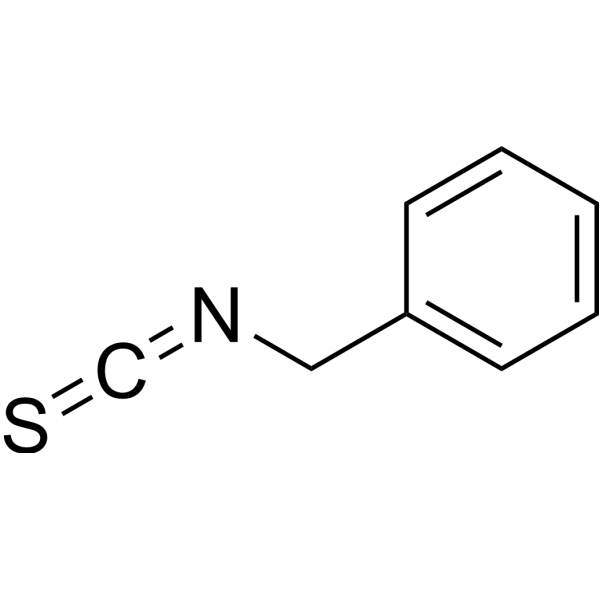
S=C=NCC1=CC=CC=C1
-
Structure Classification
-
Initial Source
-
Livraison
Room temperature in continental US; may vary elsewhere.
-
Stockage
4°C, stored under nitrogen
* In solvent : -80°C, 6 months; -20°C, 1 month (stored under nitrogen)


Solvant et solubilité
In Vitro:
DMSO : 100 mg/mL (670.20 mM; Need ultrasonic; Hygroscopic DMSO has a significant impact on the solubility of product, please use newly opened DMSO)
H2O : < 0.1 mg/mL (insoluble)
Please refer to the solubility information to select the appropriate solvent. Once prepared, please aliquot and store the solution to prevent product inactivation from repeated freeze-thaw cycles.
Storage method and period of stock solution: -80°C, 6 months; -20°C, 1 month (stored under nitrogen). When stored at -80°C, please use it within 6 months. When stored at -20°C, please use it within 1 month.
Please refer to the solubility information to select the appropriate solvent. Once prepared, please aliquot and store the solution to prevent product inactivation from repeated freeze-thaw cycles.
Storage method and period of stock solution: -80°C, 6 months; -20°C, 1 month (stored under nitrogen). When stored at -80°C, please use it within 6 months. When stored at -20°C, please use it within 1 month.
Concentration (start) × Volume (start) = Concentration (final) × Volume (final)
In Vivo:
Select the appropriate dissolution method based on your experimental animal and administration route.
- For the following dissolution methods, please ensure to first prepare a clear stock solution using an In Vitro approach and then sequentially add co-solvents:
- To ensure reliable experimental results, the clarified stock solution can be appropriately stored based on storage conditions. As for the working solution for In Vivo experiments, it is recommended to prepare freshly and use it on the same day.
- The percentages shown for the solvents indicate their volumetric ratio in the final prepared solution. If precipitation or phase separation occurs during preparation, heat and/or sonication can be used to aid dissolution.
In Vivo Dissolution Calculator
Please enter the basic information of animal experiments:
-
-
-
-
Recommended: Prepare an additional quantity of animals to account for potential losses during experiments.
Please enter your animal formula composition:
-
%DMSO +
Recommended: Keep the proportion of DMSO in working solution below 2% if your animal is weak.
-
%+
-
+%Tween-80 + +
-
%Saline +
The co-solvents required include: DMSO, . All of co-solvents are available by MedChemExpress (MCE). , Tween 80. All of co-solvents are available by MedChemExpress (MCE).
Working solution concentration: 0.22 mg/mL
Method for preparing stock solution: mg drug dissolved in μL DMSO. Stock solution concentration: mg/mL. * In solvent : -80°C, 6 months; -20°C, 1 month (stored under nitrogen)
1. Take μL DMSO stock solution;
2. Add μL .
μL , mix evenly;
3. Then add μL Tween 80, mix evenly;
4. Then add μL
Please ensure that the stock solution in the first step is dissolved to a clear state, and add co-solvents in sequence. You can use ultrasonic heating (ultrasonic cleaner, recommended frequency 20-40 kHz), vortexing, etc. to assist dissolution.


Pureté et documentation
-
Fiche technique (278 KB)
-
SDS (618 KB)
- English - EN (618 KB)
- Français - FR (618 KB)
- Deutsch - DE (618 KB)
- Norwegian - NO (618 KB)
- Español - ES (618 KB)
- Swedish - SV (618 KB)
- Italian - IT (618 KB)
- Korean - KR (618 KB)
- Portuguese - PT (618 KB)
-
Instruction de manipulation (2659 KB)
Références
[1]. Abdel-Kader MS, et al. Quantitative Analysis of Benzyl Isothiocyanate in Salvadora persica Extract and Dental Care Herbal Formulations Using Reversed Phase C18 High-Performance Liquid Chromatography Method. Pharmacogn Mag. 2017 Oct;13(Suppl 3):S412-S416. [Content Brief]
[2]. Lai KC, et al. Benzyl isothiocyanate and phenethyl isothiocyanate inhibit murine melanoma B16F10 cell migration and invasion in vitro. Int J Oncol. 2017 Sep;51(3):832-840. [Content Brief]
[3]. Dinh T N, et al. Anticancer activities of dietary benzyl isothiocyanate: A comprehensive review[J]. Pharmacological Research, 2021, 169: 105666. [Content Brief]
[4]. Kassie F, et al. Genotoxic effects of benzyl isothiocyanate, a natural chemopreventive agent[J]. Mutagenesis, 1999, 14(6): 595-604. [Content Brief]
[5]. Kermanshai R, et al. Benzyl isothiocyanate is the chief or sole anthelmintic in papaya seed extracts[J]. Phytochemistry, 2001, 57(3): 427-435. [Content Brief]
[6]. Jensen J, et al. The toxic effects of benzyl glucosinolate and its hydrolysis product, the biofumigant benzyl isothiocyanate, to Folsomia fimetaria[J]. Environmental Toxicology and Chemistry, 2010, 29(2): 359-364. [Content Brief]
[7]. Pintão A M, et al. In vitro and in vivo antitumor activity of benzyl isothiocyanate: a natural product from Tropaeolum majus[J]. Planta Medica, 1995, 61(03): 233-236. [Content Brief]
[8]. Chuang W T, et al. Benzyl isothiocyanate ameliorates high-fat diet-induced hyperglycemia by enhancing Nrf2-dependent antioxidant defense-mediated IRS-1/AKT/TBC1D1 signaling and GLUT4 expression in skeletal muscle[J]. Journal of agricultural and food chemistry, 2020, 68(51): 15228-15238. [Content Brief]


Complete Stock Solution Preparation Table
Please refer to the solubility information to select the appropriate solvent. Once prepared, please aliquot and store the solution to prevent product inactivation from repeated freeze-thaw cycles.
Storage method and period of stock solution: -80°C, 6 months; -20°C, 1 month (stored under nitrogen). When stored at -80°C, please use it within 6 months. When stored at -20°C, please use it within 1 month.
| Optional Solvent | Concentration Solvent Mass | 1 mg | 5 mg | 10 mg | 25 mg |
|---|---|---|---|---|---|
| DMSO | 1 mM | 6.7020 mL | 33.5098 mL | 67.0196 mL | 167.5491 mL |
| 5 mM | 1.3404 mL | 6.7020 mL | 13.4039 mL | 33.5098 mL | |
| 10 mM | 0.6702 mL | 3.3510 mL | 6.7020 mL | 16.7549 mL | |
| 15 mM | 0.4468 mL | 2.2340 mL | 4.4680 mL | 11.1699 mL | |
| 20 mM | 0.3351 mL | 1.6755 mL | 3.3510 mL | 8.3775 mL | |
| 25 mM | 0.2681 mL | 1.3404 mL | 2.6808 mL | 6.7020 mL | |
| 30 mM | 0.2234 mL | 1.1170 mL | 2.2340 mL | 5.5850 mL | |
| 40 mM | 0.1675 mL | 0.8377 mL | 1.6755 mL | 4.1887 mL | |
| 50 mM | 0.1340 mL | 0.6702 mL | 1.3404 mL | 3.3510 mL | |
| 60 mM | 0.1117 mL | 0.5585 mL | 1.1170 mL | 2.7925 mL | |
| 80 mM | 0.0838 mL | 0.4189 mL | 0.8377 mL | 2.0944 mL | |
| 100 mM | 0.0670 mL | 0.3351 mL | 0.6702 mL | 1.6755 mL |


Benzyl isothiocyanate Related Classifications
HY-77813 Related Classifications
 Powered by Bioz