

133 Results for "

DMSO

" in MedChemExpress (MCE) Product Catalog:
Products (133)

133 Results for "DMSO" in MCE Product Catalog:

2066
2066 Publications Verification
Cat. No.: HY-K0010

MCE Protease Inhibitor Cocktail (EDTA-Free, 100× in DMSO) is a blend of 6 pan-protease inhibitors for protection of protein integrity.The 1 mL volume is defined as the base specification. All larger sizes correspond to incremental volumes of this base.

loading...
    loading...
722
722 Cited Publications
Cat. No.: HY-K0021

Phosphatase Inhibitor Cocktail I (100× in DMSO) is a blend of 2 phosphatase inhibitors that can effectively inhibit alkaline phosphatases and serine/threonine phosphatases. It is used to maintain the phosphorylation status of proteins.The 1 mL volume is defined as the base specification. All larger sizes correspond to incremental volumes of this base.

loading...
    loading...
379
379 Cited Publications
Cat. No.: HY-Y0320
CAS No.: 67-68-5
Synonyms: DMSO, meets analytical specification of Ch.P.
Dimethyl sulfoxide (DMSO), meets analytical specification of Ch.P. is an aprotic solvent that dissolves polar and non-polar compounds, including water-insoluble therapeutic and toxic agents. Dimethyl sulfoxide (DMSO) has a strong affinity for water and can rapidly penetrate or enhance the penetration of other substances into biological membranes. Dimethyl sulfoxide also has potential free radical scavenging and anticholinesterase effects and may affect coagulation activity. Dimethyl sulfoxide also induces histamine release from mast cells but is thought to have low systemic toxicity. Dimethyl sulfoxide also exhibits antifreeze and antibacterial properties .
MCE provides Dimethyl sulfoxide that complies with the inspection standards (Ch.P) of Part 4 of the Chinese Pharmacopoeia (2020 Edition). Amicrobic, low endotoxin, can be used in various biochemical experiments such as drug dissolution.
loading...
    loading...
300
300 Cited Publications
Cat. No.: HY-10999A
CAS No.: 1187431-43-1
Pureté:  99.56%
Synonyms: GSK-1120212 (DMSO solvate); JTP-74057 (DMSO solvate)
Target:  

MEK Apoptosis

Domaines de recherche:  

Cancer

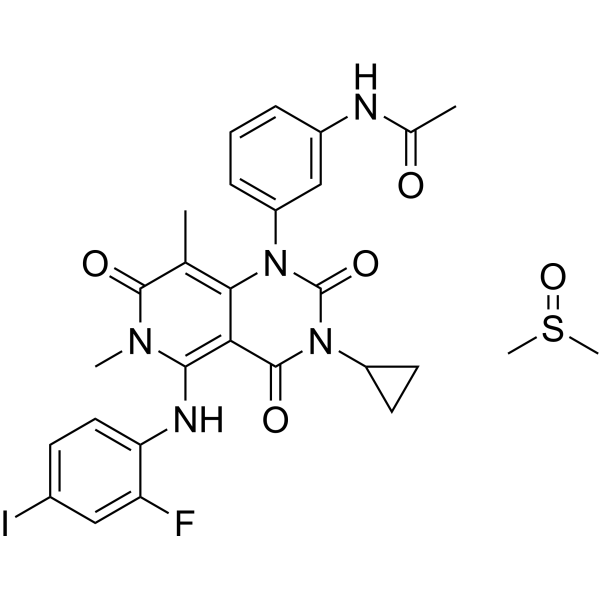
Trametinib (DMSO solvate) (GSK-1120212 (DMSO solvate)) is an orally active MEK inhibitor that inhibits MEK1 and MEK2 with IC50s of about 2 nM. Trametinib (DMSO solvate) activates autophagy and induces apoptosis . This product is in solid form, a DMSO solvate, and a stable crystalline form.
loading...
    loading...
244
244 Cited Publications
Cat. No.: HY-K0023

Phosphatase Inhibitor Cocktail Ⅲ (100× in DMSO) is a mixture of multiple phosphatase inhibitors that effectively inhibit serine/threonine phosphatases and alkaline phosphatases, and is used to preserve the phosphorylation status of proteins.The 1 mL volume is defined as the base specification. All larger sizes correspond to incremental volumes of this base.

loading...
    loading...
53
53 Cited Publications
Cat. No.: HY-Y0320C
CAS No.: 67-68-5
Synonyms: DMSO
Dimethyl sulfoxide (DMSO) is an aprotic solvent that can dissolve water-insoluble therapeutic and toxic agents. Dimethyl sulfoxide (DMSO) has a strong affinity for water and has the ability to rapidly penetrate or enhance the penetration of other substances through biological membranes. Dimethyl sulfoxide also has potential free radical scavenging and anticholinesterase effects and may affect coagulation activity. Dimethyl sulfoxide also induces histamine release from mast cells but is thought to have low systemic toxicity .
Low endotoxin, can be used in various biochemical experiments such as drug dissolution.
loading...
    loading...
45
45 Cited Publications
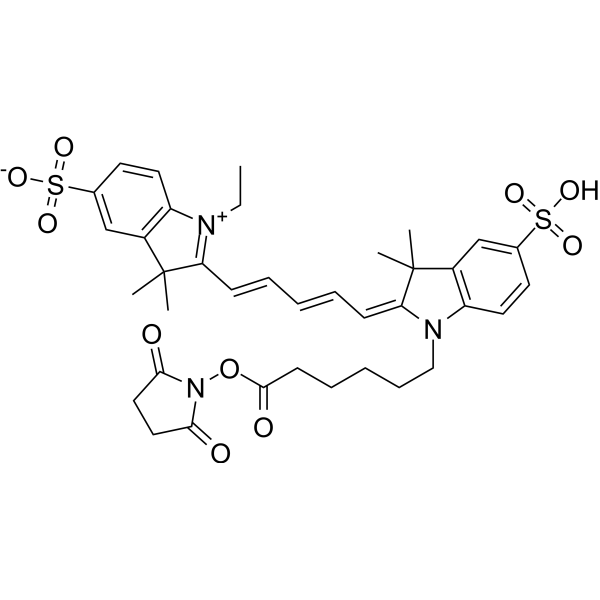
Cat. No.: HY-D0819
CAS No.: 146368-14-1
Synonyms: Cy5 NHS Ester; Sulfo-Cyanine5 Succinimidyl Ester
Cy5-SE (Cy5 NHS Ester) is a reactive dye for the labeling of amino-groups in peptides, proteins, and oligonucleotides. This dye requires small amount of organic co-solvent (such as DMF or DMSO) to be used in labeling reaction. This reagent is ideal for very cost-efficient labeling of soluble proteins, as well as all kinds of peptides and oligonucleotides. This reagent also works well in organic solvents for small molecule labeling. Excitation (nm):649, Emission (nm): 670.
loading...
    loading...
27
27 Cited Publications
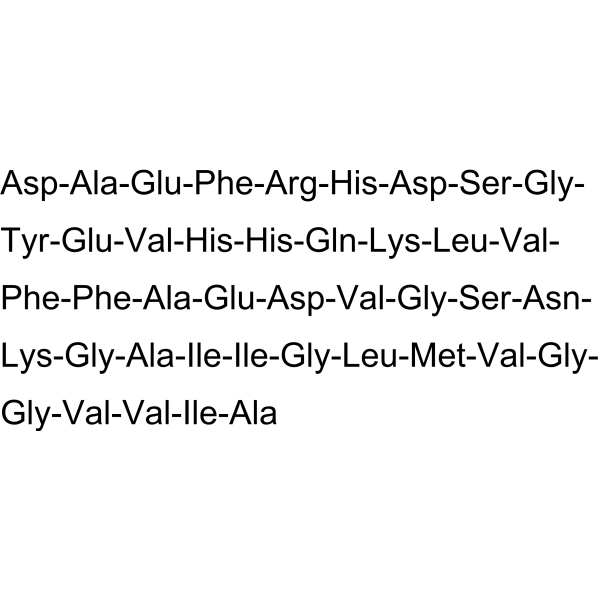
Cat. No.: HY-P1363
Synonyms: Amyloid β-peptide (1-42) (human) TFA
Target:  

Amyloid-β

Domaines de recherche:  

Neurological Disease

β-Amyloid (1-42) (Amyloid β-peptide (1-42), human TFA, a 42-amino acid peptide that has not been treated with HFIP, is a brain-penetrant amyloid protein fragment, which can be used in research on Alzheimer's disease and Down’s syndrome. β-Amyloid (1-42), human TFA remaining as a monomer exhibits antioxidant and neuroprotective effects. β-Amyloid (1-42), human TFA, after being monomericized by HFIP and dissolved in DMSO to form the stock solution, on the one hand, can form soluble oligomers (AβOs) when incubated at 4 °C, which have synaptic toxicity and neurotoxicity; on the other hand, it can be incubated at 37 °C to form insoluble fibrils, with lower neurotoxicity, and participating in the oxidative damage process. Aβ42 oligomers bind to various neuronal surface receptors (such as PrPc, mGluR5, NMDA receptors, etc.), triggering oxidative stress, calcium homeostasis imbalance, and synaptic toxicity via activating downstream signaling pathways, leading to neuronal dysfunction and death .
loading...
    loading...
27
27 Cited Publications
Cat. No.: HY-P1363A
CAS No.: 107761-42-2
Synonyms: Amyloid β-peptide (1-42) (human)
Target:  

Amyloid-β

Domaines de recherche:  

Neurological Disease

β-Amyloid (1-42) (Amyloid β-peptide (1-42)), human, a 42-amino acid peptide that has not been treated with HFIP, is a brain-penetrant amyloid protein fragment, which can be used in research on Alzheimer's disease and Down’s syndrome. β-Amyloid (1-42), human remaining as a monomer exhibits antioxidant and neuroprotective effects. β-Amyloid (1-42), human, after being monomericized by HFIP and dissolved in DMSO to form the stock solution, on the one hand, can form soluble oligomers (AβOs) when incubated at 4 °C, which have synaptic toxicity and neurotoxicity; on the other hand, it can be incubated at 37 °C to form insoluble fibrils, with lower neurotoxicity, and participating in the oxidative damage process. Aβ42 oligomers bind to various neuronal surface receptors (such as PrPc, mGluR5, NMDA receptors, etc.), triggering oxidative stress, calcium homeostasis imbalance, and synaptic toxicity via activating downstream signaling pathways, leading to neuronal dysfunction and death .
loading...
    loading...
27
27 Cited Publications
Cat. No.: HY-P1363B
CAS No.: 107761-42-2
Target:  

Amyloid-β

Domaines de recherche:  

Neurological Disease

β-Amyloid (1-42), human, HFIP-treated, a 42-amino acid peptide that has been treated with HFIP from β-Amyloid (1-42), human (HY-P1363A), is a brain-penetrant amyloid protein fragment, which can be used in research on Alzheimer's disease and Down’s syndrome. β-Amyloid (1-42), human, HFIP-treated remaining as a monomer exhibits antioxidant and neuroprotective effects. β-Amyloid (1-42), human, HFIP-treated, after being dissolved in DMSO to form the stock solution, on the one hand, can form soluble oligomers (AβOs) when incubated at 4°C, which have synaptic toxicity and neurotoxicity; on the other hand, it can be incubated at 37°C to form insoluble fibrils, with lower neurotoxicity, and participating in the oxidative damage process. Aβ42 oligomers bind to various neuronal surface receptors (such as PrPc, mGluR5, NMDA receptors, etc.), triggering oxidative stress, calcium homeostasis imbalance, and synaptic toxicity via activating downstream signaling pathways, leading to neuronal dysfunction and death .
loading...
    loading...
14
14 Cited Publications
Cat. No.: HY-K0012

MCE Protease Inhibitor Cocktail, Bacteria (EDTA-Free, 100× in DMSO) protects proteins from degradation by endogenous proteases released during protein extraction and purification.The 1 mL volume is defined as the base specification. All larger sizes correspond to incremental volumes of this base.

loading...
    loading...
1
1 Cited Publications
Cat. No.: HY-Y0320D
CAS No.: 67-68-5
Synonyms: DMSO, cryoprotectant vitrification agent; Dimethyl sulfoxide vitrification agent
Dimethyl sulfoxide, cryoprotectant vitrification agent (DMSO, cryoprotectant vitrification agent) is a biochemical reagent that can be used as a biological material or organic compound for life science related research . This product has been sterilized and has no endotoxin. It can be used for long-term cell cryopreservation and will not affect the normal growth of cells.
loading...
    loading...
1
1 Cited Publications
Cat. No.: HY-DY1022
CAS No.: 217075-36-0
BODIPY 581/591 C11 (solution) is a BODIPY borofluoroprene derivative with good light stability and low fluorescence artifacts. BODIPY 581/591 C11 can be used for study lipid peroxidation and antioxidant properties in living cells, or detect ferroptosis by reaction with hydroxyl radicals. BODIPY 581/591 C11 is emitted at 591 nm (reduced prototype) , or redshifted to 510 nm (oxidized type). The excitation wavelengths were 581 nm (reduced prototype) and 500 nm (oxidized type) .
Solvent and concentration: DMSO: 2 mM
loading...
    loading...
1
1 Cited Publications
Cat. No.: HY-Y0320R
CAS No.: 67-68-5
Synonyms: DMSO, meets analytical specification of Ch.P. (Standard)
Dimethyl sulfoxide (Standard) is the analytical standard of Dimethyl sulfoxide. This product is intended for research and analytical applications. Dimethyl sulfoxide (DMSO) is an aprotic solvent that dissolves both polar and nonpolar compounds. Dimethyl sulfoxide has anti-freezing and bacteriostatic properties .
loading...
    loading...
1
1 Cited Publications
Cat. No.: HY-DY1002
H2DCFDA (DCFH-DA) (solution) is a cell-permeable probe used to detect intracellular reactive oxygen species (ROS) (Ex/Em=488/525 nm) .
Solvent and concentration: DMSO: 10 mM.
The 1 mL volume is defined as the base specification. All larger sizes correspond to incremental volumes of this base.
loading...
    loading...
Cat. No.: HY-DY1040
CAS No.: 231946-72-8
LysoTracker Red (solution) is a Red fluorescently labeled lysosomal probe with a maximum excitation/emission wavelength of 577/590 nm. The structure is composed of a fluorescein group and linked weak bases, which can freely cross the cell membrane and gather on spherical organelles. It is suitable for observing the internal biosynthesis and related pathogenesis of lysosomes .
Solvent and concentration: DMSO: 1 mM
loading...
    loading...
Cat. No.: HY-Y0320GL
CAS No.: 67-68-5
Synonyms: DMSO (GMP Like)
Dimethyl sulfoxide (DMSO) (GMP Like) is the GMP Like class Dimethyl sulfoxide (HY-Y0320C). Dimethyl sulfoxide is an aprotic solvent that can dissolve water-insoluble therapeutic and toxic agents. Dimethyl sulfoxide has a strong affinity for water and has the ability to rapidly penetrate or enhance the penetration of other substances through biological membranes. Dimethyl sulfoxide also has potential free radical scavenging and anticholinesterase effects and may affect coagulation activity. Dimethyl sulfoxide also induces histamine release from mast cells but is thought to have low systemic toxicity .
loading...
    loading...
Cat. No.: HY-DY1046
CAS No.: 136832-63-8
Green CMFDA (solution) is a cell-permeable fluorescent probe with Em of 514 nm and Ex of 485 nm and can be used as a cell tracer. Green CMFDA can be cleaved by non-specific esterases common in living cells, producing a fluorescent compound, fluorescein, visible using a fluorescent microscope .
Solvent and concentration: DMSO: 10 mM
loading...
    loading...
Cat. No.: HY-DY1036
CAS No.: 148504-34-1
Calcein AM (solution) , has cell membrane permeability and can easily enter the cell. Calcein AM has no fluorescence and is hydrolyzed by endogenous esterase in the cell to produce polar molecule Calcein (Calcein) , which has strong negative charge and cannot permeate the cell membrane. Calcein can emit strong green fluorescence, so it is often used with Propidium Iodide for cell viability/virulence detection, excitation/emission wavelength: 494/515 nm .
Solvent and concentration: DMSO: 2 mM
loading...
    loading...
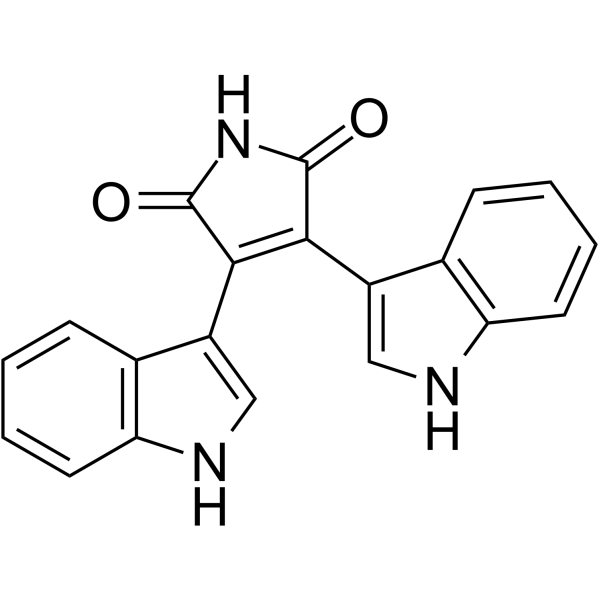
Cat. No.: HY-108254
CAS No.: 119139-23-0
Pureté:  99.62%
Synonyms: Arcyriarubin A
Target:  

PKC CMV

Domaines de recherche:  

Infection

Bisindolylmaleimide IV (Arcyriarubin A) is a potent protein kinase C (PKC) inhibitor, with IC50s ranging from 0.1 to 0.55 μM. Bisindolylmaleimide IV also inhibits PKA (IC50=3.1-11.8μM) . Bisindolylmaleimide IV is a potent, selective inhibitor of human cytomegalovirus (HCMV) replication in cell culture with an IC50 of 0.2 μM .
loading...
    loading...

