12 Results for "

HR-deficient cancers

" in MedChemExpress (MCE) Product Catalog:
Products (12)

12 Results for "HR-deficient cancers" in MCE Product Catalog:

5
5 Cited Publications
Cat. No.: HY-114778
CAS No.: 1358715-18-0
Purity:  99.96%
Synonyms: SHR3162; Fuzuloparib
Target:  

PARP

Research Areas:  

Cancer

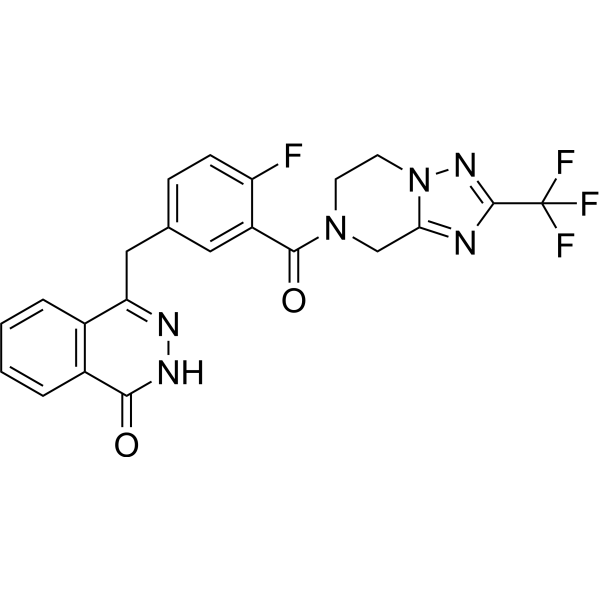
Fluzoparib (SHR3162) is a potent and orally active PARP1 inhibitor (IC50=1.46±0.72 nM, a cell-free enzymatic assay) with superior antitumor activity. Fluzoparib selectively inhibits the proliferation of homologous recombination repair (HR)-deficient cells, and sensitizes both HR-deficient and HR-proficient cells to cytotoxic agents. Fluzoparib exhibits good pharmacokinetic properties in vivo and can be used for BRCA1/2-mutant relapsed ovarian cancer research .
loading...
    loading...
Cat. No.: HY-161430
CAS No.: 3035072-49-9
Research Areas:  

Cancer

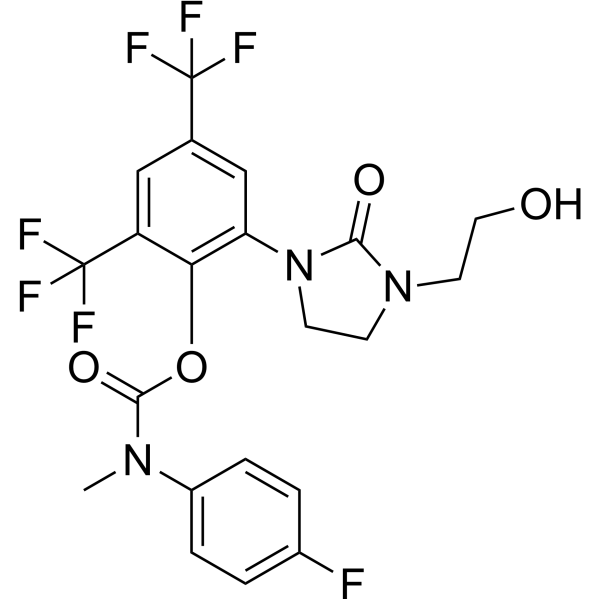
RTx-161 is a DNA polymerase θ inhibitor with an IC50 of 4.1 nM. RTx-161 induces DNA damage, PARP cleavage, apoptosis, and selectively kills homologous recombination-deficient (HRD) cells. RTx-161 acts synergistically with PARP inhibitors to suppress PARP inhibitor resistance in cancer cells. RTx-161 can be used for the research of BRCA G12C mutant cancer and HR-deficient cancers .
loading...
    loading...
Cat. No.: HY-161431
CAS No.: 3035072-48-8
Target:  

DNA/RNA Synthesis

Research Areas:  

Cancer

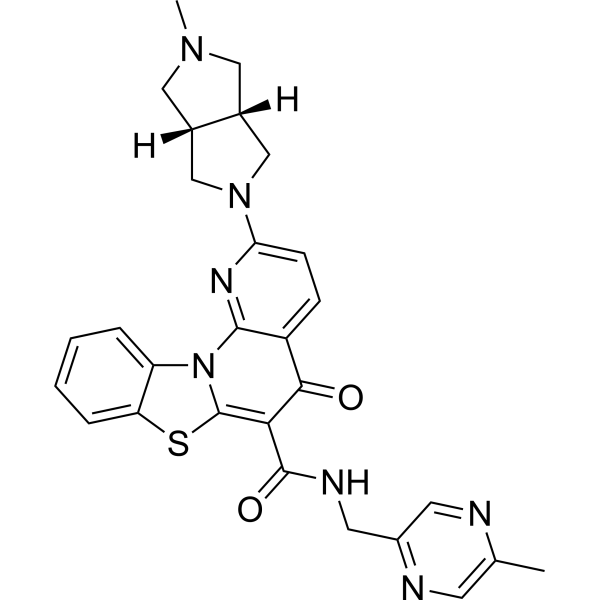
RTx-152 traps Polθ on DNA and is an allosteric Polθ-pol inhibitor (IC50: 6.2 nM). RTx-152 selectively kills HR-deficient cancer cells, and suppresses PARP inhibitor resistance in multiple genetic backgrounds, including homologous recombination (HR)-proficient cells. RTx-152 selectively kills BRCA2-null cells .
loading...
    loading...
Cat. No.: HY-148953
CAS No.: 1639357-93-9
Purity:  99.40%
Research Areas:  

Cancer

MTR-106 is a potent and orally active G-quadruplex stabilizer and RNA polymerase I inhibitor. MTR-106 induces apoptosis and inhibits cell growth. MTR-106 can be used in research of cancer .
loading...
    loading...
Cat. No.: HY-158346
CAS No.: 2922287-81-6
Target:  

DNA/RNA Synthesis

Research Areas:  

Cancer

RP-2119 is an orally bioactive Polymerase Theta (Polθ) inhibitor, with an IC50 of 0.7 nM against human Polθ ATPase. RP-2119 reduces Polθ activity and exerts antiproliferative effects in BRCA2-deficient cancer cells. RP-2119 exhibits antitumor activity in BRCA2-deficient cancer cell xenograft mouse models . RP-2119 can be used for the research of cancer and homologous recombination-deficient cancers, including brca1/brca2-mutant cancers and shld2-mutant cancers .
loading...
    loading...
Cat. No.: HY-175482
CAS No.: 3066798-40-8
Target:  

PARP

Research Areas:  

Neurological Disease Cancer

PARP1-IN-43 (Compound 5350) is a blood-brain barrier (BBB) permeable PARP1 inhibitor, with an IC50 of 5 nM. PARP1-IN-43 can be used for the study of homologous recombination (HR)-deficient central nerve system (CNS) cancers .
loading...
    loading...
Cat. No.: HY-183748
CAS No.: 3082173-75-6
Research Areas:  

Cancer

Polθ-IN-11 is an orally active DNA polymerase θ (Polθ) ATPase inhibitor with an IC50 of 4.3 nM against human targets. Polθ-IN-11 activates the cGAS-STING pathway. Polθ-IN-11 upregulates the expression of PD-L1 in HR-deficient cancer cells. Polθ-IN-11 acts synergistically with PARP inhibition in HR-deficient cancer cells and in vivo xenograft models. Polθ-IN-11 can be used in studies related to HR-deficient cancers .
loading...
    loading...
Cat. No.: HY-181611
CAS No.: 3068829-46-6
Research Areas:  

Cancer

Polθ-IN-10 is an orally active Polθ-pol inhibitor (with a human IC50 of 1.3 nM) that exhibits oral bioavailability in mice and rats. Polθ-IN-10 binds to the allosteric site of Polθ-pol, disrupts the microhomology-mediated end-joining DNA repair pathway, and inhibits CYP2C9 (IC50=1.63 μM). Polθ-IN-10 selectively inhibits the proliferation of HR-deficient cancer cells and induces apoptosis. Polθ-IN-10 is applicable to the research of HR-deficient cancers .
loading...
    loading...
Cat. No.: HY-181026
Target:  

DNA/RNA Synthesis

Research Areas:  

Cancer

RP-4029 is a selective, covalent hPolθ inhibitor (IC50s: 0.013 nM for hPolθ; 6.6 nM for mPolθ). RP-4029 can be used in the research of homologous recombination (HR)-deficient cancers .
loading...
    loading...
Cat. No.: HY-189225
Research Areas:  

Cancer

PP-048 is a selective dual inhibitor of Polθ/PARP1, with IC50 values of 4.9 nM and 6.8 nM for the Polθ helicase/ATPase domain and PARP1, respectively. PP-048 impairs the compensatory DNA repair capacity of homologous recombination-deficient cells by simultaneously inhibiting the DNA repair functions associated with Polθ and PARP1, thereby exacerbating DNA double-strand damage and inducing apoptosis. PP-048 exhibits more potent selective antiproliferative activity against HR-deficient cancer cells. PP-048 can be used in studies related to Polθ/PARP1 dual-target inhibition, synthetic lethality, DNA damage repair, and HR-deficient triple-negative breast cancer .
loading...
    loading...
Cat. No.: HY-179413
CAS No.: 3050552-13-8
Target:  

DNA/RNA Synthesis

Research Areas:  

Cancer

Polθ-IN-9 is an orally active Polθ polymerase inhibitor (IC50 = 9.6 nM, Kd = 47.5 nM). Polθ-IN-9 shows remarkable selectivity with no inhibitory activity against other human DNA polymerases, including Pol α, Pol ε, Pol γ, Pol λ, and Pol μ. Polθ-IN-9 exhibits strong antiproliferative activity in DLD1 BRCA2 KO cells (IC50 = 2.9 μM), and high sensitivity to MDA-MB-436 cells (IC50 = 4.9 μM). Polθ-IN-9 increases DNA damage accumulation, induces γH2AX levels, and inhibits tumor growth in combination with Olaparib (HY-10162), in the MDA-MB-436 xenograft model. Polθ-IN-9 can be used for the research of homologous recombination (HR)-deficient cancers such as breast cancer .
loading...
    loading...
Cat. No.: HY-181557
CAS No.: 3077714-09-8
SY-589 is an orally active DNA polymerase Polθ helicase domain inhibitor (IC50=2.29 nM) and DNA damage inducer. SY-589 inhibits the ATPase activity of the Polθ helicase domain and blocks the Polθ-mediated microhomology-mediated end joining (MMEJ) DNA repair pathway (IC50=0.85 nM). SY-589 also induces the accumulation of DNA double-strand breaks by increasing γ-H2AX levels. SY-589 exerts antiproliferative effects on BRCA2-deficient cells and is used in the research of HR-deficient tumors .
loading...
    loading...
  • 1

