Search Result
Results for "
NHS Group
" in MedChemExpress (MCE) Product Catalog:
158
Biochemical Assay Reagents
1
Isotope-Labeled Compounds
| Cat. No. |
Product Name |
Target |
Research Areas |
Chemical Structure |
-
- HY-140272
-
|
|
PROTAC Linkers
|
Cancer
|
|
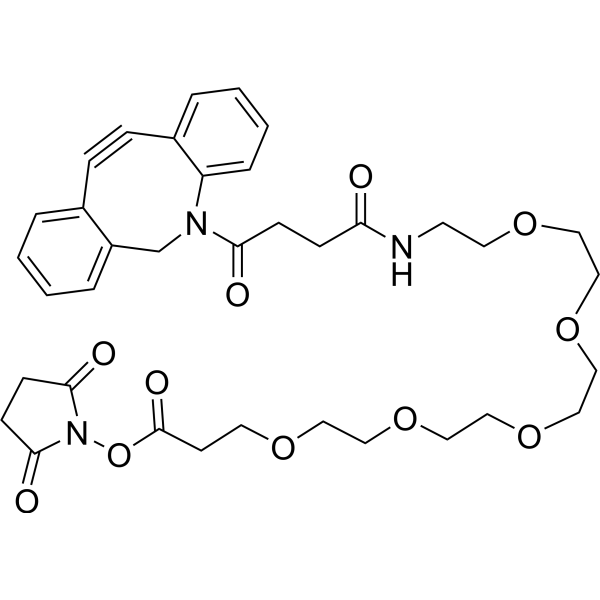
DBCO-PEG4-NHS ester is a PEG-based PROTAC linker that can be used in the synthesis of PROTACs . DBCO-PEG4-NHS ester is a click chemistry reagent, it contains a DBCO group that can undergo strain-promoted alkyne-azide cycloaddition (SPAAC) with molecules containing Azide groups.
|
-
-
- HY-140273
-
|
|
PROTAC Linkers
|
Cancer
|
|
DBCO-PEG8-NHS ester is a PEG-based PROTAC linker that can be used in the synthesis of PROTACs . DBCO-PEG8-NHS ester is a click chemistry reagent, it contains a DBCO group that can undergo strain-promoted alkyne-azide cycloaddition (SPAAC) with molecules containing Azide groups.
|
-
-
- HY-130085
-
|
|
ADC Linker
|
Cancer
|
|
Mal-PEG6-NHS ester is a nonclaevable ADC linker containing a Maleimide group, 6-unit PEG and a NHS ester.
|
-
-
- HY-126504
-
|
|
ADC Linker
|
Cancer
|
|
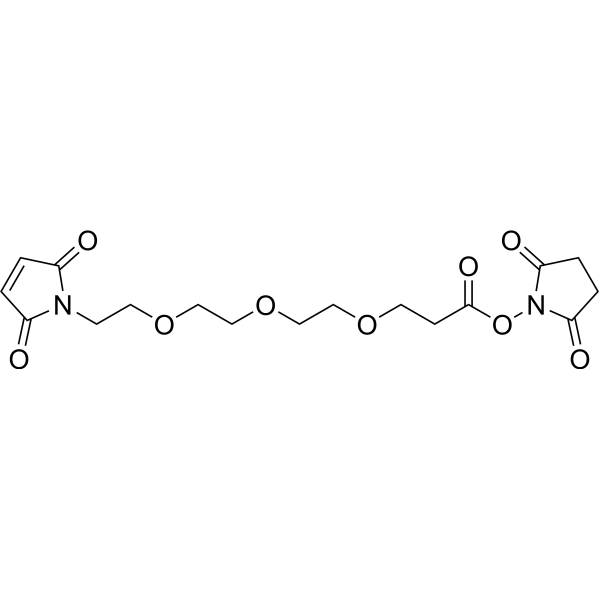
Mal-PEG2-NHS ester is a nonclaevable ADC linker containing a Maleimide group, 2-unit PEG and an NHS ester.
|
-
-
- HY-129526
-
|
|
ADC Linker
|
Cancer
|
|
Mal-PEG3-NHS ester is a noncleavable ADC linker containing a Maleimide group. Mal-PEG3-NHS ester is used for making antibody-drug conjugate .
|
-
-
- HY-140274
-
|
|
PROTAC Linkers
|
Cancer
|
|
DBCO-PEG12-NHS ester is a PEG-based PROTAC linker that can be used in the synthesis of PROTACs . DBCO-PEG12-NHS ester is a click chemistry reagent, it contains a DBCO group that can undergo strain-promoted alkyne-azide cycloaddition (SPAAC) with molecules containing Azide groups.
|
-
-
- HY-141167A
-
|
|
PROTAC Linkers
|
Cancer
|
|
TCO-PEG4-NHS ester is a PEG-based PROTAC linker that can be used in the synthesis of PROTACs . TCO-PEG4-NHS ester is a click chemistry reagent, it contains a TCO group that can undergo an inverse electron demand Diels-Alder reaction (iEDDA) with molecules containing Tetrazine groups.
|
-
-
- HY-126513
-
|
|
ADC Linker
|
Cancer
|
|
Propargyl-PEG1-NHS ester is a nonclaevable 1-unit PEG linker for antibody-agent-conjugation (ADC). Propargyl-PEG1-NHS ester is a click chemistry reagent, it contains an Alkyne group and can undergo copper-catalyzed azide-alkyne cycloaddition (CuAAc) with molecules containing Azide groups.
|
-
-
- HY-140069
-
|
|
PROTAC Linkers
|
Cancer
|
|
endo-BCN-PEG4-NHS ester is a PEG-based PROTAC linker that can be used in the synthesis of PROTACs . endo-BCN-PEG4-NHS ester is a click chemistry reagent, it contains a BCN group that can undergo strain-promoted alkyne-azide cycloaddition (SPAAC) with molecules containing Azide groups.
|
-
-
- HY-126885
-
|
|
ADC Linker
PROTAC Linkers
|
Cancer
|
|
DBCO-PEG5-NHS ester is a PEG/Alkyl/ether-based PROTAC linker can be used in the synthesis of PROTACs. DBCO-PEG5-NHS ester is a cleavable ADC linker used in the synthesis of antibody-drug conjugates (ADCs) . DBCO-PEG5-NHS ester is a click chemistry reagent, it contains a DBCO group that can undergo strain-promoted alkyne-azide cycloaddition (SPAAC) with molecules containing Azide groups.
|
-
-
- HY-133439
-
|
|
PROTAC Linkers
ADC Linker
|
Cancer
|
|
BCN-PEG4-NHS ester is a PEG-based PROTAC linker that can be used in the synthesis of PROTACs . BCN-PEG4-NHS ester is a click chemistry reagent, it contains a BCN group that can undergo strain-promoted alkyne-azide cycloaddition (SPAAC) with molecules containing Azide groups.
|
-
-
- HY-126974
-
|
|
ADC Linker
PROTAC Linkers
|
Cancer
|
|
Propargyl-PEG3-NHS ester is a PEG/Alkyl/ether-based PROTAC linker can be used in the synthesis of PROTACs. Propargyl-PEG3-NHS ester is a cleavable ADC linker used in the synthesis of antibody-drug conjugates (ADCs) . Propargyl-PEG3-NHS ester is a click chemistry reagent, it contains an Alkyne group and can undergo copper-catalyzed azide-alkyne cycloaddition (CuAAc) with molecules containing Azide groups.
|
-
-
- HY-130388
-
|
|
ADC Linker
PROTAC Linkers
|
Cancer
|
|
Propargyl-PEG5-NHS ester is a PEG/Alkyl/ether-based PROTAC linker can be used in the synthesis of PROTACs. Propargyl-PEG5-NHS ester is a cleavable ADC linker used in the synthesis of antibody-drug conjugates (ADCs) . Propargyl-PEG5-NHS ester is a click chemistry reagent, it contains an Alkyne group and can undergo copper-catalyzed azide-alkyne cycloaddition (CuAAc) with molecules containing Azide groups.
|
-
-
- HY-D2801A
-
|
|
Fluorescent Dye
|
Others
|
|
FITC-PEG1000-NHS is a fluorescent dye composed of polyethylene glycol (PEG), FITC (HY-66019) and a hydroxysuccinimide (NHS) group. The NHS group can react with amine-containing groups. FITC-PEG1000-NHS can be used for fluorescent labeling and imaging .
|
-
-
- HY-126511
-
|
|
ADC Linker
|
Cancer
|
|
Propargyl-C1-NHS ester is a nonclaevable linker for antibody-agent-conjugation (ADC). Propargyl-C1-NHS ester is a click chemistry reagent, it contains an Alkyne group and can undergo copper-catalyzed azide-alkyne cycloaddition (CuAAc) with molecules containing Azide groups.
|
-
-
- HY-126516
-
|
|
ADC Linker
|
Cancer
|
|
Propargyl-PEG4-NHS ester is a nonclaevable 4-unit PEG linker for antibody-agent-conjugation (ADC). Propargyl-PEG4-NHS ester is a click chemistry reagent, it contains an Alkyne group and can undergo copper-catalyzed azide-alkyne cycloaddition (CuAAc) with molecules containing Azide groups.
|
-
-
- HY-174893
-
|
|
Biochemical Assay Reagents
|
Others
|
|
Azido-PEG20-NHS ester is a PEG derivative that can be used for drug delivery and other research. Azido-PEG20-NHS ester is a click chemistry reagent. Azido-PEG20-NHS contains an azide group and can undergo copper-catalyzed azide-alkyne cycloaddition reaction (CuAAc) with molecules containing an alkyne group. Azido-PEG20-NHS can also undergo ring strain driven alkyne-azide cycloaddition (SPAAC) with molecules containing DBCO or BCN groups .
|
-
-
- HY-126512
-
|
|
ADC Linker
|
Cancer
|
|
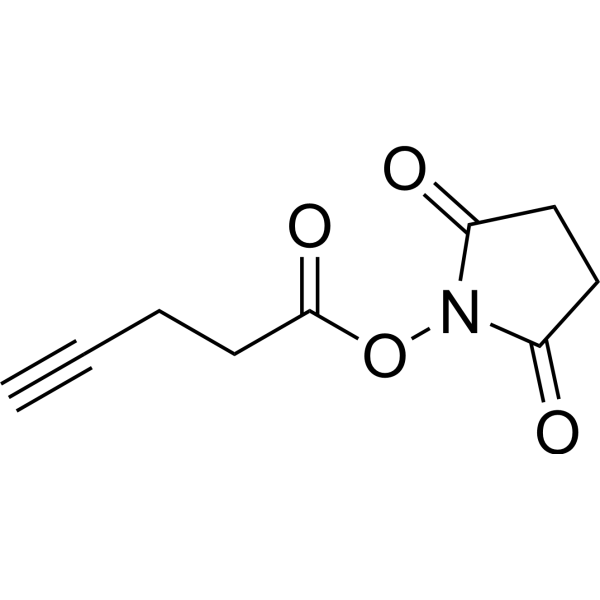
Propargyl-C2-NHS ester is a nonclaevable linker for antibody-agent-conjugation (ADC). Propargyl-C2-NHS ester is a click chemistry reagent, it contains an Alkyne group and can undergo copper-catalyzed azide-alkyne cycloaddition (CuAAc) with molecules containing Azide groups.
|
-
-
- HY-140070
-
|
|
PROTAC Linkers
|
Cancer
|
|
endo-BCN-PEG8-NHS ester is a PEG-based PROTAC linker that can be used in the synthesis of PROTACs . endo-BCN-PEG8-NHS ester is a click chemistry reagent, it contains a BCN group that can undergo strain-promoted alkyne-azide cycloaddition (SPAAC) with molecules containing Azide groups.
|
-
-
- HY-130551
-
|
|
PROTAC Linkers
|
Cancer
|
|
Tetrazine-Ph-PEG5-NHS ester is a PEG-based PROTAC linker that can be used in the synthesis of PROTACs . Tetrazine-Ph-PEG5-NHS ester is a click chemistry reagent, it contains a Tetrazine group that can undergo an inverse electron demand Diels-Alder reaction (iEDDA) with molecules containing TCO groups.
|
-
-
- HY-156383
-
|
|
PROTAC Linkers
|
Cancer
|
|
SCO-PEG3-NHS is a PEG linker with a terminal imine(NH) group. SCO-PEG3-NHS is a PEG-based PROTAC linker can be used in the synthesis of PROTACs.
|
-
-
- HY-160773
-
|
|
Biochemical Assay Reagents
|
Others
|
|
DBCO-PEG6-NHS ester is a click chemistry PEG reagent containing an NHS ester that reacts specifically with primary amines, such as side chains of lysine residues or aminosilane-coated surfaces, under neutral or slightly alkaline conditions. , efficient reaction to form covalent bonds. DBCO-PEG6-NHS ester also contains a DBCO group that can undergo strain-promoted alkyne-azide cycloaddition (SPAAC) with molecules containing Azide groups .
|
-
-
- HY-W190908A
-
|
|
Biochemical Assay Reagents
|
Others
|
|
Desthiobiotin-PEG4-NHS ester is a PEG derivative composed of desthiobiotin, 4 PEG units, and NHS ester. NHS ester can be conjugated to amino acids or other molecules containing amino groups.
|
-
-
- HY-164165
-
|
|
Microtubule/Tubulin
Drug Derivative
|
Cancer
|
|
Paclitaxel-2′-succinate NHS ester is a paclitaxel derivative with a succinic acid linker, in which the carboxyl group is activated by the NHS ester. The NHS ester group is highly reactive toward amino or hydroxyl groups and can be used to conjugate with other molecules such as peptides, proteins, antibodies, enzymes or polymers. Paclitaxel-2′-succinate NHS ester can be used in the development of nanomedicines and in the study of cancer therapy .
|
-
-
- HY-174935
-
|
|
Biochemical Assay Reagents
|
Others
|
|
DBCO-PEG1000-NHS is a dibenzocyclooctyne-conjugated polyethylene glycol derivative bearing an NHS group. DBCO-PEG-NHS forms a stable covalent linkage with the amino group of target molecules via the NHS ester at one end, while introducing a DBCO group at the other end, thus preparing for subsequent click chemical conjugation with any azide-bearing molecule or material .
|
-
-
- HY-140271
-
|
|
PROTAC Linkers
|
Cancer
|
|
DBCO-PEG1-NHS ester is a PEG-based PROTAC linker that can be used in the synthesis of PROTACs . DBCO-PEG1-NHS ester is a click chemistry reagent, it contains a DBCO group that can undergo strain-promoted alkyne-azide cycloaddition (SPAAC) with molecules containing Azide groups.
|
-
-
- HY-138734
-
|
|
PROTAC Linkers
|
Cancer
|
|
Propargyl-PEG2-NHS ester is a PEG-based PROTAC linker that can be used in the synthesis of PROTACs . Propargyl-PEG2-NHS ester is a click chemistry reagent, it contains an Alkyne group and can undergo copper-catalyzed azide-alkyne cycloaddition (CuAAc) with molecules containing Azide groups.
|
-
-
- HY-W879004
-
|
|
Biochemical Assay Reagents
|
Others
|
|
m-PEG16-NHS ester is a PEG derivative composed of an NHS ester that can be conjugated to amino acids or other molecules containing amino groups .
|
-
-
- HY-130385
-
|
|
ADC Linker
PROTAC Linkers
|
Cancer
|
|
Propargyl-PEG6-NHS ester is a PEG/Alkyl/ether-based PROTAC linker can be used in the synthesis of PROTACs. Propargyl-PEG6-NHS ester is a cleavable ADC linker used in the synthesis of antibody-drug conjugates (ADCs) . Propargyl-PEG6-NHS ester is a click chemistry reagent, it contains an Alkyne group and can undergo copper-catalyzed azide-alkyne cycloaddition (CuAAc) with molecules containing Azide groups.
|
-
-
- HY-130376
-
|
|
ADC Linker
PROTAC Linkers
|
Cancer
|
|
Propargyl-PEG8-NHS ester is a PEG/Alkyl/ether-based PROTAC linker can be used in the synthesis of PROTACs. Propargyl-PEG8-NHS ester is a cleavable ADC linker used in the synthesis of antibody-drug conjugates (ADCs) . Propargyl-PEG8-NHS ester is a click chemistry reagent, it contains an Alkyne group and can undergo copper-catalyzed azide-alkyne cycloaddition (CuAAc) with molecules containing Azide groups.
|
-
-
- HY-D2801B
-
|
|
Fluorescent Dye
|
Others
|
|
FITC-PEG3400-NHS is a fluorescent dye composed of polyethylene glycol (PEG), FITC (HY-66019) and a hydroxysuccinimide (NHS) group. The NHS group can react with amine-containing groups. FITC-PEG3400-NHS can be used for fluorescent labeling and imaging .
|
-
-
- HY-145090
-
|
|
PROTAC Linkers
ADC Linker
|
Others
|
|
DBCO-N-bis(PEG4-NHS ester) is a PEG linker which contains two PEG4-NHS ester and a DBCO group. DBCO-N-bis(PEG4-NHS ester) is useful for protein modification or labeling. DBCO-N-bis(PEG4-NHS ester) is a click chemistry reagent, it contains a DBCO group that can undergo strain-promoted alkyne-azide cycloaddition (SPAAC) with molecules containing Azide groups.
|
-
-
- HY-174935A
-
|
|
Biochemical Assay Reagents
|
Others
|
|
DBCO-PEG2000-NHS is a dibenzocyclooctyne-conjugated polyethylene glycol derivative bearing an NHS group. DBCO-PEG-NHS forms a stable covalent linkage with the amino group of target molecules via the NHS ester at one end, while introducing a DBCO group at the other end, thus preparing for subsequent click chemical conjugation with any azide-bearing molecule or material .
|
-
-
- HY-W190908C
-
|
|
Biochemical Assay Reagents
|
Others
|
|
Desthiobiotin-PEG12-NHS ester is a PEG derivative composed of desthiobiotin, 12 PEG units, and NHS ester. NHS ester can be conjugated to amino acids or other molecules containing amino groups.
|
-
-
- HY-W190908B
-
|
|
Biochemical Assay Reagents
|
Others
|
|
Desthiobiotin-PEG6-NHS ester is a PEG derivative composed of desthiobiotin, 6 PEG units, and NHS ester. NHS ester can be conjugated to amino acids or other molecules containing amino groups.
|
-
-
- HY-156313
-
|
|
ADC Linker
|
Cancer
|
|
Me-Tet-PEG4-NHS is an ADC Linker containing 4 PEG units. Me-Tet-PEG4-NHS can utilize its own Tetrazine group to undergo a specific inverse electron demand Diels-Alder reaction (iEDDA) with compounds with TCO groups.
|
-
-
- HY-138744
-
|
|
PROTAC Linkers
|
Cancer
|
|
DBCO-PEG13-NHS ester is a PEG-based PROTAC linker that can be used in the synthesis of PROTACs . DBCO-PEG13-NHS ester is a click chemistry reagent, it contains a DBCO group that can undergo strain-promoted alkyne-azide cycloaddition (SPAAC) with molecules containing Azide groups.
|
-
-
- HY-138756
-
|
|
PROTAC Linkers
|
Cancer
|
|
PC DBCO-PEG4-NHS ester is a PEG-based PROTAC linker that can be used in the synthesis of PROTACs . PC DBCO-PEG4-NHS ester is a click chemistry reagent, it contains a DBCO group that can undergo strain-promoted alkyne-azide cycloaddition (SPAAC) with molecules containing Azide groups.
|
-
-
- HY-174888
-
|
|
Biochemical Assay Reagents
|
Others
|
|
DBCO-PEG16-NHS ester is a PEG derivative consisting of DBCO, PEG units, and NHS ester. NHS ester can bind to amino acids or other molecules containing amino groups. DBCO-PEG16-NHS ester contains a DBCO group and can undergo a strain-promoted alkyne-azide cycloaddition reaction (SPAAC) with molecules containing an azide group .
|
-
-
- HY-D2890
-
|
|
Fluorescent Dye
|
Others
|
|
5-TAMRA-NHS is a fluorescent dye that combines 5-TAMRA (HY-15942) with a hydroxysuccinimide (NHS) group. The NHS group can react with amine-containing groups. 5-TAMRA-NHS can be used for fluorescent labeling and imaging (Ex/Em = 541/567 nm) .
|
-
-
- HY-140068
-
|
|
PROTAC Linkers
|
Cancer
|
|
endo-BCN-PEG3-NHS ester is a PEG-based PROTAC linker that can be used in the synthesis of PROTACs . endo-BCN-PEG3-NHS ester is a click chemistry reagent, it contains a BCN group that can undergo strain-promoted alkyne-azide cycloaddition (SPAAC) with molecules containing Azide groups.
|
-
-
- HY-130381
-
|
|
ADC Linker
PROTAC Linkers
|
Cancer
|
|
Propargyl-PEG7-NHS ester is a PEG/Alkyl/ether-based PROTAC linker can be used in the synthesis of PROTACs. Propargyl-PEG7-NHS ester is a cleavable ADC linker used in the synthesis of antibody-drug conjugates (ADCs) . Propargyl-PEG7-NHS ester is a click chemistry reagent, it contains an Alkyne group and can undergo copper-catalyzed azide-alkyne cycloaddition (CuAAc) with molecules containing Azide groups.
|
-
-
- HY-111456
-
|
|
ADC Linker
PROTAC Linkers
|
Cancer
|
|
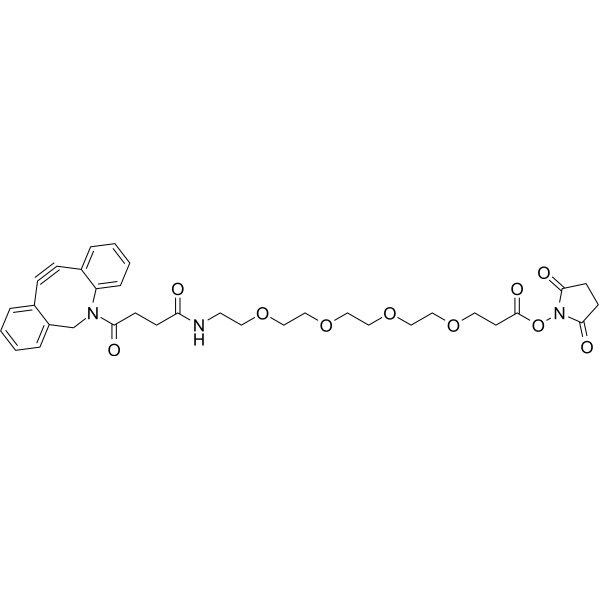
DBCO-NHCO-PEG4-NHS ester is a PEG/Alkyl/ether-based PROTAC linker can be used in the synthesis of PROTACs. DBCO-NHCO-PEG4-NHS ester is a cleavable ADC linker used in the synthesis of antibody-drug conjugates (ADCs) . DBCO-NHCO-PEG4-NHS ester is a click chemistry reagent, it contains a DBCO group that can undergo strain-promoted alkyne-azide cycloaddition (SPAAC) with molecules containing Azide groups.
|
-
-
- HY-202399
-
|
|
PROTAC Linkers
|
Others
|
|
TCO-PEG2-NHS ester is a PEG/Alkyl/ether-based PROTAC linker can be used in the synthesis of PROTACs. TCO-PEG2-NHS ester is a click chemistry reagent, it contains a TCO group that can undergo an inverse electron demand Diels-Alder reaction (iEDDA) with molecules containing Tetrazine groups .
|
-
-
- HY-D2801
-
|
|
Fluorescent Dye
|
Others
|
|
FITC-PEG400-NHS is a fluorescent dye composed of polyethylene glycol (PEG), FITC (HY-66019) and a hydroxysuccinimide (NHS) group. The NHS group can react with amine-containing groups. FITC-PEG400-NHS can be used for fluorescent labeling and imaging .
|
-
-
- HY-174935C
-
|
|
Biochemical Assay Reagents
|
Others
|
|
DBCO-PEG5000-NHS is a dibenzocyclooctyne-conjugated polyethylene glycol derivative bearing an NHS group. DBCO-PEG-NHS forms a stable covalent linkage with the amino group of target molecules via the NHS ester at one end, while introducing a DBCO group at the other end, thus preparing for subsequent click chemical conjugation with any azide-bearing molecule or material .
|
-
-
- HY-140275
-
|
|
PROTAC Linkers
|
Cancer
|
|
DBCO-NHCO-PEG5-NHS ester is a PEG-based PROTAC linker that can be used in the synthesis of PROTACs . DBCO-NHCO-PEG5-NHS ester is a click chemistry reagent, it contains a DBCO group that can undergo strain-promoted alkyne-azide cycloaddition (SPAAC) with molecules containing Azide groups.
|
-
-
- HY-D1309
-
|
|
Fluorescent Dye
|
|
|
Sulfo-cyanine3 NHS ester sodium is a water-soluble cyanine dye that contains NHS ester groups and is amino-reactive.
|
-
-
- HY-160773A
-
|
|
Biochemical Assay Reagents
|
Others
|
|
DBCO-C3-amide-PEG6-NHS ester is a click chemistry PEG reagent containing an NHS ester that reacts specifically with primary amines, such as side chains of lysine residues or aminosilane-coated surfaces, under neutral or slightly alkaline conditions. , efficient reaction to form covalent bonds. DBCO-C3-amide-PEG6-NHS ester also contains a DBCO group that can undergo strain-promoted alkyne-azide cycloaddition (SPAAC) with molecules containing Azide groups .
|
-
-
- HY-D2801C
-
|
|
Fluorescent Dye
|
Others
|
|
FITC-PEG5000-NHS is a fluorescent dye composed of polyethylene glycol (PEG), FITC (HY-66019) and a hydroxysuccinimide (NHS) group. The NHS group can react with amine-containing groups. FITC-PEG5000-NHS can be used for fluorescent labeling and imaging .
|
-
- HY-174948
-
|
NHS-PEG1000-Aldehyde
|
Biochemical Assay Reagents
|
Others
|
|
NHS-PEG1000-CHO (NHS-PEG1000-Aldehyde) is a PEG derivative consisting of an aldehyde group (-CHO), a PEG unit, and an NHS ester. NHS esters can be conjugated to amino acids or other molecules containing amino groups. Aldehyde groups are reactive functional groups that can react with compounds containing amino or hydroxyl groups .
|
-
- HY-174948C
-
|
NHS-PEG5000-Aldehyde
|
Biochemical Assay Reagents
|
Others
|
|
NHS-PEG5000-CHO (NHS-PEG5000-Aldehyde) is a PEG derivative consisting of an aldehyde group (-CHO), a PEG unit, and an NHS ester. NHS esters can be conjugated to amino acids or other molecules containing amino groups. Aldehyde groups are reactive functional groups that can react with compounds containing amino or hydroxyl groups .
|
-
- HY-174935B
-
|
|
Biochemical Assay Reagents
|
Others
|
|
DBCO-PEG3400-NHS is a dibenzocyclooctyne-conjugated polyethylene glycol derivative bearing an NHS group. DBCO-PEG-NHS forms a stable covalent linkage with the amino group of target molecules via the NHS ester at one end, while introducing a DBCO group at the other end, thus preparing for subsequent click chemical conjugation with any azide-bearing molecule or material .
|
-
- HY-174935D
-
|
|
Biochemical Assay Reagents
|
Others
|
|
DBCO-PEG10000-NHS is a dibenzocyclooctyne-conjugated polyethylene glycol derivative bearing an NHS group. DBCO-PEG-NHS forms a stable covalent linkage with the amino group of target molecules via the NHS ester at one end, while introducing a DBCO group at the other end, thus preparing for subsequent click chemical conjugation with any azide-bearing molecule or material .
|
-
- HY-D2477
-
|
|
Fluorescent Dye
|
Others
|
|
Sulfo-QSY21-NHS is a fluorescent dye, which contains a NHS group that can react with amine groups (-NH2) in proteins or other molecules to form stable amide bonds. Sulfo-QSY21-NHS can be used in the synthesis of activity-based probes (ABPs) .
|
-
- HY-140025
-
|
|
ADC Linker
|
Cancer
|
|
Propargyl-PEG4-CH2CO2-NHS (compound P-7) is a PEG derivative containing a propargyl group and an NHS group. Propargyl-PEG4-CH2CO2-NHS is an ADC linker used in the synthesis of antibody-drug conjugates (ADCs). Propargyl-PEG4-CH2CO2-NHS is a click chemistry reagent, it contains an Alkyne group and can undergo copper-catalyzed azide-alkyne cycloaddition (CuAAc) with molecules containing Azide groups .
|
-
- HY-141167B
-
|
|
ADC Linker
|
Cancer
|
|
(S)-TCO-PEG4-NHS ester is an ADC linker containing 4 PEG units. (S)-TCO-PEG4-NHS ester can use its own TCO group to perform an inverse electron demand Diels-Alder reaction (iEDDA) with molecules with Tetrazine groups.
|
-
- HY-141169B
-
|
|
ADC Linker
|
Cancer
|
|
(R)-TCO-PEG8-NHS ester is an ADC linker containing 8 PEG units. (R)-TCO-PEG8-NHS ester can use its own TCO group to perform an inverse electron demand Diels-Alder reaction (iEDDA) with molecules with Tetrazine groups.
|
-
- HY-141169A
-
|
|
ADC Linker
|
Cancer
|
|
(S)-TCO-PEG8-NHS ester is an ADC linker containing 8 PEG units. (S)-TCO-PEG8-NHS ester can use its own TCO group to perform an inverse electron demand Diels-Alder reaction (iEDDA) with molecules with Tetrazine groups.
|
-
- HY-D2105
-
|
|
Fluorescent Dye
|
Others
|
|
TAMRA-PEG3-NHS is a dye derivative of TAMRA (HY-135640) containing 3 PEG units. TAMRA-PEG3-NHS contains NHS groups that react with ammonia to form ester bonds.
|
-
- HY-D2106
-
|
|
Fluorescent Dye
|
Others
|
|
TAMRA-PEG4-NHS is a dye derivative of TAMRA (HY-135640) containing 4 PEG units. TAMRA-PEG4-NHS contains NHS groups that react with ammonia to form ester bonds.
|
-
- HY-D2107
-
|
|
Fluorescent Dye
|
Others
|
|
TAMRA-PEG8-NHS is a dye derivative of TAMRA (HY-135640) containing 8 PEG units. TAMRA-PEG8-NHS contains NHS groups that react with ammonia to form ester bonds.
|
-
- HY-156491
-
|
|
ADC Linker
|
Cancer
|
|
Me-Tet-PEG9-NHS is an ADC Linker containing 9 PEG units. Me-Tet-PEG9-NHS can utilize its own Tetrazine group to undergo a specific inverse electron demand Diels-Alder reaction (iEDDA) with compounds with TCO groups.
|
-
- HY-140067A
-
|
|
PROTAC Linkers
|
Cancer
|
|
endo-BCN-PEG2-NHS ester is a PEG-based PROTAC linker that can be used in the synthesis of PROTACs. endo-BCN-PEG2-NHS ester contains a BCN group that can undergo strain-promoted alkyne-azide cycloaddition (SPAAC) with molecules containing Azide groups .
|
-
- HY-156476
-
|
|
ADC Linker
|
Cancer
|
|
Me-Tet-PEG2-NHS is an ADC Linker containing 2 PEG units. Me-Tet-PEG2-NHS can utilize its own Tetrazine group to undergo a specific inverse electron demand Diels-Alder reaction (iEDDA) with compounds with TCO groups.
|
-
- HY-156490
-
|
|
ADC Linker
|
Cancer
|
|
Me-Tet-PEG5-NHS is an ADC Linker containing 5 PEG units. Me-Tet-PEG5-NHS can utilize its own Tetrazine group to undergo a specific inverse electron demand Diels-Alder reaction (iEDDA) with compounds with TCO groups.
|
-
- HY-D1596B
-
|
(E)-Cy3.5 NHS ester chloride; (E)-Cy 3.5 chloride
|
Fluorescent Dye
|
Others
|
|
(E)-Cyanine 3.5 ((E)-Cy3.5 NHS ester) chloride is a cyanine dye functionalized with a N-hydroxysuccinimide (NHS) group. (E)-Cyanine 3.5 chloride contains NHS groups that react with ammonia to form ester bonds (Ex/Em = 586/612 nm).
|
-
- HY-W588715D
-
|
|
Biochemical Assay Reagents
|
Others
|
|
Acid-PEG6-NHS ester is a PEG derivative composed of NHS ester, which can be conjugated to amino acids or other molecules containing amino groups.
|
-
- HY-W588715A
-
|
|
Biochemical Assay Reagents
|
Others
|
|
Acid-PEG2-NHS ester is a PEG derivative composed of NHS ester, which can be conjugated to amino acids or other molecules containing amino groups.
|
-
- HY-W588715
-
|
|
Biochemical Assay Reagents
|
Others
|
|
Acid-PEG8-NHS ester is a PEG derivative composed of NHS ester, which can be conjugated to amino acids or other molecules containing amino groups.
|
-
- HY-W588715B
-
|
|
Biochemical Assay Reagents
|
Others
|
|
Acid-PEG12-NHS ester is a PEG derivative composed of NHS ester, which can be conjugated to amino acids or other molecules containing amino groups.
|
-
- HY-140276
-
|
|
PROTAC Linkers
|
Cancer
|
|
DBCO-NHCO-PEG13-NHS ester is a PEG-based PROTAC linker that can be used in the synthesis of PROTACs . DBCO-NHCO-PEG13-NHS ester is a click chemistry reagent, it contains a DBCO group that can undergo strain-promoted alkyne-azide cycloaddition (SPAAC) with molecules containing Azide groups.
|
-
- HY-141171
-
|
|
PROTAC Linkers
|
Cancer
|
|
TCO-PEG24-NHS ester is a PEG-based PROTAC linker that can be used in the synthesis of PROTACs . TCO-PEG24-NHS ester is a click chemistry reagent, it contains a TCO group that can undergo an inverse electron demand Diels-Alder reaction (iEDDA) with molecules containing Tetrazine groups.
|
-
- HY-141166A
-
|
|
Biochemical Assay Reagents
|
Cancer
|
|
(S,E)-TCO2-PEG3-NHS ester is NH2 reactive, and can be used in chemical synthesis. (S,E)-TCO2-PEG3-NHS ester contains TCO groups, which can undergo specific "click" reactions with tetrazine groups .
|
-
- HY-133375
-
|
|
PROTAC Linkers
|
Cancer
|
|
DBCO-NHCO-PEG2-NHS ester is a PEG-based PROTAC linker that can be used in the synthesis of PROTACs . DBCO-NHCO-PEG2-NHS ester is a click chemistry reagent, it contains a DBCO group that can undergo strain-promoted alkyne-azide cycloaddition (SPAAC) with molecules containing Azide groups.
|
-
- HY-151758
-
|
|
ADC Linker
|
Others
|
|
Methyltetrazine-PEG12-NHS ester is a click chemistry reagent containing an azide group. Methyltetrazine-PEG12-NHS ester reacts with compounds containing TCO to form stable covalent bonds .
|
-
- HY-133371
-
|
|
PROTAC Linkers
|
Cancer
|
|
DBCO-NHCO-C4-NHS ester is an alkyl chain-based PROTAC linker that can be used in the synthesis of PROTACs . DBCO-NHCO-C4-NHS ester is a click chemistry reagent, it contains a DBCO group that can undergo strain-promoted alkyne-azide cycloaddition (SPAAC) with molecules containing Azide groups.
|
-
- HY-171559
-
|
|
PROTAC Linkers
|
Others
|
|
TCO-PEG5-NHS ester is a PEG/Alkyl/ether-based PROTAC linker can be used in the synthesis of PROTACs. TCO-PEG5-NHS ester is a click chemistry reagent, it contains a TCO group that can undergo an inverse electron demand Diels-Alder reaction (iEDDA) with molecules containing Tetrazine groups .
|
-
- HY-D2884D
-
|
Rhodamine B-PEG3400-NHS
|
Fluorescent Dye
|
Others
|
|
RB-PEG3400-NHS (Rhodamine B-PEG3400-NHS) is a fluorescent dye composed of Rhodamine B (HY-Y0016), PEG and a hydroxysuccinimide (NHS) group. The NHS group can react with amine-containing groups. RB-PEG3400-NHS can be used for fluorescent labeling and imaging (Ex/Em=546/610 nm) .
|
-
- HY-D2884E
-
|
Rhodamine B-PEG5000-NHS
|
Fluorescent Dye
|
Others
|
|
RB-PEG5000-NHS (Rhodamine B-PEG5000-NHS) is a fluorescent dye composed of Rhodamine B (HY-Y0016), PEG and a hydroxysuccinimide (NHS) group. The NHS group can react with amine-containing groups. RB-PEG5000-NHS can be used for fluorescent labeling and imaging (Ex/Em=546/610 nm) .
|
-
- HY-D2884H
-
|
Rhodamine B-PEG10000-NHS
|
Fluorescent Dye
|
Others
|
|
RB-PEG10000-NHS (Rhodamine B-PEG10000-NHS) is a fluorescent dye composed of Rhodamine B (HY-Y0016), PEG and a hydroxysuccinimide (NHS) group. The NHS group can react with amine-containing groups. RB-PEG10000-NHS can be used for fluorescent labeling and imaging (Ex/Em=546/610 nm) .
|
-
- HY-D2884A
-
|
Rhodamine B-PEG600-NHS
|
Fluorescent Dye
|
Others
|
|
RB-PEG600-NHS (Rhodamine B-PEG600-NHS) is a fluorescent dye composed of Rhodamine B (HY-Y0016), PEG and a hydroxysuccinimide (NHS) group. The NHS group can react with amine-containing groups. RB-PEG600-NHS can be used for fluorescent labeling and imaging (Ex/Em=546/610 nm) .
|
-
- HY-D2884B
-
|
Rhodamine B-PEG1000-NHS
|
Fluorescent Dye
|
Others
|
|
RB-PEG1000-NHS (Rhodamine B-PEG1000-NHS) is a fluorescent dye composed of Rhodamine B (HY-Y0016), PEG and a hydroxysuccinimide (NHS) group. The NHS group can react with amine-containing groups. RB-PEG1000-NHS can be used for fluorescent labeling and imaging (Ex/Em=546/610 nm) .
|
-
- HY-D2884C
-
|
Rhodamine B-PEG2000-NHS
|
Fluorescent Dye
|
Others
|
|
RB-PEG2000-NHS (Rhodamine B-PEG2000-NHS) is a fluorescent dye composed of Rhodamine B (HY-Y0016), PEG and a hydroxysuccinimide (NHS) group. The NHS group can react with amine-containing groups. RB-PEG2000-NHS can be used for fluorescent labeling and imaging (Ex/Em=546/610 nm) .
|
-
- HY-D2884
-
|
Rhodamine B-PEG400-NHS
|
Fluorescent Dye
|
Others
|
|
RB-PEG400-NHS (Rhodamine B-PEG400-NHS) is a fluorescent dye composed of Rhodamine B (HY-Y0016), PEG and a hydroxysuccinimide (NHS) group. The NHS group can react with amine-containing groups. RB-PEG400-NHS can be used for fluorescent labeling and imaging (Ex/Em=546/610 nm) .
|
-
- HY-W800684
-
|
|
Biochemical Assay Reagents
|
Others
|
|
Benzyloxy carbonyl-PEG4-NHS ester is a reagent with a benzyl protecting group and an NHS ester. The NHS ester reacts with primary amines (-NH2). The benzyl protecting group can be removed by hydrogenolysis.
|
-
- HY-174948B
-
|
NHS-PEG3400-Aldehyde
|
Biochemical Assay Reagents
|
Others
|
|
NHS-PEG3400-CHO (NHS-PEG3400-Aldehyde) is a PEG derivative consisting of an aldehyde group (-CHO), a PEG unit, and an NHS ester. NHS esters can be conjugated to amino acids or other molecules containing amino groups. Aldehyde groups are reactive functional groups that can react with compounds containing amino or hydroxyl groups .
|
-
- HY-174948A
-
|
NHS-PEG2000-Aldehyde
|
Biochemical Assay Reagents
|
Others
|
|
NHS-PEG2000-CHO (NHS-PEG2000-Aldehyde) is a PEG derivative consisting of an aldehyde group (-CHO), a PEG unit, and an NHS ester. NHS esters can be conjugated to amino acids or other molecules containing amino groups. Aldehyde groups are reactive functional groups that can react with compounds containing amino or hydroxyl groups .
|
-
- HY-W615173
-
|
|
Biochemical Assay Reagents
|
Others
|
|
NHS ester-C2-NHCO-C2-NHS is a heterobifunctional PEG linker, featuring a terminal NHS ester that can be used to label amine compounds and maleimide group for reactions with thiol groups.
|
-
- HY-141121
-
|
|
Drug Intermediate
|
Others
|
|
T-Butoxycarbonyl-PEG1-NHS ester contains a t-boc protecting group and an NHS ester moiety. T-Butoxycarbonyl-PEG1-NHS ester can be used for the modification and labeling of biomolecules.
|
-
- HY-174895
-
|
|
Biochemical Assay Reagents
|
Others
|
|
Propargyl-PEG12-NHS ester is a PEG derivative composed of NHS ester, which can be conjugated to amino acids or other molecules containing amino groups.
|
-
- HY-W588715C
-
|
|
Biochemical Assay Reagents
|
Others
|
|
Acid-PEG1-NHS ester is a PEG derivative composed of NHS ester, which can be conjugated to amino acids or other molecules containing amino groups.
|
-
- HY-174889
-
|
|
Biochemical Assay Reagents
|
Others
|
|
Acetal-PEG18-NHS is a PEG derivative composed of NHS ester, which can be conjugated to amino acids or other molecules containing amino groups.
|
-
- HY-126908A
-
|
|
Biochemical Assay Reagents
|
Others
|
|
Tetrazine-Ph-PEG17-NHS ester is a PEG derivative composed of NHS ester, which can be conjugated to amino acids or other molecules containing amino groups.
|
-
- HY-W591384
-
|
|
Biochemical Assay Reagents
|
Others
|
|
Boc-NH-PEG12-NHS ester is a PEG derivative composed of NHS ester, which can be conjugated to amino acids or other molecules containing amino groups.
|
-
- HY-W190745
-
|
|
Biochemical Assay Reagents
|
Others
|
|
DNP-PEG8-NHS ester is a PEG derivative that contains DNP (2,4-dinitroaniline), eight PEG units, and NHS ester. NHS ester can covalently bind to molecules with amino groups (such as proteins, antibodies, etc.). DNP-PEG8-NHS ester can be used for drug delivery.
|
-
- HY-W190745A
-
|
|
Biochemical Assay Reagents
|
Others
|
|
DNP-PEG2-NHS ester is a PEG derivative that contains DNP (2,4-dinitroaniline), two PEG units, and NHS ester. NHS ester can covalently bind to molecules with amino groups (such as proteins, antibodies, etc.). DNP-PEG2-NHS ester can be used for drug delivery.
|
-
- HY-W190745B
-
|
|
Biochemical Assay Reagents
|
Others
|
|
DNP-PEG3-NHS ester is a PEG derivative that contains DNP (2,4-dinitroaniline), three PEG units, and NHS ester. NHS ester can covalently bind to molecules with amino groups (such as proteins, antibodies, etc.). DNP-PEG3-NHS ester can be used for drug delivery.
|
-
- HY-W800686
-
|
|
Biochemical Assay Reagents
|
Others
|
|
Acid-PEG4-NHS ester is a PEG linker with a carboxylic acid and an NHS ester. Both functional group can react with primary amine, but the carboxylic acid will need activators such as EDC or HATU.
|
-
- HY-N15975
-
|
|
Biochemical Assay Reagents
|
Others
|
|
12:0 N-Biotinyl fatty acid, NHS is a biotinylated lipid. 12:0 N-Biotinyl fatty acid, NHS contains NHS groups that react with ammonia to form ester bonds .
|
-
- HY-140141
-
|
|
PROTAC Linkers
|
Cancer
|
|
PC Methyltetrazine-PEG4-NHS carbonate ester is a PEG-based PROTAC linker that can be used in the synthesis of PROTACs . PC Methyltetrazine-PEG4-NHS carbonate ester is a click chemistry reagent, it contains a Tetrazine group that can undergo an inverse electron demand Diels-Alder reaction (iEDDA) with molecules containing TCO groups.
|
-
- HY-140139
-
|
|
ADC Linker
|
Cancer
|
|
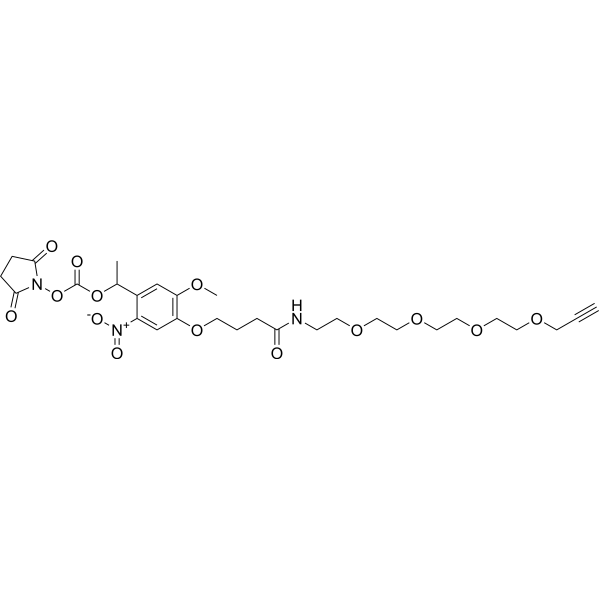
PC Alkyne-PEG4-NHS ester is a cleavable 4 unit PEG ADC linker used in the synthesis of antibody-drug conjugates (ADCs) . PC Alkyne-PEG4-NHS ester is a click chemistry reagent, it contains an Alkyne group and can undergo copper-catalyzed azide-alkyne cycloaddition (CuAAc) with molecules containing Azide groups.
|
-
- HY-133479
-
|
|
PROTAC Linkers
|
Cancer
|
|
Tetrazine-Ph-NHCO-C3-NHS ester is a PEG-based PROTAC linker that can be used in the synthesis of PROTACs . Tetrazine-Ph-NHCO-C3-NHS ester is a click chemistry reagent, it contains a Tetrazine group that can undergo an inverse electron demand Diels-Alder reaction (iEDDA) with molecules containing TCO groups.
|
-
- HY-140756
-
|
|
PROTAC Linkers
|
Cancer
|
|
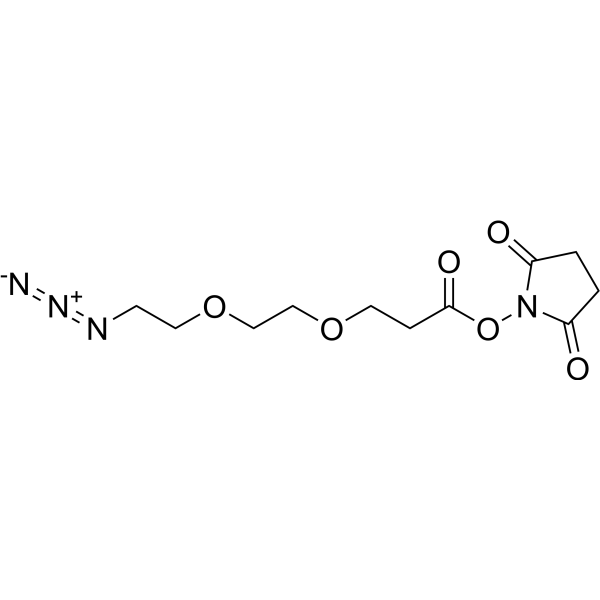
Azido-PEG1-NHS ester is a PEG-based PROTAC linker that can be used in the synthesis of PROTACs . Azido-PEG1-NHS ester is a click chemistry reagent, it contains an Azide group and can undergo copper-catalyzed azide-alkyne cycloaddition reaction (CuAAc) with molecules containing Alkyne groups. It can also undergo strain-promoted alkyne-azide cycloaddition (SPAAC) reactions with molecules containing DBCO or BCN groups.
|
-
- HY-140758
-
|
|
PROTAC Linkers
|
Cancer
|
|
Azido-PEG9-NHS ester is a PEG-based PROTAC linker that can be used in the synthesis of PROTACs . Azido-PEG9-NHS ester is a click chemistry reagent, it contains an Azide group and can undergo copper-catalyzed azide-alkyne cycloaddition reaction (CuAAc) with molecules containing Alkyne groups. It can also undergo strain-promoted alkyne-azide cycloaddition (SPAAC) reactions with molecules containing DBCO or BCN groups.
|
-
- HY-174894
-
|
|
Biochemical Assay Reagents
|
Others
|
|
Azido-PEG11-NHS ester is a PEG derivative that can be used for drug delivery and other research. Azido-PEG11-NHS ester is a click chemistry reagent. It contains an azide group and can undergo copper-catalyzed azide-alkyne cycloaddition reaction (CuAAc) with molecules containing an alkyne group. It can also undergo ring strain driven alkyne-azide cycloaddition (SPAAC) with molecules containing DBCO or BCN groups .
|
-
- HY-140762
-
|
|
PROTAC Linkers
|
Cancer
|
|
Azido-PEG24-NHS ester is a PEG-based PROTAC linker that can be used in the synthesis of PROTACs . Azido-PEG24-NHS ester is a click chemistry reagent, it contains an Azide group and can undergo copper-catalyzed azide-alkyne cycloaddition reaction (CuAAc) with molecules containing Alkyne groups. It can also undergo strain-promoted alkyne-azide cycloaddition (SPAAC) reactions with molecules containing DBCO or BCN groups.
|
-
- HY-140761
-
|
|
PROTAC Linkers
|
Cancer
|
|
Azido-PEG16-NHS ester is a PEG-based PROTAC linker that can be used in the synthesis of PROTACs . Azido-PEG16-NHS ester is a click chemistry reagent, it contains an Azide group and can undergo copper-catalyzed azide-alkyne cycloaddition reaction (CuAAc) with molecules containing Alkyne groups. It can also undergo strain-promoted alkyne-azide cycloaddition (SPAAC) reactions with molecules containing DBCO or BCN groups.
|
-
- HY-138463
-
|
|
PROTAC Linkers
|
Cancer
|
|
Azido-PEG36-NHS ester is a PEG-based PROTAC linker that can be used in the synthesis of PROTACs . Azido-PEG36-NHS ester is a click chemistry reagent, it contains an Azide group and can undergo copper-catalyzed azide-alkyne cycloaddition reaction (CuAAc) with molecules containing Alkyne groups. It can also undergo strain-promoted alkyne-azide cycloaddition (SPAAC) reactions with molecules containing DBCO or BCN groups.
|
-
- HY-140764
-
|
|
PROTAC Linkers
|
Cancer
|
|
Azido-PEG3-NHS ester is a PEG-based PROTAC linker that can be used in the synthesis of PROTACs . Azido-PEG3-NHS ester is a click chemistry reagent, it contains an Azide group and can undergo copper-catalyzed azide-alkyne cycloaddition reaction (CuAAc) with molecules containing Alkyne groups. It can also undergo strain-promoted alkyne-azide cycloaddition (SPAAC) reactions with molecules containing DBCO or BCN groups.
|
-
- HY-140759
-
|
|
PROTAC Linkers
|
Cancer
|
|
Azido-PEG10-NHS ester is a PEG-based PROTAC linker that can be used in the synthesis of PROTACs . Azido-PEG10-NHS ester is a click chemistry reagent, it contains an Azide group and can undergo copper-catalyzed azide-alkyne cycloaddition reaction (CuAAc) with molecules containing Alkyne groups. It can also undergo strain-promoted alkyne-azide cycloaddition (SPAAC) reactions with molecules containing DBCO or BCN groups.
|
-
- HY-140760
-
|
|
PROTAC Linkers
|
Cancer
|
|
Azido-PEG12-NHS ester is a PEG-based PROTAC linker that can be used in the synthesis of PROTACs . Azido-PEG12-NHS ester is a click chemistry reagent, it contains an Azide group and can undergo copper-catalyzed azide-alkyne cycloaddition reaction (CuAAc) with molecules containing Alkyne groups. It can also undergo strain-promoted alkyne-azide cycloaddition (SPAAC) reactions with molecules containing DBCO or BCN groups.
|
-
- HY-138707
-
|
|
PROTAC Linkers
|
Cancer
|
|
Azido-PEG7-NHS ester is a PEG-based PROTAC linker that can be used in the synthesis of PROTACs . Azido-PEG7-NHS ester is a click chemistry reagent, it contains an Azide group and can undergo copper-catalyzed azide-alkyne cycloaddition reaction (CuAAc) with molecules containing Alkyne groups. It can also undergo strain-promoted alkyne-azide cycloaddition (SPAAC) reactions with molecules containing DBCO or BCN groups.
|
-
- HY-140757
-
|
|
PROTAC Linkers
|
Cancer
|
|
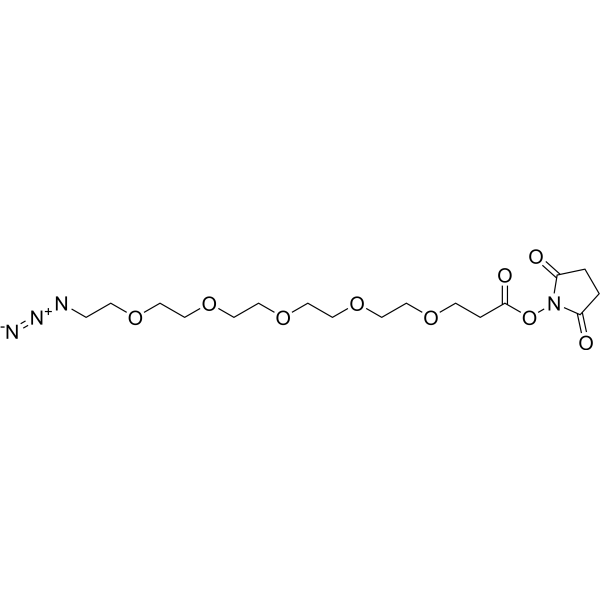
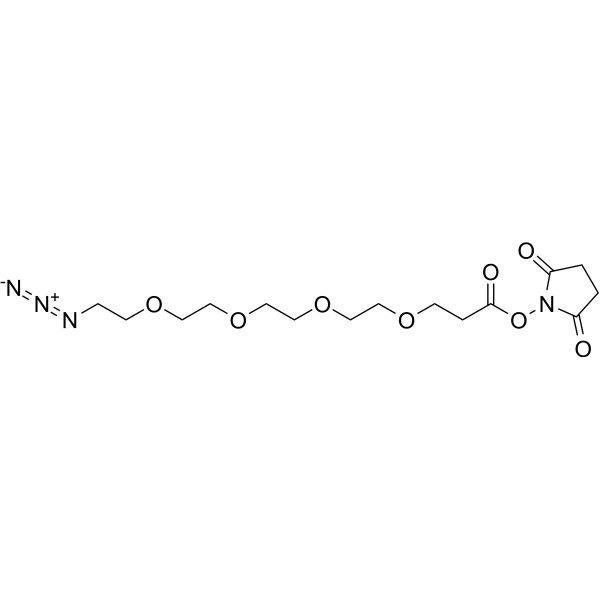
Azido-PEG5-NHS ester is a PEG-based PROTAC linker that can be used in the synthesis of PROTACs . Azido-PEG5-NHS ester is a click chemistry reagent, it contains an Azide group and can undergo copper-catalyzed azide-alkyne cycloaddition reaction (CuAAc) with molecules containing Alkyne groups. It can also undergo strain-promoted alkyne-azide cycloaddition (SPAAC) reactions with molecules containing DBCO or BCN groups.
|
-
- HY-130312
-
|
|
PROTAC Linkers
|
Cancer
|
|
N-(Azido-PEG4)-N-Boc-PEG4-NHS ester is a PEG-based PROTAC linker with a terminal azide group. N-(Azido-PEG4)-N-Boc-PEG4-NHS ester is used in the synthesis of PROTACs N-(Azido-PEG4)-N-Boc-PEG4-NHS ester is a click chemistry reagent, it contains an Azide group and can undergo copper-catalyzed azide-alkyne cycloaddition reaction (CuAAc) with molecules containing Alkyne groups. It can also undergo strain-promoted alkyne-azide cycloaddition (SPAAC) reactions with molecules containing DBCO or BCN groups.
|
-
- HY-W451415
-
|
|
Biochemical Assay Reagents
|
Others
|
|
NHS-PEG-NHS is a derivative of activated polyethylene glycol (PEG) that can modify functional groups on protein surfaces via covalent binding. NHS-PEG-NHS serves as a bioconjugation modification reagent for modifying proteins, enzymes, peptides and antibodies .
|
-
- HY-130474
-
|
|
ADC Linker
PROTAC Linkers
|
Cancer
|
|
Azido-PEG6-NHS ester is a cleavable 6 unit PEG ADC linker used in the synthesis of antibody-drug conjugates (ADCs) . Azido-PEG6-NHS ester is also a PEG- and Alkyl/ether based PROTAC linker that can be used in the synthesis of PROTACs . Azido-PEG6-NHS ester is a click chemistry reagent, it contains an Azide group and can undergo copper-catalyzed azide-alkyne cycloaddition reaction (CuAAc) with molecules containing Alkyne groups. It can also undergo strain-promoted alkyne-azide cycloaddition (SPAAC) reactions with molecules containing DBCO or BCN groups.
|
-
- HY-130184
-
|
|
ADC Linker
PROTAC Linkers
|
Cancer
|
|
Azido-PEG8-NHS ester is a cleavable 8 unit PEG ADC linker used in the synthesis of antibody-drug conjugates (ADCs) . Azido-PEG8-NHS ester is also a PEG- and Alkyl/ether-based PROTAC linker that can be used in the synthesis of PROTACs . Azido-PEG8-NHS ester is a click chemistry reagent, it contains an Azide group and can undergo copper-catalyzed azide-alkyne cycloaddition reaction (CuAAc) with molecules containing Alkyne groups. It can also undergo strain-promoted alkyne-azide cycloaddition (SPAAC) reactions with molecules containing DBCO or BCN groups.
|
-
- HY-W800828
-
|
|
Biochemical Assay Reagents
|
Others
|
|
Iodoacetamido-PEG3-NHS ester is a PEG reagent containing an Iodoacetamide group and a Boc-protected amino group. The iodoacetamide group is an alkylating agent that can be used to bind covalently with the thiol group. The Boc group can be deprotected under mild acidic conditions to form the free amine.
|
-
- HY-140755
-
|
|
PROTAC Linkers
|
Cancer
|
|
Aeide-C1-NHS ester is an alkyl/ether-based PROTAC linker that can be used in the synthesis of PROTACs . Aeide-C1-NHS ester is a click chemistry reagent, it contains an Azide group and can undergo copper-catalyzed azide-alkyne cycloaddition reaction (CuAAc) with molecules containing Alkyne groups. It can also undergo strain-promoted alkyne-azide cycloaddition (SPAAC) reactions with molecules containing DBCO or BCN groups.
|
-
- HY-140142
-
|
|
PROTAC Linkers
|
Cancer
|
|
PC Azido-PEG11-NHS carbonate ester is a PEG-based PROTAC linker that can be used in the synthesis of PROTACs . PC Azido-PEG11-NHS carbonate ester is a click chemistry reagent, it contains an Azide group and can undergo copper-catalyzed azide-alkyne cycloaddition reaction (CuAAc) with molecules containing Alkyne groups. It can also undergo strain-promoted alkyne-azide cycloaddition (SPAAC) reactions with molecules containing DBCO or BCN groups.
|
-
- HY-D1310
-
|
|
Fluorescent Dye
|
Others
|
|
Sulfo-cyanine3.5 NHS ester tripotassium is a water-soluble cyanine dye that contains NHS ester groups and is amino-reactive.
|
-
- HY-174891
-
|
|
Biochemical Assay Reagents
|
Others
|
|
Betiatide-NHS ester is a PEG derivative composed of NHS ester, which can be conjugated to amino acids or other molecules containing amino groups.
|
-
- HY-W591479
-
|
|
ADC Linker
|
Cancer
|
|
MC-Val-Ala-NHS ester is a cleavable ADC linker with a malimide group and an NHS ester group. The Val-Ala linkers can be cleaved by Cathepsin B. Maleimide group is reactive toward thiol groups. MC is reactive with thiol moieties. The NHS ester is able to react specifically and efficiently with amines (e.g. the side chain of lysine residues or aminosilane-coated surfaces) at neutral or slightly basic condition to form a covalent bond.
|
-
- HY-170528
-
|
|
PROTAC Linkers
|
Others
|
|
DBCO-PEG3-NHS is a biochemical assay reagent, that can be used to chemically modify proteins and antibodies with an alkynyl (DBCO) or N-hydroxysuccinimide (NHS) ester group. DBCO-PEG3-NHS can be used as a linker in PROTAC synthesis or for drug delivery and the development of biosensors and diagnostic reagents .
|
-
- HY-W040289
-
|
|
ADC Linker
|
Cancer
|
|
Mal-amido-PEG2-NHS ester is a nonclaevable ADC linker containing a maleimide group and an NHS ester. The NHS ester can be used to label the primary amines (-NH2) of proteins, amine-modified oligonucleotides, and other amine-containing molecules .
|
-
- HY-D3271
-
|
|
Fluorescent Dye
|
Others
|
|
IR 750 NHS ester is a near-infrared fluorescent dye composed of IRDye 750 near-infrared fluorophore and NHS ester reactive group. IR 750 NHS ester can be applied to fluorescent labeling, imaging and detection.
|
-
- HY-135959
-
|
|
PROTAC Linkers
|
Cancer
|
|
DBCO-NH-PEG7-C2-NHS ester is a PEG-based PROTAC linker that can be used in the synthesis of PROTACs . DBCO-NH-PEG7-C2-NHS ester is a click chemistry reagent, it contains a DBCO group that can undergo strain-promoted alkyne-azide cycloaddition (SPAAC) with molecules containing Azide groups.
|
-
- HY-156385
-
|
|
PROTAC Linkers
|
Cancer
|
|
SCO-PEG8-NHS SCO is a PROTAC linker and belongs to the PEG class. SCO-PEG8-NHS SCO contains SCO and NHS esters that can be covalently bound to amino groups, respectively. SCO is often used to react with amino acid residues of proteins or peptides, particularly lysine.
|
-
- HY-148840
-
|
|
Biochemical Assay Reagents
|
Others
|
|
Sulfo DBCO-PEG3-NHS ester is a click chemistry reagent containing an azide group. Sulfo DBCO-PEG3-NHS ester is an analog of DBCO-Acid with PEG linker and a DBCO group. The DBCO group is commonly used for copper-free Click Chemistry reactions due to its strain promoted high energy. The hydrophilic PEG chain and sulfo group increase water solubility. The terminal carboxylic acid can react with primary amine groups in the presence of activators (e.g. EDC, or HATU) to form a stable amide bond. Reagent grade, for research use only .
|
-
- HY-148840A
-
|
|
Biochemical Assay Reagents
|
Others
|
|
Sulfo DBCO-PEG3-NHS ester TEA is a click chemistry reagent containing an azide group. Sulfo DBCO-PEG3-NHS ester (TEA) is an analog of DBCO-Acid with PEG linker and a DBCO group. The DBCO group is commonly used for copper-free Click Chemistry reactions due to its strain promoted high energy. The hydrophilic PEG chain and sulfo group increase water solubility. The terminal carboxylic acid can react with primary amine groups in the presence of activators (e.g. EDC, or HATU) to form a stable amide bond. Reagent grade, for research use only .
|
-
- HY-174892B
-
|
|
Biochemical Assay Reagents
|
Others
|
|
Biotin-PEG20-NHS ester is a PEG derivative composed of Biotin, 20 PEG units, and NHS ester. Biotin can form a stable non-covalent bond with streptavidin. NHS ester can bind to amino acids or other molecules containing amino groups .
|
-
- HY-174892A
-
|
|
Biochemical Assay Reagents
|
Others
|
|
Biotin-PEG32-NHS ester is a PEG derivative composed of Biotin, 32 PEG units, and NHS ester. Biotin can form a stable non-covalent bond with streptavidin. NHS ester can bind to amino acids or other molecules containing amino groups .
|
-
- HY-182833A
-
|
|
Biochemical Assay Reagents
|
Others
|
|
DPPE-PEG2000-NHS is a conjugate composed of DPPE, PEG chains, and terminal active esters (NHS). The NHS ester in DMPE-PEG2000-NHS can rapidly covalently react with molecules containing primary amines (such as proteins, peptides, and small molecules modified with amino groups) to form stable amide bonds, enabling targeted modification of liposomes/nanoparticles.
|
-
- HY-182833D
-
|
|
Biochemical Assay Reagents
|
Others
|
|
DPPE-PEG10000-NHS is a conjugate composed of DPPE, PEG chains, and terminal active esters (NHS). The NHS ester in DMPE-PEG10000-NHS can rapidly covalently react with molecules containing primary amines (such as proteins, peptides, and small molecules modified with amino groups) to form stable amide bonds, enabling targeted modification of liposomes/nanoparticles.
|
-
- HY-182833B
-
|
|
Biochemical Assay Reagents
|
Others
|
|
DPPE-PEG3400-NHS is a conjugate composed of DPPE, PEG chains, and terminal active esters (NHS). The NHS ester in DMPE-PEG3400-NHS can rapidly covalently react with molecules containing primary amines (such as proteins, peptides, and small molecules modified with amino groups) to form stable amide bonds, enabling targeted modification of liposomes/nanoparticles.
|
-
- HY-183104D
-
|
|
Biochemical Assay Reagents
|
Others
|
|
DSG-PEG10000-NHS is a conjugate composed of DSG, PEG chains, and terminal active esters (NHS). The NHS ester in DSG-PEG10000-NHS can rapidly covalently react with molecules containing primary amines (such as proteins, peptides, and small molecules modified with amino groups) to form stable amide bonds, enabling targeted modification of liposomes/nanoparticles.
|
-
- HY-183104
-
|
|
Biochemical Assay Reagents
|
Others
|
|
DSG-PEG1000-NHS is a conjugate composed of DSG, PEG chains, and terminal active esters (NHS). The NHS ester in DSG-PEG1000-NHS can rapidly covalently react with molecules containing primary amines (such as proteins, peptides, and small molecules modified with amino groups) to form stable amide bonds, enabling targeted modification of liposomes/nanoparticles.
|
-
- HY-183016
-
|
|
Biochemical Assay Reagents
|
Others
|
|
DMPE-PEG1000-NHS is a conjugate composed of DMPE, PEG chains, and terminal active esters (NHS). The NHS ester in DMPE-PEG1000-NHS can rapidly covalently react with molecules containing primary amines (such as proteins, peptides, and small molecules modified with amino groups) to form stable amide bonds, enabling targeted modification of liposomes/nanoparticles.
|
-
- HY-183104B
-
|
|
Biochemical Assay Reagents
|
Others
|
|
DSG-PEG3400-NHS is a conjugate composed of DSG, PEG chains, and terminal active esters (NHS). The NHS ester in DSG-PEG3400-NHS can rapidly covalently react with molecules containing primary amines (such as proteins, peptides, and small molecules modified with amino groups) to form stable amide bonds, enabling targeted modification of liposomes/nanoparticles.
|
-
- HY-183104A
-
|
|
Biochemical Assay Reagents
|
Others
|
|
DSG-PEG2000-NHS is a conjugate composed of DSG, PEG chains, and terminal active esters (NHS). The NHS ester in DSG-PEG2000-NHS can rapidly covalently react with molecules containing primary amines (such as proteins, peptides, and small molecules modified with amino groups) to form stable amide bonds, enabling targeted modification of liposomes/nanoparticles.
|
-
- HY-183016C
-
|
|
Biochemical Assay Reagents
|
Others
|
|
DMPE-PEG5000-NHS is a conjugate composed of DMPE, PEG chains, and terminal active esters (NHS). The NHS ester in DMPE-PEG5000-NHS can rapidly covalently react with molecules containing primary amines (such as proteins, peptides, and small molecules modified with amino groups) to form stable amide bonds, enabling targeted modification of liposomes/nanoparticles.
|
-
- HY-183016B
-
|
|
Biochemical Assay Reagents
|
Others
|
|
DMPE-PEG3400-NHS is a conjugate composed of DMPE, PEG chains, and terminal active esters (NHS). The NHS ester in DMPE-PEG3400-NHS can rapidly covalently react with molecules containing primary amines (such as proteins, peptides, and small molecules modified with amino groups) to form stable amide bonds, enabling targeted modification of liposomes/nanoparticles.
|
-
- HY-182833
-
|
|
Biochemical Assay Reagents
|
Others
|
|
DPPE-PEG1000-NHS is a conjugate composed of DPPE, PEG chains, and terminal active esters (NHS). The NHS ester in DMPE-PEG1000-NHS can rapidly covalently react with molecules containing primary amines (such as proteins, peptides, and small molecules modified with amino groups) to form stable amide bonds, enabling targeted modification of liposomes/nanoparticles.
|
-
- HY-183104C
-
|
|
Biochemical Assay Reagents
|
Others
|
|
DSG-PEG5000-NHS is a conjugate composed of DSG, PEG chains, and terminal active esters (NHS). The NHS ester in DSG-PEG5000-NHS can rapidly covalently react with molecules containing primary amines (such as proteins, peptides, and small molecules modified with amino groups) to form stable amide bonds, enabling targeted modification of liposomes/nanoparticles.
|
-
- HY-182833C
-
|
|
Biochemical Assay Reagents
|
Others
|
|
DPPE-PEG5000-NHS is a conjugate composed of DPPE, PEG chains, and terminal active esters (NHS). The NHS ester in DMPE-PEG5000-NHS can rapidly covalently react with molecules containing primary amines (such as proteins, peptides, and small molecules modified with amino groups) to form stable amide bonds, enabling targeted modification of liposomes/nanoparticles.
|
-
- HY-183016A
-
|
|
Biochemical Assay Reagents
|
Others
|
|
DMPE-PEG2000-NHS is a conjugate composed of DMPE, PEG chains, and terminal active esters (NHS). The NHS ester in DMPE-PEG2000-NHS can rapidly covalently react with molecules containing primary amines (such as proteins, peptides, and small molecules modified with amino groups) to form stable amide bonds, enabling targeted modification of liposomes/nanoparticles.
|
-
- HY-183016D
-
|
|
Biochemical Assay Reagents
|
Others
|
|
DMPE-PEG10000-NHS is a conjugate composed of DMPE, PEG chains, and terminal active esters (NHS). The NHS ester in DMPE-PEG10000-NHS can rapidly covalently react with molecules containing primary amines (such as proteins, peptides, and small molecules modified with amino groups) to form stable amide bonds, enabling targeted modification of liposomes/nanoparticles.
|
-
- HY-126523
-
|
|
ADC Linker
|
Cancer
|
|
N3-C5-NHS ester is a noncleavable ADC linker used in the synthesis of antibody-drug conjugates (ADCs). N3-C5-NHS ester is a click chemistry reagent, it contains an Azide group and can undergo copper-catalyzed azide-alkyne cycloaddition reaction (CuAAc) with molecules containing Alkyne groups. It can also undergo strain-promoted alkyne-azide cycloaddition (SPAAC) reactions with molecules containing DBCO or BCN groups.
|
-
- HY-126521
-
|
|
ADC Linker
|
Cancer
|
|
N3-C3-NHS ester is a noncleavable ADC linker used in the synthesis of antibody-drug conjugates (ADCs). N3-C3-NHS ester is a click chemistry reagent, it contains an Azide group and can undergo copper-catalyzed azide-alkyne cycloaddition reaction (CuAAc) with molecules containing Alkyne groups. It can also undergo strain-promoted alkyne-azide cycloaddition (SPAAC) reactions with molecules containing DBCO or BCN groups.
|
-
- HY-126522
-
|
|
ADC Linker
|
Cancer
|
|
N3-C4-NHS ester is a noncleavable ADC linker used in the synthesis of antibody-drug conjugates (ADCs). N3-C4-NHS ester is a click chemistry reagent, it contains an Azide group and can undergo copper-catalyzed azide-alkyne cycloaddition reaction (CuAAc) with molecules containing Alkyne groups. It can also undergo strain-promoted alkyne-azide cycloaddition (SPAAC) reactions with molecules containing DBCO or BCN groups.
|
-
- HY-126520
-
|
|
ADC Linker
|
Cancer
|
|
N3-C2-NHS ester is a noncleavable ADC linker used in the synthesis of antibody-drug conjugates (ADCs). N3-C2-NHS ester is a click chemistry reagent, it contains an Azide group and can undergo copper-catalyzed azide-alkyne cycloaddition reaction (CuAAc) with molecules containing Alkyne groups. It can also undergo strain-promoted alkyne-azide cycloaddition (SPAAC) reactions with molecules containing DBCO or BCN groups.
|
-
- HY-140767
-
|
|
PROTAC Linkers
|
Cancer
|
|
Azido-PEG8-C1-NHS ester is a PEG-based PROTAC linker that can be used in the synthesis of PROTACs . Azido-PEG8-C1-NHS ester is a click chemistry reagent, it contains an Azide group and can undergo copper-catalyzed azide-alkyne cycloaddition reaction (CuAAc) with molecules containing Alkyne groups. It can also undergo strain-promoted alkyne-azide cycloaddition (SPAAC) reactions with molecules containing DBCO or BCN groups.
|
-
- HY-W016550
-
|
CHMI; NCMI; NSC 524431
|
Biochemical Assay Reagents
|
Others
|
|
N-Cyclohexylmaleimide is a compound containing a maleimide group, and this maleimide group can react with NHS ester.
|
-
- HY-130390
-
|
|
PROTAC Linkers
|
Cancer
|
|
Propargyl-PEG4-O-C1-NHS ester (compound 8) is a PEG-based PROTAC linker can be used in the synthesis of PROTACs. Propargyl-PEG4-O-C1-NHS ester is a click chemistry reagent, it contains an Alkyne group and can undergo copper-catalyzed azide-alkyne cycloaddition (CuAAc) with molecules containing Azide groups.
|
-
- HY-164862
-
|
|
PROTAC Linkers
|
Others
|
|
N-(NHS ester-PEG2)-N-bis(PEG3-azide) is a PEG linker with an NHS ester group and two terminal azide groups. N-(NHS ester-PEG2)-N-bis(PEG3-azide) can be utilized in Click Chemistry .
|
-
- HY-140585
-
|
|
PROTAC Linkers
|
Cancer
|
|
N-DBCO-N-bis(PEG2-C2-NHS ester) is a PEG-based PROTAC linker that can be used in the synthesis of PROTACs . N-DBCO-N-bis(PEG2-C2-NHS ester) is a click chemistry reagent, it contains a DBCO group that can undergo strain-promoted alkyne-azide cycloaddition (SPAAC) with molecules containing Azide groups.
|
-
- HY-W190920
-
|
|
Biochemical Assay Reagents
|
Others
|
|
t-Butoxycarbonyl-PEG2-NHS ester has a t-Boc protecting group and an NHS ester moiety. The t-butyl group can be deprotected under acidic conditions. NHS ester can react specifically and efficiently with primary amines such as the side chain of lysine residues or aminosilane-coated surfaces at neutral or slightly basic condition to form a covalent bond. The hydrophilic PEG linker increases the water solubility of the compound in aqueous media.
|
-
- HY-W1052510
-
|
|
Biochemical Assay Reagents
|
Others
|
|
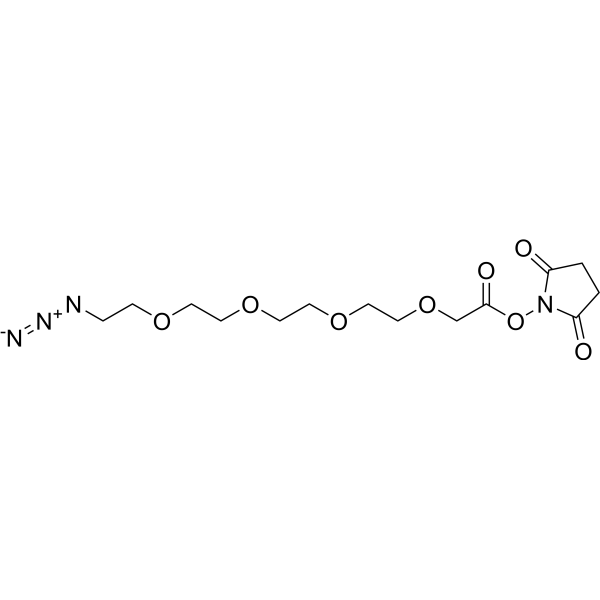
N3-PEG2-CH2CO2-NHS is a PEG derivative containing an azide group and an NHS ester. The azide group can react with alkyne, BCN, DBCO via Click Chemistry to yield a stable triazole linkage. The NHS ester can be used to label the primary amines (-NH2) of proteins, amine-modified oligonucleotides, and other amine-containing molecules.
|
-
- HY-140582
-
|
|
PROTAC Linkers
|
Cancer
|
|
N-(DBCO-PEG4)-N-Biotin-PEG4-NHS is a PEG-based PROTAC linker that can be used in the synthesis of PROTACs . N-(DBCO-PEG4)-N-Biotin-PEG4-NHS is a click chemistry reagent, it contains a DBCO group that can undergo strain-promoted alkyne-azide cycloaddition (SPAAC) with molecules containing Azide groups.
|
-
- HY-126509
-
|
|
ADC Linker
|
Cancer
|
|
Mal-amido-PEG10-C2-NHS ester is a nonclaevable ADC linker containing a maleimide group and an NHS ester. The NHS ester can be used to label the primary amines (-NH2) of proteins, amine-modified oligonucleotides, and other amine-containing molecules .
|
-
- HY-126508
-
|
|
ADC Linker
|
Cancer
|
|
Mal-amido-PEG10-C2-NHS ester is a nonclaevable ADC linker containing a maleimide group and an NHS ester. The NHS ester can be used to label the primary amines (-NH2) of proteins, amine-modified oligonucleotides, and other amine-containing molecules
|
-
- HY-126507
-
|
|
ADC Linker
|
Cancer
|
|
Mal-amido-PEG1-C2-NHS ester is a nonclaevable ADC linker containing a maleimide group and an NHS ester. The NHS ester can be used to label the primary amines (-NH2) of proteins, amine-modified oligonucleotides, and other amine-containing molecules
|
-
- HY-W591977
-
|
|
Biochemical Assay Reagents
|
Others
|
|
Boc-5-aminopentanoic NHS ester is a linker containing an NHS ester and a t-Boc protected amine group. The t-Boc group can be deprotected under mild acidic conditions to form a free amine. The NHS ester can be used to label the primary amines (-NH2) of proteins, amine-modified oligonucleotides, and other amine-containing molecules.
|
-
- HY-D1993
-
|
|
Fluorescent Dye
HIV
|
Infection
|
|
ATTO 647 NHS ester is a fluorescent label targeting free amino groups. ATTO 647 NHS ester can undergo a nucleophilic reaction with the free amino groups of EF-C peptide via its activated carboxylic acid group to form a stable covalent conjugate. ATTO 647 NHS ester-labeled nanofibers not only retain retroviral transduction-enhancing activity but also maintain stable fluorescent signals in both buffer and cell culture systems. ATTO 647 NHS ester is suitable for detection applications including fluorescence spectroscopy, microscopy and flow cytometry. ATTO 647 NHS ester has been used in studies related to HIV-1 infection .
|
-
- HY-D1848
-
|
|
Fluorescent Dye
|
Others
|
|
Sulfo-Cy3-NHS disodium is a derivative of Cy3 (Cyanine3) (HY-D0822) dye containing sulfonate ions. Sulfo-Cy3-NHS disodium contains sulfonate ions and has improved water solubility. Sulfo-Cy3-NHS disodium can label biomolecules containing amine groups, such as proteins, antibodies or peptides.
|
-
- HY-D1848A
-
|
|
Fluorescent Dye
|
Others
|
|
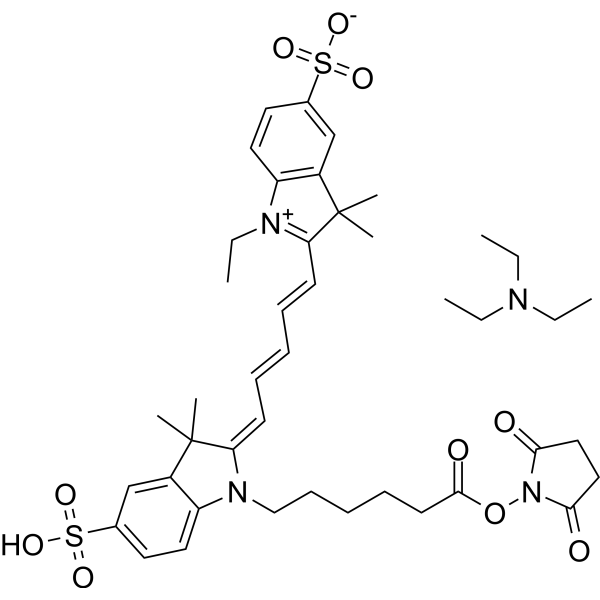
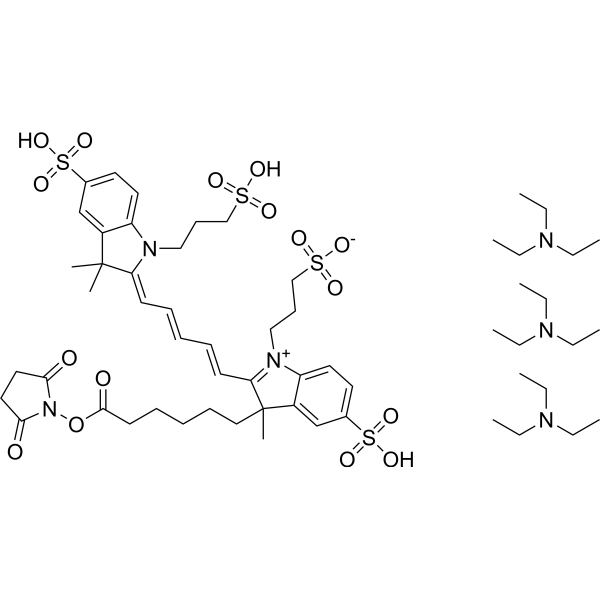
Sulfo-Cy3-NHS ditriethylamine is a derivative of Cy3 (Cyanine3) (HY-D0822) dye containing sulfonate ions. Sulfo-Cy3-NHS ditriethylamine contains sulfonate ions and has improved water solubility. Sulfo-Cy3-NHS ditriethylamine can label biomolecules containing amine groups, such as proteins, antibodies or peptides.
|
-
- HY-174897
-
|
|
Biochemical Assay Reagents
|
Others
|
|
DSPE-PEG4-NHS ester is a lipid-containing PEG derivative that can be used to form micelles as nanoparticles for drug delivery . NHS esters can be conjugated to amino acids or other molecules containing an amino group.
|
-
- HY-W879040
-
|
|
Biochemical Assay Reagents
|
Others
|
|
Sulfo-DBCO-NHS ester is a click chemistry reagent containing an azide group. The DBCO group is commonly used for copper-free Click Chemistry reactions due to its strain promoted high energy. NHS ester can bind to amino acids or other molecules containing amino groups .
|
-
- HY-130931
-
|
|
ADC Linker
|
Cancer
|
|
Propargyl-NH-PEG3-C2-NHS ester is a non-cleavable 3 unit PEG ADC linker used in the synthesis of antibody-drug conjugates (ADCs) . Propargyl-NH-PEG3-C2-NHS ester is a click chemistry reagent, it contains an Alkyne group and can undergo copper-catalyzed azide-alkyne cycloaddition (CuAAc) with molecules containing Azide groups.
|
-
- HY-133539
-
|
|
ADC Linker
|
Cancer
|
|
Propargyl-C8-amido-PEG2-NHS ester is a non-cleavable 2 unit PEG ADC linker used in the synthesis of antibody-drug conjugates (ADCs) . Propargyl-C8-amido-PEG2-NHS ester is a click chemistry reagent, it contains an Alkyne group and can undergo copper-catalyzed azide-alkyne cycloaddition (CuAAc) with molecules containing Azide groups.
|
-
- HY-D2746
-
|
|
Fluorescent Dye
|
Others
|
|
Cy5.5 bis-NHS ester is a reactive cyanine dye containing NHS ester which can be used to label amine groups in peptides, proteins, and oligonucleotides.
|
-
- HY-130086
-
|
|
ADC Linker
|
Cancer
|
|
Bis-PEG4-NHS ester is a crosslinking reagent and amine-reactive modulator [2].Bis-PEG4-NHS ester reacts with primary amine groups on liposome surfaces via amide bond formation to covalently attach dibenzylcyclooctyne groups, with a hydrophilic PEG4 spacer reducing steric hindrance for subsequent click chemistry [1].Bis-PEG4-NHS ester enables site-specific antibody coupling to liposome surfaces via copper-free strain-promoted alkyne-azide cycloaddition click chemistry without disrupting liposome structure in minimal organic solvent volumes [1].Bis-PEG4-NHS ester undergoes hydrolysis during annealing to form -COOH groups that interact with PbI and FAI to enhance perovskite structural integrity, passivate defects, and modulate nucleation kinetics to regulate crystal growth [2].Bis-PEG4-NHS ester enhances device efficiency and long-term stability when used as an antisolvent additive for p-i-n perovskite solar cells .
|
-
- HY-W190948
-
|
|
Biochemical Assay Reagents
|
Others
|
|
10-(tert-Butoxy)-10-oxodecanoic NHS ester has a t-butyl ester group and an NHS ester moiety. The t-butyl group can be deprotected under acidic conditions. NHS ester can react specifically and efficiently with primary amines such as the side chain of lysine residues or aminosilane-coated surfaces at neutral or slightly basic condition to form a covalent bond.
|
-
- HY-115524
-
|
|
ADC Linker
|
Cancer
|
|
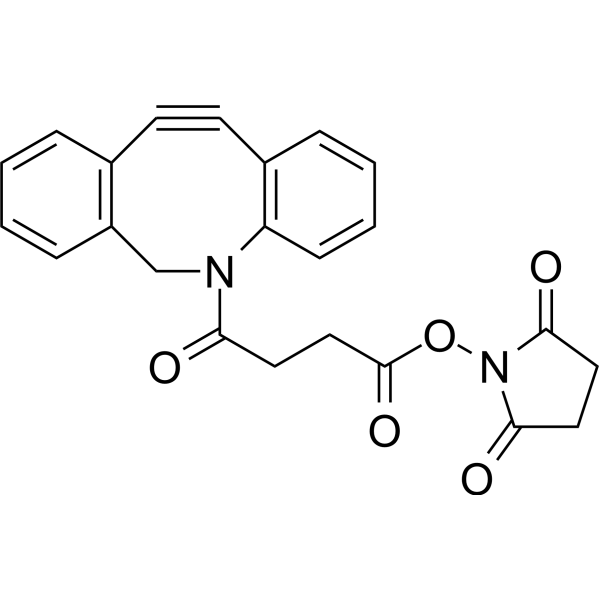
DBCO-NHS ester 2 is a cleavable linker that is used for making antibody-drug conjugate (ADC). DBCO-NHS ester 2 is a derivative of Dibenzylcyclooctyne (DBCO) used in copper-free click chemistry[1]. DBCO-NHS ester 2 is a click chemistry reagent, it contains a DBCO group that can undergo strain-promoted alkyne-azide cycloaddition (SPAAC) with molecules containing Azide groups.
|
-
- HY-W190906
-
|
|
Biochemical Assay Reagents
|
Others
|
|
6-(tert-Butoxy)-6-oxohexanoic NHS ester has a t-butyl ester group and an NHS ester moiety. The t-butyl group can be deprotected under acidic conditions. NHS ester can react specifically and efficiently with primary amines such as the side chain of lysine residues or aminosilane-coated surfaces at neutral or slightly basic condition to form a covalent bond.
|
-
- HY-D2741
-
|
|
Fluorescent Dye
|
Others
|
|
MB 488 NHS ester is a fluroescent agent with a terminal NHS ester group. MB 488 NHS ester is a green fluorescent, very hydrophilic dye molecule that has a maximal absorption of 501 nm and emission at 524 nm. The NHS ester can be applied to label the primary amines (-NH2) of proteins, amine-modified oligonucleotides, and other amine-containing molecules.
|
-
- HY-D2767
-
|
|
Fluorescent Dye
|
Others
|
|
MB 660R NHS Ester is a fluroescent agent with a terminal NHS ester group.MB 660R NHS Ester is a far-red fluorescent dye that has a maximal absorption of 665 nm and emission at 690 nm. The NHS ester can be applied to label the primary amines (-NH2) of proteins, amine-modified oligonucleotides, and other amine-containing molecules.
|
-
- HY-153631
-
-
- HY-151698A
-
|
|
Biochemical Assay Reagents
|
Others
|
|
(S,E)-TCO-NHS Ester is a Click Amino Acid that can be used to label amine-containing compounds or biomolecules. TCO-NHS ester contains a TCO group that can undergo an inverse electron demand Diels-Alder reaction (iEDDA) with molecules containing a Tetrazine group.
|
-
- HY-151698B
-
|
|
Biochemical Assay Reagents
|
Others
|
|
(R,E)-TCO-NHS Ester is a Click Amino Acid that can be used to label amine-containing compounds or biomolecules. TCO-NHS ester contains a TCO group that can undergo an inverse electron demand Diels-Alder reaction (iEDDA) with molecules containing a Tetrazine group.
|
-
- HY-140766
-
|
|
PROTAC Linkers
|
Cancer
|
|
Azido-PEG5-CH2CO2-NHS is a PEG-based PROTAC linker that can be used in the synthesis of PROTACs . Azido-PEG5-CH2CO2-NHS is a click chemistry reagent, it contains an Azide group and can undergo copper-catalyzed azide-alkyne cycloaddition reaction (CuAAc) with molecules containing Alkyne groups. It can also undergo strain-promoted alkyne-azide cycloaddition (SPAAC) reactions with molecules containing DBCO or BCN groups.
|
-
- HY-140560
-
|
|
PROTAC Linkers
|
Cancer
|
|
N-(Azido-PEG2)-N-Boc-PEG4-NHS ester is a PEG-based PROTAC linker that can be used in the synthesis of PROTACs . N-(Azido-PEG2)-N-Boc-PEG4-NHS ester is a click chemistry reagent, it contains an Azide group and can undergo copper-catalyzed azide-alkyne cycloaddition reaction (CuAAc) with molecules containing Alkyne groups. It can also undergo strain-promoted alkyne-azide cycloaddition (SPAAC) reactions with molecules containing DBCO or BCN groups.
|
-
- HY-138350
-
|
|
PROTAC Linkers
|
Cancer
|
|
Azido-PEG10-CH2CO2-NHS is a PEG-based PROTAC linker that can be used in the synthesis of PROTACs . Azido-PEG10-CH2CO2-NHS is a click chemistry reagent, it contains an Azide group and can undergo copper-catalyzed azide-alkyne cycloaddition reaction (CuAAc) with molecules containing Alkyne groups. It can also undergo strain-promoted alkyne-azide cycloaddition (SPAAC) reactions with molecules containing DBCO or BCN groups.
|
-
- HY-140561
-
|
|
PROTAC Linkers
|
Cancer
|
|
N-(Azido-PEG3)-N-Boc-PEG3-NHS ester is a PEG-based PROTAC linker that can be used in the synthesis of PROTACs . N-(Azido-PEG3)-N-Boc-PEG3-NHS ester is a click chemistry reagent, it contains an Azide group and can undergo copper-catalyzed azide-alkyne cycloaddition reaction (CuAAc) with molecules containing Alkyne groups. It can also undergo strain-promoted alkyne-azide cycloaddition (SPAAC) reactions with molecules containing DBCO or BCN groups.
|
-
- HY-140866
-
|
|
PROTAC Linkers
|
Cancer
|
|
N-(Azido-PEG4)-N-bis(PEG4-NHS ester) is a PEG-based PROTAC linker that can be used in the synthesis of PROTACs . N-(Azido-PEG4)-N-bis(PEG4-NHS ester) is a click chemistry reagent, it contains an Azide group and can undergo copper-catalyzed azide-alkyne cycloaddition reaction (CuAAc) with molecules containing Alkyne groups. It can also undergo strain-promoted alkyne-azide cycloaddition (SPAAC) reactions with molecules containing DBCO or BCN groups.
|
-
- HY-140559
-
|
|
PROTAC Linkers
|
Cancer
|
|
N-(Azido-PEG2)-N-Boc-PEG3-NHS ester is a PEG-based PROTAC linker that can be used in the synthesis of PROTACs . N-(Azido-PEG2)-N-Boc-PEG3-NHS ester is a click chemistry reagent, it contains an Azide group and can undergo copper-catalyzed azide-alkyne cycloaddition reaction (CuAAc) with molecules containing Alkyne groups. It can also undergo strain-promoted alkyne-azide cycloaddition (SPAAC) reactions with molecules containing DBCO or BCN groups.
|
-
- HY-203300D
-
|
|
Biochemical Assay Reagents
|
Others
|
|
DOPE-PEG1000-NHS is a conjugate composed of DOPE, PEG chains, and terminal active ester (NHS). The NHS ester in DOPE-PEG1000-NHS can rapidly covalently react with molecules containing primary amines (such as proteins, peptide chains, and small molecules modified with amino groups) to form stable amide bonds, suitable for the construction of carriers requiring membrane fusion properties or pH-sensitive release (such as gene delivery systems).
|
-
- HY-203300C
-
|
|
Biochemical Assay Reagents
|
Others
|
|
DOPE-PEG5000-NHS is a conjugate composed of DOPE, PEG chains, and terminal active ester (NHS). The NHS ester in DOPE-PEG5000-NHS can rapidly covalently react with molecules containing primary amines (such as proteins, peptide chains, and small molecules modified with amino groups) to form stable amide bonds, suitable for the construction of carriers requiring membrane fusion properties or pH-sensitive release (such as gene delivery systems).
|
-
- HY-203300B
-
|
|
Biochemical Assay Reagents
|
Others
|
|
DOPE-PEG3400-NHS is a conjugate composed of DOPE, PEG chains, and terminal active ester (NHS). The NHS ester in DOPE-PEG3400-NHS can rapidly covalently react with molecules containing primary amines (such as proteins, peptide chains, and small molecules modified with amino groups) to form stable amide bonds, suitable for the construction of carriers requiring membrane fusion properties or pH-sensitive release (such as gene delivery systems).
|
-
- HY-203300A
-
|
|
Biochemical Assay Reagents
|
Others
|
|
DOPE-PEG1000-NHS is a conjugate composed of DOPE, PEG chains, and terminal active ester (NHS). The NHS ester in DOPE-PEG1000-NHS can rapidly covalently react with molecules containing primary amines (such as proteins, peptide chains, and small molecules modified with amino groups) to form stable amide bonds, suitable for the construction of carriers requiring membrane fusion properties or pH-sensitive release (such as gene delivery systems).
|
-
- HY-203300
-
|
|
Biochemical Assay Reagents
|
Others
|
|
DOPE-PEG2000-NHS is a conjugate composed of DOPE, PEG chains, and terminal active ester (NHS). The NHS ester in DOPE-PEG2000-NHS can rapidly covalently react with molecules containing primary amines (such as proteins, peptide chains, and small molecules modified with amino groups) to form stable amide bonds, suitable for the construction of carriers requiring membrane fusion properties or pH-sensitive release (such as gene delivery systems).
|
-
- HY-151742
-
|
|
ADC Linker
|
Others
|
|
Norbornene-methyl-NHS is a norbornene-based antibody-drug conjugate linker (ADC Linker) bearing methyl and NHS ester functional groups, which can be used for specific antibody conjugation. Norbornene-methyl-NHS is also a click chemistry reagent containing a TCO group, acting as a dienophile for conjugation via the Diels-Alder reaction, namely the copper-free click reaction with tetrazine .
|
-
- HY-151698
-
|
|
ADC Linker
|
Others
|
|
TCO-NHS Ester axial is a click chemistry reagent that can be used as a building block in amine reactions. TCO-NHS Ester axial contains TCO groups, which can undergo inverse electron demand Diels-Alder reaction (iEDDA) with molecules containing Tetrazine groups.
|
-
- HY-D3263
-
|
|
Fluorescent Dye
|
Others
|
|
IR 650 NHS ester is a far-red-fluorescent probe with NHS ester. NHS ester is the most popular amine-reactive group for labeling with the primary amines of proteins (Lys), amine-modified oligonucleotides, and other amine-containing molecules. (Ex=651nm, Em=668 nm)
|
-
- HY-42973
-
|
|
ADC Linker
|
Cancer
|
|
DBCO-NHS ester is a non-cleavable ADC linker used in the synthesis of antibody-drug conjugates (ADCs) . DBCO-NHS ester is a click chemistry reagent, it contains a DBCO group that can undergo strain-promoted alkyne-azide cycloaddition (SPAAC) with molecules containing Azide groups.
|
-
- HY-141165
-
|
|
PROTAC Linkers
|
Cancer
|
|
TCO-NHS ester is an alkyl/ether-based PROTAC linker that can be used in the synthesis of PROTACs . TCO-NHS ester is a click chemistry reagent, it contains a TCO group that can undergo an inverse electron demand Diels-Alder reaction (iEDDA) with molecules containing Tetrazine groups.
|
-
- HY-126514
-
|
|
ADC Linker
|
Cancer
|
|
Propargyl-O-C1-amido-PEG2-C2-NHS ester is a nonclaevable 2-unit PEG linker for antibody-agent-conjugation (ADC). Propargyl-O-C1-amido-PEG2-C2-NHS ester is a click chemistry reagent, it contains an Alkyne group and can undergo copper-catalyzed azide-alkyne cycloaddition (CuAAc) with molecules containing Azide groups.
|
-
- HY-126515
-
|
|
ADC Linker
|
Cancer
|
|
Propargyl-O-C1-amido-PEG4-C2-NHS ester is a nonclaevable 4-unit PEG linker for antibody-agent-conjugation (ADC). Propargyl-O-C1-amido-PEG4-C2-NHS ester is a click chemistry reagent, it contains an Alkyne group and can undergo copper-catalyzed azide-alkyne cycloaddition (CuAAc) with molecules containing Azide groups.
|
-
- HY-141048
-
|
|
PROTAC Linkers
|
Cancer
|
|
N-(Azide-PEG3)-N'-(PEG4-NHS ester)-Cy5 is a PEG-based PROTAC linker that can be used in the synthesis of PROTACs . N-(Azide-PEG3)-N'-(PEG4-NHS ester)-Cy5 is a click chemistry reagent, it contains an Azide group and can undergo copper-catalyzed azide-alkyne cycloaddition reaction (CuAAc) with molecules containing Alkyne groups. It can also undergo strain-promoted alkyne-azide cycloaddition (SPAAC) reactions with molecules containing DBCO or BCN groups.
|
-
- HY-140763
-
|
|
PROTAC Linkers
|
Cancer
|
|
Azido-PEG1-CH2CO2-NHS is an alkyl/ether-based PROTAC linker that can be used in the synthesis of PROTACs . Azido-PEG1-CH2CO2-NHS is a click chemistry reagent, it contains an Azide group and can undergo copper-catalyzed azide-alkyne cycloaddition reaction (CuAAc) with molecules containing Alkyne groups. It can also undergo strain-promoted alkyne-azide cycloaddition (SPAAC) reactions with molecules containing DBCO or BCN groups.
|
-
- HY-126528
-
|
|
ADC Linker
|
Cancer
|
|
N3-PEG3-C2-NHS ester is a nonclaevable 3-unit PEG linker used in the synthesis of antibody-drug conjugates (ADCs). N3-PEG3-C2-NHS ester is a click chemistry reagent, it contains an Azide group and can undergo copper-catalyzed azide-alkyne cycloaddition reaction (CuAAc) with molecules containing Alkyne groups. It can also undergo strain-promoted alkyne-azide cycloaddition (SPAAC) reactions with molecules containing DBCO or BCN groups.
|
-
- HY-126526
-
|
|
ADC Linker
|
Cancer
|
|
N3-PEG2-C2-NHS ester is a nonclaevable 2-unit PEG linker used in the synthesis of antibody-drug conjugates (ADCs). N3-PEG2-C2-NHS ester is a click chemistry reagent, it contains an Azide group and can undergo copper-catalyzed azide-alkyne cycloaddition reaction (CuAAc) with molecules containing Alkyne groups. It can also undergo strain-promoted alkyne-azide cycloaddition (SPAAC) reactions with molecules containing DBCO or BCN groups.
|
-
- HY-130109
-
|
|
ADC Linker
|
Cancer
|
|
N3-PEG4-C2-NHS ester is a nonclaevable 4-unit PEG linker used in the synthesis of antibody-drug conjugates (ADCs). N3-PEG4-C2-NHS ester is a click chemistry reagent, it contains an Azide group and can undergo copper-catalyzed azide-alkyne cycloaddition reaction (CuAAc) with molecules containing Alkyne groups. It can also undergo strain-promoted alkyne-azide cycloaddition (SPAAC) reactions with molecules containing DBCO or BCN groups.
|
-
- HY-135973
-
|
|
ADC Linker
|
Cancer
|
|
BCN-SS-NHS is a cleavable ADC linker used in the synthesis of antibody-drug conjugates (ADCs) . BCN-SS-NHS is a click chemistry reagent, it contains a BCN group that can undergo strain-promoted alkyne-azide cycloaddition (SPAAC) with molecules containing Azide groups.
|
-
- HY-123687
-
|
|
ADC Linker
|
Cancer
|
|
DBCO-Sulfo-NHS ester sodium is a cleavable ADC linker used in the synthesis of antibody-drug conjugates (ADCs) . DBCO-Sulfo-NHS ester (sodium) is a click chemistry reagent, it contains a DBCO group that can undergo strain-promoted alkyne-azide cycloaddition (SPAAC) with molecules containing Azide groups.
|
-
- HY-126517
-
|
|
ADC Linker
|
Cancer
|
|
Cyclooctyne-O-NHS ester is a cleavable ADC linker used in the synthesis of antibody-drug conjugates (ADCs) . Cyclooctyne-O-NHS ester is a click chemistry reagent, it contains an Alkyne group and can undergo copper-catalyzed azide-alkyne cycloaddition (CuAAc) with molecules containing Azide groups.
|
-
- HY-156323
-
|
|
ADC Linker
|
Cancer
|
|
BCN-exo-PEG4-NHS is an ADC Linker containing 4 PEG units. BCN-exo-PEG4-NHS contains the lyophilic bidentate macrocyclic ligand BCN, which allows for further synthesis of macrocyclic complexes. In click chemistry, BCN reacts with molecules containing azide groups to form stable triazoles in the absence of catalysts.
|
-
- HY-156324
-
|
|
ADC Linker
|
Cancer
|
|
BCN-exo-PEG8-NHS is an ADC Linker containing 8 PEG units. BCN-exo-PEG8-NHS contains the lyophilic bidentate macrocyclic ligand BCN, which allows for further synthesis of macrocyclic complexes. In click chemistry, BCN reacts with molecules containing azide groups to form stable triazoles in the absence of catalysts.
|
-
- HY-151769
-
|
|
ADC Linker
|
Others
|
|
TCO-PEG2-Sulfo-NHS ester-EDC Urea is a click chemistry reagent containing an azide group. TCO-PEG2-Sulfo-NHS ester is a PEG linker containing a TCO moiety and a sulfo-NHS ester moiety. The sulfo group makes this molecule soluble in waqueous buffer. This reagent can be used to label antibodies, proteins and other primary amine-containing macromolecules with TCO moiety. Reagent grade, for research use only . TCO-PEG2-Sulfo-NHS ester-EDC Urea is a click chemistry reagent, it contains a TCO group that can undergo an inverse electron demand Diels-Alder reaction (iEDDA) with molecules containing Tetrazine groups.
|
-
- HY-136033
-
|
|
ADC Linker
|
Cancer
|
|
Methyltetrazine-SS-NHS is a cleavable ADC linker used in the synthesis of antibody-drug conjugates (ADCs) . Methyltetrazine-SS-NHS is a click chemistry reagent, it contains a Tetrazine group that can undergo an inverse electron demand Diels-Alder reaction (iEDDA) with molecules containing TCO groups.
|
-
- HY-126908
-
|
|
PROTAC Linkers
|
Cancer
|
|
Tetrazine-Ph-NHS ester is an alkyl/ether-based PROTAC linker that can be used in the synthesis of PROTACs . Tetrazine-Ph-NHS ester is a click chemistry reagent, it contains a Tetrazine group that can undergo an inverse electron demand Diels-Alder reaction (iEDDA) with molecules containing TCO groups.
|
-
- HY-130283
-
|
|
PROTAC Linkers
|
Cancer
|
|
Methyltetrazine-Ph-NHS ester is an alkyl/ether-based PROTAC linker that can be used in the synthesis of PROTACs . Methyltetrazine-Ph-NHS ester is a click chemistry reagent, it contains a Tetrazine group that can undergo an inverse electron demand Diels-Alder reaction (iEDDA) with molecules containing TCO groups.
|
-
- HY-136032
-
|
|
ADC Linker
|
Cancer
|
|
Tetrazine-SS-NHS is a cleavable ADC linker used in the synthesis of antibody-drug conjugates (ADCs) . Tetrazine-SS-NHS is a click chemistry reagent, it contains a Tetrazine group that can undergo an inverse electron demand Diels-Alder reaction (iEDDA) with molecules containing TCO groups.
|
-
- HY-D2166
-
|
|
Fluorescent Dye
|
Others
|
|
AF 594 NHS ester is a derivative of the red fluorescent dye AF 594 with high fluorescence quantum yield and high photostability (Ex=594 nm, Em=615 nm). AF 594 NHS ester can form an ester bond by reacting the NHS group with ammonia, with maximum excitation wavelength of 594 nm .
|
-
- HY-D1119C
-
|
|
Fluorescent Dye
|
Others
|
|
AF647-NHS ester is an analogue of Alexa Fluor 647 (AF647), which has excitation wavelength (λex) of 635 nm (conventional fluorescence detection)/620 nm (instantaneous detection). NHS ester can covalently bind to molecules with amino groups (such as proteins, antibodies, etc.) .
|
-
- HY-133583
-
|
|
ADC Linker
|
Cancer
|
|
Propargyl-O-C1-amido-PEG3-C2-NHS ester is a non-cleavable 3 unit PEG ADC linker used in the synthesis of antibody-drug conjugates (ADCs) . Propargyl-O-C1-amido-PEG3-C2-NHS ester is a click chemistry reagent, it contains an Alkyne group and can undergo copper-catalyzed azide-alkyne cycloaddition (CuAAc) with molecules containing Azide groups.
|
-
- HY-W437745
-
|
|
Fluorescent Dye
|
Others
|
|
Desthiobiotin-NHS ester is a biotinylated biochemical assay reagent that reacts with amine groups (such as lysine residues) of proteins or other biomolecules to form stable amide bonds. Desthiobiotin-NHS ester can be used as probes for metalloproteins .
|
-
- HY-115545
-
|
|
ADC Linker
|
Cancer
|
|
DBCO-NHS ester 3 (Compound 12) is a cleavable linker that is used for making antibody-drug conjugate (ADC). DBCO-NHS ester 3 is a derivative of Dibenzylcyclooctyne (DBCO) obtained by activation of N-hydroxysuccinimide by the carboxylic acid moiety of both methyl-oxanorbornadiene (MeOND) and dibenzoazacyclooctyne (DIBAC) . DBCO-NHS ester 3 is a click chemistry reagent, it contains a DBCO group that can undergo strain-promoted alkyne-azide cycloaddition (SPAAC) with molecules containing Azide groups.
|
-
- HY-150014
-
|
|
Others
|
Others
|
|
AMT-NHS is an RNA-protein crosslinker. AMT-NHS is composed of a psoralen derivative and an N-hydroxysuccinimide ester group which react with RNA bases and primary amines of protein, respectively. AMT-NHS can penetrate into living yeast cells and crosslink Cbf5 to H/ACA snoRNAs with high specificity. AMT-NHS induces different crosslinking patterns and targets both single- and double-stranded regions of RNA. AMT-NHS can be used for capturing diverse RNA-protein interactions in cells .
|
-
- HY-23629
-
|
|
PROTAC Linkers
|
Cancer
|
|
16-Aminohexadecanoic acid is an alkane chain with terminal carboxlic acid and amine groups. 16-Aminohexadecanoic acid can be used as a PROTAC linker in the synthesis of PROTACs. The amino group (NH2) is reactive with carboxylic acids, activated NHS esters, carbonyls (ketone, aldehyde) etc. The terminal carboxylic acid can react with primary amine groups of activated NHS ester to form a stable amide bond.
|
-
- HY-W401143
-
|
|
PROTAC Linkers
|
Cancer
|
|
15-Aminopentadecanoic Acid can be used as a PROTAC linker in the synthesis of PROTACs. 15-Aminopentadecanoic Acid is an alkane chain with terminal carboxlic acid and amine groups. The amino group (NH2) is reactive with carboxylic acids, activated NHS esters, carbonyls (ketone, aldehyde) etc. The terminal carboxylic acid can react with primary amine groups of activated NHS ester to form a stable amide bond.
|
-
- HY-D1568
-
|
|
Fluorescent Dye
|
Others
|
|
Sulfo-Cy7.5 NHS ester is a near infrared water soluble hydrophilic dye, also is an NHS ester for the modification of amine groups. Sulfo-Cy7.5 NHS ester contains a trimeth ylene bridge and has a linker arm for its attachment to proteins, peptides, and other molecules. Sulfo-Cy7.5 NHS ester can be used for the research of NIR imaging applications .
|
-
- HY-W096079
-
|
|
ADC Linker
|
Cancer
|
|
BCN-endo-PEG4-NHS is an ADC Linker containing 4 PEG units. BCN-endo-PEG4-NHS contains the lyophilic bidentate macrocyclic ligand endo-BCN, which allows for further synthesis of macrocyclic complexes. In click chemistry, endo-BCN can react with molecules containing azide groups to form stable triazoles in the absence of catalysts.
|
-
- HY-W451460
-
|
|
Biochemical Assay Reagents
|
Others
|
|
2,5-Dioxopyrrolidin-1-yl 2-(prop-2-yn-1-yloxy)acetate is a Click Chemistry reagent with a propargyl group and an NHS ester group. The propargyl group can react with biomolecules containing azide group via copper catalyzed Click Chemistry reaction. The NHS ester is an amine reactive group which can be used for derivatizing peptides, antibodies, amine coated surfaces, etc.
|
-
- HY-133412
-
|
|
ADC Linker
|
Cancer
|
|
DBCO-NHCO-S-S-NHS ester is a cleavable ADC linker used in the synthesis of antibody-drug conjugates (ADCs) . DBCO-NHCO-S-S-NHS ester is a click chemistry reagent, it contains a DBCO group that can undergo strain-promoted alkyne-azide cycloaddition (SPAAC) with molecules containing Azide groups.
|
-
- HY-133413
-
|
|
ADC Linker
|
Cancer
|
|
DBCO-CONH-S-S-NHS ester is a cleavable ADC linker used in the synthesis of antibody-drug conjugates (ADCs) . DBCO-CONH-S-S-NHS ester is a click chemistry reagent, it contains a DBCO group that can undergo strain-promoted alkyne-azide cycloaddition (SPAAC) with molecules containing Azide groups.
|
-
- HY-158072
-
|
|
Biochemical Assay Reagents
Radionuclide-Drug Conjugates (RDCs)
|
Cancer
|
|
DOTAM-NHS-ester is a bifunctional chelator and a macrocyclic DOTA derivative used for tumor pre-targeting. DOTAM-NHS-ester combines the efficient metal chelating ability of DOTAM macrocyclic ligands with the bioconjugation function of NHS ester active groups, and can be widely used in the biomedical field for metal labeling, molecular imaging and drug delivery development .
|
-
- HY-W105727
-
|
|
PROTAC Linkers
|
Cancer
|
|
9-Aminononanoic acid can be used as a PROTAC linker and other conjugation in the synthesis of PROTACs. 9-Aminononanoic acid is an alkane chain with terminal carboxlic acid and amine groups. The amino group (NH2) is reactive with carboxylic acids, activated NHS esters, carbonyls (ketone, aldehyde) etc. The terminal carboxylic acid can react with primary amine groups of activated NHS ester to form a stable amide bond.
|
-
- HY-172290
-
|
|
ADC Linker
|
Cancer
|
|
Benzyl N1-[PEG1-NHS] -N6-(t-Boc)-L-lysinate is a multifunctional ADC linker consisting of a terminal benzyl group, one PEG unit, an NHS ester, and a t-Boc-protected L-lysine, often used for bioconjugation and chemical modifications in R&D.
|
-
- HY-151727
-
|
|
ADC Linker
|
Others
|
|
Norbornene-NHS is a norbornene-functionalized antibody-drug conjugate linker (ADC Linker) bearing an NHS ester, which is applicable for highly efficient and specific antibody conjugation reactions in ADC research and development. Norbornene-NHS also acts as an azide-group-containing click chemistry reagent, serving as a dienophile for copper-free click reaction conjugation .
|
-
- HY-118431
-
|
|
Biochemical Assay Reagents
|
Others
|
|
DMABA NHS ester can chemically react with the primary amine groups of the major phospholipid component of the cell membrane, Phosphatidylethanolamine (PE). Through precursor ion scanning, all PE subclasses labeled with DMABA can be detected. DMABA NHS ester can be used in combination with isotope-labeled compounds such as DMABA-d6 NHS ester, DMABA-d10 NHS ester, and DMABA-d4 NHS ester to observe changes in the distribution of PE lipids and the formation of novel PE lipid products .
|
-
- HY-D1730
-
|
|
Fluorescent Dye
|
Others
|
|
AF488 NHS ester is an amine specific fluorescence probe (Em=525 nm). AF488 NHS ester reacts with sulfhydryl groups and amines in aqueous and biological samples then change their chemical structure and fluorescence properties after derivatization .
|
-
- HY-D1568A
-
|
|
Fluorescent Dye
|
Others
|
|
Sulfo-Cy7.5 NHS ester tripotassium is a near infrared water soluble hydrophilic dye, also is an NHS ester for the modification of amine groups. Sulfo-Cy7.5 NHS ester tripotassium contains a trimeth ylene bridge and has a linker arm for its attachment to proteins, peptides, and other molecules. Sulfo-Cy7.5 NHS ester tripotassium can be used for the research of NIR imaging applications .
|
-
- HY-W035129
-
|
|
Biochemical Assay Reagents
|
Others
|
|
endo-BCN-NHS carbonate is an elastin-like protein (ELP) modification reagent. endo-BCN-NHS carbonate can react with lysine residues in ELP to make ELP carry BCN groups, and then cross-link ELP through strain-promoted azide-alkyne cycloaddition (SPAAC) reaction. endo-BCN-NHS carbonate promotes hydrogel formation. endo-BCN-NHS carbonate is mainly used in cell encapsulation related research .
|
-
- HY-W105744
-
|
|
PROTAC Linkers
|
Cancer
|
|
10-Aminodecanoic acid is an alkane chain with terminal carboxlic acid and amine groups. 10-Aminodecanoic acid can be used as a PROTAC linker in the synthesis of PROTACs and other conjugation applications. The amino group (NH2) is reactive with carboxylic acids, activated NHS esters, carbonyls (ketone, aldehyde) etc. The terminal carboxylic acid can react with primary amine groups of activated NHS ester to form a stable amide bond.
|
-
- HY-135414A
-
|
|
Fluorescent Dye
|
Others
|
|
Cyanine5 NHS ester bromide is a active compound, can be used to label amino groups in peptides, proteins, and oligonucleotides. Cyanine5 NHS ester bromide is a cyanine dye, fluorescence-labeling neurotensin (8-13) via arginine residues .
|
-
- HY-155500
-
|
|
Fluorescent Dye
|
Others
|
|
Digoxigenin NHS ester is an activated ester which readily reacts with amino groups under mild conditions, attaching the Digoxigenin (HY-B1025) moiety to proteins or amino-. Digoxigenin NHS ester can be used to label proteins and oligonucleotides .
|
-
- HY-D0975
-
|
|
ADC Linker
|
Cancer
|
|
Sulfo-SMCC sodium is a commonly used hetero-bifunctional, noncleavable ADC crosslinker bearing N-hydroxysuccinimide (NHS) ester and maleimide groups to react with primary amines and sulfhydryl groups, respectively.
|
-
- HY-156991
-
|
NODA-GA-NHS ester
|
EGFR
Radionuclide-Drug Conjugates (RDCs)
|
Cancer
|
|
NODAGA-NHS (NODA-GA-NHS ester) is the activated ester form of the NODAGA chelator. NODAGA-NHS conjugates with Trastuzumab (HY-P9907) to form NODAGA-Trastuzumab, a conjugate that can chelate 64Cu for the preparation of radiotracers. NODAGA-NHS covalently binds to the amino group of lactosamine derivatives to form radiotracer precursors. [ 64Cu]NODAGA-trastuzumab enables PET imaging of tumors expressing HER2. NODAGA-NHS is used in studies of HER2-positive breast cancer and ovarian adenocarcinoma .
|
-
- HY-128925
-
AMAS
1 Publications Verification
|
ADC Linker
|
Cancer
|
|
AMAS is a nonclaevable heterobifunctional crosslinker with NHS ester and maleimide groups that allows covalent conjugation of amine- and sulfhydryl-containing molecules.
|
-
- HY-135414
-
|
|
Fluorescent Dye
|
Others
|
|
Cyanine5 NHS ester chloride is a red emitting fluorescent dye for labeling of amino-groups in peptides, proteins, and oligonucleotides .
|
-
- HY-D1119
-
|
|
Fluorescent Dye
|
Others
|
|
AF647-NHS ester is an analog of Alexa Fluor 647 (AF647). NHS ester can covalently bind to molecules with amino groups (such as proteins, antibodies, etc.). AF647 is a far-red fluorescent dye with an excitation wavelength (λex) of 635 nm (conventional fluorescence detection)/620 nm (instantaneous detection). Storage: Protect from light .
|
-
- HY-154802
-
|
|
ADC Linker
Radionuclide-Drug Conjugates (RDCs)
|
Cancer
|
|
TCO-GK-PEG4-NHS ester is an ADC Linker, and can be used for synthesis of [18F]AlF-NOTA-Tz-TCO-GK-2Rs15d. [18F]AlF-NOTA-Tz-TCO-GK-2Rs15d binds with high affinity and immunoreactivity to HER2 . TCO-GK-PEG4-NHS ester is a click chemistry reagent, it contains a TCO group that can undergo an inverse electron demand Diels-Alder reaction (iEDDA) with molecules containing Tetrazine groups.
|
-
- HY-140102
-
|
|
ADC Linker
|
Cancer
|
|
Azidoethyl-SS-propionic NHS ester is a cleavable ADC linker used in the synthesis of antibody-drug conjugates (ADCs) . Azidoethyl-SS-propionic NHS ester is a click chemistry reagent, it contains an Azide group and can undergo copper-catalyzed azide-alkyne cycloaddition reaction (CuAAc) with molecules containing Alkyne groups. It can also undergo strain-promoted alkyne-azide cycloaddition (SPAAC) reactions with molecules containing DBCO or BCN groups.
|
-
- HY-133431
-
|
|
ADC Linker
|
Cancer
|
|
DBCO-PEG3-SS-NHS ester is a cleavable 3 unit PEG ADC linker used in the synthesis of antibody-drug conjugates (ADCs) . DBCO-PEG3-SS-NHS ester is a click chemistry reagent, it contains a DBCO group that can undergo strain-promoted alkyne-azide cycloaddition (SPAAC) with molecules containing Azide groups.
|
-
- HY-W190926
-
|
|
Biochemical Assay Reagents
|
Others
|
|
2,5 -Dioxo-1-pyrrolidinyl 11-azidoundecanoate is a linker containing an azide group and an NHS ester. The azide group can react with alkyne, BCN, DBCO via Click Chemistry to yield a stable triazole linkage. The NHS ester can be used to label the primary amines (-NH2) of proteins, amine-modified oligonucleotides, and other amine-containing molecules.
|
-
- HY-W591424
-
|
mPEG2000-SC; mPEG2000-Succinimidyl ester
|
Biochemical Assay Reagents
MMP
|
Cancer
|
|
m-PEG2000-NHS ester (mPEG2000-SC) is a reagent with both cell adhesion inhibition and peptide conjugation functions. The NHS ester group of m-PEG2000-NHS ester forms stable amide bonds with primary amine-containing molecules (e.g., the N-terminus of MMP-2-cleavable octapeptide) to generate mPEG-peptide intermediates for liposome surface modification. When m-PEG2000-NHS ester is immobilized on a cystamine-modified gold surface, it can construct an in vitro model for cell adhesion kinetic studies, and higher PEG density and thicker layers correlate with lower cell adhesion rates. m-PEG2000-NHS ester can synthesize MMP-2-responsive PEGylated lipid conjugates to achieve MMP-triggered dePEGylation in the tumor microenvironment. m-PEG2000-NHS ester can be used in studies related to colon cancer and other conditions .
|
-
- HY-135414B
-
|
|
Fluorescent Dye
|
Others
|
|
Cyanine5 NHS ester iodide is a red emitting fluorescent dye for labeling of amino-groups in peptides, proteins, and oligonucleotides .
|
-
- HY-W096149
-
|
|
Biochemical Assay Reagents
|
Others
|
|
exo-BCN-NHS carbonate carbonate contains BCN group. Strain-promoted alkyne-azide cycloaddition (SPAAC) can also occur with molecules containing DBCO or BCN groups.
|
-
- HY-D3325
-
|
|
Fluorescent Dye
|
Others
|
|
AF 700 NHS ester is a fluorescent dye AF 700 derivative exhibits high fluorescence quantum yield and high photostability. AF 700 NHS ester can form an ester bond with ammonia via the NHS group, and can be used to label proteins, amine-modified oligonucleotides, and other primary amines (R-NH2) containing amine molecules (Ex/Em = 702/723 nm).
|
-
- HY-D3258
-
|
|
Fluorescent Dye
|
Others
|
|
AF 660 NHS ester is a fluorescent dye AF 660 derivative exhibits high fluorescence quantum yield and high photostability. AF 660 NHS ester can form an ester bond with ammonia via the NHS group, and can be used to label proteins, amine-modified oligonucleotides, and other primary amines (R-NH2) containing amine molecules (Ex/Em = 668/698 nm).
|
-
- HY-D3257
-
|
|
Fluorescent Dye
|
Others
|
|
AF 546 NHS ester is a fluorescent dye AF 546 derivative exhibits high fluorescence quantum yield and high photostability. AF 546 NHS ester can form an ester bond with ammonia via the NHS group, and can be used to label proteins, amine-modified oligonucleotides, and other primary amines (R-NH2) containing amine molecules (Ex/Em = 554/570 nm).
|
-
- HY-D3259
-
|
|
Fluorescent Dye
|
Others
|
|
AF 680 NHS ester is a fluorescent dye AF 680 derivative exhibits high fluorescence quantum yield and high photostability. AF 680 NHS ester can form an ester bond with ammonia via the NHS group, and can be used to label proteins, amine-modified oligonucleotides, and other primary amines (R-NH2) containing amine molecules (Ex/Em = 684/707 nm).
|
-
- HY-D3326
-
|
|
Fluorescent Dye
|
Others
|
|
AF 750 NHS ester is a fluorescent dye AF 750 derivative exhibits high fluorescence quantum yield and high photostability. AF 750 NHS ester can form an ester bond with ammonia via the NHS group, and can be used to label proteins, amine-modified oligonucleotides, and other primary amines (R-NH2) containing amine molecules (Ex/Em = 753/782 nm).
|
-
- HY-D3323
-
|
|
Fluorescent Dye
|
Others
|
|
AF 350 NHS ester is a fluorescent dye AF 350 derivative exhibits high fluorescence quantum yield and high photostability. AF 350 NHS ester can form an ester bond with ammonia via the NHS group, and can be used to label proteins, amine-modified oligonucleotides, and other primary amines (R-NH2) containing amine molecules (Ex/Em = 346/445 nm) .
|
-
- HY-D3256
-
|
|
Fluorescent Dye
|
Others
|
|
AF 532 NHS ester is a fluorescent dye AF 532 derivative exhibits high fluorescence quantum yield and high photostability. AF 532 NHS ester can form an ester bond with ammonia via the NHS group, and can be used to label proteins, amine-modified oligonucleotides, and other primary amines (R-NH2) containing amine molecules (Ex/Em = 530/555 nm).
|
-
- HY-140765
-
|
|
PROTAC Linkers
|
Cancer
|
|
Azido-PEG4-NHS-ester is a PEG-based PROTAC linker that can be used in the synthesis of PROTACs . Azido-PEG4-NHS-ester is a click chemistry reagent, it contains an Azide group and can undergo copper-catalyzed azide-alkyne cycloaddition reaction (CuAAc) with molecules containing Alkyne groups. It can also undergo strain-promoted alkyne-azide cycloaddition (SPAAC) reactions with molecules containing DBCO or BCN groups.
|
-
- HY-133466
-
|
|
ADC Linker
|
Cancer
|
|
Methyltetrazine-PEG4-SS-NHS ester is a cleavable 4 unit PEG ADC linker used in the synthesis of antibody-drug conjugates (ADCs) . Methyltetrazine-PEG4-SS-NHS ester is a click chemistry reagent, it contains a Tetrazine group that can undergo an inverse electron demand Diels-Alder reaction (iEDDA) with molecules containing TCO groups.
|
-
- HY-136040
-
|
|
ADC Linker
|
Cancer
|
|
Tetrazine-PEG4-SS-NHS is a cleavable 4 unit PEG ADC linker used in the synthesis of antibody-drug conjugates (ADCs) . Tetrazine-PEG4-SS-NHS is a click chemistry reagent, it contains a Tetrazine group that can undergo an inverse electron demand Diels-Alder reaction (iEDDA) with molecules containing TCO groups.
|
-
- HY-132270
-
|
|
Fluorescent Dye
|
Others
|
|
FAM amine, 5-isomer is a fluorescein linker that undergoes enzymatic transamination. The addition of the amine group makes the compound more reactive with carboxylic acids, activated NHS ester and other carbonyl groups.
|
-
- HY-140770
-
|
|
PROTAC Linkers
|
Cancer
|
|
Azido-PEG3-aminoacetic acid-NHS ester is a PEG-based PROTAC linker that can be used in the synthesis of PROTACs . Azido-PEG3-aminoacetic acid-NHS ester is a click chemistry reagent, it contains an Azide group and can undergo copper-catalyzed azide-alkyne cycloaddition reaction (CuAAc) with molecules containing Alkyne groups. It can also undergo strain-promoted alkyne-azide cycloaddition (SPAAC) reactions with molecules containing DBCO or BCN groups.
|
-
- HY-140768
-
|
|
PROTAC Linkers
|
Cancer
|
|
Azido-PEG3-O-NHS ester is a PEG-based PROTAC linker that can be used in the synthesis of PROTACs . Azido-PEG3-O-NHS ester is a click chemistry reagent, it contains an Azide group and can undergo copper-catalyzed azide-alkyne cycloaddition reaction (CuAAc) with molecules containing Alkyne groups. It can also undergo strain-promoted alkyne-azide cycloaddition (SPAAC) reactions with molecules containing DBCO or BCN groups.
|
-
- HY-D1119A
-
|
|
Fluorescent Dye
|
Others
|
|
AF647-NHS ester tripotassium is an analogue of Alexa Fluor 647 (AF647) (HY-D1119). NHS ester can covalently bind to molecules with amino groups (such as proteins, antibodies, etc.). AF647 is a bright, far-red fluorescent dye with an excitation wavelength (λex) of 635 nm (conventional fluorescence detection)/620 nm (instantaneous detection). Storage: protect from light .
|
-
- HY-D1119B
-
|
|
Fluorescent Dye
|
Others
|
|
AF647-NHS ester (trisodium) is an analogue of Alexa Fluor 647 (AF647) (HY-D1119). NHS ester can covalently bind to molecules with amino groups (such as proteins, antibodies, etc.). AF647 is a bright, far-red fluorescent dye with an excitation wavelength (λex) of 635 nm (conventional fluorescence detection)/620 nm (instantaneous detection). Storage: protect from light .
|
-
- HY-W156324
-
|
|
PROTAC Linkers
Liposome
|
Others
|
|
Biotin-PEGn-NHS ester is a biotin-labeled PROTAC linker, which belongs to the PEG class and can be used to synthesize PROTAC molecules. Biotin-PEGn-NHS ester can interact with free neutral avidin in solution and successfully target malignant glioma cells. Biotin-PEGn-NHS ester can also be grafted onto the amino group of GelMA to prepare biotin-modified functionalized hydrogel, gelatin methacryloyl (Bio-GelMA) .
|
-
- HY-W012971
-
|
|
Biochemical Assay Reagents
|
Others
|
|
5-Amino-1-pentanol is a linker containing a hydroxyl group and amine group. The hydroxyl group enables further derivatization or replacement with other reactive functional groups. The amine group is reactive with carboxylic acids, activated NHS esters, carbonyls (ketone, aldehyde) etc.
|
-
- HY-137251
-
|
|
Biochemical Assay Reagents
|
Others
|
|
Sulfo-MBS sodium is a heterobifunctional crosslinker with a maleimide group and an N-hydroxysuccinimide (NHS) ester group, which can react with cysteine residues and lysine residues on proteins. Sulfo-MBS sodium be used for protein cross-linking studies .
|
-
- HY-D1849
-
|
|
Fluorescent Dye
|
Others
|
|
Cy3B NHS ester is a fluorescent dye compound that is commonly used in biomarking and fluorescent labeling experiments, especially for labeling biomolecules containing amino functional groups (amine groups), such as proteins, antibodies or peptides.
|
-
- HY-151827
-
|
|
ADC Linker
|
Others
|
|
DBCO-PEG2-NHS ester is a click chemistry reagent containing an azide group. DBCO-PEG2-NHS ester is a click chemistry PEG reagent containing NHS ester that is able to react specifically and efficiently with primary amines (e.g. the side chain of lysine residues or aminosilane-coated surfaces) at neutral or slightly basic condition to form a covalent bond. The hydrophilic PEG spacer arm improves water solubility and provides a long and flexible connection that minimizes steric hindrance involved with ligation. DBCO is commonly used for copper-free Click Chemistry reactions. Reagent grade, for research use only .
|
-
- HY-172309
-
|
|
Fluorescent Dye
|
Others
|
|
UBQ-3 NHS Ester is a fluroescent agent with a terminal NHS ester group. UBQ-3 NHS Ester has a wide quenching range from 620-730 nm, which makes the compound useful as an acceptor in fluorescence resonance energy transfer (FRET) applications in conjunction with far-red to near-IR emitting dyes such as Cy5, Cy5.5, Alexa Fluor 633, 647, 700. The NHS ester can be applied to label the primary amines (-NH2) of proteins, amine-modified oligonucleotides, and other amine-containing molecules.
|
-
- HY-W591352
-
|
|
Ligands for E3 Ligase
|
Cancer
|
|
Thalidomide-5-(C6-amine) is a PROTAC building block that contains an E3 ligase ligand substituted with a terminal amine group. The amine group can react with NHS ester group or carboxylic acid in the presence of EDC or HATU.
|
-
- HY-135966
-
|
|
ADC Linker
|
Cancer
|
|
Azido-PEG3-SS-NHS is a cleavable 3 unit PEG ADC linker used in the synthesis of antibody-drug conjugates (ADCs) . Azido-PEG3-SS-NHS is a click chemistry reagent, it contains an Azide group and can undergo copper-catalyzed azide-alkyne cycloaddition reaction (CuAAc) with molecules containing Alkyne groups. It can also undergo strain-promoted alkyne-azide cycloaddition (SPAAC) reactions with molecules containing DBCO or BCN groups.
|
-
- HY-126525
-
|
|
ADC Linker
|
Cancer
|
|
4-N3Pfp-NHS ester is a noncleavable ADC linker used in the synthesis of antibody-drug conjugates (ADCs) . 4-N3Pfp-NHS ester is a click chemistry reagent, it contains an Azide group and can undergo copper-catalyzed azide-alkyne cycloaddition reaction (CuAAc) with molecules containing Alkyne groups. It can also undergo strain-promoted alkyne-azide cycloaddition (SPAAC) reactions with molecules containing DBCO or BCN groups.
|
-
- HY-149117
-
|
|
Fluorescent Dye
|
Others
|
|
AF430 NHS ester is an AF 430 maleimide is a derivative of the yellow fluorescent dye AF 430. AF430 has an excitation wavelength of 425 nm and an emission wavelength of 542 nm. AF430 NHS ester can be uesd for the labeling of amino-groups in peptides, proteins, and oligonucleotides. To achieve specific coupling of dye labels and biomolecules .
|
-
- HY-D3049
-
|
|
Fluorescent Dye
|
Others
|
|
5(6)-carbonylated rhodamine 110 NHS ester is a reactive ester fluorescent reagent based on 5(6)-carbonylated rhodamine 110. NHS ester is a highly reactive ester capable of covalently coupling with primary amine groups in molecules such as proteins, peptides, amino sugars, and nucleic acids to form stable amide bonds (Ex/Em = 502/527 nm).
|
-
- HY-W800753
-
|
|
Biochemical Assay Reagents
|
Others
|
|
2,5-Dioxopyrrolidin-1-yl 6-bromohexanoate is an alkane linker with a terminal bromide and an NHS ester. The bromide is a very good leaving group for nucleophilic substitution reactions. The NHS ester can be used to label the primary amines (-NH2) of proteins, amine-modified oligonucleotides, and other amine-containing molecules.
|
-
- HY-W800651
-
|
|
Biochemical Assay Reagents
|
Others
|
|
Biotin-SS-Amine hydrochloride is a cleavable biotinylation reagent. The amine group can react with carboxylic acids, activated NHS esters and other carbonyl groups. The disulfide bond in this linker can be cleaved using reducing agents such as DTT, BME and TCEP.
|
-
- HY-W190753
-
|
|
Biochemical Assay Reagents
|
Others
|
|
BocNH-PEG8-CH2CH2COONHS is a PEG linker containing an NHS ester and a Boc-protected amino group. The hydrophilic PEG spacer increases the water solubility of a compound in aqueous media. The Boc group can be deprotected under mild acidic conditions to form a free amine. The NHS ester can be used to label the primary amines (-NH2) of proteins, amine-modified oligonucleotides, and other amine-containing molecules.
|
-
- HY-118112
-
|
|
Biochemical Assay Reagents
|
Others
|
|
4-N-Maleimidobenzoicacid-NHS is a PEG linker that finds utility in bioconjugation endeavors and protein labeling ventures. Specifically designed for selective reaction with thiol groups, the maleimide group establishes covalent linkages, thereby facilitating the coupling of proteins, peptides, or diverse molecules to thiol-bearing biomolecules. The NHS ester is able to react specifically and efficiently with primary amines (e.g. the side chain of lysine residues or aminosilane-coated surfaces) at neutral or slightly basic conditions to form a covalent bond.
|
-
- HY-D1730A
-
|
|
Fluorescent Dye
|
Others
|
|
AF488 NHS ester TEA is an amine specific fluorescence probe (λem=525 nm=525 nm). AF488 NHS ester reacts with sulfhydryl groups and amines in aqueous and biological samples then change their chemical structure and fluorescence properties after derivatization. AF488 exhibits the λem and λex wavelength of 520 nm and 470 nm, respectively .
|
-
- HY-D3050
-
|
|
Fluorescent Dye
|
Others
|
|
5(6)-carbonylated rhodamine 110 X NHS ester is a reactive ester fluorescent reagent based on 5(6)-carbonylated rhodamine 110 X. NHS ester is a highly reactive ester capable of covalently coupling with primary amine groups in molecules such as proteins, peptides, amino sugars, and nucleic acids to form stable amide bonds (Ex/Em = 496/522 nm).
|
-
- HY-W800754
-
|
|
Biochemical Assay Reagents
|
Others
|
|
8-Bromo-octanoic acid 2,5-dioxo-pyrrolidin-1-yl ester is an alkane linker with a terminal bromide and an NHS ester. The bromide is a very good leaving group for nucleophilic substitution reactions. The NHS ester can be used to label the primary amines (-NH2) of proteins, amine-modified oligonucleotides, and other amine-containing molecules.
|
-
- HY-D3053
-
|
|
Fluorescent Dye
|
Others
|
|
5(6)-Rhodamine 6G NHS ester is a reactive ester fluorescent reagent based on Rhodamine 6G (HY-D0309). NHS ester is a highly reactive ester capable of covalently coupling with primary amine groups in molecules such as proteins, peptides, amino sugars, and nucleic acids to form stable amide bonds (Ex/Em = 526/547 nm).
|
-
- HY-W591353
-
|
|
E3 Ligase Ligand-Linker Conjugates
|
Cancer
|
|
Thalidomide-5-(PEG2-amine) is a PROTAC building block that contains an E3 ligase ligand substituted with a terminal amine group. The amine group can react with NHS ester group or carboxylic acid in the presence of EDC or HATU. The PEG spacer improves water solubility.
|
-
- HY-W479025
-
|
|
Biochemical Assay Reagents
|
Others
|
|
Fmoc-DODA hydrochloride is a linker with an Fmoc-protected amine and a terminal amine group. The Fmoc group can be deprotected under basic condition to obtain the free amine which can be used for further conjugations. The amino group is reactive with carboxylic acids, activated NHS esters, carbonyls (ketone, aldehyde) etc.
|
-
- HY-140865
-
|
|
PROTAC Linkers
|
Cancer
|
|
2-(Azido-PEG3-amido)-1,3-bis(NHS ester) is a PEG-based PROTAC linker that can be used in the synthesis of PROTACs . 2-(Azido-PEG3-amido)-1,3-bis(NHS ester) is a click chemistry reagent, it contains an Azide group and can undergo copper-catalyzed azide-alkyne cycloaddition reaction (CuAAc) with molecules containing Alkyne groups. It can also undergo strain-promoted alkyne-azide cycloaddition (SPAAC) reactions with molecules containing DBCO or BCN groups.
|
-
- HY-W1048567
-
|
|
Biochemical Assay Reagents
|
Others
|
|
mPEG1000-SCM is a high quality amine-reactive PEG product with a stable non-degradable functional group between the PEG polymer chain and the NHS ester .
|
-
- HY-W1048567B
-
|
|
Biochemical Assay Reagents
|
Others
|
|
mPEG5000-SCM is a high quality amine-reactive PEG product with a stable non-degradable functional group between the PEG polymer chain and the NHS ester .
|
-
- HY-W1048567E
-
|
|
Biochemical Assay Reagents
|
Others
|
|
mPEG40000-SCM is a high quality amine-reactive PEG product with a stable non-degradable functional group between the PEG polymer chain and the NHS ester .
|
-
- HY-W1048567D
-
|
|
Biochemical Assay Reagents
|
Others
|
|
mPEG20000-SCM is a high quality amine-reactive PEG product with a stable non-degradable functional group between the PEG polymer chain and the NHS ester .
|
-
- HY-W1048567C
-
|
|
Biochemical Assay Reagents
|
Others
|
|
mPEG10000-SCM is a high quality amine-reactive PEG product with a stable non-degradable functional group between the PEG polymer chain and the NHS ester .
|
-
- HY-W1048567A
-
|
|
Biochemical Assay Reagents
|
Others
|
|
mPEG2000-SCM is a high quality amine-reactive PEG product with a stable non-degradable functional group between the PEG polymer chain and the NHS ester .
|
-
- HY-W1048567H
-
|
|
Biochemical Assay Reagents
|
Others
|
|
mPEG3400-SCM is a high quality amine-reactive PEG product with a stable non-degradable functional group between the PEG polymer chain and the NHS ester .
|
-
- HY-W190915
-
|
|
Biochemical Assay Reagents
|
Others
|
|
4,7,10,13,16–Pentaoxanonadecane-1,19-diamine is a PEG based linker with two terminal amine groups. The amine group is reactive with carboxylic acids, activated NHS esters, carbonyls (ketone, aldehyde) etc.
|
-
- HY-W800654
-
|
|
Biochemical Assay Reagents
|
Others
|
|
Mal-PEG5-amine is a PEG linker containing a maleimide group and an amine group. The hydrophilic PEG spacer increases solubility in aqueous media. The amine group is reactive with carboxylic acids, activated NHS esters, carbonyls (ketone, aldehyde) etc. The maleimide group will react with a thiol group to form a covalent bond, enabling the connection of biomolecule with a thiol.
|
-
- HY-W190922
-
|
|
Biochemical Assay Reagents
|
Others
|
|
Mal-PEG4-amine is a PEG linker containing a maleimide group and an amine group. The hydrophilic PEG spacer increases solubility in aqueous media. The amine group is reactive with carboxylic acids, activated NHS esters, carbonyls (ketone, aldehyde) etc. The maleimide group will react with a thiol group to form a covalent bond, enabling the connection of biomolecule with a thiol.
|
-
- HY-D1372
-
|
|
Fluorescent Dye
|
Others
|
|
Cyanine3 amine hydrochloride, an analog of Cyanine3 amine, is a potent green fluorescent dye. Cyanine3 amine hydrochloride has the primary amine group and is covalently coupled with reactive groups such as NHS esters, carboxy groups (after carbodiimide activation), and epoxides. (λex=555 nm, λem=570 nm) .
|
-
- HY-157745
-
|
mPEG40000-SC; mPEG40000-Succinimidyl ester
|
Biochemical Assay Reagents
|
Others
|
|
m-PEG-NHS ester (mPEG-SC; mPEG-Succinimidyl ester) (MW 40000) is a polyethylene glycol derivative. m-PEG-NHS ester serves as a modifying agent that reacts with free amino groups on the surface of protein or polypeptide molecules to form stable amide bonds, thereby covalently linking PEG chains to biomacromolecules, improving their antigenicity and immunogenicity, and facilitating the preparation of injectable formulations .
|
-
- HY-W591379
-
|
|
Biochemical Assay Reagents
|
Others
|
|
Amino-PEG19-amine is a PEG linker containing two amine functional groups. The hydrophilic PEG spacer increases solubility in aqueous media. The amino groups are reactive with carboxylic acids, activated NHS esters, carbonyls (ketone, aldehyde), etc.
|
-
- HY-42213
-
|
|
Biochemical Assay Reagents
|
Others
|
|
N1,N4-Bis-Boc-spermidine is a linker containing an amino group with two Boc-protected amino groups. The amino group is reactive with carboxylic acids, activated NHS esters, carbonyls (ketone, aldehyde) etc. The Boc group can be deprotected under mild acidic conditions to form the free amine.
|
-
- HY-42222
-
|
|
Biochemical Assay Reagents
|
Others
|
|
N1,N5-Bis-Boc-spermidine is a linker containing an amino group with two Boc-protected amino groups. The amino group is reactive with carboxylic acids, activated NHS esters, carbonyls (ketone, aldehyde) etc. The Boc group can be deprotected under mild acidic conditions to form the free amine.
|
-
- HY-129655
-
|
|
ADC Linker
|
Cancer
|
|
Sulfo-SMPB sodium is a non-cleavable, heterobifunctional chemical cross-linking reagent which contains N-hydroxysuccinimide (NHS) ester and maleimide groups, allowing covalent conjugation of amine- and sulfhydryl-containing molecules .
|
-
- HY-W020546
-
|
|
Biochemical Assay Reagents
|
Others
|
|
DBCO-amine TFA is a simple building block containing a DBCO moiety and an amine group. Amine is very reactive with NHS ester. DBCO is commonly used for copper-free Click Chemistry reactions.
|
-
- HY-W590588
-
|
|
Biochemical Assay Reagents
|
Others
|
|
Diethyl acetal-PEG4-amine is a PEG reagent containing an amino (NH2) group and a terminal diethyl acetal protecting group, which can be deprotected to form the free aldehyde. NH2 group is reactive with carboxylic acids, activated NHS esters, carbonyls (ketone, aldehyde), etc.
|
-
- HY-W591965
-
|
|
Biochemical Assay Reagents
|
Others
|
|
t-Boc-Aminooxy-pentane-amine is a linker containing an aminooxy group and a primary amine. The aminooxy group can be used in bioconjugation. It reacts with an aldehyde to form an oxime bond. If a reductant is used, it will form a hydroxylamine linkage. The amino group is reactive with carboxylic acids, activated NHS esters, carbonyls (ketone, aldehyde) etc.
|
-
- HY-W190904
-
|
|
Biochemical Assay Reagents
|
Others
|
|
2-Amino-1,3-bis(tert-butyldimethylsilanoxy)propane has a TBDMS, acid labile protecting group. TBDMS is used for the protection of alcohol groups. The primary amine is able to react with carboxylic acids, active NHS esters and other carbonyl compounds.
|
-
- HY-24592
-
|
|
PROTAC Linkers
|
Cancer
|
|
(S,E)-Cyclooct-2-enol is a Click Amino Acid that can be used as a linker in the synthesis of PROTAC molecules. TCO-NHS ester contains a TCO group that can undergo an inverse electron demand Diels-Alder reaction (iEDDA) with molecules containing a Tetrazine group.
|
-
- HY-W793100
-
|
|
Biochemical Assay Reagents
|
Others
|
|
Endo-BCN-PEG2-Biotin is a PEG linker containing a BCN group and a terminal carboxylic acid. The BCN groupis very reactive with azide-tagged molecules. The amino group is reactive with carboxylic acids, activated NHS esters, carbonyls (ketone, aldehyde) etc.
|
-
- HY-W154175
-
|
|
Biochemical Assay Reagents
|
Others
|
|
Boc-DODA is a linker containing a Boc-protected amino group and a terminal amine. The Boc group can be deprotected under mild acidic conditions to form the free amine. The terminal amine is reactive with carboxylic acids, activated NHS esters, carbonyls (ketone, aldehyde) etc.
|
-
- HY-D1372A
-
|
|
Fluorescent Dye
|
Others
|
|
Cyanine3 amine (TFA), an analog of Cyanine3 amine, is a potent green fluorescent dye. Cyanine3 amine (TFA) has the primary amine group and is covalently coupled with reactive groups such as NHS esters, carboxy groups (after carbodiimide activation), and epoxides. (λex=555 nm, λem=570 nm) .
|
-
- HY-W998707
-
|
|
Fluorescent Dye
|
Others
|
|
TAMRA amine, 5-isomer hydrochloride is a rhodamine dye with excitation/emission maximum 553/575 nm. The amine group is reactive with carboxylic acids, activated NHS esters, carbonyls (ketone, aldehyde) etc.
|
-
- HY-WAA0302
-
|
|
Biochemical Assay Reagents
|
Others
|
|
1,4-Bis-Boc-1,4,7-triazaheptane is a PEG derivative containing an amino group with two Boc-protected amino groups. The amino group is reactive with carboxylic acids, activated NHS esters, carbonyls (ketone, aldehyde) etc. The Boc group can be deprotected under mild acidic conditions to form the free amine.
|
-
- HY-W590569
-
|
|
Biochemical Assay Reagents
|
Others
|
|
Azido-PEG12-amine is a water soluble PEG compound. The azide group enables Click Chemistry. The amine group is reactive with carboxylic acids, activated NHS esters, carbonyls (ketone, aldehyde), etc. The hydrophilic PEG arm increases solubility in aqueous media.
|
-
- HY-D1085
-
|
|
Fluorescent Dye
|
Others
|
|
AMCA-X-SE is a coumarin derivative that generates fixed blue fluorescence and an NHS-activated ester that forms stable amide bonds with primary amine groups. It is used as a reactive dye for labeling amino groups of peptides, proteins, and oligonucleotides. Maximum excitation/emission wavelength: 354/442 nm .
|
-
- HY-137023
-
|
|
Fluorescent Dye
|
Others
|
|
Sulfo-Cy7 amine is a cyanine containing a free amine group, which can be conjugated with a variety of functionalities, including NHS esters, and epoxides. This NIR dye amine can be used to derivate various targets by the reaction with electrophilic groups, and also by enzymatical reactions involving transamination.
|
-
- HY-W800653
-
|
|
Biochemical Assay Reagents
|
Others
|
|
N-(Azido-PEG3)-NH-PEG3-t-butyl ester is a click chemistry reagent with a terminal azide group and secondary amine NH group. NH group is reactive with NHS ester, The terminal carboxylic acid can react with primary amine groups in the presence of activators (e.g. EDC, or HATU) to form a stable amide bond. The azide group can participate in Click Chemistry.
|
-
- HY-W1113139
-
|
|
Biochemical Assay Reagents
|
Others
|
|
H2N-PEG4-C3-OH is a PEG linker with a terminal amino group that can react with carboxylic acids, activated NHS esters, carbonyls (ketone, aldehyde), etc. Hydroxyl group can react with a variety of functional groups. PEG spacer improves the compound's aqueous solubility.
|
-
- HY-W1052523C
-
|
|
Biochemical Assay Reagents
|
Others
|
|
DPPE-PEG1000-NH2 is a conjugate composed of DPPE, a PEG chain, and a terminal primary amino group (-NH2). The primary amino group in DPPE-PEG1000-NH2 can be covalently linked to functional groups such as carboxylic acids, NHS esters, and isocyanates for targeted modification of liposomes/nanoparticles.
|
-
- HY-W800650
-
|
|
Biochemical Assay Reagents
|
Others
|
|
Aminooxy-PEG1-amine is a chemical reagent containing an aminooxy group and a primary amine. The aminooxy group is reactive with an aldehyde to form an oxime bond. If a reductant is used, it will form a hydroxylamine linkage. The amino group is reactive withactivated NHS esters, or carboxylic acid in the presence of coupling reagent EDC. Aminooxy compounds are very reactive and sensitive; they cannot be stored for long term.
|
-
- HY-W1052523B
-
|
|
Biochemical Assay Reagents
|
Others
|
|
DPPE-PEG5000-NH2 is a conjugate composed of DPPE, a PEG chain, and a terminal primary amino group (-NH2). The primary amino group in DPPE-PEG5000-NH2 can be covalently linked to functional groups such as carboxylic acids, NHS esters, and isocyanates for targeted modification of liposomes/nanoparticles.
|
-
- HY-W1052523
-
|
|
Biochemical Assay Reagents
|
Others
|
|
DPPE-PEG2000-NH2 is a conjugate composed of DPPE, a PEG chain, and a terminal primary amino group (-NH2). The primary amino group in DPPE-PEG2000-NH2 can be covalently linked to functional groups such as carboxylic acids, NHS esters, and isocyanates for targeted modification of liposomes/nanoparticles.
|
-
- HY-W1052523D
-
|
|
Biochemical Assay Reagents
|
Others
|
|
DPPE-PEG10000-NH2 is a conjugate composed of DPPE, a PEG chain, and a terminal primary amino group (-NH2). The primary amino group in DPPE-PEG10000-NH2 can be covalently linked to functional groups such as carboxylic acids, NHS esters, and isocyanates for targeted modification of liposomes/nanoparticles.
|
-
- HY-W1052523A
-
|
|
Biochemical Assay Reagents
|
Others
|
|
DPPE-PEG3400-NH2 is a conjugate composed of DPPE, a PEG chain, and a terminal primary amino group (-NH2). The primary amino group in DPPE-PEG3400-NH2 can be covalently linked to functional groups such as carboxylic acids, NHS esters, and isocyanates for targeted modification of liposomes/nanoparticles.
|
-
- HY-200288B
-
|
|
Biochemical Assay Reagents
|
Others
|
|
DMG-PEG3400-COOH is a conjugate composed of DMG, a PEG chain, and a terminal carboxyl group (-COOH). The carboxyl group in DMG-PEG3400-COOH can form an amide bond with a primary amine via EDC/NHS activation, enabling targeted modification of liposomes/nanoparticles.
|
-
- HY-W1052117A
-
|
|
Biochemical Assay Reagents
|
Others
|
|
DMPE-PEG3400-COOH is a conjugate composed of DMPE, a PEG chain, and a terminal carboxyl group (-COOH). The carboxyl group in DMPE-PEG3400-COOH can form an amide bond with a primary amine via EDC/NHS activation, enabling targeted modification of liposomes/nanoparticles.
|
-
- HY-W1052873C
-
|
|
Biochemical Assay Reagents
|
Others
|
|
DPPE-PEG1000-COOH is a conjugate composed of DPPE, a PEG chain, and a terminal carboxyl group (-COOH). The carboxyl group in DPPE-PEG1000-COOH can form an amide bond with a primary amine via EDC/NHS activation, enabling targeted modification of liposomes/nanoparticles.
|
-
- HY-W1052117
-
|
|
Biochemical Assay Reagents
|
Others
|
|
DMPE-PEG2000-COOH is a conjugate composed of DMPE, a PEG chain, and a terminal carboxyl group (-COOH). The carboxyl group in DMPE-PEG2000-COOH can form an amide bond with a primary amine via EDC/NHS activation, enabling targeted modification of liposomes/nanoparticles.
|
-
- HY-183173D
-
|
|
Biochemical Assay Reagents
|
Others
|
|
DSG-PEG10000-COOH is a conjugate composed of DSG, a PEG chain, and a terminal carboxyl group (-COOH). The carboxyl group in DSG-PEG10000-COOH can form an amide bond with a primary amine via EDC/NHS activation, enabling targeted modification of liposomes/nanoparticles.
|
-
- HY-200288D
-
|
|
Biochemical Assay Reagents
|
Others
|
|
DMG-PEG10000-COOH is a conjugate composed of DMG, a PEG chain, and a terminal carboxyl group (-COOH). The carboxyl group in DMG-PEG10000-COOH can form an amide bond with a primary amine via EDC/NHS activation, enabling targeted modification of liposomes/nanoparticles.
|
-
- HY-W1052873B
-
|
|
Biochemical Assay Reagents
|
Others
|
|
DPPE-PEG5000-COOH is a conjugate composed of DPPE, a PEG chain, and a terminal carboxyl group (-COOH). The carboxyl group in DPPE-PEG5000-COOH can form an amide bond with a primary amine via EDC/NHS activation, enabling targeted modification of liposomes/nanoparticles.
|
-
- HY-W1052873A
-
|
|
Biochemical Assay Reagents
|
Others
|
|
DPPE-PEG3400-COOH is a conjugate composed of DPPE, a PEG chain, and a terminal carboxyl group (-COOH). The carboxyl group in DPPE-PEG3400-COOH can form an amide bond with a primary amine via EDC/NHS activation, enabling targeted modification of liposomes/nanoparticles.
|
-
- HY-W1052117C
-
|
|
Biochemical Assay Reagents
|
Others
|
|
DMPE-PEG1000-COOH is a conjugate composed of DMPE, a PEG chain, and a terminal carboxyl group (-COOH). The carboxyl group in DMPE-PEG1000-COOH can form an amide bond with a primary amine via EDC/NHS activation, enabling targeted modification of liposomes/nanoparticles.
|
-
- HY-183173C
-
|
|
Biochemical Assay Reagents
|
Others
|
|
DSG-PEG5000-COOH is a conjugate composed of DSG, a PEG chain, and a terminal carboxyl group (-COOH). The carboxyl group in DSG-PEG5000-COOH can form an amide bond with a primary amine via EDC/NHS activation, enabling targeted modification of liposomes/nanoparticles.
|
-
- HY-183173B
-
|
|
Biochemical Assay Reagents
|
Others
|
|
DSG-PEG3400-COOH is a conjugate composed of DSG, a PEG chain, and a terminal carboxyl group (-COOH). The carboxyl group in DSG-PEG3400-COOH can form an amide bond with a primary amine via EDC/NHS activation, enabling targeted modification of liposomes/nanoparticles.
|
-
- HY-183173
-
|
|
Biochemical Assay Reagents
|
Others
|
|
DSG-PEG1000-COOH is a conjugate composed of DSG, a PEG chain, and a terminal carboxyl group (-COOH). The carboxyl group in DSG-PEG1000-COOH can form an amide bond with a primary amine via EDC/NHS activation, enabling targeted modification of liposomes/nanoparticles.
|
-
- HY-W1052873D
-
|
|
Biochemical Assay Reagents
|
Others
|
|
DPPE-PEG10000-COOH is a conjugate composed of DPPE, a PEG chain, and a terminal carboxyl group (-COOH). The carboxyl group in DPPE-PEG10000-COOH can form an amide bond with a primary amine via EDC/NHS activation, enabling targeted modification of liposomes/nanoparticles.
|
-
- HY-200288
-
|
|
Biochemical Assay Reagents
|
Others
|
|
DMG-PEG2000-COOH is a conjugate composed of DMG, a PEG chain, and a terminal carboxyl group (-COOH). The carboxyl group in DMG-PEG2000-COOH can form an amide bond with a primary amine via EDC/NHS activation, enabling targeted modification of liposomes/nanoparticles.
|
-
- HY-183173A
-
|
|
Biochemical Assay Reagents
|
Others
|
|
DSG-PEG2000-COOH is a conjugate composed of DSG, a PEG chain, and a terminal carboxyl group (-COOH). The carboxyl group in DSG-PEG2000-COOH can form an amide bond with a primary amine via EDC/NHS activation, enabling targeted modification of liposomes/nanoparticles.
|
-
- HY-200288A
-
|
|
Biochemical Assay Reagents
|
Others
|
|
DMG-PEG1000-COOH is a conjugate composed of DMG, a PEG chain, and a terminal carboxyl group (-COOH). The carboxyl group in DMG-PEG1000-COOH can form an amide bond with a primary amine via EDC/NHS activation, enabling targeted modification of liposomes/nanoparticles.
|
-
- HY-W1052873
-
|
|
Biochemical Assay Reagents
|
Others
|
|
DPPE-PEG2000-COOH is a conjugate composed of DPPE, a PEG chain, and a terminal carboxyl group (-COOH). The carboxyl group in DPPE-PEG2000-COOH can form an amide bond with a primary amine via EDC/NHS activation, enabling targeted modification of liposomes/nanoparticles.
|
-
- HY-W1052117D
-
|
|
Biochemical Assay Reagents
|
Others
|
|
DMPE-PEG1000-COOH is a conjugate composed of DMPE, a PEG chain, and a terminal carboxyl group (-COOH). The carboxyl group in DMPE-PEG1000-COOH can form an amide bond with a primary amine via EDC/NHS activation, enabling targeted modification of liposomes/nanoparticles.
|
-
- HY-200288C
-
|
|
Biochemical Assay Reagents
|
Others
|
|
DMG-PEG5000-COOH is a conjugate composed of DMG, a PEG chain, and a terminal carboxyl group (-COOH). The carboxyl group in DMG-PEG5000-COOH can form an amide bond with a primary amine via EDC/NHS activation, enabling targeted modification of liposomes/nanoparticles.
|
-
- HY-W1052117B
-
|
|
Biochemical Assay Reagents
|
Others
|
|
DMPE-PEG5000-COOH is a conjugate composed of DMPE, a PEG chain, and a terminal carboxyl group (-COOH). The carboxyl group in DMPE-PEG5000-COOH can form an amide bond with a primary amine via EDC/NHS activation, enabling targeted modification of liposomes/nanoparticles.
|
-
- HY-D0049
-
|
6-TAMRA-NHS ester; 6-Carboxytetramethylrhodamine N-succinimidyl ester
|
DNA Stain
|
Others
|
|
6-TAMRA-SE (6-TAMRA-NHS ester) is a fluorescent dye carrying the amine reactive group. 6-TAMRA-SE is one of the traditional fluorophores used for automated DNA sequencing .
|
-
- HY-172284
-
|
|
Fluorescent Dye
|
Others
|
|
6-TAMRA cadaverine has achieved prominence as a dye for oligonucleotide labeling and automated DNA sequencing applications. The amino group (NH2) is reactive with carboxylic acids, activated NHS esters, carbonyls (ketone, aldehyde), etc.
|
-
- HY-W101722
-
|
|
PROTAC Linkers
|
Cancer
|
|
tert-Butyl (9-aminononyl)carbamate is an alkane chain with terminal amine and Boc-protected amino groups. The compound can be used as a PROTAC linker in the synthesis of PROTACs and other conjugation applications. Amine group is reactive with carboxylic acids, activated NHS esters, carbonyls (ketone, aldehyde) etc. The Boc group can be deprotected under mild acidic conditions to form the free amine.
|
-
- HY-D2735
-
|
|
Fluorescent Dye
|
Others
|
|
QSY-9-succinimidyl ester is a nonfluorescent acceptor molecule with a terminal NHS ester group. QSY-9-succinimidyl ester has a wide and intense quenching range from 500-600 nm that makes it useful as an acceptor in fluorescence resonance energy transfer (FRET) applications in conjunction with fluorescent dyes at 500 nm to 600 nm. The NHS ester can be applied to label the primary amines (-NH2) of proteins, amine-modified oligonucleotides, and other amine-containing molecules.
|
-
- HY-D2764
-
|
|
Fluorescent Dye
|
Others
|
|
Difluorocarboxyfluorescein cadaverine, 5-isomer is a carbonyl reactive building block used to modify carboxylic groups in the presence of activators (e.g. EDC, or DCC) or activated esters (e.g. NHS esters) through a stable amide bond.
|
-
- HY-D2751
-
|
|
Fluorescent Dye
|
Others
|
|
BP Fluor 488 Cadaverine is a carboxyl/carbonyl reactive building block used widely to modify carboxylic groups in the presence of activators (e.g. EDC or DCC) or activated esters (e.g. NHS esters) through a stable amide bond.
|
-
- HY-W190918
-
|
|
Biochemical Assay Reagents
|
Others
|
|
endo-BCN-PEG4-amine is a click chemistry crosslinker reagent. The BCN groupis very reactive with azide-tagged molecules. The amino group is reactive with carboxylic acids, activated NHS esters, carbonyls (ketone, aldehyde) etc.
|
-
- HY-140895B
-
|
Biotin-PEG10000-NH2
|
Biochemical Assay Reagents
|
Others
|
|
Biotin-PEG10000-Amine (Biotin-PEG10000-NH2) is a biotin PEG polymer containing a free amine group (-NH2). The amine group is reactive with an activated NHS ester via formation of an amide bond. Biotin-labeled compounds can then be linked to avidin or streptavidin for further purification or detection .
|
-
- HY-140895C
-
|
Biotin-PEG20000-NH2
|
Biochemical Assay Reagents
|
Others
|
|
Biotin-PEG20000-Amine (Biotin-PEG20000-NH2) is a biotin PEG polymer containing a free amine group (-NH2). The amine group is reactive with an activated NHS ester via formation of an amide bond. Biotin-labeled compounds can then be linked to avidin or streptavidin for further purification or detection .
|
-
- HY-W092344
-
|
|
Biochemical Assay Reagents
|
Others
|
|
1,5-Bis-Boc-1,5,9-triazanonane is a linker containing two Boc-protected amino groups and a terminal amine. The Boc groups can be deprotected under mild acidic conditions to form the free amines. The terminal amine is reactive with carboxylic acids, activated NHS esters, carbonyls (ketone, aldehyde) etc.
|
-
- HY-140895D
-
|
Biotin-PEG40000-NH2
|
Biochemical Assay Reagents
|
Others
|
|
Biotin-PEG40000-Amine (Biotin-PEG40000-NH2) is a biotin PEG polymer containing a free amine group (-NH2). The amine group is reactive with an activated NHS ester via formation of an amide bond. Biotin-labeled compounds can then be linked to avidin or streptavidin for further purification or detection .
|
-
- HY-140895A
-
|
Biotin-PEG5000-NH2
|
Biochemical Assay Reagents
|
Others
|
|
Biotin-PEG5000-Amine (Biotin-PEG5000-NH2) is a biotin PEG polymer containing a free amine group (-NH2). The amine group is reactive with an activated NHS ester via formation of an amide bond. Biotin-labeled compounds can then be linked to avidin or streptavidin for further purification or detection .
|
-
- HY-W1048547A
-
|
HOOC-PEG2000-Amine
|
Biochemical Assay Reagents
|
Others
|
|
HOOC-PEG2000-NH2 (HOOC-PEG2000-Amine) is a heterobifunctional PEG crosslinker that can be used to attach functional PEG to biomolecules, particles, and other surface materials. The carboxyl group reacts with the amine group to form a stable amide bond. It can also react with the hydroxyl group to form an unstable ester bond. On the other hand, the amine group can be used to react with many amine-reactive groups, such as succinimidyl NHS esters, aldehydes, etc .
|
-
- HY-W1048547J
-
|
HOOC-PEG40000-Amine
|
PROTAC Linkers
|
Others
|
|
HOOC-PEG40000-NH2 (HOOC-PEG40000-Amine) is a heterobifunctional PEG crosslinker that can be used to attach functional PEG to biomolecules, particles, and other surface materials. The carboxyl group reacts with the amine group to form a stable amide bond. It can also react with the hydroxyl group to form an unstable ester bond. On the other hand, the amine group can be used to react with many amine-reactive groups, such as succinimidyl NHS esters, aldehydes, etc .
|
-
- HY-W1048547H
-
|
HOOC-PEG1000-Amine
|
Biochemical Assay Reagents
|
Others
|
|
HOOC-PEG1000-NH2 (HOOC-PEG1000-Amine) is a heterobifunctional PEG crosslinker that can be used to attach functional PEG to biomolecules, particles, and other surface materials. The carboxyl group reacts with the amine group to form a stable amide bond. It can also react with the hydroxyl group to form an unstable ester bond. On the other hand, the amine group can be used to react with many amine-reactive groups, such as succinimidyl NHS esters, aldehydes, etc .
|
-
- HY-W1048547E
-
|
HOOC-PEG20000-Amine
|
Biochemical Assay Reagents
|
Others
|
|
HOOC-PEG20000-NH2 (HOOC-PEG20000-Amine) is a heterobifunctional PEG crosslinker that can be used to attach functional PEG to biomolecules, particles, and other surface materials. The carboxyl group reacts with the amine group to form a stable amide bond. It can also react with the hydroxyl group to form an unstable ester bond. On the other hand, the amine group can be used to react with many amine-reactive groups, such as succinimidyl NHS esters, aldehydes, etc .
|
-
- HY-W1048547I
-
|
HOOC-PEG3400-Amine
|
Biochemical Assay Reagents
|
Others
|
|
HOOC-PEG3400-NH2 (HOOC-PEG3400-Amine) is a heterobifunctional PEG crosslinker that can be used to attach functional PEG to biomolecules, particles, and other surface materials. The carboxyl group reacts with the amine group to form a stable amide bond. It can also react with the hydroxyl group to form an unstable ester bond. On the other hand, the amine group can be used to react with many amine-reactive groups, such as succinimidyl NHS esters, aldehydes, etc .
|
-
- HY-W1048547C
-
|
HOOC-PEG5000-Amine
|
Biochemical Assay Reagents
|
Others
|
|
HOOC-PEG5000-NH2 (HOOC-PEG5000-Amine) is a heterobifunctional PEG crosslinker that can be used to attach functional PEG to biomolecules, particles, and other surface materials. The carboxyl group reacts with the amine group to form a stable amide bond. It can also react with the hydroxyl group to form an unstable ester bond. On the other hand, the amine group can be used to react with many amine-reactive groups, such as succinimidyl NHS esters, aldehydes, etc .
|
-
- HY-W1048547D
-
|
HOOC-PEG10000-Amine
|
Biochemical Assay Reagents
|
Others
|
|
HOOC-PEG10000-NH2 (HOOC-PEG10000-Amine) is a heterobifunctional PEG crosslinker that can be used to attach functional PEG to biomolecules, particles, and other surface materials. The carboxyl group reacts with the amine group to form a stable amide bond. It can also react with the hydroxyl group to form an unstable ester bond. On the other hand, the amine group can be used to react with many amine-reactive groups, such as succinimidyl NHS esters, aldehydes, etc .
|
-
- HY-160885
-
|
|
ADC Payload
|
Others
|
|
NH2-Gly-PAB-Exatecan-D-glucuronic acid (Compound 8) is an intermediate, which reacts with NHS group to form drug-linker conjugate for ADC, Mal-Gly-PAB-Exatecan-D-glucuronic acid (HY-153179) .
|
-
- HY-W1052298
-
|
DMPE-PEG2000-Amine
|
Biochemical Assay Reagents
|
Others
|
|
DMPE-PEG2000-NH2 (DMPE-PEG2000-Amine) is a conjugate composed of DMPE, a PEG chain, and a terminal primary amino group (-NH2). The primary amino group in DMPE-PEG2000-NH2 can be covalently linked to functional groups such as carboxylic acids, NHS esters, and isocyanates for targeted modification of liposomes/nanoparticles.
|
-
- HY-W1052298B
-
|
DMPE-PEG5000-Amine
|
Biochemical Assay Reagents
|
Others
|
|
DMPE-PEG5000-NH2 (DMPE-PEG5000-Amine) is a conjugate composed of DMPE, a PEG chain, and a terminal primary amino group (-NH2). The primary amino group in DMPE-PEG5000-NH2 can be covalently linked to functional groups such as carboxylic acids, NHS esters, and isocyanates for targeted modification of liposomes/nanoparticles.
|
-
- HY-W1052298D
-
|
DMPE-PEG10000-Amine
|
Biochemical Assay Reagents
|
|
|
DMPE-PEG2000-NH2 (DMPE-PEG2000-Amine) is a conjugate composed of DMPE, a PEG chain, and a terminal primary amino group (-NH2). The primary amino group in DMPE-PEG2000-NH2 can be covalently linked to functional groups such as carboxylic acids, NHS esters, and isocyanates for targeted modification of liposomes/nanoparticles.
|
-
- HY-W1052298A
-
|
DMPE-PEG3400-Amine
|
Biochemical Assay Reagents
|
Others
|
|
DMPE-PEG3400-NH2 (DMPE-PEG3400-Amine) is a conjugate composed of DMPE, a PEG chain, and a terminal primary amino group (-NH2). The primary amino group in DMPE-PEG3400-NH2 can be covalently linked to functional groups such as carboxylic acids, NHS esters, and isocyanates for targeted modification of liposomes/nanoparticles.
|
-
- HY-W1052298C
-
|
DMPE-PEG1000-Amine
|
Biochemical Assay Reagents
|
Others
|
|
DMPE-PEG1000-NH2 (DMPE-PEG1000-Amine) is a conjugate composed of DMPE, a PEG chain, and a terminal primary amino group (-NH2). The primary amino group in DMPE-PEG1000-NH2 can be covalently linked to functional groups such as carboxylic acids, NHS esters, and isocyanates for targeted modification of liposomes/nanoparticles.
|
-
- HY-W190905
-
|
|
Biochemical Assay Reagents
|
Others
|
|
N4, N9-di-Boc-spermine is a spermine linker containing two a Boc-protected amino groups and two amine groups. The Boc groups can be deprotected under mild acidic conditions to form the free amine. The amino groups are reactive with carboxylic acids, activated NHS esters, carbonyls (ketone, aldehyde) etc. Spermidine is a polyamine that modulates various cellular activities like cellular development and differentiation, stability of DNA, and apoptosis.
|
-
- HY-W348348
-
|
|
Biochemical Assay Reagents
|
Others
|
|
CbzNH-PEG3-CH2CH2NH2 is a PEG linker containing an amine group and a benzyl (Cbz) protecting group. The hydrophilic PEG spacer increases the water solubility of a compound in aqueous media. Amine group is reactive with carboxylic acids, activated NHS esters, carbonyls (ketone, aldehyde), etc. The benzyl protecting group can be removed via hydrogenolysis to form a free amine.
|
-
- HY-100216
-
SPDP
5 Publications Verification
SPDP Crosslinker; Py-ds-Prp-OSu
|
ADC Linker
|
Cancer
|
|
SPDP (SPDP Crosslinker) is a short-chain crosslinker for amine-to-sulfhydryl conjugation via NHS-ester and pyridyldithiol reactive groups that form cleavable (reducible) disulfide bonds with cysteine sulfhydryls. It is a glutathione cleavable ADC linker used for the antibody-drug conjugates (ADCs) .
|
-
- HY-130736
-
|
JF549, SE; JF549, NHS
|
Fluorescent Dye
|
Others
|
|
Janelia Fluor® 549, SE (JF549, SE) is a cell-permeable fluorescent dye with an NHS ester (succinimidyl ester (SE)) reactive group. NHS esters react with primary amines and are commonly used to conjugate dyes to proteins, antibodies, amine-modified oligonucleotides, and other molecules. Janelia Fluor® 549, SE also acts as a ligand for self-labeling tags such as HaloTag and SNAP-tag, and can be used in live-cell imaging studies (Ex/Em = 549 nm/571 nm) .\n
|
-
- HY-W131541
-
|
|
PROTAC Linkers
|
Cancer
|
|
tert-Butyl (11-aminoundecyl)carbamate is an alkane chain with terminal amine and Boc-protected amino groups. tert-Butyl (11-aminoundecyl)carbamate can be used as a PROTAC linker in the synthesis of PROTACs and other conjugation applications. Amine group is reactive with carboxylic acids, activated NHS esters, carbonyls (ketone, aldehyde) etc. The Boc group can be deprotected under mild acidic conditions to form the free amine.
|
-
- HY-D2768
-
|
|
Fluorescent Dye
|
Others
|
|
BP Fluor 430 NHS Ester is a water-soluble, green-fluorescent dye that is often used in multi-color applications, including flow cytometry and super-resolution microscopy using STORM. Its excitation is ideally suited for the 407 nm spectral line of the krypton laser or the 408 nm violet laser diode. BP Fluor 405 conjugates are pH-insensitive from pH 4 to pH 10.
The NHS ester (or succinimidyl ester) is the most popular amine reactive group for labeling the primary amines of proteins (Lys), amine-modified oligonucleotides, and other amine-containing molecules. Proteins can be labeled with BP Fluor 430 NHS Ester at high molar ratios without significant self-quenching, leading to brighter conjugates and more sensitive detection.
|
-
- HY-183168B
-
|
|
Biochemical Assay Reagents
|
Others
|
|
C18-PEG5000-COOH is a conjugate composed of an octadecyl group (C18 aliphatic chain), a PEG chain, and a carboxyl group (-COOH). C18-PEG5000-COOH combines the membrane compatibility of lipids with the carboxyl group, which can form amide bonds with primary amines via EDC/NHS activation, making it suitable for research in biomaterial construction and drug delivery.
|
-
- HY-183168A
-
|
|
Biochemical Assay Reagents
|
Others
|
|
C18-PEG3400-COOH is a conjugate composed of an octadecyl group (C18 aliphatic chain), a PEG chain, and a carboxyl group (-COOH). C18-PEG3400-COOH combines the membrane compatibility of lipids with the carboxyl group, which can form amide bonds with primary amines via EDC/NHS activation, making it suitable for research in biomaterial construction and drug delivery.
|
-
- HY-183168
-
|
|
Biochemical Assay Reagents
|
Others
|
|
C18-PEG2000-COOH is a conjugate composed of an octadecyl group (C18 aliphatic chain), a PEG chain, and a carboxyl group (-COOH). C18-PEG2000-COOH combines the membrane compatibility of lipids with the carboxyl group, which can form amide bonds with primary amines via EDC/NHS activation, making it suitable for research in biomaterial construction and drug delivery.
|
-
- HY-W1048525B
-
|
8-Arm PEG40000-Amine
|
Biochemical Assay Reagents
|
Others
|
|
8-Arm PEG40000-NH2 (8-Arm PEG40000-Amine) is a multi-arm PEG derivative with amino groups at each end of the eight arms. The reactive primary amine or NH2 groups can react rapidly with activated carboxylic acids such as NHS esters to form stable amide bonds .
|
-
- HY-W1048526
-
|
8-Arm PEG5000-amine HCL salt
|
Biochemical Assay Reagents
|
Others
|
|
8-Arm PEG5000-NH2 (8-Arm PEG5000-amine) HCL is a multi-arm PEG derivative with amino groups at each end of the eight arms. The reactive primary amine or NH2 groups can react rapidly with activated carboxylic acids such as NHS esters to form stable amide bonds .
|
-
- HY-W1048526C
-
|
8-Arm PEG10000-amine HCL salt
|
Biochemical Assay Reagents
|
Others
|
|
8-Arm PEG10000-NH2 (8-Arm PEG10000-amine) HCL is a multi-arm PEG derivative with amino groups at each end of the eight arms. The reactive primary amine or NH2 groups can react rapidly with activated carboxylic acids such as NHS esters to form stable amide bonds .
|
-
- HY-W1048525C
-
|
8-Arm PEG10000-Amine
|
Biochemical Assay Reagents
|
Others
|
|
8-Arm PEG10000-NH2 (8-Arm PEG10000-Amine) is a multi-arm PEG derivative with amino groups at each end of the eight arms. The reactive primary amine or NH2 groups can react rapidly with activated carboxylic acids such as NHS esters to form stable amide bonds .
|
-
- HY-W1048526B
-
|
8-Arm PEG40000-amine HCL salt
|
Biochemical Assay Reagents
|
Others
|
|
8-Arm PEG40000-NH2 (8-Arm PEG40000-amine) HCL is a multi-arm PEG derivative with amino groups at each end of the eight arms. The reactive primary amine or NH2 groups can react rapidly with activated carboxylic acids such as NHS esters to form stable amide bonds .
|
-
- HY-W1048526A
-
|
8-Arm PEG20000-amine HCL salt
|
Biochemical Assay Reagents
|
Others
|
|
8-Arm PEG20000-NH2 (8-Arm PEG20000-amine) HCL is a multi-arm PEG derivative with amino groups at each end of the eight arms. The reactive primary amine or NH2 groups can react rapidly with activated carboxylic acids such as NHS esters to form stable amide bonds .
|
-
- HY-W1048525
-
|
8-Arm PEG5000-Amine
|
Biochemical Assay Reagents
|
Others
|
|
8-Arm PEG5000-NH2 (8-Arm PEG5000-Amine) is a multi-arm PEG derivative with amino groups at each end of the eight arms. The reactive primary amine or NH2 groups can react rapidly with activated carboxylic acids such as NHS esters to form stable amide bonds .
|
-
- HY-W1048525A
-
|
8-Arm PEG20000-Amine
|
Biochemical Assay Reagents
|
Others
|
|
8-Arm PEG20000-NH2 (8-Arm PEG20000-Amine) is a multi-arm PEG derivative with amino groups at each end of the eight arms. The reactive primary amine or NH2 groups can react rapidly with activated carboxylic acids such as NHS esters to form stable amide bonds .
|
-
- HY-172270D
-
|
|
Liposome
|
Cancer
|
|
DSPE-PEG1000-PTP is synthesised by conjugating the amino group of plectin-1 peptide (PTP) with DSPE-PEG-NHS ester via amide bonds. DSPE-PEG1000-PTP can be used to construct drug delivery vectors .
|
-
- HY-172270C
-
|
|
Liposome
|
Cancer
|
|
DSPE-PEG1000-PTP is synthesised by conjugating the amino group of plectin-1 peptide (PTP) with DSPE-PEG-NHS ester via amide bonds. DSPE-PEG1000-PTP can be used to construct drug delivery vectors .
|
-
- HY-172270
-
|
|
Liposome
|
Cancer
|
|
DSPE-PEG1000-PTP is synthesised by conjugating the amino group of plectin-1 peptide (PTP) with DSPE-PEG-NHS ester via amide bonds. DSPE-PEG1000-PTP can be used to construct drug delivery vectors .
|
-
- HY-172270A
-
|
|
Liposome
|
Cancer
|
|
DSPE-PEG1000-PTP is synthesised by conjugating the amino group of plectin-1 peptide (PTP) with DSPE-PEG-NHS ester via amide bonds. DSPE-PEG1000-PTP can be used to construct drug delivery vectors .
|
-
- HY-W1048553C
-
|
|
Biochemical Assay Reagents
|
Others
|
|
Mal-PEG5000-NH2TFA is a linear heterobifunctional PEG product with maleimide and NH2 groups. The maleimide can react with thiols, SH, sulfhydryls or sulfhydryls, and the amine can react with carboxylic acids or activated NHS esters .
|
-
- HY-W1048553H
-
|
|
Biochemical Assay Reagents
|
Others
|
|
Mal-PEG40000-NH2TFA is a linear heterobifunctional PEG product with maleimide and NH2 groups. The maleimide can react with thiols, SH, sulfhydryls or sulfhydryls, and the amine can react with carboxylic acids or activated NHS esters .
|
-
- HY-W1048553A
-
|
|
Biochemical Assay Reagents
|
Others
|
|
Mal-PEG2000-NH2TFA is a linear heterobifunctional PEG product with maleimide and NH2 groups. The maleimide can react with thiols, SH, sulfhydryls or sulfhydryls, and the amine can react with carboxylic acids or activated NHS esters .
|
-
- HY-W1048553B
-
|
|
Biochemical Assay Reagents
|
Others
|
|
Mal-PEG3400-NH2TFA is a linear heterobifunctional PEG product with maleimide and NH2 groups. The maleimide can react with thiols, SH, sulfhydryls or sulfhydryls, and the amine can react with carboxylic acids or activated NHS esters .
|
-
- HY-W1048553E
-
|
|
Biochemical Assay Reagents
|
Others
|
|
Mal-PEG20000-NH2TFA is a linear heterobifunctional PEG product with maleimide and NH2 groups. The maleimide can react with thiols, SH, sulfhydryls or sulfhydryls, and the amine can react with carboxylic acids or activated NHS esters .
|
-
- HY-W1048553
-
|
|
Biochemical Assay Reagents
|
Others
|
|
Mal-PEG1000-NH2TFA is a linear heterobifunctional PEG product with maleimide and NH2 groups. The maleimide can react with thiols, SH, sulfhydryls or sulfhydryls, and the amine can react with carboxylic acids or activated NHS esters .
|
-
- HY-W1048553D
-
|
|
Biochemical Assay Reagents
|
Others
|
|
Mal-PEG10000-NH2TFA is a linear heterobifunctional PEG product with maleimide and NH2 groups. The maleimide can react with thiols, SH, sulfhydryls or sulfhydryls, and the amine can react with carboxylic acids or activated NHS esters .
|
-
- HY-D2771
-
|
|
Fluorescent Dye
|
Others
|
|
BP Fluor 405 NHS Ester is a water-soluble, blue-fluorescent dye that is often used in multi-color applications, including flow cytometry and super-resolution microscopy using STORM. Its excitation is ideally suited for the 407 nm spectral line of the krypton laser or the 408 nm violet laser diode. BP Fluor 405 conjugates are pH-insensitive from pH 4 to pH 10.
The NHS ester (or succinimidyl ester) is the most popular amine reactive group for labeling with the primary amines of proteins (Lys), amine-modified oligonucleotides, and other amine-containing molecules. Proteins can be labeled with BP Fluor 405 NHS Ester at high molar ratios without significant self-quenching, leading to brighter conjugates and more sensitive detection. BP Fluor 405 conjugates can also be used for the detection of abundance targets.
|
-
- HY-W451406C
-
|
|
PROTAC Linkers
|
Others
|
|
NH2-PEG2000-NH2 is a polyethylene glycol derivative containing two primary amine groups. The amino group can react quickly with activated carboxylic acid or carboxyl groups such as NHS esters to form stable amide bonds. The PEGylation of NH2-PEG-NH2 can increase solubility and stability, and reduce the immunogenicity of peptides and proteins, so it is mostly used to modify proteins, peptides and other substances.
|
-
- HY-W144703
-
|
9-Aminoheptadecane
|
Biochemical Assay Reagents
|
Others
|
|
Heptadecan-9-amine (9-Aminoheptadecane) is PEG linker containing a maleimide and TFP ester end group. Maleimide groups are reactive with thiols between pH 6.5 and 7.5. The TFP ester can react with primary amine groups and is also less susceptible to undergo hydrolysis compared to NHS ester. The hydrophilic PEG chains increase the water solubility of a compound in aqueous media. Longer PEG chains have improved water solubility relative to shorter PEG chains.
|
-
- HY-W451406D
-
|
|
PROTAC Linkers
|
Others
|
|
NH2-PEG10000-NH2 is a polyethylene glycol derivative containing two primary amine groups. The amino group can react quickly with activated carboxylic acid or carboxyl groups such as NHS esters to form stable amide bonds. The PEGylation of NH2-PEG-NH2 can increase solubility and stability, and reduce the immunogenicity of peptides and proteins, so it is mostly used to modify proteins, peptides and other substances.
|
-
- HY-W451406A
-
|
|
PROTAC Linkers
|
Others
|
|
NH2-PEG5000-NH2 is a polyethylene glycol derivative containing two primary amine groups. The amino group can react quickly with activated carboxylic acid or carboxyl groups such as NHS esters to form stable amide bonds. The PEGylation of NH2-PEG-NH2 can increase solubility and stability, and reduce the immunogenicity of peptides and proteins, so it is mostly used to modify proteins, peptides and other substances.
|
-
- HY-42773
-
|
1-Boc-1,8-diaminooctane
|
PROTAC Linkers
|
Cancer
|
|
tert-Butyl (8-aminooctyl)carbamate (1-Boc-1,8-diaminooctane) can be used as a PROTAC linker in the synthesis of PROTACs. tert-butyl (8-aminooctyl)carbamate is an alkane chain with terminal amine and Boc-protected amino groups. Amine group is reactive with carboxylic acids, activated NHS esters, carbonyls (ketone, aldehyde) etc. The Boc group can be deprotected under mild acidic conditions to form the free amine.
|
-
- HY-W800649
-
|
|
Biochemical Assay Reagents
|
Others
|
|
Aminooxy-PEG2-amine hydrochloride (compound L3) is an aqueous soluble crosslinker. The aminooxy group can be used in bioconjugation. It reacts with an aldehyde to form an oxime bond, if a reductant is used, it will form a hydroxylamine linkage. The amino group is reactive with carboxylic acids, activated NHS esters, carbonyls (ketone, aldehyde) etc. Aminooxy compounds are very reactive and sensitive; they cannot be stored for long term .
|
-
- HY-141147
-
|
|
Drug-Linker Conjugates for ADC
|
Cancer
|
|
7-O-(Amino-PEG4)-paclitaxel is a PEG-class Drug-linker conjugates for ADC, containing a paclitaxel moiety and a amino group. The amine group is reactive with carboxylic acids, activated NHS esters, carbonyls (ketone, aldehyde) etc. 7-O-(Amino-PEG4)-paclitaxel can be used in the synthesis of Antibody-Drug Conjugates (ADCs) .
|
-
- HY-42972
-
|
|
Biochemical Assay Reagents
|
Cancer
|
|
DBCO-acid is a click chemistry reagent used in the synthesis of ADC linker DBCO-NHS ester ((HY-115524) and (HY-115545)), and agent-linker conjugates DBCO-PEG-MMAE (HY-111012 and HY-126690). DBCO-acid contains a DBCO group that can undergo strain-promoted alkyne-azide cycloaddition (SPAAC) with molecules containing Azide groups .
|
-
- HY-W047688
-
|
1-Boc-1,10-diaminodecane
|
PROTAC Linkers
|
Cancer
|
|
tert-Butyl (10-aminodecyl) carbamate (1-Boc-1,10-diaminodecane) is a synthetic intermediate that serves as a PROTAC linker in PROTAC synthesis and other conjugation applications. tert-Butyl (10-aminodecyl) carbamate is an alkane chain with a terminal amine and a Boc-protected amino group. The amine group can react with carboxylic acids, active NHS esters, carbonyl groups (ketones, aldehydes), etc. The Boc group can be deprotected under mild acidic conditions to form a free amine .
|
-
- HY-D1756
-
|
|
Fluorescent Dye
|
Others
|
|
ROX NHS ester, 6-isomer is a highly fluorescent, and photostable rhodamine dye for various applications. ROX labeled oligonucleotide probes are often used in qPCR, and qPCR instruments have ROX channel. This is reactive dye for the labeling of amino-groups in peptides, proteins, and amino-oligonucleotides. Pure single isomer.
|
-
- HY-404548
-
|
|
Biochemical Assay Reagents
|
Others
|
|
Sulfo-TAG TFP ester disodium is a tetrafluorophenyl (TFP) ester that can be coupled to proteins via primary amine groups. Sulfo-TAG TFP ester disodium is more hydrophobic than NHS esters and exhibits higher hydrolytic stability in aqueous solutions. Sulfo-TAG TFP ester disodium can be used for antibody labeling.
|
-
- HY-W1048843B
-
|
4-Arm PEG10000-amine
|
Biochemical Assay Reagents
|
Others
|
|
4-Arm PEG10000-NH2 (4-Arm PEG10000-amine) is a multi-arm PEG derivative with amine groups at each end of four arms attached to a pentaerythritol core. The reactive primary amine or NH2 groups can react rapidly with activated carboxylic acids such as NHS esters to form stable amide bonds .
|
-
- HY-W1048843A
-
|
4-Arm PEG5000-amine
|
Biochemical Assay Reagents
|
Others
|
|
4-Arm PEG5000-NH2 (4-Arm PEG5000-amine) is a multi-arm PEG derivative with amine groups at each end of four arms attached to a pentaerythritol core. The reactive primary amine or NH2 groups can react rapidly with activated carboxylic acids such as NHS esters to form stable amide bonds .
|
-
- HY-W1048519B
-
|
4-Arm PEG20000-amine HCL salt
|
Biochemical Assay Reagents
|
Others
|
|
4-Arm PEG20000-NH2 (4-Arm PEG20000-amine) hydrochloride is a multi-arm PEG derivative with amine groups at each end of four arms attached to a pentaerythritol core. The reactive primary amine or NH2 groups can react rapidly with activated carboxylic acids such as NHS esters to form stable amide bonds .
|
-
- HY-W1048843C
-
|
4-Arm PEG20000-amine
|
Biochemical Assay Reagents
|
Others
|
|
4-Arm PEG20000-NH2 (4-Arm PEG20000-amine) is a multi-arm PEG derivative with amine groups at each end of four arms attached to a pentaerythritol core. The reactive primary amine or NH2 groups can react rapidly with activated carboxylic acids such as NHS esters to form stable amide bonds .
|
-
- HY-W1048519C
-
|
4-Arm PEG40000-amine HCL salt
|
Biochemical Assay Reagents
|
Others
|
|
4-Arm PEG40000-NH2 (4-Arm PEG40000-amine) hydrochloride is a multi-arm PEG derivative with amine groups at each end of four arms attached to a pentaerythritol core. The reactive primary amine or NH2 groups can react rapidly with activated carboxylic acids such as NHS esters to form stable amide bonds .
|
-
- HY-W1048519
-
|
4-Arm PEG5000-amine HCL salt
|
Biochemical Assay Reagents
|
Others
|
|
4-Arm PEG5000-NH2 (4-Arm PEG5000-amine) hydrochloride is a multi-arm PEG derivative with amine groups at each end of four arms attached to a pentaerythritol core. The reactive primary amine or NH2 groups can react rapidly with activated carboxylic acids such as NHS esters to form stable amide bonds .
|
-
- HY-W1048843D
-
|
4-Arm PEG40000-amine
|
Biochemical Assay Reagents
|
Others
|
|
4-Arm PEG40000-NH2 (4-Arm PEG40000-amine) is a multi-arm PEG derivative with amine groups at each end of four arms attached to a pentaerythritol core. The reactive primary amine or NH2 groups can react rapidly with activated carboxylic acids such as NHS esters to form stable amide bonds .
|
-
- HY-W1048519A
-
|
4-Arm PEG10000-amine HCL salt
|
Biochemical Assay Reagents
|
Others
|
|
4-Arm PEG10000-NH2 (4-Arm PEG100000-amine) hydrochloride is a multi-arm PEG derivative with amine groups at each end of four arms attached to a pentaerythritol core. The reactive primary amine or NH2 groups can react rapidly with activated carboxylic acids such as NHS esters to form stable amide bonds .
|
-
- HY-W879032
-
|
|
Biochemical Assay Reagents
|
Others
|
|
Endo-BCN-PEG4-Pomalidomide is a PEG derivative composed of BCN, PEG4 and Pomalidomide (HY-10984). The BCN groupis very reactive with azide-tagged molecules. The amino group is reactive with carboxylic acids, activated NHS esters, carbonyls (ketone, aldehyde) etc .
|
-
- HY-130695
-
|
|
ADC Linker
|
Cancer
|
|
N-(Amino-PEG5)-N-bis(PEG4-acid) is a PEG derivative containing an amino group with two terminal carboxylic acids. The amino group is reactive with carboxylic acids, activated NHS esters. The terminal carboxylic acids can react with primary amine groups in the presence of activators to form a stable amide bond. N-(Amino-PEG5)-N-bis(PEG4-acid) can be useful in the development of antibody drug conjugates (ADCs) .
|
-
- HY-D2895E
-
|
Rhodamine B-PEG5000-NH2
|
Fluorescent Dye
|
Others
|
|
RB-PEG5000-NH2 (Rhodamine B-PEG5000-NH2) is a fluorescent dye composed of Rhodamine B (HY-Y0016), PEG and an amino group. The reactive primary amine or NH2 groups can react rapidly with activated carboxylic acids such as NHS esters to form stable amide bonds (Ex/Em=546/610 nm) .
|
-
- HY-D2895A
-
|
Rhodamine B-PEG600-NH2
|
Fluorescent Dye
|
Others
|
|
RB-PEG600-NH2 (Rhodamine B-PEG600-NH2) is a fluorescent dye composed of Rhodamine B (HY-Y0016), PEG and an amino group. The reactive primary amine or NH2 groups can react rapidly with activated carboxylic acids such as NHS esters to form stable amide bonds (Ex/Em=546/610 nm) .
|
-
- HY-141148
-
|
|
Drug-Linker Conjugates for ADC
|
Cancer
|
|
7-O-(Cbz-N-amido-PEG4)-paclitaxel is a PEG-class Drug-linker conjugates for ADC, containing a paclitaxel moiety and a amino group. The amine group is reactive with carboxylic acids, activated NHS esters, carbonyls (ketone, aldehyde) etc. 7-O-(Cbz-N-amido-PEG4)-paclitaxel can be used in the synthesis of Antibody-Drug Conjugates (ADCs) .
|
-
- HY-D2895C
-
|
Rhodamine B-PEG2000-NH2
|
Fluorescent Dye
|
Others
|
|
RB-PEG2000-NH2 (Rhodamine B-PEG2000-NH2) is a fluorescent dye composed of Rhodamine B (HY-Y0016), PEG and an amino group. The reactive primary amine or NH2 groups can react rapidly with activated carboxylic acids such as NHS esters to form stable amide bonds (Ex/Em=546/610 nm) .
|
-
- HY-D2895H
-
|
Rhodamine B-PEG10000-NH2
|
Fluorescent Dye
|
Others
|
|
RB-PEG10000-NH2 (Rhodamine B-PEG10000-NH2) is a fluorescent dye composed of Rhodamine B (HY-Y0016), PEG and an amino group. The reactive primary amine or NH2 groups can react rapidly with activated carboxylic acids such as NHS esters to form stable amide bonds (Ex/Em=546/610 nm) .
|
-
- HY-D2895D
-
|
Rhodamine B-PEG3400-NH2
|
Fluorescent Dye
|
Others
|
|
RB-PEG3400-NH2 (Rhodamine B-PEG3400-NH2) is a fluorescent dye composed of Rhodamine B (HY-Y0016), PEG and an amino group. The reactive primary amine or NH2 groups can react rapidly with activated carboxylic acids such as NHS esters to form stable amide bonds (Ex/Em=546/610 nm) .
|
-
- HY-D2895B
-
|
Rhodamine B-PEG1000-NH2
|
Fluorescent Dye
|
Others
|
|
RB-PEG1000-NH2 (Rhodamine B-PEG1000-NH2) is a fluorescent dye composed of Rhodamine B (HY-Y0016), PEG and an amino group. The reactive primary amine or NH2 groups can react rapidly with activated carboxylic acids such as NHS esters to form stable amide bonds (Ex/Em=546/610 nm) .
|
-
- HY-D2895
-
|
Rhodamine B-PEG400-NH2
|
Fluorescent Dye
|
Others
|
|
RB-PEG400-NH2 (Rhodamine B-PEG400-NH2) is a fluorescent dye composed of Rhodamine B (HY-Y0016), PEG and an amino group. The reactive primary amine or NH2 groups can react rapidly with activated carboxylic acids such as NHS esters to form stable amide bonds (Ex/Em=546/610 nm) .
|
-
- HY-D1596
-
|
Cy3.5 NHS ester chloride; Cy 3.5 chloride
|
Fluorescent Dye
|
Others
|
|
Cyanine 3.5 (Cy3.5 NHS ester) chloride is an analog of Cy3.5 fluorophore. Cyanine 3.5 chloride is a reactive, red fluorescent dye. Cyanine 3.5 chloride is used for labeling of amino-groups in peptides, proteins, and oligonucleotides. (λex=591 nm, λem=604 nm) .
|
-
- HY-183133B
-
|
|
Biochemical Assay Reagents
|
Others
|
|
C16-PEG5000-COOH is a conjugate composed of a hexadecyl (C16 aliphatic chain), a PEG chain, and a carboxyl group (-COOH). C16-PEG5000-COOH combines the membrane compatibility of lipids with the carboxyl group, which can form amide bonds with primary amines via EDC/NHS activation, making it suitable for research in biomaterial construction and drug delivery.
|
-
- HY-183133A
-
|
|
Biochemical Assay Reagents
|
Others
|
|
C16-PEG3400-COOH is a conjugate composed of a hexadecyl (C16 aliphatic chain), a PEG chain, and a carboxyl group (-COOH). C16-PEG3400-COOH combines the membrane compatibility of lipids with the carboxyl group, which can form amide bonds with primary amines via EDC/NHS activation, making it suitable for research in biomaterial construction and drug delivery.
|
-
- HY-183133
-
|
|
Biochemical Assay Reagents
|
Others
|
|
C16-PEG2000-COOH is a conjugate composed of a hexadecyl (C16 aliphatic chain), a PEG chain, and a carboxyl group (-COOH). C16-PEG2000-COOH combines the membrane compatibility of lipids with the carboxyl group, which can form amide bonds with primary amines via EDC/NHS activation, making it suitable for research in biomaterial construction and drug delivery.
|
-
- HY-W879044
-
|
Endo-BCN-PEG15-NH2
|
Biochemical Assay Reagents
|
Others
|
|
Endo-BCN-PEG15-amine (Endo-BCN-PEG15-NH2) is a click chemistry crosslinker reagent. The BCN groupis very reactive with azide-tagged molecules. The amino group is reactive with carboxylic acids, activated NHS esters, carbonyls (ketone, aldehyde) etc .
|
-
- HY-W879025
-
|
Endo-BCN-PEG8-NH2
|
Biochemical Assay Reagents
|
Others
|
|
Endo-BCN-PEG8-amine (Endo-BCN-PEG8-NH2) is a click chemistry crosslinker reagent. The BCN groupis very reactive with azide-tagged molecules. The amino group is reactive with carboxylic acids, activated NHS esters, carbonyls (ketone, aldehyde) etc .
|
-
- HY-W879045
-
|
Endo-BCN-PEG5-NH2
|
Biochemical Assay Reagents
|
Others
|
|
Endo-BCN-PEG5-amine (Endo-BCN-PEG5-NH2) is a click chemistry crosslinker reagent. The BCN groupis very reactive with azide-tagged molecules. The amino group is reactive with carboxylic acids, activated NHS esters, carbonyls (ketone, aldehyde) etc .
|
-
- HY-D3051
-
|
|
Fluorescent Dye
|
Others
|
|
5(6)-carbonylated rhodamine 110 amine is a primary amine fluorescent reagent based on 5(6)-carbonylated rhodamine 110. Primary amines can be covalently linked with various functional groups such as carboxylic acids, active esters (e.g., NHS esters), and isothiocyanates to achieve labeling (Ex/Em = 502/527 nm).
|
-
- HY-42972G
-
|
|
Biochemical Assay Reagents
|
Cancer
|
|
DBCO-acid GMP is a GMP grade DBCO-acid (HY-42972). DBCO-acid is a click chemistry reagent used in the synthesis of ADC linker DBCO-NHS ester ((HY-115524) and (HY-115545)), and agent-linker conjugates DBCO-PEG-MMAE (HY-111012 and HY-126690). DBCO-acid contains a DBCO group that can undergo strain-promoted alkyne-azide cycloaddition (SPAAC) with molecules containing Azide groups .
|
-
- HY-D0819A
-
|
Cy5 NHS Ester triethylamine salt; Sulfo-Cyanine5 Succinimidyl Ester triethylamine salt
|
Fluorescent Dye
|
Others
|
|
Cy5-SE (Cy5 NHS Ester) triethylamine salt is a reactive dye for the labeling of amino-groups in peptides, proteins, and oligonucleotides. Cy5-SE triethylamine salt is ideal for very cost-efficient labeling of soluble proteins, as well as all kinds of peptides and oligonucleotides Ex=649 nm; Em=670 nm) .
|
-
- HY-D3054
-
|
|
Fluorescent Dye
|
Others
|
|
5(6)-Rhodamine 6G amine is a primary amine fluorescent reagent based on Rhodamine 6G (HY-D0309). Primary amines can be covalently linked with various functional groups such as carboxylic acids, active esters (e.g., NHS esters), and isothiocyanates to achieve labeling (Ex/Em = 526/547 nm).
|
-
- HY-D1596A
-
|
Cy3.5 NHS ester bromide; Cy 3.5 bromide
|
Fluorescent Dye
|
Others
|
|
Cyanine 3.5 bromide (Cy3.5 NHS ester bromide) is an analog of the Cy3.5 fluorophore. Cyanine 3.5 bromide is a red reactive fluorescent dye. Cyanine 3.5 bromide is used to label amino groups in peptides, proteins, and oligonucleotides. (λex=591 nm, λem=604 nm) .
|
-
- HY-D1794
-
|
VF 405 SE
|
Fluorescent Dye
|
Others
|
|
Vari Fluor 405 SE (VF 405 SE) is a dye marker of the Vari Fluor SE series (Ex/Em=399 nm/421 nm). The Vari Fluor SE series of dyes are a class of fluorescent dyes containing NHS ester groups used to label free amines (-NHX) on antibodies, proteins, peptides, amine-modified oligonucleotides and other biomolecules.
|
-
- HY-D1791
-
|
VF 750 SE
|
Fluorescent Dye
|
Others
|
|
Vari Fluor 750 SE (VF 750 SE) is a dye marker of the Vari Fluor SE series (Ex/Em=747 nm/770 nm). The Vari Fluor SE series of dyes are a class of fluorescent dyes containing NHS ester groups used to label free amines (-NHX) on antibodies, proteins, peptides, amine-modified oligonucleotides and other biomolecules.
|
-
- HY-D1797
-
|
VF 660 SE
|
Fluorescent Dye
|
Others
|
|
Vari Fluor 660 SE (VF 660 SE) is a dye marker of the Vari Fluor SE series (Ex/Em=660 nm/679 nm). The Vari Fluor SE series of dyes are a class of fluorescent dyes containing NHS ester groups used to label free amines (-NHX) on antibodies, proteins, peptides, amine-modified oligonucleotides and other biomolecules.
|
-
- HY-D1802
-
|
VF 425 SE
|
Fluorescent Dye
|
Others
|
|
Vari Fluor 425 SE (VF 425 SE) is a dye marker of the Vari Fluor SE series (Ex/Em=430 nm/475 nm). The Vari Fluor SE series of dyes are a class of fluorescent dyes containing NHS ester groups used to label free amines (-NHX) on antibodies, proteins, peptides, amine-modified oligonucleotides and other biomolecules.
|
-
- HY-100216R
-
|
SPDP Crosslinker (Standard); Py-ds-Prp-OSu (Standard)
|
ADC Linker
Reference Standards
|
Cancer
|
|
SPDP (Standard) is the analytical standard of SPDP (HY-100216). This product is intended for research and analytical applications. SPDP (SPDP Crosslinker) is a short-chain crosslinker for amine-to-sulfhydryl conjugation via NHS-ester and pyridyldithiol reactive groups that form cleavable (reducible) disulfide bonds with cysteine sulfhydryls. It is a glutathione cleavable ADC linker used for the antibody-drug conjugates (ADCs) .
|
-
- HY-D1800
-
|
VF 680 SE
|
Fluorescent Dye
|
Others
|
|
Vari Fluor 680 SE (VF 680 SE) is a dye marker of the Vari Fluor SE series (Ex/Em=680 nm/700 nm). The Vari Fluor SE series of dyes are a class of fluorescent dyes containing NHS ester groups used to label free amines (-NHX) on antibodies, proteins, peptides, amine-modified oligonucleotides and other biomolecules.
|
-
- HY-D1792
-
|
VF 555 SE
|
Fluorescent Dye
|
Others
|
|
Vari Fluor 555 SE (VF 555 SE) is a dye marker of the Vari Fluor SE series (Ex/Em=550 nm/561 nm). The Vari Fluor SE series of dyes are a class of fluorescent dyes containing NHS ester groups used to label free amines (-NHX) on antibodies, proteins, peptides, amine-modified oligonucleotides and other biomolecules.
|
-
- HY-D1790
-
|
VF 640 SE
|
Fluorescent Dye
|
Others
|
|
Vari Fluor 640 SE (VF 640 SE) is a dye marker of the Vari Fluor SE series (Ex/Em=648 nm/664 nm). The Vari Fluor SE series of dyes are a class of fluorescent dyes containing NHS ester groups used to label free amines (-NHX) on antibodies, proteins, peptides, amine-modified oligonucleotides and other biomolecules.
|
-
- HY-D1803
-
|
VF 565 SE
|
Fluorescent Dye
|
Others
|
|
Vari Fluor 565 SE (VF 565 SE) is a dye marker of the Vari Fluor SE series (Ex/Em=563 nm/594 nm). The Vari Fluor SE series of dyes are a class of fluorescent dyes containing NHS ester groups used to label free amines (-NHX) on antibodies, proteins, peptides, amine-modified oligonucleotides and other biomolecules.
|
-
- HY-D1798
-
|
VF 350 SE
|
Fluorescent Dye
|
Others
|
|
Vari Fluor 350 SE (VF 350 SE) is a dye marker of the Vari Fluor SE series (Ex/Em=350 nm/448 nm). The Vari Fluor SE series of dyes are a class of fluorescent dyes containing NHS ester groups used to label free amines (-NHX) on antibodies, proteins, peptides, amine-modified oligonucleotides and other biomolecules.
|
-
- HY-D1796
-
|
VF 594 SE
|
Fluorescent Dye
|
Others
|
|
Vari Fluor 594 SE (VF 594 SE) is a dye marker of the Vari Fluor SE series (Ex/Em=585 nm/609 nm). The Vari Fluor SE series of dyes are a class of fluorescent dyes containing NHS ester groups used to label free amines (-NHX) on antibodies, proteins, peptides, amine-modified oligonucleotides and other biomolecules.
|
-
- HY-D1801
-
|
VF 488 SE
|
Fluorescent Dye
|
Others
|
|
Vari Fluor 488 SE (VF 488 SE) is a dye marker of the Vari Fluor SE series (Ex/Em=488 nm/513 nm). The Vari Fluor SE series of dyes are a class of fluorescent dyes containing NHS ester groups used to label free amines (-NHX) on antibodies, proteins, peptides, amine-modified oligonucleotides and other biomolecules.
|
-
- HY-D1795
-
|
VF 532 SE
|
Fluorescent Dye
|
Others
|
|
Vari Fluor 532 SE (VF 532 SE) is a dye marker of the Vari Fluor SE series (Ex/Em=532 nm/545 nm). The Vari Fluor SE series of dyes are a class of fluorescent dyes containing NHS ester groups used to label free amines (-NHX) on antibodies, proteins, peptides, amine-modified oligonucleotides and other biomolecules.
|
-
- HY-W190955
-
|
|
Biochemical Assay Reagents
|
Others
|
|
N-(t-butyl ester-PEG3)-N-bis(PEG3-amine) is a PEG reagent that can easily react with activated NHS esters or carboxylic acid in the presence of EDC or HATU. The t-butyl group can be deprotected under acidic conditions. The hydrophilic PEG spacers increase the compounds water solubility in aqueous media.
|
-
- HY-D1799
-
|
VF 568 SE
|
Fluorescent Dye
|
Others
|
|
Vari Fluor 568 SE (VF 568 SE) is a dye marker of the Vari Fluor SE series (Ex/Em=573 nm/595 nm). The Vari Fluor SE series of dyes are a class of fluorescent dyes containing NHS ester groups used to label free amines (-NHX) on antibodies, proteins, peptides, amine-modified oligonucleotides and other biomolecules.
|
-
- HY-W440807
-
|
|
Liposome
|
Others
|
|
Oleoyl-Gly-Lys-(m-PEG11)-NH2 is a PEG-lipid molecule featuring an oleoyl amide linked to a Gly-Lys dipeptide and a methoxy PEG11 chain on the C-terminus of the lysine. The lysine primary amine may be used in a wide variety of reactions with carboxylic acids, NHS esters, and carbonyl groups. The PEG linker provides aqueous solubility.
|
-
- HY-W1048555B
-
|
|
Biochemical Assay Reagents
|
Others
|
|
Mal-PEG3400-SCM is a linear hetero-bifunctional PEG product with maleimide and succinimidyl NHS ester groups. Mal-PEG3400-SCM is an important cross-linker with PEG chains. Maleimide reacts with thiols, SH, sulfhydryls or sulfhydryls, and SCM stands for succinimidyl carboxymethyl ester, which reacts with primary amines. Maleimide contains a reactive C=C double bond and is sensitive to light or oxygen .
|
-
- HY-W1048555D
-
|
|
Biochemical Assay Reagents
|
Others
|
|
Mal-PEG10000-SCM is a linear hetero-bifunctional PEG product with maleimide and succinimidyl NHS ester groups. Mal-PEG10000-SCM is an important cross-linker with PEG chains. Maleimide reacts with thiols, SH, sulfhydryls or sulfhydryls, and SCM stands for succinimidyl carboxymethyl ester, which reacts with primary amines. Maleimide contains a reactive C=C double bond and is sensitive to light or oxygen .
|
-
- HY-W1048555H
-
|
|
Biochemical Assay Reagents
|
Others
|
|
Mal-PEG40000-SCM is a linear hetero-bifunctional PEG product with maleimide and succinimidyl NHS ester groups. Mal-PEG40000-SCM is an important cross-linker with PEG chains. Maleimide reacts with thiols, SH, sulfhydryls or sulfhydryls, and SCM stands for succinimidyl carboxymethyl ester, which reacts with primary amines. Maleimide contains a reactive C=C double bond and is sensitive to light or oxygen .
|
-
- HY-W1048572E
-
|
|
PROTAC Linkers
|
Others
|
|
N3-PEG5000-NH2 is a hetero-bifunctional PEG product with an azide and an amine group at the PEG terminus. N3-PEG5000-NH2 is an important cross-linker with PEG chains. The azide can be used for molecular conjugation through chemical reactions, and the amine can react with carboxylic acid or NHS ester .
|
-
- HY-W1048572A
-
|
|
PROTAC Linkers
|
Others
|
|
N3-PEG2000-NH2 is a hetero-bifunctional PEG product with an azide and an amine group at the PEG terminus. N3-PEG2000-NH2 is an important cross-linker with PEG chains. The azide can be used for molecular conjugation through chemical reactions, and the amine can react with carboxylic acid or NHS ester .
|
-
- HY-W1048555C
-
|
|
Biochemical Assay Reagents
|
Others
|
|
Mal-PEG5000-SCM is a linear hetero-bifunctional PEG product with maleimide and succinimidyl NHS ester groups. Mal-PEG5000-SCM is an important cross-linker with PEG chains. Maleimide reacts with thiols, SH, sulfhydryls or sulfhydryls, and SCM stands for succinimidyl carboxymethyl ester, which reacts with primary amines. Maleimide contains a reactive C=C double bond and is sensitive to light or oxygen .
|
-
- HY-W1048555E
-
|
|
Biochemical Assay Reagents
|
Others
|
|
Mal-PEG20000-SCM is a linear hetero-bifunctional PEG product with maleimide and succinimidyl NHS ester groups. Mal-PEG20000-SCM is an important cross-linker with PEG chains. Maleimide reacts with thiols, SH, sulfhydryls or sulfhydryls, and SCM stands for succinimidyl carboxymethyl ester, which reacts with primary amines. Maleimide contains a reactive C=C double bond and is sensitive to light or oxygen .
|
-
- HY-W1048555
-
|
|
Biochemical Assay Reagents
|
Others
|
|
Mal-PEG1000-SCM is a linear hetero-bifunctional PEG product with maleimide and succinimidyl NHS ester groups. Mal-PEG1000-SCM is an important cross-linker with PEG chains. Maleimide reacts with thiols, SH, sulfhydryls or sulfhydryls, and SCM stands for succinimidyl carboxymethyl ester, which reacts with primary amines. Maleimide contains a reactive C=C double bond and is sensitive to light or oxygen .
|
-
- HY-131026
-
|
JF635, SE; JF635, NHS
|
Fluorescent Dye
|
Others
|
|
Janelia Fluor 635, SE (JF635, SE) is a red fluorogenic fluorescent dye containing an NHS ester that can be conjugated with primary amine groups. JF635, SE can be used for live cell imaging . Janelia Fluor products are licensed under U.S. Pat. Nos. 9,933,417, 10,018,624 and 10,161,932 and other patents from Howard Hughes Medical Institute.
|
-
- HY-160885A
-
|
|
ADC Payload
|
Cancer
|
|
NH2-Gly-PAB-Exatecan-D-glucuronic acid formic (Compound 8) is the formic salt form of H2N-Gly-PAB-Exatecan-D-glucuronic acid. H2N-Gly-PAB-Exatecan-D-glucuronic acid formic is an intermediate, which reacts with NHS group to form drug-linker conjugate for ADC, Mal-Gly-PAB-Exatecan-D-glucuronic acid (HY-153179) .
|
-
- HY-W1048572C
-
|
Azide-PEG1000-Amine
|
Biochemical Assay Reagents
|
Others
|
|
N3-PEG1000-NH2 (Azide-PEG1000-Amine) is a hetero-bifunctional PEG product with an azide and an amine group at the PEG terminus. N3-PEG1000-NH2 is an important cross-linker with PEG chains. The azide can be used for molecular conjugation through chemical reactions, and the amine can react with carboxylic acid or NHS ester .
|
-
- HY-W1048572H
-
|
Azide-PEG10000-Amine
|
PROTAC Linkers
|
Others
|
|
N3-PEG10000-NH2 (Azide-PEG10000-Amine) is a hetero-bifunctional PEG product with an azide and an amine group at the PEG terminus. N3-PEG10000-NH2 is an important cross-linker with PEG chains. The azide can be used for molecular conjugation through chemical reactions, and the amine can react with carboxylic acid or NHS ester .
|
-
- HY-DY1063
-
|
|
Fluorescent Dye
|
Others
|
Cy5-SE (Cy5 NHS Ester) (solution) is a reactive dye for the labeling of amino-groups in peptides, proteins, and oligonucleotides. This dye requires small amount of organic co-solvent (such as DMF or DMSO) to be used in labeling reaction. This reagent is ideal for very cost-efficient labeling of soluble proteins, as well as all kinds of peptides and oligonucleotides. This reagent also works well in organic solvents for small molecule labeling.
Excitation (nm) :649, Emission (nm) : 670. Solvent and concentration: DMSO: 10 mM
|
-
- HY-W1048572I
-
|
Azide-PEG20000-Amine
|
PROTAC Linkers
|
Others
|
|
N3-PEG20000-NH2 (Azide-PEG20000-Amine) is a hetero-bifunctional PEG product with an azide and an amine group at the PEG terminus. N3-PEG20000-NH2 is an important cross-linker with PEG chains. The azide can be used for molecular conjugation through chemical reactions, and the amine can react with carboxylic acid or NHS ester .
|
-
- HY-138658
-
|
JF526, SE; JF526, NHS
|
Fluorescent Dye
|
Others
|
|
Janelia Fluor 526, SE (JF526,SE) is a fluorogenic yellow fluorescent dye that contains NHS ester group. JF526 is a versatile scaffold for fluorogenic ligands, including labels for genetically encoded self-labeling protein tags and stains for endogenous structures . Janelia Fluor products are licensed under U.S. Pat. Nos. 9,933,417, 10,018,624 and 10,161,932 and other patents from Howard Hughes Medical Institute.
|
-
- HY-D0819
-
CY5-SE
Maximum Cited Publications
37 Publications Verification
Cy5 NHS Ester; Sulfo-Cyanine5 Succinimidyl Ester
|
Fluorescent Dye
|
Others
|
|
Cy5-SE (Cy5 NHS Ester) is a reactive dye for the labeling of amino-groups in peptides, proteins, and oligonucleotides. This dye requires small amount of organic co-solvent (such as DMF or DMSO) to be used in labeling reaction. This reagent is ideal for very cost-efficient labeling of soluble proteins, as well as all kinds of peptides and oligonucleotides. This reagent also works well in organic solvents for small molecule labeling.
Excitation (nm):649, Emission (nm): 670.
|
-
- HY-W1048572D
-
|
Azide-PEG3400-Amine
|
PROTAC Linkers
|
Others
|
|
N3-PEG3400-NH2 (Azide-PEG3400-Amine) is a hetero-bifunctional PEG product with an azide and an amine group at the PEG terminus. N3-PEG3400-NH2 is an important cross-linker with PEG chains. The azide can be used for molecular conjugation through chemical reactions, and the amine can react with carboxylic acid or NHS ester .
|
-
- HY-W1048572J
-
|
Azide-PEG40000-Amine
|
PROTAC Linkers
|
Others
|
|
N3-PEG40000-NH2 (Azide-PEG40000-Amine) is a hetero-bifunctional PEG product with an azide and an amine group at the PEG terminus. N3-PEG40000-NH2 is an important cross-linker with PEG chains. The azide can be used for molecular conjugation through chemical reactions, and the amine can react with carboxylic acid or NHS ester .
|
-
- HY-151686
-
|
|
Biochemical Assay Reagents
|
Others
|
|
Bz-(Me)Tz-NHS is a methyltetrazine carboxylic acid NHS ester that enables conjugation of the tetrazine moiety to the 5' end of oligonucleotides via amide coupling reaction, and it is used in oligonucleotide template-mediated fluorescent bioorthogonal cycloaddition reactions. Bz-(Me) Tz-NHS is applicable to click chemistry-related studies .
|
-
- HY-W012166
-
|
NHS-Bromoacetate
|
Biochemical Assay Reagents
|
Infection
|
|
N-Succinimidyl bromoacetate (NHS-Bromoacetate) is a heterobifunctional crosslinking reagent, mainly used to modify the ɛ-amino group of lysine side chains. By covalently linking its bromoacetyl moiety to the ɛ-amino group of lysine in peptidomimetics, N-Succinimidyl bromoacetate enables their conjugation with thiol-modified nanoparticles via thioether bonds. N-Succinimidyl bromoacetate also performs bromoacetylation modification on carrier proteins, which then forms stable thioether bonds with the thiol groups of cysteine in peptides, thus efficiently preparing soluble peptide-protein conjugates with high substitution ratios. N-Succinimidyl bromoacetate can be used to prepare activated Sepharose derivatives for affinity chromatography, protein affinity labeling reagents, and peptide-protein immunogen conjugates with non-immunogenic linkages. N-Succinimidyl bromoacetate is applicable to studies related to HIV-1 infection and glioblastoma multiforme .
|
-
- HY-W1048843AG
-
|
4-Arm PEG5000-amine
|
Biochemical Assay Reagents
|
Others
|
|
4-Arm PEG5000-NH2 (GMP) (4-Arm PEG5000-amine (GMP)) is 4-Arm PEG-NH2 (HY-W1048843A) produced by using GMP guidelines. GMP small molecules works appropriately as an auxiliary reagent for cell therapy manufacture. 4-Arm PEG5000-NH2 is a multi-arm PEG derivative with amine groups at each end of four arms attached to a pentaerythritol core. The reactive primary amine or NH2 groups can react rapidly with activated carboxylic acids such as NHS esters to form stable amide bonds .
|
-
- HY-W1048843AGL
-
|
4-Arm PEG5000-amine (GMP Like)
|
Biochemical Assay Reagents
|
Others
|
|
4-Arm PEG5000-NH2 (GMP Like) (4-Arm PEG5000-amine (GMP Like)) is 4-Arm PEG-NH2 (HY-W1048843A) produced by using GMP like guidelines. GMP like small molecules works appropriately as an auxiliary reagent for cell therapy manufacture. 4-Arm PEG5000-NH2 is a multi-arm PEG derivative with amine groups at each end of four arms attached to a pentaerythritol core. The reactive primary amine or NH2 groups can react rapidly with activated carboxylic acids such as NHS esters to form stable amide bonds .
|
-
- HY-131025
-
|
JF585, SE; JF585, NHS
|
Fluorescent Dye
|
Others
|
|
Janelia Fluor 585, SE (JF585, SE) is an orange fluorescent dye containing an NHS ester that can be conjugated with primary amine groups. Janelia Fluor 585, SE can be used immediately for structured illumination (SIM) and stimulated emission depletion (STED) imaging and could be converted to photoactivatable derivative for single-molecule localization microscopy (SMLM) experiments . Janelia Fluor products are licensed under U.S. Pat. Nos. 9,933,417, 10,018,624 and 10,161,932 and other patents from Howard Hughes Medical Institute.
|
-
- HY-145547
-
|
14:0 Lyso PE; 1-Myristoyl-2-hydroxy-sn-glycero-3-PE; 1-Tetradecanoyl-sn-glycero-3-phosphoethanolamine
|
Liposome
|
Metabolic Disease
|
|
1-Myristoyl-2-hydroxy-sn-glycero-3-phosphoethanolamine (14:0 Lyso PE) is a lysophospholipid with a phosphoethanolamine head and a myristoyl tail. The free amine group can conjugate with NHS active ester or coupled with carboxylic acid in the presence of a coupling agent. It also induces transient increases in intracellular calcium in PC12 cells . Serum levels of 1-Myristoyl-2-hydroxy-sn-glycero-3-phosphoethanolamine are elevated in patients with malignant breast cancer compared to healthy controls .
|
-
- HY-D2765
-
|
|
Biochemical Assay Reagents
|
Others
|
|
BP Fluor 405 Cadaverine is a carbonyl-reactive building block used to modify carboxylic groups in the presence of activators (e.g. EDC or DCC) or activated esters (e.g. NHS esters) through a stable amide bond. Another common application for BP Fluor 405 Cadaverine is cell fixing by treatment with formaldehyde or glutaraldehyde.
BP Fluor 405 is a water-soluble, blue-fluorescent dye that is often used in multi-color applications, including flow cytometry and super-resolution microscopy using STORM. Its excitation is ideally suited for the 407 nm spectral line of the krypton laser or the 408 nm violet laser diode.
|
-
- HY-145547S
-
|
14:0 Lyso PE-d27; 1-Myristoyl-2-hydroxy-sn-glycero-3-PE-d27; 1-Tetradecanoyl-sn-glycero-3-phosphoethanolamine-d27
|
Isotope-Labeled Compounds
|
Metabolic Disease
|
|
1-Myristoyl-2-hydroxy-sn-glycero-3-phosphoethanolamine-d27 (14:0 Lyso PE-d27) is the deuterium labeled 1-Myristoyl-2-hydroxy-sn-glycero-3-phosphoethanolamine. 1-Myristoyl-2-hydroxy-sn-glycero-3-phosphoethanolamine (14:0 Lyso PE) is a lysophospholipid with a phosphoethanolamine head and a myristoyl tail. The free amine group can conjugate with NHS active ester or coupled with carboxylic acid in the presence of a coupling agent. It also induces transient increases in intracellular calcium in PC12 cells .
|
-
- HY-D2772
-
|
|
Biochemical Assay Reagents
|
Others
|
|
5-TAMRA cadaverine can used to modify carboxylic acid group in the presence of activators (e.g. EDC, or DCC) or activated esters (e.g. NHS esters) through a stable amide bond. It also can be reversibly coupled to aldehydes and ketones to form a Schiff base – which can be reduced to a generate stable amine derivative by sodium borohydride (NaBH4) or sodium cyanoborohydride (NaCNH3).
Although the mixed isomers of 5(6)-TAMRA cadaverine is a preferred, routinely used orange-fluorescent dye for staining proteins, it is rearly used for labeling peptides and nucleotides. Purification of 5(6)-TAMRA labeled peptide and nucleotides might be troublesome due to significant signal broadening in HPLC purification. Peptides and nucleotides labeled with a single isomer TAMRA usually give better resolution in HPLC purification that is often required in the conjugation processes.
|
-
| Cat. No. |
Product Name |
Type |
-
- HY-D0819
-
CY5-SE
Maximum Cited Publications
37 Publications Verification
Cy5 NHS Ester; Sulfo-Cyanine5 Succinimidyl Ester
|
Fluorescent Dyes
|
|
Cy5-SE (Cy5 NHS Ester) is a reactive dye for the labeling of amino-groups in peptides, proteins, and oligonucleotides. This dye requires small amount of organic co-solvent (such as DMF or DMSO) to be used in labeling reaction. This reagent is ideal for very cost-efficient labeling of soluble proteins, as well as all kinds of peptides and oligonucleotides. This reagent also works well in organic solvents for small molecule labeling.
Excitation (nm):649, Emission (nm): 670.
|
-
- HY-D1119
-
|
|
Fluorescent Dyes
|
|
AF647-NHS ester is an analog of Alexa Fluor 647 (AF647). NHS ester can covalently bind to molecules with amino groups (such as proteins, antibodies, etc.). AF647 is a far-red fluorescent dye with an excitation wavelength (λex) of 635 nm (conventional fluorescence detection)/620 nm (instantaneous detection). Storage: Protect from light .
|
-
- HY-135414
-
|
|
Fluorescent Dyes
|
|
Cyanine5 NHS ester chloride is a red emitting fluorescent dye for labeling of amino-groups in peptides, proteins, and oligonucleotides .
|
-
- HY-D0819A
-
|
Cy5 NHS Ester triethylamine salt; Sulfo-Cyanine5 Succinimidyl Ester triethylamine salt
|
Fluorescent Dyes
|
|
Cy5-SE (Cy5 NHS Ester) triethylamine salt is a reactive dye for the labeling of amino-groups in peptides, proteins, and oligonucleotides. Cy5-SE triethylamine salt is ideal for very cost-efficient labeling of soluble proteins, as well as all kinds of peptides and oligonucleotides Ex=649 nm; Em=670 nm) .
|
-
- HY-123687
-
|
|
Fluorescent Dyes
|
|
DBCO-Sulfo-NHS ester sodium is a cleavable ADC linker used in the synthesis of antibody-drug conjugates (ADCs) . DBCO-Sulfo-NHS ester (sodium) is a click chemistry reagent, it contains a DBCO group that can undergo strain-promoted alkyne-azide cycloaddition (SPAAC) with molecules containing Azide groups.
|
-
- HY-D1119C
-
|
|
Fluorescent Dyes
|
|
AF647-NHS ester is an analogue of Alexa Fluor 647 (AF647), which has excitation wavelength (λex) of 635 nm (conventional fluorescence detection)/620 nm (instantaneous detection). NHS ester can covalently bind to molecules with amino groups (such as proteins, antibodies, etc.) .
|
-
- HY-D0049
-
|
6-TAMRA-NHS ester; 6-Carboxytetramethylrhodamine N-succinimidyl ester
|
Fluorescent Dyes
|
|
6-TAMRA-SE (6-TAMRA-NHS ester) is a fluorescent dye carrying the amine reactive group. 6-TAMRA-SE is one of the traditional fluorophores used for automated DNA sequencing .
|
-
- HY-D1730A
-
|
|
Fluorescent Dyes
|
|
AF488 NHS ester TEA is an amine specific fluorescence probe (λem=525 nm=525 nm). AF488 NHS ester reacts with sulfhydryl groups and amines in aqueous and biological samples then change their chemical structure and fluorescence properties after derivatization. AF488 exhibits the λem and λex wavelength of 520 nm and 470 nm, respectively .
|
-
- HY-D1849
-
|
|
Fluorescent Dyes
|
|
Cy3B NHS ester is a fluorescent dye compound that is commonly used in biomarking and fluorescent labeling experiments, especially for labeling biomolecules containing amino functional groups (amine groups), such as proteins, antibodies or peptides.
|
-
- HY-D2801A
-
|
|
Fluorescent Dyes
|
|
FITC-PEG1000-NHS is a fluorescent dye composed of polyethylene glycol (PEG), FITC (HY-66019) and a hydroxysuccinimide (NHS) group. The NHS group can react with amine-containing groups. FITC-PEG1000-NHS can be used for fluorescent labeling and imaging .
|
-
- HY-D2746
-
|
|
Fluorescent Dyes
|
|
Cy5.5 bis-NHS ester is a reactive cyanine dye containing NHS ester which can be used to label amine groups in peptides, proteins, and oligonucleotides.
|
-
- HY-D1568
-
|
|
Fluorescent Dyes
|
|
Sulfo-Cy7.5 NHS ester is a near infrared water soluble hydrophilic dye, also is an NHS ester for the modification of amine groups. Sulfo-Cy7.5 NHS ester contains a trimeth ylene bridge and has a linker arm for its attachment to proteins, peptides, and other molecules. Sulfo-Cy7.5 NHS ester can be used for the research of NIR imaging applications .
|
-
- HY-D1085
-
|
|
Fluorescent Dyes
|
|
AMCA-X-SE is a coumarin derivative that generates fixed blue fluorescence and an NHS-activated ester that forms stable amide bonds with primary amine groups. It is used as a reactive dye for labeling amino groups of peptides, proteins, and oligonucleotides. Maximum excitation/emission wavelength: 354/442 nm .
|
-
- HY-D1800
-
|
VF 680 SE
|
Fluorescent Dyes
|
|
Vari Fluor 680 SE (VF 680 SE) is a dye marker of the Vari Fluor SE series (Ex/Em=680 nm/700 nm). The Vari Fluor SE series of dyes are a class of fluorescent dyes containing NHS ester groups used to label free amines (-NHX) on antibodies, proteins, peptides, amine-modified oligonucleotides and other biomolecules.
|
-
- HY-D1801
-
|
VF 488 SE
|
Fluorescent Dyes
|
|
Vari Fluor 488 SE (VF 488 SE) is a dye marker of the Vari Fluor SE series (Ex/Em=488 nm/513 nm). The Vari Fluor SE series of dyes are a class of fluorescent dyes containing NHS ester groups used to label free amines (-NHX) on antibodies, proteins, peptides, amine-modified oligonucleotides and other biomolecules.
|
-
- HY-D2166
-
|
|
Fluorescent Dyes
|
|
AF 594 NHS ester is a derivative of the red fluorescent dye AF 594 with high fluorescence quantum yield and high photostability (Ex=594 nm, Em=615 nm). AF 594 NHS ester can form an ester bond by reacting the NHS group with ammonia, with maximum excitation wavelength of 594 nm .
|
-
- HY-131026
-
|
JF635, SE; JF635, NHS
|
Fluorescent Dyes
|
|
Janelia Fluor 635, SE (JF635, SE) is a red fluorogenic fluorescent dye containing an NHS ester that can be conjugated with primary amine groups. JF635, SE can be used for live cell imaging . Janelia Fluor products are licensed under U.S. Pat. Nos. 9,933,417, 10,018,624 and 10,161,932 and other patents from Howard Hughes Medical Institute.
|
-
- HY-D2751
-
|
|
Fluorescent Dyes
|
|
BP Fluor 488 Cadaverine is a carboxyl/carbonyl reactive building block used widely to modify carboxylic groups in the presence of activators (e.g. EDC or DCC) or activated esters (e.g. NHS esters) through a stable amide bond.
|
-
- HY-130736
-
|
JF549, SE; JF549, NHS
|
Fluorescent Dyes
|
|
Janelia Fluor® 549, SE (JF549, SE) is a cell-permeable fluorescent dye with an NHS ester (succinimidyl ester (SE)) reactive group. NHS esters react with primary amines and are commonly used to conjugate dyes to proteins, antibodies, amine-modified oligonucleotides, and other molecules. Janelia Fluor® 549, SE also acts as a ligand for self-labeling tags such as HaloTag and SNAP-tag, and can be used in live-cell imaging studies (Ex/Em = 549 nm/571 nm) .\n
|
-
- HY-D1802
-
|
VF 425 SE
|
Fluorescent Dyes
|
|
Vari Fluor 425 SE (VF 425 SE) is a dye marker of the Vari Fluor SE series (Ex/Em=430 nm/475 nm). The Vari Fluor SE series of dyes are a class of fluorescent dyes containing NHS ester groups used to label free amines (-NHX) on antibodies, proteins, peptides, amine-modified oligonucleotides and other biomolecules.
|
-
- HY-D1790
-
|
VF 640 SE
|
Fluorescent Dyes
|
|
Vari Fluor 640 SE (VF 640 SE) is a dye marker of the Vari Fluor SE series (Ex/Em=648 nm/664 nm). The Vari Fluor SE series of dyes are a class of fluorescent dyes containing NHS ester groups used to label free amines (-NHX) on antibodies, proteins, peptides, amine-modified oligonucleotides and other biomolecules.
|
-
- HY-DY1063
-
|
|
Fluorescent Dyes
|
Cy5-SE (Cy5 NHS Ester) (solution) is a reactive dye for the labeling of amino-groups in peptides, proteins, and oligonucleotides. This dye requires small amount of organic co-solvent (such as DMF or DMSO) to be used in labeling reaction. This reagent is ideal for very cost-efficient labeling of soluble proteins, as well as all kinds of peptides and oligonucleotides. This reagent also works well in organic solvents for small molecule labeling.
Excitation (nm) :649, Emission (nm) : 670. Solvent and concentration: DMSO: 10 mM
|
-
- HY-D2801B
-
|
|
Fluorescent Dyes
|
|
FITC-PEG3400-NHS is a fluorescent dye composed of polyethylene glycol (PEG), FITC (HY-66019) and a hydroxysuccinimide (NHS) group. The NHS group can react with amine-containing groups. FITC-PEG3400-NHS can be used for fluorescent labeling and imaging .
|
-
- HY-D1848A
-
|
|
Fluorescent Dyes
|
|
Sulfo-Cy3-NHS ditriethylamine is a derivative of Cy3 (Cyanine3) (HY-D0822) dye containing sulfonate ions. Sulfo-Cy3-NHS ditriethylamine contains sulfonate ions and has improved water solubility. Sulfo-Cy3-NHS ditriethylamine can label biomolecules containing amine groups, such as proteins, antibodies or peptides.
|
-
- HY-135414B
-
|
|
Fluorescent Dyes
|
|
Cyanine5 NHS ester iodide is a red emitting fluorescent dye for labeling of amino-groups in peptides, proteins, and oligonucleotides .
|
-
- HY-D1372
-
|
|
Fluorescent Dyes
|
|
Cyanine3 amine hydrochloride, an analog of Cyanine3 amine, is a potent green fluorescent dye. Cyanine3 amine hydrochloride has the primary amine group and is covalently coupled with reactive groups such as NHS esters, carboxy groups (after carbodiimide activation), and epoxides. (λex=555 nm, λem=570 nm) .
|
-
- HY-D1372A
-
|
|
Fluorescent Dyes
|
|
Cyanine3 amine (TFA), an analog of Cyanine3 amine, is a potent green fluorescent dye. Cyanine3 amine (TFA) has the primary amine group and is covalently coupled with reactive groups such as NHS esters, carboxy groups (after carbodiimide activation), and epoxides. (λex=555 nm, λem=570 nm) .
|
-
- HY-D1791
-
|
VF 750 SE
|
Fluorescent Dyes
|
|
Vari Fluor 750 SE (VF 750 SE) is a dye marker of the Vari Fluor SE series (Ex/Em=747 nm/770 nm). The Vari Fluor SE series of dyes are a class of fluorescent dyes containing NHS ester groups used to label free amines (-NHX) on antibodies, proteins, peptides, amine-modified oligonucleotides and other biomolecules.
|
-
- HY-D2890
-
|
|
Fluorescent Dyes
|
|
5-TAMRA-NHS is a fluorescent dye that combines 5-TAMRA (HY-15942) with a hydroxysuccinimide (NHS) group. The NHS group can react with amine-containing groups. 5-TAMRA-NHS can be used for fluorescent labeling and imaging (Ex/Em = 541/567 nm) .
|
-
- HY-D1993
-
|
|
Fluorescent Dyes
|
|
ATTO 647 NHS ester is a fluorescent label targeting free amino groups. ATTO 647 NHS ester can undergo a nucleophilic reaction with the free amino groups of EF-C peptide via its activated carboxylic acid group to form a stable covalent conjugate. ATTO 647 NHS ester-labeled nanofibers not only retain retroviral transduction-enhancing activity but also maintain stable fluorescent signals in both buffer and cell culture systems. ATTO 647 NHS ester is suitable for detection applications including fluorescence spectroscopy, microscopy and flow cytometry. ATTO 647 NHS ester has been used in studies related to HIV-1 infection .
|
-
- HY-W998707
-
|
|
Fluorescent Dyes
|
|
TAMRA amine, 5-isomer hydrochloride is a rhodamine dye with excitation/emission maximum 553/575 nm. The amine group is reactive with carboxylic acids, activated NHS esters, carbonyls (ketone, aldehyde) etc.
|
-
- HY-D2771
-
|
|
Fluorescent Dyes
|
|
BP Fluor 405 NHS Ester is a water-soluble, blue-fluorescent dye that is often used in multi-color applications, including flow cytometry and super-resolution microscopy using STORM. Its excitation is ideally suited for the 407 nm spectral line of the krypton laser or the 408 nm violet laser diode. BP Fluor 405 conjugates are pH-insensitive from pH 4 to pH 10.
The NHS ester (or succinimidyl ester) is the most popular amine reactive group for labeling with the primary amines of proteins (Lys), amine-modified oligonucleotides, and other amine-containing molecules. Proteins can be labeled with BP Fluor 405 NHS Ester at high molar ratios without significant self-quenching, leading to brighter conjugates and more sensitive detection. BP Fluor 405 conjugates can also be used for the detection of abundance targets.
|
-
- HY-D1596A
-
|
Cy3.5 NHS ester bromide; Cy 3.5 bromide
|
Fluorescent Dyes
|
|
Cyanine 3.5 bromide (Cy3.5 NHS ester bromide) is an analog of the Cy3.5 fluorophore. Cyanine 3.5 bromide is a red reactive fluorescent dye. Cyanine 3.5 bromide is used to label amino groups in peptides, proteins, and oligonucleotides. (λex=591 nm, λem=604 nm) .
|
-
- HY-131025
-
|
JF585, SE; JF585, NHS
|
Fluorescent Dyes
|
|
Janelia Fluor 585, SE (JF585, SE) is an orange fluorescent dye containing an NHS ester that can be conjugated with primary amine groups. Janelia Fluor 585, SE can be used immediately for structured illumination (SIM) and stimulated emission depletion (STED) imaging and could be converted to photoactivatable derivative for single-molecule localization microscopy (SMLM) experiments . Janelia Fluor products are licensed under U.S. Pat. Nos. 9,933,417, 10,018,624 and 10,161,932 and other patents from Howard Hughes Medical Institute.
|
-
- HY-D2801
-
|
|
Fluorescent Dyes
|
|
FITC-PEG400-NHS is a fluorescent dye composed of polyethylene glycol (PEG), FITC (HY-66019) and a hydroxysuccinimide (NHS) group. The NHS group can react with amine-containing groups. FITC-PEG400-NHS can be used for fluorescent labeling and imaging .
|
-
- HY-D1309
-
|
|
Fluorescent Dyes
|
|
Sulfo-cyanine3 NHS ester sodium is a water-soluble cyanine dye that contains NHS ester groups and is amino-reactive.
|
-
- HY-D1119A
-
|
|
Fluorescent Dyes
|
|
AF647-NHS ester tripotassium is an analogue of Alexa Fluor 647 (AF647) (HY-D1119). NHS ester can covalently bind to molecules with amino groups (such as proteins, antibodies, etc.). AF647 is a bright, far-red fluorescent dye with an excitation wavelength (λex) of 635 nm (conventional fluorescence detection)/620 nm (instantaneous detection). Storage: protect from light .
|
-
- HY-D2735
-
|
|
Fluorescent Dyes
|
|
QSY-9-succinimidyl ester is a nonfluorescent acceptor molecule with a terminal NHS ester group. QSY-9-succinimidyl ester has a wide and intense quenching range from 500-600 nm that makes it useful as an acceptor in fluorescence resonance energy transfer (FRET) applications in conjunction with fluorescent dyes at 500 nm to 600 nm. The NHS ester can be applied to label the primary amines (-NH2) of proteins, amine-modified oligonucleotides, and other amine-containing molecules.
|
-
- HY-D1596
-
|
Cy3.5 NHS ester chloride; Cy 3.5 chloride
|
Fluorescent Dyes
|
|
Cyanine 3.5 (Cy3.5 NHS ester) chloride is an analog of Cy3.5 fluorophore. Cyanine 3.5 chloride is a reactive, red fluorescent dye. Cyanine 3.5 chloride is used for labeling of amino-groups in peptides, proteins, and oligonucleotides. (λex=591 nm, λem=604 nm) .
|
-
- HY-42972G
-
|
|
Fluorescent Dyes
|
|
DBCO-acid GMP is a GMP grade DBCO-acid (HY-42972). DBCO-acid is a click chemistry reagent used in the synthesis of ADC linker DBCO-NHS ester ((HY-115524) and (HY-115545)), and agent-linker conjugates DBCO-PEG-MMAE (HY-111012 and HY-126690). DBCO-acid contains a DBCO group that can undergo strain-promoted alkyne-azide cycloaddition (SPAAC) with molecules containing Azide groups .
|
-
- HY-D1798
-
|
VF 350 SE
|
Fluorescent Dyes
|
|
Vari Fluor 350 SE (VF 350 SE) is a dye marker of the Vari Fluor SE series (Ex/Em=350 nm/448 nm). The Vari Fluor SE series of dyes are a class of fluorescent dyes containing NHS ester groups used to label free amines (-NHX) on antibodies, proteins, peptides, amine-modified oligonucleotides and other biomolecules.
|
-
- HY-D1796
-
|
VF 594 SE
|
Fluorescent Dyes
|
|
Vari Fluor 594 SE (VF 594 SE) is a dye marker of the Vari Fluor SE series (Ex/Em=585 nm/609 nm). The Vari Fluor SE series of dyes are a class of fluorescent dyes containing NHS ester groups used to label free amines (-NHX) on antibodies, proteins, peptides, amine-modified oligonucleotides and other biomolecules.
|
-
- HY-W1048843AGL
-
|
4-Arm PEG5000-amine (GMP Like)
|
Fluorescent Dyes
|
|
4-Arm PEG5000-NH2 (GMP Like) (4-Arm PEG5000-amine (GMP Like)) is 4-Arm PEG-NH2 (HY-W1048843A) produced by using GMP like guidelines. GMP like small molecules works appropriately as an auxiliary reagent for cell therapy manufacture. 4-Arm PEG5000-NH2 is a multi-arm PEG derivative with amine groups at each end of four arms attached to a pentaerythritol core. The reactive primary amine or NH2 groups can react rapidly with activated carboxylic acids such as NHS esters to form stable amide bonds .
|
-
- HY-D2772
-
|
|
Fluorescent Dyes
|
|
5-TAMRA cadaverine can used to modify carboxylic acid group in the presence of activators (e.g. EDC, or DCC) or activated esters (e.g. NHS esters) through a stable amide bond. It also can be reversibly coupled to aldehydes and ketones to form a Schiff base – which can be reduced to a generate stable amine derivative by sodium borohydride (NaBH4) or sodium cyanoborohydride (NaCNH3).
Although the mixed isomers of 5(6)-TAMRA cadaverine is a preferred, routinely used orange-fluorescent dye for staining proteins, it is rearly used for labeling peptides and nucleotides. Purification of 5(6)-TAMRA labeled peptide and nucleotides might be troublesome due to significant signal broadening in HPLC purification. Peptides and nucleotides labeled with a single isomer TAMRA usually give better resolution in HPLC purification that is often required in the conjugation processes.
|
-
- HY-D2801C
-
|
|
Fluorescent Dyes
|
|
FITC-PEG5000-NHS is a fluorescent dye composed of polyethylene glycol (PEG), FITC (HY-66019) and a hydroxysuccinimide (NHS) group. The NHS group can react with amine-containing groups. FITC-PEG5000-NHS can be used for fluorescent labeling and imaging .
|
-
- HY-D2477
-
|
|
Fluorescent Dyes
|
|
Sulfo-QSY21-NHS is a fluorescent dye, which contains a NHS group that can react with amine groups (-NH2) in proteins or other molecules to form stable amide bonds. Sulfo-QSY21-NHS can be used in the synthesis of activity-based probes (ABPs) .
|
-
- HY-D2105
-
|
|
Fluorescent Dyes
|
|
TAMRA-PEG3-NHS is a dye derivative of TAMRA (HY-135640) containing 3 PEG units. TAMRA-PEG3-NHS contains NHS groups that react with ammonia to form ester bonds.
|
-
- HY-D2106
-
|
|
Fluorescent Dyes
|
|
TAMRA-PEG4-NHS is a dye derivative of TAMRA (HY-135640) containing 4 PEG units. TAMRA-PEG4-NHS contains NHS groups that react with ammonia to form ester bonds.
|
-
- HY-D2107
-
|
|
Fluorescent Dyes
|
|
TAMRA-PEG8-NHS is a dye derivative of TAMRA (HY-135640) containing 8 PEG units. TAMRA-PEG8-NHS contains NHS groups that react with ammonia to form ester bonds.
|
-
- HY-D1310
-
|
|
Fluorescent Dyes
|
|
Sulfo-cyanine3.5 NHS ester tripotassium is a water-soluble cyanine dye that contains NHS ester groups and is amino-reactive.
|
- HY-D1848
-
|
|
Fluorescent Dyes
|
|
Sulfo-Cy3-NHS disodium is a derivative of Cy3 (Cyanine3) (HY-D0822) dye containing sulfonate ions. Sulfo-Cy3-NHS disodium contains sulfonate ions and has improved water solubility. Sulfo-Cy3-NHS disodium can label biomolecules containing amine groups, such as proteins, antibodies or peptides.
|
- HY-D2741
-
|
|
Fluorescent Dyes
|
|
MB 488 NHS ester is a fluroescent agent with a terminal NHS ester group. MB 488 NHS ester is a green fluorescent, very hydrophilic dye molecule that has a maximal absorption of 501 nm and emission at 524 nm. The NHS ester can be applied to label the primary amines (-NH2) of proteins, amine-modified oligonucleotides, and other amine-containing molecules.
|
- HY-D2767
-
|
|
Fluorescent Dyes
|
|
MB 660R NHS Ester is a fluroescent agent with a terminal NHS ester group.MB 660R NHS Ester is a far-red fluorescent dye that has a maximal absorption of 665 nm and emission at 690 nm. The NHS ester can be applied to label the primary amines (-NH2) of proteins, amine-modified oligonucleotides, and other amine-containing molecules.
|
- HY-D1568A
-
|
|
Fluorescent Dyes
|
|
Sulfo-Cy7.5 NHS ester tripotassium is a near infrared water soluble hydrophilic dye, also is an NHS ester for the modification of amine groups. Sulfo-Cy7.5 NHS ester tripotassium contains a trimeth ylene bridge and has a linker arm for its attachment to proteins, peptides, and other molecules. Sulfo-Cy7.5 NHS ester tripotassium can be used for the research of NIR imaging applications .
|
- HY-135414A
-
|
|
Fluorescent Dyes
|
|
Cyanine5 NHS ester bromide is a active compound, can be used to label amino groups in peptides, proteins, and oligonucleotides. Cyanine5 NHS ester bromide is a cyanine dye, fluorescence-labeling neurotensin (8-13) via arginine residues .
|
- HY-132270
-
|
|
Fluorescent Dyes
|
|
FAM amine, 5-isomer is a fluorescein linker that undergoes enzymatic transamination. The addition of the amine group makes the compound more reactive with carboxylic acids, activated NHS ester and other carbonyl groups.
|
- HY-D1119B
-
|
|
Fluorescent Dyes
|
|
AF647-NHS ester (trisodium) is an analogue of Alexa Fluor 647 (AF647) (HY-D1119). NHS ester can covalently bind to molecules with amino groups (such as proteins, antibodies, etc.). AF647 is a bright, far-red fluorescent dye with an excitation wavelength (λex) of 635 nm (conventional fluorescence detection)/620 nm (instantaneous detection). Storage: protect from light .
|
- HY-149117
-
|
|
Fluorescent Dyes
|
|
AF430 NHS ester is an AF 430 maleimide is a derivative of the yellow fluorescent dye AF 430. AF430 has an excitation wavelength of 425 nm and an emission wavelength of 542 nm. AF430 NHS ester can be uesd for the labeling of amino-groups in peptides, proteins, and oligonucleotides. To achieve specific coupling of dye labels and biomolecules .
|
- HY-137023
-
|
|
Fluorescent Dyes
|
|
Sulfo-Cy7 amine is a cyanine containing a free amine group, which can be conjugated with a variety of functionalities, including NHS esters, and epoxides. This NIR dye amine can be used to derivate various targets by the reaction with electrophilic groups, and also by enzymatical reactions involving transamination.
|
- HY-172284
-
|
|
Fluorescent Dyes
|
|
6-TAMRA cadaverine has achieved prominence as a dye for oligonucleotide labeling and automated DNA sequencing applications. The amino group (NH2) is reactive with carboxylic acids, activated NHS esters, carbonyls (ketone, aldehyde), etc.
|
- HY-D2764
-
|
|
Fluorescent Dyes
|
|
Difluorocarboxyfluorescein cadaverine, 5-isomer is a carbonyl reactive building block used to modify carboxylic groups in the presence of activators (e.g. EDC, or DCC) or activated esters (e.g. NHS esters) through a stable amide bond.
|
- HY-D2768
-
|
|
Fluorescent Dyes
|
|
BP Fluor 430 NHS Ester is a water-soluble, green-fluorescent dye that is often used in multi-color applications, including flow cytometry and super-resolution microscopy using STORM. Its excitation is ideally suited for the 407 nm spectral line of the krypton laser or the 408 nm violet laser diode. BP Fluor 405 conjugates are pH-insensitive from pH 4 to pH 10.
The NHS ester (or succinimidyl ester) is the most popular amine reactive group for labeling the primary amines of proteins (Lys), amine-modified oligonucleotides, and other amine-containing molecules. Proteins can be labeled with BP Fluor 430 NHS Ester at high molar ratios without significant self-quenching, leading to brighter conjugates and more sensitive detection.
|
- HY-D1756
-
|
|
Fluorescent Dyes
|
|
ROX NHS ester, 6-isomer is a highly fluorescent, and photostable rhodamine dye for various applications. ROX labeled oligonucleotide probes are often used in qPCR, and qPCR instruments have ROX channel. This is reactive dye for the labeling of amino-groups in peptides, proteins, and amino-oligonucleotides. Pure single isomer.
|
- HY-D2895A
-
|
Rhodamine B-PEG600-NH2
|
Fluorescent Dyes
|
|
RB-PEG600-NH2 (Rhodamine B-PEG600-NH2) is a fluorescent dye composed of Rhodamine B (HY-Y0016), PEG and an amino group. The reactive primary amine or NH2 groups can react rapidly with activated carboxylic acids such as NHS esters to form stable amide bonds (Ex/Em=546/610 nm) .
|
- HY-D2895H
-
|
Rhodamine B-PEG10000-NH2
|
Fluorescent Dyes
|
|
RB-PEG10000-NH2 (Rhodamine B-PEG10000-NH2) is a fluorescent dye composed of Rhodamine B (HY-Y0016), PEG and an amino group. The reactive primary amine or NH2 groups can react rapidly with activated carboxylic acids such as NHS esters to form stable amide bonds (Ex/Em=546/610 nm) .
|
- HY-D2895D
-
|
Rhodamine B-PEG3400-NH2
|
Fluorescent Dyes
|
|
RB-PEG3400-NH2 (Rhodamine B-PEG3400-NH2) is a fluorescent dye composed of Rhodamine B (HY-Y0016), PEG and an amino group. The reactive primary amine or NH2 groups can react rapidly with activated carboxylic acids such as NHS esters to form stable amide bonds (Ex/Em=546/610 nm) .
|
- HY-D2895B
-
|
Rhodamine B-PEG1000-NH2
|
Fluorescent Dyes
|
|
RB-PEG1000-NH2 (Rhodamine B-PEG1000-NH2) is a fluorescent dye composed of Rhodamine B (HY-Y0016), PEG and an amino group. The reactive primary amine or NH2 groups can react rapidly with activated carboxylic acids such as NHS esters to form stable amide bonds (Ex/Em=546/610 nm) .
|
- HY-D2895
-
|
Rhodamine B-PEG400-NH2
|
Fluorescent Dyes
|
|
RB-PEG400-NH2 (Rhodamine B-PEG400-NH2) is a fluorescent dye composed of Rhodamine B (HY-Y0016), PEG and an amino group. The reactive primary amine or NH2 groups can react rapidly with activated carboxylic acids such as NHS esters to form stable amide bonds (Ex/Em=546/610 nm) .
|
- HY-D1799
-
|
VF 568 SE
|
Fluorescent Dyes
|
|
Vari Fluor 568 SE (VF 568 SE) is a dye marker of the Vari Fluor SE series (Ex/Em=573 nm/595 nm). The Vari Fluor SE series of dyes are a class of fluorescent dyes containing NHS ester groups used to label free amines (-NHX) on antibodies, proteins, peptides, amine-modified oligonucleotides and other biomolecules.
|
- HY-D1794
-
|
VF 405 SE
|
Fluorescent Dyes
|
|
Vari Fluor 405 SE (VF 405 SE) is a dye marker of the Vari Fluor SE series (Ex/Em=399 nm/421 nm). The Vari Fluor SE series of dyes are a class of fluorescent dyes containing NHS ester groups used to label free amines (-NHX) on antibodies, proteins, peptides, amine-modified oligonucleotides and other biomolecules.
|
- HY-D1797
-
|
VF 660 SE
|
Fluorescent Dyes
|
|
Vari Fluor 660 SE (VF 660 SE) is a dye marker of the Vari Fluor SE series (Ex/Em=660 nm/679 nm). The Vari Fluor SE series of dyes are a class of fluorescent dyes containing NHS ester groups used to label free amines (-NHX) on antibodies, proteins, peptides, amine-modified oligonucleotides and other biomolecules.
|
- HY-D1792
-
|
VF 555 SE
|
Fluorescent Dyes
|
|
Vari Fluor 555 SE (VF 555 SE) is a dye marker of the Vari Fluor SE series (Ex/Em=550 nm/561 nm). The Vari Fluor SE series of dyes are a class of fluorescent dyes containing NHS ester groups used to label free amines (-NHX) on antibodies, proteins, peptides, amine-modified oligonucleotides and other biomolecules.
|
- HY-D1795
-
|
VF 532 SE
|
Fluorescent Dyes
|
|
Vari Fluor 532 SE (VF 532 SE) is a dye marker of the Vari Fluor SE series (Ex/Em=532 nm/545 nm). The Vari Fluor SE series of dyes are a class of fluorescent dyes containing NHS ester groups used to label free amines (-NHX) on antibodies, proteins, peptides, amine-modified oligonucleotides and other biomolecules.
|
- HY-D1803
-
|
VF 565 SE
|
Fluorescent Dyes
|
|
Vari Fluor 565 SE (VF 565 SE) is a dye marker of the Vari Fluor SE series (Ex/Em=563 nm/594 nm). The Vari Fluor SE series of dyes are a class of fluorescent dyes containing NHS ester groups used to label free amines (-NHX) on antibodies, proteins, peptides, amine-modified oligonucleotides and other biomolecules.
|
- HY-138658
-
|
JF526, SE; JF526, NHS
|
Fluorescent Dyes
|
|
Janelia Fluor 526, SE (JF526,SE) is a fluorogenic yellow fluorescent dye that contains NHS ester group. JF526 is a versatile scaffold for fluorogenic ligands, including labels for genetically encoded self-labeling protein tags and stains for endogenous structures . Janelia Fluor products are licensed under U.S. Pat. Nos. 9,933,417, 10,018,624 and 10,161,932 and other patents from Howard Hughes Medical Institute.
|
- HY-D2765
-
|
|
Fluorescent Dyes
|
|
BP Fluor 405 Cadaverine is a carbonyl-reactive building block used to modify carboxylic groups in the presence of activators (e.g. EDC or DCC) or activated esters (e.g. NHS esters) through a stable amide bond. Another common application for BP Fluor 405 Cadaverine is cell fixing by treatment with formaldehyde or glutaraldehyde.
BP Fluor 405 is a water-soluble, blue-fluorescent dye that is often used in multi-color applications, including flow cytometry and super-resolution microscopy using STORM. Its excitation is ideally suited for the 407 nm spectral line of the krypton laser or the 408 nm violet laser diode.
|
- HY-D2884D
-
|
Rhodamine B-PEG3400-NHS
|
Fluorescent Dyes
|
|
RB-PEG3400-NHS (Rhodamine B-PEG3400-NHS) is a fluorescent dye composed of Rhodamine B (HY-Y0016), PEG and a hydroxysuccinimide (NHS) group. The NHS group can react with amine-containing groups. RB-PEG3400-NHS can be used for fluorescent labeling and imaging (Ex/Em=546/610 nm) .
|
- HY-D2884E
-
|
Rhodamine B-PEG5000-NHS
|
Fluorescent Dyes
|
|
RB-PEG5000-NHS (Rhodamine B-PEG5000-NHS) is a fluorescent dye composed of Rhodamine B (HY-Y0016), PEG and a hydroxysuccinimide (NHS) group. The NHS group can react with amine-containing groups. RB-PEG5000-NHS can be used for fluorescent labeling and imaging (Ex/Em=546/610 nm) .
|
- HY-D2884H
-
|
Rhodamine B-PEG10000-NHS
|
Fluorescent Dyes
|
|
RB-PEG10000-NHS (Rhodamine B-PEG10000-NHS) is a fluorescent dye composed of Rhodamine B (HY-Y0016), PEG and a hydroxysuccinimide (NHS) group. The NHS group can react with amine-containing groups. RB-PEG10000-NHS can be used for fluorescent labeling and imaging (Ex/Em=546/610 nm) .
|
- HY-D2884A
-
|
Rhodamine B-PEG600-NHS
|
Fluorescent Dyes
|
|
RB-PEG600-NHS (Rhodamine B-PEG600-NHS) is a fluorescent dye composed of Rhodamine B (HY-Y0016), PEG and a hydroxysuccinimide (NHS) group. The NHS group can react with amine-containing groups. RB-PEG600-NHS can be used for fluorescent labeling and imaging (Ex/Em=546/610 nm) .
|
- HY-D2884B
-
|
Rhodamine B-PEG1000-NHS
|
Fluorescent Dyes
|
|
RB-PEG1000-NHS (Rhodamine B-PEG1000-NHS) is a fluorescent dye composed of Rhodamine B (HY-Y0016), PEG and a hydroxysuccinimide (NHS) group. The NHS group can react with amine-containing groups. RB-PEG1000-NHS can be used for fluorescent labeling and imaging (Ex/Em=546/610 nm) .
|
- HY-D2884C
-
|
Rhodamine B-PEG2000-NHS
|
Fluorescent Dyes
|
|
RB-PEG2000-NHS (Rhodamine B-PEG2000-NHS) is a fluorescent dye composed of Rhodamine B (HY-Y0016), PEG and a hydroxysuccinimide (NHS) group. The NHS group can react with amine-containing groups. RB-PEG2000-NHS can be used for fluorescent labeling and imaging (Ex/Em=546/610 nm) .
|
- HY-D2884
-
|
Rhodamine B-PEG400-NHS
|
Fluorescent Dyes
|
|
RB-PEG400-NHS (Rhodamine B-PEG400-NHS) is a fluorescent dye composed of Rhodamine B (HY-Y0016), PEG and a hydroxysuccinimide (NHS) group. The NHS group can react with amine-containing groups. RB-PEG400-NHS can be used for fluorescent labeling and imaging (Ex/Em=546/610 nm) .
|
- HY-D3271
-
|
|
Fluorescent Dyes
|
|
IR 750 NHS ester is a near-infrared fluorescent dye composed of IRDye 750 near-infrared fluorophore and NHS ester reactive group. IR 750 NHS ester can be applied to fluorescent labeling, imaging and detection.
|
- HY-D3263
-
|
|
Fluorescent Dyes
|
|
IR 650 NHS ester is a far-red-fluorescent probe with NHS ester. NHS ester is the most popular amine-reactive group for labeling with the primary amines of proteins (Lys), amine-modified oligonucleotides, and other amine-containing molecules. (Ex=651nm, Em=668 nm)
|
- HY-D3325
-
|
|
Fluorescent Dyes
|
|
AF 700 NHS ester is a fluorescent dye AF 700 derivative exhibits high fluorescence quantum yield and high photostability. AF 700 NHS ester can form an ester bond with ammonia via the NHS group, and can be used to label proteins, amine-modified oligonucleotides, and other primary amines (R-NH2) containing amine molecules (Ex/Em = 702/723 nm).
|
- HY-D3258
-
|
|
Fluorescent Dyes
|
|
AF 660 NHS ester is a fluorescent dye AF 660 derivative exhibits high fluorescence quantum yield and high photostability. AF 660 NHS ester can form an ester bond with ammonia via the NHS group, and can be used to label proteins, amine-modified oligonucleotides, and other primary amines (R-NH2) containing amine molecules (Ex/Em = 668/698 nm).
|
- HY-D3257
-
|
|
Fluorescent Dyes
|
|
AF 546 NHS ester is a fluorescent dye AF 546 derivative exhibits high fluorescence quantum yield and high photostability. AF 546 NHS ester can form an ester bond with ammonia via the NHS group, and can be used to label proteins, amine-modified oligonucleotides, and other primary amines (R-NH2) containing amine molecules (Ex/Em = 554/570 nm).
|
- HY-D3259
-
|
|
Fluorescent Dyes
|
|
AF 680 NHS ester is a fluorescent dye AF 680 derivative exhibits high fluorescence quantum yield and high photostability. AF 680 NHS ester can form an ester bond with ammonia via the NHS group, and can be used to label proteins, amine-modified oligonucleotides, and other primary amines (R-NH2) containing amine molecules (Ex/Em = 684/707 nm).
|
- HY-D3326
-
|
|
Fluorescent Dyes
|
|
AF 750 NHS ester is a fluorescent dye AF 750 derivative exhibits high fluorescence quantum yield and high photostability. AF 750 NHS ester can form an ester bond with ammonia via the NHS group, and can be used to label proteins, amine-modified oligonucleotides, and other primary amines (R-NH2) containing amine molecules (Ex/Em = 753/782 nm).
|
- HY-D3323
-
|
|
Fluorescent Dyes
|
|
AF 350 NHS ester is a fluorescent dye AF 350 derivative exhibits high fluorescence quantum yield and high photostability. AF 350 NHS ester can form an ester bond with ammonia via the NHS group, and can be used to label proteins, amine-modified oligonucleotides, and other primary amines (R-NH2) containing amine molecules (Ex/Em = 346/445 nm) .
|
- HY-D3256
-
|
|
Fluorescent Dyes
|
|
AF 532 NHS ester is a fluorescent dye AF 532 derivative exhibits high fluorescence quantum yield and high photostability. AF 532 NHS ester can form an ester bond with ammonia via the NHS group, and can be used to label proteins, amine-modified oligonucleotides, and other primary amines (R-NH2) containing amine molecules (Ex/Em = 530/555 nm).
|
- HY-D3049
-
|
|
Fluorescent Dyes
|
|
5(6)-carbonylated rhodamine 110 NHS ester is a reactive ester fluorescent reagent based on 5(6)-carbonylated rhodamine 110. NHS ester is a highly reactive ester capable of covalently coupling with primary amine groups in molecules such as proteins, peptides, amino sugars, and nucleic acids to form stable amide bonds (Ex/Em = 502/527 nm).
|
- HY-D3050
-
|
|
Fluorescent Dyes
|
|
5(6)-carbonylated rhodamine 110 X NHS ester is a reactive ester fluorescent reagent based on 5(6)-carbonylated rhodamine 110 X. NHS ester is a highly reactive ester capable of covalently coupling with primary amine groups in molecules such as proteins, peptides, amino sugars, and nucleic acids to form stable amide bonds (Ex/Em = 496/522 nm).
|
- HY-D3053
-
|
|
Fluorescent Dyes
|
|
5(6)-Rhodamine 6G NHS ester is a reactive ester fluorescent reagent based on Rhodamine 6G (HY-D0309). NHS ester is a highly reactive ester capable of covalently coupling with primary amine groups in molecules such as proteins, peptides, amino sugars, and nucleic acids to form stable amide bonds (Ex/Em = 526/547 nm).
|
- HY-D2895E
-
|
Rhodamine B-PEG5000-NH2
|
Fluorescent Dyes
|
|
RB-PEG5000-NH2 (Rhodamine B-PEG5000-NH2) is a fluorescent dye composed of Rhodamine B (HY-Y0016), PEG and an amino group. The reactive primary amine or NH2 groups can react rapidly with activated carboxylic acids such as NHS esters to form stable amide bonds (Ex/Em=546/610 nm) .
|
- HY-D2895C
-
|
Rhodamine B-PEG2000-NH2
|
Fluorescent Dyes
|
|
RB-PEG2000-NH2 (Rhodamine B-PEG2000-NH2) is a fluorescent dye composed of Rhodamine B (HY-Y0016), PEG and an amino group. The reactive primary amine or NH2 groups can react rapidly with activated carboxylic acids such as NHS esters to form stable amide bonds (Ex/Em=546/610 nm) .
|
- HY-D3051
-
|
|
Fluorescent Dyes
|
|
5(6)-carbonylated rhodamine 110 amine is a primary amine fluorescent reagent based on 5(6)-carbonylated rhodamine 110. Primary amines can be covalently linked with various functional groups such as carboxylic acids, active esters (e.g., NHS esters), and isothiocyanates to achieve labeling (Ex/Em = 502/527 nm).
|
- HY-D3054
-
|
|
Fluorescent Dyes
|
|
5(6)-Rhodamine 6G amine is a primary amine fluorescent reagent based on Rhodamine 6G (HY-D0309). Primary amines can be covalently linked with various functional groups such as carboxylic acids, active esters (e.g., NHS esters), and isothiocyanates to achieve labeling (Ex/Em = 526/547 nm).
|
- HY-W1048843AG
-
|
4-Arm PEG5000-amine
|
Fluorescent Dyes
|
|
4-Arm PEG5000-NH2 (GMP) (4-Arm PEG5000-amine (GMP)) is 4-Arm PEG-NH2 (HY-W1048843A) produced by using GMP guidelines. GMP small molecules works appropriately as an auxiliary reagent for cell therapy manufacture. 4-Arm PEG5000-NH2 is a multi-arm PEG derivative with amine groups at each end of four arms attached to a pentaerythritol core. The reactive primary amine or NH2 groups can react rapidly with activated carboxylic acids such as NHS esters to form stable amide bonds .
|
| Cat. No. |
Product Name |
Type |
-
- HY-D0975
-
|
|
Biochemical Assay Reagents
|
|
Sulfo-SMCC sodium is a commonly used hetero-bifunctional, noncleavable ADC crosslinker bearing N-hydroxysuccinimide (NHS) ester and maleimide groups to react with primary amines and sulfhydryl groups, respectively.
|
-
- HY-W591424
-
|
mPEG2000-SC; mPEG2000-Succinimidyl ester
|
Biochemical Assay Reagents
|
|
m-PEG2000-NHS ester (mPEG2000-SC) is a reagent with both cell adhesion inhibition and peptide conjugation functions. The NHS ester group of m-PEG2000-NHS ester forms stable amide bonds with primary amine-containing molecules (e.g., the N-terminus of MMP-2-cleavable octapeptide) to generate mPEG-peptide intermediates for liposome surface modification. When m-PEG2000-NHS ester is immobilized on a cystamine-modified gold surface, it can construct an in vitro model for cell adhesion kinetic studies, and higher PEG density and thicker layers correlate with lower cell adhesion rates. m-PEG2000-NHS ester can synthesize MMP-2-responsive PEGylated lipid conjugates to achieve MMP-triggered dePEGylation in the tumor microenvironment. m-PEG2000-NHS ester can be used in studies related to colon cancer and other conditions .
|
-
- HY-174893
-
|
|
Biochemical Assay Reagents
|
|
Azido-PEG20-NHS ester is a PEG derivative that can be used for drug delivery and other research. Azido-PEG20-NHS ester is a click chemistry reagent. Azido-PEG20-NHS contains an azide group and can undergo copper-catalyzed azide-alkyne cycloaddition reaction (CuAAc) with molecules containing an alkyne group. Azido-PEG20-NHS can also undergo ring strain driven alkyne-azide cycloaddition (SPAAC) with molecules containing DBCO or BCN groups .
|
-
- HY-W437745
-
|
|
Biochemical Assay Reagents
|
|
Desthiobiotin-NHS ester is a biotinylated biochemical assay reagent that reacts with amine groups (such as lysine residues) of proteins or other biomolecules to form stable amide bonds. Desthiobiotin-NHS ester can be used as probes for metalloproteins .
|
-
- HY-W190908A
-
|
|
Biochemical Assay Reagents
|
|
Desthiobiotin-PEG4-NHS ester is a PEG derivative composed of desthiobiotin, 4 PEG units, and NHS ester. NHS ester can be conjugated to amino acids or other molecules containing amino groups.
|
-
- HY-174935
-
|
|
Biochemical Assay Reagents
|
|
DBCO-PEG1000-NHS is a dibenzocyclooctyne-conjugated polyethylene glycol derivative bearing an NHS group. DBCO-PEG-NHS forms a stable covalent linkage with the amino group of target molecules via the NHS ester at one end, while introducing a DBCO group at the other end, thus preparing for subsequent click chemical conjugation with any azide-bearing molecule or material .
|
-
- HY-W879004
-
|
|
Biochemical Assay Reagents
|
|
m-PEG16-NHS ester is a PEG derivative composed of an NHS ester that can be conjugated to amino acids or other molecules containing amino groups .
|
-
- HY-158072
-
|
|
Biochemical Assay Reagents
|
|
DOTAM-NHS-ester is a bifunctional chelator and a macrocyclic DOTA derivative used for tumor pre-targeting. DOTAM-NHS-ester combines the efficient metal chelating ability of DOTAM macrocyclic ligands with the bioconjugation function of NHS ester active groups, and can be widely used in the biomedical field for metal labeling, molecular imaging and drug delivery development .
|
-
- HY-174935A
-
|
|
Biochemical Assay Reagents
|
|
DBCO-PEG2000-NHS is a dibenzocyclooctyne-conjugated polyethylene glycol derivative bearing an NHS group. DBCO-PEG-NHS forms a stable covalent linkage with the amino group of target molecules via the NHS ester at one end, while introducing a DBCO group at the other end, thus preparing for subsequent click chemical conjugation with any azide-bearing molecule or material .
|
-
- HY-W190908C
-
|
|
Biochemical Assay Reagents
|
|
Desthiobiotin-PEG12-NHS ester is a PEG derivative composed of desthiobiotin, 12 PEG units, and NHS ester. NHS ester can be conjugated to amino acids or other molecules containing amino groups.
|
-
- HY-W190908B
-
|
|
Biochemical Assay Reagents
|
|
Desthiobiotin-PEG6-NHS ester is a PEG derivative composed of desthiobiotin, 6 PEG units, and NHS ester. NHS ester can be conjugated to amino acids or other molecules containing amino groups.
|
-
- HY-174888
-
|
|
Biochemical Assay Reagents
|
|
DBCO-PEG16-NHS ester is a PEG derivative consisting of DBCO, PEG units, and NHS ester. NHS ester can bind to amino acids or other molecules containing amino groups. DBCO-PEG16-NHS ester contains a DBCO group and can undergo a strain-promoted alkyne-azide cycloaddition reaction (SPAAC) with molecules containing an azide group .
|
-
- HY-174935C
-
|
|
Biochemical Assay Reagents
|
|
DBCO-PEG5000-NHS is a dibenzocyclooctyne-conjugated polyethylene glycol derivative bearing an NHS group. DBCO-PEG-NHS forms a stable covalent linkage with the amino group of target molecules via the NHS ester at one end, while introducing a DBCO group at the other end, thus preparing for subsequent click chemical conjugation with any azide-bearing molecule or material .
|
-
- HY-W1048547J
-
|
HOOC-PEG40000-Amine
|
Biochemical Assay Reagents
|
|
HOOC-PEG40000-NH2 (HOOC-PEG40000-Amine) is a heterobifunctional PEG crosslinker that can be used to attach functional PEG to biomolecules, particles, and other surface materials. The carboxyl group reacts with the amine group to form a stable amide bond. It can also react with the hydroxyl group to form an unstable ester bond. On the other hand, the amine group can be used to react with many amine-reactive groups, such as succinimidyl NHS esters, aldehydes, etc .
|
-
- HY-174948
-
|
NHS-PEG1000-Aldehyde
|
Biochemical Assay Reagents
|
|
NHS-PEG1000-CHO (NHS-PEG1000-Aldehyde) is a PEG derivative consisting of an aldehyde group (-CHO), a PEG unit, and an NHS ester. NHS esters can be conjugated to amino acids or other molecules containing amino groups. Aldehyde groups are reactive functional groups that can react with compounds containing amino or hydroxyl groups .
|
-
- HY-174948C
-
|
NHS-PEG5000-Aldehyde
|
Biochemical Assay Reagents
|
|
NHS-PEG5000-CHO (NHS-PEG5000-Aldehyde) is a PEG derivative consisting of an aldehyde group (-CHO), a PEG unit, and an NHS ester. NHS esters can be conjugated to amino acids or other molecules containing amino groups. Aldehyde groups are reactive functional groups that can react with compounds containing amino or hydroxyl groups .
|
-
- HY-174935B
-
|
|
Biochemical Assay Reagents
|
|
DBCO-PEG3400-NHS is a dibenzocyclooctyne-conjugated polyethylene glycol derivative bearing an NHS group. DBCO-PEG-NHS forms a stable covalent linkage with the amino group of target molecules via the NHS ester at one end, while introducing a DBCO group at the other end, thus preparing for subsequent click chemical conjugation with any azide-bearing molecule or material .
|
-
- HY-174935D
-
|
|
Biochemical Assay Reagents
|
|
DBCO-PEG10000-NHS is a dibenzocyclooctyne-conjugated polyethylene glycol derivative bearing an NHS group. DBCO-PEG-NHS forms a stable covalent linkage with the amino group of target molecules via the NHS ester at one end, while introducing a DBCO group at the other end, thus preparing for subsequent click chemical conjugation with any azide-bearing molecule or material .
|
-
- HY-W588715D
-
|
|
Biochemical Assay Reagents
|
|
Acid-PEG6-NHS ester is a PEG derivative composed of NHS ester, which can be conjugated to amino acids or other molecules containing amino groups.
|
-
- HY-W588715A
-
|
|
Biochemical Assay Reagents
|
|
Acid-PEG2-NHS ester is a PEG derivative composed of NHS ester, which can be conjugated to amino acids or other molecules containing amino groups.
|
-
- HY-W588715
-
|
|
Biochemical Assay Reagents
|
|
Acid-PEG8-NHS ester is a PEG derivative composed of NHS ester, which can be conjugated to amino acids or other molecules containing amino groups.
|
-
- HY-W588715B
-
|
|
Biochemical Assay Reagents
|
|
Acid-PEG12-NHS ester is a PEG derivative composed of NHS ester, which can be conjugated to amino acids or other molecules containing amino groups.
|
-
- HY-174892B
-
|
|
Biochemical Assay Reagents
|
|
Biotin-PEG20-NHS ester is a PEG derivative composed of Biotin, 20 PEG units, and NHS ester. Biotin can form a stable non-covalent bond with streptavidin. NHS ester can bind to amino acids or other molecules containing amino groups .
|
-
- HY-W1048567E
-
|
|
Biochemical Assay Reagents
|
|
mPEG40000-SCM is a high quality amine-reactive PEG product with a stable non-degradable functional group between the PEG polymer chain and the NHS ester .
|
-
- HY-W1048567A
-
|
|
Biochemical Assay Reagents
|
|
mPEG2000-SCM is a high quality amine-reactive PEG product with a stable non-degradable functional group between the PEG polymer chain and the NHS ester .
|
-
- HY-W1048567H
-
|
|
Biochemical Assay Reagents
|
|
mPEG3400-SCM is a high quality amine-reactive PEG product with a stable non-degradable functional group between the PEG polymer chain and the NHS ester .
|
-
- HY-140895B
-
|
Biotin-PEG10000-NH2
|
Biochemical Assay Reagents
|
|
Biotin-PEG10000-Amine (Biotin-PEG10000-NH2) is a biotin PEG polymer containing a free amine group (-NH2). The amine group is reactive with an activated NHS ester via formation of an amide bond. Biotin-labeled compounds can then be linked to avidin or streptavidin for further purification or detection .
|
-
- HY-140895C
-
|
Biotin-PEG20000-NH2
|
Biochemical Assay Reagents
|
|
Biotin-PEG20000-Amine (Biotin-PEG20000-NH2) is a biotin PEG polymer containing a free amine group (-NH2). The amine group is reactive with an activated NHS ester via formation of an amide bond. Biotin-labeled compounds can then be linked to avidin or streptavidin for further purification or detection .
|
-
- HY-140895D
-
|
Biotin-PEG40000-NH2
|
Biochemical Assay Reagents
|
|
Biotin-PEG40000-Amine (Biotin-PEG40000-NH2) is a biotin PEG polymer containing a free amine group (-NH2). The amine group is reactive with an activated NHS ester via formation of an amide bond. Biotin-labeled compounds can then be linked to avidin or streptavidin for further purification or detection .
|
-
- HY-174948B
-
|
NHS-PEG3400-Aldehyde
|
Biochemical Assay Reagents
|
|
NHS-PEG3400-CHO (NHS-PEG3400-Aldehyde) is a PEG derivative consisting of an aldehyde group (-CHO), a PEG unit, and an NHS ester. NHS esters can be conjugated to amino acids or other molecules containing amino groups. Aldehyde groups are reactive functional groups that can react with compounds containing amino or hydroxyl groups .
|
-
- HY-174948A
-
|
NHS-PEG2000-Aldehyde
|
Biochemical Assay Reagents
|
|
NHS-PEG2000-CHO (NHS-PEG2000-Aldehyde) is a PEG derivative consisting of an aldehyde group (-CHO), a PEG unit, and an NHS ester. NHS esters can be conjugated to amino acids or other molecules containing amino groups. Aldehyde groups are reactive functional groups that can react with compounds containing amino or hydroxyl groups .
|
-
- HY-174895
-
|
|
Biochemical Assay Reagents
|
|
Propargyl-PEG12-NHS ester is a PEG derivative composed of NHS ester, which can be conjugated to amino acids or other molecules containing amino groups.
|
-
- HY-W588715C
-
|
|
Biochemical Assay Reagents
|
|
Acid-PEG1-NHS ester is a PEG derivative composed of NHS ester, which can be conjugated to amino acids or other molecules containing amino groups.
|
-
- HY-174889
-
|
|
Biochemical Assay Reagents
|
|
Acetal-PEG18-NHS is a PEG derivative composed of NHS ester, which can be conjugated to amino acids or other molecules containing amino groups.
|
-
- HY-126908A
-
|
|
Biochemical Assay Reagents
|
|
Tetrazine-Ph-PEG17-NHS ester is a PEG derivative composed of NHS ester, which can be conjugated to amino acids or other molecules containing amino groups.
|
-
- HY-W591384
-
|
|
Biochemical Assay Reagents
|
|
Boc-NH-PEG12-NHS ester is a PEG derivative composed of NHS ester, which can be conjugated to amino acids or other molecules containing amino groups.
|
-
- HY-W190745
-
|
|
Biochemical Assay Reagents
|
|
DNP-PEG8-NHS ester is a PEG derivative that contains DNP (2,4-dinitroaniline), eight PEG units, and NHS ester. NHS ester can covalently bind to molecules with amino groups (such as proteins, antibodies, etc.). DNP-PEG8-NHS ester can be used for drug delivery.
|
-
- HY-W190745A
-
|
|
Biochemical Assay Reagents
|
|
DNP-PEG2-NHS ester is a PEG derivative that contains DNP (2,4-dinitroaniline), two PEG units, and NHS ester. NHS ester can covalently bind to molecules with amino groups (such as proteins, antibodies, etc.). DNP-PEG2-NHS ester can be used for drug delivery.
|
-
- HY-W190745B
-
|
|
Biochemical Assay Reagents
|
|
DNP-PEG3-NHS ester is a PEG derivative that contains DNP (2,4-dinitroaniline), three PEG units, and NHS ester. NHS ester can covalently bind to molecules with amino groups (such as proteins, antibodies, etc.). DNP-PEG3-NHS ester can be used for drug delivery.
|
-
- HY-174894
-
|
|
Biochemical Assay Reagents
|
|
Azido-PEG11-NHS ester is a PEG derivative that can be used for drug delivery and other research. Azido-PEG11-NHS ester is a click chemistry reagent. It contains an azide group and can undergo copper-catalyzed azide-alkyne cycloaddition reaction (CuAAc) with molecules containing an alkyne group. It can also undergo ring strain driven alkyne-azide cycloaddition (SPAAC) with molecules containing DBCO or BCN groups .
|
-
- HY-174891
-
|
|
Biochemical Assay Reagents
|
|
Betiatide-NHS ester is a PEG derivative composed of NHS ester, which can be conjugated to amino acids or other molecules containing amino groups.
|
-
- HY-174892A
-
|
|
Biochemical Assay Reagents
|
|
Biotin-PEG32-NHS ester is a PEG derivative composed of Biotin, 32 PEG units, and NHS ester. Biotin can form a stable non-covalent bond with streptavidin. NHS ester can bind to amino acids or other molecules containing amino groups .
|
-
- HY-182833A
-
|
|
Biochemical Assay Reagents
|
|
DPPE-PEG2000-NHS is a conjugate composed of DPPE, PEG chains, and terminal active esters (NHS). The NHS ester in DMPE-PEG2000-NHS can rapidly covalently react with molecules containing primary amines (such as proteins, peptides, and small molecules modified with amino groups) to form stable amide bonds, enabling targeted modification of liposomes/nanoparticles.
|
-
- HY-182833D
-
|
|
Biochemical Assay Reagents
|
|
DPPE-PEG10000-NHS is a conjugate composed of DPPE, PEG chains, and terminal active esters (NHS). The NHS ester in DMPE-PEG10000-NHS can rapidly covalently react with molecules containing primary amines (such as proteins, peptides, and small molecules modified with amino groups) to form stable amide bonds, enabling targeted modification of liposomes/nanoparticles.
|
-
- HY-182833B
-
|
|
Biochemical Assay Reagents
|
|
DPPE-PEG3400-NHS is a conjugate composed of DPPE, PEG chains, and terminal active esters (NHS). The NHS ester in DMPE-PEG3400-NHS can rapidly covalently react with molecules containing primary amines (such as proteins, peptides, and small molecules modified with amino groups) to form stable amide bonds, enabling targeted modification of liposomes/nanoparticles.
|
-
- HY-183104D
-
|
|
Biochemical Assay Reagents
|
|
DSG-PEG10000-NHS is a conjugate composed of DSG, PEG chains, and terminal active esters (NHS). The NHS ester in DSG-PEG10000-NHS can rapidly covalently react with molecules containing primary amines (such as proteins, peptides, and small molecules modified with amino groups) to form stable amide bonds, enabling targeted modification of liposomes/nanoparticles.
|
-
- HY-183104
-
|
|
Biochemical Assay Reagents
|
|
DSG-PEG1000-NHS is a conjugate composed of DSG, PEG chains, and terminal active esters (NHS). The NHS ester in DSG-PEG1000-NHS can rapidly covalently react with molecules containing primary amines (such as proteins, peptides, and small molecules modified with amino groups) to form stable amide bonds, enabling targeted modification of liposomes/nanoparticles.
|
-
- HY-183016
-
|
|
Biochemical Assay Reagents
|
|
DMPE-PEG1000-NHS is a conjugate composed of DMPE, PEG chains, and terminal active esters (NHS). The NHS ester in DMPE-PEG1000-NHS can rapidly covalently react with molecules containing primary amines (such as proteins, peptides, and small molecules modified with amino groups) to form stable amide bonds, enabling targeted modification of liposomes/nanoparticles.
|
-
- HY-183104B
-
|
|
Biochemical Assay Reagents
|
|
DSG-PEG3400-NHS is a conjugate composed of DSG, PEG chains, and terminal active esters (NHS). The NHS ester in DSG-PEG3400-NHS can rapidly covalently react with molecules containing primary amines (such as proteins, peptides, and small molecules modified with amino groups) to form stable amide bonds, enabling targeted modification of liposomes/nanoparticles.
|
-
- HY-183104A
-
|
|
Biochemical Assay Reagents
|
|
DSG-PEG2000-NHS is a conjugate composed of DSG, PEG chains, and terminal active esters (NHS). The NHS ester in DSG-PEG2000-NHS can rapidly covalently react with molecules containing primary amines (such as proteins, peptides, and small molecules modified with amino groups) to form stable amide bonds, enabling targeted modification of liposomes/nanoparticles.
|
- HY-183016C
-
|
|
Biochemical Assay Reagents
|
|
DMPE-PEG5000-NHS is a conjugate composed of DMPE, PEG chains, and terminal active esters (NHS). The NHS ester in DMPE-PEG5000-NHS can rapidly covalently react with molecules containing primary amines (such as proteins, peptides, and small molecules modified with amino groups) to form stable amide bonds, enabling targeted modification of liposomes/nanoparticles.
|
- HY-183016B
-
|
|
Biochemical Assay Reagents
|
|
DMPE-PEG3400-NHS is a conjugate composed of DMPE, PEG chains, and terminal active esters (NHS). The NHS ester in DMPE-PEG3400-NHS can rapidly covalently react with molecules containing primary amines (such as proteins, peptides, and small molecules modified with amino groups) to form stable amide bonds, enabling targeted modification of liposomes/nanoparticles.
|
- HY-182833
-
|
|
Biochemical Assay Reagents
|
|
DPPE-PEG1000-NHS is a conjugate composed of DPPE, PEG chains, and terminal active esters (NHS). The NHS ester in DMPE-PEG1000-NHS can rapidly covalently react with molecules containing primary amines (such as proteins, peptides, and small molecules modified with amino groups) to form stable amide bonds, enabling targeted modification of liposomes/nanoparticles.
|
- HY-183104C
-
|
|
Biochemical Assay Reagents
|
|
DSG-PEG5000-NHS is a conjugate composed of DSG, PEG chains, and terminal active esters (NHS). The NHS ester in DSG-PEG5000-NHS can rapidly covalently react with molecules containing primary amines (such as proteins, peptides, and small molecules modified with amino groups) to form stable amide bonds, enabling targeted modification of liposomes/nanoparticles.
|
- HY-182833C
-
|
|
Biochemical Assay Reagents
|
|
DPPE-PEG5000-NHS is a conjugate composed of DPPE, PEG chains, and terminal active esters (NHS). The NHS ester in DMPE-PEG5000-NHS can rapidly covalently react with molecules containing primary amines (such as proteins, peptides, and small molecules modified with amino groups) to form stable amide bonds, enabling targeted modification of liposomes/nanoparticles.
|
- HY-183016A
-
|
|
Biochemical Assay Reagents
|
|
DMPE-PEG2000-NHS is a conjugate composed of DMPE, PEG chains, and terminal active esters (NHS). The NHS ester in DMPE-PEG2000-NHS can rapidly covalently react with molecules containing primary amines (such as proteins, peptides, and small molecules modified with amino groups) to form stable amide bonds, enabling targeted modification of liposomes/nanoparticles.
|
- HY-183016D
-
|
|
Biochemical Assay Reagents
|
|
DMPE-PEG10000-NHS is a conjugate composed of DMPE, PEG chains, and terminal active esters (NHS). The NHS ester in DMPE-PEG10000-NHS can rapidly covalently react with molecules containing primary amines (such as proteins, peptides, and small molecules modified with amino groups) to form stable amide bonds, enabling targeted modification of liposomes/nanoparticles.
|
- HY-174897
-
|
|
Biochemical Assay Reagents
|
|
DSPE-PEG4-NHS ester is a lipid-containing PEG derivative that can be used to form micelles as nanoparticles for drug delivery . NHS esters can be conjugated to amino acids or other molecules containing an amino group.
|
- HY-203300D
-
|
|
Biochemical Assay Reagents
|
|
DOPE-PEG1000-NHS is a conjugate composed of DOPE, PEG chains, and terminal active ester (NHS). The NHS ester in DOPE-PEG1000-NHS can rapidly covalently react with molecules containing primary amines (such as proteins, peptide chains, and small molecules modified with amino groups) to form stable amide bonds, suitable for the construction of carriers requiring membrane fusion properties or pH-sensitive release (such as gene delivery systems).
|
- HY-203300C
-
|
|
Biochemical Assay Reagents
|
|
DOPE-PEG5000-NHS is a conjugate composed of DOPE, PEG chains, and terminal active ester (NHS). The NHS ester in DOPE-PEG5000-NHS can rapidly covalently react with molecules containing primary amines (such as proteins, peptide chains, and small molecules modified with amino groups) to form stable amide bonds, suitable for the construction of carriers requiring membrane fusion properties or pH-sensitive release (such as gene delivery systems).
|
- HY-203300B
-
|
|
Biochemical Assay Reagents
|
|
DOPE-PEG3400-NHS is a conjugate composed of DOPE, PEG chains, and terminal active ester (NHS). The NHS ester in DOPE-PEG3400-NHS can rapidly covalently react with molecules containing primary amines (such as proteins, peptide chains, and small molecules modified with amino groups) to form stable amide bonds, suitable for the construction of carriers requiring membrane fusion properties or pH-sensitive release (such as gene delivery systems).
|
- HY-203300A
-
|
|
Biochemical Assay Reagents
|
|
DOPE-PEG1000-NHS is a conjugate composed of DOPE, PEG chains, and terminal active ester (NHS). The NHS ester in DOPE-PEG1000-NHS can rapidly covalently react with molecules containing primary amines (such as proteins, peptide chains, and small molecules modified with amino groups) to form stable amide bonds, suitable for the construction of carriers requiring membrane fusion properties or pH-sensitive release (such as gene delivery systems).
|
- HY-203300
-
|
|
Biochemical Assay Reagents
|
|
DOPE-PEG2000-NHS is a conjugate composed of DOPE, PEG chains, and terminal active ester (NHS). The NHS ester in DOPE-PEG2000-NHS can rapidly covalently react with molecules containing primary amines (such as proteins, peptide chains, and small molecules modified with amino groups) to form stable amide bonds, suitable for the construction of carriers requiring membrane fusion properties or pH-sensitive release (such as gene delivery systems).
|
- HY-W1048567
-
|
|
Biochemical Assay Reagents
|
|
mPEG1000-SCM is a high quality amine-reactive PEG product with a stable non-degradable functional group between the PEG polymer chain and the NHS ester .
|
- HY-W1048567B
-
|
|
Biochemical Assay Reagents
|
|
mPEG5000-SCM is a high quality amine-reactive PEG product with a stable non-degradable functional group between the PEG polymer chain and the NHS ester .
|
- HY-W1048567D
-
|
|
Biochemical Assay Reagents
|
|
mPEG20000-SCM is a high quality amine-reactive PEG product with a stable non-degradable functional group between the PEG polymer chain and the NHS ester .
|
- HY-W1048567C
-
|
|
Biochemical Assay Reagents
|
|
mPEG10000-SCM is a high quality amine-reactive PEG product with a stable non-degradable functional group between the PEG polymer chain and the NHS ester .
|
- HY-W793100
-
|
|
Biochemical Assay Reagents
|
|
Endo-BCN-PEG2-Biotin is a PEG linker containing a BCN group and a terminal carboxylic acid. The BCN groupis very reactive with azide-tagged molecules. The amino group is reactive with carboxylic acids, activated NHS esters, carbonyls (ketone, aldehyde) etc.
|
- HY-W1052523C
-
|
|
Biochemical Assay Reagents
|
|
DPPE-PEG1000-NH2 is a conjugate composed of DPPE, a PEG chain, and a terminal primary amino group (-NH2). The primary amino group in DPPE-PEG1000-NH2 can be covalently linked to functional groups such as carboxylic acids, NHS esters, and isocyanates for targeted modification of liposomes/nanoparticles.
|
- HY-W1052523B
-
|
|
Biochemical Assay Reagents
|
|
DPPE-PEG5000-NH2 is a conjugate composed of DPPE, a PEG chain, and a terminal primary amino group (-NH2). The primary amino group in DPPE-PEG5000-NH2 can be covalently linked to functional groups such as carboxylic acids, NHS esters, and isocyanates for targeted modification of liposomes/nanoparticles.
|
- HY-W1052523
-
|
|
Biochemical Assay Reagents
|
|
DPPE-PEG2000-NH2 is a conjugate composed of DPPE, a PEG chain, and a terminal primary amino group (-NH2). The primary amino group in DPPE-PEG2000-NH2 can be covalently linked to functional groups such as carboxylic acids, NHS esters, and isocyanates for targeted modification of liposomes/nanoparticles.
|
- HY-W1052523D
-
|
|
Biochemical Assay Reagents
|
|
DPPE-PEG10000-NH2 is a conjugate composed of DPPE, a PEG chain, and a terminal primary amino group (-NH2). The primary amino group in DPPE-PEG10000-NH2 can be covalently linked to functional groups such as carboxylic acids, NHS esters, and isocyanates for targeted modification of liposomes/nanoparticles.
|
- HY-W1052523A
-
|
|
Biochemical Assay Reagents
|
|
DPPE-PEG3400-NH2 is a conjugate composed of DPPE, a PEG chain, and a terminal primary amino group (-NH2). The primary amino group in DPPE-PEG3400-NH2 can be covalently linked to functional groups such as carboxylic acids, NHS esters, and isocyanates for targeted modification of liposomes/nanoparticles.
|
- HY-200288B
-
|
|
Biochemical Assay Reagents
|
|
DMG-PEG3400-COOH is a conjugate composed of DMG, a PEG chain, and a terminal carboxyl group (-COOH). The carboxyl group in DMG-PEG3400-COOH can form an amide bond with a primary amine via EDC/NHS activation, enabling targeted modification of liposomes/nanoparticles.
|
- HY-W1052117A
-
|
|
Biochemical Assay Reagents
|
|
DMPE-PEG3400-COOH is a conjugate composed of DMPE, a PEG chain, and a terminal carboxyl group (-COOH). The carboxyl group in DMPE-PEG3400-COOH can form an amide bond with a primary amine via EDC/NHS activation, enabling targeted modification of liposomes/nanoparticles.
|
- HY-W1052873C
-
|
|
Biochemical Assay Reagents
|
|
DPPE-PEG1000-COOH is a conjugate composed of DPPE, a PEG chain, and a terminal carboxyl group (-COOH). The carboxyl group in DPPE-PEG1000-COOH can form an amide bond with a primary amine via EDC/NHS activation, enabling targeted modification of liposomes/nanoparticles.
|
- HY-W1052117
-
|
|
Biochemical Assay Reagents
|
|
DMPE-PEG2000-COOH is a conjugate composed of DMPE, a PEG chain, and a terminal carboxyl group (-COOH). The carboxyl group in DMPE-PEG2000-COOH can form an amide bond with a primary amine via EDC/NHS activation, enabling targeted modification of liposomes/nanoparticles.
|
- HY-183173D
-
|
|
Biochemical Assay Reagents
|
|
DSG-PEG10000-COOH is a conjugate composed of DSG, a PEG chain, and a terminal carboxyl group (-COOH). The carboxyl group in DSG-PEG10000-COOH can form an amide bond with a primary amine via EDC/NHS activation, enabling targeted modification of liposomes/nanoparticles.
|
- HY-200288D
-
|
|
Biochemical Assay Reagents
|
|
DMG-PEG10000-COOH is a conjugate composed of DMG, a PEG chain, and a terminal carboxyl group (-COOH). The carboxyl group in DMG-PEG10000-COOH can form an amide bond with a primary amine via EDC/NHS activation, enabling targeted modification of liposomes/nanoparticles.
|
- HY-W1052873B
-
|
|
Biochemical Assay Reagents
|
|
DPPE-PEG5000-COOH is a conjugate composed of DPPE, a PEG chain, and a terminal carboxyl group (-COOH). The carboxyl group in DPPE-PEG5000-COOH can form an amide bond with a primary amine via EDC/NHS activation, enabling targeted modification of liposomes/nanoparticles.
|
- HY-W1052873A
-
|
|
Biochemical Assay Reagents
|
|
DPPE-PEG3400-COOH is a conjugate composed of DPPE, a PEG chain, and a terminal carboxyl group (-COOH). The carboxyl group in DPPE-PEG3400-COOH can form an amide bond with a primary amine via EDC/NHS activation, enabling targeted modification of liposomes/nanoparticles.
|
- HY-W1052117C
-
|
|
Biochemical Assay Reagents
|
|
DMPE-PEG1000-COOH is a conjugate composed of DMPE, a PEG chain, and a terminal carboxyl group (-COOH). The carboxyl group in DMPE-PEG1000-COOH can form an amide bond with a primary amine via EDC/NHS activation, enabling targeted modification of liposomes/nanoparticles.
|
- HY-183173C
-
|
|
Biochemical Assay Reagents
|
|
DSG-PEG5000-COOH is a conjugate composed of DSG, a PEG chain, and a terminal carboxyl group (-COOH). The carboxyl group in DSG-PEG5000-COOH can form an amide bond with a primary amine via EDC/NHS activation, enabling targeted modification of liposomes/nanoparticles.
|
- HY-183173B
-
|
|
Biochemical Assay Reagents
|
|
DSG-PEG3400-COOH is a conjugate composed of DSG, a PEG chain, and a terminal carboxyl group (-COOH). The carboxyl group in DSG-PEG3400-COOH can form an amide bond with a primary amine via EDC/NHS activation, enabling targeted modification of liposomes/nanoparticles.
|
- HY-183173
-
|
|
Biochemical Assay Reagents
|
|
DSG-PEG1000-COOH is a conjugate composed of DSG, a PEG chain, and a terminal carboxyl group (-COOH). The carboxyl group in DSG-PEG1000-COOH can form an amide bond with a primary amine via EDC/NHS activation, enabling targeted modification of liposomes/nanoparticles.
|
- HY-W1052873D
-
|
|
Biochemical Assay Reagents
|
|
DPPE-PEG10000-COOH is a conjugate composed of DPPE, a PEG chain, and a terminal carboxyl group (-COOH). The carboxyl group in DPPE-PEG10000-COOH can form an amide bond with a primary amine via EDC/NHS activation, enabling targeted modification of liposomes/nanoparticles.
|
- HY-200288
-
|
|
Biochemical Assay Reagents
|
|
DMG-PEG2000-COOH is a conjugate composed of DMG, a PEG chain, and a terminal carboxyl group (-COOH). The carboxyl group in DMG-PEG2000-COOH can form an amide bond with a primary amine via EDC/NHS activation, enabling targeted modification of liposomes/nanoparticles.
|
- HY-183173A
-
|
|
Biochemical Assay Reagents
|
|
DSG-PEG2000-COOH is a conjugate composed of DSG, a PEG chain, and a terminal carboxyl group (-COOH). The carboxyl group in DSG-PEG2000-COOH can form an amide bond with a primary amine via EDC/NHS activation, enabling targeted modification of liposomes/nanoparticles.
|
- HY-200288A
-
|
|
Biochemical Assay Reagents
|
|
DMG-PEG1000-COOH is a conjugate composed of DMG, a PEG chain, and a terminal carboxyl group (-COOH). The carboxyl group in DMG-PEG1000-COOH can form an amide bond with a primary amine via EDC/NHS activation, enabling targeted modification of liposomes/nanoparticles.
|
- HY-W1052873
-
|
|
Biochemical Assay Reagents
|
|
DPPE-PEG2000-COOH is a conjugate composed of DPPE, a PEG chain, and a terminal carboxyl group (-COOH). The carboxyl group in DPPE-PEG2000-COOH can form an amide bond with a primary amine via EDC/NHS activation, enabling targeted modification of liposomes/nanoparticles.
|
- HY-W1052117D
-
|
|
Biochemical Assay Reagents
|
|
DMPE-PEG1000-COOH is a conjugate composed of DMPE, a PEG chain, and a terminal carboxyl group (-COOH). The carboxyl group in DMPE-PEG1000-COOH can form an amide bond with a primary amine via EDC/NHS activation, enabling targeted modification of liposomes/nanoparticles.
|
- HY-200288C
-
|
|
Biochemical Assay Reagents
|
|
DMG-PEG5000-COOH is a conjugate composed of DMG, a PEG chain, and a terminal carboxyl group (-COOH). The carboxyl group in DMG-PEG5000-COOH can form an amide bond with a primary amine via EDC/NHS activation, enabling targeted modification of liposomes/nanoparticles.
|
- HY-W1052117B
-
|
|
Biochemical Assay Reagents
|
|
DMPE-PEG5000-COOH is a conjugate composed of DMPE, a PEG chain, and a terminal carboxyl group (-COOH). The carboxyl group in DMPE-PEG5000-COOH can form an amide bond with a primary amine via EDC/NHS activation, enabling targeted modification of liposomes/nanoparticles.
|
- HY-140895A
-
|
Biotin-PEG5000-NH2
|
Biochemical Assay Reagents
|
|
Biotin-PEG5000-Amine (Biotin-PEG5000-NH2) is a biotin PEG polymer containing a free amine group (-NH2). The amine group is reactive with an activated NHS ester via formation of an amide bond. Biotin-labeled compounds can then be linked to avidin or streptavidin for further purification or detection .
|
- HY-W1048547A
-
|
HOOC-PEG2000-Amine
|
Biochemical Assay Reagents
|
|
HOOC-PEG2000-NH2 (HOOC-PEG2000-Amine) is a heterobifunctional PEG crosslinker that can be used to attach functional PEG to biomolecules, particles, and other surface materials. The carboxyl group reacts with the amine group to form a stable amide bond. It can also react with the hydroxyl group to form an unstable ester bond. On the other hand, the amine group can be used to react with many amine-reactive groups, such as succinimidyl NHS esters, aldehydes, etc .
|
- HY-W1048547H
-
|
HOOC-PEG1000-Amine
|
Biochemical Assay Reagents
|
|
HOOC-PEG1000-NH2 (HOOC-PEG1000-Amine) is a heterobifunctional PEG crosslinker that can be used to attach functional PEG to biomolecules, particles, and other surface materials. The carboxyl group reacts with the amine group to form a stable amide bond. It can also react with the hydroxyl group to form an unstable ester bond. On the other hand, the amine group can be used to react with many amine-reactive groups, such as succinimidyl NHS esters, aldehydes, etc .
|
- HY-W1048547E
-
|
HOOC-PEG20000-Amine
|
Biochemical Assay Reagents
|
|
HOOC-PEG20000-NH2 (HOOC-PEG20000-Amine) is a heterobifunctional PEG crosslinker that can be used to attach functional PEG to biomolecules, particles, and other surface materials. The carboxyl group reacts with the amine group to form a stable amide bond. It can also react with the hydroxyl group to form an unstable ester bond. On the other hand, the amine group can be used to react with many amine-reactive groups, such as succinimidyl NHS esters, aldehydes, etc .
|
- HY-W1048547I
-
|
HOOC-PEG3400-Amine
|
Biochemical Assay Reagents
|
|
HOOC-PEG3400-NH2 (HOOC-PEG3400-Amine) is a heterobifunctional PEG crosslinker that can be used to attach functional PEG to biomolecules, particles, and other surface materials. The carboxyl group reacts with the amine group to form a stable amide bond. It can also react with the hydroxyl group to form an unstable ester bond. On the other hand, the amine group can be used to react with many amine-reactive groups, such as succinimidyl NHS esters, aldehydes, etc .
|
- HY-W1048547C
-
|
HOOC-PEG5000-Amine
|
Biochemical Assay Reagents
|
|
HOOC-PEG5000-NH2 (HOOC-PEG5000-Amine) is a heterobifunctional PEG crosslinker that can be used to attach functional PEG to biomolecules, particles, and other surface materials. The carboxyl group reacts with the amine group to form a stable amide bond. It can also react with the hydroxyl group to form an unstable ester bond. On the other hand, the amine group can be used to react with many amine-reactive groups, such as succinimidyl NHS esters, aldehydes, etc .
|
- HY-W1048547D
-
|
HOOC-PEG10000-Amine
|
Biochemical Assay Reagents
|
|
HOOC-PEG10000-NH2 (HOOC-PEG10000-Amine) is a heterobifunctional PEG crosslinker that can be used to attach functional PEG to biomolecules, particles, and other surface materials. The carboxyl group reacts with the amine group to form a stable amide bond. It can also react with the hydroxyl group to form an unstable ester bond. On the other hand, the amine group can be used to react with many amine-reactive groups, such as succinimidyl NHS esters, aldehydes, etc .
|
- HY-W1052298
-
|
DMPE-PEG2000-Amine
|
Biochemical Assay Reagents
|
|
DMPE-PEG2000-NH2 (DMPE-PEG2000-Amine) is a conjugate composed of DMPE, a PEG chain, and a terminal primary amino group (-NH2). The primary amino group in DMPE-PEG2000-NH2 can be covalently linked to functional groups such as carboxylic acids, NHS esters, and isocyanates for targeted modification of liposomes/nanoparticles.
|
- HY-W1052298B
-
|
DMPE-PEG5000-Amine
|
Biochemical Assay Reagents
|
|
DMPE-PEG5000-NH2 (DMPE-PEG5000-Amine) is a conjugate composed of DMPE, a PEG chain, and a terminal primary amino group (-NH2). The primary amino group in DMPE-PEG5000-NH2 can be covalently linked to functional groups such as carboxylic acids, NHS esters, and isocyanates for targeted modification of liposomes/nanoparticles.
|
- HY-W1052298D
-
|
DMPE-PEG10000-Amine
|
Biochemical Assay Reagents
|
|
DMPE-PEG2000-NH2 (DMPE-PEG2000-Amine) is a conjugate composed of DMPE, a PEG chain, and a terminal primary amino group (-NH2). The primary amino group in DMPE-PEG2000-NH2 can be covalently linked to functional groups such as carboxylic acids, NHS esters, and isocyanates for targeted modification of liposomes/nanoparticles.
|
- HY-W1052298A
-
|
DMPE-PEG3400-Amine
|
Biochemical Assay Reagents
|
|
DMPE-PEG3400-NH2 (DMPE-PEG3400-Amine) is a conjugate composed of DMPE, a PEG chain, and a terminal primary amino group (-NH2). The primary amino group in DMPE-PEG3400-NH2 can be covalently linked to functional groups such as carboxylic acids, NHS esters, and isocyanates for targeted modification of liposomes/nanoparticles.
|
- HY-W1052298C
-
|
DMPE-PEG1000-Amine
|
Biochemical Assay Reagents
|
|
DMPE-PEG1000-NH2 (DMPE-PEG1000-Amine) is a conjugate composed of DMPE, a PEG chain, and a terminal primary amino group (-NH2). The primary amino group in DMPE-PEG1000-NH2 can be covalently linked to functional groups such as carboxylic acids, NHS esters, and isocyanates for targeted modification of liposomes/nanoparticles.
|
- HY-183168B
-
|
|
Biochemical Assay Reagents
|
|
C18-PEG5000-COOH is a conjugate composed of an octadecyl group (C18 aliphatic chain), a PEG chain, and a carboxyl group (-COOH). C18-PEG5000-COOH combines the membrane compatibility of lipids with the carboxyl group, which can form amide bonds with primary amines via EDC/NHS activation, making it suitable for research in biomaterial construction and drug delivery.
|
- HY-183168A
-
|
|
Biochemical Assay Reagents
|
|
C18-PEG3400-COOH is a conjugate composed of an octadecyl group (C18 aliphatic chain), a PEG chain, and a carboxyl group (-COOH). C18-PEG3400-COOH combines the membrane compatibility of lipids with the carboxyl group, which can form amide bonds with primary amines via EDC/NHS activation, making it suitable for research in biomaterial construction and drug delivery.
|
- HY-183168
-
|
|
Biochemical Assay Reagents
|
|
C18-PEG2000-COOH is a conjugate composed of an octadecyl group (C18 aliphatic chain), a PEG chain, and a carboxyl group (-COOH). C18-PEG2000-COOH combines the membrane compatibility of lipids with the carboxyl group, which can form amide bonds with primary amines via EDC/NHS activation, making it suitable for research in biomaterial construction and drug delivery.
|
- HY-W1048525B
-
|
8-Arm PEG40000-Amine
|
Biochemical Assay Reagents
|
|
8-Arm PEG40000-NH2 (8-Arm PEG40000-Amine) is a multi-arm PEG derivative with amino groups at each end of the eight arms. The reactive primary amine or NH2 groups can react rapidly with activated carboxylic acids such as NHS esters to form stable amide bonds .
|
- HY-W1048526
-
|
8-Arm PEG5000-amine HCL salt
|
Biochemical Assay Reagents
|
|
8-Arm PEG5000-NH2 (8-Arm PEG5000-amine) HCL is a multi-arm PEG derivative with amino groups at each end of the eight arms. The reactive primary amine or NH2 groups can react rapidly with activated carboxylic acids such as NHS esters to form stable amide bonds .
|
- HY-W1048526C
-
|
8-Arm PEG10000-amine HCL salt
|
Biochemical Assay Reagents
|
|
8-Arm PEG10000-NH2 (8-Arm PEG10000-amine) HCL is a multi-arm PEG derivative with amino groups at each end of the eight arms. The reactive primary amine or NH2 groups can react rapidly with activated carboxylic acids such as NHS esters to form stable amide bonds .
|
- HY-W1048525C
-
|
8-Arm PEG10000-Amine
|
Biochemical Assay Reagents
|
|
8-Arm PEG10000-NH2 (8-Arm PEG10000-Amine) is a multi-arm PEG derivative with amino groups at each end of the eight arms. The reactive primary amine or NH2 groups can react rapidly with activated carboxylic acids such as NHS esters to form stable amide bonds .
|
- HY-W1048526B
-
|
8-Arm PEG40000-amine HCL salt
|
Biochemical Assay Reagents
|
|
8-Arm PEG40000-NH2 (8-Arm PEG40000-amine) HCL is a multi-arm PEG derivative with amino groups at each end of the eight arms. The reactive primary amine or NH2 groups can react rapidly with activated carboxylic acids such as NHS esters to form stable amide bonds .
|
- HY-W1048526A
-
|
8-Arm PEG20000-amine HCL salt
|
Biochemical Assay Reagents
|
|
8-Arm PEG20000-NH2 (8-Arm PEG20000-amine) HCL is a multi-arm PEG derivative with amino groups at each end of the eight arms. The reactive primary amine or NH2 groups can react rapidly with activated carboxylic acids such as NHS esters to form stable amide bonds .
|
- HY-W1048525
-
|
8-Arm PEG5000-Amine
|
Biochemical Assay Reagents
|
|
8-Arm PEG5000-NH2 (8-Arm PEG5000-Amine) is a multi-arm PEG derivative with amino groups at each end of the eight arms. The reactive primary amine or NH2 groups can react rapidly with activated carboxylic acids such as NHS esters to form stable amide bonds .
|
- HY-W1048525A
-
|
8-Arm PEG20000-Amine
|
Biochemical Assay Reagents
|
|
8-Arm PEG20000-NH2 (8-Arm PEG20000-Amine) is a multi-arm PEG derivative with amino groups at each end of the eight arms. The reactive primary amine or NH2 groups can react rapidly with activated carboxylic acids such as NHS esters to form stable amide bonds .
|
- HY-172270D
-
|
|
Biochemical Assay Reagents
|
|
DSPE-PEG1000-PTP is synthesised by conjugating the amino group of plectin-1 peptide (PTP) with DSPE-PEG-NHS ester via amide bonds. DSPE-PEG1000-PTP can be used to construct drug delivery vectors .
|
- HY-172270C
-
|
|
Biochemical Assay Reagents
|
|
DSPE-PEG1000-PTP is synthesised by conjugating the amino group of plectin-1 peptide (PTP) with DSPE-PEG-NHS ester via amide bonds. DSPE-PEG1000-PTP can be used to construct drug delivery vectors .
|
- HY-172270
-
|
|
Biochemical Assay Reagents
|
|
DSPE-PEG1000-PTP is synthesised by conjugating the amino group of plectin-1 peptide (PTP) with DSPE-PEG-NHS ester via amide bonds. DSPE-PEG1000-PTP can be used to construct drug delivery vectors .
|
- HY-172270A
-
|
|
Biochemical Assay Reagents
|
|
DSPE-PEG1000-PTP is synthesised by conjugating the amino group of plectin-1 peptide (PTP) with DSPE-PEG-NHS ester via amide bonds. DSPE-PEG1000-PTP can be used to construct drug delivery vectors .
|
- HY-W1048553C
-
|
|
Biochemical Assay Reagents
|
|
Mal-PEG5000-NH2TFA is a linear heterobifunctional PEG product with maleimide and NH2 groups. The maleimide can react with thiols, SH, sulfhydryls or sulfhydryls, and the amine can react with carboxylic acids or activated NHS esters .
|
- HY-W1048553H
-
|
|
Biochemical Assay Reagents
|
|
Mal-PEG40000-NH2TFA is a linear heterobifunctional PEG product with maleimide and NH2 groups. The maleimide can react with thiols, SH, sulfhydryls or sulfhydryls, and the amine can react with carboxylic acids or activated NHS esters .
|
- HY-W1048553A
-
|
|
Biochemical Assay Reagents
|
|
Mal-PEG2000-NH2TFA is a linear heterobifunctional PEG product with maleimide and NH2 groups. The maleimide can react with thiols, SH, sulfhydryls or sulfhydryls, and the amine can react with carboxylic acids or activated NHS esters .
|
- HY-W1048553B
-
|
|
Biochemical Assay Reagents
|
|
Mal-PEG3400-NH2TFA is a linear heterobifunctional PEG product with maleimide and NH2 groups. The maleimide can react with thiols, SH, sulfhydryls or sulfhydryls, and the amine can react with carboxylic acids or activated NHS esters .
|
- HY-W1048553E
-
|
|
Biochemical Assay Reagents
|
|
Mal-PEG20000-NH2TFA is a linear heterobifunctional PEG product with maleimide and NH2 groups. The maleimide can react with thiols, SH, sulfhydryls or sulfhydryls, and the amine can react with carboxylic acids or activated NHS esters .
|
- HY-W1048553
-
|
|
Biochemical Assay Reagents
|
|
Mal-PEG1000-NH2TFA is a linear heterobifunctional PEG product with maleimide and NH2 groups. The maleimide can react with thiols, SH, sulfhydryls or sulfhydryls, and the amine can react with carboxylic acids or activated NHS esters .
|
- HY-W1048553D
-
|
|
Biochemical Assay Reagents
|
|
Mal-PEG10000-NH2TFA is a linear heterobifunctional PEG product with maleimide and NH2 groups. The maleimide can react with thiols, SH, sulfhydryls or sulfhydryls, and the amine can react with carboxylic acids or activated NHS esters .
|
- HY-W1048843B
-
|
4-Arm PEG10000-amine
|
Biochemical Assay Reagents
|
|
4-Arm PEG10000-NH2 (4-Arm PEG10000-amine) is a multi-arm PEG derivative with amine groups at each end of four arms attached to a pentaerythritol core. The reactive primary amine or NH2 groups can react rapidly with activated carboxylic acids such as NHS esters to form stable amide bonds .
|
- HY-W1048843A
-
|
4-Arm PEG5000-amine
|
Biochemical Assay Reagents
|
|
4-Arm PEG5000-NH2 (4-Arm PEG5000-amine) is a multi-arm PEG derivative with amine groups at each end of four arms attached to a pentaerythritol core. The reactive primary amine or NH2 groups can react rapidly with activated carboxylic acids such as NHS esters to form stable amide bonds .
|
- HY-W1048519B
-
|
4-Arm PEG20000-amine HCL salt
|
Biochemical Assay Reagents
|
|
4-Arm PEG20000-NH2 (4-Arm PEG20000-amine) hydrochloride is a multi-arm PEG derivative with amine groups at each end of four arms attached to a pentaerythritol core. The reactive primary amine or NH2 groups can react rapidly with activated carboxylic acids such as NHS esters to form stable amide bonds .
|
- HY-W1048843C
-
|
4-Arm PEG20000-amine
|
Biochemical Assay Reagents
|
|
4-Arm PEG20000-NH2 (4-Arm PEG20000-amine) is a multi-arm PEG derivative with amine groups at each end of four arms attached to a pentaerythritol core. The reactive primary amine or NH2 groups can react rapidly with activated carboxylic acids such as NHS esters to form stable amide bonds .
|
- HY-W1048519C
-
|
4-Arm PEG40000-amine HCL salt
|
Biochemical Assay Reagents
|
|
4-Arm PEG40000-NH2 (4-Arm PEG40000-amine) hydrochloride is a multi-arm PEG derivative with amine groups at each end of four arms attached to a pentaerythritol core. The reactive primary amine or NH2 groups can react rapidly with activated carboxylic acids such as NHS esters to form stable amide bonds .
|
- HY-W1048519
-
|
4-Arm PEG5000-amine HCL salt
|
Biochemical Assay Reagents
|
|
4-Arm PEG5000-NH2 (4-Arm PEG5000-amine) hydrochloride is a multi-arm PEG derivative with amine groups at each end of four arms attached to a pentaerythritol core. The reactive primary amine or NH2 groups can react rapidly with activated carboxylic acids such as NHS esters to form stable amide bonds .
|
- HY-W1048843D
-
|
4-Arm PEG40000-amine
|
Biochemical Assay Reagents
|
|
4-Arm PEG40000-NH2 (4-Arm PEG40000-amine) is a multi-arm PEG derivative with amine groups at each end of four arms attached to a pentaerythritol core. The reactive primary amine or NH2 groups can react rapidly with activated carboxylic acids such as NHS esters to form stable amide bonds .
|
- HY-W1048519A
-
|
4-Arm PEG10000-amine HCL salt
|
Biochemical Assay Reagents
|
|
4-Arm PEG10000-NH2 (4-Arm PEG100000-amine) hydrochloride is a multi-arm PEG derivative with amine groups at each end of four arms attached to a pentaerythritol core. The reactive primary amine or NH2 groups can react rapidly with activated carboxylic acids such as NHS esters to form stable amide bonds .
|
- HY-W879032
-
|
|
Biochemical Assay Reagents
|
|
Endo-BCN-PEG4-Pomalidomide is a PEG derivative composed of BCN, PEG4 and Pomalidomide (HY-10984). The BCN groupis very reactive with azide-tagged molecules. The amino group is reactive with carboxylic acids, activated NHS esters, carbonyls (ketone, aldehyde) etc .
|
- HY-183133B
-
|
|
Biochemical Assay Reagents
|
|
C16-PEG5000-COOH is a conjugate composed of a hexadecyl (C16 aliphatic chain), a PEG chain, and a carboxyl group (-COOH). C16-PEG5000-COOH combines the membrane compatibility of lipids with the carboxyl group, which can form amide bonds with primary amines via EDC/NHS activation, making it suitable for research in biomaterial construction and drug delivery.
|
- HY-183133A
-
|
|
Biochemical Assay Reagents
|
|
C16-PEG3400-COOH is a conjugate composed of a hexadecyl (C16 aliphatic chain), a PEG chain, and a carboxyl group (-COOH). C16-PEG3400-COOH combines the membrane compatibility of lipids with the carboxyl group, which can form amide bonds with primary amines via EDC/NHS activation, making it suitable for research in biomaterial construction and drug delivery.
|
- HY-183133
-
|
|
Biochemical Assay Reagents
|
|
C16-PEG2000-COOH is a conjugate composed of a hexadecyl (C16 aliphatic chain), a PEG chain, and a carboxyl group (-COOH). C16-PEG2000-COOH combines the membrane compatibility of lipids with the carboxyl group, which can form amide bonds with primary amines via EDC/NHS activation, making it suitable for research in biomaterial construction and drug delivery.
|
- HY-W879044
-
|
Endo-BCN-PEG15-NH2
|
Biochemical Assay Reagents
|
|
Endo-BCN-PEG15-amine (Endo-BCN-PEG15-NH2) is a click chemistry crosslinker reagent. The BCN groupis very reactive with azide-tagged molecules. The amino group is reactive with carboxylic acids, activated NHS esters, carbonyls (ketone, aldehyde) etc .
|
- HY-W879025
-
|
Endo-BCN-PEG8-NH2
|
Biochemical Assay Reagents
|
|
Endo-BCN-PEG8-amine (Endo-BCN-PEG8-NH2) is a click chemistry crosslinker reagent. The BCN groupis very reactive with azide-tagged molecules. The amino group is reactive with carboxylic acids, activated NHS esters, carbonyls (ketone, aldehyde) etc .
|
- HY-W879045
-
|
Endo-BCN-PEG5-NH2
|
Biochemical Assay Reagents
|
|
Endo-BCN-PEG5-amine (Endo-BCN-PEG5-NH2) is a click chemistry crosslinker reagent. The BCN groupis very reactive with azide-tagged molecules. The amino group is reactive with carboxylic acids, activated NHS esters, carbonyls (ketone, aldehyde) etc .
|
- HY-42972G
-
|
|
Biochemical Assay Reagents
|
|
DBCO-acid GMP is a GMP grade DBCO-acid (HY-42972). DBCO-acid is a click chemistry reagent used in the synthesis of ADC linker DBCO-NHS ester ((HY-115524) and (HY-115545)), and agent-linker conjugates DBCO-PEG-MMAE (HY-111012 and HY-126690). DBCO-acid contains a DBCO group that can undergo strain-promoted alkyne-azide cycloaddition (SPAAC) with molecules containing Azide groups .
|
- HY-W1048555B
-
|
|
Biochemical Assay Reagents
|
|
Mal-PEG3400-SCM is a linear hetero-bifunctional PEG product with maleimide and succinimidyl NHS ester groups. Mal-PEG3400-SCM is an important cross-linker with PEG chains. Maleimide reacts with thiols, SH, sulfhydryls or sulfhydryls, and SCM stands for succinimidyl carboxymethyl ester, which reacts with primary amines. Maleimide contains a reactive C=C double bond and is sensitive to light or oxygen .
|
- HY-W1048555D
-
|
|
Biochemical Assay Reagents
|
|
Mal-PEG10000-SCM is a linear hetero-bifunctional PEG product with maleimide and succinimidyl NHS ester groups. Mal-PEG10000-SCM is an important cross-linker with PEG chains. Maleimide reacts with thiols, SH, sulfhydryls or sulfhydryls, and SCM stands for succinimidyl carboxymethyl ester, which reacts with primary amines. Maleimide contains a reactive C=C double bond and is sensitive to light or oxygen .
|
- HY-W1048555H
-
|
|
Biochemical Assay Reagents
|
|
Mal-PEG40000-SCM is a linear hetero-bifunctional PEG product with maleimide and succinimidyl NHS ester groups. Mal-PEG40000-SCM is an important cross-linker with PEG chains. Maleimide reacts with thiols, SH, sulfhydryls or sulfhydryls, and SCM stands for succinimidyl carboxymethyl ester, which reacts with primary amines. Maleimide contains a reactive C=C double bond and is sensitive to light or oxygen .
|
- HY-W1048572E
-
|
|
Biochemical Assay Reagents
|
|
N3-PEG5000-NH2 is a hetero-bifunctional PEG product with an azide and an amine group at the PEG terminus. N3-PEG5000-NH2 is an important cross-linker with PEG chains. The azide can be used for molecular conjugation through chemical reactions, and the amine can react with carboxylic acid or NHS ester .
|
- HY-W1048572A
-
|
|
Biochemical Assay Reagents
|
|
N3-PEG2000-NH2 is a hetero-bifunctional PEG product with an azide and an amine group at the PEG terminus. N3-PEG2000-NH2 is an important cross-linker with PEG chains. The azide can be used for molecular conjugation through chemical reactions, and the amine can react with carboxylic acid or NHS ester .
|
- HY-W1048555C
-
|
|
Biochemical Assay Reagents
|
|
Mal-PEG5000-SCM is a linear hetero-bifunctional PEG product with maleimide and succinimidyl NHS ester groups. Mal-PEG5000-SCM is an important cross-linker with PEG chains. Maleimide reacts with thiols, SH, sulfhydryls or sulfhydryls, and SCM stands for succinimidyl carboxymethyl ester, which reacts with primary amines. Maleimide contains a reactive C=C double bond and is sensitive to light or oxygen .
|
- HY-W1048555E
-
|
|
Biochemical Assay Reagents
|
|
Mal-PEG20000-SCM is a linear hetero-bifunctional PEG product with maleimide and succinimidyl NHS ester groups. Mal-PEG20000-SCM is an important cross-linker with PEG chains. Maleimide reacts with thiols, SH, sulfhydryls or sulfhydryls, and SCM stands for succinimidyl carboxymethyl ester, which reacts with primary amines. Maleimide contains a reactive C=C double bond and is sensitive to light or oxygen .
|
- HY-W1048555
-
|
|
Biochemical Assay Reagents
|
|
Mal-PEG1000-SCM is a linear hetero-bifunctional PEG product with maleimide and succinimidyl NHS ester groups. Mal-PEG1000-SCM is an important cross-linker with PEG chains. Maleimide reacts with thiols, SH, sulfhydryls or sulfhydryls, and SCM stands for succinimidyl carboxymethyl ester, which reacts with primary amines. Maleimide contains a reactive C=C double bond and is sensitive to light or oxygen .
|
- HY-W1048572C
-
|
Azide-PEG1000-Amine
|
Biochemical Assay Reagents
|
|
N3-PEG1000-NH2 (Azide-PEG1000-Amine) is a hetero-bifunctional PEG product with an azide and an amine group at the PEG terminus. N3-PEG1000-NH2 is an important cross-linker with PEG chains. The azide can be used for molecular conjugation through chemical reactions, and the amine can react with carboxylic acid or NHS ester .
|
- HY-W1048572H
-
|
Azide-PEG10000-Amine
|
Biochemical Assay Reagents
|
|
N3-PEG10000-NH2 (Azide-PEG10000-Amine) is a hetero-bifunctional PEG product with an azide and an amine group at the PEG terminus. N3-PEG10000-NH2 is an important cross-linker with PEG chains. The azide can be used for molecular conjugation through chemical reactions, and the amine can react with carboxylic acid or NHS ester .
|
- HY-W1048572I
-
|
Azide-PEG20000-Amine
|
Biochemical Assay Reagents
|
|
N3-PEG20000-NH2 (Azide-PEG20000-Amine) is a hetero-bifunctional PEG product with an azide and an amine group at the PEG terminus. N3-PEG20000-NH2 is an important cross-linker with PEG chains. The azide can be used for molecular conjugation through chemical reactions, and the amine can react with carboxylic acid or NHS ester .
|
- HY-W1048572D
-
|
Azide-PEG3400-Amine
|
Biochemical Assay Reagents
|
|
N3-PEG3400-NH2 (Azide-PEG3400-Amine) is a hetero-bifunctional PEG product with an azide and an amine group at the PEG terminus. N3-PEG3400-NH2 is an important cross-linker with PEG chains. The azide can be used for molecular conjugation through chemical reactions, and the amine can react with carboxylic acid or NHS ester .
|
- HY-W1048572J
-
|
Azide-PEG40000-Amine
|
Biochemical Assay Reagents
|
|
N3-PEG40000-NH2 (Azide-PEG40000-Amine) is a hetero-bifunctional PEG product with an azide and an amine group at the PEG terminus. N3-PEG40000-NH2 is an important cross-linker with PEG chains. The azide can be used for molecular conjugation through chemical reactions, and the amine can react with carboxylic acid or NHS ester .
|
- HY-W1048843AG
-
|
4-Arm PEG5000-amine
|
Biochemical Assay Reagents
|
|
4-Arm PEG5000-NH2 (GMP) (4-Arm PEG5000-amine (GMP)) is 4-Arm PEG-NH2 (HY-W1048843A) produced by using GMP guidelines. GMP small molecules works appropriately as an auxiliary reagent for cell therapy manufacture. 4-Arm PEG5000-NH2 is a multi-arm PEG derivative with amine groups at each end of four arms attached to a pentaerythritol core. The reactive primary amine or NH2 groups can react rapidly with activated carboxylic acids such as NHS esters to form stable amide bonds .
|
- HY-W1048843AGL
-
|
4-Arm PEG5000-amine (GMP Like)
|
Biochemical Assay Reagents
|
|
4-Arm PEG5000-NH2 (GMP Like) (4-Arm PEG5000-amine (GMP Like)) is 4-Arm PEG-NH2 (HY-W1048843A) produced by using GMP like guidelines. GMP like small molecules works appropriately as an auxiliary reagent for cell therapy manufacture. 4-Arm PEG5000-NH2 is a multi-arm PEG derivative with amine groups at each end of four arms attached to a pentaerythritol core. The reactive primary amine or NH2 groups can react rapidly with activated carboxylic acids such as NHS esters to form stable amide bonds .
|
-
- HY-K0227
-
|
|
|
MCE NHS Magnetic Beads (200 nm, 10 mg/mL) contain N-hydroxysuccinimide (NHS) functional groups, which react with primary amines on proteins or
other molecules to form stable amide linkages,can covalently immobilize proteins for the affinity purification of antibodies, antigens and other
biomolecules.
|
| Cat. No. |
Product Name |
Category |
Target |
Chemical Structure |
-
- HY-D1596B
-
|
(E)-Cy3.5 NHS ester chloride; (E)-Cy 3.5 chloride
|
Lipid
|
Fluorescent Dye
|
|
(E)-Cyanine 3.5 ((E)-Cy3.5 NHS ester) chloride is a cyanine dye functionalized with a N-hydroxysuccinimide (NHS) group. (E)-Cyanine 3.5 chloride contains NHS groups that react with ammonia to form ester bonds (Ex/Em = 586/612 nm).
|
-
-
- HY-N15975
-
|
|
Lipid
|
Biochemical Assay Reagents
|
|
12:0 N-Biotinyl fatty acid, NHS is a biotinylated lipid. 12:0 N-Biotinyl fatty acid, NHS contains NHS groups that react with ammonia to form ester bonds .
|
-
| Cat. No. |
Product Name |
Chemical Structure |
-
- HY-145547S
-
|
|
|
1-Myristoyl-2-hydroxy-sn-glycero-3-phosphoethanolamine-d27 (14:0 Lyso PE-d27) is the deuterium labeled 1-Myristoyl-2-hydroxy-sn-glycero-3-phosphoethanolamine. 1-Myristoyl-2-hydroxy-sn-glycero-3-phosphoethanolamine (14:0 Lyso PE) is a lysophospholipid with a phosphoethanolamine head and a myristoyl tail. The free amine group can conjugate with NHS active ester or coupled with carboxylic acid in the presence of a coupling agent. It also induces transient increases in intracellular calcium in PC12 cells .
|
-
| Cat. No. |
Product Name |
|
Classification |
-
- HY-140272
-
|
|
|
PROTAC Synthesis
DBCO
|
|
DBCO-PEG4-NHS ester is a PEG-based PROTAC linker that can be used in the synthesis of PROTACs . DBCO-PEG4-NHS ester is a click chemistry reagent, it contains a DBCO group that can undergo strain-promoted alkyne-azide cycloaddition (SPAAC) with molecules containing Azide groups.
|
-
- HY-42973
-
|
|
|
DBCO
ADC Synthesis
|
|
DBCO-NHS ester is a non-cleavable ADC linker used in the synthesis of antibody-drug conjugates (ADCs) . DBCO-NHS ester is a click chemistry reagent, it contains a DBCO group that can undergo strain-promoted alkyne-azide cycloaddition (SPAAC) with molecules containing Azide groups.
|
-
- HY-140273
-
|
|
|
PROTAC Synthesis
DBCO
|
|
DBCO-PEG8-NHS ester is a PEG-based PROTAC linker that can be used in the synthesis of PROTACs . DBCO-PEG8-NHS ester is a click chemistry reagent, it contains a DBCO group that can undergo strain-promoted alkyne-azide cycloaddition (SPAAC) with molecules containing Azide groups.
|
-
- HY-126521
-
|
|
|
ADC Synthesis
Azide
|
|
N3-C3-NHS ester is a noncleavable ADC linker used in the synthesis of antibody-drug conjugates (ADCs). N3-C3-NHS ester is a click chemistry reagent, it contains an Azide group and can undergo copper-catalyzed azide-alkyne cycloaddition reaction (CuAAc) with molecules containing Alkyne groups. It can also undergo strain-promoted alkyne-azide cycloaddition (SPAAC) reactions with molecules containing DBCO or BCN groups.
|
-
- HY-115524
-
|
|
|
DBCO
ADC Synthesis
|
|
DBCO-NHS ester 2 is a cleavable linker that is used for making antibody-drug conjugate (ADC). DBCO-NHS ester 2 is a derivative of Dibenzylcyclooctyne (DBCO) used in copper-free click chemistry[1]. DBCO-NHS ester 2 is a click chemistry reagent, it contains a DBCO group that can undergo strain-promoted alkyne-azide cycloaddition (SPAAC) with molecules containing Azide groups.
|
-
- HY-140274
-
|
|
|
DBCO
PROTAC Synthesis
|
|
DBCO-PEG12-NHS ester is a PEG-based PROTAC linker that can be used in the synthesis of PROTACs . DBCO-PEG12-NHS ester is a click chemistry reagent, it contains a DBCO group that can undergo strain-promoted alkyne-azide cycloaddition (SPAAC) with molecules containing Azide groups.
|
-
- HY-126513
-
|
|
|
Alkynes
ADC Synthesis
|
|
Propargyl-PEG1-NHS ester is a nonclaevable 1-unit PEG linker for antibody-agent-conjugation (ADC). Propargyl-PEG1-NHS ester is a click chemistry reagent, it contains an Alkyne group and can undergo copper-catalyzed azide-alkyne cycloaddition (CuAAc) with molecules containing Azide groups.
|
-
- HY-130184
-
|
|
|
PROTAC Synthesis
ADC Synthesis
Azide
|
|
Azido-PEG8-NHS ester is a cleavable 8 unit PEG ADC linker used in the synthesis of antibody-drug conjugates (ADCs) . Azido-PEG8-NHS ester is also a PEG- and Alkyl/ether-based PROTAC linker that can be used in the synthesis of PROTACs . Azido-PEG8-NHS ester is a click chemistry reagent, it contains an Azide group and can undergo copper-catalyzed azide-alkyne cycloaddition reaction (CuAAc) with molecules containing Alkyne groups. It can also undergo strain-promoted alkyne-azide cycloaddition (SPAAC) reactions with molecules containing DBCO or BCN groups.
|
-
- HY-140755
-
|
|
|
Azide
PROTAC Synthesis
|
|
Aeide-C1-NHS ester is an alkyl/ether-based PROTAC linker that can be used in the synthesis of PROTACs . Aeide-C1-NHS ester is a click chemistry reagent, it contains an Azide group and can undergo copper-catalyzed azide-alkyne cycloaddition reaction (CuAAc) with molecules containing Alkyne groups. It can also undergo strain-promoted alkyne-azide cycloaddition (SPAAC) reactions with molecules containing DBCO or BCN groups.
|
-
- HY-126523
-
|
|
|
ADC Synthesis
Azide
|
|
N3-C5-NHS ester is a noncleavable ADC linker used in the synthesis of antibody-drug conjugates (ADCs). N3-C5-NHS ester is a click chemistry reagent, it contains an Azide group and can undergo copper-catalyzed azide-alkyne cycloaddition reaction (CuAAc) with molecules containing Alkyne groups. It can also undergo strain-promoted alkyne-azide cycloaddition (SPAAC) reactions with molecules containing DBCO or BCN groups.
|
-
- HY-140069
-
|
|
|
PROTAC Synthesis
BCN
|
|
endo-BCN-PEG4-NHS ester is a PEG-based PROTAC linker that can be used in the synthesis of PROTACs . endo-BCN-PEG4-NHS ester is a click chemistry reagent, it contains a BCN group that can undergo strain-promoted alkyne-azide cycloaddition (SPAAC) with molecules containing Azide groups.
|
-
- HY-126885
-
|
|
|
DBCO
ADC Synthesis
PROTAC Synthesis
|
|
DBCO-PEG5-NHS ester is a PEG/Alkyl/ether-based PROTAC linker can be used in the synthesis of PROTACs. DBCO-PEG5-NHS ester is a cleavable ADC linker used in the synthesis of antibody-drug conjugates (ADCs) . DBCO-PEG5-NHS ester is a click chemistry reagent, it contains a DBCO group that can undergo strain-promoted alkyne-azide cycloaddition (SPAAC) with molecules containing Azide groups.
|
-
- HY-140762
-
|
|
|
PROTAC Synthesis
Azide
|
|
Azido-PEG24-NHS ester is a PEG-based PROTAC linker that can be used in the synthesis of PROTACs . Azido-PEG24-NHS ester is a click chemistry reagent, it contains an Azide group and can undergo copper-catalyzed azide-alkyne cycloaddition reaction (CuAAc) with molecules containing Alkyne groups. It can also undergo strain-promoted alkyne-azide cycloaddition (SPAAC) reactions with molecules containing DBCO or BCN groups.
|
-
- HY-130109
-
|
|
|
Azide
ADC Synthesis
|
|
N3-PEG4-C2-NHS ester is a nonclaevable 4-unit PEG linker used in the synthesis of antibody-drug conjugates (ADCs). N3-PEG4-C2-NHS ester is a click chemistry reagent, it contains an Azide group and can undergo copper-catalyzed azide-alkyne cycloaddition reaction (CuAAc) with molecules containing Alkyne groups. It can also undergo strain-promoted alkyne-azide cycloaddition (SPAAC) reactions with molecules containing DBCO or BCN groups.
|
-
- HY-126974
-
|
|
|
PROTAC Synthesis
ADC Synthesis
Alkynes
|
|
Propargyl-PEG3-NHS ester is a PEG/Alkyl/ether-based PROTAC linker can be used in the synthesis of PROTACs. Propargyl-PEG3-NHS ester is a cleavable ADC linker used in the synthesis of antibody-drug conjugates (ADCs) . Propargyl-PEG3-NHS ester is a click chemistry reagent, it contains an Alkyne group and can undergo copper-catalyzed azide-alkyne cycloaddition (CuAAc) with molecules containing Azide groups.
|
-
- HY-130388
-
|
|
|
Alkynes
ADC Synthesis
PROTAC Synthesis
|
|
Propargyl-PEG5-NHS ester is a PEG/Alkyl/ether-based PROTAC linker can be used in the synthesis of PROTACs. Propargyl-PEG5-NHS ester is a cleavable ADC linker used in the synthesis of antibody-drug conjugates (ADCs) . Propargyl-PEG5-NHS ester is a click chemistry reagent, it contains an Alkyne group and can undergo copper-catalyzed azide-alkyne cycloaddition (CuAAc) with molecules containing Azide groups.
|
-
- HY-140764
-
|
|
|
Azide
PROTAC Synthesis
|
|
Azido-PEG3-NHS ester is a PEG-based PROTAC linker that can be used in the synthesis of PROTACs . Azido-PEG3-NHS ester is a click chemistry reagent, it contains an Azide group and can undergo copper-catalyzed azide-alkyne cycloaddition reaction (CuAAc) with molecules containing Alkyne groups. It can also undergo strain-promoted alkyne-azide cycloaddition (SPAAC) reactions with molecules containing DBCO or BCN groups.
|
-
- HY-126522
-
|
|
|
Azide
ADC Synthesis
|
|
N3-C4-NHS ester is a noncleavable ADC linker used in the synthesis of antibody-drug conjugates (ADCs). N3-C4-NHS ester is a click chemistry reagent, it contains an Azide group and can undergo copper-catalyzed azide-alkyne cycloaddition reaction (CuAAc) with molecules containing Alkyne groups. It can also undergo strain-promoted alkyne-azide cycloaddition (SPAAC) reactions with molecules containing DBCO or BCN groups.
|
-
- HY-126520
-
|
|
|
ADC Synthesis
Azide
|
|
N3-C2-NHS ester is a noncleavable ADC linker used in the synthesis of antibody-drug conjugates (ADCs). N3-C2-NHS ester is a click chemistry reagent, it contains an Azide group and can undergo copper-catalyzed azide-alkyne cycloaddition reaction (CuAAc) with molecules containing Alkyne groups. It can also undergo strain-promoted alkyne-azide cycloaddition (SPAAC) reactions with molecules containing DBCO or BCN groups.
|
-
- HY-126511
-
|
|
|
ADC Synthesis
Alkynes
|
|
Propargyl-C1-NHS ester is a nonclaevable linker for antibody-agent-conjugation (ADC). Propargyl-C1-NHS ester is a click chemistry reagent, it contains an Alkyne group and can undergo copper-catalyzed azide-alkyne cycloaddition (CuAAc) with molecules containing Azide groups.
|
-
- HY-126516
-
|
|
|
Alkynes
ADC Synthesis
|
|
Propargyl-PEG4-NHS ester is a nonclaevable 4-unit PEG linker for antibody-agent-conjugation (ADC). Propargyl-PEG4-NHS ester is a click chemistry reagent, it contains an Alkyne group and can undergo copper-catalyzed azide-alkyne cycloaddition (CuAAc) with molecules containing Azide groups.
|
-
- HY-140757
-
|
|
|
Azide
PROTAC Synthesis
|
|
Azido-PEG5-NHS ester is a PEG-based PROTAC linker that can be used in the synthesis of PROTACs . Azido-PEG5-NHS ester is a click chemistry reagent, it contains an Azide group and can undergo copper-catalyzed azide-alkyne cycloaddition reaction (CuAAc) with molecules containing Alkyne groups. It can also undergo strain-promoted alkyne-azide cycloaddition (SPAAC) reactions with molecules containing DBCO or BCN groups.
|
-
- HY-130474
-
|
|
|
Azide
PROTAC Synthesis
ADC Synthesis
|
|
Azido-PEG6-NHS ester is a cleavable 6 unit PEG ADC linker used in the synthesis of antibody-drug conjugates (ADCs) . Azido-PEG6-NHS ester is also a PEG- and Alkyl/ether based PROTAC linker that can be used in the synthesis of PROTACs . Azido-PEG6-NHS ester is a click chemistry reagent, it contains an Azide group and can undergo copper-catalyzed azide-alkyne cycloaddition reaction (CuAAc) with molecules containing Alkyne groups. It can also undergo strain-promoted alkyne-azide cycloaddition (SPAAC) reactions with molecules containing DBCO or BCN groups.
|
-
- HY-151698
-
|
|
|
TCO
|
|
TCO-NHS Ester axial is a click chemistry reagent that can be used as a building block in amine reactions. TCO-NHS Ester axial contains TCO groups, which can undergo inverse electron demand Diels-Alder reaction (iEDDA) with molecules containing Tetrazine groups.
|
-
- HY-126528
-
|
|
|
ADC Synthesis
Azide
|
|
N3-PEG3-C2-NHS ester is a nonclaevable 3-unit PEG linker used in the synthesis of antibody-drug conjugates (ADCs). N3-PEG3-C2-NHS ester is a click chemistry reagent, it contains an Azide group and can undergo copper-catalyzed azide-alkyne cycloaddition reaction (CuAAc) with molecules containing Alkyne groups. It can also undergo strain-promoted alkyne-azide cycloaddition (SPAAC) reactions with molecules containing DBCO or BCN groups.
|
-
- HY-126526
-
|
|
|
Azide
ADC Synthesis
|
|
N3-PEG2-C2-NHS ester is a nonclaevable 2-unit PEG linker used in the synthesis of antibody-drug conjugates (ADCs). N3-PEG2-C2-NHS ester is a click chemistry reagent, it contains an Azide group and can undergo copper-catalyzed azide-alkyne cycloaddition reaction (CuAAc) with molecules containing Alkyne groups. It can also undergo strain-promoted alkyne-azide cycloaddition (SPAAC) reactions with molecules containing DBCO or BCN groups.
|
-
- HY-174893
-
|
|
|
Azide
|
|
Azido-PEG20-NHS ester is a PEG derivative that can be used for drug delivery and other research. Azido-PEG20-NHS ester is a click chemistry reagent. Azido-PEG20-NHS contains an azide group and can undergo copper-catalyzed azide-alkyne cycloaddition reaction (CuAAc) with molecules containing an alkyne group. Azido-PEG20-NHS can also undergo ring strain driven alkyne-azide cycloaddition (SPAAC) with molecules containing DBCO or BCN groups .
|
-
- HY-126512
-
|
|
|
ADC Synthesis
Alkynes
|
|
Propargyl-C2-NHS ester is a nonclaevable linker for antibody-agent-conjugation (ADC). Propargyl-C2-NHS ester is a click chemistry reagent, it contains an Alkyne group and can undergo copper-catalyzed azide-alkyne cycloaddition (CuAAc) with molecules containing Azide groups.
|
-
- HY-140070
-
|
|
|
PROTAC Synthesis
BCN
|
|
endo-BCN-PEG8-NHS ester is a PEG-based PROTAC linker that can be used in the synthesis of PROTACs . endo-BCN-PEG8-NHS ester is a click chemistry reagent, it contains a BCN group that can undergo strain-promoted alkyne-azide cycloaddition (SPAAC) with molecules containing Azide groups.
|
-
- HY-130551
-
|
|
|
Tetrazine
PROTAC Synthesis
|
|
Tetrazine-Ph-PEG5-NHS ester is a PEG-based PROTAC linker that can be used in the synthesis of PROTACs . Tetrazine-Ph-PEG5-NHS ester is a click chemistry reagent, it contains a Tetrazine group that can undergo an inverse electron demand Diels-Alder reaction (iEDDA) with molecules containing TCO groups.
|
-
- HY-140756
-
|
|
|
Azide
PROTAC Synthesis
|
|
Azido-PEG1-NHS ester is a PEG-based PROTAC linker that can be used in the synthesis of PROTACs . Azido-PEG1-NHS ester is a click chemistry reagent, it contains an Azide group and can undergo copper-catalyzed azide-alkyne cycloaddition reaction (CuAAc) with molecules containing Alkyne groups. It can also undergo strain-promoted alkyne-azide cycloaddition (SPAAC) reactions with molecules containing DBCO or BCN groups.
|
-
- HY-140759
-
|
|
|
Azide
PROTAC Synthesis
|
|
Azido-PEG10-NHS ester is a PEG-based PROTAC linker that can be used in the synthesis of PROTACs . Azido-PEG10-NHS ester is a click chemistry reagent, it contains an Azide group and can undergo copper-catalyzed azide-alkyne cycloaddition reaction (CuAAc) with molecules containing Alkyne groups. It can also undergo strain-promoted alkyne-azide cycloaddition (SPAAC) reactions with molecules containing DBCO or BCN groups.
|
-
- HY-170528
-
|
|
|
DBCO
|
|
DBCO-PEG3-NHS is a biochemical assay reagent, that can be used to chemically modify proteins and antibodies with an alkynyl (DBCO) or N-hydroxysuccinimide (NHS) ester group. DBCO-PEG3-NHS can be used as a linker in PROTAC synthesis or for drug delivery and the development of biosensors and diagnostic reagents .
|
-
- HY-D2746
-
|
|
|
Azide
|
|
Cy5.5 bis-NHS ester is a reactive cyanine dye containing NHS ester which can be used to label amine groups in peptides, proteins, and oligonucleotides.
|
-
- HY-160773
-
|
|
|
DBCO
|
|
DBCO-PEG6-NHS ester is a click chemistry PEG reagent containing an NHS ester that reacts specifically with primary amines, such as side chains of lysine residues or aminosilane-coated surfaces, under neutral or slightly alkaline conditions. , efficient reaction to form covalent bonds. DBCO-PEG6-NHS ester also contains a DBCO group that can undergo strain-promoted alkyne-azide cycloaddition (SPAAC) with molecules containing Azide groups .
|
-
- HY-140760
-
|
|
|
PROTAC Synthesis
Azide
|
|
Azido-PEG12-NHS ester is a PEG-based PROTAC linker that can be used in the synthesis of PROTACs . Azido-PEG12-NHS ester is a click chemistry reagent, it contains an Azide group and can undergo copper-catalyzed azide-alkyne cycloaddition reaction (CuAAc) with molecules containing Alkyne groups. It can also undergo strain-promoted alkyne-azide cycloaddition (SPAAC) reactions with molecules containing DBCO or BCN groups.
|
-
- HY-174935
-
|
|
|
DBCO
|
|
DBCO-PEG1000-NHS is a dibenzocyclooctyne-conjugated polyethylene glycol derivative bearing an NHS group. DBCO-PEG-NHS forms a stable covalent linkage with the amino group of target molecules via the NHS ester at one end, while introducing a DBCO group at the other end, thus preparing for subsequent click chemical conjugation with any azide-bearing molecule or material .
|
-
- HY-140271
-
|
|
|
DBCO
PROTAC Synthesis
|
|
DBCO-PEG1-NHS ester is a PEG-based PROTAC linker that can be used in the synthesis of PROTACs . DBCO-PEG1-NHS ester is a click chemistry reagent, it contains a DBCO group that can undergo strain-promoted alkyne-azide cycloaddition (SPAAC) with molecules containing Azide groups.
|
-
- HY-138734
-
|
|
|
Alkynes
PROTAC Synthesis
|
|
Propargyl-PEG2-NHS ester is a PEG-based PROTAC linker that can be used in the synthesis of PROTACs . Propargyl-PEG2-NHS ester is a click chemistry reagent, it contains an Alkyne group and can undergo copper-catalyzed azide-alkyne cycloaddition (CuAAc) with molecules containing Azide groups.
|
-
- HY-130385
-
|
|
|
PROTAC Synthesis
Alkynes
ADC Synthesis
|
|
Propargyl-PEG6-NHS ester is a PEG/Alkyl/ether-based PROTAC linker can be used in the synthesis of PROTACs. Propargyl-PEG6-NHS ester is a cleavable ADC linker used in the synthesis of antibody-drug conjugates (ADCs) . Propargyl-PEG6-NHS ester is a click chemistry reagent, it contains an Alkyne group and can undergo copper-catalyzed azide-alkyne cycloaddition (CuAAc) with molecules containing Azide groups.
|
-
- HY-130376
-
|
|
|
Alkynes
PROTAC Synthesis
ADC Synthesis
|
|
Propargyl-PEG8-NHS ester is a PEG/Alkyl/ether-based PROTAC linker can be used in the synthesis of PROTACs. Propargyl-PEG8-NHS ester is a cleavable ADC linker used in the synthesis of antibody-drug conjugates (ADCs) . Propargyl-PEG8-NHS ester is a click chemistry reagent, it contains an Alkyne group and can undergo copper-catalyzed azide-alkyne cycloaddition (CuAAc) with molecules containing Azide groups.
|
-
- HY-140761
-
|
|
|
Azide
PROTAC Synthesis
|
|
Azido-PEG16-NHS ester is a PEG-based PROTAC linker that can be used in the synthesis of PROTACs . Azido-PEG16-NHS ester is a click chemistry reagent, it contains an Azide group and can undergo copper-catalyzed azide-alkyne cycloaddition reaction (CuAAc) with molecules containing Alkyne groups. It can also undergo strain-promoted alkyne-azide cycloaddition (SPAAC) reactions with molecules containing DBCO or BCN groups.
|
-
- HY-140559
-
|
|
|
Azide
PROTAC Synthesis
|
|
N-(Azido-PEG2)-N-Boc-PEG3-NHS ester is a PEG-based PROTAC linker that can be used in the synthesis of PROTACs . N-(Azido-PEG2)-N-Boc-PEG3-NHS ester is a click chemistry reagent, it contains an Azide group and can undergo copper-catalyzed azide-alkyne cycloaddition reaction (CuAAc) with molecules containing Alkyne groups. It can also undergo strain-promoted alkyne-azide cycloaddition (SPAAC) reactions with molecules containing DBCO or BCN groups.
|
-
- HY-145090
-
|
|
|
DBCO
ADC Synthesis
PROTAC Synthesis
|
|
DBCO-N-bis(PEG4-NHS ester) is a PEG linker which contains two PEG4-NHS ester and a DBCO group. DBCO-N-bis(PEG4-NHS ester) is useful for protein modification or labeling. DBCO-N-bis(PEG4-NHS ester) is a click chemistry reagent, it contains a DBCO group that can undergo strain-promoted alkyne-azide cycloaddition (SPAAC) with molecules containing Azide groups.
|
-
- HY-174935A
-
|
|
|
DBCO
|
|
DBCO-PEG2000-NHS is a dibenzocyclooctyne-conjugated polyethylene glycol derivative bearing an NHS group. DBCO-PEG-NHS forms a stable covalent linkage with the amino group of target molecules via the NHS ester at one end, while introducing a DBCO group at the other end, thus preparing for subsequent click chemical conjugation with any azide-bearing molecule or material .
|
-
- HY-156313
-
|
|
|
ADC Synthesis
Tetrazine
|
|
Me-Tet-PEG4-NHS is an ADC Linker containing 4 PEG units. Me-Tet-PEG4-NHS can utilize its own Tetrazine group to undergo a specific inverse electron demand Diels-Alder reaction (iEDDA) with compounds with TCO groups.
|
-
- HY-138744
-
|
|
|
PROTAC Synthesis
DBCO
|
|
DBCO-PEG13-NHS ester is a PEG-based PROTAC linker that can be used in the synthesis of PROTACs . DBCO-PEG13-NHS ester is a click chemistry reagent, it contains a DBCO group that can undergo strain-promoted alkyne-azide cycloaddition (SPAAC) with molecules containing Azide groups.
|
-
- HY-138756
-
|
|
|
DBCO
PROTAC Synthesis
|
|
PC DBCO-PEG4-NHS ester is a PEG-based PROTAC linker that can be used in the synthesis of PROTACs . PC DBCO-PEG4-NHS ester is a click chemistry reagent, it contains a DBCO group that can undergo strain-promoted alkyne-azide cycloaddition (SPAAC) with molecules containing Azide groups.
|
-
- HY-140139
-
|
|
|
ADC Synthesis
Alkynes
|
|
PC Alkyne-PEG4-NHS ester is a cleavable 4 unit PEG ADC linker used in the synthesis of antibody-drug conjugates (ADCs) . PC Alkyne-PEG4-NHS ester is a click chemistry reagent, it contains an Alkyne group and can undergo copper-catalyzed azide-alkyne cycloaddition (CuAAc) with molecules containing Azide groups.
|
-
- HY-140758
-
|
|
|
PROTAC Synthesis
Azide
|
|
Azido-PEG9-NHS ester is a PEG-based PROTAC linker that can be used in the synthesis of PROTACs . Azido-PEG9-NHS ester is a click chemistry reagent, it contains an Azide group and can undergo copper-catalyzed azide-alkyne cycloaddition reaction (CuAAc) with molecules containing Alkyne groups. It can also undergo strain-promoted alkyne-azide cycloaddition (SPAAC) reactions with molecules containing DBCO or BCN groups.
|
- HY-138463
-
|
|
|
PROTAC Synthesis
Azide
|
|
Azido-PEG36-NHS ester is a PEG-based PROTAC linker that can be used in the synthesis of PROTACs . Azido-PEG36-NHS ester is a click chemistry reagent, it contains an Azide group and can undergo copper-catalyzed azide-alkyne cycloaddition reaction (CuAAc) with molecules containing Alkyne groups. It can also undergo strain-promoted alkyne-azide cycloaddition (SPAAC) reactions with molecules containing DBCO or BCN groups.
|
- HY-140585
-
|
|
|
DBCO
PROTAC Synthesis
|
|
N-DBCO-N-bis(PEG2-C2-NHS ester) is a PEG-based PROTAC linker that can be used in the synthesis of PROTACs . N-DBCO-N-bis(PEG2-C2-NHS ester) is a click chemistry reagent, it contains a DBCO group that can undergo strain-promoted alkyne-azide cycloaddition (SPAAC) with molecules containing Azide groups.
|
- HY-140766
-
|
|
|
PROTAC Synthesis
Azide
|
|
Azido-PEG5-CH2CO2-NHS is a PEG-based PROTAC linker that can be used in the synthesis of PROTACs . Azido-PEG5-CH2CO2-NHS is a click chemistry reagent, it contains an Azide group and can undergo copper-catalyzed azide-alkyne cycloaddition reaction (CuAAc) with molecules containing Alkyne groups. It can also undergo strain-promoted alkyne-azide cycloaddition (SPAAC) reactions with molecules containing DBCO or BCN groups.
|
- HY-140866
-
|
|
|
PROTAC Synthesis
Azide
|
|
N-(Azido-PEG4)-N-bis(PEG4-NHS ester) is a PEG-based PROTAC linker that can be used in the synthesis of PROTACs . N-(Azido-PEG4)-N-bis(PEG4-NHS ester) is a click chemistry reagent, it contains an Azide group and can undergo copper-catalyzed azide-alkyne cycloaddition reaction (CuAAc) with molecules containing Alkyne groups. It can also undergo strain-promoted alkyne-azide cycloaddition (SPAAC) reactions with molecules containing DBCO or BCN groups.
|
- HY-151742
-
|
|
|
TCO
|
|
Norbornene-methyl-NHS is a norbornene-based antibody-drug conjugate linker (ADC Linker) bearing methyl and NHS ester functional groups, which can be used for specific antibody conjugation. Norbornene-methyl-NHS is also a click chemistry reagent containing a TCO group, acting as a dienophile for conjugation via the Diels-Alder reaction, namely the copper-free click reaction with tetrazine .
|
- HY-174888
-
|
|
|
DBCO
|
|
DBCO-PEG16-NHS ester is a PEG derivative consisting of DBCO, PEG units, and NHS ester. NHS ester can bind to amino acids or other molecules containing amino groups. DBCO-PEG16-NHS ester contains a DBCO group and can undergo a strain-promoted alkyne-azide cycloaddition reaction (SPAAC) with molecules containing an azide group .
|
- HY-140068
-
|
|
|
BCN
PROTAC Synthesis
|
|
endo-BCN-PEG3-NHS ester is a PEG-based PROTAC linker that can be used in the synthesis of PROTACs . endo-BCN-PEG3-NHS ester is a click chemistry reagent, it contains a BCN group that can undergo strain-promoted alkyne-azide cycloaddition (SPAAC) with molecules containing Azide groups.
|
- HY-130381
-
|
|
|
Alkynes
ADC Synthesis
PROTAC Synthesis
|
|
Propargyl-PEG7-NHS ester is a PEG/Alkyl/ether-based PROTAC linker can be used in the synthesis of PROTACs. Propargyl-PEG7-NHS ester is a cleavable ADC linker used in the synthesis of antibody-drug conjugates (ADCs) . Propargyl-PEG7-NHS ester is a click chemistry reagent, it contains an Alkyne group and can undergo copper-catalyzed azide-alkyne cycloaddition (CuAAc) with molecules containing Azide groups.
|
- HY-111456
-
|
|
|
PROTAC Synthesis
DBCO
ADC Synthesis
|
|
DBCO-NHCO-PEG4-NHS ester is a PEG/Alkyl/ether-based PROTAC linker can be used in the synthesis of PROTACs. DBCO-NHCO-PEG4-NHS ester is a cleavable ADC linker used in the synthesis of antibody-drug conjugates (ADCs) . DBCO-NHCO-PEG4-NHS ester is a click chemistry reagent, it contains a DBCO group that can undergo strain-promoted alkyne-azide cycloaddition (SPAAC) with molecules containing Azide groups.
|
- HY-133479
-
|
|
|
Tetrazine
PROTAC Synthesis
|
|
Tetrazine-Ph-NHCO-C3-NHS ester is a PEG-based PROTAC linker that can be used in the synthesis of PROTACs . Tetrazine-Ph-NHCO-C3-NHS ester is a click chemistry reagent, it contains a Tetrazine group that can undergo an inverse electron demand Diels-Alder reaction (iEDDA) with molecules containing TCO groups.
|
- HY-W879040
-
|
|
|
DBCO
|
|
Sulfo-DBCO-NHS ester is a click chemistry reagent containing an azide group. The DBCO group is commonly used for copper-free Click Chemistry reactions due to its strain promoted high energy. NHS ester can bind to amino acids or other molecules containing amino groups .
|
- HY-141048
-
|
|
|
PROTAC Synthesis
Azide
|
|
N-(Azide-PEG3)-N'-(PEG4-NHS ester)-Cy5 is a PEG-based PROTAC linker that can be used in the synthesis of PROTACs . N-(Azide-PEG3)-N'-(PEG4-NHS ester)-Cy5 is a click chemistry reagent, it contains an Azide group and can undergo copper-catalyzed azide-alkyne cycloaddition reaction (CuAAc) with molecules containing Alkyne groups. It can also undergo strain-promoted alkyne-azide cycloaddition (SPAAC) reactions with molecules containing DBCO or BCN groups.
|
- HY-174935C
-
|
|
|
DBCO
|
|
DBCO-PEG5000-NHS is a dibenzocyclooctyne-conjugated polyethylene glycol derivative bearing an NHS group. DBCO-PEG-NHS forms a stable covalent linkage with the amino group of target molecules via the NHS ester at one end, while introducing a DBCO group at the other end, thus preparing for subsequent click chemical conjugation with any azide-bearing molecule or material .
|
- HY-140275
-
|
|
|
DBCO
PROTAC Synthesis
|
|
DBCO-NHCO-PEG5-NHS ester is a PEG-based PROTAC linker that can be used in the synthesis of PROTACs . DBCO-NHCO-PEG5-NHS ester is a click chemistry reagent, it contains a DBCO group that can undergo strain-promoted alkyne-azide cycloaddition (SPAAC) with molecules containing Azide groups.
|
- HY-130312
-
|
|
|
Azide
PROTAC Synthesis
|
|
N-(Azido-PEG4)-N-Boc-PEG4-NHS ester is a PEG-based PROTAC linker with a terminal azide group. N-(Azido-PEG4)-N-Boc-PEG4-NHS ester is used in the synthesis of PROTACs N-(Azido-PEG4)-N-Boc-PEG4-NHS ester is a click chemistry reagent, it contains an Azide group and can undergo copper-catalyzed azide-alkyne cycloaddition reaction (CuAAc) with molecules containing Alkyne groups. It can also undergo strain-promoted alkyne-azide cycloaddition (SPAAC) reactions with molecules containing DBCO or BCN groups.
|
- HY-148840
-
|
|
|
DBCO
|
|
Sulfo DBCO-PEG3-NHS ester is a click chemistry reagent containing an azide group. Sulfo DBCO-PEG3-NHS ester is an analog of DBCO-Acid with PEG linker and a DBCO group. The DBCO group is commonly used for copper-free Click Chemistry reactions due to its strain promoted high energy. The hydrophilic PEG chain and sulfo group increase water solubility. The terminal carboxylic acid can react with primary amine groups in the presence of activators (e.g. EDC, or HATU) to form a stable amide bond. Reagent grade, for research use only .
|
- HY-140582
-
|
|
|
DBCO
PROTAC Synthesis
|
|
N-(DBCO-PEG4)-N-Biotin-PEG4-NHS is a PEG-based PROTAC linker that can be used in the synthesis of PROTACs . N-(DBCO-PEG4)-N-Biotin-PEG4-NHS is a click chemistry reagent, it contains a DBCO group that can undergo strain-promoted alkyne-azide cycloaddition (SPAAC) with molecules containing Azide groups.
|
- HY-160773A
-
|
|
|
DBCO
|
|
DBCO-C3-amide-PEG6-NHS ester is a click chemistry PEG reagent containing an NHS ester that reacts specifically with primary amines, such as side chains of lysine residues or aminosilane-coated surfaces, under neutral or slightly alkaline conditions. , efficient reaction to form covalent bonds. DBCO-C3-amide-PEG6-NHS ester also contains a DBCO group that can undergo strain-promoted alkyne-azide cycloaddition (SPAAC) with molecules containing Azide groups .
|
- HY-174935B
-
|
|
|
DBCO
|
|
DBCO-PEG3400-NHS is a dibenzocyclooctyne-conjugated polyethylene glycol derivative bearing an NHS group. DBCO-PEG-NHS forms a stable covalent linkage with the amino group of target molecules via the NHS ester at one end, while introducing a DBCO group at the other end, thus preparing for subsequent click chemical conjugation with any azide-bearing molecule or material .
|
- HY-174935D
-
|
|
|
DBCO
|
|
DBCO-PEG10000-NHS is a dibenzocyclooctyne-conjugated polyethylene glycol derivative bearing an NHS group. DBCO-PEG-NHS forms a stable covalent linkage with the amino group of target molecules via the NHS ester at one end, while introducing a DBCO group at the other end, thus preparing for subsequent click chemical conjugation with any azide-bearing molecule or material .
|
- HY-141167B
-
|
|
|
ADC Synthesis
TCO
|
|
(S)-TCO-PEG4-NHS ester is an ADC linker containing 4 PEG units. (S)-TCO-PEG4-NHS ester can use its own TCO group to perform an inverse electron demand Diels-Alder reaction (iEDDA) with molecules with Tetrazine groups.
|
- HY-141169A
-
|
|
|
TCO
ADC Synthesis
|
|
(S)-TCO-PEG8-NHS ester is an ADC linker containing 8 PEG units. (S)-TCO-PEG8-NHS ester can use its own TCO group to perform an inverse electron demand Diels-Alder reaction (iEDDA) with molecules with Tetrazine groups.
|
- HY-156491
-
|
|
|
ADC Synthesis
Tetrazine
|
|
Me-Tet-PEG9-NHS is an ADC Linker containing 9 PEG units. Me-Tet-PEG9-NHS can utilize its own Tetrazine group to undergo a specific inverse electron demand Diels-Alder reaction (iEDDA) with compounds with TCO groups.
|
- HY-156476
-
|
|
|
Tetrazine
ADC Synthesis
|
|
Me-Tet-PEG2-NHS is an ADC Linker containing 2 PEG units. Me-Tet-PEG2-NHS can utilize its own Tetrazine group to undergo a specific inverse electron demand Diels-Alder reaction (iEDDA) with compounds with TCO groups.
|
- HY-156490
-
|
|
|
Tetrazine
ADC Synthesis
|
|
Me-Tet-PEG5-NHS is an ADC Linker containing 5 PEG units. Me-Tet-PEG5-NHS can utilize its own Tetrazine group to undergo a specific inverse electron demand Diels-Alder reaction (iEDDA) with compounds with TCO groups.
|
- HY-140276
-
|
|
|
PROTAC Synthesis
DBCO
|
|
DBCO-NHCO-PEG13-NHS ester is a PEG-based PROTAC linker that can be used in the synthesis of PROTACs . DBCO-NHCO-PEG13-NHS ester is a click chemistry reagent, it contains a DBCO group that can undergo strain-promoted alkyne-azide cycloaddition (SPAAC) with molecules containing Azide groups.
|
- HY-141171
-
|
|
|
PROTAC Synthesis
TCO
|
|
TCO-PEG24-NHS ester is a PEG-based PROTAC linker that can be used in the synthesis of PROTACs . TCO-PEG24-NHS ester is a click chemistry reagent, it contains a TCO group that can undergo an inverse electron demand Diels-Alder reaction (iEDDA) with molecules containing Tetrazine groups.
|
- HY-141166A
-
|
|
|
TCO
|
|
(S,E)-TCO2-PEG3-NHS ester is NH2 reactive, and can be used in chemical synthesis. (S,E)-TCO2-PEG3-NHS ester contains TCO groups, which can undergo specific "click" reactions with tetrazine groups .
|
- HY-133375
-
|
|
|
PROTAC Synthesis
DBCO
|
|
DBCO-NHCO-PEG2-NHS ester is a PEG-based PROTAC linker that can be used in the synthesis of PROTACs . DBCO-NHCO-PEG2-NHS ester is a click chemistry reagent, it contains a DBCO group that can undergo strain-promoted alkyne-azide cycloaddition (SPAAC) with molecules containing Azide groups.
|
- HY-151758
-
|
|
|
Tetrazine
|
|
Methyltetrazine-PEG12-NHS ester is a click chemistry reagent containing an azide group. Methyltetrazine-PEG12-NHS ester reacts with compounds containing TCO to form stable covalent bonds .
|
- HY-133371
-
|
|
|
PROTAC Synthesis
DBCO
|
|
DBCO-NHCO-C4-NHS ester is an alkyl chain-based PROTAC linker that can be used in the synthesis of PROTACs . DBCO-NHCO-C4-NHS ester is a click chemistry reagent, it contains a DBCO group that can undergo strain-promoted alkyne-azide cycloaddition (SPAAC) with molecules containing Azide groups.
|
- HY-140141
-
|
|
|
PROTAC Synthesis
Tetrazine
|
|
PC Methyltetrazine-PEG4-NHS carbonate ester is a PEG-based PROTAC linker that can be used in the synthesis of PROTACs . PC Methyltetrazine-PEG4-NHS carbonate ester is a click chemistry reagent, it contains a Tetrazine group that can undergo an inverse electron demand Diels-Alder reaction (iEDDA) with molecules containing TCO groups.
|
- HY-138707
-
|
|
|
Azide
PROTAC Synthesis
|
|
Azido-PEG7-NHS ester is a PEG-based PROTAC linker that can be used in the synthesis of PROTACs . Azido-PEG7-NHS ester is a click chemistry reagent, it contains an Azide group and can undergo copper-catalyzed azide-alkyne cycloaddition reaction (CuAAc) with molecules containing Alkyne groups. It can also undergo strain-promoted alkyne-azide cycloaddition (SPAAC) reactions with molecules containing DBCO or BCN groups.
|
- HY-140142
-
|
|
|
PROTAC Synthesis
Azide
|
|
PC Azido-PEG11-NHS carbonate ester is a PEG-based PROTAC linker that can be used in the synthesis of PROTACs . PC Azido-PEG11-NHS carbonate ester is a click chemistry reagent, it contains an Azide group and can undergo copper-catalyzed azide-alkyne cycloaddition reaction (CuAAc) with molecules containing Alkyne groups. It can also undergo strain-promoted alkyne-azide cycloaddition (SPAAC) reactions with molecules containing DBCO or BCN groups.
|
- HY-135959
-
|
|
|
PROTAC Synthesis
DBCO
|
|
DBCO-NH-PEG7-C2-NHS ester is a PEG-based PROTAC linker that can be used in the synthesis of PROTACs . DBCO-NH-PEG7-C2-NHS ester is a click chemistry reagent, it contains a DBCO group that can undergo strain-promoted alkyne-azide cycloaddition (SPAAC) with molecules containing Azide groups.
|
- HY-148840A
-
|
|
|
DBCO
|
|
Sulfo DBCO-PEG3-NHS ester TEA is a click chemistry reagent containing an azide group. Sulfo DBCO-PEG3-NHS ester (TEA) is an analog of DBCO-Acid with PEG linker and a DBCO group. The DBCO group is commonly used for copper-free Click Chemistry reactions due to its strain promoted high energy. The hydrophilic PEG chain and sulfo group increase water solubility. The terminal carboxylic acid can react with primary amine groups in the presence of activators (e.g. EDC, or HATU) to form a stable amide bond. Reagent grade, for research use only .
|
- HY-140767
-
|
|
|
PROTAC Synthesis
Azide
|
|
Azido-PEG8-C1-NHS ester is a PEG-based PROTAC linker that can be used in the synthesis of PROTACs . Azido-PEG8-C1-NHS ester is a click chemistry reagent, it contains an Azide group and can undergo copper-catalyzed azide-alkyne cycloaddition reaction (CuAAc) with molecules containing Alkyne groups. It can also undergo strain-promoted alkyne-azide cycloaddition (SPAAC) reactions with molecules containing DBCO or BCN groups.
|
- HY-130390
-
|
|
|
Alkynes
PROTAC Synthesis
|
|
Propargyl-PEG4-O-C1-NHS ester (compound 8) is a PEG-based PROTAC linker can be used in the synthesis of PROTACs. Propargyl-PEG4-O-C1-NHS ester is a click chemistry reagent, it contains an Alkyne group and can undergo copper-catalyzed azide-alkyne cycloaddition (CuAAc) with molecules containing Azide groups.
|
- HY-130931
-
|
|
|
Alkynes
ADC Synthesis
|
|
Propargyl-NH-PEG3-C2-NHS ester is a non-cleavable 3 unit PEG ADC linker used in the synthesis of antibody-drug conjugates (ADCs) . Propargyl-NH-PEG3-C2-NHS ester is a click chemistry reagent, it contains an Alkyne group and can undergo copper-catalyzed azide-alkyne cycloaddition (CuAAc) with molecules containing Azide groups.
|
- HY-133539
-
|
|
|
Alkynes
ADC Synthesis
|
|
Propargyl-C8-amido-PEG2-NHS ester is a non-cleavable 2 unit PEG ADC linker used in the synthesis of antibody-drug conjugates (ADCs) . Propargyl-C8-amido-PEG2-NHS ester is a click chemistry reagent, it contains an Alkyne group and can undergo copper-catalyzed azide-alkyne cycloaddition (CuAAc) with molecules containing Azide groups.
|
- HY-151698A
-
|
|
|
TCO
|
|
(S,E)-TCO-NHS Ester is a Click Amino Acid that can be used to label amine-containing compounds or biomolecules. TCO-NHS ester contains a TCO group that can undergo an inverse electron demand Diels-Alder reaction (iEDDA) with molecules containing a Tetrazine group.
|
- HY-151698B
-
|
|
|
TCO
|
|
(R,E)-TCO-NHS Ester is a Click Amino Acid that can be used to label amine-containing compounds or biomolecules. TCO-NHS ester contains a TCO group that can undergo an inverse electron demand Diels-Alder reaction (iEDDA) with molecules containing a Tetrazine group.
|
- HY-140560
-
|
|
|
Azide
PROTAC Synthesis
|
|
N-(Azido-PEG2)-N-Boc-PEG4-NHS ester is a PEG-based PROTAC linker that can be used in the synthesis of PROTACs . N-(Azido-PEG2)-N-Boc-PEG4-NHS ester is a click chemistry reagent, it contains an Azide group and can undergo copper-catalyzed azide-alkyne cycloaddition reaction (CuAAc) with molecules containing Alkyne groups. It can also undergo strain-promoted alkyne-azide cycloaddition (SPAAC) reactions with molecules containing DBCO or BCN groups.
|
- HY-138350
-
|
|
|
PROTAC Synthesis
Azide
|
|
Azido-PEG10-CH2CO2-NHS is a PEG-based PROTAC linker that can be used in the synthesis of PROTACs . Azido-PEG10-CH2CO2-NHS is a click chemistry reagent, it contains an Azide group and can undergo copper-catalyzed azide-alkyne cycloaddition reaction (CuAAc) with molecules containing Alkyne groups. It can also undergo strain-promoted alkyne-azide cycloaddition (SPAAC) reactions with molecules containing DBCO or BCN groups.
|
- HY-140561
-
|
|
|
PROTAC Synthesis
Azide
|
|
N-(Azido-PEG3)-N-Boc-PEG3-NHS ester is a PEG-based PROTAC linker that can be used in the synthesis of PROTACs . N-(Azido-PEG3)-N-Boc-PEG3-NHS ester is a click chemistry reagent, it contains an Azide group and can undergo copper-catalyzed azide-alkyne cycloaddition reaction (CuAAc) with molecules containing Alkyne groups. It can also undergo strain-promoted alkyne-azide cycloaddition (SPAAC) reactions with molecules containing DBCO or BCN groups.
|
- HY-126515
-
|
|
|
ADC Synthesis
Alkynes
|
|
Propargyl-O-C1-amido-PEG4-C2-NHS ester is a nonclaevable 4-unit PEG linker for antibody-agent-conjugation (ADC). Propargyl-O-C1-amido-PEG4-C2-NHS ester is a click chemistry reagent, it contains an Alkyne group and can undergo copper-catalyzed azide-alkyne cycloaddition (CuAAc) with molecules containing Azide groups.
|
- HY-126514
-
|
|
|
ADC Synthesis
Alkynes
|
|
Propargyl-O-C1-amido-PEG2-C2-NHS ester is a nonclaevable 2-unit PEG linker for antibody-agent-conjugation (ADC). Propargyl-O-C1-amido-PEG2-C2-NHS ester is a click chemistry reagent, it contains an Alkyne group and can undergo copper-catalyzed azide-alkyne cycloaddition (CuAAc) with molecules containing Azide groups.
|
- HY-140763
-
|
|
|
Azide
PROTAC Synthesis
|
|
Azido-PEG1-CH2CO2-NHS is an alkyl/ether-based PROTAC linker that can be used in the synthesis of PROTACs . Azido-PEG1-CH2CO2-NHS is a click chemistry reagent, it contains an Azide group and can undergo copper-catalyzed azide-alkyne cycloaddition reaction (CuAAc) with molecules containing Alkyne groups. It can also undergo strain-promoted alkyne-azide cycloaddition (SPAAC) reactions with molecules containing DBCO or BCN groups.
|
- HY-174894
-
|
|
|
Azide
|
|
Azido-PEG11-NHS ester is a PEG derivative that can be used for drug delivery and other research. Azido-PEG11-NHS ester is a click chemistry reagent. It contains an azide group and can undergo copper-catalyzed azide-alkyne cycloaddition reaction (CuAAc) with molecules containing an alkyne group. It can also undergo ring strain driven alkyne-azide cycloaddition (SPAAC) with molecules containing DBCO or BCN groups .
|
- HY-W1052510
-
|
|
|
Azide
|
|
N3-PEG2-CH2CO2-NHS is a PEG derivative containing an azide group and an NHS ester. The azide group can react with alkyne, BCN, DBCO via Click Chemistry to yield a stable triazole linkage. The NHS ester can be used to label the primary amines (-NH2) of proteins, amine-modified oligonucleotides, and other amine-containing molecules.
|
- HY-135973
-
|
|
|
BCN
ADC Synthesis
|
|
BCN-SS-NHS is a cleavable ADC linker used in the synthesis of antibody-drug conjugates (ADCs) . BCN-SS-NHS is a click chemistry reagent, it contains a BCN group that can undergo strain-promoted alkyne-azide cycloaddition (SPAAC) with molecules containing Azide groups.
|
- HY-123687
-
|
|
|
DBCO
ADC Synthesis
|
|
DBCO-Sulfo-NHS ester sodium is a cleavable ADC linker used in the synthesis of antibody-drug conjugates (ADCs) . DBCO-Sulfo-NHS ester (sodium) is a click chemistry reagent, it contains a DBCO group that can undergo strain-promoted alkyne-azide cycloaddition (SPAAC) with molecules containing Azide groups.
|
- HY-156323
-
|
|
|
BCN
|
|
BCN-exo-PEG4-NHS is an ADC Linker containing 4 PEG units. BCN-exo-PEG4-NHS contains the lyophilic bidentate macrocyclic ligand BCN, which allows for further synthesis of macrocyclic complexes. In click chemistry, BCN reacts with molecules containing azide groups to form stable triazoles in the absence of catalysts.
|
- HY-156324
-
|
|
|
BCN
|
|
BCN-exo-PEG8-NHS is an ADC Linker containing 8 PEG units. BCN-exo-PEG8-NHS contains the lyophilic bidentate macrocyclic ligand BCN, which allows for further synthesis of macrocyclic complexes. In click chemistry, BCN reacts with molecules containing azide groups to form stable triazoles in the absence of catalysts.
|
- HY-151769
-
|
|
|
Labeling and Fluorescence Imaging
TCO
|
|
TCO-PEG2-Sulfo-NHS ester-EDC Urea is a click chemistry reagent containing an azide group. TCO-PEG2-Sulfo-NHS ester is a PEG linker containing a TCO moiety and a sulfo-NHS ester moiety. The sulfo group makes this molecule soluble in waqueous buffer. This reagent can be used to label antibodies, proteins and other primary amine-containing macromolecules with TCO moiety. Reagent grade, for research use only . TCO-PEG2-Sulfo-NHS ester-EDC Urea is a click chemistry reagent, it contains a TCO group that can undergo an inverse electron demand Diels-Alder reaction (iEDDA) with molecules containing Tetrazine groups.
|
- HY-136033
-
|
|
|
Tetrazine
ADC Synthesis
|
|
Methyltetrazine-SS-NHS is a cleavable ADC linker used in the synthesis of antibody-drug conjugates (ADCs) . Methyltetrazine-SS-NHS is a click chemistry reagent, it contains a Tetrazine group that can undergo an inverse electron demand Diels-Alder reaction (iEDDA) with molecules containing TCO groups.
|
- HY-126908
-
|
|
|
Tetrazine
PROTAC Synthesis
|
|
Tetrazine-Ph-NHS ester is an alkyl/ether-based PROTAC linker that can be used in the synthesis of PROTACs . Tetrazine-Ph-NHS ester is a click chemistry reagent, it contains a Tetrazine group that can undergo an inverse electron demand Diels-Alder reaction (iEDDA) with molecules containing TCO groups.
|
- HY-130283
-
|
|
|
Tetrazine
PROTAC Synthesis
|
|
Methyltetrazine-Ph-NHS ester is an alkyl/ether-based PROTAC linker that can be used in the synthesis of PROTACs . Methyltetrazine-Ph-NHS ester is a click chemistry reagent, it contains a Tetrazine group that can undergo an inverse electron demand Diels-Alder reaction (iEDDA) with molecules containing TCO groups.
|
- HY-136032
-
|
|
|
ADC Synthesis
Tetrazine
|
|
Tetrazine-SS-NHS is a cleavable ADC linker used in the synthesis of antibody-drug conjugates (ADCs) . Tetrazine-SS-NHS is a click chemistry reagent, it contains a Tetrazine group that can undergo an inverse electron demand Diels-Alder reaction (iEDDA) with molecules containing TCO groups.
|
- HY-133583
-
|
|
|
Alkynes
ADC Synthesis
|
|
Propargyl-O-C1-amido-PEG3-C2-NHS ester is a non-cleavable 3 unit PEG ADC linker used in the synthesis of antibody-drug conjugates (ADCs) . Propargyl-O-C1-amido-PEG3-C2-NHS ester is a click chemistry reagent, it contains an Alkyne group and can undergo copper-catalyzed azide-alkyne cycloaddition (CuAAc) with molecules containing Azide groups.
|
- HY-115545
-
|
|
|
ADC Synthesis
DBCO
|
|
DBCO-NHS ester 3 (Compound 12) is a cleavable linker that is used for making antibody-drug conjugate (ADC). DBCO-NHS ester 3 is a derivative of Dibenzylcyclooctyne (DBCO) obtained by activation of N-hydroxysuccinimide by the carboxylic acid moiety of both methyl-oxanorbornadiene (MeOND) and dibenzoazacyclooctyne (DIBAC) . DBCO-NHS ester 3 is a click chemistry reagent, it contains a DBCO group that can undergo strain-promoted alkyne-azide cycloaddition (SPAAC) with molecules containing Azide groups.
|
- HY-W096079
-
|
|
|
ADC Synthesis
BCN
|
|
BCN-endo-PEG4-NHS is an ADC Linker containing 4 PEG units. BCN-endo-PEG4-NHS contains the lyophilic bidentate macrocyclic ligand endo-BCN, which allows for further synthesis of macrocyclic complexes. In click chemistry, endo-BCN can react with molecules containing azide groups to form stable triazoles in the absence of catalysts.
|
- HY-133412
-
|
|
|
ADC Synthesis
DBCO
|
|
DBCO-NHCO-S-S-NHS ester is a cleavable ADC linker used in the synthesis of antibody-drug conjugates (ADCs) . DBCO-NHCO-S-S-NHS ester is a click chemistry reagent, it contains a DBCO group that can undergo strain-promoted alkyne-azide cycloaddition (SPAAC) with molecules containing Azide groups.
|
- HY-133413
-
|
|
|
ADC Synthesis
DBCO
|
|
DBCO-CONH-S-S-NHS ester is a cleavable ADC linker used in the synthesis of antibody-drug conjugates (ADCs) . DBCO-CONH-S-S-NHS ester is a click chemistry reagent, it contains a DBCO group that can undergo strain-promoted alkyne-azide cycloaddition (SPAAC) with molecules containing Azide groups.
|
- HY-151727
-
|
|
|
Tetrazine
|
|
Norbornene-NHS is a norbornene-functionalized antibody-drug conjugate linker (ADC Linker) bearing an NHS ester, which is applicable for highly efficient and specific antibody conjugation reactions in ADC research and development. Norbornene-NHS also acts as an azide-group-containing click chemistry reagent, serving as a dienophile for copper-free click reaction conjugation .
|
- HY-W035129
-
|
|
|
BCN
|
|
endo-BCN-NHS carbonate is an elastin-like protein (ELP) modification reagent. endo-BCN-NHS carbonate can react with lysine residues in ELP to make ELP carry BCN groups, and then cross-link ELP through strain-promoted azide-alkyne cycloaddition (SPAAC) reaction. endo-BCN-NHS carbonate promotes hydrogel formation. endo-BCN-NHS carbonate is mainly used in cell encapsulation related research .
|
- HY-154802
-
|
|
|
TCO
ADC Synthesis
|
|
TCO-GK-PEG4-NHS ester is an ADC Linker, and can be used for synthesis of [18F]AlF-NOTA-Tz-TCO-GK-2Rs15d. [18F]AlF-NOTA-Tz-TCO-GK-2Rs15d binds with high affinity and immunoreactivity to HER2 . TCO-GK-PEG4-NHS ester is a click chemistry reagent, it contains a TCO group that can undergo an inverse electron demand Diels-Alder reaction (iEDDA) with molecules containing Tetrazine groups.
|
- HY-140102
-
|
|
|
Azide
ADC Synthesis
|
|
Azidoethyl-SS-propionic NHS ester is a cleavable ADC linker used in the synthesis of antibody-drug conjugates (ADCs) . Azidoethyl-SS-propionic NHS ester is a click chemistry reagent, it contains an Azide group and can undergo copper-catalyzed azide-alkyne cycloaddition reaction (CuAAc) with molecules containing Alkyne groups. It can also undergo strain-promoted alkyne-azide cycloaddition (SPAAC) reactions with molecules containing DBCO or BCN groups.
|
- HY-133431
-
|
|
|
DBCO
ADC Synthesis
|
|
DBCO-PEG3-SS-NHS ester is a cleavable 3 unit PEG ADC linker used in the synthesis of antibody-drug conjugates (ADCs) . DBCO-PEG3-SS-NHS ester is a click chemistry reagent, it contains a DBCO group that can undergo strain-promoted alkyne-azide cycloaddition (SPAAC) with molecules containing Azide groups.
|
- HY-W096149
-
|
|
|
BCN
|
|
exo-BCN-NHS carbonate carbonate contains BCN group. Strain-promoted alkyne-azide cycloaddition (SPAAC) can also occur with molecules containing DBCO or BCN groups.
|
- HY-140765
-
|
|
|
Azide
PROTAC Synthesis
|
|
Azido-PEG4-NHS-ester is a PEG-based PROTAC linker that can be used in the synthesis of PROTACs . Azido-PEG4-NHS-ester is a click chemistry reagent, it contains an Azide group and can undergo copper-catalyzed azide-alkyne cycloaddition reaction (CuAAc) with molecules containing Alkyne groups. It can also undergo strain-promoted alkyne-azide cycloaddition (SPAAC) reactions with molecules containing DBCO or BCN groups.
|
- HY-133466
-
|
|
|
ADC Synthesis
Tetrazine
|
|
Methyltetrazine-PEG4-SS-NHS ester is a cleavable 4 unit PEG ADC linker used in the synthesis of antibody-drug conjugates (ADCs) . Methyltetrazine-PEG4-SS-NHS ester is a click chemistry reagent, it contains a Tetrazine group that can undergo an inverse electron demand Diels-Alder reaction (iEDDA) with molecules containing TCO groups.
|
- HY-136040
-
|
|
|
ADC Synthesis
Tetrazine
|
|
Tetrazine-PEG4-SS-NHS is a cleavable 4 unit PEG ADC linker used in the synthesis of antibody-drug conjugates (ADCs) . Tetrazine-PEG4-SS-NHS is a click chemistry reagent, it contains a Tetrazine group that can undergo an inverse electron demand Diels-Alder reaction (iEDDA) with molecules containing TCO groups.
|
- HY-140770
-
|
|
|
Azide
PROTAC Synthesis
|
|
Azido-PEG3-aminoacetic acid-NHS ester is a PEG-based PROTAC linker that can be used in the synthesis of PROTACs . Azido-PEG3-aminoacetic acid-NHS ester is a click chemistry reagent, it contains an Azide group and can undergo copper-catalyzed azide-alkyne cycloaddition reaction (CuAAc) with molecules containing Alkyne groups. It can also undergo strain-promoted alkyne-azide cycloaddition (SPAAC) reactions with molecules containing DBCO or BCN groups.
|
- HY-140768
-
|
|
|
Azide
PROTAC Synthesis
|
|
Azido-PEG3-O-NHS ester is a PEG-based PROTAC linker that can be used in the synthesis of PROTACs . Azido-PEG3-O-NHS ester is a click chemistry reagent, it contains an Azide group and can undergo copper-catalyzed azide-alkyne cycloaddition reaction (CuAAc) with molecules containing Alkyne groups. It can also undergo strain-promoted alkyne-azide cycloaddition (SPAAC) reactions with molecules containing DBCO or BCN groups.
|
- HY-151827
-
|
|
|
DBCO
|
|
DBCO-PEG2-NHS ester is a click chemistry reagent containing an azide group. DBCO-PEG2-NHS ester is a click chemistry PEG reagent containing NHS ester that is able to react specifically and efficiently with primary amines (e.g. the side chain of lysine residues or aminosilane-coated surfaces) at neutral or slightly basic condition to form a covalent bond. The hydrophilic PEG spacer arm improves water solubility and provides a long and flexible connection that minimizes steric hindrance involved with ligation. DBCO is commonly used for copper-free Click Chemistry reactions. Reagent grade, for research use only .
|
- HY-135966
-
|
|
|
ADC Synthesis
Azide
|
|
Azido-PEG3-SS-NHS is a cleavable 3 unit PEG ADC linker used in the synthesis of antibody-drug conjugates (ADCs) . Azido-PEG3-SS-NHS is a click chemistry reagent, it contains an Azide group and can undergo copper-catalyzed azide-alkyne cycloaddition reaction (CuAAc) with molecules containing Alkyne groups. It can also undergo strain-promoted alkyne-azide cycloaddition (SPAAC) reactions with molecules containing DBCO or BCN groups.
|
- HY-126525
-
|
|
|
Azide
ADC Synthesis
|
|
4-N3Pfp-NHS ester is a noncleavable ADC linker used in the synthesis of antibody-drug conjugates (ADCs) . 4-N3Pfp-NHS ester is a click chemistry reagent, it contains an Azide group and can undergo copper-catalyzed azide-alkyne cycloaddition reaction (CuAAc) with molecules containing Alkyne groups. It can also undergo strain-promoted alkyne-azide cycloaddition (SPAAC) reactions with molecules containing DBCO or BCN groups.
|
- HY-140865
-
|
|
|
PROTAC Synthesis
Azide
|
|
2-(Azido-PEG3-amido)-1,3-bis(NHS ester) is a PEG-based PROTAC linker that can be used in the synthesis of PROTACs . 2-(Azido-PEG3-amido)-1,3-bis(NHS ester) is a click chemistry reagent, it contains an Azide group and can undergo copper-catalyzed azide-alkyne cycloaddition reaction (CuAAc) with molecules containing Alkyne groups. It can also undergo strain-promoted alkyne-azide cycloaddition (SPAAC) reactions with molecules containing DBCO or BCN groups.
|
- HY-W020546
-
|
|
|
DBCO
|
|
DBCO-amine TFA is a simple building block containing a DBCO moiety and an amine group. Amine is very reactive with NHS ester. DBCO is commonly used for copper-free Click Chemistry reactions.
|
- HY-24592
-
|
|
|
TCO
PROTAC Synthesis
|
|
(S,E)-Cyclooct-2-enol is a Click Amino Acid that can be used as a linker in the synthesis of PROTAC molecules. TCO-NHS ester contains a TCO group that can undergo an inverse electron demand Diels-Alder reaction (iEDDA) with molecules containing a Tetrazine group.
|
- HY-W590569
-
|
|
|
Azide
|
|
Azido-PEG12-amine is a water soluble PEG compound. The azide group enables Click Chemistry. The amine group is reactive with carboxylic acids, activated NHS esters, carbonyls (ketone, aldehyde), etc. The hydrophilic PEG arm increases solubility in aqueous media.
|
- HY-W800653
-
|
|
|
Azide
|
|
N-(Azido-PEG3)-NH-PEG3-t-butyl ester is a click chemistry reagent with a terminal azide group and secondary amine NH group. NH group is reactive with NHS ester, The terminal carboxylic acid can react with primary amine groups in the presence of activators (e.g. EDC, or HATU) to form a stable amide bond. The azide group can participate in Click Chemistry.
|
- HY-42972
-
|
|
|
ADC Synthesis
DBCO
|
|
DBCO-acid is a click chemistry reagent used in the synthesis of ADC linker DBCO-NHS ester ((HY-115524) and (HY-115545)), and agent-linker conjugates DBCO-PEG-MMAE (HY-111012 and HY-126690). DBCO-acid contains a DBCO group that can undergo strain-promoted alkyne-azide cycloaddition (SPAAC) with molecules containing Azide groups .
|
- HY-W879032
-
|
|
|
BCN
|
|
Endo-BCN-PEG4-Pomalidomide is a PEG derivative composed of BCN, PEG4 and Pomalidomide (HY-10984). The BCN groupis very reactive with azide-tagged molecules. The amino group is reactive with carboxylic acids, activated NHS esters, carbonyls (ketone, aldehyde) etc .
|
- HY-W879045
-
|
Endo-BCN-PEG5-NH2
|
|
BCN
|
|
Endo-BCN-PEG5-amine (Endo-BCN-PEG5-NH2) is a click chemistry crosslinker reagent. The BCN groupis very reactive with azide-tagged molecules. The amino group is reactive with carboxylic acids, activated NHS esters, carbonyls (ketone, aldehyde) etc .
|
- HY-42972G
-
|
|
|
DBCO
|
|
DBCO-acid GMP is a GMP grade DBCO-acid (HY-42972). DBCO-acid is a click chemistry reagent used in the synthesis of ADC linker DBCO-NHS ester ((HY-115524) and (HY-115545)), and agent-linker conjugates DBCO-PEG-MMAE (HY-111012 and HY-126690). DBCO-acid contains a DBCO group that can undergo strain-promoted alkyne-azide cycloaddition (SPAAC) with molecules containing Azide groups .
|
- HY-151686
-
|
|
|
Tetrazine
|
|
Bz-(Me)Tz-NHS is a methyltetrazine carboxylic acid NHS ester that enables conjugation of the tetrazine moiety to the 5' end of oligonucleotides via amide coupling reaction, and it is used in oligonucleotide template-mediated fluorescent bioorthogonal cycloaddition reactions. Bz-(Me) Tz-NHS is applicable to click chemistry-related studies .
|
| Cat. No. |
Product Name |
|
Classification |
-
- HY-W591424
-
|
mPEG2000-SC; mPEG2000-Succinimidyl ester
|
|
Polymers
|
|
m-PEG2000-NHS ester (mPEG2000-SC) is a reagent with both cell adhesion inhibition and peptide conjugation functions. The NHS ester group of m-PEG2000-NHS ester forms stable amide bonds with primary amine-containing molecules (e.g., the N-terminus of MMP-2-cleavable octapeptide) to generate mPEG-peptide intermediates for liposome surface modification. When m-PEG2000-NHS ester is immobilized on a cystamine-modified gold surface, it can construct an in vitro model for cell adhesion kinetic studies, and higher PEG density and thicker layers correlate with lower cell adhesion rates. m-PEG2000-NHS ester can synthesize MMP-2-responsive PEGylated lipid conjugates to achieve MMP-triggered dePEGylation in the tumor microenvironment. m-PEG2000-NHS ester can be used in studies related to colon cancer and other conditions .
|
-
- HY-157745
-
|
mPEG40000-SC; mPEG40000-Succinimidyl ester
|
|
Polymers
|
|
m-PEG-NHS ester (mPEG-SC; mPEG-Succinimidyl ester) (MW 40000) is a polyethylene glycol derivative. m-PEG-NHS ester serves as a modifying agent that reacts with free amino groups on the surface of protein or polypeptide molecules to form stable amide bonds, thereby covalently linking PEG chains to biomacromolecules, improving their antigenicity and immunogenicity, and facilitating the preparation of injectable formulations .
|
-
- HY-172270D
-
|
|
|
Pegylated Lipids
|
|
DSPE-PEG1000-PTP is synthesised by conjugating the amino group of plectin-1 peptide (PTP) with DSPE-PEG-NHS ester via amide bonds. DSPE-PEG1000-PTP can be used to construct drug delivery vectors .
|
-
- HY-172270
-
|
|
|
Pegylated Lipids
|
|
DSPE-PEG1000-PTP is synthesised by conjugating the amino group of plectin-1 peptide (PTP) with DSPE-PEG-NHS ester via amide bonds. DSPE-PEG1000-PTP can be used to construct drug delivery vectors .
|
-
- HY-172270A
-
|
|
|
Pegylated Lipids
|
|
DSPE-PEG1000-PTP is synthesised by conjugating the amino group of plectin-1 peptide (PTP) with DSPE-PEG-NHS ester via amide bonds. DSPE-PEG1000-PTP can be used to construct drug delivery vectors .
|
-
- HY-W440807
-
|
|
|
Pegylated Lipids
|
|
Oleoyl-Gly-Lys-(m-PEG11)-NH2 is a PEG-lipid molecule featuring an oleoyl amide linked to a Gly-Lys dipeptide and a methoxy PEG11 chain on the C-terminus of the lysine. The lysine primary amine may be used in a wide variety of reactions with carboxylic acids, NHS esters, and carbonyl groups. The PEG linker provides aqueous solubility.
|
-
- HY-145547
-
|
14:0 Lyso PE; 1-Myristoyl-2-hydroxy-sn-glycero-3-PE; 1-Tetradecanoyl-sn-glycero-3-phosphoethanolamine
|
|
Phospholipids
|
|
1-Myristoyl-2-hydroxy-sn-glycero-3-phosphoethanolamine (14:0 Lyso PE) is a lysophospholipid with a phosphoethanolamine head and a myristoyl tail. The free amine group can conjugate with NHS active ester or coupled with carboxylic acid in the presence of a coupling agent. It also induces transient increases in intracellular calcium in PC12 cells . Serum levels of 1-Myristoyl-2-hydroxy-sn-glycero-3-phosphoethanolamine are elevated in patients with malignant breast cancer compared to healthy controls .
|
-
- HY-172270C
-
|
|
|
Pegylated Lipids
|
|
DSPE-PEG1000-PTP is synthesised by conjugating the amino group of plectin-1 peptide (PTP) with DSPE-PEG-NHS ester via amide bonds. DSPE-PEG1000-PTP can be used to construct drug delivery vectors .
|
| Cat. No. |
Product Name |
Target |
Research Areas |
Chemical Structure |
-
- HY-42972G
-
|
|
Biochemical Assay Reagents
|
Cancer
|
|
DBCO-acid GMP is a GMP grade DBCO-acid (HY-42972). DBCO-acid is a click chemistry reagent used in the synthesis of ADC linker DBCO-NHS ester ((HY-115524) and (HY-115545)), and agent-linker conjugates DBCO-PEG-MMAE (HY-111012 and HY-126690). DBCO-acid contains a DBCO group that can undergo strain-promoted alkyne-azide cycloaddition (SPAAC) with molecules containing Azide groups .
|
-
-
- HY-W1048843AG
-
|
4-Arm PEG5000-amine
|
Biochemical Assay Reagents
|
Others
|
|
4-Arm PEG5000-NH2 (GMP) (4-Arm PEG5000-amine (GMP)) is 4-Arm PEG-NH2 (HY-W1048843A) produced by using GMP guidelines. GMP small molecules works appropriately as an auxiliary reagent for cell therapy manufacture. 4-Arm PEG5000-NH2 is a multi-arm PEG derivative with amine groups at each end of four arms attached to a pentaerythritol core. The reactive primary amine or NH2 groups can react rapidly with activated carboxylic acids such as NHS esters to form stable amide bonds .
|
-
-
- HY-W1048843AGL
-
|
4-Arm PEG5000-amine (GMP Like)
|
Biochemical Assay Reagents
|
Others
|
|
4-Arm PEG5000-NH2 (GMP Like) (4-Arm PEG5000-amine (GMP Like)) is 4-Arm PEG-NH2 (HY-W1048843A) produced by using GMP like guidelines. GMP like small molecules works appropriately as an auxiliary reagent for cell therapy manufacture. 4-Arm PEG5000-NH2 is a multi-arm PEG derivative with amine groups at each end of four arms attached to a pentaerythritol core. The reactive primary amine or NH2 groups can react rapidly with activated carboxylic acids such as NHS esters to form stable amide bonds .
|
-
Your information is safe with us. * Required Fields.
Inquiry Information
- Product Name:
- Cat. No.:
- Quantity:
- MCE Japan Authorized Agent:

