1. Search Result
Search Result
Pathways Recommended: Stem Cell/Wnt Cell Cycle/DNA Damage
Results for "

cell suspension cultures

" in MedChemExpress (MCE) Product Catalog:

12

Inhibitors & Agonists

1

Biochemical Assay Reagents

1

Peptides

3

MCE Kits

7

Natural
Products

Cat. No. Product Name Target Research Areas Chemical Structure
  • HY-131577A

    Dispase I

    Collagen Others
    Neutral protease I (Dispase I) is a rapid, effective, gentle and neutral protease that can separate intact epidermis from the dermis. Neutral protease I can also separate intact epithelial sheets in culture from the substratum. Neutral protease I preserves the viability of the epithelial cells while cleaving the basement membrane zone region. Neutral protease I can also be used to prevent clumping in suspension cultures. Neutral protease I cleaves fibronectin and type IV collagen, but not laminin, type V collagen, serum albumin, or transferrin .
    Neutral protease I
  • HY-N2188
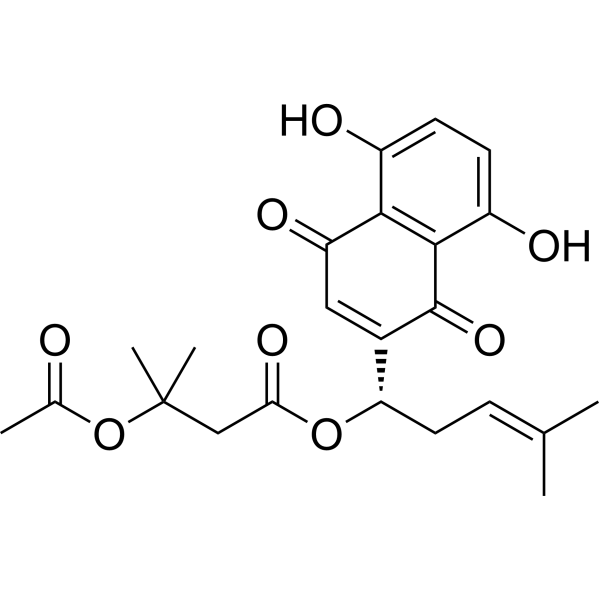
    Beta-Acetoxyisovalerylshikonin
    1 Publications Verification

    HIV Infection
    Beta-Acetoxyisovalerylshikonin is a naturally occurring naphthoquinone-type shikonin derivative that is widely distributed in the roots and cell suspension cultures of *Arnebia euchroma*, *Arnebia guttata*, *Onosma hispidum* and *Lithospermum erythrorhizon*. Beta-Acetoxyisovalerylshikonin exhibits favorable antibacterial, anti-inflammatory, wound-healing promoting and antioxidant activities, and also possesses potential anti-tumor and anti-HIV properties .
    Beta-Acetoxyisovalerylshikonin
  • HY-W004494
    2-Aminoindan-2-phosphonic acid
    1 Publications Verification

    Biochemical Assay Reagents Others
    2-Aminoindan-2-phosphonic acid is an inhibitor of phenylalanine ammonia-lyase (PAL). 2-Aminoindan-2-phosphonic acid reduces the biosynthesis and accumulation of total phenolic compounds in the suspension cell culture system of Cistanche .
    2-Aminoindan-2-phosphonic acid
  • HY-W134423B

    Biochemical Assay Reagents Others
    Agar, meets USP testing specifications is a high-quality selective growth support and substrate for non-adherent cells. Agar, meets USP testing specifications effectively supports the growth, colony formation and metachromatic matrix production of chondrocytes, and also facilitates the isolation and differentiation of pure chondrocyte strains by restricting the proliferation of fibroblast-like cells. Chondrocytes grown in Agar, meets USP testing specifications can be successfully transferred to a liquid suspension culture system, where they continue to proliferate while retaining the characteristics exhibited during growth in agar .
    Agar, meets USP testing specifications
  • HY-N0229R

    L-2-Aminopropionic acid (Standard)

    Reference Standards Endogenous Metabolite Neurological Disease Metabolic Disease
    L-Alanine (Standard) is the analytical standard of L-Alanine. This product is intended for research and analytical applications. L-Alanine is a non-essential amino acid, involved in sugar and acid metabolism, increases immunity, and provides energy for muscle tissue, brain, and central nervous system. In Vitro: The viability of both hiPSCs, 201B7 cells and ehiPSCs decrease with an increase in L-Alanine concentration, and reach 7.5±1.3% and 3.7±0.7% respectively at 1.2 M of L-Alanine. On the other hand, no decrease in the viability of hFBs and hSkMCs are observed. Although the viability of iCMs slightly decreases along with the increase of the L-Alanine concentration, viability of iCMs at 1.2 M concentration of L-Alanine, 49.4±6.9%, is significantly higher than that of undifferentiated iPSCs, 201B7 cells and ehiPSCs (p< 0.01). The viability of hiPSCs, 201B7 cells and ehiPSCs, drastically decrease even after 2 or 4 h treatment. In contrast, the viability of hFBs fails to decrease at 1, 2, and 4 h and shows a small decrease at 24 h treatment. The viability of 201B7 cells in suspension culture decreases to 11.8±6.0% following treatment with 1.2 M L-Alanine for 2 h, whereas that of hFBs is 72.9±14.2% .
    L-Alanine (Standard)
  • HY-P10400A

    Phytohormone Infection
    AtPep1 TFA is an endogenous inducer of innate immune responses. AtPep1 TFA can be isolated from Arabidopsis thaliana leaves. AtPep1 TFA activates the transcription of defensin (PDF1.2), the expression of PROPEP1, the synthesis of hydrogen peroxide (H2O2) near leaf veins, and the alkalization of Arabidopsis suspension cell culture medium. AtPep1 TFA induces the expression of genes encoding defensins and PR-1. AtPep1 TFA is applicable to studies related to Pythium irregulare infection and pathogen infection .
    AtPep1 TFA
  • HY-N12748

    Others Others
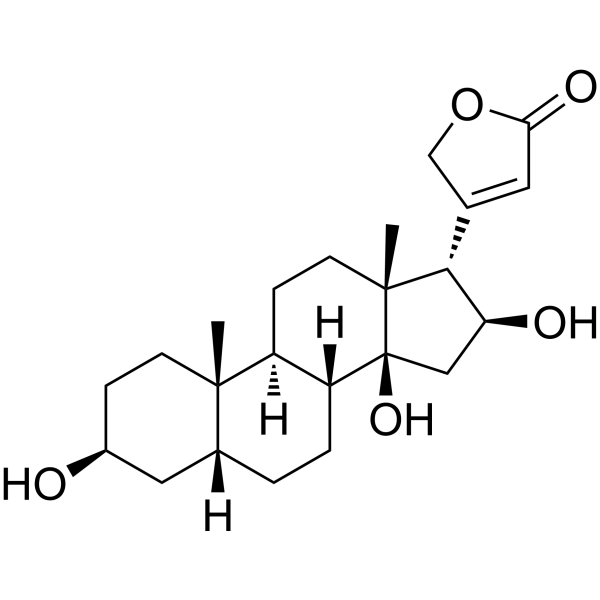
    17βH-Gitoxigenin is a compound that can be isolated from cell suspension cultures of Stropanthus divaricatus .
    17βH-Gitoxigenin
  • HY-N15731

    Drug Derivative Inflammation/Immunology
    Cyanidin 3-xylosyl-(feruloyl-glucosyl)-galactoside (Compound 5) is an orally active cyanidin triglycoside derivative found in carrot cell suspension cultures. Cyanidin 3-xylosyl-(feruloyl-glucosyl)-galactoside is promising for research of natural pigment stability, antioxidant mechanisms, and oxidative stress-related diseases (e.g., inflammation) .
    Cyanidin 3-xylosyl-(feruloyl-glucosyl)-galactoside
  • HY-N17915

    Others Others
    2-Methyl-3,5,6-trihydroxyanthraquinone (compound 6) is an anthraquinone found in cell suspension cultures of Morinda citrifolia .
    2-Methyl-3,5,6-trihydroxyanthraquinone
  • HY-107852

    Insecticide Others
    Demeton-S-methyl sulfone is an organophosphorus insecticide metabolite.Demeton-S-methyl sulfone serves as a substrate for metabolic breakdown.Demeton-S-methyl sulfone forms via oxidation of demeton S-methyl sulfoxide in sugar-beet cell suspension cultures.Demeton-S-methyl sulfone undergoes thioester bond cleavage, producing ethanethiols that convert into S-methylated compounds or S-glucosides .
    Demeton-S-methyl sulfone
  • HY-W726472

    Endogenous Metabolite Others
    N-(E-4-Coumaroyl)-aspartate is a hydroxycinnamic acid amide compound that can be isolated from Arabidopsis thaliana cell suspension cultures. N-(E-4-Coumaroyl)-aspartate may be involved in metabolic processes related to specific metabolites found in Arabidopsis thaliana cell cultures.
    N-(E-4-Coumaroyl)-aspartate
  • HY-N16838

    Drug Derivative Inflammation/Immunology
    cis-Oxyresveratrol-4'-O-glucoside (compound 2a) is a β-D-glucoside derivative of oxyresveratrol, whose parent compound possesses potential anti-inflammatory, antioxidant, free radical scavenging, and tyrosinase inhibitory activities, and can be used in anti-inflammatory, antioxidant, and whitening-related research. cis-Oxyresveratrol-4'-O-glucoside is a product obtained by the biotransformation of oxyresveratrol using cell suspension cultures of Solanum mammosum (a plant of the genus Solanum in the Solanaceae family) .
    cis-Oxyresveratrol-4'-O-glucoside

Inquiry Online

Your information is safe with us. * Required Fields.

Salutation


Country or Region *

Applicant Name *


Organization Name *

Department *


Email Address *


Product Name *

Cat. No.


Requested quantity *

Phone Number *


Remarks

Inquiry Online

Inquiry Information

Product Name:
Cat. No.:
Quantity:
MCE Japan Authorized Agent:

