
1. Search Result
Search Result
Results for "

textile

" in MedChemExpress (MCE) Product Catalog:

347

Inhibitors & Agonists

276

Fluorescent Dye

37

Biochemical Assay Reagents

1

Peptides

5

Natural
Products

13

Isotope-Labeled Compounds

9

Click Chemistry

5

Oligonucleotides

Cat. No. Product Name Target Research Areas Chemical Structure
  • HY-Y0016
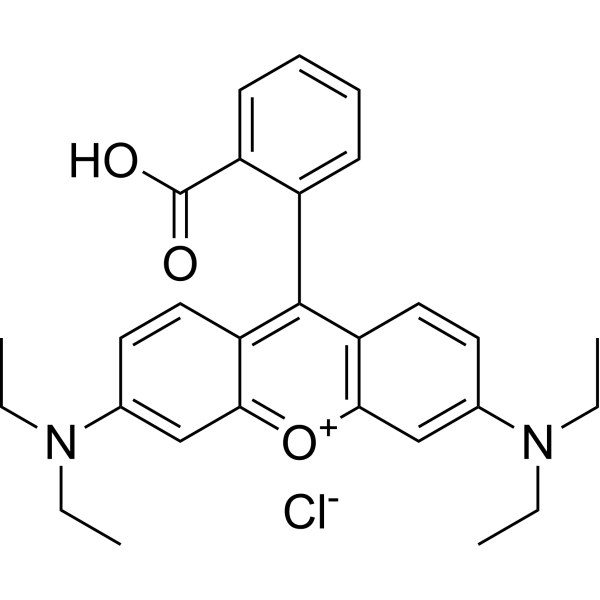
    Rhodamine B
    Maximum Cited Publications
    19 Publications Verification

    Basic Violet 10; Brilliant Pink B; Rhodamine O; Tetraethylrhodamine

    Environmental Pollutants Fluorescent Dye Others
    Rhodamine B is a staining fluorescent dye, commonly used for dyeing textiles, paper, soap, leather, and agents.
    Rhodamine B
  • HY-W017766

    PHMB

    Environmental Pollutants Bacterial Infection
    Poly(hexamethylenebiguanide) hydrochloride (PHMB) is an antimicrobial and antiviral agent. Poly(hexamethylenebiguanide) hydrochloride is active against both Gram-positive and Gram-negative bacteria. Poly(hexamethylenebiguanide) hydrochloride works by adsorbing to the surface of cellulose, which can damage microbial cell membranes and interfere with metabolism. Poly(hexamethylenebiguanide) hydrochloride is widely used in medical, clothing and household textiles, and cosmetic fields .
    Poly(hexamethylenebiguanide) hydrochloride
  • HY-D0367
    Fluorescent Brightener 28
    1 Publications Verification

    Calcofluor White M2R

    Fluorescent Dye Others
    Fluorescent brightener 28 is a fluorescent whitening agent commonly used in the padding process of the textile industry. Fluorescent brightener 28 is capable of staining polysaccharides such as cellulose, and when the plasma membrane ruptures, it also weakly stains the cytoplasm and strongly stains the cell nucleus. Additionally, Fluorescent brightener 28 can be utilized to detect intracellular chitin in living cells. Fluorescent Brightener 28 also is a visible light emitting diode (LED)-light sensitive photoinitiator for free radical photopolymerizations .
    Fluorescent Brightener 28
  • HY-D0896
    ANS
    1 Publications Verification

    ANSA; 8-Anilino-1-naphthalenesulfonic acid

    Bacterial Infection
    ANS (8-Anilino-1-naphthalenesulfonic acid) is a competitive inhibitor targeting thyroxine binding globulin (TBG) (Ki=2.09×10 6 M -1). ANS is used in radioimmunoassay by displacing bound triiodothyronine (T3) to improve detection sensitivity. ANS can block the protein binding site of T3 and release free T3 for antibody recognition. As a fluorescent probe, ANS can specifically bind to the hydrophobic region of proteins (such as membrane proteins) and monitor the dynamics of protein conformation through changes in fluorescent signals. It is widely used in biochemical research and antibacterial material development .
    ANS
  • HY-B1729

    Environmental Pollutants Bacterial Fungal Oxidative Phosphorylation Infection
    Phenoxyethanol has a broad spectrum of antimicrobial agent. Phenoxyethanol is an uncouple agent in oxidative phosphorylation from respiration and competitively inhibits malate dehydrogenase. Phenoxyethanol is used as a preservative in cosmetic, vaccine, and textile, et al .
    Phenoxyethanol
  • HY-D0259

    Erythrosin extra bluish

    Environmental Pollutants Fluorescent Dye Others
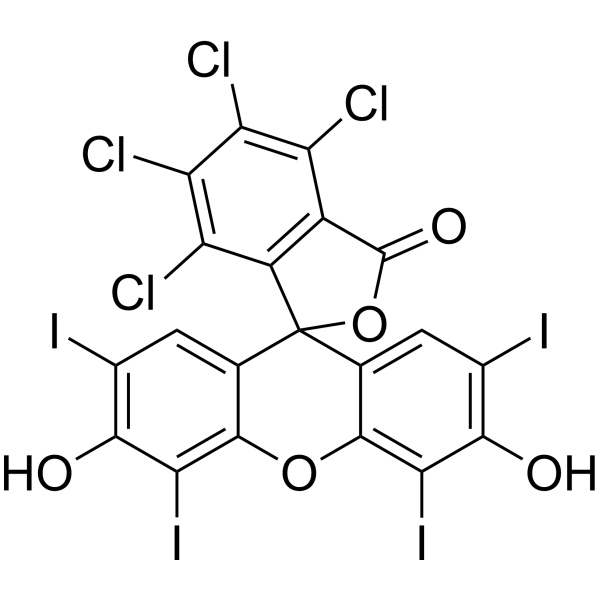
    Erythrosine B is an artificial dye widely used in the food and textile industries. Erythrosine B is also a novel photosensitizer which has been used to develop animal models.
    Erythrosine B
  • HY-D0342

    Fluorescent Dye Others
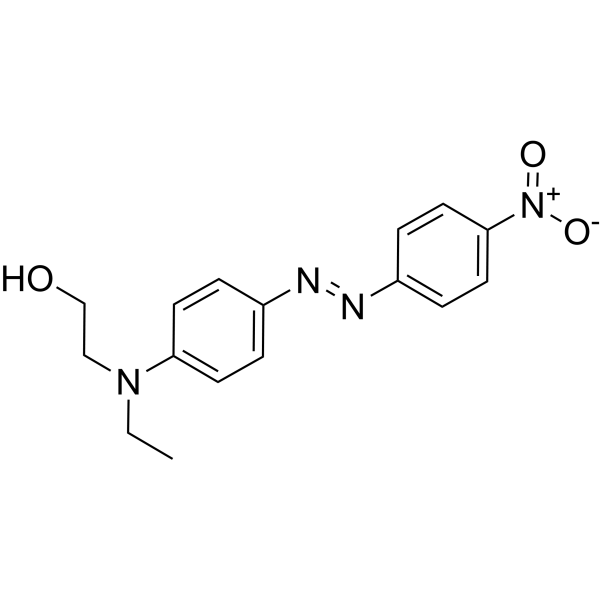
    Disperse Red 1, an azobenzene derivative, is an azo textile dye extensively used for dyeing polyester fabrics in textile industry .
    Disperse Red 1
  • HY-125815
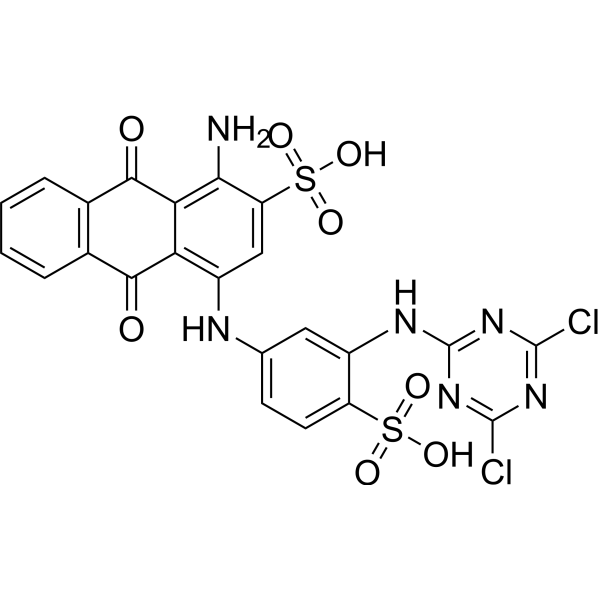
    Reactive Blue 4
    3 Publications Verification

    Fluorescent Dye Others
    Reactive Blue 4 is an anthraquinone dye used extensively in the textile industry. Reactive Blue 4 is a single colorimetric chemosensor for sequential determination of multiple analytes with different optical responses in aqueous media .
    Reactive Blue 4
  • HY-D0331

    Biochemical Assay Reagents Others
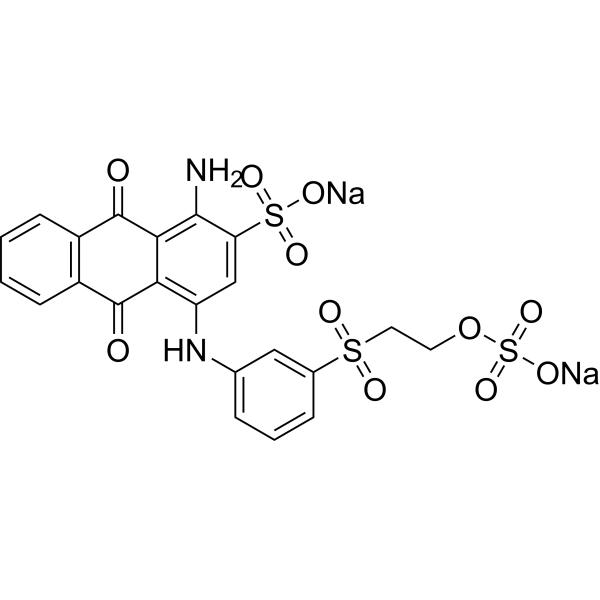
    Reactive Blue 19 is an anthraquinone dye that can be used in the textile industry .
    Reactive Blue 19
  • HY-135712

    Acid Orange GG

    Environmental Pollutants Biochemical Assay Reagents Others
    Orange G is an azo dye commonly found in textile wastewater and is mainly used for textile dyeing. Orange G has a coloring function and can give textiles a specific color. The stability and potential hazards of Orange G in the environment are often used to study the removal effects of various wastewater treatment technologies on difficult-to-degrade organic pollutants, especially the degradation of azo dyes. Related research focuses on how to destroy the azo bond of Orange G through chemical, physical or biological methods to achieve harmless treatment to solve the problem of textile wastewater pollution .
    Orange G
  • HY-D0896A
    ANS ammonium
    1 Publications Verification

    NSC 1746 ammonium; Peri acid, phenyl- ammonium; Phenyl peri acid ammonium

    Bacterial Infection
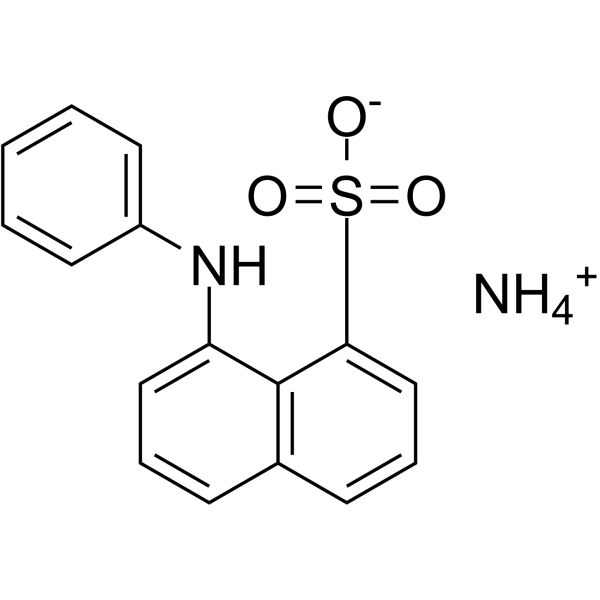
    ANS ammonium is a potent antibacterial agent and a textile dye. ANS ammonium can be used as fluorescence probe. ANS ammonium blocks the binding of triiodothyronine to thyroxine binding globulin in radioimmunoassay of triiodothyronine .
    ANS ammonium
  • HY-W750459

    Fluorescent Dye Others
    Fluorescent brightener 28 (Technical Grade) is a fluorescent whitening agent commonly used in the padding process of the textile industry. Fluorescent brightener 28 is capable of staining polysaccharides such as cellulose, and when the plasma membrane ruptures, it also weakly stains the cytoplasm and strongly stains the cell nucleus. Additionally, Fluorescent brightener 28 can be utilized to detect intracellular chitin in living cells. Fluorescent Brightener 28 also is a visible light emitting diode (LED)-light sensitive photoinitiator for free radical photopolymerizations .
    Fluorescent brightener 28 (Technical Grade)
  • HY-D0411

    Acidyellow 17; Yellow 2G

    Biochemical Assay Reagents Others
    Xylene Fast Yellow 2G is a synthetic dye belonging to the class of azo dyes. It is commonly used in the textile industry to dye natural and synthetic fibers as well as in the paper and ink industries. Xylene Fast Yellow 2G produces a bright yellow color that is fade and wash resistant and can be applied to textiles by a variety of methods including dipping, padding and printing.
    Xylene Fast Yellow 2G
  • HY-DY1077

    Fluorescent Dye Others
    Rhodamine B (solution) is a staining fluorescent dye, commonly used for dyeing textiles, paper, soap, leather, and agents.
    Solvent and concentration: DMSO: 10 mM
    Rhodamine B (solution)
  • HY-W440408

    Polyester short-cut fiber

    Environmental Pollutants Biochemical Assay Reagents Others
    Poly(oxyethyleneoxyterephthaloyl) is a commonly used waterproof polymer material. Poly(oxyethyleneoxyterephthaloyl) can be used in textile, electrical and other fields .
    Poly(oxyethyleneoxyterephthaloyl)
  • HY-D1225

    Fluorescent Dye
    Reactive red 180 is common textile dyes that can be adsorbed onto single-walled carbon nanotubes (SWCNTs) through electrostatic interactions, allowing the separation of residual dyes.
    Reactive red 180
  • HY-D0370

    Environmental Pollutants Biochemical Assay Reagents Others
    Solvent Yellow 16 is a disperse dye. Dyes are important tools in biological experiments. They can help researchers observe and analyze cell structures, track biomolecules, evaluate cell functions, distinguish cell types, detect biomolecules, study tissue pathology and monitor microorganisms. Their applications range from basic scientific research to clinical A wide range of diagnostics. Dyes are also widely used in traditional fields such as textile dyeing, as well as in emerging fields such as functional textile processing, food pigments and dye-sensitized solar cells .
    Solvent Yellow 16
  • HY-D0563

    Fluorescent Dye Others
    Direct yellow 86 is a multifunctional dye. Dyes are important tools in biological experiments. They can help researchers observe and analyze cell structures, track biomolecules, evaluate cell functions, distinguish cell types, detect biomolecules, study tissue pathology and monitor microorganisms. Their applications range from basic scientific research to clinical A wide range of diagnostics. Dyes are also widely used in traditional fields such as textile dyeing, as well as in emerging fields such as functional textile processing, food pigments and dye-sensitized solar cells.
    Direct yellow 86
  • HY-D0348

    Disperse Blue 7; 1,4-DiOH-5,8-bis(2-OHethyl)aminoanthraquinone

    Biochemical Assay Reagents Others
    Celliton Fast Blue Green B (Disperse Blue 7), a blue-green dye used in textiles. The aqueous extract of Celliton Fast Blue Green B causes no signs of skin irritation and sensitization in laboratory animals. Celliton Fast Blue Green B colored textiles with no irritation in human .
    Celliton Fast Blue Green B
  • HY-W206911

    Environmental Pollutants Biochemical Assay Reagents Others
    Erythrosin B sodium salt, is a synthetic azo dye commonly used as a food colorant and textile dye. It is a water-soluble compound that produces a bright red color and is often used to improve the appearance of products. Erythrosin B sodium salt is also used in the textile industry for dyeing wool, silk and leather. However, it has been linked to potentially negative health effects, such as allergic reactions and hyperactivity in children.
    Erythrosin B sodium salt
  • HY-D1138

    Fluorescent Dye
    Reactive red 120 is common textile dyes that can be adsorbed onto single-walled carbon nanotubes (SWCNTs) through electrostatic interactions, allowing the separation of residual dyes.
    Reactive red 120
  • HY-D0087

    Fluorescent Dye Others
    MDCC is a multifunctional dye. Dyes are important tools in biological experiments. They can help researchers observe and analyze cell structures, track biomolecules, evaluate cell functions, distinguish cell types, detect biomolecules, study tissue pathology and monitor microorganisms. Their applications range from basic scientific research to clinical A wide range of diagnostics. Dyes are also widely used in traditional fields such as textile dyeing, as well as in emerging fields such as functional textile processing, food pigments and dye-sensitized solar cells.
    MDCC
  • HY-D0374

    Fluorescent Dye Others
    Reactive Blue 4 sodium is an anthraquinone dye used extensively in the textile industry. Reactive Blue 4 sodium is a single colorimetric chemosensor for sequential determination of multiple analytes with different optical responses in aqueous media .
    Reactive Blue 4 sodium
  • HY-D0312

    Sunchromine Fast Blue MB

    Biochemical Assay Reagents Others
    Mordant Blue 13 is a synthetic dye used in the textile industry. It belongs to a class of metal complex dyes that are able to form strong bonds with fabrics and other materials. Mordant Blue 13 is commonly used for dyeing cotton, wool and silk fibres, it produces a fast blue color. It can be applied to textiles by a variety of methods including impregnation, padding and printing.
    Mordant Blue 13
  • HY-D0479

    Fluorescent Dye Others
    Disperse Blue 60 is a textile anthraquinone dye .
    Disperse Blue 60
  • HY-D0896AR

    NSC 1746 ammonium (Standard); Peri acid, phenyl- ammonium (Standard); Phenyl peri acid ammonium (Standard)

    Bacterial Reference Standards Infection
    ANS (ammonium) (Standard) is the analytical standard of ANS (ammonium). This product is intended for research and analytical applications. ANS ammonium is a potent antibacterial agent and a textile dye. ANS ammonium can be used as fluorescence probe. ANS ammonium blocks the binding of triiodothyronine to thyroxine binding globulin in radioimmunoassay of triiodothyronine .
    ANS ammonium (Standard)
  • HY-D1123

    CI 70801

    Fluorescent Dye
    Indigosol brown IBR is a dye commonly used for dyeing textiles.
    Indigosol brown IBR
  • HY-D0341

    Solvent Violet 26

    Fluorescent Dye
    Disperse Red 11 is a red dye derived from anthraquinone. It is used in plastics, textiles and cosmetics.
    Disperse Red 11
  • HY-D0545

    Fluorescent Dye Others
    Disperse red 91 is a red dye derived from anthraquinone. It is used in plastics, textiles and cosmetics.
    Disperse red 91
  • HY-D0687

    Fluorescent Dye
    Disperse red 324 is a red dye derived from anthraquinone. It is used in plastics, textiles and cosmetics.
    Disperse red 324
  • HY-D0673

    Fluorescent Dye
    Disperse red 311 is a red dye derived from anthraquinone. It is used in plastics, textiles and cosmetics.
    Disperse red 311
  • HY-D1273

    Blue K

    Fluorescent Dye Others
    Vat Blue 6 (Blue K) is a vat dye that used in textile dyeing processes .
    Vat Blue 6
  • HY-D2424

    Fluorescent Dye Others
    Disperse Red 343 is an azo dye widely used in the textile industry for dyeing polyester fabrics .
    Disperse Red 343
  • HY-D0316

    DR 167:1

    Fluorescent Dye
    Disperse red 167:1 is a red dye derived from anthraquinone. It is used in plastics, textiles and cosmetics.
    Disperse red 167:1
  • HY-D0622

    Fluorescent Dye
    Reactive Green 19 is common textile dyes that can be adsorbed onto single-walled carbon nanotubes (SWCNTs) through electrostatic interactions, allowing the separation of residual dyes.
    Reactive Green 19
  • HY-D0514

    Fluorescent Dye
    Reactive blue 5 is common textile dyes that can be adsorbed onto single-walled carbon nanotubes (SWCNTs) through electrostatic interactions, allowing the separation of residual dyes.
    Reactive blue 5
  • HY-D0661

    Fluorescent Dye
    Reactive red 45 is common textile dyes that can be adsorbed onto single-walled carbon nanotubes (SWCNTs) through electrostatic interactions, allowing the separation of residual dyes.
    Reactive red 45
  • HY-W592622

    Biochemical Assay Reagents Others
    Polyacrylonitrile is a fiber. Polyacrylonitrile is widely used as a material for the preparation of ultrafiltration membranes, hemodialysis membranes, textiles, flame retardants and carbon fibers. Polyacrylonitrile (MW 250000) can be electrospun .
    Polyacrylonitrile (MW 250000)
  • HY-D0578

    Fluorescent Dye Others
    Basic yellow 28 is a multifunctional dye. Dyes are important tools in biological experiments. They can help researchers observe and analyze cell structures, track biomolecules, evaluate cell functions, distinguish cell types, detect biomolecules, study tissue pathology and monitor microorganisms. Their applications range from basic scientific research to clinical A wide range of diagnostics. Dyes are also widely used in traditional fields such as textile dyeing, as well as in emerging fields such as functional textile processing, food pigments and dye-sensitized solar cells.
    Basic yellow 28
  • HY-D1354

    Fluorescent Dye Others
    Azide MegaStokes dye 673 is a multifunctional dye. Dyes are important tools in biological experiments. They can help researchers observe and analyze cell structures, track biomolecules, evaluate cell functions, distinguish cell types, detect biomolecules, study tissue pathology and monitor microorganisms. Their applications range from basic scientific research to clinical A wide range of diagnostics. Dyes are also widely used in traditional fields such as textile dyeing, as well as in emerging fields such as functional textile processing, food pigments and dye-sensitized solar cells.
    Azide MegaStokes dye 673
  • HY-D0572

    Fluorescent Dye Others
    Acid red 260 is a multifunctional dye. Dyes are important tools in biological experiments. They can help researchers observe and analyze cell structures, track biomolecules, evaluate cell functions, distinguish cell types, detect biomolecules, study tissue pathology and monitor microorganisms. Their applications range from basic scientific research to clinical A wide range of diagnostics. Dyes are also widely used in traditional fields such as textile dyeing, as well as in emerging fields such as functional textile processing, food pigments and dye-sensitized solar cells.
    Acid red 260
  • HY-D0474

    Fluorescent Dye Others
    Acid green 12 is a multifunctional dye. Dyes are important tools in biological experiments. They can help researchers observe and analyze cell structures, track biomolecules, evaluate cell functions, distinguish cell types, detect biomolecules, study tissue pathology and monitor microorganisms. Their applications range from basic scientific research to clinical A wide range of diagnostics. Dyes are also widely used in traditional fields such as textile dyeing, as well as in emerging fields such as functional textile processing, food pigments and dye-sensitized solar cells.
    Acid green 12
  • HY-D0461

    Fluorescent Dye Others
    beta-Naphthol violet is a multifunctional dye. Dyes are important tools in biological experiments. They can help researchers observe and analyze cell structures, track biomolecules, evaluate cell functions, distinguish cell types, detect biomolecules, study tissue pathology and monitor microorganisms. Their applications range from basic scientific research to clinical A wide range of diagnostics. Dyes are also widely used in traditional fields such as textile dyeing, as well as in emerging fields such as functional textile processing, food pigments and dye-sensitized solar cells.
    beta-Naphthol violet
  • HY-D0951

    Fluorescent Dye Others
    Methyl violet dye is a multifunctional dye. Dyes are important tools in biological experiments. They can help researchers observe and analyze cell structures, track biomolecules, evaluate cell functions, distinguish cell types, detect biomolecules, study tissue pathology and monitor microorganisms. Their applications range from basic scientific research to clinical A wide range of diagnostics. Dyes are also widely used in traditional fields such as textile dyeing, as well as in emerging fields such as functional textile processing, food pigments and dye-sensitized solar cells.
    Methyl violet dye
  • HY-D1303

    Fluorescent Dye Others
    Marina blue is a multifunctional dye. Dyes are important tools in biological experiments. They can help researchers observe and analyze cell structures, track biomolecules, evaluate cell functions, distinguish cell types, detect biomolecules, study tissue pathology and monitor microorganisms. Their applications range from basic scientific research to clinical A wide range of diagnostics. Dyes are also widely used in traditional fields such as textile dyeing, as well as in emerging fields such as functional textile processing, food pigments and dye-sensitized solar cells.
    Marina blue
  • HY-B1533A

    Fluorescent Dye Others
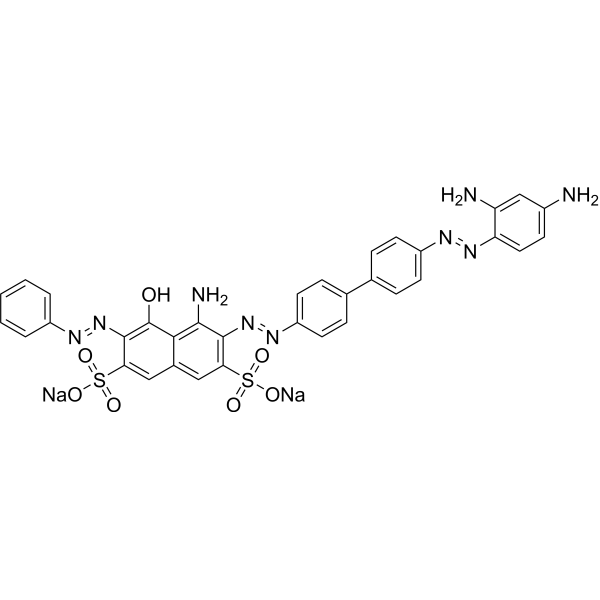
    Anazolene trisodium is an anionic dye, a textile azo dye with a maximum absorption wavelength of λmax = 571 nm .
    Anazolene trisodium
  • HY-D0360

    Fluorescent Dye
    Mordant Blue 9 is an azo dye commonly used for dyeing textiles.
    Mordant Blue 9
  • HY-D1230

    Fluorescent Dye
    Mordant red 15 is an azo dye commonly used for dyeing textiles.
    Mordant red 15
  • HY-D1283

    Fluorescent Dye
    Mordant red 19 is an azo dye commonly used for dyeing textiles.
    Mordant red 19
  • HY-D0318

    Fluorescent Dye
    Mordant Black PV is an azo dye commonly used for dyeing textiles.
    Mordant Black PV

Inquiry Online

Your information is safe with us. * Required Fields.

Salutation


Country or Region *

Applicant Name *


Organization Name *

Department *


Email Address *


Product Name *

Cat. No.


Requested quantity *

Phone Number *


Remarks

Inquiry Online

Inquiry Information

Product Name:
Cat. No.:
Quantity:
MCE Japan Authorized Agent:

