



TBI-223
Based on 1 publication(s) in Google Scholar
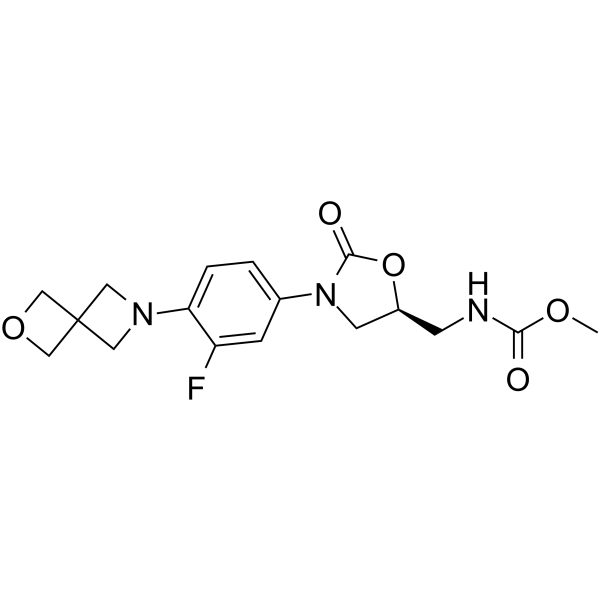
TBI-223 is an orally active oxazolidinone antibiotic and an antimicrobial. TBI-223 shows activity against Mycobacterium tuberculosis (Mtb). TBI-223 exhibits an IC50 of 68 μg/mL for inhibiting mitochondrial protein synthesis (MPS) in HepG2 cells. TBI-223 is effective in three mouse models (bloodstream infection, skin infection, and bone infection) of methicillin-resistant staphylococcus aureus infection. TBI-223 can be used for the study of tuberculosis.
Nur für Forschungszwecke. Wir verkaufen nicht an Patienten.
- Reinheit : 99.73%
- CAS. Nr.: 2071265-08-0
- Formel: C17H20FN3O5
- Molecular Weight:365.36
-
Speicherung:Powder -20°C, 3 years , 4°C, 2 years ; In solvent -80°C, 6 months , -20°C, 1 month

To place orders, for customer services and technical support, please contact: MedChemExpress USA
Tel: 609-228-6898 E-mail: [email protected] [email protected]


-
 Biologische Aktivität
-
Chemical Information
-
Lösungsmittel & Löslichkeit
- Protokoll
- Reinheit & Dokumentation
- Verweise
-
 Help & FAQs


Publications Citing Use of MedChemExpress (MCE) TBI-223
MoreAlle Antibiotic Isoform-spezifische Produkte anzeigen
More

Biologische Aktivität
Beschreibung
IC50 & Target
[1]|
Oxazolidinone |
Cellular Effect
|
Cell Line

|
Type | Value | Description | References |
|---|---|---|---|---|
| PC-3 | IC50 |
>74 μM
Compound: TBI-223
|
Inhibition of mitochondrial protein synthesis in human PC-3 cells at 100 uM incubated for 5 days
Inhibition of mitochondrial protein synthesis in human PC-3 cells at 100 uM incubated for 5 days
|
[PMID: 36893700] |
In Vitro
TBI-223 shows MIC50 of 1.50 μg/mL against M. tuberculosis, 2.00 μg/mL against M. kansasii, 8.00 μg/mL against MAC, and 2.00 μg/mL against MAbC in 7H9 medium[1].
MedChemExpress (MCE) has not independently confirmed the accuracy of these methods. They are for reference only.
Parmacokinetics
| Species | Dose | Route | AUC0-24 | Cmax | T1/2 |
|---|---|---|---|---|---|
| Mice[2] | 100 mg/kg | p.o. | 179.4 μg·h/mL | 44.5 μg/mL | 3.0 h |
In Vivo
TBI-223 (80-160 mg/kg, p.o., twice daily, 7 days) significantly reduces lesion size in nondiabetic C57BL/6 mice and diabetic TallyHo/JngJ mice with MRSA skin wound infection[2].
TBI-223 (80-160 mg/kg, p.o., twice daily, 7 days) significantly reduces in vivo BLI signals, joint tissue and implant CFU counts in C57BL/6 mice with MRSA orthopedic-implant-associated infection[2].
MedChemExpress (MCE) has not independently confirmed the accuracy of these methods. They are for reference only.
-
Animal Model:MRSA bacteremia model: C57BL/6 mice (6-week-old female) were intravenously inoculated with 5 × 10⁶ CFU of MRSA strain SAP231 or AR-997 via the retro-orbital vein in a 100-μL volume of PBS[2]
-
Dosage:80, 160 mg/kg
-
Administration:p.o. twice daily for 7 days
-
Result:Achieved 100% survival rate, while all sham-treated mice succumbed by day 4.
Significantly reduced CFU counts in heart, liver, and kidneys on day 3 compared with sham treatment.
-
Animal Model:Mouse MRSA skin infection model: 8- to 9-week-old male C57BL/6 mice or TallyHo/JngJ mice (with hyperglycemia, blood glucose levels >300 mg/dL) were anesthetized, the posterior upper backs were shaved, three parallel 8-mm linear full-thickness scalpel cuts were made, and the wounds were inoculated with 2 × 10⁶ CFU of SAP231[2]
-
Dosage:80, 160 mg/kg
-
Administration:p.o. twice daily for 7 days
-
Result:Significantly reduced lesion size and in vivo BLI signals (P<0.001 except P<0.01 for linezolid 40 mg/kg vs sham) compared with sham treatment.
Significantly decreased skin CFU counts on day 5 compared with sham treatment.
-
Animal Model:MRSA orthopedic-implant-associated infection model: 10- to 12-week-old C57BL/6 male mice were anesthetized, a medial parapatellar approach was performed, the patella was dislocated laterally, the femoral medullary canal was reamed with a 25-gauge needle, a surgical-grade titanium K-wire was inserted, and an inoculum of 1 × 10³ CFU of SAP231 in 2 μL of PBS was pipetted onto the K-wire before closure[2]
-
Dosage:80, 160 mg/kg
-
Administration:p.o. twice daily for 7 days
-
Result:Significantly reduced in vivo BLI signals throughout the experiment.
Significantly decreased CFU counts in joint tissue and implants on day 42.
Reduced the percentage of implant samples with bacterial growth compared with sham treatment.
Significantly increased body weight.
Showed reduced femur width and area in high-dose group.
Clinical Trial
| NCT Number | Sponsor | Condition | Start Date |
Phase
|
|---|---|---|---|---|
| NCT01329991 | Plexxikon| | 2011-05 | PHASE1 |


Chemical Information
-
CAS. Nr. 2071265-08-0
-
Appearance Solid
-
Molecular Weight 365.36
-
Formel C17H20FN3O5
-
Color White to off-white
-
SMILES
O=C(OC)NC[C@H]1CN(C2=CC=C(N(C3)CC43COC4)C(F)=C2)C(O1)=O
-
Versand
Room temperature in continental US; may vary elsewhere.
-
Speicherung
Powder -20°C 3 years 4°C 2 years In solvent -80°C 6 months -20°C 1 month


Publications (1)
-
Journal Impact Factor
-
Most Recent
-
Antimicrob Agents Chemother
Side-by-Side Profiling of Oxazolidinones to Estimate the Therapeutic Window against Mycobacterial Infections. [Abstract]2023 Apr 18;67(4):e0165522. PMID: 36920191


Lösungsmittel & Löslichkeit
In Vitro:
DMSO : 50 mg/mL (136.85 mM; Need ultrasonic; Hygroscopic DMSO has a significant impact on the solubility of product, please use newly opened DMSO)
Please refer to the solubility information to select the appropriate solvent. Once prepared, please aliquot and store the solution to prevent product inactivation from repeated freeze-thaw cycles.
Storage method and period of stock solution: -80°C, 6 months; -20°C, 1 month. When stored at -80°C, please use it within 6 months. When stored at -20°C, please use it within 1 month.
Please refer to the solubility information to select the appropriate solvent. Once prepared, please aliquot and store the solution to prevent product inactivation from repeated freeze-thaw cycles.
Storage method and period of stock solution: -80°C, 6 months; -20°C, 1 month. When stored at -80°C, please use it within 6 months. When stored at -20°C, please use it within 1 month.
Konzentration (Stammlösung) × Volumen (Stammlösung) = Konzentration (Ziellösung) × Volumen (Ziellösung)
In Vivo:
Select the appropriate dissolution method based on your experimental animal and administration route.
- For the following dissolution methods, please ensure to first prepare a clear stock solution using an In Vitro approach and then sequentially add co-solvents:
- To ensure reliable experimental results, the clarified stock solution can be appropriately stored based on storage conditions. As for the working solution for In Vivo experiments, it is recommended to prepare freshly and use it on the same day.
- The percentages shown for the solvents indicate their volumetric ratio in the final prepared solution. If precipitation or phase separation occurs during preparation, heat and/or sonication can be used to aid dissolution.
Add each solvent one by one: 10% DMSO 40% PEG300 5% Tween-80 45% Saline
Solubility: ≥ 2.5 mg/mL (6.84 mM); Clear solution
This protocol yields a clear solution of ≥ 2.5 mg/mL (saturation unknown).
Taking 1 mL working solution as an example, add 100 μL DMSO stock solution (25.0 mg/mL) to 400 μL PEG300, and mix evenly; then add 50 μL Tween-80 and mix evenly; then add 450 μL Saline to adjust the volume to 1 mL.
Preparation of Saline: Dissolve 0.9 g sodium chloride in ddH₂O and dilute to 100 mL to obtain a clear Saline solution.
Add each solvent one by one: 10% DMSO 90% (20% SBE-β-CD in Saline)
Solubility: ≥ 2.5 mg/mL (6.84 mM); Clear solution
This protocol yields a clear solution of ≥ 2.5 mg/mL (saturation unknown).
Taking 1 mL working solution as an example, add 100 μL DMSO stock solution (25.0 mg/mL) to 900 μL 20% SBE-β-CD in Saline, and mix evenly.
Preparation of 20% SBE-β-CD in Saline (4°C, storage for one week): 2 g SBE-β-CD powder is dissolved in 10 mL Saline, completely dissolve until clear.
In Vivo Dissolution Calculator
Please enter the basic information of animal experiments:
-
-
-
-
Recommended: Prepare an additional quantity of animals to account for potential losses during experiments.
Please enter your animal formula composition:
-
%DMSO +
Recommended: Keep the proportion of DMSO in working solution below 2% if your animal is weak.
-
%+
-
+%Tween-80 + +
-
%Saline +
The co-solvents required include: DMSO, . All of co-solvents are available by MedChemExpress (MCE). , Tween 80. All of co-solvents are available by MedChemExpress (MCE).
Working solution concentration: 0.22 mg/mL
Method for preparing stock solution: mg drug dissolved in μL DMSO. Stock solution concentration: mg/mL.
1. Take μL DMSO stock solution;
2. Add μL .
μL , mix evenly;
3. Then add μL Tween 80, mix evenly;
4. Then add μL
Please ensure that the stock solution in the first step is dissolved to a clear state, and add co-solvents in sequence. You can use ultrasonic heating (ultrasonic cleaner, recommended frequency 20-40 kHz), vortexing, etc. to assist dissolution.


Reinheit & Dokumentation
-
Data Sheet (278 KB)
-
SDS (251 KB)
- English - EN (251 KB)
- Français - FR (251 KB)
- Deutsch - DE (251 KB)
- Norwegian - NO (251 KB)
- Español - ES (251 KB)
- Swedish - SV (251 KB)
- Italian - IT (251 KB)
- Korean - KR (251 KB)
- Portuguese - PT (251 KB)
-
Handling Instructions (2659 KB)
Verweise
[1]. Negatu DA, et al. Side-by-Side Profiling of Oxazolidinones to Estimate the Therapeutic Window against Mycobacterial Infections. Antimicrob Agents Chemother. 2023 Apr 18;67(4):e0165522. [Content Brief]
[2]. Gordon O, et al. The Novel Oxazolidinone TBI-223 Is Effective in Three Preclinical Mouse Models of Methicillin-Resistant Staphylococcus aureus Infection. Microbiol Spectr. 2022 Oct 26;10(5):e0245121. [Content Brief]


Complete Stock Solution Preparation Table
Please refer to the solubility information to select the appropriate solvent. Once prepared, please aliquot and store the solution to prevent product inactivation from repeated freeze-thaw cycles.
Storage method and period of stock solution: -80°C, 6 months; -20°C, 1 month. When stored at -80°C, please use it within 6 months. When stored at -20°C, please use it within 1 month.
| Optional Solvent | Concentration Solvent Mass | 1 mg | 5 mg | 10 mg | 25 mg |
|---|---|---|---|---|---|
| DMSO | 1 mM | 2.7370 mL | 13.6851 mL | 27.3703 mL | 68.4257 mL |
| 5 mM | 0.5474 mL | 2.7370 mL | 5.4741 mL | 13.6851 mL | |
| 10 mM | 0.2737 mL | 1.3685 mL | 2.7370 mL | 6.8426 mL | |
| 15 mM | 0.1825 mL | 0.9123 mL | 1.8247 mL | 4.5617 mL | |
| 20 mM | 0.1369 mL | 0.6843 mL | 1.3685 mL | 3.4213 mL | |
| 25 mM | 0.1095 mL | 0.5474 mL | 1.0948 mL | 2.7370 mL | |
| 30 mM | 0.0912 mL | 0.4562 mL | 0.9123 mL | 2.2809 mL | |
| 40 mM | 0.0684 mL | 0.3421 mL | 0.6843 mL | 1.7106 mL | |
| 50 mM | 0.0547 mL | 0.2737 mL | 0.5474 mL | 1.3685 mL | |
| 60 mM | 0.0456 mL | 0.2281 mL | 0.4562 mL | 1.1404 mL | |
| 80 mM | 0.0342 mL | 0.1711 mL | 0.3421 mL | 0.8553 mL | |
| 100 mM | 0.0274 mL | 0.1369 mL | 0.2737 mL | 0.6843 mL |


TBI-223 Related Classifications
HY-139398 Related Classifications
 Powered by Bioz