



Tetranactin
Tetranactin is an orally active antibiotic that has insecticidal properties and can inhibit the growth of Gram-positive bacteria and plant pathogenic fungal in vitro. Tetranactin LD50 for intraperitoneal injection in mice is greater than 300 mg/kg, and the LD50 is greater than 15,000 mg/kg.
For research use only. We do not sell to patients.
- CAS No.: 33956-61-5
- Formula: C44H72O12
- Molecular Weight:793.04
-
Storage:
Please store the product under the recommended conditions in the Certificate of Analysis.


To place orders, for customer services and technical support, please contact: MedChemExpress USA
Tel: 609-228-6898 E-mail: [email protected] [email protected]


-
 Biological Activity
-
Chemical Information
- Protocols
- Purity & Documentation
- References
-
 Help & FAQs


-
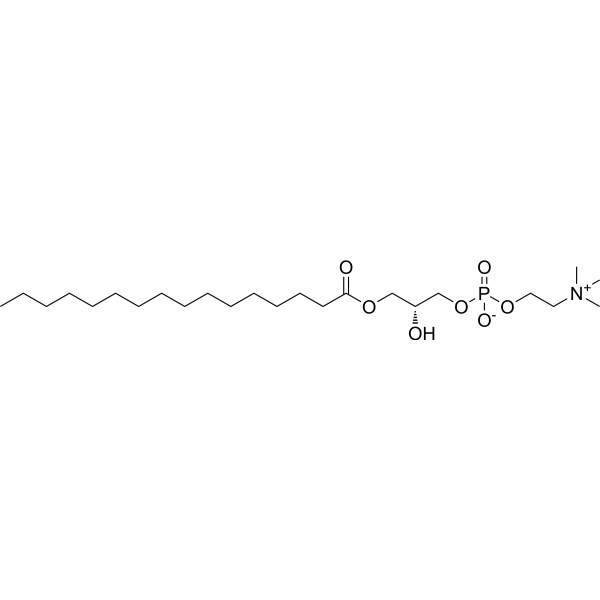
HY-125783
1-Palmitoyl-sn-glycero-3-phosphocholineLysophosphatidylcholine -
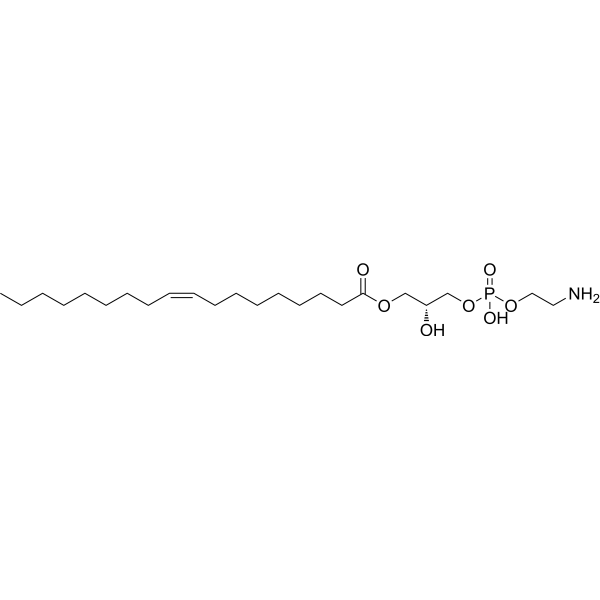
HY-W355700
1-Oleoyl-2-hydroxy-sn-glycero-3-phosphoethanolamineDeltamethrin Metabolite -
HY-N0707
(S)-IndoximodIDO Inhibitor -
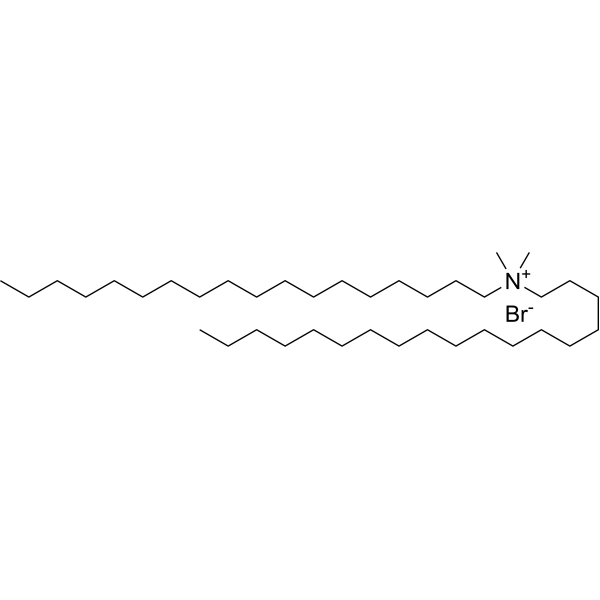
HY-131119
Dimethyldioctadecylammonium bromideBiochemical Assay Reagent -

HY-W679754
Pentacosafluorotridecanoic AcidBiochemical Assay Reagents -
HY-145491
Resolvin D5Inflammation Inhibitor -
HY-121106
9-Deazaguanine -
HY-W010248
2-Phenylglycine -

HY-119657
Cellocidin -
HY-119663
AverantinFungus Metabolite -

HY-156209
Gb3(d18:1/16:0)Pk Antigen -

HY-W679754R
Pentacosafluorotridecanoic Acid (Standard)
All Antibiotic Isoforms
More

Biological Activity
Description


Chemical Information
-
CAS No. 33956-61-5
-
Molecular Weight 793.04
-
Formula C44H72O12
-
SMILES
O=C([C@H]([C@@]1(CC[C@@]([H])(O1)C[C@H](OC([C@H](C)[C@@]2(O[C@@]([H])(CC2)C[C@H](CC)OC([C@H]([C@]3(O[C@@]([H])(C[C@H](OC4=O)CC)CC3)[H])C)=O)[H])=O)CC)[H])C)O[C@H](C[C@]5(O[C@]([H])(CC5)[C@H]4C)[H])CC
-
Structure Classification
-
Initial Source
Streptomyces aureus
-
Shipping
Room temperature in continental US; may vary elsewhere.
-
Storage
Please store the product under the recommended conditions in the Certificate of Analysis.

Protocols
-
How to Select the Route of Administration for Mammals
Route-of-administration selection in mammals is a pharmacokinetic, pharmacodynamic, formulation, animal-welfare, and translational decision, not a default technical choice. The selected route should match the study goal: intravenous dosing is most useful when complete systemic exposure and rapid onset are required, oral dosing is most translational for orally intended medicines but is affected by absorption and first-pass metabolism, subcutaneous or intramuscular dosing can provide slower systemic exposure, and intraperitoneal dosing can be useful in rodent proof-of-concept studies but may have limited clinical translation. Published route-comparison studies show that the same compound can produce different exposure, onset, bioavailability, tissue distribution, and tolerability depending on route; therefore, route choice should be supported by pilot pharmacokinetic or pharmacodynamic evidence when the literature is insufficient. Unresolved questions include how to standardize route sel
-
Gram Staining of Tissue Sections
Gram staining of tissue sections is a histochemical technique used to differentiate Gram-positive and Gram-negative bacteria within histological specimens based on differences in bacterial cell wall structure and dye retention, adapted from classical bacteriological Gram staining into tissue-compatible “histological Gram stain” variants. In tissue applications, modifications of the Brown-Hopps and Brown-Brenn methods are commonly used to improve differentiation of microorganisms embedded within host connective tissue and to reduce overstaining or loss of Gram-negative signal, which are known limitations of earlier approaches. The principle relies on crystal violet-iodine complex retention in Gram-positive organisms and subsequent decolorization and counterstaining steps that allow contrast visualization of Gram-negative organisms against tissue background.
-
Acute Systemic Toxicity Study
Acute systemic toxicity studies evaluate adverse effects occurring after a single exposure, or repeated exposure within a short acute window, and the main in vivo readouts are mortality, moribund condition, clinical signs, body-weight change, and gross pathological findings; acute oral toxicity methods were developed to replace classical LD50 testing with reduced-animal designs such as fixed-dose procedure, acute toxic class method, and up-and-down procedure. The fixed-dose procedure classifies acute toxicity by administering predefined dose levels and observing evident toxicity rather than using death as the primary endpoint, whereas the acute toxic class method uses sequential groups of three animals per step and the up-and-down procedure doses animals sequentially to estimate an LD50 with fewer animals than conventional LD50 testing.


Purity & Documentation
References

Calculators
Concentration (start) × Volume (start) = Concentration (final) × Volume (final)


Tetranactin Related Classifications
HY-125721 Related Classifications
 Powered by Bioz