



Triptolide-d3

Based on 1 Customer Validation
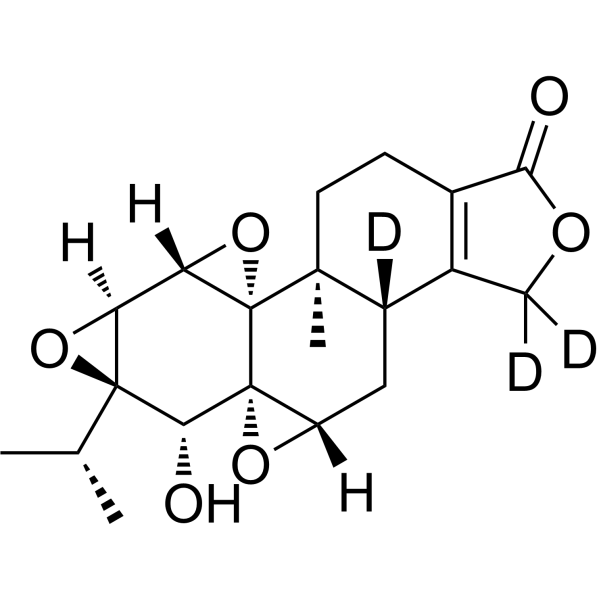
Triptolide-d3 is the deuterium labeled Triptolide. Triptolide is a diterpenoid triepoxide extracted from the root of Tripterygium wilfordii with immunosuppressive, anti-inflammatory, antiproliferative and antitumour effects. Triptolide is a NF-κB activation inhibitor.
For research use only. We do not sell to patients.
- Purity : 91.98%
- Formula: C20H21D3O6
- Molecular Weight:363.42
-
Storage:
-20°C, protect from light, stored under nitrogen
* In solvent : -80°C, 6 months; -20°C, 1 month (protect from light, stored under nitrogen)

To place orders, for customer services and technical support, please contact: MedChemExpress USA
Tel: 609-228-6898 E-mail: [email protected] [email protected]


-
 Biological Activity
-
Chemical Information
-
Solvent & Solubility
- Protocols
- Purity & Documentation
- References
-
 Help & FAQs




Biological Activity
Description
In Vitro
Stable heavy isotopes of hydrogen, carbon, and other elements have been incorporated into drug molecules, largely as tracers for quantitation during the drug development process. Deuteration has gained attention because of its potential to affect the pharmacokinetic and metabolic profiles of drugs[1].
MedChemExpress (MCE) has not independently confirmed the accuracy of these methods. They are for reference only.
Application
1. This compound can be used as a tracer
2. This compound can be used as an internal standard for quantitative analysis by NMR, GC-MS, or LC-MS.


Chemical Information
-
Unlabeled CAS 38748-32-2
-
Appearance Solid
-
Molecular Weight 363.42
-
Formula C20H21D3O6
-
Color White to off-white
-
SMILES
C[C@@]12[C@@]34[C@]5([C@@H]([C@@]6([C@](O6)([H])[C@]3([H])O4)C(C)C)O)[C@@](C[C@@]1([2H])C7=C(C(OC7([2H])[2H])=O)CC2)([H])O5
-
Synonyms
PG490-d3
-
Shipping
Room temperature in continental US; may vary elsewhere.
-
Storage
-20°C, protect from light, stored under nitrogen
* In solvent : -80°C, 6 months; -20°C, 1 month (protect from light, stored under nitrogen)


Solvent & Solubility
In Vitro:
DMSO : 25 mg/mL (68.79 mM; Need ultrasonic and warming; Hygroscopic DMSO has a significant impact on the solubility of product, please use newly opened DMSO)
Please refer to the solubility information to select the appropriate solvent. Once prepared, please aliquot and store the solution to prevent product inactivation from repeated freeze-thaw cycles.
Storage method and period of stock solution: -80°C, 6 months; -20°C, 1 month (protect from light, stored under nitrogen). When stored at -80°C, please use it within 6 months. When stored at -20°C, please use it within 1 month.
Please refer to the solubility information to select the appropriate solvent. Once prepared, please aliquot and store the solution to prevent product inactivation from repeated freeze-thaw cycles.
Storage method and period of stock solution: -80°C, 6 months; -20°C, 1 month (protect from light, stored under nitrogen). When stored at -80°C, please use it within 6 months. When stored at -20°C, please use it within 1 month.
Concentration (start) × Volume (start) = Concentration (final) × Volume (final)


Purity & Documentation
-
Data Sheet (283 KB)
-
SDS (420 KB)
- English - EN (420 KB)
- Français - FR (420 KB)
- Deutsch - DE (420 KB)
- Norwegian - NO (420 KB)
- Español - ES (420 KB)
- Swedish - SV (420 KB)
- Italian - IT (420 KB)
- Korean - KR (420 KB)
- Portuguese - PT (420 KB)
-
Handling Instructions (2659 KB)
References
[1]. Russak EM, et al. Impact of Deuterium Substitution on the Pharmacokinetics of Pharmaceuticals. Ann Pharmacother. 2019;53(2):211-216. [Content Brief]
[2]. Ganguly S, et al. Targeting HSF1 disrupts HSP90 chaperone function in chronic lymphocytic leukemia. Oncotarget. 2015 Oct 13;6(31):31767-79. [Content Brief]
[3]. Huang M, et al. Triptolide inhibits MDM2 and induces apoptosis in acute lymphoblastic leukemia cells through a p53-independent pathway. Mol Cancer Ther. 2013 Feb;12(2):184-94. [Content Brief]
[4]. Xu P, et al. Triptolide Inhibited Cytotoxicity of Differentiated PC12 Cells Induced by Amyloid-Beta25-35 via the Autophagy Pathway. PLoS One. 2015 Nov 10;10(11):e0142719. [Content Brief]
[5]. Kong LL, et al. Inhibition of P-glycoprotein Gene Expression and Function Enhances Triptolide-induced Hepatotoxicity in Mice. Sci Rep. 2015 Jul 2;5:11747. [Content Brief]
[6]. Zhang W, et al. Triptolide Combined with Radiotherapy for the Treatment of Nasopharyngeal Carcinoma via NF-κB-Related Mechanism. Int J Mol Sci. 2016 Dec 19;17(12). pii: E2139. [Content Brief]
[7]. Cai J, et al. Natural product triptolide induces GSDME-mediated pyroptosis in head and neck cancer through suppressing mitochondrial hexokinase-ΙΙ. J Exp Clin Cancer Res. 2021;40(1):190. Published 2021 Jun 9. [Content Brief]


Complete Stock Solution Preparation Table
Please refer to the solubility information to select the appropriate solvent. Once prepared, please aliquot and store the solution to prevent product inactivation from repeated freeze-thaw cycles.
Storage method and period of stock solution: -80°C, 6 months; -20°C, 1 month (protect from light, stored under nitrogen). When stored at -80°C, please use it within 6 months. When stored at -20°C, please use it within 1 month.
| Optional Solvent | Concentration Solvent Mass | 1 mg | 5 mg | 10 mg | 25 mg |
|---|---|---|---|---|---|
| DMSO | 1 mM | 2.7516 mL | 13.7582 mL | 27.5164 mL | 68.7909 mL |
| 5 mM | 0.5503 mL | 2.7516 mL | 5.5033 mL | 13.7582 mL | |
| 10 mM | 0.2752 mL | 1.3758 mL | 2.7516 mL | 6.8791 mL | |
| 15 mM | 0.1834 mL | 0.9172 mL | 1.8344 mL | 4.5861 mL | |
| 20 mM | 0.1376 mL | 0.6879 mL | 1.3758 mL | 3.4395 mL | |
| 25 mM | 0.1101 mL | 0.5503 mL | 1.1007 mL | 2.7516 mL | |
| 30 mM | 0.0917 mL | 0.4586 mL | 0.9172 mL | 2.2930 mL | |
| 40 mM | 0.0688 mL | 0.3440 mL | 0.6879 mL | 1.7198 mL | |
| 50 mM | 0.0550 mL | 0.2752 mL | 0.5503 mL | 1.3758 mL | |
| 60 mM | 0.0459 mL | 0.2293 mL | 0.4586 mL | 1.1465 mL |


Triptolide-d3 Related Classifications
HY-32735S Related Classifications
 Powered by Bioz