



Pentoxifylline-d6

Based on 1 Customer Validation
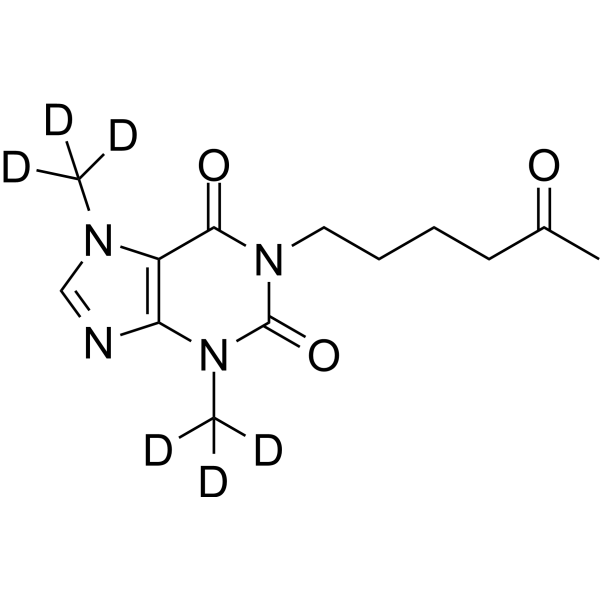
Pentoxifylline-d6 is the deuterium labeled Pentoxifylline. Pentoxifylline (BL-191), a haemorheological agent, is an orally active non-selective phosphodiesterase (PDE) inhibitor, with immune modulation, anti-inflammatory, hemorheological, anti-fibrinolytic and anti-proliferation effects. Pentoxifylline can be used for the research of peripheral vascular disease, cerebrovascular disease and a number of other conditions involving a defective regional microcirculation.
For research use only. We do not sell to patients.
- Purity : 99.0%
- CAS No.: 1185878-98-1
- Formula: C13H12D6N4O3
- Molecular Weight:284.34
-
Storage:Powder -20°C, 3 years , 4°C, 2 years ; In solvent -80°C, 6 months , -20°C, 1 month

To place orders, for customer services and technical support, please contact: MedChemExpress USA
Tel: 609-228-6898 E-mail: [email protected] [email protected]


-
 Biological Activity
-
Chemical Information
-
Solvent & Solubility
- Protocols
- Purity & Documentation
- References
-
 Help & FAQs




Biological Activity
Description
In Vitro
Stable heavy isotopes of hydrogen, carbon, and other elements have been incorporated into drug molecules, largely as tracers for quantitation during the drug development process. Deuteration has gained attention because of its potential to affect the pharmacokinetic and metabolic profiles of drugs[1].
MedChemExpress (MCE) has not independently confirmed the accuracy of these methods. They are for reference only.
Application
1. This compound can be used as a tracer
2. This compound can be used as an internal standard for quantitative analysis by NMR, GC-MS, or LC-MS.


Chemical Information
-
CAS No. 1185878-98-1
-
Unlabeled CAS 6493-05-6
-
Appearance Solid
-
Molecular Weight 284.34
-
Formula C13H12D6N4O3
-
Color White to off-white
-
SMILES
O=C1C2=C(N(C([2H])([2H])[2H])C(=O)N1CCCCC(C)=O)N=CN2C([2H])([2H])[2H]
-
Synonyms
BL-191-d6; Oxpentifylline-d6
-
Shipping
Room temperature in continental US; may vary elsewhere.
-
Storage
Powder -20°C 3 years 4°C 2 years In solvent -80°C 6 months -20°C 1 month


Solvent & Solubility
In Vitro:
DMSO : ≥ 10 mg/mL (35.17 mM; Hygroscopic DMSO has a significant impact on the solubility of product, please use newly opened DMSO)
DMF : ≥ 10 mg/mL (35.17 mM)
Ethanol : ≥ 2 mg/mL (7.03 mM)
* "≥" means soluble, but saturation unknown.
Please refer to the solubility information to select the appropriate solvent. Once prepared, please aliquot and store the solution to prevent product inactivation from repeated freeze-thaw cycles.
Storage method and period of stock solution: -80°C, 6 months; -20°C, 1 month. When stored at -80°C, please use it within 6 months. When stored at -20°C, please use it within 1 month.
Please refer to the solubility information to select the appropriate solvent. Once prepared, please aliquot and store the solution to prevent product inactivation from repeated freeze-thaw cycles.
Storage method and period of stock solution: -80°C, 6 months; -20°C, 1 month. When stored at -80°C, please use it within 6 months. When stored at -20°C, please use it within 1 month.
Concentration (start) × Volume (start) = Concentration (final) × Volume (final)


Purity & Documentation
-
Data Sheet (275 KB)
-
SDS (252 KB)
- English - EN (252 KB)
- Français - FR (252 KB)
- Deutsch - DE (252 KB)
- Norwegian - NO (252 KB)
- Español - ES (252 KB)
- Swedish - SV (252 KB)
- Italian - IT (252 KB)
- Korean - KR (252 KB)
- Portuguese - PT (252 KB)
-
Handling Instructions (2659 KB)
References
[1]. Russak EM, et al. Impact of Deuterium Substitution on the Pharmacokinetics of Pharmaceuticals. Ann Pharmacother. 2019;53(2):211-216. [Content Brief]
[2]. Iffat Hassan, et al. Pentoxifylline and its applications in dermatology. Indian Dermatol Online J. 2014 Oct-Dec; 5(4): 510–516. [Content Brief]
[3]. A Ward, et al. Pentoxifylline. A review of its pharmacodynamic and pharmacokinetic properties, and its therapeutic efficacy. Drugs. 1987 Jul;34(1):50-97. [Content Brief]
[4]. Yessica Cristina Castellanos-Esparza, et al. Synergistic promoting effects of pentoxifylline and simvastatin on the apoptosis of triple-negative MDA-MB-231 breast cancer cells. Int J Oncol. 2018 Apr;52(4):1246-1254. [Content Brief]
[5]. Shabnam Movassaghi, et al. Effect of Pentoxifylline on Ischemia- induced Brain Damage and Spatial Memory Impairment in Rat. Iran J Basic Med Sci. 2012 Sep-Oct; 15(5): 1083-1090. [Content Brief]


Complete Stock Solution Preparation Table
Please refer to the solubility information to select the appropriate solvent. Once prepared, please aliquot and store the solution to prevent product inactivation from repeated freeze-thaw cycles.
Storage method and period of stock solution: -80°C, 6 months; -20°C, 1 month. When stored at -80°C, please use it within 6 months. When stored at -20°C, please use it within 1 month.
| Optional Solvent | Concentration Solvent Mass | 1 mg | 5 mg | 10 mg | 25 mg |
|---|---|---|---|---|---|
| Ethanol / DMSO / DMF | 1 mM | 3.5169 mL | 17.5846 mL | 35.1692 mL | 87.9229 mL |
| 5 mM | 0.7034 mL | 3.5169 mL | 7.0338 mL | 17.5846 mL | |
| DMSO / DMF | 10 mM | 0.3517 mL | 1.7585 mL | 3.5169 mL | 8.7923 mL |
| 15 mM | 0.2345 mL | 1.1723 mL | 2.3446 mL | 5.8615 mL | |
| 20 mM | 0.1758 mL | 0.8792 mL | 1.7585 mL | 4.3961 mL | |
| 25 mM | 0.1407 mL | 0.7034 mL | 1.4068 mL | 3.5169 mL | |
| 30 mM | 0.1172 mL | 0.5862 mL | 1.1723 mL | 2.9308 mL |


Pentoxifylline-d6 Related Classifications
HY-B0715S Related Classifications
 Powered by Bioz