



Vinaxanthone
Based on 3 publication(s) in Google Scholar
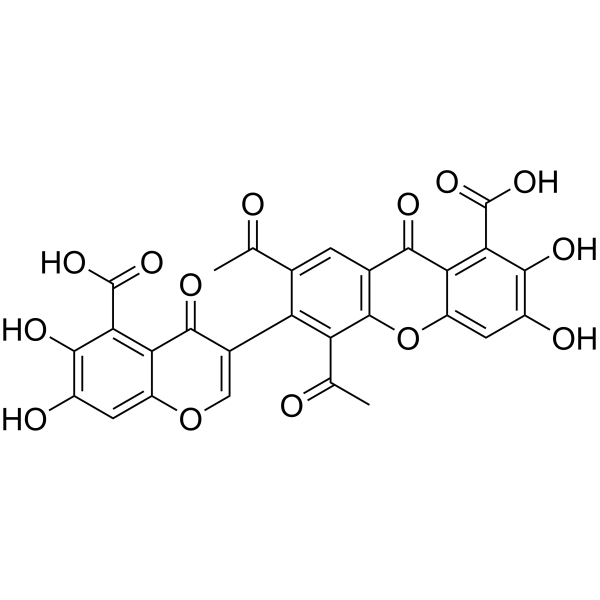
Vinaxanthone (SM-345431) is a potent and selective semaphorin3A, phospholipase C (PLC) and FabI inhibitor, with IC50s of 0.1-0.2 μM and 0.9 mM for semaphorin3A and FabI. Vinaxanthone inhibits the substrate (t-o-NAC thioester) and the cofactor (NADPH) with Kis of 3.1 μM and 1.0 μM, respectively. Vinaxanthone can be used to handle infections caused by multidrug-resistant pathogens.
For research use only. We do not sell to patients.
- Purity : 98.15%
- CAS No.: 133293-89-7
- Formula: C28H16O14
- Molecular Weight:576.42
-
Storage:Powder -20°C, 3 years , 4°C, 2 years ; In solvent -80°C, 6 months , -20°C, 1 month

To place orders, for customer services and technical support, please contact: MedChemExpress USA
Tel: 609-228-6898 E-mail: [email protected] [email protected]


-
 Biological Activity
-
Chemical Information
-
Solvent & Solubility
- Purity & Documentation
- References
-
 Help & FAQs



Publications Citing Use of MedChemExpress (MCE) Vinaxanthone
MoreAll Phospholipase Isoforms
More

Biological Activity
Description
In Vitro
Vinaxanthone shows selective inhibitory activity against phospholipase C (PLC) from rat brain, mutine colon 26 Adenocarcinoma and murine fibroblasts NIH3T3 with IC50s being 5.4, 9.3 and 44 μM, respectively[1].
Vinaxanthone (0.1 mg/mL, 24 h) enhances peripheral nerve regeneration and induces small amounts of neovascularization growth into the cornea[4].
Vinaxanthone (0.5 μM, 20 min) may protects from Dox-induced podocyte apoptosis[5].
Vinaxanthone (0.1-1 μM, 24 h) ameliorates the TGF-β1-induced tubular cell characteristic change[6].
MedChemExpress (MCE) has not independently confirmed the accuracy of these methods. They are for reference only. .
-
Cell Line:mouse corneal epithelial cell line (TKE2)
-
Concentration:0.1 mg/mL
-
Incubation Time:24 h
-
Result:Didn't affect cell viability by dose.
-
Cell Line:TKE2
-
Concentration:0.01-1 mg/mL
-
Incubation Time:24 h
-
Result:Showed a slight dose-dependent inhibition on cell proliferation.
-
Cell Line:mouse podocytes
-
Concentration:0.5 μM
-
Incubation Time:20 min
-
Result:Exhibited less C-Caspase3-positive cells.
-
Cell Line:HK-2 cells
-
Concentration:0.1-1 μM
-
Incubation Time:24 h
-
Result:Decreased the expression of E-cadherin.
Increased the expression of ɑ-SMA and vimentin.
In Vivo
Vinaxanthone (SEMA3A-I) (20 µg, i.p.) protects from Doxorubicin (HY-15142A)-induced podocyte injury through an anti-apoptosis mechanism in mouse model of Doxorubicin (HY-15142A)-induced podocytopathy[5].
MedChemExpress (MCE) has not independently confirmed the accuracy of these methods. They are for reference only.
-
Animal Model:murine corneal transplantation model[4]
-
Dosage:0.1 mg/mL
-
Administration:Subconjunctival injections, every 2 days, 3 weeks
-
Result:Showed significantly higher nerve growth.
Improved the corneal sensitivity.
-
Animal Model:mouse model of Doxorubicin (10 mg/kg)-induced podocytopathy[5]
-
Dosage:20 µg
-
Administration:Intraperitoneal injection (i.p.), every day
-
Result:Improved the expression of nephrin.
Reduced podocytopathy and tubular casts.
Detected rarely TUNEL-positive cells in the Dox + Vinaxanthone group.
Had fewer p-c-Jun-positive cells in the Dox + Vinaxanthone group.


Chemical Information
-
CAS No. 133293-89-7
-
Appearance Solid
-
Molecular Weight 576.42
-
Formula C28H16O14
-
Color Light yellow to brown
-
SMILES
O=C(C(C(O)=C(C=C1OC=C2C3=C(C(C)=O)C4=C(C(C5=C(C(O)=O)C(O)=C(O)C=C5O4)=O)C=C3C(C)=O)O)=C1C2=O)O
-
Synonyms
SM-345431
-
Initial Source
Penicillium vinaceum
-
Shipping
Room temperature in continental US; may vary elsewhere.
-
Storage
Powder -20°C 3 years 4°C 2 years In solvent -80°C 6 months -20°C 1 month


Publications (3)
-
Journal Impact Factor
-
Most Recent
-
Cell
2025 Oct 2;188(20):5499-5515.e20. PMID: 40712576 -
Nat Commun
Pulsed electromagnetic fields mediate sensory nerve regulation for bone formation in aging models. [Abstract]2025 Sep 29;16(1):8223. PMID: 41022817 -
J Cell Mol Med
Peripheral nerve-derived Sema3A promotes osteogenic differentiation of mesenchymal stem cells through the Wnt/β-catenin/Nrp1 positive feedback loop. [Abstract]2024 Apr;28(8):e18201. PMID: 38568078


Solvent & Solubility
In Vitro:
DMSO : 100 mg/mL (173.48 mM; Need ultrasonic; Hygroscopic DMSO has a significant impact on the solubility of product, please use newly opened DMSO)
Please refer to the solubility information to select the appropriate solvent. Once prepared, please aliquot and store the solution to prevent product inactivation from repeated freeze-thaw cycles.
Storage method and period of stock solution: -80°C, 6 months; -20°C, 1 month. When stored at -80°C, please use it within 6 months. When stored at -20°C, please use it within 1 month.
Please refer to the solubility information to select the appropriate solvent. Once prepared, please aliquot and store the solution to prevent product inactivation from repeated freeze-thaw cycles.
Storage method and period of stock solution: -80°C, 6 months; -20°C, 1 month. When stored at -80°C, please use it within 6 months. When stored at -20°C, please use it within 1 month.
Concentration (start) × Volume (start) = Concentration (final) × Volume (final)
In Vivo:
Select the appropriate dissolution method based on your experimental animal and administration route.
- For the following dissolution methods, please ensure to first prepare a clear stock solution using an In Vitro approach and then sequentially add co-solvents:
- To ensure reliable experimental results, the clarified stock solution can be appropriately stored based on storage conditions. As for the working solution for In Vivo experiments, it is recommended to prepare freshly and use it on the same day.
- The percentages shown for the solvents indicate their volumetric ratio in the final prepared solution. If precipitation or phase separation occurs during preparation, heat and/or sonication can be used to aid dissolution.
Add each solvent one by one: 10% DMSO 40% PEG300 5% Tween-80 45% Saline
Solubility: ≥ 2.5 mg/mL (4.34 mM); Clear solution
This protocol yields a clear solution of ≥ 2.5 mg/mL (saturation unknown).
Taking 1 mL working solution as an example, add 100 μL DMSO stock solution (25.0 mg/mL) to 400 μL PEG300, and mix evenly; then add 50 μL Tween-80 and mix evenly; then add 450 μL Saline to adjust the volume to 1 mL.
Preparation of Saline: Dissolve 0.9 g sodium chloride in ddH₂O and dilute to 100 mL to obtain a clear Saline solution.
In Vivo Dissolution Calculator
Please enter the basic information of animal experiments:
-
-
-
-
Recommended: Prepare an additional quantity of animals to account for potential losses during experiments.
Please enter your animal formula composition:
-
%DMSO +
Recommended: Keep the proportion of DMSO in working solution below 2% if your animal is weak.
-
%+
-
+%Tween-80 + +
-
%Saline +
The co-solvents required include: DMSO, . All of co-solvents are available by MedChemExpress (MCE). , Tween 80. All of co-solvents are available by MedChemExpress (MCE).
Working solution concentration: 0.22 mg/mL
Method for preparing stock solution: mg drug dissolved in μL DMSO. Stock solution concentration: mg/mL.
1. Take μL DMSO stock solution;
2. Add μL .
μL , mix evenly;
3. Then add μL Tween 80, mix evenly;
4. Then add μL
Please ensure that the stock solution in the first step is dissolved to a clear state, and add co-solvents in sequence. You can use ultrasonic heating (ultrasonic cleaner, recommended frequency 20-40 kHz), vortexing, etc. to assist dissolution.


Purity & Documentation
-
Data Sheet (283 KB)
-
SDS (252 KB)
- English - EN (252 KB)
- Français - FR (252 KB)
- Deutsch - DE (252 KB)
- Norwegian - NO (252 KB)
- Español - ES (252 KB)
- Swedish - SV (252 KB)
- Italian - IT (252 KB)
- Korean - KR (252 KB)
- Portuguese - PT (252 KB)
-
Handling Instructions (2659 KB)
References
[2]. Liang Zhang, et al. Rewiring of regenerated axons by combining treadmill training with semaphorin3A inhibition. Mol Brain. 2014 Mar 10; 7:14. [Content Brief]
[3]. Zheng CJ, et al. Vinaxanthone, a new FabI inhibitor from Penicillium sp. J Antimicrob Chemother. 2009 May;63(5):949-53. [Content Brief]
[4]. Omoto M, Yoshida S, Miyashita H, Kawakita T, Yoshida K, Kishino A, Kimura T, Shibata S, Tsubota K, Okano H, Shimmura S. The semaphorin 3A inhibitor SM-345431 accelerates peripheral nerve regeneration and sensitivity in a murine corneal transplantation model. PLoS One. 2012;7(11):e47716. [Content Brief]
[5]. Sang Y, et al. Semaphorin3A-Inhibitor Ameliorates Doxorubicin-Induced Podocyte Injury. Int J Mol Sci. 2020 Jun 8;21(11):4099. [Content Brief]
[6]. Sang Y, et al. Semaporin3A inhibitor ameliorates renal fibrosis through the regulation of JNK signaling. Am J Physiol Renal Physiol. 2021 Dec 1;321(6):F740-F756. [Content Brief]


Complete Stock Solution Preparation Table
Please refer to the solubility information to select the appropriate solvent. Once prepared, please aliquot and store the solution to prevent product inactivation from repeated freeze-thaw cycles.
Storage method and period of stock solution: -80°C, 6 months; -20°C, 1 month. When stored at -80°C, please use it within 6 months. When stored at -20°C, please use it within 1 month.
| Optional Solvent | Concentration Solvent Mass | 1 mg | 5 mg | 10 mg | 25 mg |
|---|---|---|---|---|---|
| DMSO | 1 mM | 1.7348 mL | 8.6742 mL | 17.3485 mL | 43.3712 mL |
| 5 mM | 0.3470 mL | 1.7348 mL | 3.4697 mL | 8.6742 mL | |
| 10 mM | 0.1735 mL | 0.8674 mL | 1.7348 mL | 4.3371 mL | |
| 15 mM | 0.1157 mL | 0.5783 mL | 1.1566 mL | 2.8914 mL | |
| 20 mM | 0.0867 mL | 0.4337 mL | 0.8674 mL | 2.1686 mL | |
| 25 mM | 0.0694 mL | 0.3470 mL | 0.6939 mL | 1.7348 mL | |
| 30 mM | 0.0578 mL | 0.2891 mL | 0.5783 mL | 1.4457 mL | |
| 40 mM | 0.0434 mL | 0.2169 mL | 0.4337 mL | 1.0843 mL | |
| 50 mM | 0.0347 mL | 0.1735 mL | 0.3470 mL | 0.8674 mL | |
| 60 mM | 0.0289 mL | 0.1446 mL | 0.2891 mL | 0.7229 mL | |
| 80 mM | 0.0217 mL | 0.1084 mL | 0.2169 mL | 0.5421 mL | |
| 100 mM | 0.0173 mL | 0.0867 mL | 0.1735 mL | 0.4337 mL |


Vinaxanthone Related Classifications
HY-N9480 Related Classifications
 Powered by Bioz