



2,3-Dihydroxybenzaldehyde

Based on 1 Customer Validation
2,3-Dihydroxybenzaldehyde is a derivative of Gentisaldehyde (HY-N1673), as well as an Antibacterial and anticancer agent. 2,3-Dihydroxybenzaldehyde inhibits the synthesis of DNA, RNA and proteins. It exhibits antibacterial activity against 172 Staphylococcus aureus isolates from bovine mastitis, with an MIC50 of 500 mg/L. 2,3-Dihydroxybenzaldehyde can be used in the research of bovine mastitis and L1210 mouse leukemia.
For research use only. We do not sell to patients.
- Purity : 99.62%
- CAS No.: 24677-78-9
- Formula: C7H6O3
- Molecular Weight:138.12
-
Storage:
4°C, stored under nitrogen
* In solvent : -80°C, 6 months; -20°C, 1 month (stored under nitrogen)


To place orders, for customer services and technical support, please contact: MedChemExpress USA
Tel: 609-228-6898 E-mail: [email protected] [email protected]


-
 Biological Activity
-
Chemical Information
-
Solvent & Solubility
- Protocols
- Purity & Documentation
- References
-
 Help & FAQs


-

HY-75887
5-NitrosalicylaldehydeDronedarone Intermediate -
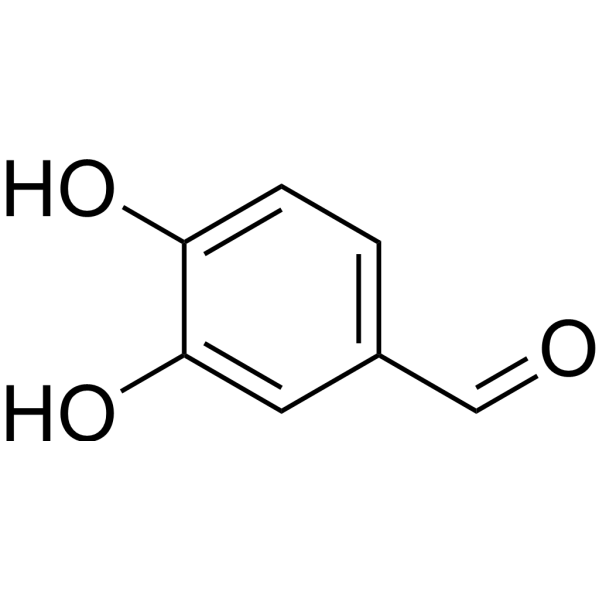
HY-N0295
ProtocatechualdehydePolyphenol Compound -

HY-Z0547
2-Hydroxy-3-nitrobenzaldehydeDrug Impurity -
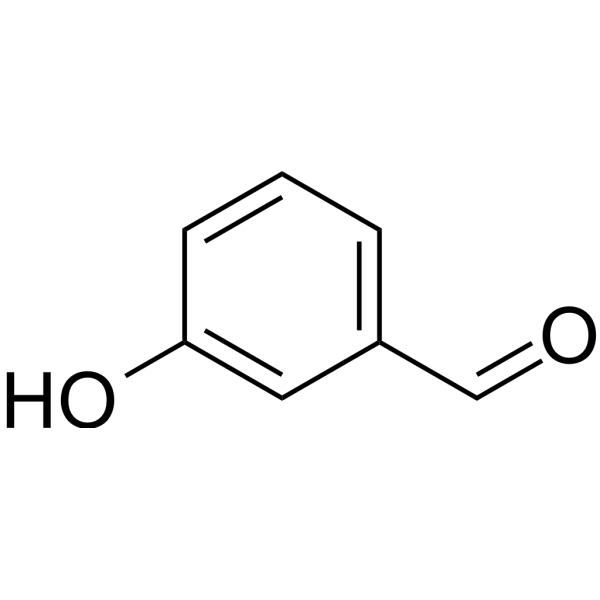
HY-76006
3-HydroxybenzaldehydeSubstrate For ALDH, Precursor Compound for Phenolic Compounds -

HY-Y0785
Glyoxal (40% w/w in water)Drug Intermediate -
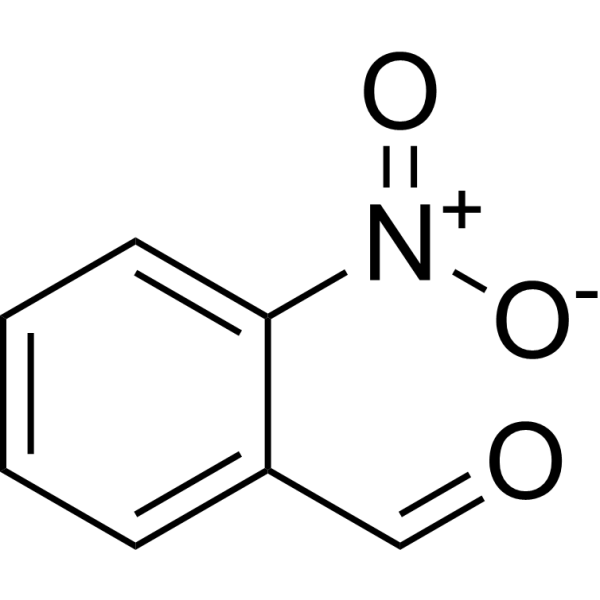
HY-W007454
2-NitrobenzaldehydeBiochemical Reagent -
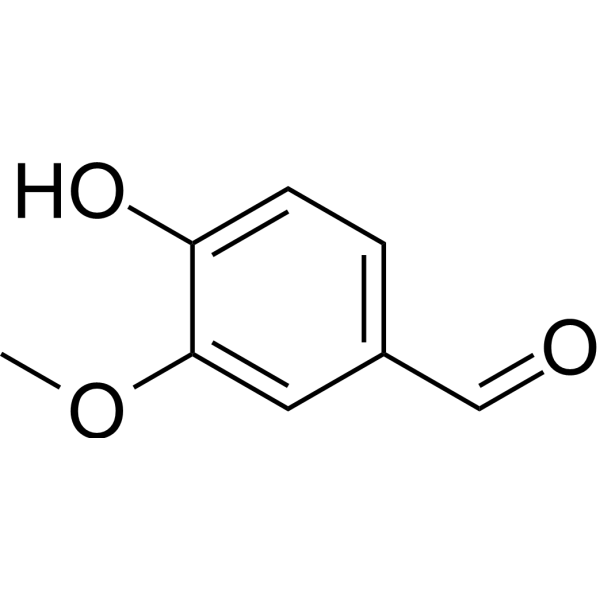
HY-N0098
VanillinPhenolic Aldehyde -
HY-W007539
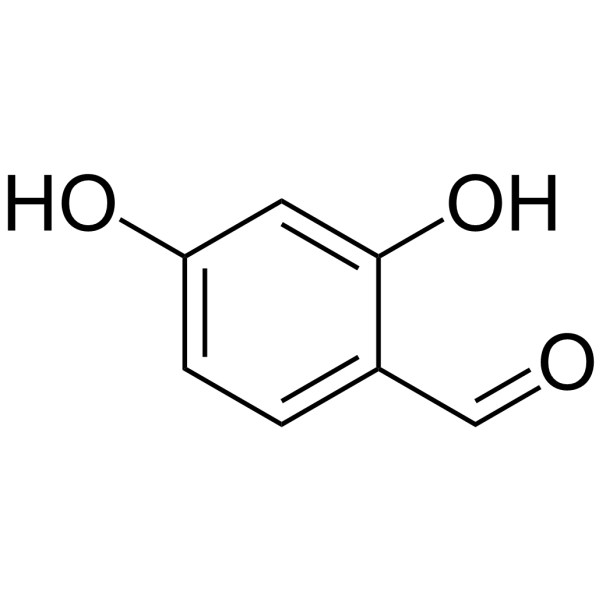
2,4-DihydroxybenzaldehydeDrug Intermediate -

HY-Z0547R
2-Hydroxy-3-nitrobenzaldehyde (Standard) -

HY-W005297
4,6-DimethoxysalicylaldehydeAntifungal Agent -

HY-Y1863
3-ChlorobenzaldehydemALDH Substrate
All DNA/RNA Synthesis Isoforms
More

Biological Activity
Description
Cellular Effect
|
Cell Line

|
Type | Value | Description | References |
|---|---|---|---|---|
| A-431 | IC50 |
0.45 μg/mL
Compound: 2,3-dihydroxybenzaldehyde
|
Inhibition of phosphatidylinositol 4-kinase in human A431 cell membrane by liquid scintillation counting
Inhibition of phosphatidylinositol 4-kinase in human A431 cell membrane by liquid scintillation counting
|
[PMID: 1666120] |
In Vitro
MedChemExpress (MCE) has not independently confirmed the accuracy of these methods. They are for reference only.
-
Cell Line:bovine mammary epithelial MAC-T cells
-
Concentration:125, 250, 500, 1,000, 2,000 mg/L
-
Incubation Time:24 h
-
Result:Maintained over 64% metabolically active MAC-T cells at all tested concentrations.
Reduced cell viability significantly compared to the untreated control at all concentrations.
Showed no significant difference in viability between the MIC50 (500 mg/L) and MIC90 (833 mg/L) concentrations.


Chemical Information
-
CAS No. 24677-78-9
-
Appearance Solid
-
Molecular Weight 138.12
-
Formula C7H6O3
-
Color Light yellow to green yellow
-
SMILES
O=CC1=C(O)C(O)=CC=C1
-
Structure Classification
-
Initial Source
-
Shipping
Room temperature in continental US; may vary elsewhere.
-
Storage
4°C, stored under nitrogen
* In solvent : -80°C, 6 months; -20°C, 1 month (stored under nitrogen)


Solvent & Solubility
In Vitro:
DMSO : 100 mg/mL (724.01 mM; Need ultrasonic; Hygroscopic DMSO has a significant impact on the solubility of product, please use newly opened DMSO)
Please refer to the solubility information to select the appropriate solvent. Once prepared, please aliquot and store the solution to prevent product inactivation from repeated freeze-thaw cycles.
Storage method and period of stock solution: -80°C, 6 months; -20°C, 1 month (stored under nitrogen). When stored at -80°C, please use it within 6 months. When stored at -20°C, please use it within 1 month.
Please refer to the solubility information to select the appropriate solvent. Once prepared, please aliquot and store the solution to prevent product inactivation from repeated freeze-thaw cycles.
Storage method and period of stock solution: -80°C, 6 months; -20°C, 1 month (stored under nitrogen). When stored at -80°C, please use it within 6 months. When stored at -20°C, please use it within 1 month.
Concentration (start) × Volume (start) = Concentration (final) × Volume (final)


Purity & Documentation
-
Data Sheet (280 KB)
-
SDS (394 KB)
- English - EN (394 KB)
- Français - FR (394 KB)
- Deutsch - DE (394 KB)
- Norwegian - NO (394 KB)
- Español - ES (394 KB)
- Swedish - SV (394 KB)
- Italian - IT (394 KB)
- Korean - KR (394 KB)
- Portuguese - PT (394 KB)
-
Handling Instructions (2659 KB)
References
[1]. Tonde SS, et al. Self-activating nuclease activity of copper (II) complexes of hydroxyl-rich ligands. Journal of inorganic biochemistry. 2006 Jan;100(1):51-7. [Content Brief]
[2]. Kato S, et al. Synthesis and biological activity of 4-amino-5-chloro-2-ethoxy-3-hydroxybenzamides, metabolites of a new gastroprokinetic agent, mosapride. Chemical & pharmaceutical bulletin. 1996 Aug;44(8):1484-92. [Content Brief]
[3]. Schabauer A, et al. Gentisaldehyde and Its Derivative 2,3-Dihydroxybenzaldehyde Show Antimicrobial Activities Against Bovine Mastitis Staphylococcus aureus. Front Vet Sci. 2018 Jul 11;5:148. [Content Brief]
[4]. Wick MM, et al. Antitumor effects of biologic reducing agents related to 3,4-dihydroxybenzylamine: dihydroxybenzaldehyde, dihydroxybenzaldoxime, and dihydroxybenzonitrile. Journal of pharmaceutical sciences. 1987 Jul;76(7):513-5. [Content Brief]


Complete Stock Solution Preparation Table
Please refer to the solubility information to select the appropriate solvent. Once prepared, please aliquot and store the solution to prevent product inactivation from repeated freeze-thaw cycles.
Storage method and period of stock solution: -80°C, 6 months; -20°C, 1 month (stored under nitrogen). When stored at -80°C, please use it within 6 months. When stored at -20°C, please use it within 1 month.
| Optional Solvent | Concentration Solvent Mass | 1 mg | 5 mg | 10 mg | 25 mg |
|---|---|---|---|---|---|
| DMSO | 1 mM | 7.2401 mL | 36.2004 mL | 72.4008 mL | 181.0020 mL |
| 5 mM | 1.4480 mL | 7.2401 mL | 14.4802 mL | 36.2004 mL | |
| 10 mM | 0.7240 mL | 3.6200 mL | 7.2401 mL | 18.1002 mL | |
| 15 mM | 0.4827 mL | 2.4134 mL | 4.8267 mL | 12.0668 mL | |
| 20 mM | 0.3620 mL | 1.8100 mL | 3.6200 mL | 9.0501 mL | |
| 25 mM | 0.2896 mL | 1.4480 mL | 2.8960 mL | 7.2401 mL | |
| 30 mM | 0.2413 mL | 1.2067 mL | 2.4134 mL | 6.0334 mL | |
| 40 mM | 0.1810 mL | 0.9050 mL | 1.8100 mL | 4.5251 mL | |
| 50 mM | 0.1448 mL | 0.7240 mL | 1.4480 mL | 3.6200 mL | |
| 60 mM | 0.1207 mL | 0.6033 mL | 1.2067 mL | 3.0167 mL | |
| 80 mM | 0.0905 mL | 0.4525 mL | 0.9050 mL | 2.2625 mL | |
| 100 mM | 0.0724 mL | 0.3620 mL | 0.7240 mL | 1.8100 mL |


2,3-Dihydroxybenzaldehyde Related Classifications
HY-W007479 Related Classifications
 Powered by Bioz