



Aurothioglucose
Based on 2 publication(s) in Google Scholar
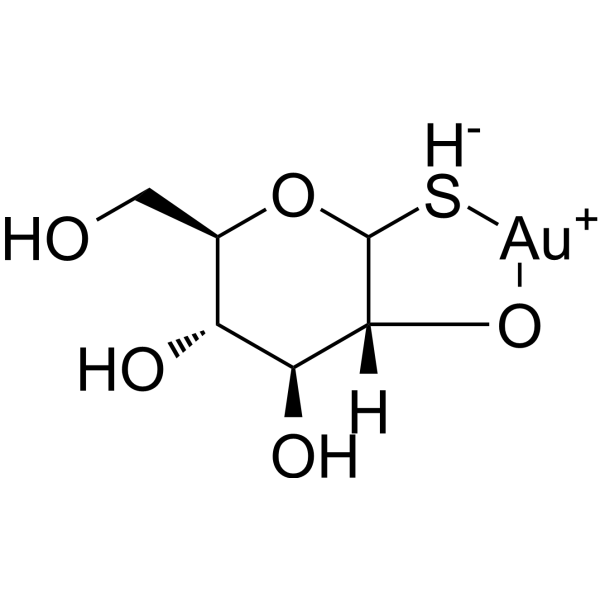
Aurothioglucose (Gold thioglucose), containing monovalent gold ion, is a potent active-site inhibitor of TrxR1 (thioredoxin reductase 1), with an IC50 of 65 nM. Aurothioglucose inhibits the DNA binding of NF-κB in vitro. Aurothioglucose shows anti-HIV and anti-rheumatic activities.
For research use only. We do not sell to patients.
- Purity : 96.1%
- CAS No.: 12192-57-3
- Formula: C6H11AuO5S
- Molecular Weight:392.18
-
Storage:Powder -20°C, 3 years , 4°C, 2 years ; In solvent -80°C, 6 months , -20°C, 1 month

To place orders, for customer services and technical support, please contact: MedChemExpress USA
Tel: 609-228-6898 E-mail: [email protected] [email protected]


-
 Biological Activity
-
Chemical Information
-
Solvent & Solubility
- Protocols
- Purity & Documentation
- References
-
 Help & FAQs


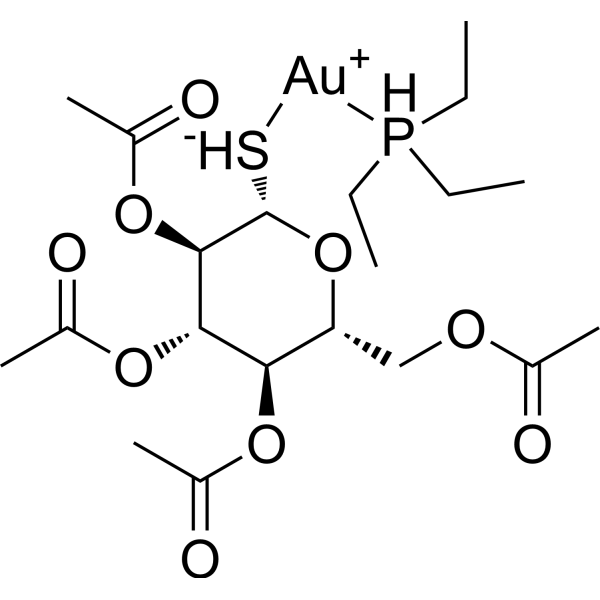
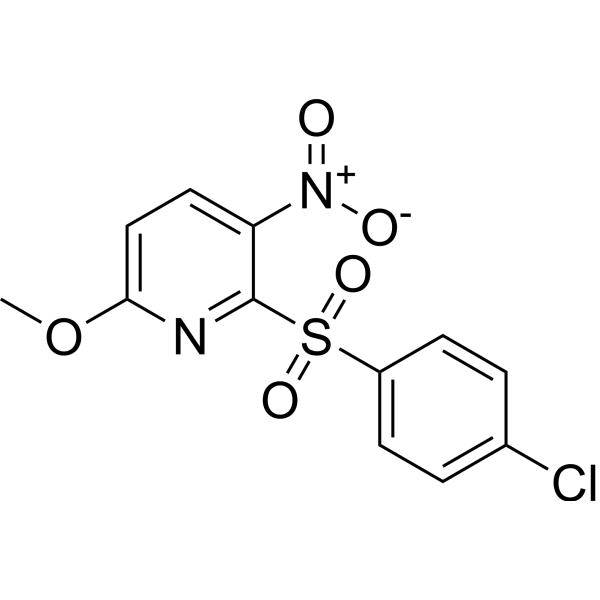
Publications Citing Use of MedChemExpress (MCE) Aurothioglucose
More

Biological Activity
Description
IC50 & Target
IC50: 65 nM (TrxR1)[1]
In Vitro
Aurothioglucose (0-100 μM, 24-72 h) inhibits TrxR1 activity in HeLa cell cytosol but has no effect on the viability of the cells[1].
Aurothioglucose (0-30 μM, 6 h) exhibits very low cytotoxicity on cells[1].
Aurothioglucose (0-20 μM, 24 h) combined with Ebselen (HY-13750) shows a strong synergistic effect, leading to Trx1 (thioredoxin 1) oxidation, reactive oxygen species (ROS) accumulation, and cell death[1].
Aurothioglucose (0-100 μM, 3-12 days) inhibits p24 levels in OM10.1 and Ach2 cells, and inhibits HIV-1 replication in vitro[2].
Aurothioglucose (0-25 μM, 12 days) increases the accumulation of metal gold in a dose-dependent manner[2].
MedChemExpress (MCE) has not independently confirmed the accuracy of these methods. They are for reference only.
-
Cell Line:HeLa cells
-
Concentration:0, 5, 10, 50, 100 μM
-
Incubation Time:24, 48, 72 h
-
Result:Inhibited TrxR activity by more than 90% at 100 μM in HeLa cells. Cell viability was unaffected by ATG treatment, even at 100 μM after 72 h.
-
Cell Line:HeLa cells
-
Concentration:0, 5, 10, and 100 μM
-
Incubation Time:24 h
-
Result:Showed no significant oxidation of Trx1 or Trx2 in HeLa cells.
-
Cell Line:OM10.1, Ach2 cells
-
Concentration:0, 4, 10, 25 and 100 μM
-
Incubation Time:3, 6 or 12 days
-
Result:Significantly inhibited p24 levels. After 12 days of incubation, the viability of cells treated with 10, 25 and 100 μM Aurothioglucose had decreased to 60% of the control.
In Vivo
Aurothioglucose (300 mg/kg, i.p., single) induces hypothalamic obesity in mice[4].
MedChemExpress (MCE) has not independently confirmed the accuracy of these methods. They are for reference only.
-
Animal Model:Adult male C3H/HeN mice (8-12 week, LPS/hyperoxia-exposed mice, inflammation/hyperoxia ARDS model)[3]
-
Dosage:25 mg/kg
-
Administration:IP, single, at 12 h after intratracheal LPS administration
-
Result:Significantly attenuated lung injury, increased lung GCLM expression and GSH levels, and decreased mortality.


Chemical Information
-
CAS No. 12192-57-3
-
Appearance Solid
-
Molecular Weight 392.18
-
Formula C6H11AuO5S
-
Color White to yellow
-
SMILES
O[C@@H]1[C@](O[Au+][SH-]2)([H])C2O[C@H](CO)[C@H]1O
-
Synonyms
Gold thioglucose
-
Shipping
Room temperature in continental US; may vary elsewhere.
-
Storage
Powder -20°C 3 years 4°C 2 years In solvent -80°C 6 months -20°C 1 month


Publications (2)
-
Journal Impact Factor
-
Most Recent
-
J Ethnopharmacol
Notopterygium incisum extract (NRE) rescues cognitive deficits in APP/PS1 Alzhneimer's disease mice by attenuating amyloid-beta, tau, and neuroinflammation pathology. [Abstract]2020 Mar 1:249:112433. PMID: 31783135 -


Solvent & Solubility
In Vitro:
H2O : 125 mg/mL (318.73 mM; Need ultrasonic)
DMSO : 6 mg/mL (15.30 mM; Need ultrasonic; Hygroscopic DMSO has a significant impact on the solubility of product, please use newly opened DMSO)
Please refer to the solubility information to select the appropriate solvent. Once prepared, please aliquot and store the solution to prevent product inactivation from repeated freeze-thaw cycles.
Storage method and period of stock solution: -80°C, 6 months; -20°C, 1 month. When stored at -80°C, please use it within 6 months. When stored at -20°C, please use it within 1 month.
* Note: If you choose water as the stock solution, please dilute it to the working solution, then filter and sterilize it with a 0.22 μm filter before use.
Please refer to the solubility information to select the appropriate solvent. Once prepared, please aliquot and store the solution to prevent product inactivation from repeated freeze-thaw cycles.
Storage method and period of stock solution: -80°C, 6 months; -20°C, 1 month. When stored at -80°C, please use it within 6 months. When stored at -20°C, please use it within 1 month.
* Note: If you choose water as the stock solution, please dilute it to the working solution, then filter and sterilize it with a 0.22 μm filter before use.
Concentration (start) × Volume (start) = Concentration (final) × Volume (final)


Purity & Documentation
-
Data Sheet (281 KB)
-
SDS (419 KB)
- English - EN (419 KB)
- Français - FR (419 KB)
- Deutsch - DE (419 KB)
- Norwegian - NO (419 KB)
- Español - ES (419 KB)
- Swedish - SV (419 KB)
- Italian - IT (419 KB)
- Korean - KR (419 KB)
- Portuguese - PT (419 KB)
-
Handling Instructions (2659 KB)
References
[1]. Du Y, et al. Glutathione and glutaredoxin act as a backup of human thioredoxin reductase 1 to reduce thioredoxin 1 preventing cell death by aurothioglucose. J Biol Chem. 2012 Nov 2;287(45):38210-9. [Content Brief]
[2]. Traber KE, et al. Anti-rheumatic compound aurothioglucose inhibits tumor necrosis factor-alpha-induced HIV-1 replication in latently infected OM10.1 and Ach2 cells. Int Immunol. 1999 Feb;11(2):143-50. [Content Brief]
[3]. Britt RD Jr, et al. The thioredoxin reductase-1 inhibitor aurothioglucose attenuates lung injury and improves survival in a murine model of acute respiratory distress syndrome. Antioxid Redox Signal. 2014 Jun 10;20(17):2681-91. [Content Brief]
[4]. Naruta E, et al. Hypolipidemic effect of pantothenic acid derivatives in mice with hypothalamic obesity induced by aurothioglucose. Exp Toxicol Pathol. 2001 Oct;53(5):393-8. [Content Brief]


Complete Stock Solution Preparation Table
Please refer to the solubility information to select the appropriate solvent. Once prepared, please aliquot and store the solution to prevent product inactivation from repeated freeze-thaw cycles.
Storage method and period of stock solution: -80°C, 6 months; -20°C, 1 month. When stored at -80°C, please use it within 6 months. When stored at -20°C, please use it within 1 month.
| Optional Solvent | Concentration Solvent Mass | 1 mg | 5 mg | 10 mg | 25 mg |
|---|---|---|---|---|---|
| DMSO / H2O | 1 mM | 2.5498 mL | 12.7492 mL | 25.4985 mL | 63.7462 mL |
| 5 mM | 0.5100 mL | 2.5498 mL | 5.0997 mL | 12.7492 mL | |
| 10 mM | 0.2550 mL | 1.2749 mL | 2.5498 mL | 6.3746 mL | |
| 15 mM | 0.1700 mL | 0.8499 mL | 1.6999 mL | 4.2497 mL | |
| H2O | 20 mM | 0.1275 mL | 0.6375 mL | 1.2749 mL | 3.1873 mL |
| 25 mM | 0.1020 mL | 0.5100 mL | 1.0199 mL | 2.5498 mL | |
| 30 mM | 0.0850 mL | 0.4250 mL | 0.8499 mL | 2.1249 mL | |
| 40 mM | 0.0637 mL | 0.3187 mL | 0.6375 mL | 1.5937 mL | |
| 50 mM | 0.0510 mL | 0.2550 mL | 0.5100 mL | 1.2749 mL | |
| 60 mM | 0.0425 mL | 0.2125 mL | 0.4250 mL | 1.0624 mL | |
| 80 mM | 0.0319 mL | 0.1594 mL | 0.3187 mL | 0.7968 mL | |
| 100 mM | 0.0255 mL | 0.1275 mL | 0.2550 mL | 0.6375 mL |
* Note: If you choose water as the stock solution, please dilute it to the working solution, then filter and sterilize it with a 0.22 μm filter before use.


Aurothioglucose Related Classifications
HY-A0068 Related Classifications
 Powered by Bioz