



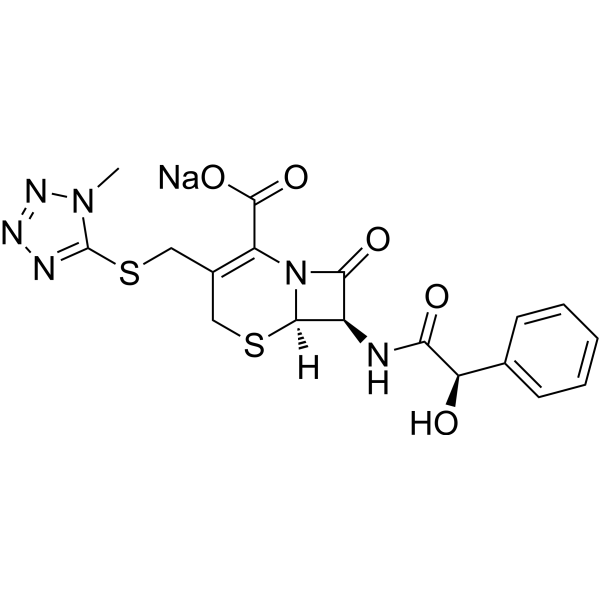
Cefamandole sodium

Based on 1 Customer Validation
Cefamandole (Cephamandole) sodium is a semi-synthetic second-generation cephalosporin antibiotic with broad-spectrum antimicrobial activity. Cefamandole sodium is resistant to hydrolysis by β-lactamases produced by some Gram-negative bacteria. Cefamandole sodium kills Gram-positive cocci and various Gram-negative bacilli mainly by inhibiting cell wall synthesis, but it is inactive against Pseudomonas, Proteus vulgaris and Providencia stuartii, and its efficacy is affected by inoculum size. The plasma elimination half-life of Cefamandole sodium in rats is only 0.4 h, it is mainly excreted in urine in biologically active form, and it hardly penetrates the non-inflamed blood-brain barrier. Cefamandole sodium is widely used in studies related to bacterial infections.
For research use only. We do not sell to patients.
- Purity : 95.0%
- CAS No.: 30034-03-8
- Formula: C18H17N6NaO5S2
- Molecular Weight:484.48
-
Storage:
-20°C, sealed storage, away from moisture
* In solvent : -80°C, 6 months; -20°C, 1 month (sealed storage, away from moisture)

To place orders, for customer services and technical support, please contact: MedChemExpress USA
Tel: 609-228-6898 E-mail: [email protected] [email protected]


-
 Biological Activity
-
Chemical Information
-
Solvent & Solubility
- Protocols
- Purity & Documentation
- References
-
 Help & FAQs


All Antibiotic Isoforms
More

Biological Activity
Description
IC50 & Target
|
β-lactam |
In Vitro
Cefamandole (sodium) (30 μg/mL; 0, 1, 3, 6, 12 h) is hydrolyzed by beta-lactamases from Enterobacter cloacae, Serratia marcescens, and Proteus morganii, allowing bacterial growth to resume after hydrolysis is complete, while Pseudomonas aeruginosa grows despite cefamandole presence prior to hydrolysis[1].
Cefamandole (sodium) (0.12-64 μg/mL; 18 h) inhibits 90-100% of methicillin-susceptible S. aureus, group A and B streptococci, S. pneumoniae, N. gonorrhoeae, H. influenzae, and S. typhosa[3].
MedChemExpress (MCE) has not independently confirmed the accuracy of these methods. They are for reference only. Further protocols information, click here.
-
Cell Line:Methicillin-susceptible S. aureus, group A and B streptococci, S. pneumoniae, N. gonorrhoeae, H. influenzae, and S. typhosa
-
Concentration:Cefamandole:
0.12, 0.25, 0.5, 1, 2, 4, 8, 16, 32, 16 μg/mL -
Incubation Time:18 h
-
Result:Inhibited 90-100% of methicillin-susceptible S. aureus, group A and B streptococci, S. pneumoniae, N. gonorrhoeae, H. influenzae, and S. typhosa at concentrations of 2 μg/mL or less, with variable activity against gram-negative rods including 70% of E. coli inhibited at 4 μg/mL and 80% of B. fragilis subsp. fragilis inhibited at 32 μg/mL.
In Vivo
Cefamandole sodium (50 mg/kg; intravenous administration; single dose) exhibits free drug pharmacokinetic characteristics consistent with a two-compartment model in male Sprague-Dawley rats, with an elimination half-life of 21.6 min[5].
MedChemExpress (MCE) has not independently confirmed the accuracy of these methods. They are for reference only.
-
Animal Model:Sprague-Dawley (male, adult, 280-350 g, specific pathogen-free)[5]
-
Dosage:50 mg/kg
-
Administration:i.v.; single dose
-
Result:Achieved an in vivo microdialysis recovery of 55.44% (n=6) at an infusion concentration of 1 μg/mL.
Fitted a two-compartment pharmacokinetic model with parameters: A = 148.4 ± 34.3 μg/mL, B = 16.9 ± 4.2 μg/mL, α = 0.11 ± 0.01 1/min, β = 0.033 ± 0.003 1/min, distribution half-life (t1/2,α) = 6.4 ± 0.5 min, elimination half-life (t1/2,β) = 21.6 ± 1.6 min, AUC = 1799.4 ± 254.7 μg min/mL, volume of distribution (Vd) = 372.2 ± 87.4 mL, clearance (Cl) = 30.5 ± 5.0 mL/min/kg, mean residence time (MRT) = 15.4 ± 1.1 min (n=5).


Chemical Information
-
CAS No. 30034-03-8
-
Appearance Solid
-
Molecular Weight 484.48
-
Formula C18H17N6NaO5S2
-
Color White to off-white
-
SMILES
O=C(C(N12)=C(CSC3=NN=NN3C)CS[C@]2([H])[C@H](NC([C@H](O)C4=CC=CC=C4)=O)C1=O)O[Na]
-
Synonyms
Cephamandole sodium
-
Shipping
Room temperature in continental US; may vary elsewhere.
-
Storage
-20°C, sealed storage, away from moisture
* In solvent : -80°C, 6 months; -20°C, 1 month (sealed storage, away from moisture)


Solvent & Solubility
In Vitro:
H2O : 250 mg/mL (516.02 mM; Need ultrasonic)
Please refer to the solubility information to select the appropriate solvent. Once prepared, please aliquot and store the solution to prevent product inactivation from repeated freeze-thaw cycles.
Storage method and period of stock solution: -80°C, 6 months; -20°C, 1 month (sealed storage, away from moisture). When stored at -80°C, please use it within 6 months. When stored at -20°C, please use it within 1 month.
* Note: If you choose water as the stock solution, please dilute it to the working solution, then filter and sterilize it with a 0.22 μm filter before use.
Please refer to the solubility information to select the appropriate solvent. Once prepared, please aliquot and store the solution to prevent product inactivation from repeated freeze-thaw cycles.
Storage method and period of stock solution: -80°C, 6 months; -20°C, 1 month (sealed storage, away from moisture). When stored at -80°C, please use it within 6 months. When stored at -20°C, please use it within 1 month.
* Note: If you choose water as the stock solution, please dilute it to the working solution, then filter and sterilize it with a 0.22 μm filter before use.
Concentration (start) × Volume (start) = Concentration (final) × Volume (final)
In Vivo:
For the following dissolution methods, please prepare the working solution directly:
It is recommended to prepare fresh solutions and use them promptly within a short period of time.
The percentages shown for the solvents indicate their volumetric ratio in the final prepared solution. If precipitation or phase separation occurs during preparation, heat and/or sonication can be used to aid dissolution.
Add each solvent one by one: PBS
Solubility: 100 mg/mL (206.41 mM); Clear solution; Need ultrasonic

Protocols
-
Research Protocol for Infectious Diseases
Infectious-disease experiments test how pathogens interact with host barriers, innate immune receptors, inflammatory signaling, pathogen replication, and tissue injury; pattern-recognition receptors such as TLRs, RIG-I-like receptors, NOD-like receptors, and inflammasomes detect microbial molecules and activate NF-κB, interferon, and cytokine responses. The central hypothesis is that infection severity reflects the balance between pathogen burden and host response: protective inflammation restricts pathogen growth, whereas excessive or mislocalized inflammation contributes to tissue damage and disease phenotype. Unresolved questions include which host pathways are protective versus pathogenic, why some infection models fail to translate to human disease, and which combined readouts best predict clinically relevant infection outcomes.
-
Protocol for Pharmacokinetic Study
Pharmacokinetic studies quantify how an organism handles a drug over time through absorption, distribution, metabolism, and excretion, and the core experimental readout is the concentration-time profile of parent drug and, when relevant, metabolites in biological matrices such as plasma, whole blood, urine, bile, or tissue. Pharmacokinetic analysis links dose, route, exposure, clearance, half-life, distribution, bioavailability, and systemic exposure to drug efficacy and toxicity hypotheses rather than measuring a signaling pathway directly. The literature links pharmacokinetics to drug-development phenotypes by showing that drug metabolism and pharmacokinetics influence compound progression, exposure-response interpretation, safety margins, dosing strategy, and failure risk during discovery and development. DMPK science contributes to compound optimization by integrating physicochemical properties, in vitro metabolism, transporter behavior, in vivo exposure, and pharmacodynamic contex
-
Gram Staining of Tissue Sections
Gram staining of tissue sections is a histochemical technique used to differentiate Gram-positive and Gram-negative bacteria within histological specimens based on differences in bacterial cell wall structure and dye retention, adapted from classical bacteriological Gram staining into tissue-compatible “histological Gram stain” variants. In tissue applications, modifications of the Brown-Hopps and Brown-Brenn methods are commonly used to improve differentiation of microorganisms embedded within host connective tissue and to reduce overstaining or loss of Gram-negative signal, which are known limitations of earlier approaches. The principle relies on crystal violet-iodine complex retention in Gram-positive organisms and subsequent decolorization and counterstaining steps that allow contrast visualization of Gram-negative organisms against tissue background.


Purity & Documentation
-
Data Sheet (280 KB)
-
SDS (558 KB)
- English - EN (558 KB)
- Français - FR (558 KB)
- Deutsch - DE (558 KB)
- Norwegian - NO (558 KB)
- Español - ES (558 KB)
- Swedish - SV (558 KB)
- Italian - IT (558 KB)
- Korean - KR (558 KB)
- Portuguese - PT (558 KB)
-
Handling Instructions (2659 KB)
References
[1]. Neu HC, et al. Cefamandole, a cephalosporin antibiotic with an unusually wide spectrum of activity. Antimicrob Agents Chemother. 1974;6(2):177-182. [Content Brief]
[2]. Eykyn S, et al. Antibacterial activity of cefamandole, a new cephalosporin antibiotic, compared with that of cephaloridine, cephalothin, and cephalexin. Antimicrob Agents Chemother. 1973;3(6):657-661. [Content Brief]
[3]. Griffith RS, et al. Cefamandole: in vitro and clinical pharmacokinetics. Antimicrob Agents Chemother. 1976;10(5):814-823. [Content Brief]
[4]. Lee FH, et al. Comparative tissue distribution of ceforanide, cefazolin, and cefamandole in rats. Antimicrob Agents Chemother. 1981;19(4):625-627. [Content Brief]
[5]. Yeh PH, et al. Determination of unbound cefamandole in rat blood by microdialysis and microbore liquid chromatography. Biomed Chromatogr. 2001;15(1):14-17. [Content Brief]


Complete Stock Solution Preparation Table
Please refer to the solubility information to select the appropriate solvent. Once prepared, please aliquot and store the solution to prevent product inactivation from repeated freeze-thaw cycles.
Storage method and period of stock solution: -80°C, 6 months; -20°C, 1 month (sealed storage, away from moisture). When stored at -80°C, please use it within 6 months. When stored at -20°C, please use it within 1 month.
| Optional Solvent | Concentration Solvent Mass | 1 mg | 5 mg | 10 mg | 25 mg |
|---|---|---|---|---|---|
| H2O | 1 mM | 2.0641 mL | 10.3203 mL | 20.6407 mL | 51.6017 mL |
| 5 mM | 0.4128 mL | 2.0641 mL | 4.1281 mL | 10.3203 mL | |
| 10 mM | 0.2064 mL | 1.0320 mL | 2.0641 mL | 5.1602 mL | |
| 15 mM | 0.1376 mL | 0.6880 mL | 1.3760 mL | 3.4401 mL | |
| 20 mM | 0.1032 mL | 0.5160 mL | 1.0320 mL | 2.5801 mL | |
| 25 mM | 0.0826 mL | 0.4128 mL | 0.8256 mL | 2.0641 mL | |
| 30 mM | 0.0688 mL | 0.3440 mL | 0.6880 mL | 1.7201 mL | |
| 40 mM | 0.0516 mL | 0.2580 mL | 0.5160 mL | 1.2900 mL | |
| 50 mM | 0.0413 mL | 0.2064 mL | 0.4128 mL | 1.0320 mL | |
| 60 mM | 0.0344 mL | 0.1720 mL | 0.3440 mL | 0.8600 mL | |
| 80 mM | 0.0258 mL | 0.1290 mL | 0.2580 mL | 0.6450 mL | |
| 100 mM | 0.0206 mL | 0.1032 mL | 0.2064 mL | 0.5160 mL |
* Note: If you choose water as the stock solution, please dilute it to the working solution, then filter and sterilize it with a 0.22 μm filter before use.


Cefamandole sodium Related Classifications
HY-B1128A Related Classifications
 Powered by Bioz