



Cancer Targeted Therapy
Cancer targeted therapy is the foundation of precision medicine; it uses drugs or other substances to target specific genes and proteins that control cancer cells’ growth, division and spreading. Compared to traditional chemotherapy drugs, targeted-drugs can specifically act on cancer cells with high efficacy without damaging normal cells. Drugs used in cancer targeted therapy mainly includes small molecules and macromolecules (e.g., monoclonal antibodies), which can target cancer cells and constituents in the tumor microenvironment to activate the immune system. Anti-angiogenesis drugs, such as those targeting vascular endothelial growth factor (VEGF), epidermal growth factor receptor (EGFR), transforming growth factor (TGF)-α, TGF-β, Tumor necrosis factor (TNF)-α, and platelet-derived endothelial growth factor (PDGFR) inhibit the proliferation and metastasis of cancer cells. In recent years, the proportion of antibody drugs in cancer treatment has gradually become prominent. Antibody-drug conjugates (ADCs) are a new type of targeted drugs that are composed of monoclonal antibody, cytotoxic drug and linker. ADCs can deliver drugs to tumor cells and minimize the toxicity to normal tissues. Proteolysis-targeting chimera (PROTAC) is a useful technology for targeted protein degradation. PROTAC exploits the ubiquitin-proteasome system and forms a ternary complex with a hijacked E3 ubiquitin ligase and target protein, leading to polyubiquitination and degradation of the target protein.
Targeted therapy is a useful strategy in treatment of cancer either alone or in combination with standard chemotherapy. At present, targeted therapy has proved significant clinical success in the treatment of many types of cancer, including breast cancer, colorectal cancer, leukemia, ovarian cancer and lung cancer.

-
hsa-miR-3146 inhibitor
 0 ImagesCat. No.: HY-RI00590
hsa-miR-3146 inhibitors are chemically-modified oligonucleotides that hybridize with mature miRNAs. The miRNA inhibitors have full-length nucleotide 2'-methoxy modification. The miRNA inhibitors strongly compete with mature miRNAs to prevent the complementary pairing of miRNAs and their target genes, thereby inhibiting miRNAs from functioning.
-
hsa-miR-4659a-3p inhibitor
 0 ImagesCat. No.: HY-RI01211
hsa-miR-4659a-3p inhibitors are chemically-modified oligonucleotides that hybridize with mature miRNAs. The miRNA inhibitors have full-length nucleotide 2'-methoxy modification. The miRNA inhibitors strongly compete with mature miRNAs to prevent the complementary pairing of miRNAs and their target genes, thereby inhibiting miRNAs from functioning.
-
Azide-PEG9-amido-C4-Boc
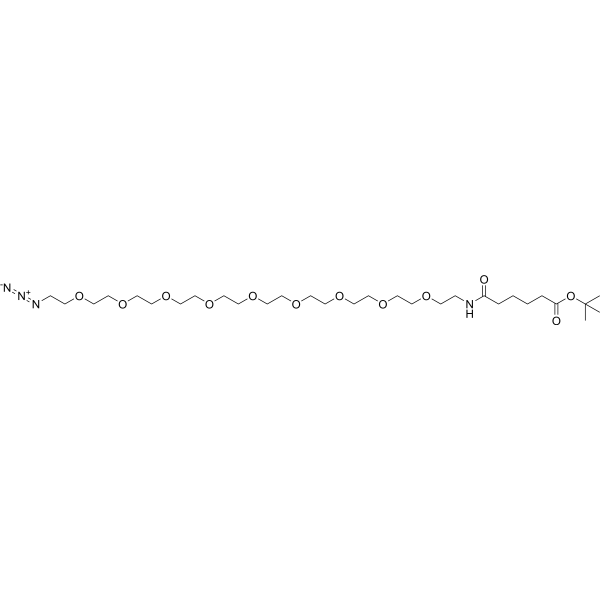 0 ImagesCat. No.: HY-140788Synonyms: 5-(Azide-PEG9-ethylcarbamoyl)pentanoic t-butyl ester
Azide-PEG9-amido-C4-Boc is a PEG-based PROTAC linker that can be used in the synthesis of PROTACs. Azide-PEG9-amido-C4-Boc is a click chemistry reagent, it contains an Azide group and can undergo copper-catalyzed azide-alkyne cycloaddition reaction (CuAAc) with molecules containing Alkyne groups. It can also undergo strain-promoted alkyne-azide cycloaddition (SPAAC) reactions with molecules containing DBCO or BCN groups.
-
mmu-miR-467e-3p inhibitor
 0 ImagesCat. No.: HY-RI03202
mmu-miR-467e-3p inhibitors are chemically-modified oligonucleotides that hybridize with mature miRNAs. The miRNA inhibitors have full-length nucleotide 2'-methoxy modification. The miRNA inhibitors strongly compete with mature miRNAs to prevent the complementary pairing of miRNAs and their target genes, thereby inhibiting miRNAs from functioning.
-
2′,3′-Dideoxy-5-fluorouridine
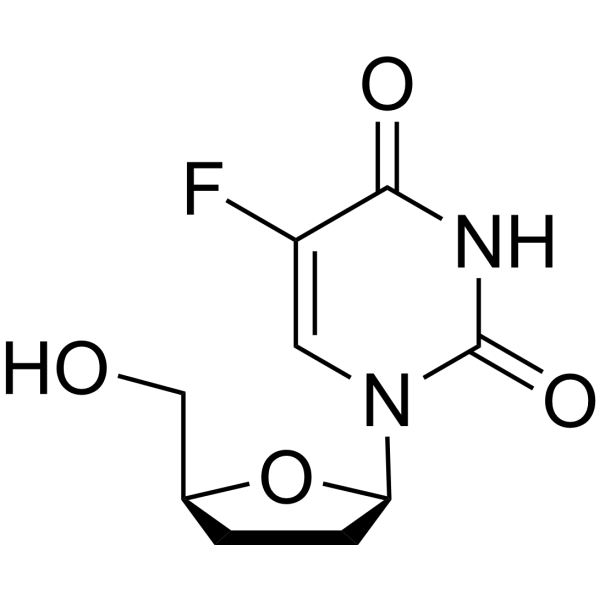 0 ImagesCat. No.: HY-154556CAS No.: 15379-30-3
2′,3′-Dideoxy-5-fluorouridine is a purine nucleoside analog. Purine nucleoside analogs have broad antitumor activity targeting indolent lymphoid malignancies. Anticancer mechanisms in this process rely on inhibition of DNA synthesis, induction of apoptosis, etc.
-
Thalidomide-O-C5-azide
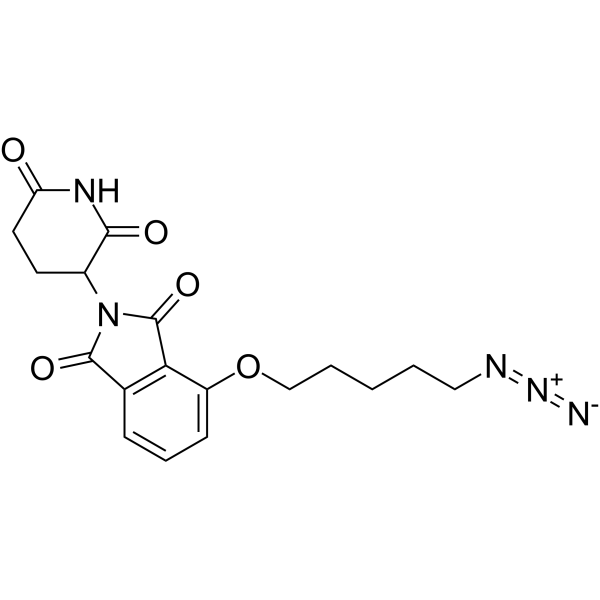 0 ImagesCat. No.: HY-157511CAS No.: 2411098-96-7
Thalidomide-O-C5-azide is a click chemistry modification of the cereblon (CRBN) inhibitor Thalidomide (HY-14658). Thalidomide-O-C5-azide contains an azide group and can undergo copper-catalyzed azide-alkyne cycloaddition reaction (CuAAc) with molecules containing alkyne groups. Thalidomide-O-C5-azide can be used as a ligand of E3 ubiquitin ligase and Linker conjugates (E3 Ligase Ligand-Linker Conjugates) for the synthesis of PROTACs.

-
F0911-7667
 0 ImagesCat. No.: HY-136479CAS No.: 361198-09-6
F0911-7667 is a SIRT1 activator that induces autophagic cell death in U87MG and T98G cells by activating the AMPK-mTOR-ULK complex. CWR tripeptide was also identified as a SIRT1 activator that reduced p53 acetylation in IMR32 neuroblastoma cells and protected cells from cell death induced by Aβ fragments.
-
mmu-miR-1904 inhibitor
 0 ImagesCat. No.: HY-RI02729
mmu-miR-1904 inhibitors are chemically-modified oligonucleotides that hybridize with mature miRNAs. The miRNA inhibitors have full-length nucleotide 2'-methoxy modification. The miRNA inhibitors strongly compete with mature miRNAs to prevent the complementary pairing of miRNAs and their target genes, thereby inhibiting miRNAs from functioning.
-
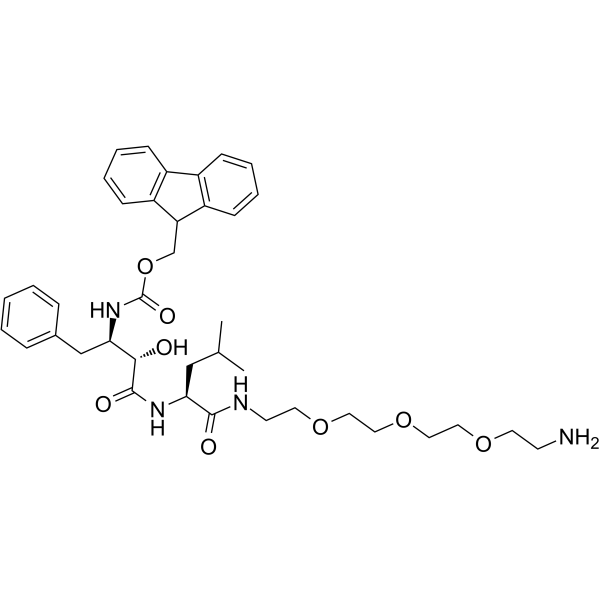
TrxR1-IN-3
 0 ImagesCat. No.: HY-184328CAS No.: 3028398-90-2
TrxR1-IN-3 is a selective TrxR1 inhibitor with an IC50 of 1.19 μM. TrxR1-IN-3 increases intracellular reactive oxygen species (ROS) levels, induces endoplasmic reticulum (ER) stress, and activates Caspase-dependent Apoptosis. TrxR1-IN-3 exhibits anticancer activity against multiple breast cancer subtypes, including triple-negative breast cancer (TNBC). TrxR1-IN-3 can be used in breast cancer-related research.
-
(R)-Bromoenol lactone-d7
 0 ImagesCat. No.: HY-117068SSynonyms: (R,E)-Bromoenol lactone-d7
(R)-Bromoenol lactone-d7 ((R,E)-Bromoenol lactone-d7) is the deuterated-labeled (R)-Bromoenol lactone (HY-117068). (R)-Bromoenol lactone ((R,E)-Bromoenol lactone) is an isomer of Bromoenol lactone (HY-107411). (R)-Bromoenol lactone acts as a selective inhibitor of microsomal calcium-independent phospholipase A2γ (iPLA2γ). (R)-Bromoenol lactone induces mild activation of p38 mitogen-activated protein kinase in prostate cancer cells, resulting in slight increases in the expressions of phosphorylated p53, total p53 and p21. (R)-Bromoenol lactone is applicable to prostate cancer-related research.
-
FR-β ligand 1
 0 ImagesCat. No.: HY-172935CAS No.: 863869-78-7
FR-β ligand 1 (III), a folate receptor-targeting ligand, possesses antitumor activity, high selectivity, and stronger affinity for folate receptor.
-
hsa-miR-548aq-5p antagomir
 0 ImagesCat. No.: HY-RI01655A
hsa-miR-548aq-5p antagomirs are chemically-modified oligonucleotides that hybridize with mature miRNAs. The miRNA antagomirs have 2 phosphorothioates at the 5' end, 4 phosphorothioates at the 3' end, 1 cholesterol group at the 3' end, and full-length nucleotide 2'-methoxy modification. The miRNA antagomirs strongly compete with mature miRNAs to prevent the complementary pairing of miRNAs and their target genes, thereby inhibiting miRNAs from functioning. Stability of miRNA antagomirs appears to be significantly higher than miRNA inhibitors, they exhibits enhanced cellular uptake, stability and regulatory activity in vivo.
-
hsa-miR-6857-3p inhibitor
 0 ImagesCat. No.: HY-RI02276
hsa-miR-6857-3p inhibitors are chemically-modified oligonucleotides that hybridize with mature miRNAs. The miRNA inhibitors have full-length nucleotide 2'-methoxy modification. The miRNA inhibitors strongly compete with mature miRNAs to prevent the complementary pairing of miRNAs and their target genes, thereby inhibiting miRNAs from functioning.
-
RA183
 0 ImagesCat. No.: HY-181523CAS No.: 2649154-64-1
RA183 is a proteasome ligand that can be used to synthesize CAP-TAC (proteasome cap-targeted chimera), such as RAPRMT5 (HY-181521).
-
mmu-miR-8096 inhibitor
 0 ImagesCat. No.: HY-RI04144
mmu-miR-8096 inhibitors are chemically-modified oligonucleotides that hybridize with mature miRNAs. The miRNA inhibitors have full-length nucleotide 2'-methoxy modification. The miRNA inhibitors strongly compete with mature miRNAs to prevent the complementary pairing of miRNAs and their target genes, thereby inhibiting miRNAs from functioning.
-
DGKζ-IN-6
 0 ImagesCat. No.: HY-169317CAS No.: 3058005-75-4



