



TBA-354

Based on 1 Customer Validation
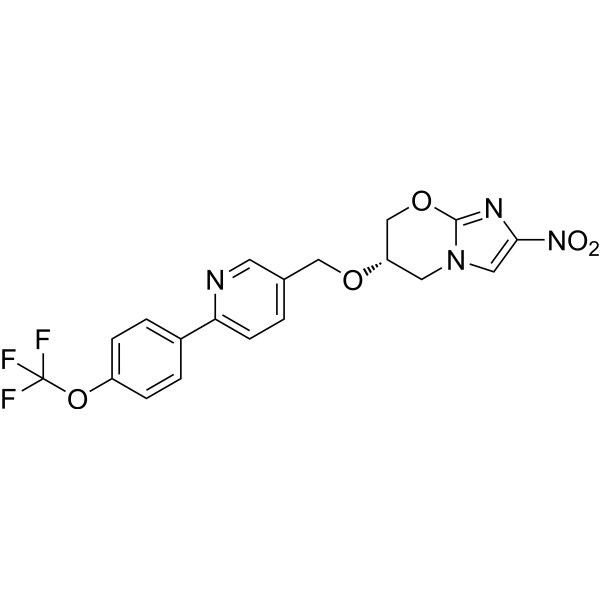
TBA-354 is an orally active, blood-brain barrier permeable anti-tuberculosis compound. TBA-354 acts on replicating, non-replicating and drug-resistant Mycobacterium tuberculosis, retains its activity in the presence of serum proteins or albumin, and induces moderate, reversible neurotoxicity at effective dose levels. TBA-354 can be used in the research of tuberculosis and multidrug-resistant tuberculosis.
For research use only. We do not sell to patients.
- Purity : 99.74%
- CAS No.: 1257426-19-9
- Formula: C19H15F3N4O5
- Molecular Weight:436.34
-
Storage:Powder -20°C, 3 years , 4°C, 2 years ; In solvent -80°C, 2 years , -20°C, 1 year

To place orders, for customer services and technical support, please contact: MedChemExpress USA
Tel: 609-228-6898 E-mail: [email protected] [email protected]


-
 Biological Activity
-
Chemical Information
-
Solvent & Solubility
- Protocols
- Purity & Documentation
- References
-
 Help & FAQs



All Antibiotic Isoforms
More

Biological Activity
Description
In Vitro
TBA-354 exhibits bactericidal activity against proliferating Mycobacterium tuberculosis H37Rv, with both its MIC and MBC at 0.006 μM, and the presence of serum proteins causes only an extremely slight change in its activity[1].
TBA-354 exhibits activity against non-replicating Mycobacterium tuberculosis H37Rv, with a LORA MIC of 0.27 μM and a LORA MBC of 3.4 μM[1].
TBA-354 remains active against isogenic H37Rv strains of Mycobacterium tuberculosis that are resistant to single agents Rifampicin (HY-B0272), Isoniazid (HY-B0329), Streptomycin (HY-B1906), and Kanamycin (HY-16566), with an MIC range of 0.003 to 0.010 μM[1].
TBA-354 (0.025 μM; 2-3 weeks) induces spontaneous drug resistance in Mycobacterium tuberculosis H37Rv, with a median frequency of 3 × 10⁻⁷[1].
TBA-354 is a narrow-spectrum agent active against Mycobacterium bovis and Mycobacterium kansasii, but inactive against most non-tuberculous mycobacteria, Gram-positive bacteria, Gram-negative bacteria, and fungi[1].
TBA-354 (1-10 μM; 40-60 min) exhibits high permeability across Caco-2 cell monolayers and is not a substrate of P-glycoprotein[1].
TBA-354 (10 μM; 8 h) exhibits moderate to high plasma protein binding rates, ranging from 92.6% (mouse) to 96.5% (human)[1].
TBA-354 (1 μM; 1 h) exhibits metabolic stability in in vitro incubation systems of human, monkey, dog, rat and mouse liver microsomes[1].
TBA-354 (1 μM; 0.5-4 h) undergoes moderate metabolism in mouse, rat, dog, monkey and human hepatocytes, with an estimated half-life of 4.6 h in human hepatocytes, and shows high stability in rabbit hepatocytes[1].
TBA-354 (1 μM; 15-60 min) is not metabolized by recombinant human CYP2C9, CYP2C19, CYP2D6, or CYP3A4[1].
TBA-354 (10 μM; 72 h) does not significantly induce human CYP1A2, CYP2B6, CYP2C9, CYP2C19, or CYP3A enzymes in cultured human hepatocytes[1].
MedChemExpress (MCE) has not independently confirmed the accuracy of these methods. They are for reference only. Further protocols information, click here.
Parmacokinetics
In Vivo
TBA-354 (10-50 mg/kg; p.o.; once daily, 5 days per week; up to 16 weeks) improves the sterilizing activity of Bedaquiline (HY-14881) plus Sutezolid (HY-10392) in a dose-dependent manner, with 50 mg/kg TBA-354 achieving a 7% relapse rate after 8 or 12 weeks of treatment[2].
TBA-354 (25-50 mg/kg; p.o.; once daily, 5 days per week; up to 8 weeks) improves the sterilizing activity of Bedaquiline plus Pyrazinamide (HY-B0271) plus Sutezolid in a dose-dependent manner, achieving 0% relapse after 6 weeks of treatment at both 25 mg/kg and 50 mg/kg, but does not improve and may reduce activity when added to Bedaquiline plus pyrazinamide plus Clofazimine (HY-B1046)[2].
TBA-354 (0.45-100 mg/kg; p.o., inhalation; once daily, 5 days/week; 28 days) reduces Mycobacterium tuberculosis burden in mouse lungs and spleens, resolves lung caseous necrosis, reduces spleen pathology, and the combined 50 mg/kg oral plus 0.45 mg/kg inhalation regimen provides non-inferior efficacy to the full 100 mg/kg oral dose[3].
MedChemExpress (MCE) has not independently confirmed the accuracy of these methods. They are for reference only.
-
Animal Model:BALB/c (female, ~20 g, low-dose aerosol infection with Mycobacterium tuberculosis Erdman)[1]
-
Dosage:3 mg/kg; 10 mg/kg; 30 mg/kg; 100 mg/kg
-
Administration:p.o.; once daily for 5 consecutive days per week; 2, 3, 4, or 8 weeks
-
Result:Reduced lung CFU by approximately 1 log10 relative to pretreatment levels in acute infection model at 100 mg/kg.
Reduced lung CFU by 2 to 3 log10 relative to pretreatment levels in chronic infection model at 100 mg/kg.
Resulted in significant CFU reduction after 2, 4, and 8 weeks of treatment at 10 mg/kg in chronic infection.
Resulted in greater CFU reduction than 30 mg/kg delamanid after 8 weeks of treatment at 30 mg/kg in chronic infection.
Resulted in significant CFU reduction after 4 weeks of treatment, with efficacy comparable to 100 mg/kg delamanid at 3 mg/kg in chronic infection.
-
Animal Model:BALB/c (5-to-6-week-old female, high-dose aerosol infection with Mycobacterium tuberculosis H37Rv)[2]
-
Dosage:3 mg/kg; 10 mg/kg; 30 mg/kg; 100 mg/kg
-
Administration:p.o.; once daily, 5 days per week; up to 8 weeks
-
Result:Achieved a mean lung log10 CFU count of 3.83 at 100 mg/kg after 8 weeks.
Selected drug-resistant mutants at all tested doses, with 2-20% of CFU resistant to 0.25 μg/mL TBA-354 in the 10 mg/kg group, 1-10% resistant in the 30 mg/kg group, and 34-100% resistant in the 100 mg/kg group.
-
Animal Model:BALB/c (5-to-6-week-old female, high-dose aerosol infection with Mycobacterium tuberculosis H37Rv)[2]
-
Dosage:10 mg/kg (in combination with Bedaquiline plus Pyrazinamide or Bedaquiline plus Sutezolid); 50 mg/kg (in combination with Bedaquiline plus Pyrazinamide or Bedaquiline plus Sutezolid)
-
Administration:p.o.; once daily, 5 days per week; up to 16 weeks
-
Result:When added to Bedaquiline plus Pyrazinamide: Resulted in higher lung CFU counts at 4 weeks at 10 mg/kg compared to Bedaquiline plus Pyrazinamide alone, while 50 mg/kg showed no antagonistic effect.
Had a 40% relapse rate at 10 mg/kg after 8 weeks of treatment, compared to 0% relapse for 50 mg/kg and Bedaquiline plus Pyrazinamide alone.
When added to Bedaquiline plus Sutezolid: Reduced lung CFU counts at 4 and 8 weeks at both 10 mg/kg and 50 mg/kg compared to Bedaquiline plus Sutezolid alone.
Had an 87% relapse rate at 10 mg/kg and 7% relapse rate at 50 mg/kg after 8 weeks of treatment.
Had a 38% relapse rate at 10 mg/kg and 7% relapse rate at 50 mg/kg after 12 weeks of treatment.
-
Animal Model:BALB/c (5-to-6-week-old female, high-dose aerosol infection with Mycobacterium tuberculosis H37Rv)[2]
-
Dosage:25 mg/kg (in combination with Bedaquiline plus pPyrazinamide plus Clofazimine or Bedaquiline plus Pyrazinamide plus Sutezolid); 50 mg/kg (in combination with Bedaquiline plus Pyrazinamide plus Clofazimine or Bedaquiline plus Pyrazinamide plus Sutezolid)
-
Administration:p.o.; once daily, 5 days per week; up to 8 weeks
-
Result:When added to Bedaquiline plus Pyrazinamide plus Sutezolid: Reduced relapse to 47% at 25 mg/kg and 40% at 50 mg/kg after 4 weeks of treatment, compared to 100% relapse for the combination alone.
Resulted in 0% relapse at both 25 mg/kg and 50 mg/kg after 6 weeks of treatment, compared to 93% relapse for the combination alone.
When added to Bedaquiline plus Pyrazinamide plus Clofazimine: Did not reduce relapse rates at both 25 mg/kg and 50 mg/kg after 4 weeks of treatment.
Resulted in a 60% relapse rate at 25 mg/kg after 6 weeks of treatment, compared to 33% relapse for the combination alone.
-
Animal Model:Swiss albino (male, 25-30 g, infected by low-dose aerosol inhalation of Mycobacterium tuberculosis H37Rv)[3]
-
Dosage:100 mg/kg (oral); 0.45 mg/kg (inhalation); 50 mg/kg (oral) + 0.45 mg/kg (inhalation)
-
Administration:p.o.; inhalation; once daily, 5 days/week; 28 days
-
Result:Reduced lung bacterial burden by at least two orders of magnitude and completely cleared cultivable bacteria from the lungs of 2 out of 4 mice; spleen bacterial burden was also reduced.
Reduced lung bacterial burden by two orders of magnitude and cleared cultivable bacteria from the lungs of 1 out of 4 mice; spleen bacterial burden was reduced.
Reduced lung and spleen bacterial burden to levels similar to the full 100 mg/kg/day oral dose, yielding non-inferior efficacy.
Eliminated caseous necrosis in lung tissue.
Induced moderate improvement in lung fibrinous degeneration and mononuclear cell infiltration (score ++).
Induced slight improvement in lung fibrinous degeneration and mononuclear cell infiltration (score 2).
Resolved the decrease in white pulp, chronic inflammation, and vacuolar degeneration seen in untreated infected mice.
Showed a moderate decrease in white pulp, resolved chronic inflammation and vacuolar degeneration, and resulted in presence of giant cells in spleen tissue.
Reduced the percent area of visible lung lesions compared to untreated infected mice.
Clinical Trial
| NCT Number | Sponsor | Condition | Start Date |
Phase

|
|---|---|---|---|---|
| NCT01329991 | Plexxikon| | 2011-05 | PHASE1 |


Chemical Information
-
CAS No. 1257426-19-9
-
Appearance Solid
-
Molecular Weight 436.34
-
Formula C19H15F3N4O5
-
Color White to off-white
-
SMILES
FC(F)(F)OC1=CC=C(C2=CC=C(CO[C@H]3CN4C(OC3)=NC([N+]([O-])=O)=C4)C=N2)C=C1
-
Shipping
Room temperature in continental US; may vary elsewhere.
-
Storage
Powder -20°C 3 years 4°C 2 years In solvent -80°C 2 years -20°C 1 year


Solvent & Solubility
In Vitro:
DMSO : 100 mg/mL (229.18 mM; Need ultrasonic; Hygroscopic DMSO has a significant impact on the solubility of product, please use newly opened DMSO)
Please refer to the solubility information to select the appropriate solvent. Once prepared, please aliquot and store the solution to prevent product inactivation from repeated freeze-thaw cycles.
Storage method and period of stock solution: -80°C, 2 years; -20°C, 1 year. When stored at -80°C, please use it within 2 years. When stored at -20°C, please use it within 1 year.
Please refer to the solubility information to select the appropriate solvent. Once prepared, please aliquot and store the solution to prevent product inactivation from repeated freeze-thaw cycles.
Storage method and period of stock solution: -80°C, 2 years; -20°C, 1 year. When stored at -80°C, please use it within 2 years. When stored at -20°C, please use it within 1 year.
Concentration (start) × Volume (start) = Concentration (final) × Volume (final)
In Vivo:
Select the appropriate dissolution method based on your experimental animal and administration route.
- For the following dissolution methods, please ensure to first prepare a clear stock solution using an In Vitro approach and then sequentially add co-solvents:
- To ensure reliable experimental results, the clarified stock solution can be appropriately stored based on storage conditions. As for the working solution for In Vivo experiments, it is recommended to prepare freshly and use it on the same day.
- The percentages shown for the solvents indicate their volumetric ratio in the final prepared solution. If precipitation or phase separation occurs during preparation, heat and/or sonication can be used to aid dissolution.
Add each solvent one by one: 10% DMSO 40% PEG300 5% Tween-80 45% Saline
Solubility: 2.5 mg/mL (5.73 mM); Suspended solution; Need ultrasonic
This protocol yields a suspended solution of 2.5 mg/mL. Suspended solution can be used for oral and intraperitoneal injection.
Taking 1 mL working solution as an example, add 100 μL DMSO stock solution (25.0 mg/mL) to 400 μL PEG300, and mix evenly; then add 50 μL Tween-80 and mix evenly; then add 450 μL Saline to adjust the volume to 1 mL.
Preparation of Saline: Dissolve 0.9 g sodium chloride in ddH₂O and dilute to 100 mL to obtain a clear Saline solution.
Add each solvent one by one: 10% DMSO 90% (20% SBE-β-CD in Saline)
Solubility: 2.5 mg/mL (5.73 mM); Suspended solution; Need ultrasonic
This protocol yields a suspended solution of 2.5 mg/mL. Suspended solution can be used for oral and intraperitoneal injection.
Taking 1 mL working solution as an example, add 100 μL DMSO stock solution (25.0 mg/mL) to 900 μL 20% SBE-β-CD in Saline, and mix evenly.
Preparation of 20% SBE-β-CD in Saline (4°C, storage for one week): 2 g SBE-β-CD powder is dissolved in 10 mL Saline, completely dissolve until clear.
In Vivo Dissolution Calculator
Please enter the basic information of animal experiments:
-
-
-
-
Recommended: Prepare an additional quantity of animals to account for potential losses during experiments.
Please enter your animal formula composition:
-
%DMSO +
Recommended: Keep the proportion of DMSO in working solution below 2% if your animal is weak.
-
%+
-
+%Tween-80 + +
-
%Saline +
The co-solvents required include: DMSO, . All of co-solvents are available by MedChemExpress (MCE). , Tween 80. All of co-solvents are available by MedChemExpress (MCE).
Working solution concentration: 0.22 mg/mL
Method for preparing stock solution: mg drug dissolved in μL DMSO. Stock solution concentration: mg/mL.
1. Take μL DMSO stock solution;
2. Add μL .
μL , mix evenly;
3. Then add μL Tween 80, mix evenly;
4. Then add μL
Please ensure that the stock solution in the first step is dissolved to a clear state, and add co-solvents in sequence. You can use ultrasonic heating (ultrasonic cleaner, recommended frequency 20-40 kHz), vortexing, etc. to assist dissolution.

Protocols
-
Neurotoxicity Study
This protocol assesses in vitro neurotoxicity by combining neuronal viability, mitochondrial/metabolic activity, neurite outgrowth, and optional neuronal network function readouts. Calcein-AM or resazurin/PrestoBlue readouts estimate viable or metabolically active cells; βIII-tubulin immunofluorescence detects neuronal morphology and neurite networks; TMRE detects mitochondrial membrane potential; and MEA recordings detect functional changes in neuronal network activity.


Purity & Documentation
-
Data Sheet (288 KB)
-
SDS (251 KB)
- English - EN (251 KB)
- Français - FR (251 KB)
- Deutsch - DE (251 KB)
- Norwegian - NO (251 KB)
- Español - ES (251 KB)
- Swedish - SV (251 KB)
- Italian - IT (251 KB)
- Korean - KR (251 KB)
- Portuguese - PT (251 KB)
-
Handling Instructions (2659 KB)
References
[1]. Upton AM, et al. In vitro and in vivo activities of the nitroimidazole TBA-354 against Mycobacterium tuberculosis. Antimicrobial agents and chemotherapy. 2015 Jan;59(1):136-44. [Content Brief]
[2]. Tasneen R, et al. Contribution of the nitroimidazoles PA-824 and TBA-354 to the activity of novel regimens in murine models of tuberculosis. Antimicrobial agents and chemotherapy. 2015 Jan;59(1):129-35. [Content Brief]


Complete Stock Solution Preparation Table
Please refer to the solubility information to select the appropriate solvent. Once prepared, please aliquot and store the solution to prevent product inactivation from repeated freeze-thaw cycles.
Storage method and period of stock solution: -80°C, 2 years; -20°C, 1 year. When stored at -80°C, please use it within 2 years. When stored at -20°C, please use it within 1 year.
| Optional Solvent | Concentration Solvent Mass | 1 mg | 5 mg | 10 mg | 25 mg |
|---|---|---|---|---|---|
| DMSO | 1 mM | 2.2918 mL | 11.4590 mL | 22.9179 mL | 57.2948 mL |
| 5 mM | 0.4584 mL | 2.2918 mL | 4.5836 mL | 11.4590 mL | |
| 10 mM | 0.2292 mL | 1.1459 mL | 2.2918 mL | 5.7295 mL | |
| 15 mM | 0.1528 mL | 0.7639 mL | 1.5279 mL | 3.8197 mL | |
| 20 mM | 0.1146 mL | 0.5729 mL | 1.1459 mL | 2.8647 mL | |
| 25 mM | 0.0917 mL | 0.4584 mL | 0.9167 mL | 2.2918 mL | |
| 30 mM | 0.0764 mL | 0.3820 mL | 0.7639 mL | 1.9098 mL | |
| 40 mM | 0.0573 mL | 0.2865 mL | 0.5729 mL | 1.4324 mL | |
| 50 mM | 0.0458 mL | 0.2292 mL | 0.4584 mL | 1.1459 mL | |
| 60 mM | 0.0382 mL | 0.1910 mL | 0.3820 mL | 0.9549 mL | |
| 80 mM | 0.0286 mL | 0.1432 mL | 0.2865 mL | 0.7162 mL | |
| 100 mM | 0.0229 mL | 0.1146 mL | 0.2292 mL | 0.5729 mL |


TBA-354 Related Classifications
HY-12485 Related Classifications
 Powered by Bioz