



Apoptosis
Apoptosis
Apoptosis is a distinctive form of cell death exhibiting specific morphological and biochemical characteristics, including cell membrane blebbing, chromatin condensation, genomic DNA fragmentation, and exposure of specific phagocytosis signaling molecules on the cell surface. Cells undergoing apoptosis differ from those dying through necrosis. Necrotic cells are usually recognized by the immune system as a danger signal and, thus, resulting in inflammation; in contrast, apoptotic death is quiet and orderly.
There are two major pathways of apoptotic cell death induction: The intrinsic pathway, also called the Bcl-2-regulated or mitochondrial pathway, is activated by various developmental cues or cytotoxic insults, such as viral infection, DNA damage and growth-factor deprivation, and is strictly controlled by the BCL-2 family of proteins. The extrinsic or death-receptor pathway is triggered by ligation of death receptors (members of the tumor necrosis factor (TNF) receptor family, such as Fas or TNF receptor-1 (TNFR1)) that contain an intracellular death domain, which can recruit and activate caspase-8 through the adaptor protein Fas-associated death domain (FADD; also known as MORT1) at the cell surface. This recruitment causes subsequent activation of downstream (effector) caspases, such as caspase-3, -6 or -7, without any involvement of the BCL-2 family.
Studies suggest that alterations in cell survival contribute to the pathogenesis of a number of human diseases, including cancer, viral infections, autoimmune diseases, neurodegenerative disorders, and AIDS (acquired immunodeficiency syndrome). Treatments designed to specifically alter the apoptotic threshold may have the potential to change the natural progression of some of these diseases.
All Product Categories
-
Apoptosis Inhibitors
(905)
View all products
-
Apoptosis Agonists
(7)
View all products
-
Apoptosis Antagonists
(9)
View all products
-
Apoptosis Activators
(363)
View all products
-
Apoptosis Modulators
(60)
View all products
-
Apoptosis Inducers
(7928)
View all products
-
Apoptosis Degrader
(1)
View all products
-
Apoptosis Controls
(33)
View all products
-
Apoptosis Related Products (9874)
Related Products (9874)

-
Antibodies (120)

-
BMX-001
 0 ImagesCat. No.: HY-125662ACAS No.: 1379783-91-1BMX-001, a novel redox-active metalloporphyrin, improves islet function and engraftment in a murine transplant model. BMX-001 reduces apoptosis in human and murine islets. BMX-001 significantly improves static-glucose stimulated insulin secretion (sGSIS) responses in murine islets. BMX-001 can significantly restore euglycemia in murine islet studies in the presence of the MnSOD. BMX-001 reduces the generation of ROS in a murine islet isolation and culture model.
-
Wheat Germ Agglutinin (Biotinylated)
 0 ImagesCat. No.: HY-NP0192Synonyms: WGA (Biotinylated)Wheat Germ Agglutinin (WGA) (Biotinylated), a type of plant lectin that binds to biotin, is a hevein class N-acetylglucosamine-binding protein found in wheat. Wheat germ agglutinin induces apoptosis in leukemic Jurkat cells via loss of transmembrane potential, mitochondrial membrane disruption, cytochrome c release, and caspase-9 activation. Wheat Germ Agglutinin undergoes surface functionalization with nanoparticles, liposomes, and other carriers for biomedical applications. Wheat Germ Agglutinin can be used as a nanoparticle stabilizer, antifungal agent, and cytotoxic agent.
-
4,5-Dicaffeoylquinic acid (Standard)
 0 ImagesSynonyms: Isochlorogenic acid C (Standard); 4,5-diCQA (Standard)4,5-Dicaffeoylquinic acid (Standard) is the analytical standard of 4,5-Dicaffeoylquinic acid. This product is intended for research and analytical applications. 4,5-Dicaffeoylquinic acid (Isochlorogenic acid C) is an antioxidant, can be isolated from Gynura divaricata and Laggera alata. 4,5-Dicaffeoylquinic acid reduces islet cell apoptosis and improves pancreatic function in type 2 diabetic mice, and has obvious inhibitory activities against yeast α-glucosidase. 4,5-Dicaffeoylquinic acid inhibits prostate cancer cells through cell cycle arrest. 4,5-Dicaffeoylquinic acid also has anti-apoptotic, anti-injury and anti-hepatitis B virus effects.
-
Sodium 4-phenylbutyrate (Standard)
 0 ImagesSynonyms: 4-PBA sodium (Standard); 4-Phenylbutyric acid sodium (Standard); Benzenebutyric acid sodium (Standard)
-
Nitroxoline (Standard)
 0 ImagesSynonyms: 8-Hydroxy-5-nitroquinoline (Standard); 5-Nitro-8-quinolinol (Standard)Nitroxoline (Standard) is the analytical standard of Nitroxoline. This product is intended for research and analytical applications. Nitroxoline (8-Hydroxy-5-nitroquinoline), an antibiotic, is an orally active antibiofilm agent. Nitroxoline reduces the formation and induces the dispersal of Pseudomonas aeruginosa biofilms by chelation of iron and zinc. Nitroxoline can be used for the urinary tract infections and cancer research.
-
Propyl gallate (Standard)
 0 ImagesPropyl gallate (Standard) is the analytical standard of Propyl gallate. This product is intended for research and analytical applications. Propyl gallate is a common food antioxidant. Propyl gallate can inhibit the production of acrolein, glyoxal and methylglyoxal. Propyl gallate exhibits anti-inflammatory, antitumor and cardioprotective activities.
-
5'-Deoxy-5'-(methylthio)adenosine-d3
 0 ImagesCat. No.: HY-W654139CAS No.: 2699607-01-55'-Deoxy-5'-(methylthio)adenosine-d3 is deuterium labeled 5'-Methylthioadenosine. 5'-Methylthioadenosine (5'-(Methylthio)-5'-deoxyadenosine) is a nucleoside generated from S-adenosylmethionine (SAM) during polyamine synthesis. 5'-Methylthioadenosine suppresses tumors by inhibiting tumor cell proliferation, invasion, and the induction of apoptosis while controlling the inflammatory micro-environments of tumor tissue. 5'-Methylthioadenosine and its associated materials have striking regulatory effects on tumorigenesis.
-
5-Aminolevulinic acid-13C hydrochloride
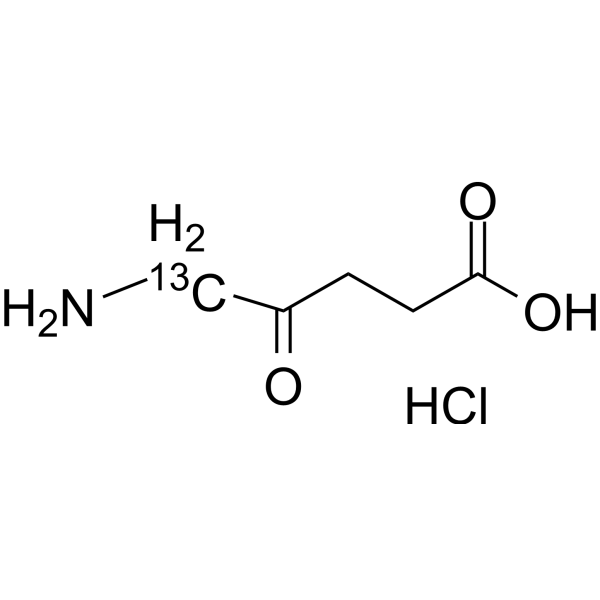 0 ImagesCat. No.: HY-N0305S2Purity: 98%Synonyms: 5-ALA-13C hydrochloride; δ-Aminolevulinic acid-13C hydrochloride; 5-Amino-4-oxopentanoic acid-13C hydrochloride5-Aminolevulinic acid-13C (hydrochloride) is the 13C labeled 5-Aminolevulinic acid hydrochloride. 5-Aminolevulinic acid hydrochloride (5-ALA hydrochloride) is an intermediate in heme biosynthesis in the body and the universal precursor of tetrapyrroles.
-
Midostaurin (Standard)
 0 ImagesSynonyms: PKC412 (Standard); CGP 41251 (Standard)Midostaurin (Standard) is the analytical standard of Midostaurin. This product is intended for research and analytical applications. Midostaurin (PKC412; CGP 41251) is an orally active, reversible multi-targeted protein kinase inhibitor. Midostaurin inhibits PKCα/β/γ, Syk, Flk-1, Akt, PKA, c-Kit, c-Fgr, c-Src, FLT3, PDFRβ and VEGFR1/2 with IC50s ranging from 22-500 nM. Midostaurin also upregulates endothelial nitric oxide synthase (eNOS) gene expression. Midostaurin shows powerful anticancer effects.
-
Nafamostat formate salt-13C6
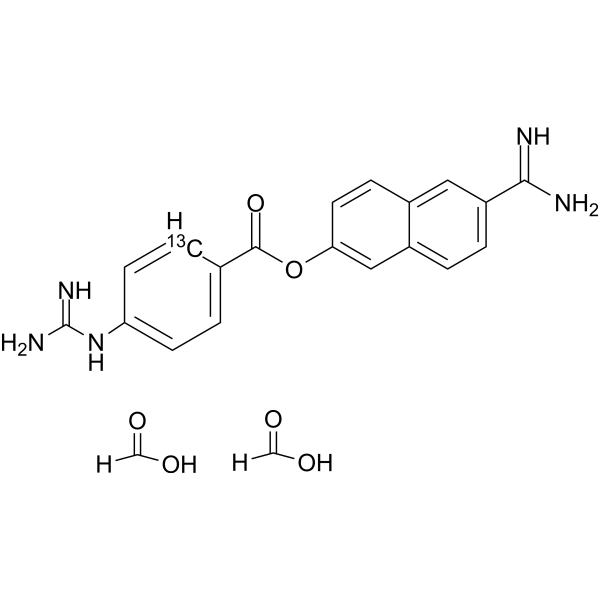 0 ImagesCat. No.: HY-B0190S1Purity: 98.11%Nafamostat formate salt-13C6 is the 13C labeled Nafamostat. Nafamostat, a synthetic serine protease inhibitor, is an anticoagulant. Nafamostat supresses T cell auto-reactivity by decreasing granzyme activity and CTL cytolysis. Nafamostat blocks activation of SARS-CoV-2.
-
Piceatannol (Standard)
 0 ImagesSynonyms: Astringenin (Standard); trans-Piceatannol (Standard)Piceatannol (Standard) is the analytical standard of Piceatannol. This product is intended for research and analytical applications. Piceatannol is a well-known Syk inhibitor and reduces the expression of iNOS induced by TNF. Piceatannol is an effective agent for research of acute lung injury (ALI). Piceatannol is a naturally occurring polyphenolic stilbene found in various fruits and vegetables and exhibits anticancer and anti-inflammatory properties. Piceatannol induces apoptosis in DLBCL cell lines. Piceatannol induces autophagy and apoptosis in MOLT-4 human leukemia cells.
-
(-)-Isoledene
 0 ImagesCat. No.: HY-N10608CAS No.: 95910-36-4(-)-Isoledene is a natural organic compound with antibacterial and anti-inflammatory activities. (-)-Isoledene has also been studied for the synthesis of a variety of compound intermediates, demonstrating its potential application in compound development.

-
Dasatinib-d4
 0 ImagesCat. No.: HY-10181S1CAS No.: 1160297-08-4Synonyms: BMS-354825-d4Dasatinib-d4 (BMS-354825-d4) is deuterium labeled Dasatinib. Dasatinib (BMS-354825) is a highly potent, ATP competitive, orally active dual Src/Bcr-Abl inhibitor with potent antitumor activity. The Kis are 16 pM and 30 pM for Src and Bcr-Abl, respectively. Dasatinib inhibits Bcr-Abl and Src with IC50s of <1.0 nM and 0.5 nM, respectively. Dasatinib also induces apoptosis and autophagy.
-
Cucurbitacin C
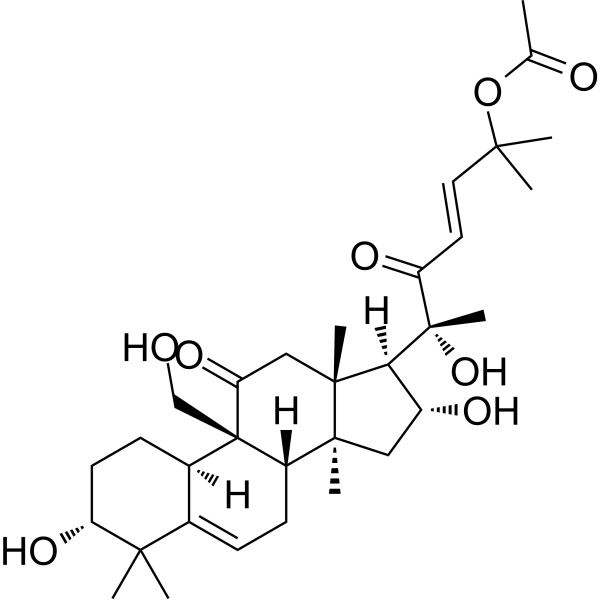 0 ImagesCucurbitacin C is a tetracyclic triterpenoid compound. Cucurbitacin C exhibits significant in vivo and in vitro anticancer activity, which inhibits the PI3K/AKT signaling pathway to induce cell cycle arrest and apoptosis in cancer cells, and significantly suppresses the growth of HepG2 and PC-3 xenograft tumors in mice. Cucurbitacin C can be used in studies on plant defense mechanisms, secondary metabolism and cancer therapy.
-
Erdafitinib (Standard)
 0 ImagesSynonyms: JNJ-42756493 (Standard)Erdafitinib (Standard) is the analytical standard of Erdafitinib. This product is intended for research and analytical applications. Erdafitinib (JNJ-42756493) is a potent and orally available FGFR family inhibitor; inhibits FGFR1/2/3/4 with IC50s of 1.2, 2.5, 3.0 and 5.7 nM, respectively.
-
Flurbiprofen (Standard)
 0 ImagesFlurbiprofen (Standard) is the analytical standard of Flurbiprofen. This product is intended for research and analytical applications. Flurbiprofen (dl-Flurbiprofen) is a potent, orally active nonsteroidal anti-inflammatory agent (NSAIA/NSAID), with antipyretic and analgesic activities. Flurbiprofen is commonly used for the research of inflammatory diseases, including osteoarthritis and rheumatoid arthritis. Flurbiprofen is a non-selective cyclooxygenase (COX) inhibitor that can be used for the research of colorectal cancer.
-
Bisphenol F-13C6
 0 ImagesCat. No.: HY-W014901SCAS No.: 1410794-06-7Synonyms: BPF-13C6; 4,4'-Dihydroxydiphenylmethane-13C6Bisphenol F-13C6 is the 13C labeled Bisphenol F (HY-W014901). Bisphenol F is an orally active endocrine disruptor. Bisphenol F promotes ROS generation, upregulates p-AKT/p-GSK3β, and induces Apoptosis. Bisphenol F interferes with glucose metabolism, affects neurodevelopment and reproductive function. Bisphenol F reduces social novelty preference in mouse offspring. Bisphenol F can be used in bone, blood, and fat-related studies. Bisphenol F is used as a substitute for Bisphenol A (HY-18260).




