



CDK
Cyclin dependent kinase
CDKs (Cyclin-dependent kinases) are serine-threonine kinases first discovered for their role in regulating the cell cycle. They are also involved in regulating transcription, mRNA processing, and the differentiation of nerve cells. CDKs are relatively small proteins, with molecular weights ranging from 34 to 40 kDa, and contain little more than the kinase domain. In fact, yeast cells can proliferate normally when their CDK gene has been replaced with the homologous human gene. By definition, a CDK binds a regulatory protein called a cyclin. Without cyclin, CDK has little kinase activity; only the cyclin-CDK complex is an active kinase.
There are around 20 Cyclin-dependent kinases (CDK1-20) known till date. CDK1, 4 and 5 are involved in cell cycle, and CDK 7, 8, 9 and 11 are associated with transcription.
CDK levels remain relatively constant throughout the cell cycle and most regulation is post-translational. Most knowledge of CDK structure and function is based on CDKs of S. pombe (Cdc2), S. cerevisia (CDC28), and vertebrates (CDC2 and CDK2). The four major mechanisms of CDK regulation are cyclin binding, CAK phosphorylation, regulatory inhibitory phosphorylation, and binding of CDK inhibitory subunits (CKIs).
CDK Isoform Specific Products
-
CDK
(488)
View all products
-
CDK1
(187)
View all products
-
CDK2
(303)
View all products
-
CDK3
(28)
View all products
-
CDK4
(223)
View all products
-
CDK5
(96)
View all products
-
CDK6
(168)
View all products
-
CDK7
(115)
View all products
-
CDK8
(56)
View all products
-
CDK9
(200)
View all products
-
CDK11
(8)
View all products
-
CDK12
(50)
View all products
-
CDK13
(25)
View all products
-
CDK14
(6)
View all products
-
CDK16
(8)
View all products
-
CDK19
(25)
View all products
-
CDC
(21)
View all products
-
CLK
(31)
View all products
-
Pho85
(1)
View all products
-
CDK10
(1)
View all products
-
CDK15
(1)
View all products
-
CDK17
(2)
View all products
-
CDK18
(1)
View all products
-
CDK20
(1)
View all products
-
PITSLRE
(1)
View all products
All Product Categories
-
CDK Inhibitors
(1062)
View all products
-
CDK Agonists
(3)
View all products
-
CDK Antagonists
(2)
View all products
-
CDK Activators
(15)
View all products
-
CDK Modulators
(14)
View all products
-
CDK Degraders
(83)
View all products
-
CDK Controls
(4)
View all products
-
CDK Substrate
(1)
View all products
-
CDK Ligands
(15)
View all products
-
Cyclin-Dependent Kinases (CDKs) Proteins
(81)
View all products
-
Cyclin Dependent Kinase 1 (CDK1) Proteins
(9)
View all products
-
Cyclin-Dependent Kinase 2 (CDK2) Proteins
(12)
View all products
-
Cyclin-Dependent Kinase 3 (CDK3) Proteins
(6)
View all products
-
Cyclin-Dependent Kinase 4 (CDK4) Proteins
(5)
View all products
-
Cyclin-Dependent Kinase 5 (CDK5) Proteins
(5)
View all products
-
Cyclin-Dependent Kinase 6 (CDK6) Proteins
(6)
View all products
-
Cyclin-Dependent Kinase 7 (CDK7) Proteins
(4)
View all products
-
CDK Related Products (1319)
Related Products (1319)

-
Recombinant Proteins (83)
-
Antibodies (42)
-
CDK Isoform Comparison
-
Sinigrin hydrate
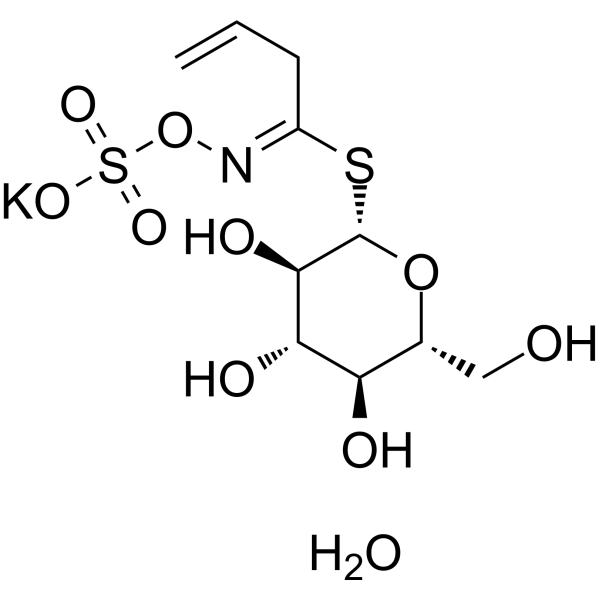 0 ImagesSynonyms: Allyl-glucosinolate hydrate; 2-Propenyl-glucosinolate hydrateSinigrin (Allyl-glucosinolate) hydrate is an orally active glucosinolate found in cruciferous plants. Sinigrin hydrate possesses multiple activities such as anti-cancer, antibacterial, antifungal, anti-inflammatory, antioxidant, and inhibition of fat synthesis. Sinigrin hydrate can be used in the research of tumors, inflammatory, and metabolic diseases.
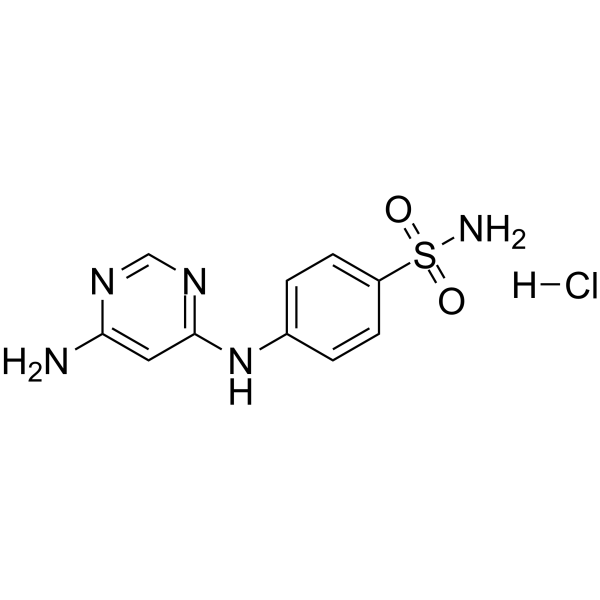
-
cis-Trismethoxy resveratrol
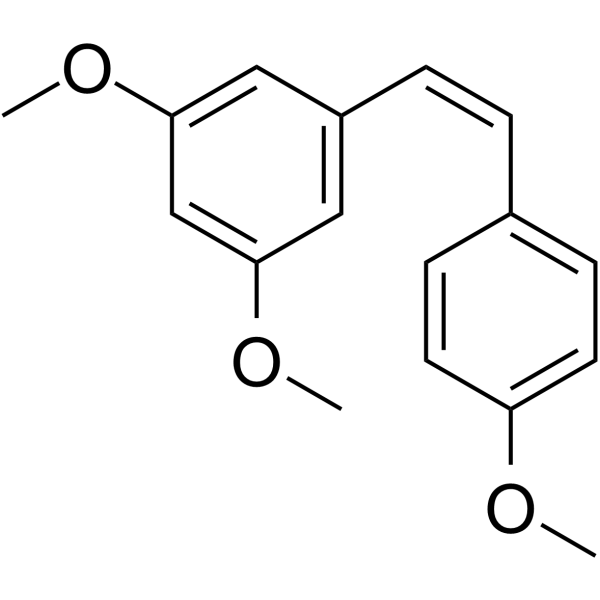 0 ImagesSynonyms: (Z)-3,5,4'-Trimethoxystilbenecis-Trismethoxy resveratrol ((Z)-3,5,4'-Trimethoxystilbene) is an anti-HCV agent and Tubulin inhibitor, with an IC50 of 4 μM against Tubulin. cis-Trismethoxy resveratrol induces G2/M phase cell cycle arrest, reduces DCLK1, decreases CDK1 levels, blocks phosphorylation of Akt Ser473, and induces the expression of p21Cip1/Waf1. cis-Trismethoxy resveratrol exhibits anti-tumor and hepatoprotective activities. cis-Trismethoxy resveratrol can be used in studies related to colon adenocarcinoma, hepatocellular carcinoma, hepatitis C, and liver injury.
-
Manzamine A
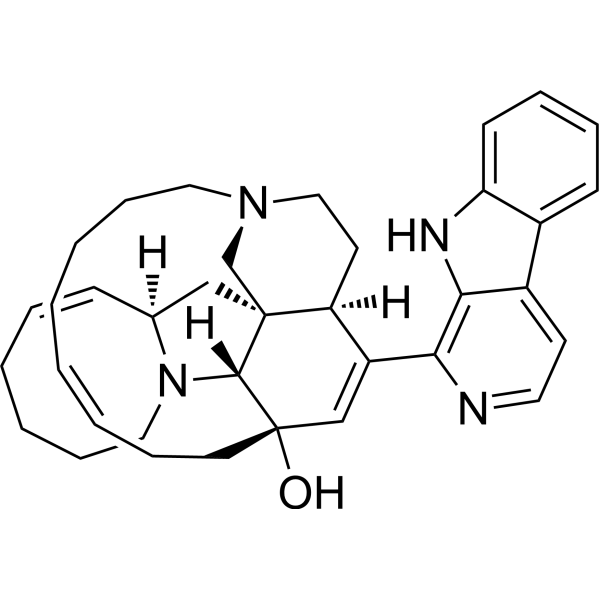 0 ImagesSynonyms: Keramamine AManzamine A, an orally active beta-carboline alkaloid, inhibits specifically GSK-3β and CDK-5 with IC50s of 10.2 μM and 1.5 μM, respectively. Manzamine A targets vacuolar ATPases and inhibits autophagy in pancreatic cancer cells. Manzamine A has antimalarial and anticancer activities. Manzamine A also shows potent activity against HSV-1.

-
Amantadine (Standard)
 0 ImagesSynonyms: 1-Adamantanamine (Standard); 1-Aminoadamantane (Standard)Amantadine (Standard) is the analytical standard of Amantadine. This product is intended for research and analytical applications. Amantadine (1-Adamantanamine) is an orally avtive and potent antiviral agent with activity against influenza A viruses. Amantadine inhibits several ion channels such as NMDA and M2, and also inhibits Coronavirus ion channels. Amantadine also has anti-orthopoxvirus and anticancer activity. Amantadine can be used for Parkinson's disease, postoperative cognitive dysfunction (POCD) and COVID-19 research[4].
-
(E/Z)-TG003
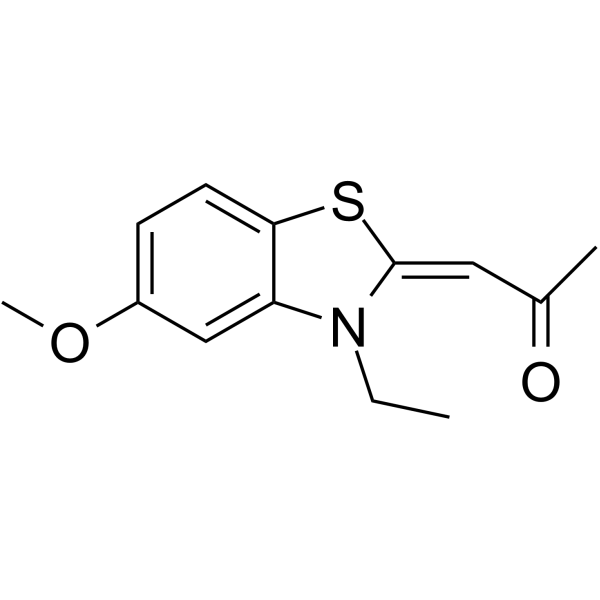 0 Images(E/Z)-TG003 is a racemic compound of (Z)-TG003 and (E)-TG003. (Z)-TG003 is a potent inhibitor of Clk1/Sty; inhibits Clk1 and Clk4 with IC50 values of 20 and 15 nM, respectively.
-
XIE18-6
 0 ImagesXIE18-6 is a potent INK4C (p18) inhibitor. XIE18-6 shows potent bioactivity in hematopoietic stem cells (HSCs) expansion with an ED50 of 105.5 nM.
-
AO-365/43472821
 0 ImagesAO-365/43472821 is a selective, brain-penetrant Dual-specificity tyrosine phosphorylation-regulated kinase 1A (DYRK1A) inhibitor (IC50 = 0.29 μM) and shows a significant inhibitory effect on (CDC-like kinase 1) CLK1 (IC50 = 0.08 μM). AO-365/43472821 could protect the human neuroblastoma cell line SH-SY5Y from Okadaic acid (HY-N6785) (OA)-induced injury. AO-365/43472821 decreased tau (pSer396)/tau and Aβ1-42 protein expression. AO-365/43472821 can be used for the study of Alzheimer's disease.
-
Abemaciclib methanesulfonate (Standard)
 0 ImagesSynonyms: LY2835219 methanesulfonate (Standard)Abemaciclib (methanesulfonate) (Standard) is the analytical standard of Abemaciclib (methanesulfonate). This product is intended for research and analytical applications. Abemaciclib methanesulfonate (LY2835219 methanesulfonate) is a selective CDK4/6 inhibitor with IC50s of 2 nM and 10 nM for CDK4 and CDK6, respectively.
-
CDK7-IN-28
 0 ImagesCat. No.: HY-158170CAS No.: 3034082-58-8CDK7-IN-28 (CDK7-1276) is a potent CDK7 inhibitor(IC50<5 nM). CDK7-IN-28 can inhibit proliferation of MDA-MB-468 cell line by blocking cell cycle and inhibiting DNA replication.
-
CTX-439
 0 ImagesCat. No.: HY-182312CAS No.: 2377487-13-1CTX-439 is an orally active, ATP-competitive small-molecule inhibitor of CDK12 and CDK13, with an IC50 of 3.1 nM and a Kd of 0.38 nM against CDK12, and an IC50 of 9.2 nM against CDK13. CTX-439 induces DNA damage and apoptosis in tumor cells. CTX-439 is applicable for the research of breast cancer and ovarian cancer.
-
PROTAC FLT3/CDKs degrader-1
 0 ImagesCat. No.: HY-161708CAS No.: 3075001-08-7PROTAC FLT3/CDKs degrader-1 is a PROTAC degrader targeting CDKs and FLT3. PROTAC FLT3/CDKs degrader-1 degrades CDK2, CDK4, CDK6, CDK9 and FLT3 proteins via a ubiquitin-proteasome-dependent bivalent mechanism, with a DC50 of 18.73 nM against CDK2. PROTAC FLT3/CDKs degrader-1 promotes myeloid cell differentiation. PROTAC FLT3/CDKs degrader-1 inhibits leukemia cell proliferation. PROTAC FLT3/CDKs degrader-1 can be used for the research of acute myeloid leukemia.
-
CDK12-IN-8
 0 ImagesCDK12-IN-8 (Compound Cpd143) is an orally active and highly selective inhibitor of cyclin-dependent kinase 12 (CDK12). CDK12-IN-8 inhibits CDK12-mediated phosphorylation of the C-terminal domain (CTD) serine 2 of RNA polymerase II, interfering with gene transcription elongation and DNA damage repair pathways. CDK12-IN-8 is promising for research of cancers with high CDK12 expression such as small cell lung cancer and triple-negative breast cancer.
-
(S)-JNJ-3738
 0 ImagesCat. No.: HY-172194ACAS No.: 2796279-22-4

-
KWZY-11
 0 ImagesCat. No.: HY-176713CAS No.: 3077131-44-0KWZY-11 (Compound 11) is a potent PARP/CDK6 dual inhibitor with IC50 values of 156.8, 197.3, and 13.3 nM for PARP1, PARP2, and CDK6, respectively. KWZY-11 inhibits tumor cell proliferation by regulating the Wnt/β-catenin signaling pathway. KWZY-11 induces excessive DNA damage and apoptosis in MDA-MB-231 breast cancer cells.

-
TMX-2138
 0 ImagesTMX-2138 is a CDK PROTAC degrader, with IC50 values against different targets as follows: CDK1 (IC50 = 8.7 nM), CDK2 (IC50 = 10.9 nM), CDK5 (IC50 = 7.0 nM), CDK4 (IC50 = 901.0 nM), CDK6 (IC50 = 465.0 nM), CDK7 (IC50 = 286.0 nM), and CDK9 (IC50 = 25.7 nM). TMX-2138 promotes the ubiquitination of CDK and induces its degradation via the proteasomal pathway. TMX-2138 can be used in ovarian cancer research.




