



HDAC1
HDAC1 is a class I histone deacetylase that supports transcriptional repression through histone deacetylase activity[1]. Mechanistically, HDAC1/2 form core catalytic components of corepressor complexes that modulate gene expression, linking chromatin regulation to proliferation and stem-cell self-renewal[2]. In human tumor cells, HDAC1 knockdown causes G1 or G2/M arrest, growth inhibition, loss of mitotic cells, and increased apoptosis[3]. In embryonic stem cells, HDAC1, but not HDAC2, is required for optimal corepressor-complex activity and cell-fate determination during differentiation[4]. Compared with HDAC2, HDAC1 shows nonredundant disease relevance in glioma stem cells, where its loss is not compensated by HDAC2 and affects the glioma stem-cell phenotype in a p53-dependent manner[5]. For experimental applications, selective HDAC1/2 inhibition suppresses colorectal cancer cells through apoptosis induction and cell-cycle regulation, supporting inhibitor use in pathway-focused cancer models[6].
References:
- [1]. Hassig CA, et al. A role for histone deacetylase activity in HDAC1-mediated transcriptional repression. Proc Natl Acad Sci U S A. 1998 Mar 31;95(7):3519-24. [Content Brief]
- [2]. Jamaladdin S, et al. Histone deacetylase (HDAC) 1 and 2 are essential for accurate cell division and the pluripotency of embryonic stem cells. Proc Natl Acad Sci U S A. 2014 Jul 8;111(27):9840-5. [Content Brief]
- [3]. Senese S, et al. Role for histone deacetylase 1 in human tumor cell proliferation. Mol Cell Biol. 2007 Jul;27(13):4784-95. [Content Brief]
- [4]. Dovey OM, et al. Histone deacetylase 1 (HDAC1), but not HDAC2, controls embryonic stem cell differentiation. Proc Natl Acad Sci U S A. 2010 May 4;107(18):8242-7. [Content Brief]
- [5]. Lo Cascio C, et al. Nonredundant, isoform-specific roles of HDAC1 in glioma stem cells. JCI Insight. 2021 Sep 8;6(17):e149232. [Content Brief]
- [6]. Lee HY, et al. A novel HDAC1/2 inhibitor suppresses colorectal cancer through apoptosis induction and cell cycle regulation. Chem Biol Interact. 2022 Jan 25;352:109778. [Content Brief]
-
HDAC1 Related Products (317)
Related Products (317)

-
Antibodies (1)
-
Wee1/HDAC-IN-1
 0 ImagesCat. No.: HY-179272CAS No.: 3037071-29-4Wee1/HDAC-IN-1 is a dual Wee1/HDAC inhibitor with an IC50 of 1.2 nM for Wee1 and IC50 values of 196 nM for HDAC1, 156 nM for HDAC3, and 55 nM for HDAC6. Wee1/HDAC-IN-1 exhibits strong antiproliferative activity against MV4-11 cells with an IC50 of 0.076 μM. Wee1/HDAC-IN-1 selectively binds to Wee1 and HDACs. Wee1/HDAC-IN-1 interferes with DNA damage repair pathways and induces apoptosis in MV4-11 cells. Wee1/HDAC-IN-1 Wee1/HDAC-IN-1 can be used for the research of acute myeloid leukemia (AML).
-
CM-545
 0 ImagesCat. No.: HY-119316ACAS No.: 1624792-70-6
-
HDAC1-IN-10
 0 ImagesCat. No.: HY-173160CAS No.: 849233-98-3HDAC1-IN-10 (Compound 2b) is a potent, selective and orally active HDAC1/2 inhibitor with IC50 values of 6 and 190 nM. HDAC1-IN-10 shows IC50 > 50 μM for HDAC3-8. HDAC1-IN-10 can inhibit tumor growth in HCT-116 colon xenograft nude mice model. HDAC1-IN-10 can be used for research of colon cancer.
-
J208
 0 ImagesCat. No.: HY-163535CAS No.: 2116468-11-0J208 is a dual inhibitor for histone deacetylase (HDAC) and DNA methyltransferase (DNMT). J208 inhibits proliferation of cancer cells, as well as the migration/invasion of triple-negative breast cancer (TNBC) cells. J208 induces apoptosis, arrests the cell cycle at G0/G1 phase. J2008 activates the innate immune signalling pathway in TNBC, by inducing the expression of endogenous retroviruses (ERVs).
-
DLC-50
 0 ImagesCat. No.: HY-161868CAS No.: 2928537-98-6
-
CDK9/HDAC1/HDAC3-IN-1
 0 ImagesCat. No.: HY-172891CAS No.: 2197029-81-3CDK9/HDAC1/HDAC3-IN-1 is dual-functional inhibitor of CDK9 and HDAC. CDK9/HDAC1/HDAC3-IN-1 inhibits the protein activity of CDK9/HDAC/HDAC3 with IC50 s of 0.17 μM, 1.73 μM and 1.11 μM for CDK9, HDAC1, and HDAC3, respectively. CDK9/HDAC1/HDAC3-IN-1 inhibits cancer cells by inducing cell apoptosis and cell cycle arrest in the G2/M phase, as well as tumor growth in a murine TNBC MDA-MB-231 xenograft model. CDK9/HDAC1/HDAC3-IN-1 has a broad-spectrum anti-cancer activity, such as breast cancer, cervical cancer, and liver cancer.
-
Naph-Se-TMZ
 0 ImagesCat. No.: HY-169433Naph-Se-TMZ is a PROTAC-like HDAC1 degrader. Naph-Se-TMZ induces ROS-dependent reduction in HDAC1 protein expression and total HDAC activity, and decreases cell viability in a dose-dependent manner. Naph-Se-TMZ exhibits activity in both TMZ-sensitive and TMZ-resistant glioma cells, and its cytotoxicity is reversed by the ROS scavenger N-acetylcysteine (HY-B0215). Naph-Se-TMZ can be used in studies related to glioblastoma.
Naph-Se-TMZ consists of a target protein ligand (red segment): Temozolomide (HY-17364), a DNA intercalator (blue segment): Nitro-Naphthalimide-C2-acylamide (HY-169437), and a molecular linker (black segment). Meanwhile, the activity control for the target protein ligand is Temozolomide-amino hydrochloride (HY-169439), and the DNA intercalator+linker is NNISC-2 (HY-169438).
-
ZWZH-21
 0 ImagesCat. No.: HY-175513CAS No.: 3069195-42-9ZWZH-21 is a selective and orally active HDAC1/2 dual inhibitor with IC50 values of 34 nM for HDAC1 and 41 nM for HDAC2. ZWZH-21 can inhibit HCT116 and SW480 cells growth with IC50 values of 0.524 μM and 1.063 μM, respectively. ZWZH-21 can inhibit proliferation and migration and induces apoptosis in multiple colorectal cancer cells. ZWZH-21 can be used for the research of cancer, such as colorectal cancer.
-
SM-06-09
 0 ImagesCat. No.: HY-184203SM-06-09 is a potent, highly selective, orally active tetrazolone-based HDAC6 inhibitor with an IC50 value of 0.49 nM. SM-06-09 promotes tumor-associated macrophage (TAM) polarization toward an antitumor M1-like phenotype and enhances macrophage phagocytosis, antigen presentation, and T-cell activation. SM-06-09 remodels the tumor immune microenvironment, exhibits antitumor activity in melanoma models, and enhances the efficacy of anti-PD-1 immune checkpoint blockade.
-
ST13
 0 ImagesCat. No.: HY-179654CAS No.: 1013620-98-8ST13, an ortho-hydroxyanilide, is a selective, slow- and tight-binding HDAC1 and HDAC2 inhibitor with IC50s of 23 nM and 49 nM, respectively. ST13 shows a weak inhibition of HDAC3 (IC50 = 4.30 μM) and HDAC6 (IC50 > 10 μM). The induced fit mechanism of ST13 proceeds through a two-step process: first, the enzyme and inhibitor rapidly form a collision complex (EI), which then slowly transforms into the stable complex E*I. ST13 induces apoptosis in cancer cells. ST13 can be used for the study of melanoma and triple-negative breast.
-
HDAC-IN-88
 0 ImagesCat. No.: HY-168962HDAC-IN-88 (Compound HJ-9) is the inhibitor for HDAC that inhibits HDAC6, HDAC1, HDAC2, HDAC8 and HDAC3 with IC50s of 0.226, 1.103, 2.308, 3.255 and 3.864 μM, respectively. HDAC-IN-88 inhibits the proliferation of cancer cell HepG2, HCT116 and MV4-11 with IC50 of 5.47, 9.78 and 0.38 μM, inhibits the migration of HCT116, arrests the cell cycle at G0/G1 phase, and induces apoptosis and autophagy in MV4-11. HDAC-IN-88 reduces ROS level and mitochondrial membrane potential. HDAC-IN-88 exhibits antimalarial activity that inhibits P. falciparum 3D7 with EC50 of 165 nM. HDAC-IN-88 also exhibits anti-angiogenic activity.
-
HDAC6-IN-85
 0 ImagesCat. No.: HY-184525CAS No.: 948837-73-8HDAC6-IN-85 is a selective HDAC6 inhibitor, with pIC50 values of 5.4, 5.5, 5.9, and 4.8 against rHDAC1, rHDAC3, rHDAC6, and rHDAC8, respectively. HDAC6-IN-85 can be used in the research of cervical cancer, lung cancer, and colon cancer.
-
HDAC6-IN-10
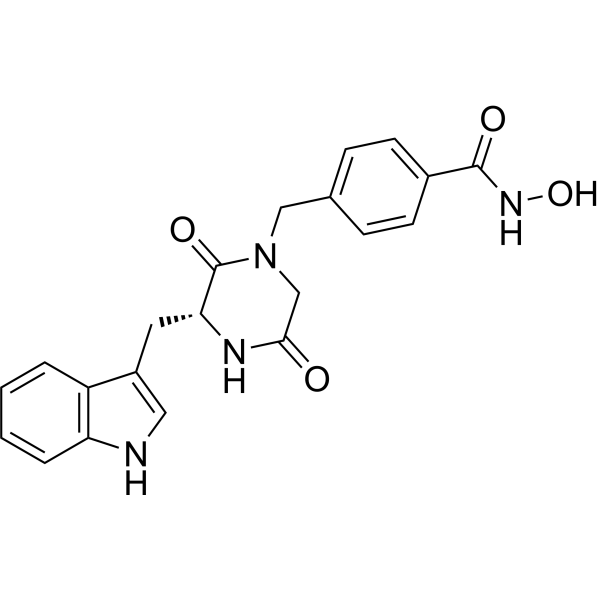 0 ImagesCat. No.: HY-150595CAS No.: 2408286-73-5HDAC6-IN-10 is a highly selective HDAC6 inhibitor with the IC50 of 0.73 nM. HDAC6-IN-10 has 144~10941-fold selectivity over other HDAC isoforms. HDAC6-IN-10 shows anti-proliferative activities against multiple myeloma cells.
-
HDAC-IN-99
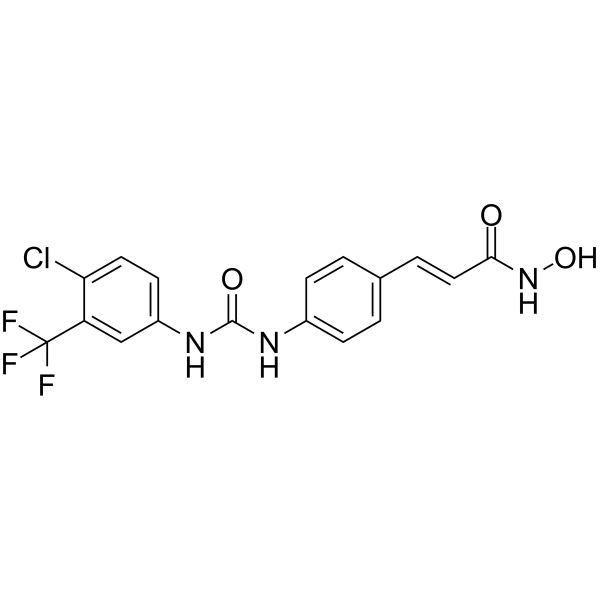
 0 ImagesCat. No.: HY-181843HDAC-IN-99 is a histone deacetylase (HDAC) inhibitor with an IC50 of 37.73 nM, and it exhibits potent inhibitory activity against HDAC1 (IC50 = 48.09 nM), HDAC2 (IC50 = 300.28 nM) and HDAC6 (IC50 = 9.16 nM). HDAC-IN-99 exerts broad-spectrum antiproliferative activity in various cancer cell lines. HDAC-IN-99 induces S-phase cell cycle arrest and apoptosis in colon cancer cells, increases the acetylation levels of histone H3, histone H4 and α-tubulin, and upregulates the expression of p21 as well as the cleavage of caspase-3. HDAC-IN-99 displays antitumor activity in colon cancer xenograft models. HDAC-IN-99 can be used for the research of colon cancer.
-
PDE5/HDAC-IN-1
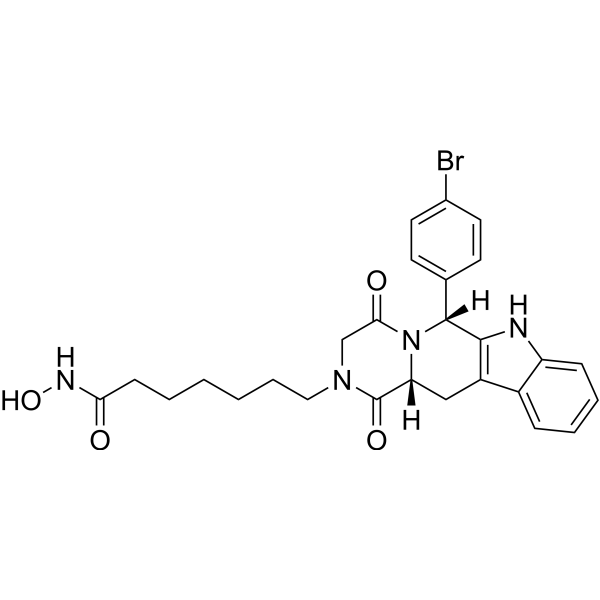 0 ImagesCat. No.: HY-147991CAS No.: 2414921-48-3PDE5/HDAC-IN-1 (Compound 26) is a potent phosphodiesterase 5 (PDE5) and HDAC inhibitor with IC50 values of 46.3 nM and 14.5 nM, respectively. PDE5/HDAC-IN-1 induces cell apoptosis and shows anticancer activities.
-
HDAC3-IN-6
 0 ImagesCat. No.: HY-172133CAS No.: 3070532-72-5HDAC3-IN-6 (Compound SC26) is a selective HDAC3 inhibitor with an IC50 of 53 nM. HDAC3-IN-6 dose-dependently induces the expression of PD-L1. HDAC3-IN-6 induces more pronounced Apoptosis and production of ROS. HDAC3-IN-6 exhibits high antitumor efficacy against colorectal cancer.
-
HDAC6-IN-73
 0 ImagesCat. No.: HY-181577HDAC6-IN-73 is a highly potent and selective HDAC6 inhibitor with an IC50 of 0.007 μM ± 0.001, ~1771-fold selectivity over HDAC1, ~131-fold selectivity over HDAC8, and antiproliferative activity in hematological cancer cell lines.HDAC6-IN-73 can be used for the research of hematological malignancies.
-
EGFR/HDAC-IN-1
 0 ImagesCat. No.: HY-173520EGFR/HDAC-IN-1 (Compound 22c2) is a potent dual inhibitor of epidermal growth factor receptor (EGFR) and histone deacetylase (HDAC) with IC50 values of 4.81 nM, 119.4 nM and 354.8 nM for EGFR, HDAC1 and HDAC3, respectively. EGFR/HDAC-IN-1 blocks the EGFR signaling pathway and affects the histone acetylation status, thereby inhibiting tumor cell proliferation. EGFR/HDAC-IN-1 is promising for research of non-small cell lung cancer (NSCLC).
-
HDAC-IN-38
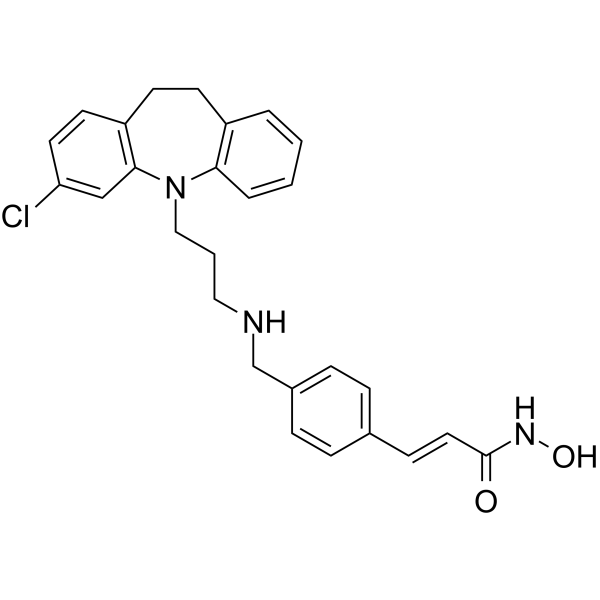 0 ImagesCat. No.: HY-146351CAS No.: 2408123-36-2HDAC-IN-38 (compound 13) is a potent HDAC inhibitor. HDAC-IN-38 shows similar micro-molar inhibitory activity toward HDAC1, 2, 3, 5, 6, and 8. HDAC-IN-38 increases cerebral blood flow (CBF), attenuates cognitive impairment, and improves hippocampal atrophy. HDAC-IN-38 also increases the level of histone acetylation (H3K14 or H4K5).




