



Microtubule/Tubulin
Microtubules are a component of the cytoskeleton, found throughout the cytoplasm. These tubular polymers of tubulin can grow as long as 50 micrometres, with an average length of 25 µm, and are highly dynamic. The outer diameter of a microtubule is about 24 nm while the inner diameter is about 12 nm. Microtubules are found in eukaryotic cells and are formed by the polymerization of a dimer of two globular proteins, alpha and beta tubulin. Tubulin is one of several members of a small family of globular proteins. The tubulin superfamily includes five distinct families, the alpha-, beta-, gamma-, delta-, and epsilon-tubulins and a sixth family which is present only in kinetoplastid protozoa. The most common members of the tubulin family are α-tubulin and β-tubulin, the proteins that make up microtubules. Microtubules are very important in a number of cellular processes. They are involved in maintaining the structure of the cell.
All Product Categories
-
Microtubule/Tubulin Inhibitors
(808)
View all products
-
Microtubule/Tubulin Agonists
(2)
View all products
-
Microtubule/Tubulin Activators
(19)
View all products
-
Microtubule/Tubulin Modulators
(19)
View all products
-
Microtubule/Tubulin Inducers
(5)
View all products
-
Microtubule/Tubulin Degraders
(3)
View all products
-
Microtubule/Tubulin Controls
(19)
View all products
-
Microtubule/Tubulin Ligands
(5)
View all products
-
Microtubule/Tubulin Related Products (992)
Related Products (992)

-
Antibodies (69)
-
Amiprofos methyl (Standard)
 0 ImagesSynonyms: BAY-NTN 6867 (Standard)Amiprofos methyl (Standard) is the analytical standard of Amiprofos methyl. This product is intended for research and analytical applications. Amiprofos methyl (BAY-NTN 6867) is a phosphoric amide herbicide. Amiprofos methyl is a specific and potent antimicrotubule agent. Amiprofos methyl directly poisons microtubule dynamics in plant cells.
-
Sabizabulin hydrochloride
 0 ImagesCat. No.: HY-120599ACAS No.: 2635953-17-0Synonyms: VERU-111 hydrochloride; ABI-231 hydrochlorideSabizabulin hydrochloride is a potent orally bioavailable microtubule inhibitor with activity that interacts with the colchicine binding site. Sabizabulin hydrochloride demonstrated significant inhibition of melanoma tumor growth with an average IC50 of 5.2 nM in melanoma and prostate cancer cell lines. Pharmacological screening of Sabizabulin hydrochloride shows it has a low risk of potential side effects.
-
Monomethyl auristatin E intermediate-5
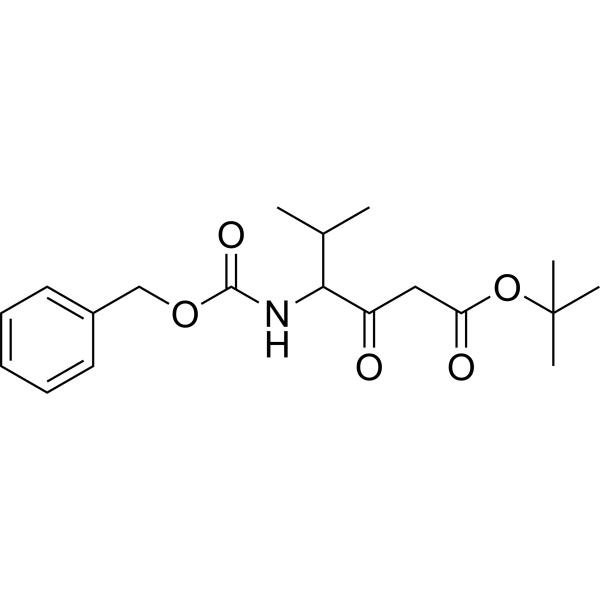 0 ImagesCat. No.: HY-43149CAS No.: 1822810-13-8Monomethyl auristatin E intermediate-5 is an intermediate reagent in the synthesis of Monomethyl auristatin E (HY-15162). Monomethyl auristatin E (MMAE) is a microtubule/tubulin inhibitor with anticancer activity. MMAE is widely used as the cytotoxic component (ADC Cytotoxin) of antibody-drug conjugates (ADCs).
-
R34803
 0 ImagesCat. No.: HY-187736CAS No.: 64420-40-2R34803 is an orally effective Microtubule inhibitor and antiparasitic agent. R34803 impedes directional migration by interfering with the cytoplasmic microtubule complex, and causes metaphase arrest to inhibit the growth of cancer cell aggregates while preventing their invasion into other tissues. R34803 exhibits activity against a variety of parasites. R34803 can be used for research on fibrosarcoma and helminthiasis.
-
N-Boc-dolaproine-amide-Me-Phe
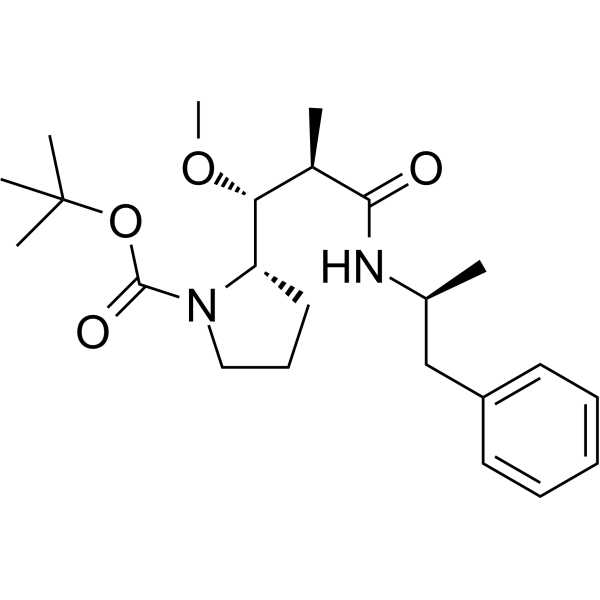 0 ImagesN-Boc-dolaproine-amide-Me-Phe is the amino acid residue of the pentapeptide Dolastatin 10 (HY-15580). Dolastatin 10 inhibits tubulin polymerization and mitosis and has anticancer activity.
-
Glucobrassicin
 0 ImagesGlucobrassicin is an indole-based anticancer agent and plant growth-regulating hormone. Glucobrassicin exerts its biological activity by disrupting the integrity of microtubule networks in both plant and mammalian cells. At high concentrations, Glucobrassicin inhibits seed germination and root growth; it can also specifically induce apoptosis in mammalian cancer cells and interfere with the intercellular transmission of viruses that rely on microtubules. In plants, Glucobrassicin can be catalyzed by myrosinase to release growth-regulating substances, exhibiting a concentration-dependent growth-regulating effect.
-
MPT0B214
 0 ImagesCat. No.: HY-124083CAS No.: 1215208-65-3MPT0B214 is a microtubule inhibitor that strongly binds to the colchicine binding site of tubulin, preventing tubulin polymerization. MPT0B214 induces apoptosis through a mitochondrial/caspase 9 dependent pathway and shows cytotoxicity across various human tumor cell lines. MPT0B214 can be used for cancer research.
-
KX2-361 (Standard)
 0 ImagesCat. No.: HY-111187RCAS No.: 897016-26-1Synonyms: KX-02 (Standard)KX2-361 (Standard) is the analytical standard of KX2-361 (HY-111187). This product is intended for research and analytical applications. KX2-361 (KX-02) is a Src-Kinase and tubulin polymerization inhibitor. KX2-361 shows good oral bioavailability and readily crosses the BBB in mice. KX2-361 shows anti-tumor activity and induces apoptosis of Glioblastoma (GBM) cell.
-
NSC 145669
 0 ImagesCat. No.: HY-116799CAS No.: 31785-60-1NSC 145669 is an inhibitor for tubulin polymerization with IC50 of 1.7 μM. NSC 145669 exhibits cytotoxicity in cancer cells and reveals antileukemic efficacy in mice.
-
Monomethyl auristatin E intermediate-3
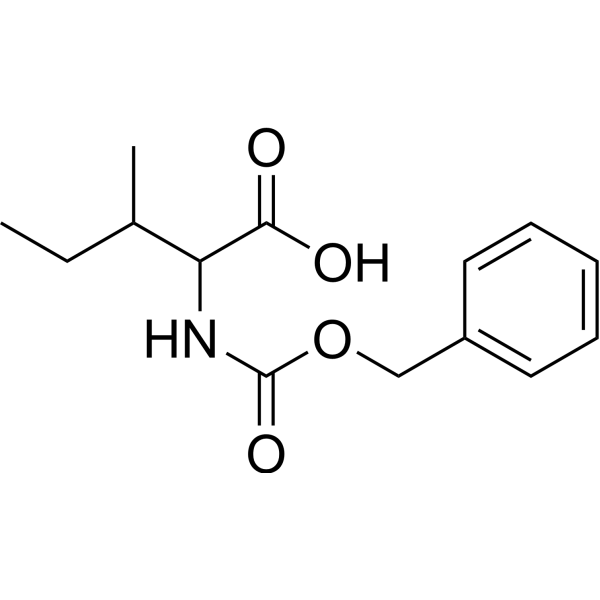 0 ImagesCat. No.: HY-43146Monomethyl auristatin E intermediate-3 is an intermediate reagent in the synthesis of Monomethyl auristatin E (HY-15162). Monomethyl auristatin E (MMAE) is a microtubule/tubulin inhibitor with anticancer activity. MMAE is widely used as the cytotoxic component (ADC Cytotoxin) of antibody-drug conjugates (ADCs).
-
Tubulin/PARP-IN-1
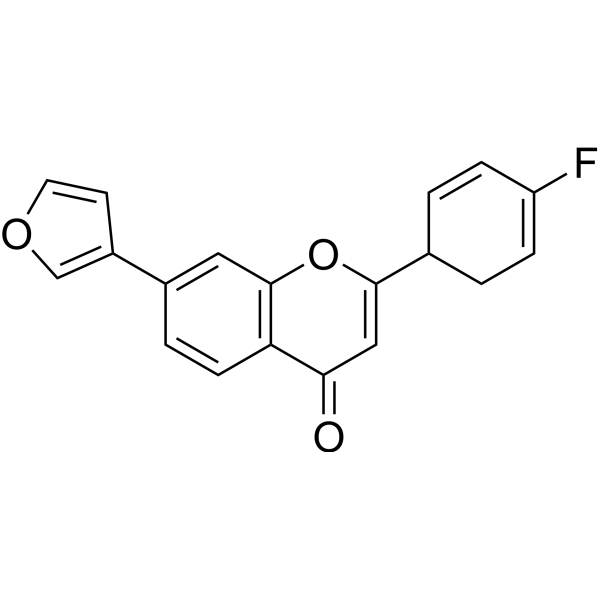 0 ImagesCat. No.: HY-157165Tubulin/PARP-IN-1 (compound 14) is a dual PARP-tubulin inhibitor with activity against endometrial cancer. Tubulin/PARP-IN-1 inhibits PARP and tubulin with IC50s of 74 nM (PARP1), 109 nM (PARP2), and 1.4 μM (Microtubule/Tubulin), respectively. Tubulin/PARP-IN-1 can induce apoptosis and autophagy and cause cell cycle arrest in the G2/M phase.
-
N-Deacetylcolchicine
 0 ImagesN-Deacetylcolchicine is a microtubule polymerization inhibitor with an IC50 of 3 μM against bovine brain microtubules. N-Deacetylcolchicine is a derivative of Colchicine (HY-16569). N-Deacetylcolchicine can activate the GTPase activity of microtubules and can be used for the research of cancer.




