



PARP Activator
-
Quinidine hydrochloride monohydrate (Standard)
 0 Images
Quinidine hydrochloride monohydrate (Standard) is the analytical standard of Quinidine hydrochloride monohydrate (HY-B1302). This product is intended for research and analytical applications. Quinidine hydrochloride monohydrate is an orally active antiarrhythmic agent. Quinidine hydrochloride monohydrate reduces the expression level of P-gp, inhibits P-gp-mediated efflux, increases the intracellular accumulation of P-gp substrates, induces PARP cleavage and Caspase-3 activation, and elevates the proportion of Apoptotic cells at the sub-G1 phase. Quinidine hydrochloride monohydrate exerts sustained block and open-channel block effects on IK(f). Quinidine hydrochloride monohydrate alters the urinary metabolic ratio of Amphetamine, modulates the Pentylenetetrazol-induced seizure threshold, and regulates the anticonvulsant effect of Dextromethorphan. Quinidine hydrochloride monohydrate can be used in studies related to uterine sarcoma and seizures.
-
NCP26
 0 ImagesCat. No.: HY-183004CAS No.: 2396683-89-7
NCP26 is an ATP-competitive ProRS inhibitor (with a KD of 271 nM in the absence of proline, and a KD of 0.35 nM in the presence of 100 μM proline). NCP26 activates AAR, induces G0/G1 phase arrest, Apoptosis, Caspase cleavage, and PARP cleavage. NCP26 downregulates MYC, TCF3, and CCND1. NCP26 inhibits the growth of multiple myeloma cells. NCP26 can be used for the research of multiple myeloma.
-
Linichlorin A
 0 ImagesCat. No.: HY-126757CAS No.: 62462-98-0
Linichlorin A is a p27Kip1 ubiquitination inhibitor that blocks p27Kip1 degradation by inhibiting the Skp2-Cks1–p27Kip1 interaction. Linichlorin A shows selective antiproliferative activity against tumor cells. Linichlorin A induces apoptosis in leukemia cells via cytochrome c release, caspase activation and PARP cleavage. Linichlorin A can be used in the study of leukemia, melanoma, cervical cancer and breast cancer.
-
Acanthoic acid
 0 ImagesCat. No.: HY-116136CAS No.: 119290-87-8Synonyms: NP1302
Acanthoic acid (NP1302) is an orally active pimarane-type diterpenoid. Acanthoic acid is isolated from the root bark of Araliaceae family plant Eleutherococcus senticosus (Siberian ginseng). Acanthoic acid activates LXR and FXR. Acanthoic acid activates the AMPK-LKB1, SIRT1, and p38 MAPK signaling pathways and increases the phosphorylation level of ACC. Acanthoic acid downregulates the expression of SREBP-1, CYP2E1, HIF-1α, and PPARγ, and upregulates the expression of PPARα. Acanthoic acid induces Apoptosis by activating Caspase-3, promoting PARP cleavage, and downregulating Bcl-xL. Acanthoic acid exhibits antioxidant, anti-fibrotic, and hepatoprotective effects. It reduces lipid accumulation and lipogenesis. Acanthoic acid is used in studies on non-alcoholic fatty liver disease, alcoholic liver disease, acute promyelocytic leukemia, and Acetaminophen-induced hepatotoxicity.
-
GO-Y078
 0 ImagesCat. No.: HY-137059CAS No.: 1217503-60-0
GO-Y078 is a curcumin (HY-N0005) analog. GO-Y078 activates p38/JNK1/2. GO-Y078 activates the MAPK pathway, Caspase 3/8/9, PARP, AP-1, DR5, and TP53, while inhibiting cIAP-1, XIAP, and NF-κB. GO-Y078 induces sub-G1/G2/M phase arrest and Apoptosis. GO-Y078 impairs angiogenesis. GO-Y078 can be used in research related to osteosarcoma, cervical cancer, oral squamous cell carcinoma, and peritoneal metastasis of gastric cancer.
-
Myrothecine A
 0 ImagesCat. No.: HY-N8508CAS No.: 910292-40-9
Myrothecine A is a trichothecene mycotoxin found in M. roridum. Myrothecine A induces apoptosis, promotes the cytochrome c release, PARP-cleavage and phosphorylation of JNK, increases Bax and cleaved caspase-3, -5, and -8 levels. Myrothecine A has anticancer activities and promotes the maturation of DC cells in the microenvironment. Myrothecine A inhibits proliferation of A549, MCF-7, HepG2, and SMMC-7721 cancer cells with IC50s of 95, 70, 60, and 25 µM, respectively.
-
1,3,5-Tricaffeoylquinic acid
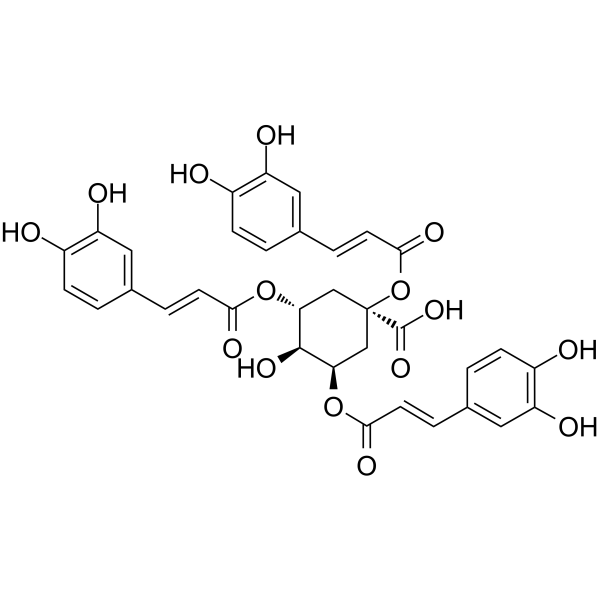 0 ImagesCat. No.: HY-N6926CAS No.: 1073897-80-9
1,3,5-Tricaffeoylquinic acid acts as an angiogenesis inhibitor and apoptosis inducer, and exhibits anti-HIV activity. 1,3,5-Tricaffeoylquinic acid inhibits the phosphorylation of VEGFR2, ERK, PI3K, Akt and mTOR in the angiogenesis signaling pathway. 1,3,5-Tricaffeoylquinic acid regulates apoptosis-related proteins, upregulates the levels of activated caspase-8, Bax, activated PARP and caspase-3/9, while downregulates the level of Bcl-2. 1,3,5-Tricaffeoylquinic acid inhibits tube formation and shows cytotoxicity against ovarian cancer cells. 1,3,5-Tricaffeoylquinic acid can be used in studies related to ovarian cancer.
-
AD-2646
 0 ImagesCat. No.: HY-124134CAS No.: 366487-89-0Synonyms: LCL102
AD-2646 (LCL102), a ceramide analog, can kill leukemic T cells (EC50: 40 μM). AD-2646 triggers the cleavage of caspase-8, -9 and -3, as well as the caspase substrate PARP. AD-2646 is a ceramidase inhibitor. AD-2646 induces an accumulation of endogenous ceramide owing to perturbed ceramide metabolism.
-
Sweroside (Standard)
 0 Images
Sweroside (Standard) is the analytical standard of Sweroside (HY-N0806). This product is intended for research and analytical applications. Sweroside is an iridoid glycoside that targets multiple targets, including the Keap1/Nrf2 axis, NLRP3 inflammasome, SIRT1, NF-κB, AMPK/mTOR pathway, and caspase family. Sweroside promotes Nrf2 nuclear translocation by competitively binding to Keap1. Sweroside also inhibits oxidative stress and NLRP3-mediated pyroptosis by activating Nrf2, inhibits NF-κB inflammatory pathway by activating SIRT1, and promotes autophagy and induces caspase-dependent apoptosis via the AMPK/mTOR pathway. Sweroside has antioxidant, anti-inflammatory, anti-apoptotic, and lipid metabolism regulating activities, and can be used in the research of myocardial ischemia-reperfusion injury, leukemia, acute lung injury, non-alcoholic fatty liver disease, and other fields.
-
Quinidine (15% dihydroquinidine) (Standard)
 0 Images
Quinidine (15% dihydroquinidine) (Standard) is the analytical standard of Quinidine (15% dihydroquinidine) (HY-B1751). This product is intended for research and analytical applications. Quinidine (15% dihydroquinidine) is an orally active antiarrhythmic agent. Quinidine (15% dihydroquinidine) reduces the expression level of P-gp, inhibits P-gp-mediated efflux, increases the intracellular accumulation of P-gp substrates, induces PARP cleavage and Caspase-3 activation, and elevates the proportion of Apoptotic cells at the sub-G1 phase. Quinidine (15% dihydroquinidine) exerts sustained block and open-channel block effects on IK(f). Quinidine (15% dihydroquinidine) alters the urinary metabolic ratio of Amphetamine, modulates the Pentylenetetrazol-induced seizure threshold, and regulates the anticonvulsant effect of Dextromethorphan. Quinidine (15% dihydroquinidine) can be used in studies related to uterine sarcoma and seizures.
-
USP7-IN-20
 0 ImagesCat. No.: HY-183942CAS No.: 2196246-28-1
USP7-IN-20 is a highly selective USP7 inhibitor that binds allosterically to the allosteric pocket of USP7 in a non-competitive and reversible manner. USP7-IN-20 downregulates MDM2 protein levels and stabilizes p53, thereby inducing p21 expression and enhancing the ubiquitin-dependent degradation of MDM2. USP7-IN-20 effectively binds endogenous USP7 to inhibit cancer cell proliferation, and also induces apoptosis by promoting the cleavage of PARP and caspase 3. USP7-IN-20 can be widely used in cancer-related basic and translational research.



