



Cefprozil

Based on 1 Customer Validation
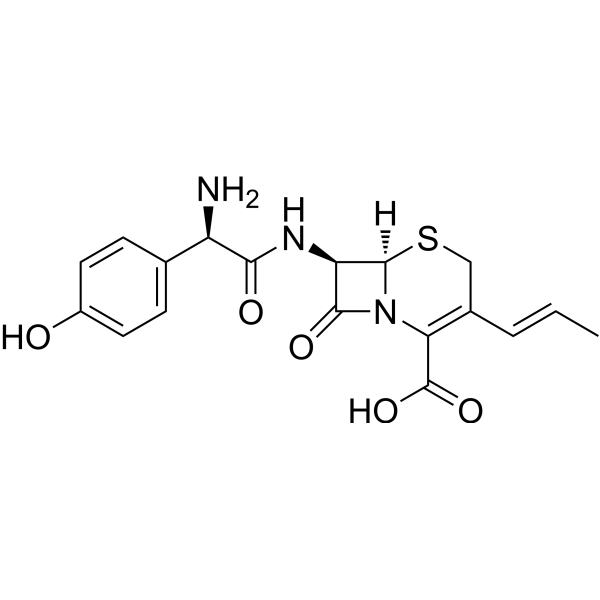
Cefprozil is a second-generation cephalosporin type antibiotic. Cefprozil exhibits broad-spectrum antibacterial activity, and is orally active. Cefprozil can be used for the study of pharyngitis, tonsillitis, otitis media, and uncomplicated skin infections.
For research use only. We do not sell to patients.
- Purity : 99.82%
- CAS No.: 92665-29-7
- Formula: C18H19N3O5S
- Molecular Weight:389.43
-
Storage:
4°C, sealed storage, away from moisture and light
* In solvent : -80°C, 6 months; -20°C, 1 month (sealed storage, away from moisture and light)

To place orders, for customer services and technical support, please contact: MedChemExpress USA
Tel: 609-228-6898 E-mail: [email protected] [email protected]


-
 Biological Activity
-
Chemical Information
- Protocols
- Purity & Documentation
- References
-
 Help & FAQs




All Antibiotic Isoforms
More

Biological Activity
Description
IC50 & Target
|
β-lactam |
In Vitro
Cefprozil inhibits S. pyogenes, S. pneumoniae, S. agalactiae, S. aureus (methicillin-susceptible), H. influenzae, M. catarrhalis, E. coli with MIC90s of 0.04, 0.23, 0.3, 1.4, 6.7, 4.5, 12.2 mg/L, respectively[2].
MedChemExpress (MCE) has not independently confirmed the accuracy of these methods. They are for reference only.
In Vivo
MedChemExpress (MCE) has not independently confirmed the accuracy of these methods. They are for reference only.


Chemical Information
-
CAS No. 92665-29-7
-
Appearance Solid
-
Molecular Weight 389.43
-
Formula C18H19N3O5S
-
Color White to off-white
-
SMILES
OC(C(N1[C@@]2([H])[C@H](NC([C@@H](C3=CC=C(O)C=C3)N)=O)C1=O)=C(CS2)/C=C/C)=O
-
Shipping
Room temperature in continental US; may vary elsewhere.
-
Storage
4°C, sealed storage, away from moisture and light
* In solvent : -80°C, 6 months; -20°C, 1 month (sealed storage, away from moisture and light)


Purity & Documentation
-
Data Sheet (268 KB)
-
SDS (394 KB)
- English - EN (394 KB)
- Français - FR (394 KB)
- Deutsch - DE (394 KB)
- Norwegian - NO (394 KB)
- Español - ES (394 KB)
- Swedish - SV (394 KB)
- Italian - IT (394 KB)
- Korean - KR (394 KB)
- Portuguese - PT (394 KB)
-
Handling Instructions (2659 KB)
References
[1]. J C Fung-Tom, et al. Antibacterial activities of cefprozil compared with those of 13 oral cephems and 3 macrolides. Antimicrob Agents Chemother. 1995 Feb;39(2):533-8. [Content Brief]
[2]. Wiseman LR, et al., Cefprozil. A review of its antibacterial activity, pharmacokinetic properties, and therapeutic potential. Drugs. 1993 Feb;45(2):295-317. [Content Brief]

Calculators
Concentration (start) × Volume (start) = Concentration (final) × Volume (final)


Cefprozil Related Classifications
HY-B0458A Related Classifications
 Powered by Bioz