



G-6599

Based on 1 Customer Validation
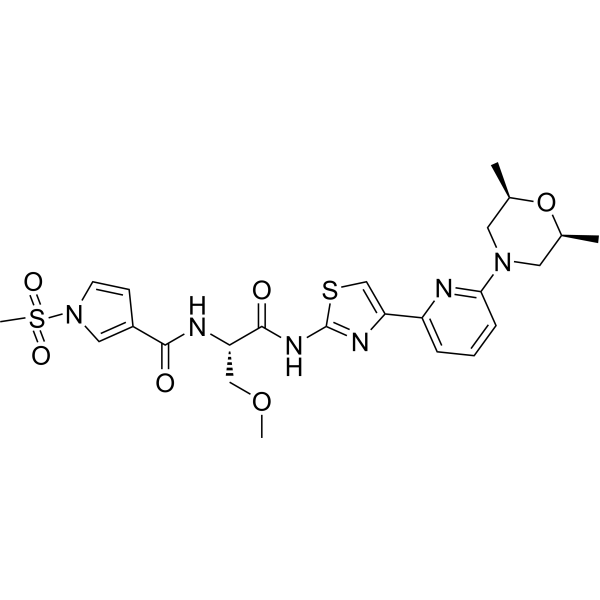
G-6599 is a covalent molecular glue degrader targeting SMARCA2/SMARCA4, with DC50 values of 0.017 nM and 0.057 nM against SMARCA2 and SMARCA4 in SW1573 cells, respectively. G-6599 exhibits proteome selectivity for SMARCA2, SMARCA4, and PBRM1. G-6599 induces the assembly of the SMARCA2-FBXO22 ternary complex, enabling ubiquitination and proteasomal degradation of both proteins via the ubiquitin-proteasome pathway without the need for biotransformation. G-6599 shows antiproliferative effects in relevant cancer cell models. G-6599 can be used for research on androgen-dependent prostate cancer and SMARCA4-mutant non-small cell lung cancer.
For research use only. We do not sell to patients.
- CAS No.: 2901806-51-5
- Formula: C31H37N7O
- Molecular Weight:523.67
-
Storage:
4°C, sealed storage, away from moisture and light
* In solvent : -80°C, 6 months; -20°C, 1 month (sealed storage, away from moisture and light)


To place orders, for customer services and technical support, please contact: MedChemExpress USA
Tel: 609-228-6898 E-mail: [email protected] [email protected]


-
 Biological Activity
-
Chemical Information
-
Solvent & Solubility
- Protocols
- Purity & Documentation
- References
-
 Help & FAQs


All SWI/SNF Complex Isoforms
More

Biological Activity
Description
IC50 & Target
[1]|
SMARCA2 0.017 nM (DC50) |
SMARCA4 0.057 nM (DC50) |
PBRM1 |
Cellular Effect
|
Cell Line

|
Type | Value | Description | References |
|---|---|---|---|---|
| SW1573 | DC50 |
0.017 nM
|
Degradation of SMARCA2 in human SW1573 cells assessed via nuclear fluorescence intensity quantification after 18-hour incubation by high-throughput immunofluorescence degradation assay.
Degradation of SMARCA2 in human SW1573 cells assessed via nuclear fluorescence intensity quantification after 18-hour incubation by high-throughput immunofluorescence degradation assay.
|
41184243 |
| SW1573 | DC50 |
0.057 nM
|
Degradation of SMARCA4 in human SW1573 cells assessed via nuclear fluorescence intensity quantification after 18-hour incubation by high-throughput immunofluorescence degradation assay.
Degradation of SMARCA4 in human SW1573 cells assessed via nuclear fluorescence intensity quantification after 18-hour incubation by high-throughput immunofluorescence degradation assay.
|
41184243 |
In Vitro
G-6599-mediated degradation of SMARCA2 and SMARCA4 in SW1573 cells depends on the ubiquitin-proteasome pathway, cullin-RING ligase activity, and binding to the bromodomains of SMARCA2/A4[1].
G-6599 (100 nM; 30 min) induces specific ubiquitination of SMARCA2, SMARCA4 and PBRM1 in SW1573 cells without altering the ubiquitination levels of other cellular proteins[1].
G-6599 (100 nM; 3 h) selectively depletes SMARCA2, SMARCA4 and PBRM1 in SW1573 cells, with no off-target effects detected at the global proteome level[1].
G‑6599 requires the ligase activity of FBXO22 together with cysteine residues C228 and C326 for efficient SMARCA2 degradation in HCC515 cells; G‑6599 mediates the physical interaction between FBXO22/SKP1 and the bromodomain of SMARCA2 in vitro[1].
G-6599 (4-333 nM; overnight) induces the formation of a dose-dependent ternary complex between SMARCA2 and FBXO22 in FBXO22-knockout HCC515 cells[1].
G-6599 (100 µM; 1 min to 2280 min) induces conformational changes in FBXO22, thereby enhancing its interaction with the bromodomain of SMARCA2, and this effect is particularly pronounced in the FIST domain region near Cys326[1].
G-6599 (20 µM; 4 h) forms covalent adducts with FBXO22 in vitro, and adduct formation is observed even in the absence of the SMARCA2 bromodomain at high concentrations[1].
G-6599 (50 µM; 4 h) covalently modifies multiple cysteine residues on FBXO22 in vitro, and Cys228 serves as the primary modification site when incubated with the SMARCA2 bromodomain[1].
MedChemExpress (MCE) has not independently confirmed the accuracy of these methods. They are for reference only.


Chemical Information
-
CAS No. 2901806-51-5
-
Appearance Solid
-
Molecular Weight 523.67
-
Formula C31H37N7O
-
Color White to light yellow
-
SMILES
OC1=CC=CC=C1C2=CC(N3CC4N(C5=CC(C#CCCN6CCCCCC6)=NC=C5)C(CC4)C3)=C(N)N=N2
-
Shipping
Room temperature in continental US; may vary elsewhere.
-
Storage
4°C, sealed storage, away from moisture and light
* In solvent : -80°C, 6 months; -20°C, 1 month (sealed storage, away from moisture and light)


Solvent & Solubility
In Vitro:
DMSO : ≥ 100 mg/mL (190.96 mM; Hygroscopic DMSO has a significant impact on the solubility of product, please use newly opened DMSO)
* "≥" means soluble, but saturation unknown.
Please refer to the solubility information to select the appropriate solvent. Once prepared, please aliquot and store the solution to prevent product inactivation from repeated freeze-thaw cycles.
Storage method and period of stock solution: -80°C, 6 months; -20°C, 1 month (sealed storage, away from moisture and light). When stored at -80°C, please use it within 6 months. When stored at -20°C, please use it within 1 month.
Concentration (start) × Volume (start) = Concentration (final) × Volume (final)
In Vivo:
Select the appropriate dissolution method based on your experimental animal and administration route.
- For the following dissolution methods, please ensure to first prepare a clear stock solution using an In Vitro approach and then sequentially add co-solvents:
- To ensure reliable experimental results, the clarified stock solution can be appropriately stored based on storage conditions. As for the working solution for In Vivo experiments, it is recommended to prepare freshly and use it on the same day.
- The percentages shown for the solvents indicate their volumetric ratio in the final prepared solution. If precipitation or phase separation occurs during preparation, heat and/or sonication can be used to aid dissolution.
Add each solvent one by one: 10% DMSO 40% PEG300 5% Tween-80 45% Saline
Solubility: 2.5 mg/mL (4.77 mM); Suspended solution; Need ultrasonic
This protocol yields a suspended solution of 2.5 mg/mL. Suspended solution can be used for oral and intraperitoneal injection.
Taking 1 mL working solution as an example, add 100 μL DMSO stock solution (25.0 mg/mL) to 400 μL PEG300, and mix evenly; then add 50 μL Tween-80 and mix evenly; then add 450 μL Saline to adjust the volume to 1 mL.
Preparation of Saline: Dissolve 0.9 g sodium chloride in ddH₂O and dilute to 100 mL to obtain a clear Saline solution.
Add each solvent one by one: 10% DMSO 90% (20% SBE-β-CD in Saline)
Solubility: 2.5 mg/mL (4.77 mM); Suspended solution; Need ultrasonic
This protocol yields a suspended solution of 2.5 mg/mL. Suspended solution can be used for oral and intraperitoneal injection.
Taking 1 mL working solution as an example, add 100 μL DMSO stock solution (25.0 mg/mL) to 900 μL 20% SBE-β-CD in Saline, and mix evenly.
Preparation of 20% SBE-β-CD in Saline (4°C, storage for one week): 2 g SBE-β-CD powder is dissolved in 10 mL Saline, completely dissolve until clear.
In Vivo Dissolution Calculator
Please enter the basic information of animal experiments:
-
-
-
-
Recommended: Prepare an additional quantity of animals to account for potential losses during experiments.
Please enter your animal formula composition:
-
%DMSO +
Recommended: Keep the proportion of DMSO in working solution below 2% if your animal is weak.
-
%+
-
+%Tween-80 + +
-
%Saline +
The co-solvents required include: DMSO, . All of co-solvents are available by MedChemExpress (MCE). , Tween 80. All of co-solvents are available by MedChemExpress (MCE).
Working solution concentration: 0.22 mg/mL
Method for preparing stock solution: mg drug dissolved in μL DMSO. Stock solution concentration: mg/mL. * In solvent : -80°C, 6 months; -20°C, 1 month (sealed storage, away from moisture and light)
1. Take μL DMSO stock solution;
2. Add μL .
μL , mix evenly;
3. Then add μL Tween 80, mix evenly;
4. Then add μL
Please ensure that the stock solution in the first step is dissolved to a clear state, and add co-solvents in sequence. You can use ultrasonic heating (ultrasonic cleaner, recommended frequency 20-40 kHz), vortexing, etc. to assist dissolution.


Purity & Documentation
-
Data Sheet (285 KB)
-
SDS (252 KB)
- English - EN (252 KB)
- Français - FR (252 KB)
- Deutsch - DE (252 KB)
- Norwegian - NO (252 KB)
- Español - ES (252 KB)
- Swedish - SV (252 KB)
- Italian - IT (252 KB)
- Korean - KR (252 KB)
- Portuguese - PT (252 KB)
-
Handling Instructions (2659 KB)
References


Complete Stock Solution Preparation Table
Please refer to the solubility information to select the appropriate solvent. Once prepared, please aliquot and store the solution to prevent product inactivation from repeated freeze-thaw cycles.
Storage method and period of stock solution: -80°C, 6 months; -20°C, 1 month (sealed storage, away from moisture and light). When stored at -80°C, please use it within 6 months. When stored at -20°C, please use it within 1 month.
| Optional Solvent | Concentration Solvent Mass | 1 mg | 5 mg | 10 mg | 25 mg |
|---|---|---|---|---|---|
| DMSO | 1 mM | 1.9096 mL | 9.5480 mL | 19.0960 mL | 47.7400 mL |
| 5 mM | 0.3819 mL | 1.9096 mL | 3.8192 mL | 9.5480 mL | |
| 10 mM | 0.1910 mL | 0.9548 mL | 1.9096 mL | 4.7740 mL | |
| 15 mM | 0.1273 mL | 0.6365 mL | 1.2731 mL | 3.1827 mL | |
| 20 mM | 0.0955 mL | 0.4774 mL | 0.9548 mL | 2.3870 mL | |
| 25 mM | 0.0764 mL | 0.3819 mL | 0.7638 mL | 1.9096 mL | |
| 30 mM | 0.0637 mL | 0.3183 mL | 0.6365 mL | 1.5913 mL | |
| 40 mM | 0.0477 mL | 0.2387 mL | 0.4774 mL | 1.1935 mL | |
| 50 mM | 0.0382 mL | 0.1910 mL | 0.3819 mL | 0.9548 mL | |
| 60 mM | 0.0318 mL | 0.1591 mL | 0.3183 mL | 0.7957 mL | |
| 80 mM | 0.0239 mL | 0.1193 mL | 0.2387 mL | 0.5967 mL | |
| 100 mM | 0.0191 mL | 0.0955 mL | 0.1910 mL | 0.4774 mL |


G-6599 Related Classifications
HY-173351 Related Classifications
 Powered by Bioz