



RKH
Based on 1 publication(s) in Google Scholar
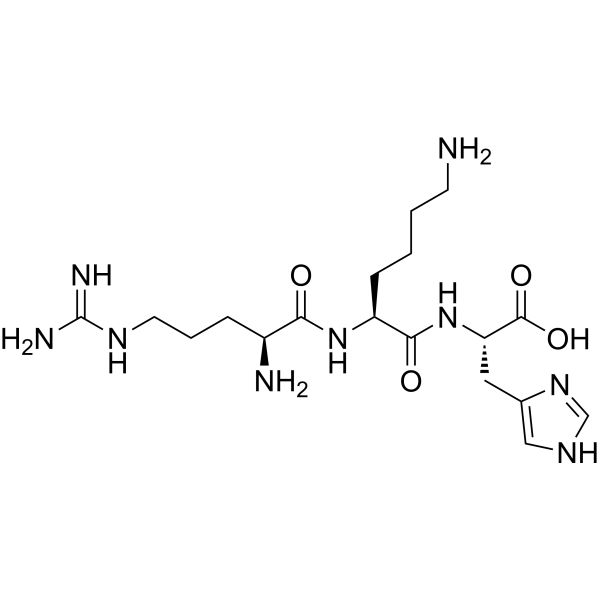
RKH is an orally active tripeptide derived from Akkermansia muciniphila and a TLR4 inhibitor that binds to TLR4 with a Kd of 3.34 nM. RKH blocks LPS-induced TLR4/MD2 dimerization, inhibits LPS-induced proinflammatory cytokine expression and systemic inflammation, and exhibits stronger inhibition of TLR4-mediated cytokine expression than other TLR pathways in macrophages. RKH inhibits sepsis-induced systemic proinflammatory cytokine production as well as macrophage recruitment and proinflammatory activation. RKH prevents lethal sepsis and attenuates organ injury in mouse and piglet sepsis models. RKH can be used for research on sepsis.
For research use only. We do not sell to patients.
- Formula: C18H33N9O4
- Molecular Weight:439.51
-
Storage:
Please store the product under the recommended conditions in the Certificate of Analysis.

To place orders, for customer services and technical support, please contact: MedChemExpress USA
Tel: 609-228-6898 E-mail: [email protected] [email protected]
Other In-stock Forms of RKH


-
 Biological Activity
-
Chemical Information
- Protocols
- Purity & Documentation
- References
-
 Help & FAQs


Publications Citing Use of MedChemExpress (MCE) RKH
MoreAll Endogenous Metabolite Isoforms
More

Biological Activity
Description
IC50 & Target
[1]|
TLR4 3.34 nM (Kd) |
In Vitro
RKH (125 μM) protects TLR4 protein from pronase hydrolysis in vitro; and exerts a thermal stabilizing effect on TLR4 in macrophages across the 37-67 °C CETSA gradient range[1].
RKH (125 μM; 15 min) inhibits LPS-induced TLR4 downstream P38, P65, JNK, and ERK signaling transduction in THP-1-dMs cells, thereby reducing LPS-induced pro-inflammatory factor expression in macrophages, with weak inhibitory effects on other TLRs[1].
RKH (125 μM; 15 min) reduces the binding of FITC-LPS to BMDMs and THP-1-dMs without altering TLR4/MD2 expression or internalization[1].
RKH inhibits LPS-induced TLR4-TLR4 and TLR4-MD2 dimerization in BMDMs and THP-1-dMs[1].
RKH-mediated inhibition of TLR4 dimerization in THP-1-dMs requires ARG264, LEU293, ASP294, and LYS362 on TLR4[1].
MedChemExpress (MCE) has not independently confirmed the accuracy of these methods. They are for reference only.
-
Cell Line:THP-1-dMs cells
-
Concentration:125 μM
-
Incubation Time:15 min
-
Result:Inhibited LPS-induced TLR4 downstream P38, P65, JNK, and ERK signaling transduction in THP-1-dMs cells, thereby reducing LPS-induced pro-inflammatory factor expression in macrophages, with weak inhibitory effects on other TLRs.
In Vivo
RKH (50 mg/kg; intragastric administration; 2 h before LPS injection) pretreatment protects mice from LPS-induced lethal sepsis and organ injury[1].
RKH (1 mg/kg; intragastric administration; 2 h before LPS injection) pretreatment prolongs the survival time of LPS-induced septic piglets and alleviates excessive inflammation and organ injury[1].
RKH pretreatment exerts a protective effect in septic mice by prolonging survival time and alleviating acute tissue injury and inflammation, and it also exerts a protective effect against sepsis in a septic piglet model[2].
MedChemExpress (MCE) has not independently confirmed the accuracy of these methods. They are for reference only.
-
Animal Model:C57BL/6 mice (mlae, 6-8 weeks, induced by CLP operation), TLR4 knockout (TLR4-/-) mice[1]
-
Dosage:50 mg/kg
-
Administration:intragastric administration; 2 h before LPS injection
-
Result:Protected mice against CLP-induced lethal sepsis, organ injury, and systemic inflammation; and exerted no protective effect against CLP-induced lethal sepsis in TLR4 knockout mice.
-
Animal Model:C57BL/6 mice (mlae, 6-8 weeks, induced by LPS administration)[1]
-
Dosage:50 mg/kg
-
Administration:intragastric administration; 2 h before LPS injection
-
Result:Protected mice from LPS-induced lethal sepsis and organ injury.
-
Animal Model:piglet (induced by LPS administration, LPS (300 μg/kg) was injected intravenously for 30 min)[1]
-
Dosage:1 mg/kg
-
Administration:intragastric administration; 2 h before LPS injection
-
Result:Prolonged the survival time of LPS-induced septic piglets and alleviates excessive inflammation and organ injury.


Chemical Information
-
Molecular Weight 439.51
-
Formula C18H33N9O4
-
Sequence
Arg-Lys-His
-
Sequence Shortening
RKH
-
Shipping
Room temperature in continental US; may vary elsewhere.
-
Storage
Please store the product under the recommended conditions in the Certificate of Analysis.


Publications (1)
-
Journal Impact Factor
-
Most Recent
-
JCI Insight
CD4+ T helper 2 cell-macrophage crosstalk induces IL-24-mediated breast cancer suppression. [Abstract]2025 Jan 9;10(1):e180962. PMID: 39782693


Purity & Documentation
References

Calculators
Concentration (start) × Volume (start) = Concentration (final) × Volume (final)


RKH Related Classifications
HY-P10208 Related Classifications
 Powered by Bioz