



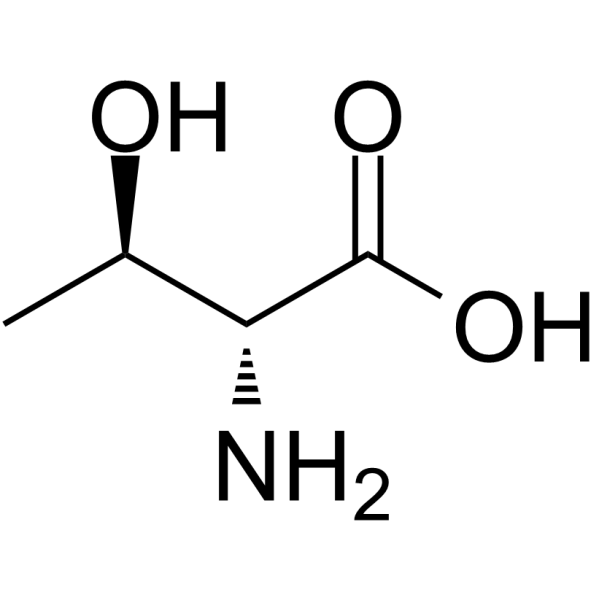
D-Allothreonine

Based on 1 Customer Validation
D-Allothreonine is a non-proteinogenic amino acid that serves as a substrate for Pyridoxal phosphate (HY-B1744)-dependent D-threonine aldolase, being cleaved into Glycine (HY-Y0966) and acetaldehyde, and acts as a constituent of bioactive peptidyl natural products such as callipeltins, conferring protease resistance. D-Allothreonine is used in natural product synthesis and metabolic research.
Nos produits utilisent uniquement pour la recherche. Nous ne vendons pas aux patients.
- Pureté : 98.0%
- CAS No.: 24830-94-2
- Formule: C4H9NO3
- Masse moléculaire:119.12
-
Stockage:Powder -20°C, 3 years , 4°C, 2 years ; In solvent -80°C, 6 months , -20°C, 1 month

To place orders, for customer services and technical support, please contact: MedChemExpress USA
Tel: 609-228-6898 E-mail: [email protected] [email protected]


-
 Activité biologique
-
Chemical Information
-
Solvant et solubilité
- Pureté et documentation
- Références
-
 Help & FAQs


Voir tous les produits spécifiques à Isoform Endogenous Metabolite
More

Activité biologique
Description
IC50 & Target
|
Microbial Metabolite |
Cellular Effect
|
Cell Line

|
Type | Value | Description | References |
|---|---|---|---|---|
| L1210 | IC50 |
> 100 μg/mL
Compound: F2-Thr (2R,3R)
|
Tested for the effect of stereochemistry on the growth of L1210 mouse leukemia cell line in vitro
Tested for the effect of stereochemistry on the growth of L1210 mouse leukemia cell line in vitro
|
10.1016/S0960-894X(01)81041-6 |
In Vitro
D‑allothreonine, together with D‑threonine, can be reversibly synthesized from glycine and acetaldehyde by D‑threonine aldolase (100‑350 mM; 2 h) derived from Arthrobacter sp. DK‑38[1].
D‑allothreonine is cleaved by D‑threonine aldolase (6‑25 mM; 30 min‑2 h) from Arthrobacter sp. DK‑38 at an enzyme concentration of 0.024 U/mL, whereas L‑threonine and L‑allothreonine are not hydrolyzed[1].
D-allothreonine (2 M; 2 h) is present in the O-polysaccharide of Escherichia coli O110 and is amide-linked to the carboxyl group of D-galacturonic acid[2].
D-Allothreonine (1.5% acetic acid containing 2% SDS; 15 min) is a constituent of the O-specific polysaccharide of Hafnia alvei strain PCM 1206 lipopolysaccharide, amide-linked to the D-galacturonic acid residue[4].
MedChemExpress (MCE) has not independently confirmed the accuracy of these methods. They are for reference only. .
In Vivo
D-Allothreonine (2%; p.o.; ad libitum; 11 d) is not growth depressing in healthy chicks, as a 2% dietary supplement does not affect weight gain, voluntary feed intake, or feed efficiency[3].
MedChemExpress (MCE) has not independently confirmed the accuracy of these methods. They are for reference only.
-
Animal Model:New Hampshire males × Columbian females chicks (male; 10-21 d posthatching; average initial body weight 104 g)[3]
-
Dosage:0.18% or 0.36%
-
Administration:p.o.; ad libitum; 11 d
-
Result:Added 0.18% D-allo-Thr resulted in weight gain of 54 g, feed intake of 250 g, and gain:feed of 220 g:kg.
Added 0.36% D-allo-Thr resulted in weight gain of 61 g, feed intake of 261 g, and gain:feed of 235 g:kg.
Both doses were without effect on chick performance, with values not significantly different from the unsupplemented basal group.
-
Animal Model:New Hampshire males × Columbian females chicks (male; 8-19 d posthatching; average initial body weight 95 g)[3]
-
Dosage:2.0%
-
Administration:p.o.; ad libitum; 11 d
-
Result:Added 2.0% D-allo-Thr resulted in weight gain of 236 g, feed intake of 353 g, and gain:feed of 668 g:kg.
Values were not significantly different from the basal diet group (weight gain 232 g, feed intake 341 g, gain:feed 680 g:kg).
D-allo-Thr is not growth depressing at a supplemental level of 2% of the diet.


Chemical Information
-
CAS No. 24830-94-2
-
Appearance Solid
-
Masse moléculaire 119.12
-
Formule C4H9NO3
-
Color White to off-white
-
SMILES
N[C@H]([C@H](O)C)C(O)=O
-
Structure Classification
-
Initial Source
-
Livraison
Room temperature in continental US; may vary elsewhere.
-
Stockage
Powder -20°C 3 years 4°C 2 years In solvent -80°C 6 months -20°C 1 month


Solvant et solubilité
In Vitro:
H2O : 25 mg/mL (209.87 mM; ultrasonic and warming and heat to 60°C)
DMSO : < 1 mg/mL (insoluble or slightly soluble)
Please refer to the solubility information to select the appropriate solvent. Once prepared, please aliquot and store the solution to prevent product inactivation from repeated freeze-thaw cycles.
Storage method and period of stock solution: -80°C, 6 months; -20°C, 1 month. When stored at -80°C, please use it within 6 months. When stored at -20°C, please use it within 1 month.
* Note: If you choose water as the stock solution, please dilute it to the working solution, then filter and sterilize it with a 0.22 μm filter before use.
Please refer to the solubility information to select the appropriate solvent. Once prepared, please aliquot and store the solution to prevent product inactivation from repeated freeze-thaw cycles.
Storage method and period of stock solution: -80°C, 6 months; -20°C, 1 month. When stored at -80°C, please use it within 6 months. When stored at -20°C, please use it within 1 month.
* Note: If you choose water as the stock solution, please dilute it to the working solution, then filter and sterilize it with a 0.22 μm filter before use.
Concentration (start) × Volume (start) = Concentration (final) × Volume (final)
In Vivo:
For the following dissolution methods, please prepare the working solution directly:
It is recommended to prepare fresh solutions and use them promptly within a short period of time.
The percentages shown for the solvents indicate their volumetric ratio in the final prepared solution. If precipitation or phase separation occurs during preparation, heat and/or sonication can be used to aid dissolution.
Add each solvent one by one: PBS
Solubility: 8.33 mg/mL (69.93 mM); Clear solution; Need ultrasonic and warming and heat to 60°C


Pureté et documentation
-
Fiche technique (279 KB)
-
SDS (393 KB)
- English - EN (393 KB)
- Français - FR (393 KB)
- Deutsch - DE (393 KB)
- Norwegian - NO (393 KB)
- Español - ES (393 KB)
- Swedish - SV (393 KB)
- Italian - IT (393 KB)
- Korean - KR (393 KB)
- Portuguese - PT (393 KB)
-
Instruction de manipulation (2659 KB)
Références
[1]. Kataoka M, et al. Isolation and characterization of D-threonine aldolase, a pyridoxal-5'-phosphate-dependent enzyme from Arthrobacter sp. DK-38. European journal of biochemistry. 1997 Sep 01;248(2):385-93. [Content Brief]
[4]. Petersson C, et al. Structural studies of the O-specific polysaccharide of Hafnia alvei strain PCM 1206 lipopolysaccharide containing D-allothreonine. European journal of biochemistry. 1997 Mar 01;244(2):580-6. [Content Brief]


Complete Stock Solution Preparation Table
Please refer to the solubility information to select the appropriate solvent. Once prepared, please aliquot and store the solution to prevent product inactivation from repeated freeze-thaw cycles.
Storage method and period of stock solution: -80°C, 6 months; -20°C, 1 month. When stored at -80°C, please use it within 6 months. When stored at -20°C, please use it within 1 month.
| Optional Solvent | Concentration Solvent Mass | 1 mg | 5 mg | 10 mg | 25 mg |
|---|---|---|---|---|---|
| H2O | 1 mM | 8.3949 mL | 41.9745 mL | 83.9490 mL | 209.8724 mL |
| 5 mM | 1.6790 mL | 8.3949 mL | 16.7898 mL | 41.9745 mL | |
| 10 mM | 0.8395 mL | 4.1974 mL | 8.3949 mL | 20.9872 mL | |
| 15 mM | 0.5597 mL | 2.7983 mL | 5.5966 mL | 13.9915 mL | |
| 20 mM | 0.4197 mL | 2.0987 mL | 4.1974 mL | 10.4936 mL | |
| 25 mM | 0.3358 mL | 1.6790 mL | 3.3580 mL | 8.3949 mL | |
| 30 mM | 0.2798 mL | 1.3991 mL | 2.7983 mL | 6.9957 mL | |
| 40 mM | 0.2099 mL | 1.0494 mL | 2.0987 mL | 5.2468 mL | |
| 50 mM | 0.1679 mL | 0.8395 mL | 1.6790 mL | 4.1974 mL | |
| 60 mM | 0.1399 mL | 0.6996 mL | 1.3991 mL | 3.4979 mL | |
| 80 mM | 0.1049 mL | 0.5247 mL | 1.0494 mL | 2.6234 mL | |
| 100 mM | 0.0839 mL | 0.4197 mL | 0.8395 mL | 2.0987 mL |
* Note: If you choose water as the stock solution, please dilute it to the working solution, then filter and sterilize it with a 0.22 μm filter before use.


D-Allothreonine Related Classifications
HY-W001959 Related Classifications
 Powered by Bioz