



Thiethylperazine
Based on 3 publication(s) in Google Scholar
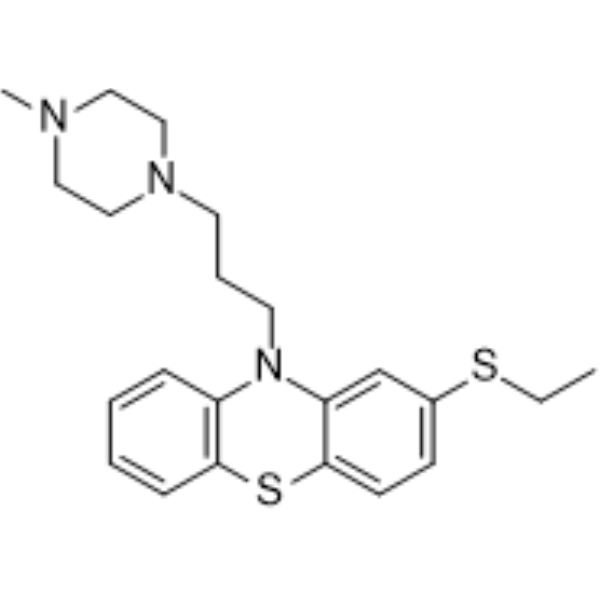
Thiethylperazine, a phenothiazine derivate, is an orally active and potent dopamine D2-receptor and histamine H1-receptor antagonist. Thiethylperazine is also a selective ABCC1activator that reduces amyloid-β (Aβ) load in mice. Thiethylperazine has anti-emetic, antipsychotic and antimicrobial effects.
Nos produits utilisent uniquement pour la recherche. Nous ne vendons pas aux patients.
- Pureté : 99.91%
- CAS No.: 1420-55-9
- Formule: C22H29N3S2
- Masse moléculaire:399.62
-
Stockage:
4°C, protect from light
* In solvent : -80°C, 6 months; -20°C, 1 month (protect from light)

To place orders, for customer services and technical support, please contact: MedChemExpress USA
Tel: 609-228-6898 E-mail: [email protected] [email protected]


-
 Activité biologique
-
Chemical Information
-
Solvant et solubilité
- Protocole
- Pureté et documentation
- Références
-
 Help & FAQs


-
HY-B0274
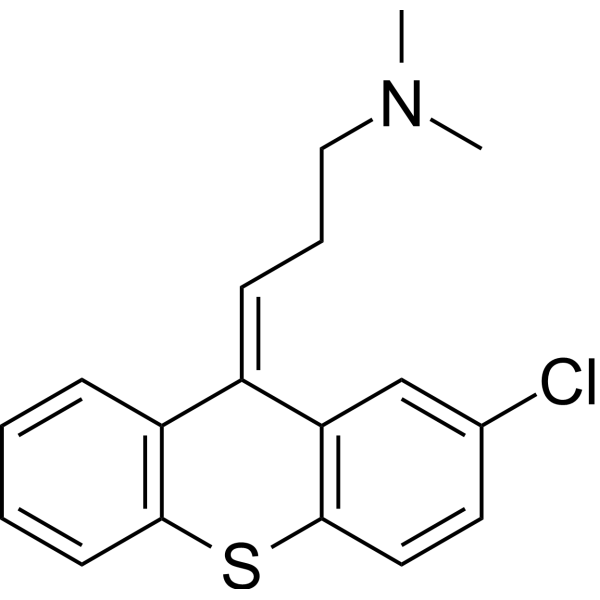
ChlorprothixeneNeuroprotective Agent -
HY-123205
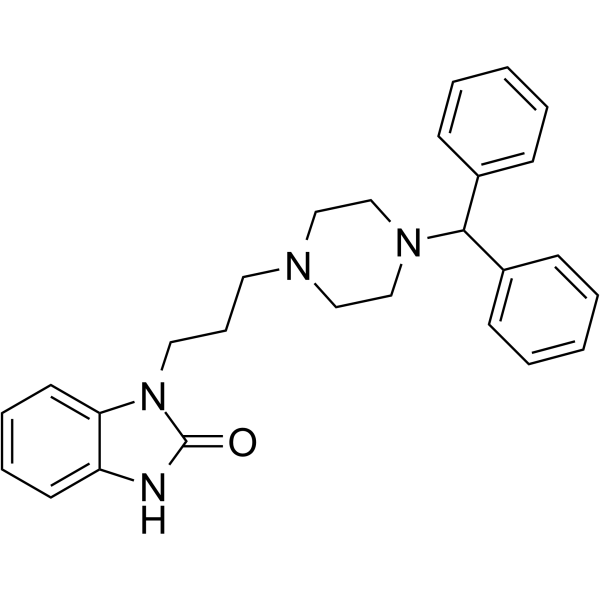
OxatomideH1-histamine/P2X7 Receptor Antagonist -
HY-B1794A
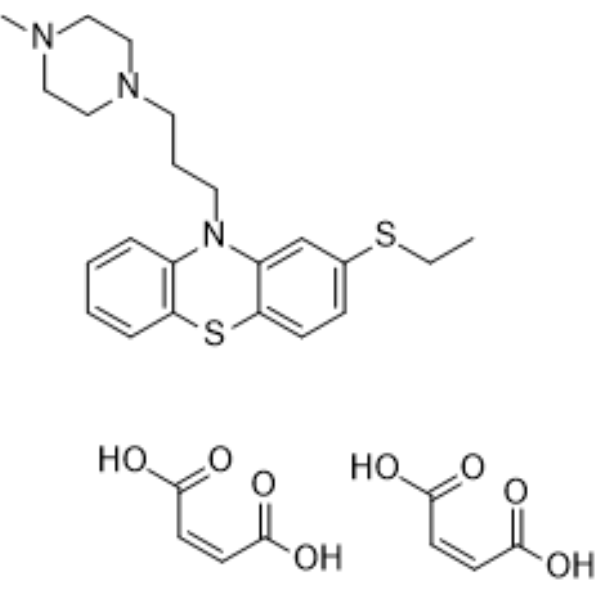
Thiethylperazine dimaleateAnti-emetic Agent -
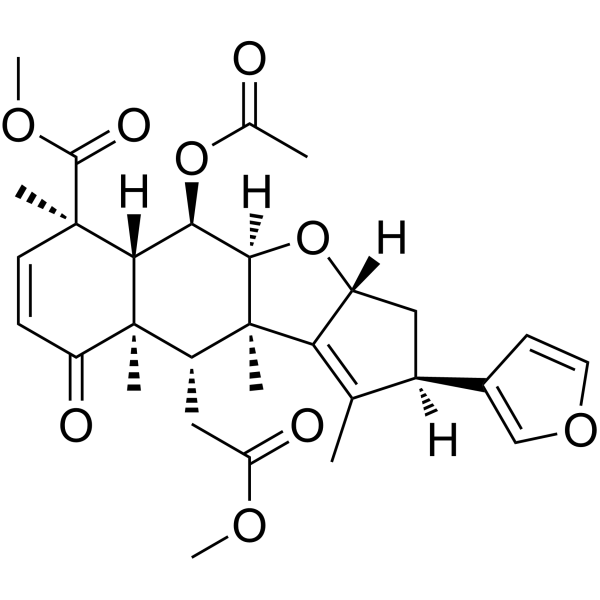
HY-N3187
NimbinTau Aggregation Inhibitor -

HY-B1794R
Thiethylperazine (Standard)D2/H1 Antagonist -

HY-123205R
Oxatomide (Standard)Standard of Oxatomide -

HY-B1794AR
Thiethylperazine dimaleate (Standard)Anti-emetic Agent
Publications Citing Use of MedChemExpress (MCE) Thiethylperazine
MoreVoir tous les produits spécifiques à Isoform Dopamine Receptor
MoreVoir tous les produits spécifiques à Isoform Histamine Receptor
More

Activité biologique
Description
IC50 & Target
|
D2 Receptor |
H1 Receptor |
In Vitro
Thiethylperazine can enhance the antibiotic (Vancomycin) activity at a concentration as low as 2 μg/mL. Thiethylperazine inhibits Vancomycin-sensitive E. faecalis ATCC 29212, Vancomycin-resistant E. faecalis ATCC 51299 and vancomycin-resistant E. faecalis (VREF) isolates with MIC values of 8 μg/mL, 16 μg/mL and 8 μg/mL, respectively[3].
MedChemExpress (MCE) has not independently confirmed the accuracy of these methods. They are for reference only.
In Vivo
MedChemExpress (MCE) has not independently confirmed the accuracy of these methods. They are for reference only.
-
Animal Model:Young Aβ precursor protein (APPswe) and mutant presenilin-1 (PS1) (APP/PS1) mice[2]
-
Dosage:3 mg/kg
-
Administration:Intramuscular injection; twice daily; for 30 days
-
Result:Significantly reduced Aβ42 levels in APP/PS1 mice.


Chemical Information
-
CAS No. 1420-55-9
-
Appearance Solid
-
Masse moléculaire 399.62
-
Formule C22H29N3S2
-
Color Light brown to gray
-
SMILES
CN1CCN(CCCN2C3=C(C=CC=C3)SC4=CC=C(SCC)C=C24)CC1
-
Livraison
Room temperature in continental US; may vary elsewhere.
-
Stockage
4°C, protect from light
* In solvent : -80°C, 6 months; -20°C, 1 month (protect from light)


Publications (3)
-
Journal Impact Factor
-
Most Recent
-
J Adv Res
The gut microbiotas with metabolites regulate the protective role of miR-30a-5p in myocardial infarction. [Abstract]2024 Oct 21:S2090-1232(24)00472-7. PMID: 39442873 -
ACS Environ Au
Machine Learning-Assisted Recognition of Environmental Sulfur-Containing Chemicals in Nontargeted Mass Spectrometry Analysis of Inadequate Mass Resolution. [Abstract]2025 Aug 5;5(6):573-582. PMID: 41277996 -
Anal Chem
Exposome-Scale Investigation of Cl-/Br-Containing Chemicals Using High-Resolution Mass Spectrometry, Multistage Machine Learning, and Cloud Computing. [Abstract]2025 Jun 3;97(21):11099-11109. PMID: 40401576


Solvant et solubilité
In Vitro:
DMSO : 100 mg/mL (250.24 mM; Need ultrasonic; Hygroscopic DMSO has a significant impact on the solubility of product, please use newly opened DMSO)
Please refer to the solubility information to select the appropriate solvent. Once prepared, please aliquot and store the solution to prevent product inactivation from repeated freeze-thaw cycles.
Storage method and period of stock solution: -80°C, 6 months; -20°C, 1 month (protect from light). When stored at -80°C, please use it within 6 months. When stored at -20°C, please use it within 1 month.
Please refer to the solubility information to select the appropriate solvent. Once prepared, please aliquot and store the solution to prevent product inactivation from repeated freeze-thaw cycles.
Storage method and period of stock solution: -80°C, 6 months; -20°C, 1 month (protect from light). When stored at -80°C, please use it within 6 months. When stored at -20°C, please use it within 1 month.
Concentration (start) × Volume (start) = Concentration (final) × Volume (final)


Pureté et documentation
-
Fiche technique (275 KB)
-
SDS (252 KB)
- English - EN (252 KB)
- Français - FR (252 KB)
- Deutsch - DE (252 KB)
- Norwegian - NO (252 KB)
- Español - ES (252 KB)
- Swedish - SV (252 KB)
- Italian - IT (252 KB)
- Korean - KR (252 KB)
- Portuguese - PT (252 KB)
-
Instruction de manipulation (2659 KB)
Références
[1]. Czeizel AE, et al. Case-control study of teratogenic potential of thiethylperazine, an anti-emetic drug. BJOG. 2003 May;110(5):497-9. [Content Brief]
[2]. Krohn M, et al. Cerebral amyloid-β proteostasis is regulated by the membrane transport protein ABCC1 in mice. J Clin Invest. 2011 Oct;121(10):3924-31. [Content Brief]
[3]. Rahbar M, et al. Enhancement of vancomycin activity by phenothiazines against vancomycin-resistant Enterococcus faecium in vitro. Basic Clin Pharmacol Toxicol. 2010 Aug;107(2):676-9. [Content Brief]


Complete Stock Solution Preparation Table
Please refer to the solubility information to select the appropriate solvent. Once prepared, please aliquot and store the solution to prevent product inactivation from repeated freeze-thaw cycles.
Storage method and period of stock solution: -80°C, 6 months; -20°C, 1 month (protect from light). When stored at -80°C, please use it within 6 months. When stored at -20°C, please use it within 1 month.
| Optional Solvent | Concentration Solvent Mass | 1 mg | 5 mg | 10 mg | 25 mg |
|---|---|---|---|---|---|
| DMSO | 1 mM | 2.5024 mL | 12.5119 mL | 25.0238 mL | 62.5594 mL |
| 5 mM | 0.5005 mL | 2.5024 mL | 5.0048 mL | 12.5119 mL | |
| 10 mM | 0.2502 mL | 1.2512 mL | 2.5024 mL | 6.2559 mL | |
| 15 mM | 0.1668 mL | 0.8341 mL | 1.6683 mL | 4.1706 mL | |
| 20 mM | 0.1251 mL | 0.6256 mL | 1.2512 mL | 3.1280 mL | |
| 25 mM | 0.1001 mL | 0.5005 mL | 1.0010 mL | 2.5024 mL | |
| 30 mM | 0.0834 mL | 0.4171 mL | 0.8341 mL | 2.0853 mL | |
| 40 mM | 0.0626 mL | 0.3128 mL | 0.6256 mL | 1.5640 mL | |
| 50 mM | 0.0500 mL | 0.2502 mL | 0.5005 mL | 1.2512 mL | |
| 60 mM | 0.0417 mL | 0.2085 mL | 0.4171 mL | 1.0427 mL | |
| 80 mM | 0.0313 mL | 0.1564 mL | 0.3128 mL | 0.7820 mL | |
| 100 mM | 0.0250 mL | 0.1251 mL | 0.2502 mL | 0.6256 mL |


Thiethylperazine Related Classifications
HY-B1794 Related Classifications
 Powered by Bioz