



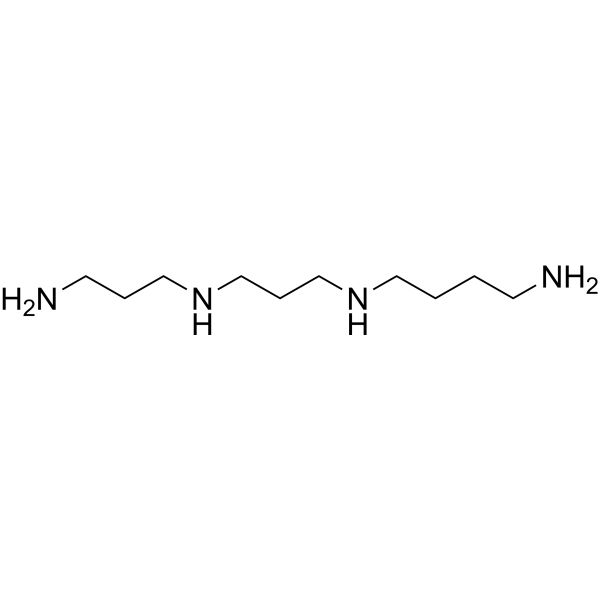
Thermospermine

Based on 1 Customer Validation
Thermospermine (tSpm) is a polyamine and a negative regulator of xylem differentiation. Thermospermine targets the MP/ARF5 auxin response transcription factor, bypasses an inhibitory upstream open reading frame (uORF) to promote SAC51 bHLH protein translation, and binds 25S rRNA to regulate uORF-dependent translation processes. Thermospermine can be back-converted by polyamine oxidase to spermidine (HY-B1776) or norspermidine, and upregulates PAO1/PAO3/PAO5 expression, participating in its own catabolism. Thermospermine inhibits lateral root initiation and primary root elongation, rescues the dwarf stem phenotype of acl5 mutants, downregulates xylem- and cell wall-related transcripts, and exerts feedback regulation on polyamine biosynthesis genes. In addition, Thermospermine stabilizes cell membrane structure, enhances plant tolerance to salt, drought, and heat as well as resistance to pathogens, and is suitable for research related to Pseudomonas viridiflava infection.
Nur für Forschungszwecke. Wir verkaufen nicht an Patienten.
- Reinheit : 99.97%
- CAS. Nr.: 70862-11-2
- Formel: C10H26N4
- Molecular Weight:202.34
-
Speicherung:Pure form -20°C, 3 years , 4°C, 2 years ; In solvent -80°C, 6 months , -20°C, 1 month

To place orders, for customer services and technical support, please contact: MedChemExpress USA
Tel: 609-228-6898 E-mail: [email protected] [email protected]


-
 Biologische Aktivität
-
Chemical Information
-
Lösungsmittel & Löslichkeit
- Protokoll
- Reinheit & Dokumentation
- Verweise
-
 Help & FAQs




Biologische Aktivität
Beschreibung
In Vitro
Thermospermine (5 µM; 24-72 HAI) reduces P. viridiflava proliferation in Arabidopsis Col-0 at 48 and 72 HAI, but has no such effect at 24 HAI[5].
Thermospermine (5 µM; 48 HAI) mediates resistance to P. viridiflava in Arabidopsis Col-0, and this resistance requires PAO and DAO activity, as SL-11061 and N,N′-diaminoguanidine block this effect[5].
Thermospermine restores the resistance of acl5-5 to P. viridiflava to the Col-0 WT level[5].
Thermospermine (100 mM; 24 h) enhances the translation of SAC51 and SACL1 5′ leader sequence reporter genes in Arabidopsis seedlings, but does not enhance the translation of SACL2 or SACL3[6].
Thermospermine (100 µM; 24 h) inhibits the expression of ACL5, VND6, and MP/ARF5 in acl5-1 spms-1 seedlings[1].
Thermospermine (100 µM; 7 days) reduces excessive xylem lignification in acl5-1 spms-1 seedlings[1].
Thermospermine (100 µM; 7 days) increases SAC51 5′ leader-dependent GUS activity in acl5-1 SAC51-GUS seedlings[1].
Thermospermine (100 µM) inhibits lateral root formation in wild-type and acl5-1 Arabidopsis seedlings[1].
Thermospermine is accumulated by T. kodakarensis KPS as its major stationary-phase polyamine and is enriched in the membrane fraction[2].
Thermospermine supports the growth of KPS at 85°C and partially restores its growth at 93°C[2].
Thermospermine (17-24 h at 85°C; four heating-cooling cycles) results in a survival rate of KPS of approximately 50% after two cold stress cycles, which decreases after the third cycle[2].
Thermospermine (60-90°C) supports HyhL expression in KPS cells at all tested temperatures[2].
Thermospermine (50 µM; four days after germination) inhibits primary root elongation and metaxylem vessel expansion in rice without altering shoot growth, crown root number, or lateral root formation[3].
Thermospermine (50 µM; 0-24 h) reduces the expression of OsACL5 in rice roots and induces OsSAMDC2, OsPAO2, OsPAO3, OsPAO4, and OsPAO6, with the strongest induction observed for OsPAO6[3].
Thermospermine (24 h) increases the phloem-related OsHB5, OsYSL16, and SAC51 family members OsSACL2/OsSACL3C in rice roots, while decreasing OsHB4 and OsSACL3B[3].
Thermospermine (500 μM; pH 5.5-9.5; 15-50°C) is maximally oxidized by recombinant SelPAO5 at pH 7.0 and 35°C[4].
Thermospermine (300 μM; pH 7.0-8.0) is the preferred substrate of recombinant SelPAO5, especially at pH 7.0[4].
Thermospermine (0-60 min; pH 7.0-8.0) is retro-converted to norspermidine by recombinant SelPAO5 via C7-carbon oxidation[4].
Thermospermine (12 h pre-incubation; 12 h dehydration) content is lower in Selaginella tissues relative to norspermidine and spermine, and dehydration does not increase Thermospermine content[4].
Thermospermine (0.5 mM; 12 h) strongly upregulates the transcript level of SelPAO5 in Selaginella lepidophylla microphylls[4].
Thermospermine (5 µM; 12 days) increases extractable thermospermine in Arabidopsis Col-0 by 4.9-fold without altering putrescine, spermidine, or spermine levels[5].
Thermospermine (5 µM; 12 days) increases the transcript levels of PAO1, PAO3, and PAO5 in Arabidopsis Col-0[5].
Thermospermine (5 µM; 14 days) selectively inhibits shoot growth of Atpao5-2 seedlings in vertical culture, while the degree of root inhibition is comparable to that of WT[7].
Thermospermine (5 µM; 8 days after sowing) induces the iron-deficiency genes #1, IRP1, IRP3, bHLH38, bHLH100, and bHLH101 in Atpao5-2 seedlings[7].
Thermospermine (5-50 µM; 6 days) causes separation of the stem-leaf vascular connection in Atpao5-2 seedlings at 5 µM, while at 50 µM it also causes separation of WT vascular tissue[7].
Thermospermine (5 µM) is associated with lower Fe in treated Atpao5-2 seedlings than in treated WT, whereas Ca, Na, and K show no significant differences[7].
Thermospermine (100 μM) partially inhibits the banding of the Mpacl5 archegoniophore[8].
Thermospermine (200 μM) strongly inhibits the growth of Mpacl5-1 and Mpacl5-2 thalli[8].
Thermospermine is back-converted to Spd via an O2-independent dehydrogenase reaction catalyzed by AtPAO5 in Arabidopsis[9].
Thermospermine inhibits xylem vessel expansion in the roots of rice seedlings, but does not inhibit xylem vessel expansion in the leaves[9].
Thermospermine enhances salt tolerance in wild-type Arabidopsis and restores salt tolerance in the acl5 mutant[9].
Thermospermine alleviates cold stress symptoms in wucai (Brassica campestris L.)[9].
Thermospermine is present in gymnosperms, green algae, and oomycete extracts[10].
Thermospermine is preferentially oxidized by Arabidopsis PAO1 in vitro[10].
Thermospermine (0.1 mM; 0-24 h) alters the transcript levels of ACL5/acl5-1, EXGT-A1, HD-Zip III genes, and SAC51 in Arabidopsis seedlings, with a stronger response in acl5-1[11].
Thermospermine (0.1 mM; 0-24 h) increases SAC51-GUS transcripts and GUS activity in transgenic Arabidopsis[11].
Thermospermine (0.25-1.0 mM; 7 d) inhibits leaf expansion in Arabidopsis seedlings, and 5 mM completely inhibits seed germination[11].
MedChemExpress (MCE) has not independently confirmed the accuracy of these methods. They are for reference only.


Product Details
-
Structure Classification
-
Initial Source
Thermus thermophilus


Chemical Information
-
CAS. Nr. 70862-11-2
-
Appearance Oil
-
Molecular Weight 202.34
-
Formel C10H26N4
-
SMILES
NCCCNCCCNCCCCN
-
Synonyms
tSpm
-
Versand
Room temperature in continental US; may vary elsewhere.
-
Speicherung
Pure form -20°C 3 years 4°C 2 years In solvent -80°C 6 months -20°C 1 month


Lösungsmittel & Löslichkeit
In Vitro:
DMSO : 100 mg/mL (494.22 mM; Need ultrasonic and warming; Hygroscopic DMSO has a significant impact on the solubility of product, please use newly opened DMSO)
Please refer to the solubility information to select the appropriate solvent. Once prepared, please aliquot and store the solution to prevent product inactivation from repeated freeze-thaw cycles.
Storage method and period of stock solution: -80°C, 6 months; -20°C, 1 month. When stored at -80°C, please use it within 6 months. When stored at -20°C, please use it within 1 month.
Konzentration (Stammlösung) × Volumen (Stammlösung) = Konzentration (Ziellösung) × Volumen (Ziellösung)
In Vivo:
Select the appropriate dissolution method based on your experimental animal and administration route.
- For the following dissolution methods, please ensure to first prepare a clear stock solution using an In Vitro approach and then sequentially add co-solvents:
- To ensure reliable experimental results, the clarified stock solution can be appropriately stored based on storage conditions. As for the working solution for In Vivo experiments, it is recommended to prepare freshly and use it on the same day.
- The percentages shown for the solvents indicate their volumetric ratio in the final prepared solution. If precipitation or phase separation occurs during preparation, heat and/or sonication can be used to aid dissolution.
Add each solvent one by one: 10% DMSO 40% PEG300 5% Tween-80 45% Saline
Solubility: ≥ 2.5 mg/mL (12.36 mM); Clear solution
This protocol yields a clear solution of ≥ 2.5 mg/mL (saturation unknown).
Taking 1 mL working solution as an example, add 100 μL DMSO stock solution (25.0 mg/mL) to 400 μL PEG300, and mix evenly; then add 50 μL Tween-80 and mix evenly; then add 450 μL Saline to adjust the volume to 1 mL.
Preparation of Saline: Dissolve 0.9 g sodium chloride in ddH₂O and dilute to 100 mL to obtain a clear Saline solution.
Add each solvent one by one: 10% DMSO 90% (20% SBE-β-CD in Saline)
Solubility: ≥ 2.5 mg/mL (12.36 mM); Clear solution
This protocol yields a clear solution of ≥ 2.5 mg/mL (saturation unknown).
Taking 1 mL working solution as an example, add 100 μL DMSO stock solution (25.0 mg/mL) to 900 μL 20% SBE-β-CD in Saline, and mix evenly.
Preparation of 20% SBE-β-CD in Saline (4°C, storage for one week): 2 g SBE-β-CD powder is dissolved in 10 mL Saline, completely dissolve until clear.
In Vivo Dissolution Calculator
Please enter the basic information of animal experiments:
-
-
-
-
Recommended: Prepare an additional quantity of animals to account for potential losses during experiments.
Please enter your animal formula composition:
-
%DMSO +
Recommended: Keep the proportion of DMSO in working solution below 2% if your animal is weak.
-
%+
-
+%Tween-80 + +
-
%Saline +
The co-solvents required include: DMSO, . All of co-solvents are available by MedChemExpress (MCE). , Tween 80. All of co-solvents are available by MedChemExpress (MCE).
Working solution concentration: 0.22 mg/mL
Method for preparing stock solution: mg drug dissolved in μL DMSO. Stock solution concentration: mg/mL.
1. Take μL DMSO stock solution;
2. Add μL .
μL , mix evenly;
3. Then add μL Tween 80, mix evenly;
4. Then add μL
Please ensure that the stock solution in the first step is dissolved to a clear state, and add co-solvents in sequence. You can use ultrasonic heating (ultrasonic cleaner, recommended frequency 20-40 kHz), vortexing, etc. to assist dissolution.
Reinheit & Dokumentation


Verweise

Complete Stock Solution Preparation Table
Please refer to the solubility information to select the appropriate solvent. Once prepared, please aliquot and store the solution to prevent product inactivation from repeated freeze-thaw cycles.
Storage method and period of stock solution: -80°C, 6 months; -20°C, 1 month. When stored at -80°C, please use it within 6 months. When stored at -20°C, please use it within 1 month.
| Optional Solvent | Concentration Solvent Mass | 1 mg | 5 mg | 10 mg | 25 mg |
|---|---|---|---|---|---|
| DMSO | 1 mM | 4.9422 mL | 24.7109 mL | 49.4218 mL | 123.5544 mL |
| 5 mM | 0.9884 mL | 4.9422 mL | 9.8844 mL | 24.7109 mL | |
| 10 mM | 0.4942 mL | 2.4711 mL | 4.9422 mL | 12.3554 mL | |
| 15 mM | 0.3295 mL | 1.6474 mL | 3.2948 mL | 8.2370 mL | |
| 20 mM | 0.2471 mL | 1.2355 mL | 2.4711 mL | 6.1777 mL | |
| 25 mM | 0.1977 mL | 0.9884 mL | 1.9769 mL | 4.9422 mL | |
| 30 mM | 0.1647 mL | 0.8237 mL | 1.6474 mL | 4.1185 mL | |
| 40 mM | 0.1236 mL | 0.6178 mL | 1.2355 mL | 3.0889 mL | |
| 50 mM | 0.0988 mL | 0.4942 mL | 0.9884 mL | 2.4711 mL | |
| 60 mM | 0.0824 mL | 0.4118 mL | 0.8237 mL | 2.0592 mL | |
| 80 mM | 0.0618 mL | 0.3089 mL | 0.6178 mL | 1.5444 mL | |
| 100 mM | 0.0494 mL | 0.2471 mL | 0.4942 mL | 1.2355 mL |


Thermospermine Related Classifications
HY-151224 Related Classifications
 Powered by Bioz