



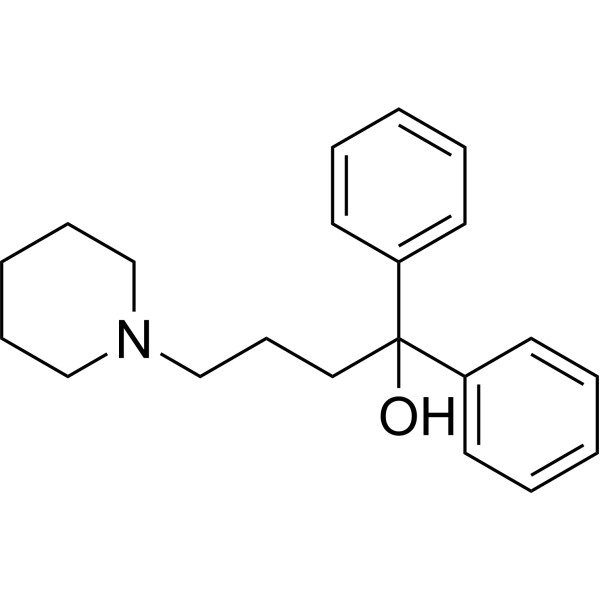
Diphenidol
Based on 1 publication(s) in Google Scholar
Diphenidol is a non-selective muscarinic M1-M4 receptor antagonist, has anti-arrhythmic activity. Diphenidol is also a potent non-specific blocker of voltage-gated ion channels (Na+, K+, and Ca2+) in neuronal cells. Diphenidol can be used in the study of antivertigo and antinausea.
Nos produits utilisent uniquement pour la recherche. Nous ne vendons pas aux patients.
- CAS No.: 972-02-1
- Formule: C21H27NO
- Masse moléculaire:309.45
-
Stockage:
Please store the product under the recommended conditions in the Certificate of Analysis.

To place orders, for customer services and technical support, please contact: MedChemExpress USA
Tel: 609-228-6898 E-mail: [email protected] [email protected]


-
 Activité biologique
-
Chemical Information
- Protocole
- Pureté et documentation
- Références
-
 Help & FAQs


Publications Citing Use of MedChemExpress (MCE) Diphenidol
More

Activité biologique
Description
IC50 & Target
|
mAChR1 |
mAChR2 |
mAChR3 |
mAChR4 |
In Vitro
Diphenidol inhibits sodium currents and produces spinal anesthesia, and at -70 and -100 mV holding potentials, N2A cells IC50 were 0.77 and 62.6 μM, respectively [3].
MedChemExpress (MCE) has not independently confirmed the accuracy of these methods. They are for reference only.
In Vivo
Diphenidol (30 mg/kg, injected intravenously) has an inhibitory effect on exercise and morphine-induced vomiting in pica rats[5].
MedChemExpress (MCE) has not independently confirmed the accuracy of these methods. They are for reference only.
-
Animal Model:Chronic constriction injury (CCI) rat model[4]
-
Dosage:2, 10 μmoL/kg
-
Administration:i.p., berore surgery, and on postoperative days 3, 6, 7, 11, 13 and 14.
-
Result:Increased mechanical withdrawal threshold in a dose-dependent manner and decreased the TNF-α level.
Essai clinique
| NCT Number | Sponsor | Condition | Start Date |
Phase

|
|---|---|---|---|---|
| NCT01329991 | Plexxikon| | 2011-05 | PHASE1 |


Chemical Information
-
CAS No. 972-02-1
-
Masse moléculaire 309.45
-
Formule C21H27NO
-
SMILES
OC(C1=CC=CC=C1)(C2=CC=CC=C2)CCCN3CCCCC3
-
Livraison
Room temperature in continental US; may vary elsewhere.
-
Stockage
Please store the product under the recommended conditions in the Certificate of Analysis.


Publications (1)
-
Journal Impact Factor
-
Most Recent
-
Int J Mol Sci
Bile Canalicular Bitter Taste Receptors Inhibit β-Adrenergic Receptor-Induced Lipolysis in Steatotic Hepatocytes. [Abstract]2026 Apr 2;27(7):3226. PMID: 41977407


Pureté et documentation
Références
[1]. Leung YM, et al. Inhibition of voltage-gated K+ channels and Ca2+ channels by diphenidol. Pharmacol Rep. 2012;64(3):739-44. [Content Brief]
[2]. Leung YM, et al. Diphenidol inhibited sodium currents and produced spinal anesthesia. Neuropharmacology. 2010 Jun;58(7):1147-52. [Content Brief]
[3]. Leung YM, et al. Diphenidol inhibited sodium currents and produced spinal anesthesia. Neuropharmacology. 2010 Jun;58(7):1147-52. [Content Brief]
[4]. Chen YW, et al. Systemic diphenidol reduces neuropathic allodynia and TNF-alpha overexpression in rats after chronic constriction injury. Neurosci Lett. 2013 Sep 27;552:62-5. [Content Brief]
[5]. Takeda N, et al. Neuropharmacological mechanisms of emesis. I. Effects of antiemetic drugs on motion- and apomorphine-induced pica in rats. Methods Find Exp Clin Pharmacol. 1995 Nov;17(9):589-90. [Content Brief]

Calculators
Concentration (start) × Volume (start) = Concentration (final) × Volume (final)


Diphenidol Related Classifications
HY-A0270 Related Classifications
 Powered by Bioz