



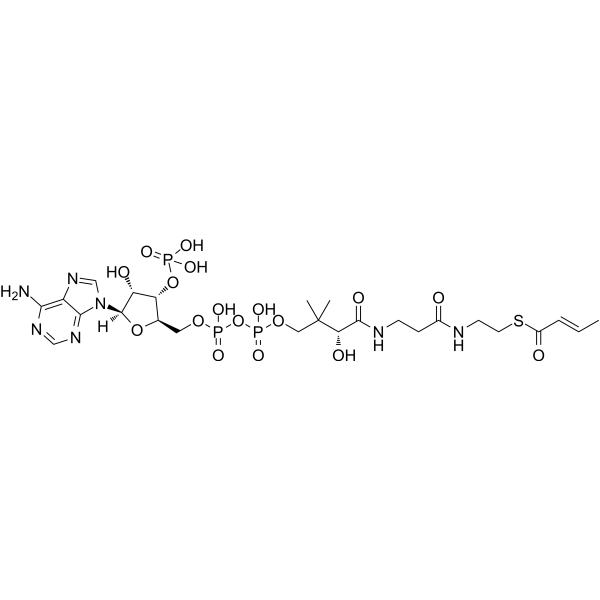
Crotonyl-CoA
Crotonyl-CoA, a high-energy acyl donor, is an intermediate in the fermentation of butyric acid, and in the metabolism of lysine and tryptophan. Crotonyl-CoA is important in the metabolism of fatty acids and amino acids. Crotonyl-CoA acts as a substrate for p300’s histone crotonyltransferase activity, competing with acetyl-CoA for p300-mediated histone acylation reactions. Crotonyl-CoA regulates global and gene-specific histone crotonylation levels in cells, with cellular concentration changes altering histone crotonylation at regulatory elements of activated genes. Crotonyl-CoA serves as the substrate for crotonyl-CoA reductase/carboxylase (CCRC)-catalyzed NADPH-mediated reduction and carbon dioxide trapping to form unusual alkylmalonyl-CoA polyketide synthase extender units. Crotonyl-CoA can be used for the research of LPS-induced inflammatory response.
For research use only. We do not sell to patients.
- CAS No.: 992-67-6
- Formula: C25H40N7O17P3S
- Molecular Weight:835.61
-
Storage:
Please store the product under the recommended conditions in the Certificate of Analysis.

To place orders, for customer services and technical support, please contact: MedChemExpress USA
Tel: 609-228-6898 E-mail: [email protected] [email protected]


-
 Biological Activity
-
Chemical Information
- Protocols
- Purity & Documentation
- References
-
 Help & FAQs


All Endogenous Metabolite Isoforms
More

Biological Activity
Description
IC50 & Target
|
Human Endogenous Metabolite |
In Vitro
Crotonyl-CoA directly stimulates transcription in a cell-free system more potently than acetylation, with a 1.66-fold greater transcript production[1].
Crotonyl-CoA, when cellular concentrations are increased via 2.5 mM, 5 mM, 10 mM sodium crotonate treatment (12 h), led to dose-dependent increases in global H3K18Cr levels in HeLa S3 cells[1].
Crotonyl-CoA, when cellular concentrations are increased via 0 mM, 2.5 mM, 5 mM, 10 mM sodium crotonate pretreatment (6 h prior to 2 h LPS stimulation), enhanced H3K18Cr at de novo-activated gene promoters and increased their expression upon LPS stimulation in RAW 264.7 cells[1].
Crotonyl-CoA, when its cellular levels are reduced via ACSS2 knockdown (72 h prior to 2 h LPS stimulation), reduced H3K18Cr at de novo-activated gene promoters and attenuated their expression upon LPS stimulation in RAW 264.7 cells[1].
MedChemExpress (MCE) has not independently confirmed the accuracy of these methods. They are for reference only. Further protocols information, click here.


Chemical Information
-
CAS No. 992-67-6
-
Molecular Weight 835.61
-
Formula C25H40N7O17P3S
-
SMILES
NC1=NC=NC2=C1N=CN2[C@H]3[C@H](O)[C@H](OP(O)(O)=O)[C@@H](COP(OP(OCC(C)(C)[C@@H](O)C(NCCC(NCCSC(/C=C/C)=O)=O)=O)(O)=O)(O)=O)O3
-
Structure Classification
-
Initial Source
-
Shipping
Room temperature in continental US; may vary elsewhere.
-
Storage
Please store the product under the recommended conditions in the Certificate of Analysis.

Protocols
-
Research Protocol for Inflammation-related Diseases
The NLRP3 inflammasome is a cytosolic innate immune signaling platform that integrates priming signals and danger-signal activation to promote caspase-1 activation, maturation of IL-1β and IL-18, and gasdermin D-mediated pyroptotic cell death. The core experimental logic is to determine whether inflammatory disease phenotypes are driven by increased NLRP3 expression, ASC-containing inflammasome assembly, caspase-1 cleavage, GSDMD cleavage, and extracellular release of IL-1β/IL-18 rather than by nonspecific cell injury alone. The pathway is strongly linked to inflammation-related disease phenotypes because monosodium urate crystals activate NALP3/NLRP3 inflammasome signaling in gout-like crystal inflammation, cholesterol crystals activate NLRP3 inflammasomes in atherogenesis models, and DSS-induced intestinal inflammation has been reported to involve NLRP3 inflammasome activity. However, experimental colitis studies also show context-dependent protective effects of NLRP3 inflammasome co


Purity & Documentation
References
[1]. Sabari BR, et al. Intracellular crotonyl-CoA stimulates transcription through p300-catalyzed histone crotonylation. Mol Cell. 2015;58(2):203-215. [Content Brief]
[2]. Ray L, et al. A crotonyl-CoA reductase-carboxylase independent pathway for assembly of unusual alkylmalonyl-CoA polyketide synthase extender units. Nat Commun. 2016;7:13609. Published 2016 Dec 21. [Content Brief]

Calculators
Concentration (start) × Volume (start) = Concentration (final) × Volume (final)


Crotonyl-CoA Related Classifications
HY-141466 Related Classifications
 Powered by Bioz