



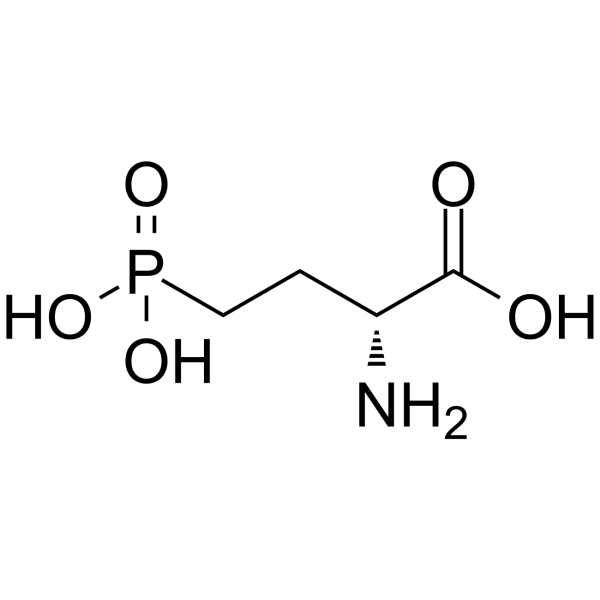
D-AP4
D-AP4 (D-APB; D-2-Amino-4-phosphonobutyric acid), a phosphono analogue of glutamate, is an NMDA broad spectrum excitatory amino acid receptor antagonist. D-AP4 also is an agonist for a quisqualate-sensitized AP6 site in hippocampus. D-AP4 inhibits AMPA receptor-stimulated 57Co2+ influx in cultured cerebellar granule cells (IC50 ≥ 100 μM).
Nur für Forschungszwecke. Wir verkaufen nicht an Patienten.
- CAS. Nr.: 78739-01-2
- Formel: C4H10NO5P
- Molecular Weight:183.10
-
Speicherung:
Please store the product under the recommended conditions in the Certificate of Analysis.

To place orders, for customer services and technical support, please contact: MedChemExpress USA
Tel: 609-228-6898 E-mail: [email protected] [email protected]


-
 Biologische Aktivität
-
Chemical Information
- Reinheit & Dokumentation
- Verweise
-
 Help & FAQs


Alle iGluR Isoform-spezifische Produkte anzeigen
More

Biologische Aktivität
Beschreibung


Chemical Information
-
CAS. Nr. 78739-01-2
-
Molecular Weight 183.10
-
Formel C4H10NO5P
-
SMILES
O=C(O)[C@H](N)CCP(O)(O)=O
-
Synonyms
D-APB; D-2-Amino-4-phosphonobutyric acid
-
Versand
Room temperature in continental US; may vary elsewhere.
-
Speicherung
Please store the product under the recommended conditions in the Certificate of Analysis.


Reinheit & Dokumentation
-
Data Sheet (267 KB)
-
SDS (252 KB)
- Français - FR (252 KB)
- Deutsch - DE (252 KB)
- Norwegian - NO (252 KB)
- Español - ES (252 KB)
- Swedish - SV (252 KB)
- Italian - IT (252 KB)
- Korean - KR (252 KB)
- Portuguese - PT (252 KB)
-
Handling Instructions (2659 KB)
Verweise
[1]. Evans RH, et al. The effects of a series of omega-phosphonic alpha-carboxylic amino acids on electrically evoked and excitant amino acid-induced responses in isolated spinal cord preparations. Br J Pharmacol. 1982;75(1):65-75. [Content Brief]
[2]. Schulte MK, et al. Utilization of the resolved L-isomer of 2-amino-6-phosphonohexanoic acid (L-AP6) as a selective agonist for a quisqualate-sensitized site in hippocampal CA1 pyramidal neurons. Brain Res. 1994;649(1-2):203-207. [Content Brief]
[3]. Toms NJ, et al. Inhibition of AMPA receptor-stimulated 57Co2+ influx by D- and L-2-amino-4-phosphonobutanoic acid (D- and L-AP4) and L-serine-O-phosphate (L-SOP) in cultured cerebellar granule cells. Neuropharmacology. 1997;36(3):335-343. [Content Brief]

Calculators
Konzentration (Stammlösung) × Volumen (Stammlösung) = Konzentration (Ziellösung) × Volumen (Ziellösung)


D-AP4 Related Classifications
HY-100781 Related Classifications
 Powered by Bioz