



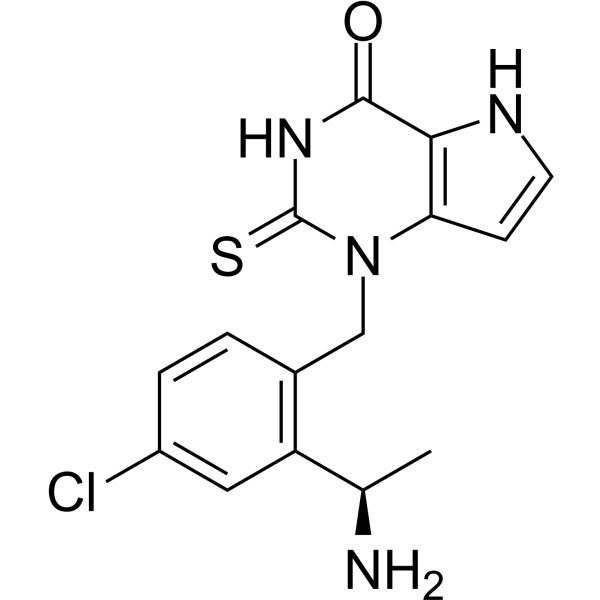
AZM198

Based on 1 Customer Validation
AZM198 is an orally active myeloperoxidase (MPO) inhibitor. AZM198 irreversibly inactivates MPO (IC50=0.015 μM) via covalent binding to the heme prosthetic group, preferentially targets extracellular MPO activity, and reduces neutrophil extracellular trap formation, reactive oxygen species production and degranulation. AZM198 increases the fibrous cap thickness of atherosclerotic plaques, reduces lesion area, ameliorates hepatic steatosis and fibrosis in non-alcoholic steatohepatitis, and alleviates proteinuria and inflammatory infiltration associated with glomerulonephritis. AZM198 also decreases circulating levels of high-sensitivity Cardiac Troponin I and IL-1β, and mitigates endothelial cell injury. Therefore, AZM198 is suitable for research on various MPO-related diseases, including atherosclerotic cardiovascular disease, myocardial infarction, ischemic stroke, non-alcoholic steatohepatitis and crescentic glomerulonephritis.
For research use only. We do not sell to patients.
- Purity : 98.40%
- CAS No.: 1933460-23-1
- Formula: C14H13ClN4OS
- Molecular Weight:320.80
-
Storage:Powder -20°C, 3 years , 4°C, 2 years ; In solvent -80°C, 6 months , -20°C, 1 month


To place orders, for customer services and technical support, please contact: MedChemExpress USA
Tel: 609-228-6898 E-mail: [email protected] [email protected]


-
 Biological Activity
-
Chemical Information
-
Solvent & Solubility
- Protocols
- Purity & Documentation
- References
-
 Help & FAQs




Biological Activity
Description
IC50 & Target
|
CYP3A4 19 μM (IC50) |
In Vitro
AZM198 (10 μM) reduces reactive oxygen species production, neutrophil degranulation and neutrophil extracellular trap formation in human neutrophils prestimulated with TNFα and activated by PR3-ANCA, and attenuates the activity of enzymatically active myeloperoxidase in human neutrophils stimulated with PMA[1].
AZM198 (10 μM; 18 h) attenuates human neutrophil-mediated endothelial cell injury in a co-culture system of TNFα-prestimulated, PR3-ANCA-activated neutrophils and endothelial cells incubated for 18 hours[1].
AZM198 (10 μM; 2 h) reduces neutrophil extracellular trap (NET) formation in human neutrophils isolated from healthy donors, which is induced by Phorbol 12-myristate 13-acetate (HY-18739)[2].
MedChemExpress (MCE) has not independently confirmed the accuracy of these methods. They are for reference only.
-
Cell Line:Endothelial Cell-Neutrophil Coculture
-
Concentration:10 μM; with TNFα (2 ng/well)
-
Incubation Time:18 h
-
Result:Attenuated human neutrophil-mediated endothelial cell injury.
In Vivo
AZM198 (133 μmol/kg; p.o.; twice daily; for 48 h) does not significantly reduce early glomerular neutrophil accumulation in a mouse model of crescentic glomerulonephritis[1].
AZM198 (400 μmol/kg; p.o.; twice daily; for 7 consecutive days) does not enhance antigen-specific T cell responses in a mouse adoptive transfer model[1].
AZM198 (400 μmol/kg; administered via gavage; twice daily; for 7 consecutive days) exerts no protective effects on either histological or biochemical indicators of disease in this mouse model of anti-neutrophil cytoplasmic antibody-associated vasculitis[2].
AZM198 (500 μmol/kg; oral administration; continuous administration via diet formulation; 26 weeks) increases the survival rate of male SR-BIΔCT/ΔCT/Ldlr-/- mice fed a Western diet by 92% (to a 63% survival rate), reduces the incidence of major adverse cardiovascular events by 57%-75%, and also attenuates cardiac fibrosis, liver injury, and inflammatory activity in atherosclerotic lesions[3].
AZM198 inhibits MPO activity in vulnerable atherosclerotic plaques, increases fibrous cap thickness by 65%, reduces intraplaque fibrin and hemosiderin, and promotes a more stable plaque phenotype in Apoe-/- mice with plaque instability induced by tandem stenosis[4].
MedChemExpress (MCE) has not independently confirmed the accuracy of these methods. They are for reference only.
-
Animal Model:C57BL/6 (female, 10-12 weeks old, average weight 25 g, injected intravenously with sheep nephrotoxic serum mixed 1:1 with LPS)[1]
-
Dosage:133 μmol/kg
-
Administration:p.o.; twice a day; 48 hours
-
Result:Resulted in median Ly6g corrected total cell fluorescence (CTCF) of 26.5 (23-70.7) AU, representing a non-significant reduction in glomerular neutrophil infiltration compared to vehicle controls.
-
Animal Model:BALB/c (female)[1]
-
Dosage:400 μmol/kg
-
Administration:p.o.; twice daily; 7 days
-
Result:Resulted in median frequency of CD44high CD4+ cells of 12.6% (11.8%-13.8%), representing no significant increase in activated total T cells compared to vehicle controls.
Resulted in median frequency of CD44high KJ+ CD4+ cells of 1.9% (1.64%-3.14%), representing no significant increase in activated ovalbumin-specific T cells compared to vehicle controls.
-
Animal Model:C57BL6/J mice (female, 8 weeks old, anti-neutrophil cytoplasmic antibody vasculitis model induced by G-CSF, anti-myeloperoxidase IgG, and lipopolysaccharide)[2]
-
Dosage:400 μmol/kg per dose (total daily dose of 128 mg/kg)
-
Administration:oral gavage; twice daily; 7 days
-
Result:Showed no significant differences from controls in percentage of glomerular crescents, number of glomerular neutrophils, number of intraglomerular or periglomerular CD68-positive cells, serum creatinine levels at day 7, or urine albumin-creatinine ratios at day 6.


Chemical Information
-
CAS No. 1933460-23-1
-
Appearance Solid
-
Molecular Weight 320.80
-
Formula C14H13ClN4OS
-
Color White to off-white
-
SMILES
O=C1NC(N(CC2=CC=C(C=C2CN)Cl)C3=C1NC=C3)=S
-
Shipping
Room temperature in continental US; may vary elsewhere.
-
Storage
Powder -20°C 3 years 4°C 2 years In solvent -80°C 6 months -20°C 1 month


Solvent & Solubility
In Vitro:
DMSO : 16.67 mg/mL (51.96 mM; ultrasonic and warming and heat to 60°C; Hygroscopic DMSO has a significant impact on the solubility of product, please use newly opened DMSO)
Please refer to the solubility information to select the appropriate solvent. Once prepared, please aliquot and store the solution to prevent product inactivation from repeated freeze-thaw cycles.
Storage method and period of stock solution: -80°C, 6 months; -20°C, 1 month. When stored at -80°C, please use it within 6 months. When stored at -20°C, please use it within 1 month.
Please refer to the solubility information to select the appropriate solvent. Once prepared, please aliquot and store the solution to prevent product inactivation from repeated freeze-thaw cycles.
Storage method and period of stock solution: -80°C, 6 months; -20°C, 1 month. When stored at -80°C, please use it within 6 months. When stored at -20°C, please use it within 1 month.
Concentration (start) × Volume (start) = Concentration (final) × Volume (final)
In Vivo:
Select the appropriate dissolution method based on your experimental animal and administration route.
- For the following dissolution methods, please ensure to first prepare a clear stock solution using an In Vitro approach and then sequentially add co-solvents:
- To ensure reliable experimental results, the clarified stock solution can be appropriately stored based on storage conditions. As for the working solution for In Vivo experiments, it is recommended to prepare freshly and use it on the same day.
- The percentages shown for the solvents indicate their volumetric ratio in the final prepared solution. If precipitation or phase separation occurs during preparation, heat and/or sonication can be used to aid dissolution.
Add each solvent one by one: 10% DMSO 40% PEG300 5% Tween-80 45% Saline
Solubility: ≥ 1.67 mg/mL (5.21 mM); Clear solution
This protocol yields a clear solution of ≥ 1.67 mg/mL (saturation unknown).
Taking 1 mL working solution as an example, add 100 μL DMSO stock solution (16.7 mg/mL) to 400 μL PEG300, and mix evenly; then add 50 μL Tween-80 and mix evenly; then add 450 μL Saline to adjust the volume to 1 mL.
Preparation of Saline: Dissolve 0.9 g sodium chloride in ddH₂O and dilute to 100 mL to obtain a clear Saline solution.
In Vivo Dissolution Calculator
Please enter the basic information of animal experiments:
-
-
-
-
Recommended: Prepare an additional quantity of animals to account for potential losses during experiments.
Please enter your animal formula composition:
-
%DMSO +
Recommended: Keep the proportion of DMSO in working solution below 2% if your animal is weak.
-
%+
-
+%Tween-80 + +
-
%Saline +
The co-solvents required include: DMSO, . All of co-solvents are available by MedChemExpress (MCE). , Tween 80. All of co-solvents are available by MedChemExpress (MCE).
Working solution concentration: 0.22 mg/mL
Method for preparing stock solution: mg drug dissolved in μL DMSO. Stock solution concentration: mg/mL.
1. Take μL DMSO stock solution;
2. Add μL .
μL , mix evenly;
3. Then add μL Tween 80, mix evenly;
4. Then add μL
Please ensure that the stock solution in the first step is dissolved to a clear state, and add co-solvents in sequence. You can use ultrasonic heating (ultrasonic cleaner, recommended frequency 20-40 kHz), vortexing, etc. to assist dissolution.


Purity & Documentation
-
Data Sheet (287 KB)
-
SDS (393 KB)
- English - EN (393 KB)
- Français - FR (393 KB)
- Deutsch - DE (393 KB)
- Norwegian - NO (393 KB)
- Español - ES (393 KB)
- Swedish - SV (393 KB)
- Italian - IT (393 KB)
- Korean - KR (393 KB)
- Portuguese - PT (393 KB)
-
Handling Instructions (2659 KB)
References
[1]. Antonelou M, et al. Therapeutic Myeloperoxidase Inhibition Attenuates Neutrophil Activation, ANCA-Mediated Endothelial Damage, and Crescentic GN. J Am Soc Nephrol. 2020;31(2):350-364. [Content Brief]
[2]. Florez-Barros F, et al. Myeloid expression of the anti-apoptotic protein Mcl1 is required in anti-myeloperoxidase vasculitis but myeloperoxidase inhibition is not protective. Kidney Int. 2023;103(1):134-143. [Content Brief]
[3]. Shamsuzzaman S, et al. Novel Mouse Model of Myocardial Infarction, Plaque Rupture, and Stroke Shows Improved Survival With Myeloperoxidase Inhibition. Circulation. 2024;150(9):687-705. [Content Brief]
[4]. Rashid I, et al. Myeloperoxidase is a potential molecular imaging and therapeutic target for the identification and stabilization of high-risk atherosclerotic plaque. Eur Heart J. 2018;39(35):3301-3310. [Content Brief]


Complete Stock Solution Preparation Table
Please refer to the solubility information to select the appropriate solvent. Once prepared, please aliquot and store the solution to prevent product inactivation from repeated freeze-thaw cycles.
Storage method and period of stock solution: -80°C, 6 months; -20°C, 1 month. When stored at -80°C, please use it within 6 months. When stored at -20°C, please use it within 1 month.
| Optional Solvent | Concentration Solvent Mass | 1 mg | 5 mg | 10 mg | 25 mg |
|---|---|---|---|---|---|
| DMSO | 1 mM | 3.1172 mL | 15.5860 mL | 31.1721 mL | 77.9302 mL |
| 5 mM | 0.6234 mL | 3.1172 mL | 6.2344 mL | 15.5860 mL | |
| 10 mM | 0.3117 mL | 1.5586 mL | 3.1172 mL | 7.7930 mL | |
| 15 mM | 0.2078 mL | 1.0391 mL | 2.0781 mL | 5.1953 mL | |
| 20 mM | 0.1559 mL | 0.7793 mL | 1.5586 mL | 3.8965 mL | |
| 25 mM | 0.1247 mL | 0.6234 mL | 1.2469 mL | 3.1172 mL | |
| 30 mM | 0.1039 mL | 0.5195 mL | 1.0391 mL | 2.5977 mL | |
| 40 mM | 0.0779 mL | 0.3897 mL | 0.7793 mL | 1.9483 mL | |
| 50 mM | 0.0623 mL | 0.3117 mL | 0.6234 mL | 1.5586 mL |


AZM198 Related Classifications
HY-W996116 Related Classifications
 Powered by Bioz
Keywords
- AZM198
- 1933460-23-1
- AZM 198
- AZM-198
- Glutathione Peroxidase
- human neutrophils
- reactive oxygen species
- crescentic glomerulonephritis
- nonalcoholic steatohepatitis
- neutrophil degranulation
- atherosclerotic cardiovascular disease
- myeloperoxidase
- haem prosthetic group
- SR-BIΔCT/ΔCT/Ldlr?/? mice
- neutrophil extracellular trap formation
- Inhibitor
- inhibitor
- inhibit