



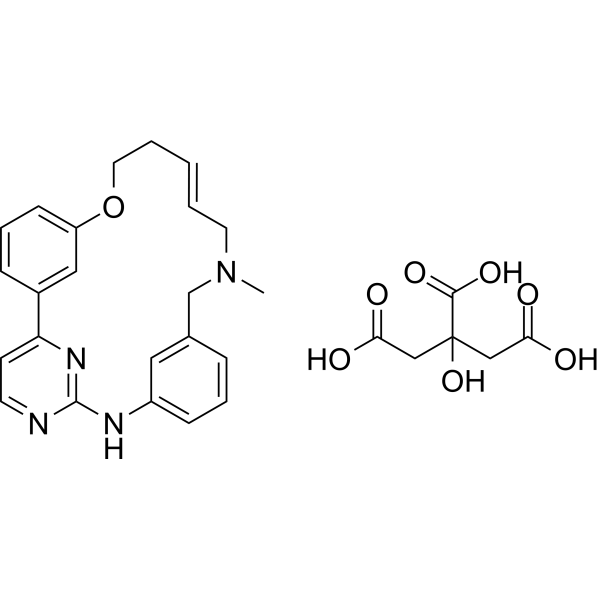
(E/Z)-Zotiraciclib citrate
Based on 6 publication(s) in Google Scholar
(E/Z)-Zotiraciclib citrate is a potent CDK2, JAK2, and FLT3 inhibitor.
For research use only. We do not sell to patients.
- Purity: 99.83%
- CAS No.: 1204918-73-9
- Formula: C29H32N4O8
- Molecular Weight:564.59
-
Storage:
4°C, sealed storage, away from moisture
* In solvent : -80°C, 6 months; -20°C, 1 month (sealed storage, away from moisture)

To place orders, for customer services and technical support, please contact: MedChemExpress USA
Tel: 609-228-6898 E-mail: [email protected] [email protected]


-
 Biological Activity
-
Chemical Information
-
Solvent & Solubility
- Purity & Documentation
- References
-
 Help & FAQs


Publications Citing Use of MedChemExpress (MCE) (E/Z)-Zotiraciclib citrate
More- Science. 2017 Dec 1;358(6367):eaan4368. [Abstract]
- Adv Sci (Weinh). 2025 Feb;12(7):e2413514. [Abstract]
- Mol Cancer Res. 2020 Oct;18(10):1512-1521. [Abstract]
- Cancers (Basel). 2022 Mar 19;14(6):1575. [Abstract]
- ACS Chem Biol. 2016 Jun 17;11(6):1710-9. [Abstract]
- J Neurosurg Pediatr. 2021 Sep 3;28(6):734-743. [Abstract]


Biological Activity
Description
IC50 & Target
[1]|
CDK2 |
JAK2 |
FLT3 |


Chemical Information
-
CAS No. 1204918-73-9
-
Appearance Solid
-
Molecular Weight 564.59
-
Formula C29H32N4O8
-
Color Off-white to light yellow
-
SMILES
OC(C(O)=O)(CC(O)=O)CC(O)=O.CN1CC2=CC(NC3=NC(C4=CC(OCC/C=C/C1)=CC=C4)=CC=N3)=CC=C2
-
Synonyms
(E/Z)-TG02 citrate; (E/Z)-SB1317 citrate
-
Shipping
Room temperature in continental US; may vary elsewhere.
-
Storage
4°C, sealed storage, away from moisture
* In solvent : -80°C, 6 months; -20°C, 1 month (sealed storage, away from moisture)


Publications (6)
-
Journal Impact Factor
-
Most Recent
-
Science
2017 Dec 1;358(6367):eaan4368. PMID: 29191878 -
Adv Sci (Weinh)
Targeting CDK2 Confers Vulnerability to Lenvatinib Via Driving Senescence in Anaplastic Thyroid Cancer. [Abstract]2025 Feb;12(7):e2413514. PMID: 39716890 -
Mol Cancer Res
2020 Oct;18(10):1512-1521. PMID: 32611550 -
Cancers (Basel)
Identification of New Vulnerabilities in Conjunctival Melanoma Using Image-Based High Content Drug Screening. [Abstract]2022 Mar 19;14(6):1575. PMID: 35326726 -
ACS Chem Biol
Conformational Adaption May Explain the Slow Dissociation Kinetics of Roniciclib (BAY 1000394), a Type I CDK Inhibitor with Kinetic Selectivity for CDK2 and CDK9. [Abstract]2016 Jun 17;11(6):1710-9. PMID: 27090615 -
J Neurosurg Pediatr
Targeting of cyclin-dependent kinases in atypical teratoid rhabdoid tumors with multikinase inhibitor TG02. [Abstract]2021 Sep 3;28(6):734-743. PMID: 34479190


Solvent & Solubility
In Vitro:
DMSO : 250 mg/mL (442.80 mM; Need ultrasonic; Hygroscopic DMSO has a significant impact on the solubility of product, please use newly opened DMSO)
Please refer to the solubility information to select the appropriate solvent. Once prepared, please aliquot and store the solution to prevent product inactivation from repeated freeze-thaw cycles.
Storage method and period of stock solution: -80°C, 6 months; -20°C, 1 month (sealed storage, away from moisture). When stored at -80°C, please use it within 6 months. When stored at -20°C, please use it within 1 month.
Please refer to the solubility information to select the appropriate solvent. Once prepared, please aliquot and store the solution to prevent product inactivation from repeated freeze-thaw cycles.
Storage method and period of stock solution: -80°C, 6 months; -20°C, 1 month (sealed storage, away from moisture). When stored at -80°C, please use it within 6 months. When stored at -20°C, please use it within 1 month.
Concentration (start) × Volume (start) = Concentration (final) × Volume (final)
In Vivo:
Select the appropriate dissolution method based on your experimental animal and administration route.
- For the following dissolution methods, please ensure to first prepare a clear stock solution using an In Vitro approach and then sequentially add co-solvents:
- To ensure reliable experimental results, the clarified stock solution can be appropriately stored based on storage conditions. As for the working solution for In Vivo experiments, it is recommended to prepare freshly and use it on the same day.
- The percentages shown for the solvents indicate their volumetric ratio in the final prepared solution. If precipitation or phase separation occurs during preparation, heat and/or sonication can be used to aid dissolution.
Add each solvent one by one: 10% DMSO 40% PEG300 5% Tween-80 45% Saline
Solubility: ≥ 6.25 mg/mL (11.07 mM); Clear solution
This protocol yields a clear solution of ≥ 6.25 mg/mL (saturation unknown).
Taking 1 mL working solution as an example, add 100 μL DMSO stock solution (62.5 mg/mL) to 400 μL PEG300, and mix evenly; then add 50 μL Tween-80 and mix evenly; then add 450 μL Saline to adjust the volume to 1 mL.
Preparation of Saline: Dissolve 0.9 g sodium chloride in ddH₂O and dilute to 100 mL to obtain a clear Saline solution.
Add each solvent one by one: 10% DMSO 90% (20% SBE-β-CD in Saline)
Solubility: ≥ 6.25 mg/mL (11.07 mM); Clear solution
This protocol yields a clear solution of ≥ 6.25 mg/mL (saturation unknown).
Taking 1 mL working solution as an example, add 100 μL DMSO stock solution (62.5 mg/mL) to 900 μL 20% SBE-β-CD in Saline, and mix evenly.
Preparation of 20% SBE-β-CD in Saline (4°C, storage for one week): 2 g SBE-β-CD powder is dissolved in 10 mL Saline, completely dissolve until clear.
In Vivo Dissolution Calculator
Please enter the basic information of animal experiments:
-
-
-
-
Recommended: Prepare an additional quantity of animals to account for potential losses during experiments.
Please enter your animal formula composition:
-
%DMSO +
Recommended: Keep the proportion of DMSO in working solution below 2% if your animal is weak.
-
%+
-
+%Tween-80 + +
-
%Saline +
The co-solvents required include: DMSO, . All of co-solvents are available by MedChemExpress (MCE). , Tween 80. All of co-solvents are available by MedChemExpress (MCE).
Working solution concentration: 0.22 mg/mL
Method for preparing stock solution: mg drug dissolved in μL DMSO. Stock solution concentration: mg/mL. * In solvent : -80°C, 6 months; -20°C, 1 month (sealed storage, away from moisture)
1. Take μL DMSO stock solution;
2. Add μL .
μL , mix evenly;
3. Then add μL Tween 80, mix evenly;
4. Then add μL
Please ensure that the stock solution in the first step is dissolved to a clear state, and add co-solvents in sequence. You can use ultrasonic heating (ultrasonic cleaner, recommended frequency 20-40 kHz), vortexing, etc. to assist dissolution.


Purity & Documentation
-
Data Sheet (274 KB)
-
SDS (252 KB)
- English - EN (252 KB)
- Français - FR (252 KB)
- Deutsch - DE (252 KB)
- Norwegian - NO (252 KB)
- Español - ES (252 KB)
- Swedish - SV (252 KB)
- Italian - IT (252 KB)
- Korean - KR (252 KB)
- Portuguese - PT (252 KB)
-
Handling Instructions (2659 KB)
References
[1]. William AD, et al. Discovery of kinase spectrum selective macrocycle (16E)-14-methyl-20-oxa-5,7,14,26-tetraazatetracyclo[19.3.1.1(2,6).1(8,12)]heptacosa-1(25),2(26),3,5,8(27),9,11,16,21,23-decaene (SB1317/TG02), a potent inhibitor of cyclin dependent kinases (CDKs), Janus kinase 2 (JAK2), and fms-like tyrosine kinase-3 (FLT3) for the treatment of cancer. J Med Chem. 2012;55(1):169-196. [Content Brief]


Complete Stock Solution Preparation Table
Please refer to the solubility information to select the appropriate solvent. Once prepared, please aliquot and store the solution to prevent product inactivation from repeated freeze-thaw cycles.
Storage method and period of stock solution: -80°C, 6 months; -20°C, 1 month (sealed storage, away from moisture). When stored at -80°C, please use it within 6 months. When stored at -20°C, please use it within 1 month.
| Optional Solvent | Concentration Solvent Mass | 1 mg | 5 mg | 10 mg | 25 mg |
|---|---|---|---|---|---|
| DMSO | 1 mM | 1.7712 mL | 8.8560 mL | 17.7120 mL | 44.2799 mL |
| 5 mM | 0.3542 mL | 1.7712 mL | 3.5424 mL | 8.8560 mL | |
| 10 mM | 0.1771 mL | 0.8856 mL | 1.7712 mL | 4.4280 mL | |
| 15 mM | 0.1181 mL | 0.5904 mL | 1.1808 mL | 2.9520 mL | |
| 20 mM | 0.0886 mL | 0.4428 mL | 0.8856 mL | 2.2140 mL | |
| 25 mM | 0.0708 mL | 0.3542 mL | 0.7085 mL | 1.7712 mL | |
| 30 mM | 0.0590 mL | 0.2952 mL | 0.5904 mL | 1.4760 mL | |
| 40 mM | 0.0443 mL | 0.2214 mL | 0.4428 mL | 1.1070 mL | |
| 50 mM | 0.0354 mL | 0.1771 mL | 0.3542 mL | 0.8856 mL | |
| 60 mM | 0.0295 mL | 0.1476 mL | 0.2952 mL | 0.7380 mL | |
| 80 mM | 0.0221 mL | 0.1107 mL | 0.2214 mL | 0.5535 mL | |
| 100 mM | 0.0177 mL | 0.0886 mL | 0.1771 mL | 0.4428 mL |


(E/Z)-Zotiraciclib citrate Related Classifications
HY-15166B Related Classifications
 Powered by Bioz